
Quick Answer
Define a meaningful return event and full follow-up window, then segment non-returners by stage and experience. Join product, job, fee, support and relevant payment evidence. Resolve confirmed payment exceptions promptly, but measure whether freelancers resume work separately. Rank fixes by estimated incremental contribution and test them without withholding owed payments or required protections.
Why Freelancers Leave Platforms#
Treat churn as an economics question#
Freelancer churn reduces usable supply, repeat work and platform fee revenue. It can also reveal poor job access or an unresolved payment problem. Diagnose what changed for the affected freelancers before funding a retention intervention.
Churn analysis asks when and why people stop using a product. On a platform serving freelancers, that answer rarely lives in one number. You need evidence across behavior, billing, support, and the operating experience around onboarding, activation, payment, and communication. Unit economics is the right lens because it shows whether the model is sustainably profitable on a per-unit basis, not just whether signups still look healthy.
Focus on losses that change growth quality#
This guide helps founders, revenue leaders, product teams, and finance operators figure out why freelancers leave, what that churn costs, and which fixes are worth funding first. The key is separating noise from the losses that actually weaken margin or future revenue quality.
Before you debate solutions, ask two questions. Which cohort is leaving, and at what stage? Does that exit reduce profitable activity from existing users, delay activation, or simply trim low-value volume? If you cannot answer both from the same analysis window, you are not ready to call the cause. Treat it as unknown, not insight.
This is where teams often go wrong. When churn rises, it is easy to jump to discounts, promo credits, or a broad product rebuild before validating the cause. If the issue is onboarding friction or payment experience, pricing changes may increase activity without fixing why people leave. If the problem is concentrated in a high-value repeat cohort, the right response may look very different from what a top-line retention chart suggests.
Use an operator standard for evidence#
Use a simple standard throughout this guide: can you tie the observed drop-off to an operational event you can verify, then estimate whether fixing it improves unit economics?
Track people and economics separately. Freelancer retention measures return to meaningful activity; platform revenue measures fees or other revenue earned from that activity. A higher payout total can reflect larger jobs or delayed settlement rather than more retained freelancers. Do not substitute payout volume or customer net revenue retention for a supply-side retention measure.
The rest of this guide is about making those calls with enough proof to act, and enough restraint to avoid fixing the wrong problem. For a deeper look, read Contractor Onboarding Optimization: How to Reduce KYC Drop-Off and Get to First Payout Faster.
What to prepare before you run contractor churn analysis#
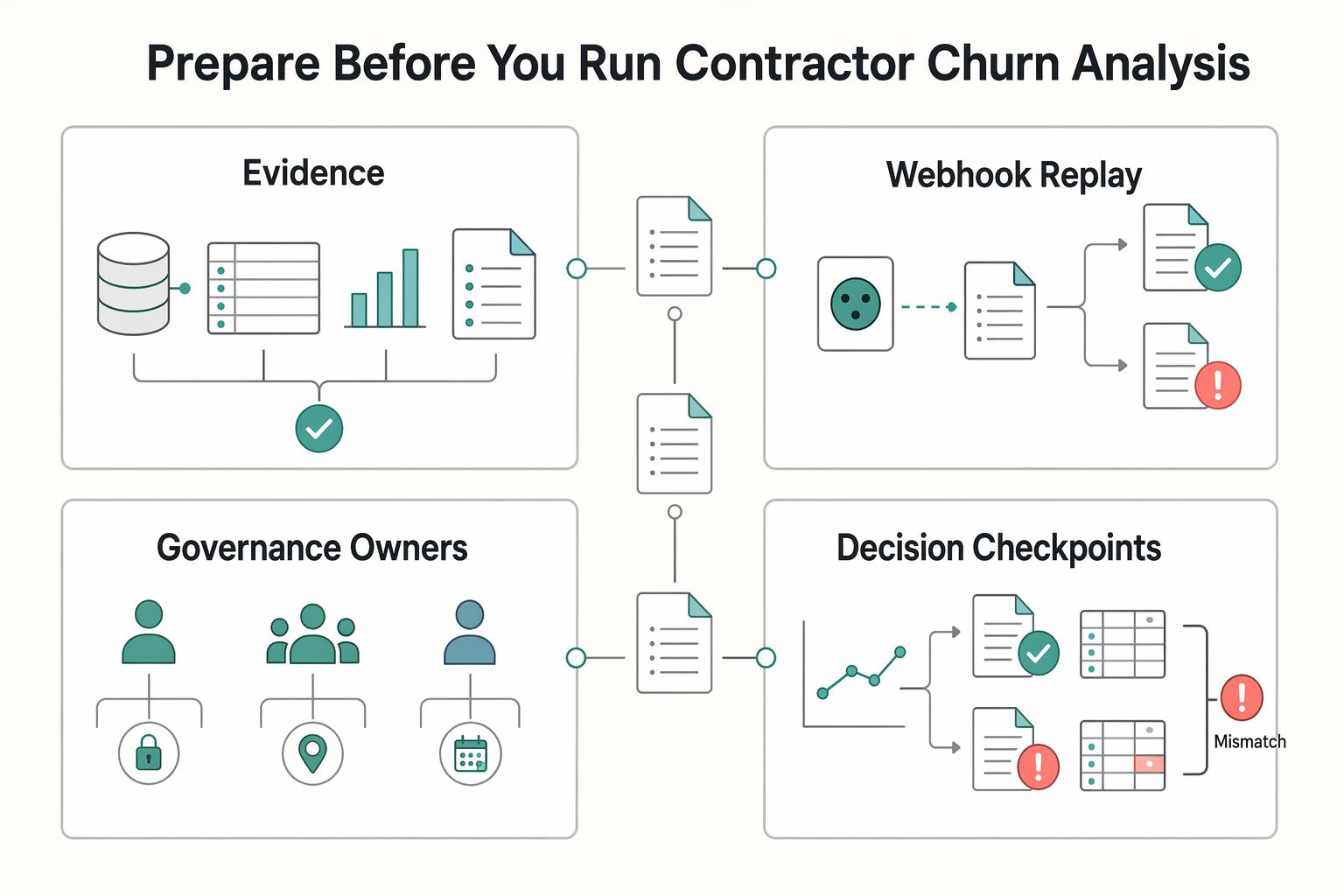
Before you start, prepare one evidence pack and assign decision ownership. Otherwise, you will see where activity dropped without being able to defend why.
| Preparation | What to pull or confirm | Checkpoint |
|---|---|---|
| Shared analysis definition | Activity start/return event, cohort IDs, timezone, horizon and data cutoff; join product, support, fees and relevant financial records | Membership and full follow-up can be reproduced; recent participants are not counted as churned |
| Payment visibility where relevant | Job obligation, transfer/account credit, payout outcome, delivery and processing records, returns | A financial exception can be traced without treating it as proof of non-return |
| Owners | Product measurement, payments exceptions, research, finance assumptions and required verification | Urgent payment issues have an owner even while causal analysis continues |
| Decision rules | Behavioural outcome, estimated incremental contribution, safety rules and planned decision date | Missing evidence is scoped to the hypothesis; no essential payment or protection is withheld |
-
Build one evidence pack. Freeze cohort IDs, definition, horizon and data cutoff. Align product activity, job availability, support, fee exposure and relevant payment records. Use the appropriate reconciliation report for the payout method. Extend the payment lookback when an earned obligation predates the activity window; do not lose a valid join merely to keep every export on identical dates.
-
Confirm event coverage. Store product activity with freelancer/job IDs. For payment hypotheses, inspect account, transfer, payout and reversal events for the correct platform or connected-account scope. Record webhook delivery and downstream processing separately, and reconstruct missing object state where possible.
-
Assign governance owners up front. KYC requirements for payouts are country-specific, and KYB checks can sit inside AML/CFT programs, so ownership for each gate and exception path must be explicit. Name who can approve pricing model changes as well. Otherwise, you can diagnose correctly and still stall because no one has authority to change policy, messaging, or fees.
-
Set decision ownership. Product owns activity definitions and job access; payments ops owns payment exceptions; finance validates observed revenue/costs and model assumptions; compliance owns required checks. A missing financial join weakens a payment claim, not every product or interview finding.
Map freelancer journey stages to churn events that actually hurt revenue#
Define activity from product records, then join operational and financial evidence where it is relevant. A login, completed job, rejected offer and payout are different events. Early onboarding drop-off can be real even when the account has never produced a payment or ledger entry.
Split the journey into operational stages#
Map stages to how freelancers actually move through your product: sign-up, verification, first earnings, first withdrawal, repeat payout, and tax-document readiness only if tax paperwork is a real gate in your flow.
| Stage | What to track in platform terms | Why it matters commercially |
|---|---|---|
| Sign-up | Account created, profile started, onboarding initiated | Shows whether acquisition is producing usable supply |
| Verification | KYC requirements requested, submitted, approved, or stalled | Shows whether requirements or review delay the capabilities needed for this account |
| First earnings | First completed job or first funds attributed | Distinguishes activated supply from casual sign-ups |
| First withdrawal | First payout requested, attempted, succeeded, or returned | Core payout trust moment |
| Repeat work and payout | New accepted/completed jobs and separate subsequent payout outcomes | Distinguishes continued work from withdrawal timing |
| Tax-document readiness | Required tax form requested and completed, if applicable | Tracks readiness when tax documentation is a platform gate |
Keep stage names tied to emitted events. For example, "stalled verification" is operationally useful because verification requirements vary by location, business type, and requested capabilities.
Define churn events in platform language#
Keep the outcome separate from a suspected driver. An unresolved verification request or failed payout is a friction event; it is not itself proof that a freelancer has left. Define a meaningful return event and an observation window appropriate to your job cycle. For example, an illustrative mature-supply rule could be no accepted or completed paid work for 30 days after the last completed job. Track confirmed closure, platform suspension, temporary inactivity and reactivation separately.
Freeze the definition, timezone, exclusion rules and data cutoff before comparing cohorts. Allow each person the full observation window; a freelancer whose last job was five days ago cannot yet satisfy a 30-day inactivity rule. Seasonal work and a lack of available jobs need separate interpretation. Then join repeated payout failures, open holds and support contacts as possible explanations for the measured outcome.
Tie each churn event to a monetization consequence#
An illustrative cohort of 100 freelancers completed a first job in April and all have a full 30-day follow-up. If 60 complete another job within that window, 30-day repeat-work retention is 60/100 = 60%; 40 have no repeat job in that window, not necessarily permanent exits. If only 80 have reached the full follow-up at the cutoff, use those 80 for the mature-window calculation and report the other 20 as not yet observable. Keep first-job activation and first-payout conversion as separate funnels.
Use stable freelancer and job IDs to connect behavior to payment records. For payment issues, add connected-account, transfer, payout and balance-transaction IDs where applicable. A platform transfer credits an account; a payout sends funds to an external destination. A freelancer can complete repeat work while choosing to leave money in the account, so no new payout alone does not establish churn.
Where a join or event is missing, label the affected measurement or payment hypothesis uncertain. Reconstruct it from current source records where possible. Continue investigating valid product and interview evidence while fixing the gap; do not require a payment webhook for a freelancer who never reached earnings.
We covered this in detail in Involuntary vs Voluntary Churn on Platforms and How to Attack Each.
Segment churn by cohort before you decide what to fix#
After you can reconstruct a churn event, segment it before choosing a fix. Averaging unlike freelancers into one headline churn rate usually hides the operational cause.
Build cohorts around monetization, not demographics#
Use cohorts that change revenue quality or operating cost: geography, payout rail, pricing model exposure, compliance path, and lifecycle stage. Cohorts are groups that share properties or event sequences, and they can be compared directly over time in retention analysis.
Segment by factors that could change the experience: country, skill category, job availability, payout method, verification path and fee exposure. Use eligibility and coverage documented for your actual program; a vendor’s broad country count does not prove a particular contractor or rail is supported. Include reported barriers or unequal access where relevant rather than assuming operational segments explain every exit.
Before analysis, run one data-quality check: can you reproduce cohort membership from stored properties and event history, without analyst interpretation? If not, fix tagging first.
Separate new freelancer churn from mature freelancer churn#
Do not combine first-stage drop-off with repeat-earner attrition. New and mature cohorts can show the same churn event for very different commercial reasons.
Separate new freelancers who have not yet reached first earnings or payout from mature freelancers with repeat work. Record the expected payment and payout schedule for each route, including holidays and verification status. Compare delay against that communicated expectation rather than imposing a universal 7–14-day first-payout timetable.
| Churn trigger | Affected cohort | Unit economics impact | Operational owner | Reversibility |
|---|---|---|---|---|
| Stalled KYC before first earnings | New freelancers in stricter verification paths by country or capability | Delayed activation and slower payback | Compliance and onboarding product | Hypothesis to test against activity recovery and incremental contribution |
| First payout delay or failure | New freelancers on specific payout rails or cross-border routes | Lower trust before repeat earnings | Payments ops | Hypothesis to test against activity recovery and incremental contribution |
| Repeated payout failure after repeat earnings | Mature freelancers with proven earning history | Higher loss of durable payout volume | Payments ops and finance | Hypothesis to test against activity recovery and incremental contribution |
| Churn after fee or pricing exposure change | Cohorts exposed to a different pricing model | Margin and retention tradeoff | Finance and growth or product | Hypothesis to test against activity recovery and incremental contribution |
Pick the fix that matches the cohort signal#
Match the intervention to the cohort pattern. If one compliance-path cohort shows high KYC/AML fallout but strong post-activation retention, prioritize verification flow, document prompts, and status messaging before broad discounting.
When mature freelancers stop returning after payment problems, compare their expected lost contribution with acquisition alternatives. Resolve verified payment exceptions promptly while measuring whether those freelancers actually resume work; paying an amount already owed is an obligation, not an experimental retention reward.
Quantify the economics before approving retention work#
Approve retention work only when the economics are credible by cohort: lost contribution, likely recovery, intervention cost, and payback period, with a clear split between observed data and assumptions.
Once cohorts are clean, turn each into a simple investment case so budget follows expected impact, not just a high churn headline.
Build a cohort impact model from contribution, not just churn rate#
Start from contribution margin, not gross volume. Contribution margin (sales revenue minus variable costs) is the clearest base for estimating what a churned cohort costs.
| Component | What it covers | Decision note |
|---|---|---|
| Estimated foregone contribution | Comparable activity and platform revenue less variable costs over a defined future horizon | Counterfactual estimate, not a ledger-observed loss |
| Incremental recovery | Activity retained because of the intervention, compared with a suitable control | Payment recovery and return to work are separate outcomes |
| Intervention cost | One-time build plus ongoing operations, provider, credit and support costs | Use the same horizon; avoid double-counting costs already in contribution |
| Payback | Setup cost divided by sustained monthly incremental contribution after ongoing cost | No positive payback if the denominator is zero or negative |
For each cohort, calculate:
- Lost contribution
Estimate foregone contribution over a stated horizon from comparable active freelancers, net of variable payment, support and servicing costs. A ceased account has observed activity loss, but the revenue it would have generated is a counterfactual estimate. Account for seasonality, job availability and whether replacement supply would earn the same work.
- Recovery value
For an illustrative three-month case, 40 inactive freelancers would each contribute an estimated $30 per month if active: at-risk contribution is $3,600. If an intervention incrementally retains 10 of them, expected preserved contribution is $900 over three months. With $600 one-time implementation and $50 monthly ongoing cost, total three-month cost is $750 and expected net benefit is $150. These assumptions are not observed recovery; verify them with a comparison group and follow-up.
- Intervention cost
Engineering time, operations headcount, vendor cost, refunds or credits, and ongoing support cost.
- Payback period
Use incremental contribution after ongoing intervention costs. In the example, 10 retained freelancers × $30 monthly contribution gives $300 per month; less $50 ongoing cost leaves $250. The $600 setup cost would pay back in $600/$250 = 2.4 months if retention and contribution persist. If incremental contribution after ongoing cost is zero or negative, there is no positive payback under those assumptions.
Finance should reproduce observed revenue and variable costs from accounting and operational records, while product reproduces cohort membership and activity. Mark the estimated future activity, recovery rate and contribution horizon separately. A documented low-cost experiment can test uncertain economics; do not label a modelled loss as a directly observed ledger amount.
Keep observed outcomes and counterfactual estimates separate. You can observe a missed job, an unpaid balance or a return to work. You estimate how much work would have occurred without the problem and how much a proposed change will recover. Payment recovery and freelancer retention are separate results.
Compare intervention classes on economic path and evidence strength#
Put intervention classes side by side before roadmap decisions:
| Intervention class | Primary economic path | Best fit signal | Confidence source | Common risk |
|---|---|---|---|---|
| Pricing change | May increase activity but reduce fee revenue per job | Measured fee exposure and complaints precede non-return | Suitable comparison, actual fees and incremental contribution | Demand changes or concurrent releases confound the result |
| Payout reliability | Resolve confirmed obligations and failures; test later activity | Failure or delay before non-return in affected cohorts | Latest payout/return records, communication and meaningful activity | A paid amount or faster payout is mistaken for retention |
| Verification communication | Reduce avoidable confusion without bypassing requirements | Unclear prompts or long unresolved reviews near activation loss | Requirement state, response timing and completed activation | Required checks are treated as optional friction |
| Support and job access | Resolve exceptions or improve access to suitable work | Repeated complaints, low relevant job availability or unanswered bids | Tickets, demand/matching data, sampled interviews and comparison | Support costs rise or control-group jobs are displaced |
Match the response to the evidence. Drop-off before first payout could reflect no jobs, onboarding, earnings availability, verification or payout failure. Investigate those paths in parallel; prioritize a confirmed unpaid or failed-payment exception without waiting for a pricing analysis. If a fee change precedes drop-off, test that hypothesis alongside concurrent product and demand changes.
Score confidence and set a kill rule before launch#
Score confidence in the measurement separately from confidence in the cause. Reconciled payment records can strongly establish a payment failure without proving it caused non-return. A causal claim needs a suitable comparison or experiment, with documented confounders and uncertainty.
Plan sample size, the smallest effect worth detecting, observation horizon and decision dates before launch. Use the actual job cycle and enough fully observed participants rather than a universal one-to-three-month rule. Randomize eligible freelancers consistently where appropriate, analyse them by assigned group and check assignment balance. Do not withhold amounts owed, required protection or mandatory verification to create a control.
Set safety and economic stop rules in advance: unresolved payment harm, unacceptable support burden or a convincingly negative incremental contribution can justify stopping. A small temporary control-group lead is not sufficient proof of failure. At the planned decision point, report uncertainty and whether the estimate can repay costs; distinguish an inconclusive test from a harmful one.
This pairs well with our guide on The Gig Economy Gender Gap and Why Female Freelancers Face More Late Payments.
Diagnose root causes in payouts, compliance, and pricing friction#
Investigate payout events, verification, pricing and access to work as parallel hypotheses. Start with urgent verified payment exceptions, but do not force every cohort through a payments-first explanation. A clear fee or demand shock can be relevant even while a different subgroup has verification problems.
| Diagnostic area | What to verify | If unclear |
|---|---|---|
| Payout hypothesis | Join earned obligation, transfer/account credit, payout object and latest return to the freelancer; inspect processing and reconciliation | Confirm the payment exception separately from any cause of non-return |
| Verification hypothesis | Requirement category, due date, eligibility, submission, review resolution and communication near activity loss | Do not assume every requested document is a disabled capability or bypass required checks |
| Pricing and tax prompts | Actual fee exposure and disclosure, required tax form prompt, support report and product activity | Keep competing hypotheses and missing evidence explicit |
| Work and experience | Relevant jobs, bids, matches, disputes, net earnings and sampled exit/re-entry interviews | Report response bias and changes in marketplace demand |
Investigate a Payout-Related Non-Return Hypothesis#
For a cohort with a plausible payment problem, sample affected and comparable unaffected freelancers. Trace their earned obligation, account credit or transfer, payout attempt and eventual outcome using the relevant object IDs. Preserve API request IDs when present, but asynchronous or system-generated events may have no initiating request. Compare the timing with product activity and what the freelancer was told.
For standard automatic Stripe payouts, transaction-to-payout associations can help trace settlement; instant and manual payouts need their own reconciliation method. Keep the latest status and returns: a payout initially marked paid can later fail. A webhook receipt or acknowledgement proves delivery to your endpoint, not final processing, bank receipt or the freelancer’s reason for leaving.
Test KYC, KYB, and AML gates as payout blockers#
Check the account’s actual requirements and eligibility. In Stripe’s v1 account flow, inspect payouts_enabled, charges_enabled, due requirements, deadlines, pending verification and disabled_reason. A request for information does not mean payouts are already disabled; pending review and overdue requirements have different meanings. Use the corresponding fields for your integration version, and keep provider review decisions with the authorized team.
Check requirement state changes, document-submission timestamps, and support contact timing near abandonment. Then ask: did an unmet KYC or KYB requirement appear before the user stopped returning, and was it resolved? If timing is unclear, label the conclusion as uncertain instead of defaulting to a pricing narrative.
Audit tax-document friction and fee fairness, then write the caveats#
Compare the fee actually experienced, including payout fees and conversion costs where relevant, with what was disclosed. Check quote, fee-change exposure date, completed work and withdrawal behavior. A price complaint, operational failure and lack of work can coexist; do not require one hypothesis to be completely ruled out before testing another.
Audit required tax-document prompts as their own onboarding events. U.S. persons may provide Form W-9 for information reporting; Form W-8BEN establishes a foreign individual’s status for applicable U.S. withholding/reporting, while entity and other circumstances use different forms. Let the responsible payer or tax process determine the required form. Track request, explanation, submission and resolution, without adding unrelated personal tax obligations as platform payout gates.
Use sequence evidence here too: did a W-8, W-9, or tax-readiness prompt appear shortly before abandonment, and is there support or UI evidence of confusion? If data is thin, do not claim you know why freelancers leave. State the cause as unknown and list the missing evidence. Related: How to Pay US-Based Freelancers from the UK.
Choose fixes with explicit decision rules and ownership#
Turn diagnosis into execution by assigning one ranked fix per owner, each with a deadline, a success metric, and a rollback condition. Keep the decision stage-specific: activation churn needs activation fixes, while repeat-stage churn needs repeat-stage fixes.
| Owner | Apply this fix when... | Success check | Rollback condition |
|---|---|---|---|
| Product | Onboarding or job-access data supports the hypothesis | Activation and meaningful repeat work for fully followed cohorts | Safety harm or negative/inconclusive economics at the planned review |
| Payments ops | An earned payment is unpaid, delayed or failed | Resolve obligation, verify latest settlement/return and communicate | Stop unsafe automated recovery; continue lawful handling of owed amounts |
| Finance | A fee or contribution hypothesis is testable | Incremental platform contribution after intervention costs | Predefined negative economics or unacceptable downside |
| Compliance | A required verification step is unresolved or confusing | Accurate communication and timely review under required controls | Pause unsafe changes without bypassing the required checks |
Add the freelancer’s perspective: sample non-returners and returners, ask about job availability, net earnings, time spent bidding, treatment, disputes, support and off-platform work. Link responses to the consented research record and stage data. Report response rate and selection bias. Interviews can suggest a mechanism; they do not establish its prevalence across all non-returners.
Evaluate payment architecture only when the diagnosed bottleneck calls for it:
- Evaluate a Merchant of Record only for an eligible selling model and a documented commercial/tax responsibility problem. It does not automatically assume contractor classification, onboarding or payout obligations; legal role, provider coverage and contract scope must fit.
- Evaluate Virtual Accounts for supported inbound-transfer identification and reconciliation. They do not by themselves repair failed outbound freelancer payouts or establish that a payment is settled.
- Compare the actual program, fund flow, obligations, implementation cost and expected improvement before changing architecture.
Use a suitable treatment/control design when practical. Predefine the eligible population, assignment, analysis, follow-up and smallest useful effect. Keep obligatory payment recovery and required verification available to both groups. Pre/post results are supporting evidence because demand, seasonality and other releases can change outcomes.
- Behavioural check: meaningful activity or stage conversion improves for fully observed assigned cohorts, with uncertainty reported.
- Operational check: the intended change occurred and exceptions were resolved; use webhook processing records only where relevant.
- Economic check: incremental platform contribution exceeds intervention cost over the stated horizon; payout volume alone is not revenue.
Scale only when the behavioural outcome, operational result and incremental contribution support the decision within the planned uncertainty and safety limits. If a relevant source disagrees, reconcile it before expansion. A documentation-only or job-access fix does not need a new financial webhook to count as a valid intervention.
Common mistakes and how to recover without burning roadmap time#
When evidence is thin, narrow the intervention and improve the relevant measurement. Keep paying amounts already owed and handling urgent complaints while diagnosis continues. Avoid a broad pricing reset based only on a blended chart.
Mistake: calling every friction event churn. Recovery: keep account closure, a fully observed inactivity window, activation failure and payout failure separate. Rebuild behavioural outcomes from product events and join financial evidence only where relevant.
Mistake: cutting fees without testing the mechanism. Recovery: compare meaningful activity for fully observed assigned cohorts and incremental contribution after intervention costs. If the result is inconclusive or non-return persists, reassess fee, job-access, onboarding, support and payment hypotheses with their uncertainty rather than automatically expanding discounts or switching to a payment explanation.
Mistake: treating delivery as processing or settlement. Recovery: record receipt, processing and reconciled outcome separately. Stripe live event delivery retries can continue for up to three days; manual resend options have different windows. Use a deduplicated processing record and current object state when recovering events. Do not wait for an arbitrary retry window before responding to a known payout failure.
Mistake: delaying tax and compliance communication until late stage. Recovery: set expectations early. Explain that U.S. payees may need Form W-9 to provide a correct TIN for information return reporting, and define a clear trigger for Form W-8BEN when requested by the payer or withholding agent; then match that with plain account-verification language.
Keep an exception record with freelancer ID, affected job or payout, confirmed obligation, latest outcome, owner, communication and next action. Restrict access to identity and review information; a research dataset needs reason categories and timestamps rather than raw identity documents or confidential review material.
Conclusion and copy-paste execution checklist#
Define the supply-side outcome before diagnosing a cause. Join meaningful activity with the relevant job, fee, support, verification and payment evidence, then estimate the incremental contribution a fix could preserve.
- Define churn by stage, not by a generic "left" label.
Map sign-up, verification, earnings, payout and repeat work separately. Fix a return event, inactivity or conversion window, timezone and data cutoff. Report only participants who have reached the full observation horizon; distinguish suspension, closure, temporary inactivity and reactivation. Add payment or verification failures as potential drivers, not alternative definitions of leaving.
- Validate the evidence chain before you approve a fix.
Join product events to the operational and financial sources relevant to the hypothesis. For Stripe integrations, validate signatures, deduplicate event IDs, separate delivery from successful processing and recover missing current object state. There is no universal eight-attempt schedule across vendors, and retrying delivery is different from retrying a payout. Use your provider’s actual behavior and reconcile disagreement before assigning a cause.
- Segment cohorts before intervention.
Cohort retention analysis matters because aggregate metrics blend different groups and hide where the real loss sits. Split cohorts by start time first, then by factors tied to monetization and operations, such as payout rail, geography, compliance path, pricing exposure, and lifecycle stage. Decision rule: if new freelancers are dropping before first payout, do not average them together with mature freelancers who churn after payout friction. Those are different problems with different owners.
- Rank fixes by unit economics and ownership.
Rank interventions by expected incremental activity and contribution after ongoing costs, with an explicit horizon and uncertainty. Give each one an owner and partner team. Prioritize verified payment harm promptly; compare fee, job-access, onboarding and support hypotheses for the remaining cohort.
- Test with explicit success and kill rules, then log unknowns.
Use a suitable comparison, predefine success and safety rules, and allow full follow-up. Where freelancers compete for the same jobs, an intervention can affect the control group’s opportunities: consider market or time clusters with an analyst rather than assuming person-level randomization is unbiased. Report confidence intervals and demand, seasonality or campaign confounders. Stop harmful changes, retain essential payment and compliance handling, and label insufficient evidence clearly.
Related reading: How to Build a Trust and Safety Program for Your Contractor Marketplace.
Frequently Asked Questions
What is contractor churn analysis and how is it different from customer churn analysis?
Customer churn analysis looks for why customers cancel, not just how many leave. Contractor churn analysis uses the same logic, but the causes are often tied to onboarding, activation, payment, and communication events rather than a simple subscription cancel. For a marketplace, that means reading churn through journey stages like first earnings and first successful payout, not only account closure.
Why do freelancers leave platforms even when demand for work is stable?
Freelancers can leave despite headline demand because suitable jobs, net earnings, payment reliability, treatment, support or opportunities elsewhere do not meet their needs. Demand should be measured for the relevant skill, country and experience cohort. Compare product and payment evidence with sampled interviews; a general contingent-workforce statistic does not establish your platform’s churn rate.
Which metrics should a marketplace track first for customer retention in freelancer cohorts?
Start with a meaningful activity return rate for cohorts with complete follow-up, then separate activation, first earnings, first successful payout and repeat work. Report denominators and observation windows. Payout conversion is a separate operational funnel: freelancers can keep working without making another withdrawal.
How do payout experience and payout batches influence churn risk?
A failed or late payout can damage trust and may precede non-return, but failure and churn are different outcomes. Reconcile the latest payout and any return, then compare activity and timing with unaffected freelancers and their reported experience. A paid event or successful webhook delivery alone does not prove final bank receipt or a causal effect on retention.
When should a team change the pricing model versus fixing compliance and payout operations first?
Respond promptly to confirmed unpaid amounts or payout failures. Test pricing when actual fee exposure, complaints and cohort timing support that hypothesis; investigate verification and job access in parallel. A suitable comparison can estimate whether the proposed fix increases meaningful activity and contribution. Do not delay owed payments or waive required checks for a retention experiment.
How can API and Webhooks instrumentation improve retention analysis confidence?
APIs and event records help join the correct freelancer, account, job, transfer and payout to the latest operational state. Keep delivery and processing separate, deduplicate repeated events and use object IDs when an initiating request ID is absent. They strengthen a payment hypothesis but do not replace product activity data, interviews or a causal comparison.
What should leaders do when evidence is incomplete but churn is rising?
Keep the observed non-return rate separate from uncertain explanations. Fix a verified payment exception or confusing onboarding message while improving the relevant source data. Run a small intervention with a defined activity outcome, horizon, cost and safety rules. Report an inconclusive result as inconclusive rather than treating missing webhook data as proof of departure.
Try a related tool
Researched and edited by the Gruv editorial team. Gruv builds cross-border billing, payouts, and finance-operations software for global businesses.
Sources
Includes 4 external sources outside the trusted-domain allowlist.
- docs.stripe.com/webhookstrusted
- docs.stripe.com/webhooks/process-undelivered-eventstrusted
- irs.gov/forms-pubs/about-form-w-9trusted
- irs.gov/forms-pubs/about-form-w-8-bentrusted
- amplitude.com/docs/analytics/charts/retention-analysis/ret...external
- amplitude.com/docs/analytics/charts/retention-analysis/ret...external
- arxiv.org/abs/2104.12222external
- microsoft.com/en-us/research/wp-content/uploads/2020/08/20...external
Educational content only. Not legal, tax, or financial advice.
Related Posts

How to Pay US-Based Freelancers from the UK
Your ability to attract and keep strong US freelance talent depends less on budget than on how you operate. Strong freelancers often work like serious one-person businesses, and they start evaluating you from the first interaction. Compliance and payment handling are not back-office details. They are early proof that you will be easy to work with, careful with details, and worth prioritizing.

The Freelance Payment Penalty: A Modeled Audit of Platform Fees, FX Spreads, and Payout Delays
The money rarely disappears through a single, easy-to-spot fee. The real loss is stacked. A marketplace takes its commission, a processor adds a charge for international cards, a bank or payment company converts the currency at a spread, a platform holds the funds before release, and a wire sheds a little to intermediaries on the way in. Each layer looks defensible on its own, but the worker feels the combined result as a smaller deposit and a later payday.

How to Respond to a Subpoena for Business Records
Move fast, but do not produce records on instinct. If you need to **respond to a subpoena for business records**, your immediate job is to control deadlines, preserve records, and make any later production defensible.