
Quick Answer
Start by treating community as a retention operation with named ownership. Define segment baselines for logo churn, gross churn, NRR, and LTV, then route accounts into onboarding, adoption, or rescue lanes using usage, feedback, and support signals. Check the first 24 hours for new-customer confusion and review results weekly with an alert log that captures signal, action, owner, and outcome. Keep scaling only when behavior change appears first and segment churn direction improves after.
Stop Guessing and Build a Community Retention System That Lowers Churn#
If you run community as an engagement channel, you can rack up activity and still miss churn. Run it as a retention loop instead: detect risk early, intervene by segment, and verify whether the action changed retention outcomes. That is how community starts affecting churn.
High churn means you can keep selling while customers keep leaving, and growth still stalls. The fix is not more community activity. It is a tighter operating loop you can execute this week.
Step 1. Define your outcome stack and rank those outcomes#
Step 1. Define your outcome stack. Start by deciding what community should influence, then rank those outcomes. Lead with customer churn, retention by segment, and one value metric you already trust, such as expansion revenue or LTV. Do not start with post counts, event attendance, or engagement rate unless you can show they lead to one of those retention outcomes.
Make the first checkpoint concrete. For new customers, the first 24 hours matter because early confusion often turns into long-term disengagement. If your community has an onboarding lane, tie it to an early activation signal, not generic participation. If a customer joins three welcome threads but never completes setup, that is not progress.
Step 2. Set evidence rules before you launch interventions#
Step 2. Set evidence rules before you launch interventions. Community data alone is not enough. Your decisions should combine three evidence types: product usage, customer feedback, and support interactions. A lively feedback thread can help, but if usage is falling and support tickets are rising, you have a rescue case, not a healthy account.
Use external benchmarks as directional context only. Keep one line in your dashboard that says: External churn benchmark range: benchmark range pending verified source. That note should frame urgency, not set targets or prove success. There is no universal blueprint, and broad public ranges may not match your pricing, product complexity, or segment mix.
One early red flag: if your team prioritizes community requests on gut feel, you are probably creating noise or feature bloat. A visible feedback board only helps when requests are logged, responses are visible, and customers can track status from "Under consideration" to "Planned" to "Completed."
Step 3. Assign clear accountability and keep an audit-style log#
Step 3. Assign clear accountability. Set clear accountability for trigger decisions, intervention approval, and the weekly review note. That owner might sit in customer success or product, or it might be you if the company is still small. What matters is simple: one name is attached to "we saw this risk, we did this, and here is what happened."
Keep an audit-style log. At minimum, record: segment, risk signal, action taken, owner, date opened, next check date, and result. This becomes the evidence pack you need when an intervention feels busy but is not moving retention.
| Segment or risk signal | Intervention lane | Owner | Leading indicator | Review checkpoint |
|---|---|---|---|---|
| New customer shows early confusion in first 24 hours | Guided onboarding thread or office hours invite | Accountable retention owner | Activation progress | Check in 7 days |
| Existing customer shows product usage drop-off | Rescue conversation in community plus direct follow-up | Accountable retention owner | Usage recovery or response rate | Check in weekly review |
| Customer raises repeated request or frustration in feedback board | Feedback and trust lane with visible team response | Accountable retention owner | Acknowledgement, votes, follow-up engagement | Check status update at next weekly review |
Step 4. Pre-decide the action for each common trigger#
Step 4. Lock trigger-to-action playbooks. Do not leave "what should we do?" open every time a signal appears. Pre-decide the action for each common trigger. If usage drops, who responds? If sentiment slips, what community motion happens first? If a request gets traction, when does product join?
Your minimum viable loop can stay simple: trigger -> action -> verification -> next decision. For example, a new customer goes quiet after setup. Your owner sees no activation in week one and invites them into a guided onboarding thread. Seven days later, the owner checks usage and support replies, then decides whether to close the risk, escalate to direct outreach, or move the account into a rescue lane.
Keep the cadence weekly. If you only review at renewal time, you are already late. If you need help setting the baseline metrics first, use How to Calculate and Manage Churn for a Subscription Business.
What Should You Prepare Before You Launch a Churn Reduction Community?#
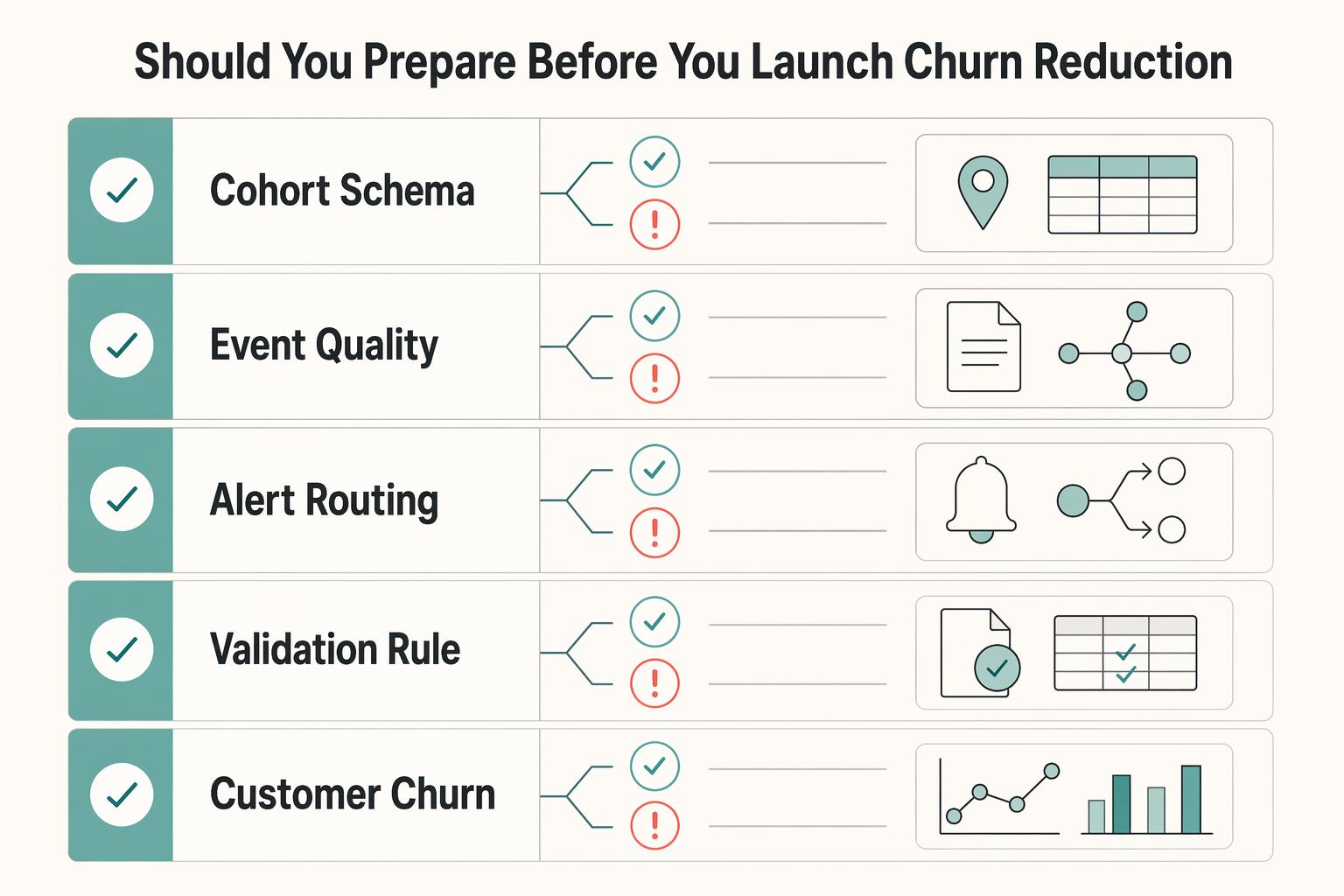
Do not launch until you can state your baselines, accountable owner, minimum data checks, and first trigger-to-action pairs on one page. If any of that is unclear, you will create activity before retention outcomes. Build the operating loop first.
| Signal-stack item | Details |
|---|---|
| Cohort schema | New customers, active accounts, at-risk accounts, and existing reporting segments |
| Event quality checks | Correct account ID, valid timestamp, expected source, no broken sync |
| Alert routing path | First recipient, destination, and confirmer |
| Validation rule | No outreach until a person verifies the signal against usage, support history, and recent feedback |
Step 1. Define your baseline by segment, not in aggregate. Set the numbers you will use before community activity starts: customer churn, revenue churn, early onboarding progress, and weekly health-review coverage. If you cannot separate customer churn from revenue churn yet, fix that first. Logo loss and revenue loss are different, and segment-level visibility is the point.
| Metric | Definition owner | Data source | Update cadence | Go or no-go check |
|---|---|---|---|---|
| Customer churn | Owner pending assignment | Billing or subscription data | Cadence pending reporting setup | Definition is written and can be broken out by segment |
| Revenue churn | Owner pending assignment | Revenue reporting | Cadence pending reporting setup | Revenue lost from churned customers is visible separately from logo loss |
| 30-day onboarding completion | Owner pending assignment | Product usage data | Weekly | You can identify new customers who did not reach early value in the first 30 days |
| Customer health dashboard coverage | Owner pending assignment | Combined usage, support, and feedback | Weekly | A real dashboard exists and is reviewed at least weekly |
If thresholds are still assumptions, mark them as internal threshold pending business verification. Use external ranges as context only, not as your launch rule.
Step 2. Assign one accountable owner and define decision rights. Name one owner for intervention approval, weekly review, and the audit note. Role title is secondary. Single accountability is not. Then remove ambiguity with three explicit rights: who approves a standard intervention, who escalates risk, and who can pause a play when data quality is in question or the account is already in a separate recovery motion.
Call out known sales/onboarding misalignment at this stage. If customers were mis-sold or poorly onboarded, record it now so your team does not confuse community activity with retention progress.
Step 3. Instrument a minimum signal stack before alerts can trigger action. Keep this checklist explicit:
- Define your cohort schema: new customers, active accounts, at-risk accounts, and existing reporting segments.
- Run event quality checks: correct account ID, valid timestamp, expected source, no broken sync.
- Set one alert routing path: first recipient, destination, and confirmer.
- Add one validation rule: no outreach until a person verifies the signal against usage, support history, and recent feedback.
Step 4. Choose channels based on customer behavior evidence. Put each intervention where customers already respond. If customers stall in the critical 30-90 day onboarding window, use a guided onboarding thread or office hours invite. Verify impact with a retention-relevant metric such as onboarding completion or usage recovery, not thread activity alone.
Step 5. Write a four-line launch gate. Use this brief before you go live:
Operating objective: Reduce churn risk for target segment pending segment selection
Baseline status: confirm customer churn, revenue churn, 30-day onboarding, and weekly dashboard status against your own data
First trigger-to-action pairs: define trigger, intervention, and verification source from your own retention data
Immediate review cadence: weekly owner review and next check date pending scheduling
If you cannot complete this cleanly, pause launch and tighten fundamentals first.
Which Members Should Get Which Community Intervention First?#
Route members by segment first, not by whoever feels most urgent in the moment. The practical rule is simple: classify by retention risk and account value, assign one intervention lane, and validate results with a fixed-period churn check.
| Intent and risk | Priority |
|---|---|
| High intent + high risk | Act first |
| High risk + low intent | Act second with a short, specific motion |
| High intent + low risk | Schedule next |
| Low intent + low risk | Monitor |
Step 1. Classify each account into one primary segment. Use two axes: retention risk and account value. Risk can come from early inactivity, usage decline, or negative feedback. Value should follow your current internal definition of high-value customers. Assign one primary lane per account and log the reason so routing stays consistent from week to week.
Before you route an account, run the same signal check each time: confirm account ID, confirm timestamp, then review recent usage, support history, and customer feedback.
| Segment profile | Trigger condition | Intervention motion | Owner | Validation metric |
|---|---|---|---|---|
| New customer with early risk | Did not complete key onboarding action; confirm the internal threshold against your own baseline data | Guided onboarding thread, office hours invite, or setup Q&A | Assigned owner from your launch brief | 30-day onboarding completion or usage recovery after 7 days |
| High-value active account with growth intent | Stable usage plus expansion signal (for example seat growth, feature interest, or peer benchmarking request) | Advanced peer session, customer roundtable, or product deep dive | Assigned owner from your launch brief | Expansion activity plus fixed-period segment churn check |
| Existing account showing churn risk | Usage drop, cancellation language, or negative sentiment; confirm the internal threshold against your own baseline data | Targeted recovery discussion with relevant peers and direct follow-up | Assigned owner from your launch brief | Segment churn checkpoint over the next fixed period |
Step 2. Resolve overlap with a simple intent-risk matrix. When one member matches multiple signals, prioritize in this order:
- High intent + high risk: act first
- High risk + low intent: act second with a short, specific motion
- High intent + low risk: schedule next
- Low intent + low risk: monitor
Step 3. Assign ownership at routing time. Name one owner when the lane is assigned. That owner approves the motion, logs the action, and sets the next review date.
Step 4. Confirm impact with a fixed-period churn check. Use the same period as your subscription cadence, usually monthly or annually. Check start-of-period customers against cancellations in that same period. For example, 100 customers at month start and 5 cancellations by month end yields a 5% churn checkpoint.
If you track NDR internally, read it alongside segment churn, not instead of it. Keep segment-level quality checks in place so expansion in one cohort does not hide retention risk in another. Then feed repeated exit reasons back into onboarding, support, or product work.
How Does a SaaS Community Actually Reduce Churn in Practice?#
You reduce churn with community when you run it as a behavior-change system: match one lifecycle risk to one community motion, define the behavior you need to see, and verify movement before renewal outcomes.
Step 1. Match one lifecycle risk to one intervention. Do not stack multiple motions on the same account at once. Community only helps when the motion fits the lifecycle stage and a real risk signal.
| Lifecycle moment | Risk signal | Intervention format | Owner | Leading indicator (behavior change) | Review checkpoint |
|---|---|---|---|---|---|
| Early onboarding | Key activation action not completed; confirm the internal threshold against your own baseline data | Guided onboarding cohort or live AMA | Named owner in your retention log | First-value action completed or activation movement | Next scheduled stage checkpoint and fixed-period churn check |
| Implementation friction | Repeated setup confusion, negative feedback, or unresolved blockers | Implementation clinic or focused office hours | Named owner in your retention log | Blocker resolved and product usage resumes | Next scheduled stage checkpoint |
| Adoption stall before renewal | Usage drop, cancellation language, or negative signal; confirm the internal threshold against your own baseline data | Targeted peer discussion with direct follow-up | Named owner in your retention log | Re-engagement in core usage behavior | Next scheduled stage checkpoint and renewal-stage review |
| Retention to loyalty/expansion | Stable usage plus clear growth intent | Advanced peer roundtable or product deep dive | Named owner in your retention log | Broader feature adoption or expansion activity | Next scheduled stage checkpoint and fixed-period churn check |
Keep the operating rule tight: one account, one default motion, one leading indicator, one review date.
Step 2. Define the expected behavior change before launch. Measure more than attendance. For each motion, state the behavior you want next, where you will observe it (usage, feedback, support interactions), and what decision you will make if movement is absent at the checkpoint. If no movement appears, escalate instead of repeating the same motion.
Step 3. Run a closed loop and log decisions. Use the same workflow every time:
- Trigger intake from usage, feedback, and support interactions.
- Intervention launch with one named owner and one expected behavior change.
- Action log entry with trigger, action, date, and next check.
- Outcome check at the planned checkpoint.
- Escalation path if risk worsens or behavior does not move.
Before launch, verify account record, signal timestamp, and whether another active escalation already exists. Missing stage signals leave you late on engagement, renewals, and expansion, so keep the loop disciplined. For baseline outcome checks, use How to Calculate and Manage Churn for a Subscription Business.
Related: The Best Community Platforms for SaaS Businesses.
Who Owns Community-Led Retention and What Is the 30-60-90 Plan?#
Assign one Customer Success owner to make retention calls, then give Community, Product, and Marketing clear handoff rules so decisions do not stall.
Step 1. Assign one accountable owner and publish decision rights#
Use a single accountable owner for intervention choice, escalation, and reallocation. Use the matrix below as your working RACI-style operating map for this motion.
| Role | Decision rights | Handoff trigger | Success signal |
|---|---|---|---|
| Customer Success owner | Final call on intervention, escalation, and go/adjust/stop decisions | Risk signal is verified in the account record | Leading indicator moves past your verified internal threshold |
| Community lead | Runs the assigned community intervention and reports execution quality | Attendance happens, but target behavior does not change | Member completes the target action after the intervention |
| Product | Owns response to repeated friction and blocker patterns | Same blocker repeats across accounts or setup stalls | Fewer repeated blockers and resumed usage |
| Marketing | Owns audience/message support for intervention uptake | Low uptake or poor-fit invite targeting | Better invite-to-action conversion |
Start customer meetings in Week 1. In the first month, aim for direct conversations with 20-30 customers, with extra focus on larger accounts. If that does not happen, treat it as a warning sign. If you have a few $100K+ clients, place them in a high-touch program with dedicated ownership and a structured plan.
Step 2. Run the 30-60-90 plan as gates#
Treat each phase as a gate with entry criteria, validation checks, and an explicit decision.
| Gate | Entry criteria | Validation checks | Decision |
|---|---|---|---|
| Day 30 | Owner assigned; churn/NRR plus onboarding and time-to-value data are usable | Customer meetings started in Week 1; first-month 20-30 customer conversations completed; onboarding/renewal/upsell workflow audit logged | Go / Adjust / Stop (use verified internal thresholds; confirm any missing decision threshold against your own baseline data) |
| Days 31-60 | Day-30 decision documented; cross-functional owners active | Health scoring includes leading and lagging indicators; onboarding simplification path to 4-5 key steps reviewed; CS is aligned with Sales, Product, and Marketing | Go / Adjust / Stop (use verified internal thresholds; confirm any missing decision threshold against your own baseline data) |
| Day 90 | 30-60 outcomes logged and comparable | Retention direction checked with churn/NRR and onboarding/time-to-value signals; high-touch coverage reviewed for largest accounts | Scale / Narrow / Pause based on repeated evidence |
Step 3. Keep a review stack and an audit-ready decision log#
Run a practical review stack:
- Weekly execution review for live interventions and handoffs.
- Periodic strategy review for trend and resource decisions.
- Reset review when leading indicators stall or risk conditions change.
Log every intervention with this schema: signal, owner, intervention, rationale, next check, outcome. That gives you fast reallocation without debating from memory.
What Metrics Prove Your Community Is Reducing Churn Instead of Creating Noise?#
If you cannot tie one community action to one risk signal and one retention outcome for a specific segment, you are measuring activity, not retention impact.
Step 1. Use a three-layer metric stack that forces decisions#
Read the stack in this order: outcomes, leading indicators, then operational signals.
- Outcomes (what changed in retention economics): Track churn direction and NRR direction by segment, not in one blended view.
- Leading indicators (whether you still have time to act): Watch for month-over-month usage decline, especially in accounts that have gone quiet. Quiet is often risk, not stability.
- Operational signals (whether your team executed): Confirm the intervention actually happened and reached the right segment.
Map each intervention to one leading signal and one outcome:
- New onboarding cohort: If you run a peer onboarding motion, track whether usage decline stabilizes or reverses; outcome is lower early renewal risk.
- Previously active accounts that went quiet: If you run a re-engagement community touchpoint, track resumed usage or response; outcome is retained revenue that might otherwise be lost through silent churn.
- Mature accounts hearing mostly upsell outreach: If you shift to health-focused check-ins, track whether usage or satisfaction risk appears before renewal; outcome is protecting renewal quality instead of finding risk too late.
Keep this in one shared, real-time dashboard view. If teams use different sources, trust drops and reporting turns into noise.
Step 2. Separate predictive signals from busy-looking activity#
| Signal that predicts retention improvement | Activity that only looks busy | How to read it | Next action |
|---|---|---|---|
| Usage decline slows or reverses after an intervention | Registrations or attendance totals alone | Behavior changed; this can indicate real movement | Keep the motion in that segment and review the next cycle |
| A previously engaged account resumes usage or replies after silence | Lower complaint volume | Silence is not safety; it can mean disengagement | Open a churn-risk alert and confirm behavior change |
| Usage holds or improves while support patterns stay healthy | Fewer support tickets by themselves | Ticket volume alone is ambiguous | Check usage trend before calling it a win |
Treat long tenure as non-protective by default: an account can stay for years, reduce usage over time, and still churn if no one acts before renewal.
Step 3. Run alerts as an operator checklist, not anecdotes#
Use one alert record format every time: signal, owner, intervention, rationale, next check, outcome.
- Route each alert to your single Customer Success owner.
- Require follow-up on behavior change (usage/risk direction), not just attendance or replies.
- Close the loop by updating the same alert record at the next check.
Keep reporting split into two views so neither gets noisy:
- Operator view (execution): live accounts, trigger source, intervention in motion, next check date, movement in usage/risk direction.
- Leadership view (economics): churn direction, NRR direction, top risk patterns, and which motions are being scaled, narrowed, or paused.
If either view is dominated by post counts, event totals, or untied engagement graphs, your program is drifting back to activity theater.
What Usually Goes Wrong and How Do You Recover Fast?#
Most community retention programs fail for one of two reasons: you target the wrong segment, or you cannot trust your measurement. Fix those first, then scale activity.
Step 1. Diagnose failure by segment before you "fix" the program#
Start with segment-level diagnosis, because a blended dashboard can hide where churn risk is growing, especially in higher-value accounts.
| Segment | Common failure mode | Early warning signal | Recovery action | Proof metric |
|---|---|---|---|---|
| New onboarding cohort | You run one generic onboarding motion for every new account | Product usage keeps declining after onboarding activity | Give targeted setup support tied to the first success milestone | Usage decline slows or reverses, then customer churn improves for that cohort |
| Previously active accounts that go quiet | You treat silence as stability | Lower response and lower product usage after earlier engagement | Move the account into a problem-solving intervention with a named owner | Response resumes and usage recovers before the next churn check |
| Mature high-value renewals | Community activity is disconnected from renewal risk | Engagement looks healthy while usage or satisfaction trends down | Shift to health-focused check-ins and account-specific peer support | Revenue churn risk improves, not just attendance or post volume |
If community engagement rises while product usage falls, escalate immediately. That is a risk signal, not a win.
Step 2. Assign one renewal owner and run one triage workflow#
Use one renewal owner per account so decisions are not split across teams. A practical model is: Customer Success owns the retention call, Sales adds renewal context, Community selects the intervention, and Ops protects metric definitions.
For each alert, run the same sequence every time:
- Trigger
- Owner
- Due date
- Intervention
- Verification metric
Keep your weekly scorecard outcome-focused: alerts opened, actions completed by due date, verified behavior change, and segment-level movement in customer churn and revenue churn.
Step 3. Keep a known-vs-unknown log and apply a hard scale gate#
Use a simple decision log format: segment, trigger, known, unknown, action, next check, outcome. This keeps assumptions visible and prevents false confidence.
Keep churn math consistent across reports. If one report uses (lost customers / total customers at beginning of period) × 100 and another includes newly acquired customers in that same period, you cannot trust trend comparisons.
Do not scale new community programs unless all three are true:
- Segment definitions are stable.
- Alert tracking is complete.
- Proof metrics show behavior change before you claim retention impact.
If any one is false, pause expansion and repair measurement discipline first.
Build Your Copy-Paste Community Retention Checklist and Execute This Week#
Use this checklist to run community as a retention system this week, not an activity stream. Follow the six steps in order, and do not scale anything until definitions, execution, and outcomes are all verifiable.
| Lane | Trigger | Intervention | Validation |
|---|---|---|---|
| Onboarding lane | Missed activation or setup milestones | Behavior-triggered emails, step emails, and a community onboarding clinic | Activation recovery |
| Adoption lane | Usage goes flat in an active account | Focused peer use-case sessions or office hours on the stuck feature | Usage or feature adoption recovery |
| Rescue lane | Declining usage, low sentiment, or a near one-year renewal (especially where switching effort may be lower) | Owner-led rescue thread plus blocker removal | Reduced renewal risk |
- Step 1. Freeze your baseline definitions before you launch anything new.
Action: Put your baseline in one shared sheet and lock definitions for the full review window. Owner: Your named retention owner, with sign-off from each data owner. Proof of completion: The same month returns the same numbers across finance, success, and community reporting.
| Metric | Definition standard | Data owner | Verification cadence |
|---|---|---|---|
| Logo churn | Customers lost from the starting customer group for the period | Customer account data owner | Weekly spot check, monthly lock |
| Gross churn | Revenue lost from full customer loss plus contraction or down-sell | Revenue data owner | Weekly spot check, monthly lock |
| Net revenue retention (NRR) | Same customer cohort period over period, including expansion, contraction, and churn | Revenue data owner | Monthly lock, reviewed in each phase |
| LTV formula used | Your current finance-approved LTV formula, frozen for this review period | Finance model owner | Once at start, then only if formally revised |
If reports disagree, stop and align the math first, including NRR and gross churn treatment. For a reset, use How to Calculate and Manage Churn for a Subscription Business.
- Step 2. Name one person to make retention calls.
Action: Assign one accountable owner to approve launches, pauses, and escalations. Owner: You, or the executive responsible for retention outcomes. Proof of completion: Every at-risk segment and open alert has one owner, one due date, and one next check.
When ownership is split, risk stays in discussion and decisions stall.
- Step 3. Map one intervention to each lane.
Action: Define one trigger, one play, and one validation metric for onboarding, adoption, and rescue. Owner: Your retention owner assigns one execution owner per lane. Proof of completion: Each lane has a written trigger, one live intervention, and one measurable outcome metric.
- Onboarding lane: Trigger on missed activation or setup milestones; run behavior-triggered emails, step emails, and a community onboarding clinic; validate with activation recovery. * Adoption lane: Trigger when usage goes flat in an active account; run focused peer use-case sessions or office hours on the stuck feature; validate with usage or feature adoption recovery. * Rescue lane: Trigger on declining usage, low sentiment, or a near one-year renewal (especially where switching effort may be lower); run an owner-led rescue thread plus blocker removal; validate with reduced renewal risk.
- Step 4. Turn every alert into an audit-ready log entry.
Action: Keep one shared alert log with a fixed schema. Owner: The assigned account or segment owner updates the entry. Proof of completion: Every fired alert includes trigger source, assigned owner, due date, action taken, and outcome check.
If the action is not in the log, treat it as incomplete retention work.
- Step 5. Review by phase and ask a different question in each phase.
Action: Run weekly reviews, but score outcomes by phase objective. Owner: Retention owner leads; data owner verifies numbers. Proof of completion: Each phase ends with a pass/fail note against documented criteria.
- Phase 1 (data quality): Check report match rate, segment integrity, and missing fields. Mark numeric cutoffs as internal thresholds pending business verification. * Phase 2 (execution): Check alert response coverage, intervention completion, and follow-up consistency. * Phase 3 (retention direction): Check segment movement in logo churn, gross churn, NRR, and LTV-linked signals.
Do not merge these phase questions into one score.
- Step 6. Apply a hard scale gate before expansion.
Action: Mark each intervention as keep, cut, or scale. Owner: Retention owner recommends; revenue data owner verifies outcomes. Proof of completion: Each intervention has a written decision with metric evidence.
Keep if the signal is promising but not yet repeatable. Cut if activity rises while retention metrics stay flat. Scale only when movement repeats in both retention and value signals.
Go only if all are true:
- Metric definitions stayed stable through the full test window. * The target segment showed usage recovery before or alongside retention movement. * At least one core retention metric improved for that segment. * The result repeated across more than one review cycle.
If any item fails, do not expand yet.
Frequently Asked Questions
How does a SaaS community reduce churn rate in a measurable way?
Treat community as an intervention layer, not as proof by itself. Tie each action to a behavior you can verify first, such as stronger onboarding completion or recovered product usage. Then check whether segment performance improves in customer churn, gross MRR churn, or net MRR churn for that same group. If engagement rises but usage keeps falling, assume you have activity without retention impact.
What metrics should I track first for community-led retention?
Start with customer churn and revenue churn, then review both by segment so you can see where the damage actually sits. Add gross and net revenue views once your finance and success teams use the same formulas consistently: gross MRR churn tracks MRR lost from cancellations and downgrades, while net MRR churn also accounts for expansion MRR. If two reports show different churn math for the same month, stop comparing outcomes until definitions match. Use How to Calculate and Manage Churn for a Subscription Business to align the calculation.
Who should own community-led retention in a small SaaS team?
Set clear ownership for retention actions, even if community, sales, and product all contribute to execution. If ownership is unclear, at-risk accounts are easier to miss until cancellation is close. Check your account list every week: each at-risk account should show a named owner, a due date, and a verification metric.
What should I do in the first 30-60-90 days?
Use phased checkpoints rather than assuming one fixed cadence works for every team. In the first phase, lock segment definitions and baselines so comparisons stay consistent. In the next phase, launch only a few segment-specific interventions. At the next checkpoint, keep only the actions that show directional improvement in usage and churn metrics, and confirm you can identify at-risk customers before cancellation.
How do I segment customers for community interventions without overcomplicating it?
Start with the few segments that clearly differ in churn behavior, such as new onboarding cohorts, previously active accounts that have gone quiet, and mature renewal cohorts. That keeps your intervention logic readable and helps you spot a common failure mode: serving the wrong customer segment while the real risk group gets generic programming. Verify segmentation quality by checking whether each segment has a distinct trigger, a distinct intervention, and a distinct proof metric.
What should I do if my community is active but churn rate is not improving?
Treat high activity as a prompt to investigate, not as a success report. Check whether the active members are already healthy accounts while the segments with the highest risk still show weak usage or flat retention movement. Then redirect your effort toward those accounts before you scale anything. | Signal | High activity but low retention impact | Activity linked to retention movement | What to check next | |---|---|---|---| | Posts and comments | Volume rises, but the same at-risk segment still shows weak usage and flat segment performance | Volume rises in the target segment, then usage stabilizes or improves before renewal | Compare activity by segment against product usage change | | Event attendance | Attendance looks strong, but customer churn and revenue churn do not improve for the intervention group | Attendance is followed by verified follow-up actions and lower risk in that group | Audit follow-up completion and due dates by account | | Peer help requests | Fast replies, but quiet accounts stay quiet and never re-engage in product behavior | Help requests lead to resolved blockers and renewed account activity | Check whether support themes connect to later usage recovery |
What is still unknown in current public evidence about community-first churn reduction?
Stay conservative with claims because public churn evidence mixes broad benchmarks with company-specific case outcomes. Keep a known/unknown decision log with segment, trigger, what you know, what is unknown, action, next check, and outcome. Then claim impact only after your own data shows repeatable retention improvement. If you cannot show the same pattern across more than one segment review, call it a promising signal, not proof.
Try a related tool
Researched and edited by the Gruv editorial team. Gruv builds cross-border billing, payouts, and finance-operations software for global businesses.
Sources
Includes 7 external sources outside the trusted-domain allowlist.
- copyhackers.com/2024/01/i-spent-60-hours-analyzing-onboardin...external
- dansiepen.io/growth-checklists/saas-community-building-st...external
- dev.to/shayy/why-your-saas-needs-a-feedback-board-a...external
- hopscotch.club/blog/how-to-reduce-customer-churn-in-saasexternal
- matrixbricks.com/blog/digital-marketing/reducing-saas-churn-i...external
- saastr.com/what-to-expect-from-a-new-vp-of-customer-suc...external
- tabs.com/blog/reducing-saas-churnexternal
Educational content only. Not legal, tax, or financial advice.
Related Posts

LinkedIn for Freelancers Who Want a Predictable Client Pipeline
Treat LinkedIn as two jobs you run at the same time: a credibility check and a conversation engine. If you only chase attention, you can get noise. If you only send messages, prospects may click through to a thin profile and hesitate.
The Best Community Platforms for SaaS Businesses
Start by classifying the job. If you want access to other people's audience, ideas, or conversations, you are choosing a community to join. If you want a place your customers or members use under your brand, with your rules and structure, you are choosing software you will need to operate every week.
How to Calculate and Manage Churn for a Subscription Business
Customer churn measures account loss; revenue churn measures lost recurring value. Calculate both for the same period, then investigate the accounts and billing events behind the result. Monthly recurring revenue (MRR) is a normalized subscription measure, not cash collected or bank payout.