
Quick Answer
Record the contract end date, amount owed and payment due date, review prior payments and applicable withholding, then authorize and execute the final payment. Revoke access and close data obligations in parallel. Missing security evidence does not automatically justify holding a due invoice; document the basis and amount of any lawful hold. Reconcile the provider outcome before declaring payment settled.
Final Payment Controls During Contractor Offboarding#
A contractor exit creates several deadlines at once: stop new work, remove access, calculate what is still owed, and keep enough records to explain the result. A single 'offboarded' flag cannot show whether the contractor has been paid or whether sensitive data has been returned. Give each obligation an owner and a due date.
Tax and reporting work can continue after the engagement ends. U.S. contractor payments may require information reporting and withholding under the applicable rules. EU DAC7 applies to covered reporting platform operators and reportable sellers, including relevant personal-service activity; it does not apply to every business that sends a payout. The operator's reporting deadline is generally 31 January following the reporting year. Closing an account must not erase records still needed for reporting.
Start with the actual worker relationship, work location, contract and governing law. The U.S. Department of Labor's final-pay guidance concerns employees: federal law does not require their last paycheck immediately, while state rules may. Singapore's salary guidance likewise concerns employment covered by its rules, including last-day or three-working-day timing after employer termination. These examples show why employee and contractor exits need distinct branches; neither supplies a general deadline for contractor invoices.
Run access revocation and data closeout promptly alongside payment review. Document credentials, tokens, shared accounts, retained files and responsible owners. A missing deletion attestation keeps the security or privacy task open; it does not by itself authorize withholding an otherwise due invoice. If a law or enforceable contract term permits a payment hold or offset, record its basis, amount and deadline rather than imposing a blanket security gate.
This article stays focused on practical controls. It covers:
- Compare four operating patterns for termination notices, contract review, payment execution and exportable evidence.
- Run payment review in sequence while security and privacy tasks proceed in parallel.
- Retain one linked evidence pack for amounts paid, authorized holds, tax withholding and unresolved closeout work.
You should be able to reconstruct who changed a payment instruction, which amount was approved and why, and what the provider ultimately did. Set retention by record type and applicable obligation rather than one blanket period. For example, the IRS employment-tax recordkeeping guidance generally requires at least four years after filing the year's fourth quarter; that is an employment-tax rule, not a universal contractor-file rule.
Market rules vary, so this guide stays concrete where obligations are clear. Where contract terms, local payout timing, classification questions, or cross-border reporting duties conflict, the right next step is specialist legal or tax review.
Related reading: IRS Form 1042-S for Platform Operators: How to Report and Withhold on Foreign Contractor Payments.
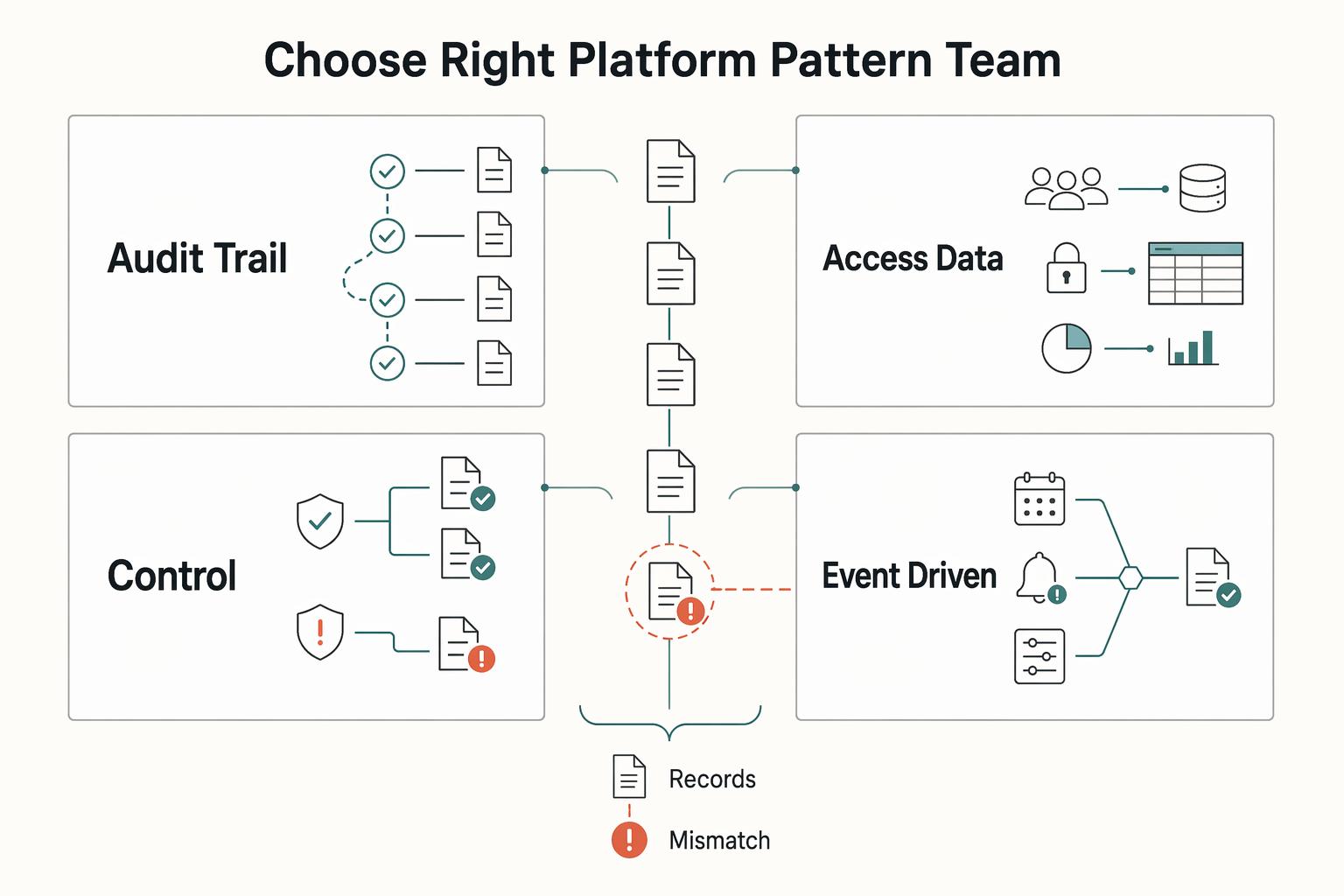
How to choose the right platform pattern for your team#
Ask whether the platform can execute a payment that is due, block an unauthorized new payment, and explain both decisions with exportable records. Finance, legal, security and operations can share a case without making every unfinished task a payment condition. Evaluate a routine exit, a disputed amount and an unknown provider result before choosing a platform.
| Criterion | What to prefer | Grounding |
|---|---|---|
| Audit trail depth | Linked notice, payment calculation, authorization and outcome | Export shows actors, timestamps and the records used for each decision |
| Access and data closeout | Separate access and privacy status with assigned owners | Revocation logs, return/deletion evidence and lawful retention exceptions |
| Final payment controls | Due-date tracking, authorized holds and gross-to-net calculations | Invoice, contract basis, withholding, provider result and ledger reconciliation |
| Event-driven operations | Durable operation identity and safe recovery | Provider-specific retry rules, event deduplication and investigation of unknown outcomes |
Use these criteria in this order.
- Audit trail depth
Prefer platforms that show status changes, review steps, and supporting records. A stronger offboarding pattern includes termination notifications, a documented review or activation flow, and a full documentation and audit trail.
- Access and data closeout evidence
Require access and data evidence for security closeout. Name the systems and files covered, record who verified them, and identify any lawful retention exception. Keep payment approval separate unless the specific obligation legally makes the evidence a condition of payment. An IT ticket should not silently extend the contractor's invoice due date.
- Final payment status and payment cessation controls
Rule out options that cannot prove final payment status changes and payment cessation per contract with exportable history. Also require post-decision reconciliation evidence, for example payout reconciliation exports and bank-linked reconciliation status, so you can verify the operational result, not just the approval event.
- Event-driven operations and safe retries
Use webhooks to update the case, but expect duplicate or delayed events and recover missed updates. Keep a durable internal payment-operation identifier and deduplicate provider events. Stripe stores the first result for a key, including errors; its keys can have up to 255 characters and can be pruned after at least 24 hours. Those limits are specific to Stripe. A key reused after pruning can create a new request, so your own payment record must outlive that window. Reconciliation still has to establish what moved.
A practical filter is to ask each vendor to show you one complete offboarding record with termination details, review status, required notifications, final payment status, and reconciliation exports. If they cannot show that evidence clearly end to end, treat it as a disqualifier. For providers with mixed published signals on offboarding depth, verify capability directly before selection.
For a deeper dive, see Construction and Trades Platform Payments: How to Pay Subcontractors with Lien Waiver Compliance.
Quick comparison of platform options for offboarding and final payment compliance#
For mixed-market, higher-exposure offboarding, choose the pattern that gives you the strongest evidence and approval chain, not just the fastest setup.
| Option | Best for | Control depth | Evidence quality | Operational burden | Escalation support | Pros | Cons / Unknowns |
|---|---|---|---|---|---|---|---|
| Unified payout stack | Teams needing payment approvals close to execution | Depends on configured amount, due-date and authorization controls | Require request-to-ledger export in a demonstration | Integration and control design | Your named legal/tax reviewers unless service scope says otherwise | Fewer handoffs between approved instruction and provider request | One interface does not prove lawful holds, worker coverage or bank settlement |
| TPRM-first system, such as Aravo | Enterprises with a vendor-risk lifecycle | Published Aravo offboarding capabilities cover reviews, access and data attestations | Verify case export and linkage to actual payment records | Cross-functional ownership and payment-system integration | Governance review can route exceptions; verify implementation | Structured termination and evidence collection | Do not infer native payout execution from a payment-finalization task |
| Contractor suite, such as Deel or Remote COR | Teams using a defined contractor engagement service | Depends on product, worker type and signed service terms | Verify notices, invoice calculations, exceptions and retained records | Potentially simpler setup; service-specific procedures remain | Confirm which disputes and countries the service actually covers | Published contractor workflows give concrete end-date or final-invoice steps | Employee/EOR/PEO guidance cannot be assumed to apply to contractors; COR is a distinct service |
| Lightweight rails with internal controls | Small teams able to own the entire exit case | Your checklist, approval rules and provider integration supply the controls | Keep a linked export outside the provider dashboard | Manual work grows with volume and exceptions | Your own advisers and escalation owners | Flexible operating policy and choice of payment provider | You own deadline tracking, tax treatment, retries and evidence; validate any Gruv implementation rather than assuming features |
If legal exposure is high and markets are mixed, prioritize evidence quality and approval controls over faster setup.
For more detail, see Build a Contractor Payment Flow for Home Services Marketplaces.
Option 1 unified payouts and compliance controls in one operating stack#
A unified stack can keep the approved amount and payment instruction close to execution. It is useful when the system can distinguish a lawful payment hold from an open security task, schedule amounts by their actual due dates, and export a time-sequenced record. Verify these behaviors in the configuration you intend to use.
The benefit is fewer handoff errors. An approval, request log and ledger entry can share a case ID, reducing drift between the amount finance authorized and the amount the provider received. This arrangement does not decide whether an offset is lawful or whether a contractor has been misclassified. Those decisions still need the relevant contract, facts and jurisdiction review.
What makes this option worth choosing#
Choose this option when amount-level payment controls are necessary. A reviewer should be able to authorize the undisputed balance, hold only an amount with a valid basis, and stop future unearned payments without canceling accrued obligations. An unresolved security task remains visible with its own owner.
Evidence quality improves when the same stack provides reconciliation and request-level logs. From one record set, or from a clearly linked internal approval record, you should be able to answer:
- What was the contractor's final payment status at each step?
- Which release, hold, or stop decision state changed, and when?
- Did the provider outcome match the recorded internal decision?
If you cannot export those records in order, the "one stack" model is mostly cosmetic.
Where teams still get this wrong#
A common failure is weak termination initiation, not weak payout rails. If the trigger is an unstructured email, Slack message, or spreadsheet edit, the platform can still execute an incomplete or incorrect instruction.
A second failure point is retry handling. Offboarding flows are often asynchronous, and payout calls get retried when responses are delayed or unclear. Without idempotent payout actions, retries can create duplicate disbursements or hold-state mistakes.
The operator rule that matters most#
Tie termination events to prompt access removal and to a review of scheduled payments. Prevent new work or unearned recurring payments after the effective end date. Preserve payment of work already owed and retain the contractor's route to submit a final invoice or receive payment records. Restrict production access without confusing it with access to their billing history.
For a marketplace offboarding a contractor, use a defensible sequence:
- Capture the notice, effective date, contract ID and owner; identify the final-invoice and payment deadlines.
- Start access revocation and data return/deletion tasks in parallel, recording systems, owners and evidence.
- Calculate the outstanding gross amount, prior payments, permitted adjustments and applicable withholding; separate disputed from undisputed amounts.
- Obtain written authorization for the payment and any hold, including its legal or contractual basis, amount, review date and responsible reviewer.
- Send the authorized instruction, then reconcile the provider result and ledger. Close payment and security tasks separately and keep the overall case open for unresolved obligations.
Used with disciplined initiation and retry controls, this pattern is a credible choice for final-payment control. Used casually, it concentrates failure in one place.
For a step-by-step walkthrough, see What Is RegTech? How Compliance Technology Helps Payment Platforms Automate Regulatory Reporting.
Option 2 TPRM-first systems for vendor termination governance#
A TPRM-first model is often a defensible choice when third-party exits require cross-functional signoff. Its core strength is governance evidence: why the relationship ended, who reviewed it, and which obligations were closed before completion.
It fits best for enterprises that already run a formal TPRM program. In U.S. federal banking guidance issued June 06, 2023, termination is explicitly part of the third-party lifecycle alongside planning, due diligence, contracting, and ongoing monitoring. That guidance is sector-specific, but the operational takeaway travels well. Treat termination as a governed stage, not a post-invoice cleanup step.
Where this option earns its keep#
A TPRM system can organize termination review, access checks and data attestations. Aravo's published offboarding capabilities describe those activities alongside contract-linked payment finalization or cessation. That supports a governance use case; it does not establish that the tool itself transfers funds or verifies bank settlement.
What matters most is the evidence attached to each approval. Your termination record should require, at minimum, contract context, confirmation of vendor access and credential removal, final payment terms to confirm, and named reviewers with a clear review trail. If those details sit in email or meeting notes, the governance control is weaker than it looks.
What to verify before you trust it#
This model is only sufficient when the governance decision can be tied to the payment outcome. TPRM tools are built for lifecycle governance, so do not assume they natively execute payout holds, stops, or ledger postings.
Run one real trace before rollout:
- Start from a completed termination approval.
- Confirm the same case ID, or equivalent, appears in finance or payments handling.
- Confirm reconciliation shows the provider outcome or ledger event that matches the decision.
If you cannot complete that trace, you have governance evidence but not final-payment control evidence. If risk can approve termination while finance can still pay from an unlinked queue, TPRM alone is not sufficient.
Limits and failure modes#
A common failure is handoff fragmentation across teams, including HR, legal, and IT. When each team closes its own ticket without a linked final-payment state check, the process can look complete while payment risk stays open.
Accountability is the second failure mode. Third-party use does not transfer responsibility for the compliance outcome, even when every reviewer signs off. For payment-processing relationships, termination governance should be linked to payment operations. Otherwise, the record shows that a decision was made, but not whether payment execution matched it.
For regulated or regulator-influenced teams, termination-rights detail deserves extra legal review when a vendor supports critical operations. Used well, this is a credible component. Used alone, it often proves approval discipline, not payment control.
Option 3 contractor suites with built-in offboarding guidance#
Contractor suites can be a practical adoption path when you need prescriptive offboarding steps without building the process from scratch. A suite such as Deel can simplify handoffs by packaging termination and offboarding into a defined workflow.
Deel's contractor end-date guide describes immediate or future dates. Its independent-contractor FAQ warns that early termination can still breach contractual notice and says Deel does not mediate client-contractor disputes. The page also contains employee and payroll language, so confirm the exact contractor workflow instead of importing every instruction into your process.
Separate contractor, Contractor of Record, employment and Employer of Record products during evaluation. A suite's calculated final amount needs to match your actual engagement terms, completed work and prior payments. Confirm who handles notice disputes, status questions and time-sensitive payment exceptions; a configured end date is not a legal determination.
What to verify before rollout#
Before rollout, test whether the built-in flow gives you evidence you can actually defend later. Focus on the record, not the interface.
- Trace a contractor case from notice through the configured end date, final invoice and provider outcome; verify the supported trigger rather than assuming automatic termination.
- Ask for the supported export format and check that actors, amounts, timestamps and source documents survive outside the UI.
- Verify how corrections, notice disputes and payment exceptions are recorded and who can authorize each change.
- Confirm the worker-type and country scope, who reviews classification evidence, and how the contractor retains invoice/payment-record access after production access is removed.
Option 4 lightweight payment tools with manual legal and compliance overlays#
This pattern works when you intentionally choose simple payment operations and add manual controls to make exits defensible. For smaller teams, it can work if you can prove payment cessation per contract, preserve termination notification records, and assign clear approval ownership.
Best for#
Use this when offboarding volume is low enough for human review. It fits early-stage teams with payment-focused operations where payout handling is the immediate need, not a full lifecycle suite. Some tools focus mainly on contractor payments, while others cover broader compliance workflows, so a lighter tool choice means you must supply the missing controls yourself.
A practical use case is a platform operating in a few markets with a named ops owner and a written escalation rule for legal or tax uncertainty. In that setup, a standardized checklist is a real control because it centralizes who did what and when.
Why teams choose it#
Teams choose this for operational simplicity. It can be simpler to roll out than a heavier model and can reduce dependence on paper checks or spreadsheet tracking, which are associated with delays and data-entry errors.
It preserves flexibility: you can issue stop-work instructions, cancel future unearned payment schedules, and collect the final invoice while adding a stronger control layer. Do not stop an accrued, due payment merely because it shares a schedule with future work. Record the cancellation boundary and remaining payable balance.
Where it breaks#
The weak point is evidence quality. An audit trail must be chronological and strong enough to reconstruct what happened, including the trigger, termination notification, payment hold or release decision, approver, payout outcome, and exception notes.
A concrete provider example is Remote's Contractor of Record termination process: it describes an immediate Stop Work Order, a 21-calendar-day final-invoice submission window, and continued historical-record access. That is a product procedure, not a universal legal deadline or a rule that a late invoice extinguishes a claim. Check your signed terms and the treatment of outstanding approved invoices before adopting it.
Non-negotiable overlays#
The tool alone is not the control here. What makes this pattern work is a short overlay with named owners and retained records.
- Ownership: name the contract reviewer, finance approver, access owner and privacy owner, plus a backup for each deadline.
- Timestamped checklist: record notice sent, effective date, invoice received or outstanding, amount due, access removal, payment authorization and outcome as separate fields.
- Jurisdiction review: identify applicable contractor-payment and worker-status rules early; send exceptions to the responsible adviser with an amount and deadline.
- Evidence outside the tool: retain notice, relevant terms, invoices, adjustment/withholding calculations, approvals, access evidence and provider outcomes under a documented access and retention policy.
Before rollout, walk through a hypothetical USD3,000 final fee with USD1,000 already paid. The remaining approved balance is USD2,000. A separate USD400 change request that has not been approved is not automatically part of that balance, and a missing deletion certificate does not automatically reduce it. Put the USD2,000 due date on finance's calendar and the certificate task on the privacy owner's calendar. If any deduction or hold is proposed, require its specific basis and amount; record a dispute separately rather than silently treating the full balance as zero.
Final payment review sequence and parallel closeout checks#
Run amount and authorization checks before initiating payment, then verify the outcome afterward. Start security and privacy closeout at the same time as payment review. A missing artifact should create an assigned exception, with its impact and deadline recorded. Hold only when the relevant law, enforceable term or unresolved payment authorization justifies it; an internal checklist cannot create permission to miss a payment deadline.
| Stage | What to verify | Exception handling | Evidence to retain |
|---|---|---|---|
| Notice and deadlines | Written trigger, effective end date, final-invoice requirements and payment due date | Resolve conflicting instructions promptly; keep accrued obligations visible | Notice, contract/case ID, actor, receipt evidence and deadline owner |
| Parallel access and data closeout | Revoke unnecessary access; return/delete data as required, retaining legally required records | Escalate live credentials or missing attestations to security/privacy; do not automatically withhold a due invoice | Affected accounts/tokens, logs, data scope, attestation and lawful retention exception |
| Amount and tax review | Final fee, prior payments, authorized adjustments, worker/payee status and withholding | Separate disputed amounts; route missing tax data through applicable withholding/documentation rules | Invoice, contract excerpts, gross-to-net calculation and protected tax records |
| Payment authorization | Authorized amount, recipient, due date and approval; basis of any hold | Unclear authority or recipient needs urgent review; any hold has an amount, basis, owner and review date | Approver, timestamp, authorized instruction and exception record |
| Execution and reconciliation | Send approved instruction once; distinguish pending, failed, returned and settled outcomes | Unknown result blocks a fresh duplicate payment, not status investigation; reconcile before retry/replacement | Operation ID, provider ID, event history, bank/ledger reconciliation |
| Separate closure and retention | Payment reconciled; access/data tasks complete or explicitly outstanding; reporting duties assigned | Keep unresolved tasks open; missing export is a records issue, not retrospective proof that payment was unlawful | Linked case export, remaining obligations, access policy and retention schedule |
The checks most teams leave too late#
Start access removal as soon as the contractor no longer needs the relevant access. Remove or rotate tokens and shared credentials as well as disabling the main account; keep the log and responsible owner. Finance should simultaneously check what is owed and when. Payment can become due while a data-return task is still being resolved.
For a controller-processor relationship, ICO contract guidance explains return or deletion at the controller's choice, including existing copies unless law requires storage. Record the data covered and any retention exception. The guidance is under review following the Data (Use and Access) Act 2025. It does not establish that missing data-closeout evidence permits withholding contractor fees.
What can justify a payment hold#
A payment hold needs a defined reason: for example, a disputed amount under an enforceable term, a legal restriction, or an unresolved recipient/authorization problem. Record the affected amount, supporting provision or determination, who can clear it, the review date and its interaction with the due date. Pay any undisputed amount when required. Missing security evidence or a verbal update should trigger the appropriate task escalation, not an automatic full-balance hold.
Escalate a deadline conflict before it expires. Have the reviewer identify the applicable contractor-payment obligation or, if status review indicates employment, the employee branch. The U.S. federal employee final-pay guidance is not permission to postpone contractor invoices. Urgent review must produce a lawful disposition or alternative payment route, not an indefinite 'legal pending' state.
The async failure mode that causes duplicate or conflicting payouts#
Add a retry checkpoint for asynchronous payout calls. After a timeout, check the latest transaction status tied to the original request ID before sending any new payout action. Stripe documents idempotent requests for retry safety, and PayPal supports PayPal-Request-Id on supported POST calls to return the latest status for the same request.
A hold can block a new, unsubmitted instruction; it cannot undo money already sent. Preserve the original operation and investigate its result even if the internal decision changed afterward. If funds failed or returned, reconcile that result before authorizing a replacement with a linked new attempt. Use a durable operation lock or equivalent approval control so two workers cannot initiate the same obligation concurrently. Check the provider's endpoint-specific key support and retention; PayPal and Stripe do not share identical retry semantics.
Map the internal statuses explicitly: approved/unsubmitted, submitted/unknown, pending, settled, failed and returned are payment states; access pending and data pending are separate closeout states. Verify that the selected provider and any Gruv integration expose the evidence your mapping needs. An internal label should never substitute for a provider outcome.
Minimum evidence pack for audit and dispute readiness#
Your process is only as defensible as the case file you can export after close. The minimum pack should let a reviewer reconstruct what happened, who approved it, what was revoked or destroyed, and why payment was released, held, or stopped.
| Evidence item | What to keep | Key details |
|---|---|---|
| Termination record | Written notice plus receipt or acknowledgment | Include notice date, sender, recipient, contract or case ID, and effective date; keep a signed copy if policy or contract requires it |
| Access and data evidence | IT system access revocation records and deletion or return confirmation | Show account deletion or privilege changes, timestamps, and affected accounts; link identity logs and data closeout records to the same case |
| Payout decision chain | Audit trail from request through pre-payment review, approval, exception notes, and payment outcome | Keep chronological evidence; for any exception path, document what was bypassed and who accepted that risk |
| Closeout evaluation | End-of-contract evaluation record and retention note | Capture relevant closeout issues and unresolved obligations; set retention by record type, jurisdiction, reporting duty and legal hold, with a review/deletion date. |
- Termination record with receipt proof
Keep the written termination notice and proof the contractor received or acknowledged it. If your policy or contract requires a signed termination notice, retain the signed copy; otherwise, retain a written notice plus receipt evidence. At minimum, include notice date, sender, recipient, contract or case ID, and effective date. Avoid keeping only an internal summary when the actual notice is left in email or chat and not linked to the case.
- Access and data evidence that stands on its own
Keep account and credential change logs with timestamps and affected systems. Add return/deletion confirmation where the data role or contract requires it, identifying what was covered rather than asserting 'all data deleted.' Protect tax forms and other personal information with restricted access. Preserve records required for reporting, disputes or a legal hold, and document why those retained copies are exempt from routine deletion.
- Linked payout decision chain from request to outcome
Preserve a full audit trail from request through pre-payment review, approval, exception notes, and payment outcome. The standard is chronological evidence that can reconstruct the sequence of events. If approval and payout outcome records are stored in disconnected systems, defensibility drops quickly. For any exception path, document what was bypassed and who accepted that risk.
- End-of-contract evaluation and retention note
Keep an end-of-contract evaluation where your framework requires it: reason for discontinuance, material performance issues, disputes, unpaid amounts and re-engagement restrictions. Record the applicable retention basis, duration, owner and eventual deletion review for each category. A tax record, an access log and a litigation file can have different lifetimes; do not assign an unsupported five-year rule to everything.
If you need to prioritize, choose linkage over volume. One complete, connected file is more useful than a large set of disconnected attachments.
Escalation points that must trigger legal or tax review#
Route facts outside approved rules to the relevant adviser with the amount, jurisdiction, due date and proposed disposition. Stop unsupported automated decisions, but do not assume that requesting advice suspends every payment obligation. Track any lawful hold separately from security, classification and reporting work.
| Case | Escalate when | Grounded details |
|---|---|---|
| Timing or worker-status conflict | Terms, work location or status evidence produce a different obligation than the configured workflow | Identify the actual contractor rule; apply employee final-pay rules only when that relationship is covered |
| U.S.–Canada treaty claim | Someone requests reduced withholding without a supported income/source/residence analysis | Independent business profits generally require Article VII/Article V analysis; Article XV addresses employment, not a universal contractor exemption |
| Construction lien waiver | A proposed waiver does not match jurisdiction, payment stage, amount or receipt of funds | Confirm statutory scope and form; distinguish conditional from unconditional waiver rather than requiring a paid-in-full acknowledgment before payment |
- Contract language conflicts with local pay timing or status facts
Have legal identify the relevant rule for the actual relationship and work location. A contract's label is not decisive, and contractor-payment statutes or enforceable terms may govern a genuinely independent contractor. If status review indicates employment, apply the applicable employee timetable instead. Record the reviewed rule, its deadline and the operational instruction; do not substitute the company's preferred checklist order for the obligation.
- U.S.–Canada treaty and withholding questions before final payout
Before reducing withholding, tax review should establish payee residence, who receives the income, where the services were performed and which treaty article applies. Independent business profits generally belong under Article VII with Article V permanent-establishment analysis; Article XV's employment tests are not a universal USD/CAD10,000 or 183-day contractor safe harbor. Form 8233 can support a qualifying nonresident individual's treaty withholding exemption for services performed in the United States; it is not the form for every foreign contractor payment. Keep the documented determination and required filing procedure. See US–Canada Tax Treaty and Contractor Payments.
- Construction payouts with lien waiver compliance issues
For construction payments, ask counsel to check the governing state's waiver rules, the payment stage, covered amount and whether funds have actually been received. Texas Property Code sections 53.281–53.284 prescribe requirements and conditional/unconditional forms. Section 53.283 prohibits requiring an unconditional progress or final waiver before the claimant receives that amount in good and sufficient funds. A conditional waiver and an acknowledgment of completed payment have different effects. Do not convert this construction-specific issue into a waiver requirement for every contractor.
Related: Contractor Misclassification at Platform Scale: Legal and Financial Risks.
Mistakes that create regulatory surprises after offboarding#
Regulatory surprises often show up when teams mark offboarding complete before payment status and evidence are actually settled. Risk drops when finance controls, records, and exception handling stay connected through the final payout decision.
Mistake 1 treating offboarding as admin cleanup instead of a finance control#
An exit can remove access successfully while leaving future unearned payment schedules active or an earned invoice unpaid. Review both: stop work and amounts no longer owed under the contract, while maintaining the balance and due date of accrued obligations. A stop-work event should not silently zero the accounts-payable record.
Link account and payment records by case ID while keeping distinct statuses. Security can report access complete, finance can report payment pending, and privacy can report data return outstanding. Record who changed a future payment schedule and its contractual basis, then show how the remaining invoice will be paid.
Mistake 2 capturing task completion but not a defensible audit trail#
A completed task is not the same as defensible evidence. Accountability expectations focus on whether you can demonstrate compliance with records, not whether a ticket says "done."
In practice, keep one retrievable chain for the offboarding decision path: request, review, approval, and payout outcome. Retention quality matters because disputes and reviews often happen after the event, and weak records make your position harder to defend.
Mistake 3 closing the case without verified final payment status#
Verify the final payment outcome before closing the payment task. A termination approval or invoice receipt establishes an earlier step; neither proves that the contractor received funds. Keep the provider result and reconciliation evidence attached to the approved amount.
If payment status is unknown, do not mark the case as fully settled. Verify the invoice or voucher, approval, and payout-rail outcome before the record is marked complete.
Mistake 4 automating edge cases that need market or tax exceptions#
Automation helps on standard exits, but it can fail when rules vary by jurisdiction or tax status. Final-pay timing is not uniform, so a single baseline rule can create timing mistakes.
Missing or invalid tax inputs require a tax-handling branch rather than a universal zero-payment state. For applicable U.S. reportable payments, backup withholding is currently 24% when its conditions apply. If a reviewed USD1,000 payment requires that withholding, USD240 is withheld and USD760 is paid to the contractor; remit and report the USD240 as required. The gross obligation remains USD1,000. Foreign-payee rules and exemptions need their own review. Track documentation follow-up without confusing required withholding with holding the entire fee.
Conclusion#
The practical win is not more software. It is clear decisions about what blocks money movement, what evidence is required before release, and what must escalate.
-
Track what is owed. Capture notice, effective date, invoice requirements, payment deadline and gross-to-net calculation. Authorize the undisputed amount and document any lawful hold separately. Termination of future work does not automatically extinguish accrued fees.
-
Keep linked, distinct closeout records. Revoke unnecessary access promptly and document data return/deletion with lawful retention exceptions. Preserve payment approvals and outcomes with durable operation identity and safe recovery. Security completion and payment settlement can occur at different times; the export should show both.
-
Escalate with an amount and a deadline. Worker-status and tax questions need the relevant facts and reviewer, not a contract label or a generic 'compliance pending' gate. A federal tax determination does not settle every labor-law test. Check current agency and jurisdiction guidance when deciding a real case, and retain the determination that actually governed the payment.
If you are evaluating a platform for contractor offboarding and final-payment compliance, score options in this order: evidence quality, final-payment control depth, and escalation support first, then market coverage. That prevents you from choosing the smoothest interface and finding out later that you cannot prove why a payment was released, held, or stopped.
Before scaling, demonstrate a routine payment, an authorized partial hold and an unknown provider result, with exported evidence for each. A scoped review with Gruv can examine the proposed integration and control ownership; verify required capabilities in your actual service configuration.
Frequently Asked Questions
What must a platform verify before releasing a contractor's final payment?
Before initiating payment, verify the amount owed, prior payments, authorized adjustments, recipient, due date and applicable withholding, then obtain the required approval. Access and data tasks proceed alongside that review. A hold needs a specific lawful or enforceable basis. After submission, reconcile the provider and ledger outcome; an unknown result requires investigation before another payment, not a claim that the invoice is settled.
Is contractor offboarding mainly an HR task or a compliance and finance control process?
It needs coordinated contract, finance, security and privacy ownership. HR may contribute, particularly where worker status is in question. Employee final-pay rules and contractor invoice obligations must be evaluated in their proper scope; the U.S. federal employee guidance does not set a universal contractor deadline.
What proof should exist to show offboarding was completed correctly?
Keep a linked notice, amount calculation, invoice, approval or hold rationale, provider outcome and reconciliation, plus separate access/data evidence. Record unresolved obligations and reporting owners. Retention depends on the record and applicable duty; the IRS four-year employment-tax rule is not a blanket retention period for every contractor file.
When should a team stop automation and escalate to legal counsel?
Stop unsupported automated decisions when classification, jurisdiction, payment authority or treaty treatment is unclear. Give legal or tax the facts, affected amount and due date. IRS Form SS-8 can address federal tax worker-status questions; it does not decide every employment-law issue or suspend payment deadlines. Missing tax data may require withholding and payment of the net amount rather than an indefinite full hold.
Can one global process handle every market, or do we need jurisdiction-specific exceptions?
Use a common case structure with scoped local branches. British Columbia's Employment Standards Act section 18 requires wages within 48 hours after employer termination and six days after employee termination for covered employees; these are not universal independent-contractor invoice rules. UK IR35 concerns services through an intermediary and employment status for tax, with responsibility varying by client type and size. Identify the actual relationship and responsible party before configuring either branch.
How do we compare offboarding tools when vendor pages are vague on compliance depth?
Compare tools by control evidence, not feature labels. Ask for documented lifecycle coverage through termination, exportable approval history, and clear records of payout holds or releases. Treat SOC 2 as general control assurance, not proof that the tool can evidence your specific final-payment compliance decisions.
Try a related tool
Researched and edited by the Gruv editorial team. Gruv builds cross-border billing, payouts, and finance-operations software for global businesses.
Sources
- bclaws.gov.bc.ca/civix/document/id/complete/statreg/00_96113_01trusted
- developer.paypal.com/api/rest/reference/idempotencytrusted
- docs.stripe.com/api/idempotent_requeststrusted
- dol.gov/general/topic/wages/lastpaychecktrusted
- irs.gov/businesses/small-businesses-self-employed/ba...trusted
- irs.gov/businesses/small-businesses-self-employed/em...trusted
- laws.justice.gc.ca/eng/acts/C-10.7/FullText.htmltrusted
- mom.gov.sg/employment-practices/salary/paying-salarytrusted
Educational content only. Not legal, tax, or financial advice.
Related Posts

The Freelance Payment Penalty: A Modeled Audit of Platform Fees, FX Spreads, and Payout Delays
The money rarely disappears through a single, easy-to-spot fee. The real loss is stacked. A marketplace takes its commission, a processor adds a charge for international cards, a bank or payment company converts the currency at a spread, a platform holds the funds before release, and a wire sheds a little to intermediaries on the way in. Each layer looks defensible on its own, but the worker feels the combined result as a smaller deposit and a later payday.

How to Respond to a Subpoena for Business Records
Move fast, but do not produce records on instinct. If you need to **respond to a subpoena for business records**, your immediate job is to control deadlines, preserve records, and make any later production defensible.
A US Expat's Guide to Investing in UCITS ETFs to Avoid PFIC Issues
The real problem is a two-system conflict. U.S. tax treatment can punish the wrong fund choice, while local product-access constraints can block the funds you want to buy in the first place. For **us expat ucits etfs**, the practical question is not "Which product is best?" It is "What can I access, report, and keep doing every year without guessing?" Use this four-part filter before any trade: