
Quick Answer
For ordinary contractor business profits, assess Article VII and Article V PE rules; Article XV is for employment and Article XVII is repealed. US service-income source generally follows where work occurs. Canadian nonresident services in Canada generally trigger 15 percent Regulation 105 withholding unless the applicable waiver route permits relief. Collect the correct claim documents, determine the actual payer’s duty and retain gross, tax and net records.
Which treaty articles govern U.S.-Canada contractor payments?#
Ordinary independent contractor business profits generally belong under Article VII, not Article XV. Article XV covers employment income. For each payment, establish tax status, where the services were performed and who has withholding responsibility before applying treaty relief.
Use the treaty with all applicable protocols. Canada’s consolidated convention includes the 2007 amendments and marks Articles XIV and XVII repealed. The original convention’s historical wording is not a current independent-services withholding rule.
Map residence to Article IV, business profits to Article VII with Article V permanent-establishment analysis, and employment to Article XV. Other income, such as royalties or entertainer fees, can have its own article. Preserve the selected provision and facts rather than routing every foreign payee through one treaty toggle.
Treaty eligibility also depends on the saving clause and applicable limitations on benefits. A US citizen living in Canada is not automatically a foreign person for US withholding documentation. A platform’s own Canadian business presence and the contractor enterprise’s PE are separate questions; record whose exposure you are assessing.
This article uses that lens throughout. It highlights where your team can make a documented internal call, where verification checkpoints may pause release, and where mixed facts may need escalation before money moves. Each payout file can at least show the treaty article considered, the facts used, and where supporting records are stored. Clear agreements and proper records help reduce audit and double-taxation risk. Related reading: How to Write a Payments and Compliance Policy for Your Gig Platform.
Start with treaty scope and what it does not decide#
Canada’s consolidated text is provided for convenient reference without official sanction. Keep the signed treaty and amending protocols in the legal policy file, with the Canadian implementing legislation where useful. Validate current amended wording before converting a provision into an automated decision.
| Item | What the article says | Operational note |
|---|---|---|
| Treaty framework | Allocates taxing rights, helps avoid double taxation, and aims to prevent fiscal evasion | Does not replace domestic-law compliance |
| Permanent establishment (PE) | Business profits can be taxable in the other country when attributable to a PE there | No-PE assumptions need explicit review |
| Domestic-law interaction | Treaty application should be checked against domestic legislation | Do not treat it in isolation |
| Process discipline | Keep an accurate record of agreed positions | Include clear escalation checkpoints |
Article-level mapping still matters operationally. In practice:
Document the payment lane, service location, applicable domestic rule, treaty claim and required evidence. Pause automated relief when those facts conflict. A review flag is not a universal legal requirement to hold all funds: identify whether payment can proceed with required withholding or must wait under a specific legal or contractual restriction.
Define payment classification before treaty logic#
Classify the worker relationship and payment context before choosing a treaty-analysis lane. If intake classification is wrong, treaty analysis gets applied to the wrong facts.
Worker classification selects the income lane. Separately, Canada’s Regulation 105 generally requires 15 percent withholding on amounts paid to nonresidents for services provided in Canada. It is not a rule for every Canadian payee or US-client payment, and treaty protection from final tax does not automatically waive it.
Treat classification as a gate, not a label#
Treat classification as a release gate, not a naming exercise. Use a two-part gate: confirm the worker relationship, then confirm the payment context.
- Worker relationship: do the facts support independent contractor treatment, or do they look closer to employment?
- Payment context: is the payment context documented well enough for a treaty-analysis path?
Do not rely on contract titles alone. A practical red flag is control over how work is performed. If records show detailed direction over how work is performed, do not auto-route the case into an independent-services lane.
Do not treat EOR use as a shortcut. An EOR may formally employ workers on a company's behalf, but that alone does not determine how tax authorities will characterize the underlying relationship. It also does not, by itself, remove possible Canadian income-tax or sales-tax exposure.
Collect the documents required for the actual payment lane#
For US documentation, W-9 generally documents a US person; W-8BEN documents a foreign individual and W-8BEN-E a foreign entity where appropriate. Entity and intermediary exceptions need the correct form. A nonresident individual claiming treaty exemption on compensation for services performed in the US generally uses Form 8233, not a W-8BEN as a substitute. Canadian Regulation 105 relief uses the Canadian waiver process. For Form 8233, the agent reviews and signs the acceptance, forwards it to the IRS within 5 days of acceptance and waits at least 10 days after proper mailing for objections before using the exemption. A form whose eligibility cannot readily be determined must not be accepted.
A form is evidence, not the entire tax decision. Check identity, signature, required fields, claim conditions and changes in circumstances. If treaty relief is unsupported, apply the correct domestic rule rather than assuming either zero tax or a universal 30 percent rate. Keep any actual payment hold and its authority separate from the form-validation status.
Your decision record should preserve the form state, collection date, reviewer or ruleset, and resulting classification call so the basis can be reconstructed during review.
Mixed facts need a hard stop#
When the documents and work facts conflict, stop automatic treaty relief and route the issue to the named reviewer. Determine the payment action under the applicable withholding rule and contract. Red flags include:
- contractor agreement, but the platform or client controls how the work is performed
- conflicting tax forms or no usable form on file
- EOR involvement used to skip classification review
- records supporting both contractor and employee-like treatment
If classification confidence is low, require human approval. Forcing uncertain cases into a treaty-analysis lane increases the risk of downstream withholding and reporting errors.
Keep the classification and required form basis together. When a claim cannot be supported, record whether the lawful path is payment with withholding, correction of documentation, or a specific hold. Preserve the amount owed and who must resolve the missing fact.
Related: US-Germany Tax Treaty and Contractor Payments: Withholding Rates and Platform Obligations.
Build residency decision gates before payout release#
Establish treaty residence from Article IV and the relevant domestic facts. Nationality, a bank address or a US client alone does not decide residence. A conflicting profile needs review before granting residence-dependent relief; it does not create a blanket permission to delay earned payments indefinitely.
For a dual-resident individual, Article IV proceeds through permanent home and centre of vital interests, habitual abode, citizenship and ultimately competent-authority agreement. Entity rules differ. Collect the relevant facts and have a qualified reviewer record the applicable outcome instead of letting a mailing address or day counter determine it.
Separate declaration from proof#
Start with self-certification for first-pass intake, then escalate when signals conflict. A declared country of tax residence, legal name, address, and TIN status can support triage, but risk-sensitive or conflicting accounts need corroboration.
Trigger corroboration when records do not line up, including U.S. and Canada touchpoints in the same profile, name and TIN conflicts across systems, entity-formation facts that conflict with claimed residence, or mismatched tax forms. These are control triggers for release quality, not treaty decision rules.
A practical approach is tiered review: self-certification for clean single-country cases, and document-backed review for conflicting or higher-exposure cases.
Use a minimum evidence table#
Use a minimum evidence matrix and preserve the outcome in the payee record.
| Payee/context | Required fact/document review | Owner | Refresh trigger |
|---|---|---|---|
| Foreign individual, straightforward facts | Tax status, treaty residence, location/dates, applicable W-8 or 8233 lane | Tax ops first pass under approved policy | Onboarding, form validity and material change |
| Foreign entity | Entity/beneficial-owner status, residence, applicable W-8 form and benefit eligibility | Tax/KYB reviewer | Form validity and ownership/status change |
| Dual-country facts or US citizenship/residence | Article IV and US-person/saving-clause analysis; corroboration and recorded outcome | Tax reviewer | Before applying residence-dependent relief and when facts change |
| Nonresident services performed in Canada | Service allocation and applicable CRA waiver/withholding documentation | Canadian payer/tax owner | Work or payment changes and waiver conditions |
The control that matters is the evidence pack: declaration, corroborating records, trigger reason, approver, and decision date. If that file cannot be reconstructed, the residence gate is weak.
Record the service location and payment direction#
For US federal sourcing, service compensation generally follows where work is performed, not the payer’s address, invoice currency or beneficiary bank. Split mixed-location work using an appropriate supported allocation.
For example, a Canadian-resident foreign individual performs all consulting work in Toronto for a US client. The fee is generally foreign-source for US purposes, so the US-source Chapter 3 withholding path is not triggered merely by that client’s location. Preserve foreign-status and service-location evidence; foreign-source income is generally outside Form 1042-S reporting, subject to specified exceptions.
Reverse the direction carefully. A US-resident independent consultant physically working in Canada can trigger Regulation 105 on the Canadian-service amount. A possible Article VII exemption from final Canadian tax is different from an approved waiver of withholding. Keep the service-location allocation and waiver evidence before reducing the usual amount. Under the ordinary waiver route, obtain the CRA letter before reducing withholding; specialized simplified artist/athlete procedures differ. A timely application alone is not approval.
Personal Form 8938 and FBAR duties do not establish treaty residence or the platform’s withholding rate. Keep those separate from this decision file. The useful consistency check is whether payee status, performed-work location, income type and required forms agree across the payout and tax records.
With residence gated, you can move to the next decision that often gets blurred in practice: which personal-services lane the payment belongs in.
Separate personal services paths before withholding decisions#
After residence is documented, do not route every service payout through a single treaty path. Split cases first: independent personal services versus dependent personal services, and keep the classification flagged so one path is not processed with the other path's withholding logic.
Use domestic law first, then apply supported treaty relief. US-source compensation paid to a nonresident independent individual generally has 30 percent withholding absent a valid exemption; employee wages follow payroll rules. Canadian nonresident service payments in Canada generally follow Regulation 105. Foreign-source US payments do not become subject to 30 percent just because the tax file is incomplete.
Start with lane selection, not withholding outcome#
Start by asking what kind of personal-services income this is before asking whether withholding can be reduced. If you cannot reliably classify the lane, you cannot defend the withholding result.
Record who performed the work, the contracting entity, payer and any intermediary, the location and dates of performance, and the income components. Determine whether the platform is the withholding agent/payer for this flow or merely transmits another payer’s documented instruction. A royalty, reimbursement or employment component should not disappear into the contractor label.
Decision table for routing and withholding action#
| Inputs to verify | System owner | Output action | Escalation trigger |
|---|---|---|---|
| Canadian foreign individual, ordinary consulting wholly in Canada | US payer/tax owner | Document foreign source and status; no US-source withholding solely because the payer is in the US | Mixed work locations, changed status or a different income component |
| Canadian foreign individual, services physically in the US | US withholding agent/tax reviewer | Assess Article VII and PE; follow the Form 8233 process for an individual exemption, otherwise applicable independent-service withholding | Uncertain PE, treaty eligibility or unsupported claim |
| US-resident service provider, nonresident of Canada, working in Canada | Canadian payer/tax owner | Apply the ordinary 15 percent Regulation 105 withholding unless the applicable waiver or reduction permits relief; identify T4A-NR reporting | Missing waiver, mixed locations or specialized artist/athlete rules |
| Employee services in the other country | Payroll/tax owner | Evaluate Article XV and actual payroll withholding or exemption documentation | Contractor label conflicts with employment facts or source is unclear |
| Mixed facts or possible PE | Tax/legal reviewer | Stop automated relief; determine the domestic default and specific payment action | Conflicting classification, residence, work location or enterprise presence |
What conservative means in practice#
No treaty relief without evidence does not mean withholding 30 percent on everything. Determine source, recipient status and the applicable domestic rule. For a valid Form 8233 claim, the withholding agent must follow the IRS review and submission process, including the required waiting period. For Canadian relief, retain the applicable CRA authorization rather than relying only on a no-PE declaration.
Keep a reconstructable evidence pack: classification result, contract version, service description, party-role map, residence record, tax-form status, reviewer, decision date, and routing rationale under the independent-services path, dependent-services path, or escalation. Thin files are harder to defend and increase exposure to double-taxation disputes, audits, and penalties.
Review permanent-establishment facts without a 183-day shortcut#
Article V includes fixed-place and dependent-agent tests as well as services PE. Under paragraph 9(a), an individual is present in the other State for 183 days or more in any twelve-month period, and during those periods more than 50 percent of the enterprise’s gross active business revenue derives from services performed in that State through that individual. Paragraph 9(b) instead requires services provided in the other State for 183 days or more in any twelve-month period on the same or connected project for customers resident there, or whose PE there receives those services. Below 183 days is not a general no-PE safe harbour.
For a travelling contractor, retain rolling-period days, project connections, customer residence/PE facts, revenue mix and any local office or contracting authority. For the platform, assess its own footprint separately. Route uncertain PE facts for tax review before granting Article VII relief; do not convert every local touchpoint into a finding of PE.
For a step-by-step walkthrough, see Non-Resident Withholding on Contractor Payments: Platform Guide to the 30% Rule and Treaty Reductions.
Worked payout decisions in the two service directions#
Assume a Canadian-resident non-US individual invoices USD4,000 for work performed wholly in Canada. The US payer documents status and work location: ordinary service income is foreign-source for US purposes, so USD1,200 withholding is not due merely because 30 percent is a familiar rate. The net payment follows the actual fees and contract, not an automatic treaty deduction.
Now assume a US-resident independent consultant earns CAD10,000 for services performed in Canada, with no applicable waiver or reduction. Regulation 105 withholding is CAD1,500 and the beneficiary payment is CAD8,500 before any agreed fees. Record the gross fee, tax remittance liability, net payout and T4A-NR information. A no-PE treaty position may affect final tax but does not by itself remove this withholding.
Decide what your platform can automate and what needs counsel#
Automate deterministic intake and control checks, and send treaty-interpretation conflicts to counsel. Once a case is routed into the right lane, keep automation focused on what your system can verify from records, not on resolving legal ambiguity.
Use three buckets so clean files move fast without over-automating risk:
| Decision bucket | What fits here | What your platform can do | Stop sign |
|---|---|---|---|
| Fully automatable | Deterministic intake and status checks | Check the required form for the actual lane, including 8233 or CRA waiver where relevant; verify required fields and expiry/change flags | Do not grant relief from incomplete or invalid required claim documentation |
| Automatable with controls | Files that are mostly straightforward but still require gating | Route by classification outcome, require complete records before treaty review, and require a named owner for the withholding decision | Mixed facts, inconsistent contracts, or facts that could change tax treatment |
| Counsel-required exceptions | Interpretation-heavy conflicts or unstable fact patterns | Create a case file, freeze automated treaty relief, and escalate to tax or legal counsel | Conflict on treaty lane, unclear source-of-income facts, or unresolved treaty-interpretation issues |
Automate required fields, form validity and approved source and payment-lane rules. A completed form does not establish relief if the supporting facts conflict. Keep the tax claim status and any actual payment restriction on separate fields.
Maintain a policy set with current treaty/protocols, IRS and CRA guidance, decision owner and escalation path. Limit access to tax forms and retain a versioned decision history. IRS internal exchange-of-information or residency-certificate processing procedures are not platform payout requirements.
Use a blunt rule in operations: forms, status checks, routing state, and evidence-pack completeness can be automated; treaty interpretation conflicts must go to counsel.
That split only works if the file itself can survive review, which is why documentation design matters as much as routing logic.
If you also need the reporting side, see IRS Form 1042-S for Platform Operators: How to Report and Withhold on Foreign Contractor Payments.
Design the documentation packet that survives audit requests#
Build the packet so you can explain one payment end to end without reconstruction. If you cannot show what was decided, by whom, and how that decision flowed into reporting, the file is not audit-ready.
Keep a minimum packet per payee and payout stream. At minimum, keep recipient tax-documentation status in your system, the withholding decision log, reviewer identity for non-automatic decisions, and a payout event trace from request to release. The goal is to preserve the decision context at the time funds moved, not just prove documentation was present.
Build the packet around reporting outputs#
For reportable US-source payments to foreign persons, retain Form 1042-S and associated Form 1042 records as applicable. A treaty-exempt amount can still be reportable. Foreign-source service income generally is not reportable on 1042-S. Canadian nonresident services in Canada use the applicable T4A-NR process; US-person compensation follows the relevant domestic reporting lane.
Structure records so one payment can map cleanly to 1042-S output logic:
- Separate form by recipient.
- Separate form by income type for the same recipient.
- Separate form by tax rate when more than one rate applies.
- One beneficial owner per Form 1042-S recipient section.
Add pre-filing verification checks#
Run checks before filing so corrections are the exception, not the default:
| Check | What to confirm | Timing |
|---|---|---|
| One beneficial owner | Each 1042-S candidate has one beneficial owner in recipient fields | Before filing |
| Totals by payment | Totals across multiple 1042-S records from one payment do not exceed actual payment and withholding totals | Before filing |
| Decision log alignment | The decision log aligns with the final reporting output | Before filing |
For joint-owner scenarios, keep amendment history. IRS guidance indicates that if a joint owner later requests a separate form, the originally filed Form 1042-S should be amended to allocate payment and withholding accordingly.
Treat correction handling as a record-quality trigger#
Use correction handling in your control design as a practical reminder to keep records clear enough for third-party review. That means durable timestamps, readable labels, and preserved decision history so another team can follow the file without re-deriving facts.
| Artifact type | Primary owner | Storage system | Retrieval path |
|---|---|---|---|
| Recipient tax-documentation status | Compliance or tax ops | Tax profile service or document repository | Profile-level retrieval |
| Withholding decision log plus reviewer identity | Tax ops, with legal escalation owner for exceptions | Case management or approval log | Compliance queue retrieval |
| Payout event trace (request to release) | Payments ops or engineering | Payments ledger and transaction store | Finance or ops export retrieval |
| Required tax reporting extract, accepted filing record and correction history | Tax reporting owner | Reporting repository | Controlled reporting-team retrieval |
Form 1042-S electronic filing generally applies at 10 or more aggregate required information returns, with separate rules for financial institutions and partnerships with more than 100 partners. IRS guidance requires IRIS for 2026 Forms 1042-S filed in 2027 as FIRE retires. Configure the correct filing-year system and TCC access, and retain accepted submission and correction records.
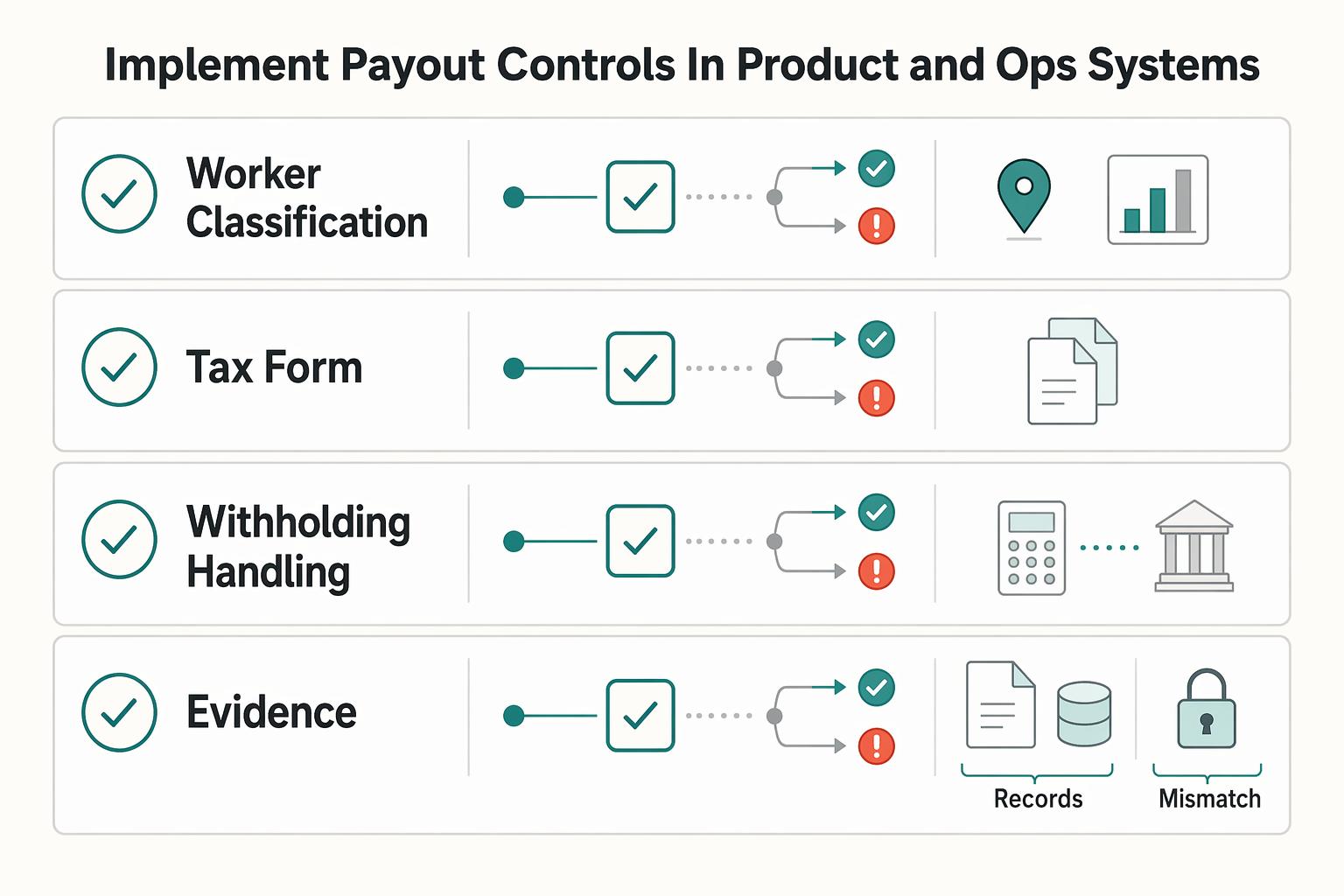
Implement payout controls in product and ops systems#
Implement the approved source, classification and withholding decision before paying. Identify the actual payer/withholding agent and required documents for each direction of flow. Do not turn all uncertain cases into universal fund holds; apply the specified default rule or genuine release restriction and keep the outstanding obligation visible.
Use a clear operating sequence as platform policy, not as a treaty-mandated order. These checkpoints apply: classify the worker correctly, collect the right forms, apply withholding rules, and keep secure records.
| Control point | What should be true before moving on | Verification detail | Common failure mode |
|---|---|---|---|
| Worker classification | Worker is classified for the engagement as employee vs. contractor | Classification decision is documented and reviewable | Payout proceeds before classification is settled |
| Tax form intake | Required form set is collected for the payee | Applicable US-status/claim form (W-9, appropriate W-8 or 8233) or Canadian waiver; identify relevant 1042-S/1042,1099 or T4A-NR lane | Payout starts from an incomplete or mismatched tax profile |
| Withholding handling | Withholding rules are identified for the payee context | Decision is recorded with enough context for later review | Withholding treatment is applied without a documented basis |
| Record-keeping | Compliance artifacts are securely stored and retrievable | Form collection and payout-tax records are kept audit-ready | Missing records during audit or year-end reporting |
Keep tax decisions separate from transfer state. Submitted, completed, failed and unknown payout outcomes must remain traceable to the original payment instruction. Recover an unknown result before issuing a replacement, and deduplicate repeated events independently of tax-document review.
That discipline supports audit-ready files. Without it, noncompliance risk can still show up as penalties, back taxes, or audits.
Handle failure modes and escalation triggers early#
Escalate before release whenever facts are incomplete, conflicting, or legally unsettled. Do not let these cases age in queue until payout pressure forces a decision.
Many breakdowns are operational. Watch for these early patterns:
- incomplete treaty or residency documentation
- residency facts that conflict across intake fields and supporting records
- payer or payee jurisdiction details that do not match the selected tax lane
- compliance approvals that are stale relative to current case facts
Use an artifact-first check, not a status-first check. Reopen the record and verify the underlying document, reviewer identity, and current decision state. If any of that is missing, treat the case as unresolved.
Recover the exact document and decision version used at payment time, then compare later changes against it. Correct the tax classification or reporting record through an approved adjustment process; a revised tax profile must not silently rewrite a prior payment or trigger another disbursement.
Escalate to tax or legal when:
- treaty interpretation is still open to more than one reasonable reading for the same worker or payment facts
- the structure or activity may create permanent-establishment questions that are not yet resolved
- the legal basis relies on an unofficial rendering or summary page instead of an official source
Validate the amended treaty wording and agency instructions that support the claim. Record the source and review date, plus any facts still unresolved. Trade, customs, securities or unrelated state-residency materials do not establish this contractor-withholding outcome.
Assign triage, treaty interpretation, payment action and reporting correction owners. Give each exception a due date and an explicit next action, and preserve any withheld amount and remittance obligation. Do not let an unresolved claim sit in an unowned hold queue.
Use a 30 day implementation checklist#
Use this 30-day plan as an internal rollout cadence, not as a legal deadline. The goal is to prove you can make, document, and report withholding decisions in a way that holds up under review.
| Week | Main task | Key point |
|---|---|---|
| Week 1 | Publish a policy map that assigns ownership and decision checkpoints before payout | Treat treaty-article decision rules as escalation items for tax review. |
| Week 2 | Enforce completeness and consistency checks on the tax documentation your program already collects before payout eligibility | Route missing or conflicting facts for review before granting relief; determine default withholding and any specific hold separately |
| Week 3 | Build an exportable evidence packet by actual reporting lane | US-source treaty exemption may still require 1042-S/1042; foreign-source and Canadian-service reporting differ |
| Week 4 | Run a controlled exception drill to validate escalation ownership and response times | Confirm correction handling, aggregate 10-return threshold and current filing-year IRIS readiness |
Week 1. Publish a policy map with ownership and decision checkpoints#
Publish a policy map that assigns ownership and decision checkpoints before payout. Treat treaty-article decision rules as escalation items for tax review.
Week 2. Enforce completeness checks on tax documentation before payout#
Validate the documents required for each program lane. Route missing or conflicting facts for review before granting relief. Determine payment with applicable default withholding or a specific hold separately, and preserve the obligation and review owner.
Week 3. Build the evidence packet by reporting lane#
Build an export by actual reporting lane: reportable US-source foreign-person payments, US-person compensation, Canadian nonresident services and payments outside those reporting scopes. Where 1042-S applies, split the required recipient, income and rate records and reconcile them to Form 1042. Treaty exemption can reduce withholding without removing reporting.
Include at least:
- withholding decision log with reviewer identity and timestamp
- linked tax-document status and supporting record references
- recipient, income-type, and tax-rate splits for Form 1042-S output
- a control that keeps aggregate paid or withheld totals across multiple Forms 1042-S for one payment from exceeding actual totals
Week 4. Run an exception drill to validate escalation ownership#
Run a controlled exception drill covering conflicting residence, mixed service locations, denied relief, unknown payout outcome and corrected reporting. Confirm each owner can recover the original decision and operation without double-paying. Test aggregate-return electronic-filing triggers and the appropriate IRIS submission and correction path for the filing year.
Before automating treaty-based residency decisions, treat the tax residency tracker as internal triage and escalate final decision rules for tax review.
What to do next#
If your current outcomes still end in hold-and-review, do not start by editing production tax logic. Build one internal decision matrix first, validate it against current treaty text and program-specific counsel guidance, then phase in controls based on the errors you are actually seeing.
Build one matrix before you touch production rules#
Your first deliverable should be one matrix that maps facts, evidence, owner, and action. The goal is shared decision gates before money moves, not forced legal conclusions in software.
At minimum, include:
- payment classification lane and any employment-like red flags
- residency evidence checks
- the treaty-analysis path your team applies under approved policy
- escalation triggers for unresolved treaty interpretation that requires counsel
- payment action: release with approved relief, pay with required withholding, or a specific justified hold
- required evidence packet for each action
Each matrix row should identify the income/source lane, actual payer, required document, decision basis, withholding treatment and reporting output. Include Form 8233 or a Canadian waiver where those are the relevant claim routes rather than forcing every case into W-8/W-9. Preserve reviewer/ruleset, time and gross/withheld/net payout trace.
Validate the legal text, not just your summary#
Validate the amended text and applicable protocol provisions alongside agency instructions. A historical treaty PDF can contain superseded wording; use the consolidated reference to locate the change, then retain the legal authority used in policy.
Stamp the policy with source versions, approver and last review date. A later model treaty or commentary does not amend this bilateral convention. Re-evaluate only the affected rules when work location, residence, ownership or the applicable legal guidance changes.
Phase controls by risk first#
Start with controls that close preventable errors: worker classification, form completeness, withholding decision logging, secure form collection, and durable record-keeping. This sequence is usually safer than trying to automate treaty outcomes first.
Fast automation can reduce ops effort, but it increases exposure when facts are incomplete. If exceptions mostly involve missing residency evidence, fix intake before adding more treaty logic. If mixed classification facts keep escalating, tighten front-end gates and require human approval.
Confirm coverage before architecture decisions#
If platform capability or provider support affects your design, request access and validate market and program availability before you commit architecture. Do not assume support from broad product language alone.
Get direct confirmation for the exact program path you need, then test that path in the environment you plan to use. Keep written confirmation in the approval file so design decisions are tied to verified coverage, not assumptions.
If you are rolling this framework into production payout flows, contact Gruv to confirm market coverage and compliance gating for your program.
Frequently Asked Questions
What does the U.S.-Canada treaty actually decide for contractor payments at a high level?
Ordinary contractor business profits generally fall under Article VII, with Article V deciding whether a PE permits the other country to tax attributable profits. Article XV covers employment. Domestic withholding and waiver rules still matter: a treaty exemption from final tax does not automatically authorize payment without Canadian Regulation 105 withholding.
Is Article XV enough on its own to decide whether a platform should withhold?
No. Article XV concerns employment, while an ordinary independent-services business-profits claim generally uses Article VII. Identify source, residence, income type and applicable domestic withholding, then collect the claim or waiver evidence. Articles XIV and XVII have been repealed in the amended convention.
What can a platform automate internally versus what should always go to tax counsel?
Automate required-field checks, document validity status, service-location capture and approved rule application for complete consistent files. Route conflicting status, disputed classification, unclear allocation or PE/benefit eligibility for review. Keep relief approval separate from payment with default withholding or any specific hold.
What is the minimum documentation set needed to defend a cross-border withholding decision?
Retain payee tax status and residence evidence, classification, contract and income components, work location/dates, payer/withholding-agent role, applicable forms or CRA waiver, source allocation, selected rule and rate, reviewer/ruleset and date, and the gross/withheld/net payment trace. Add the reporting record where required.
How should teams handle cases where residency facts conflict across Canada and the United States?
Collect Article IV facts for the individual or entity rather than selecting the country from an address or bank. The individual tie-breaker progresses through home/vital interests, habitual abode, citizenship and competent-authority agreement. US citizens and residents also require saving-clause and documentation review.
When should a potential Permanent Establishment issue stop payout automation?
Stop automatic treaty relief when the relevant enterprise’s fixed-place, agent or services-PE facts are unresolved. Record the actual service days, project/customer facts and revenue tests; 183 days is not a universal safe harbour. Determine lawful payment/withholding separately and keep the exception owned.
Try a related tool
Researched and edited by the Gruv editorial team. Gruv builds cross-border billing, payouts, and finance-operations software for global businesses.
Sources
Includes 2 external sources outside the trusted-domain allowlist.
Educational content only. Not legal, tax, or financial advice.
Related Posts
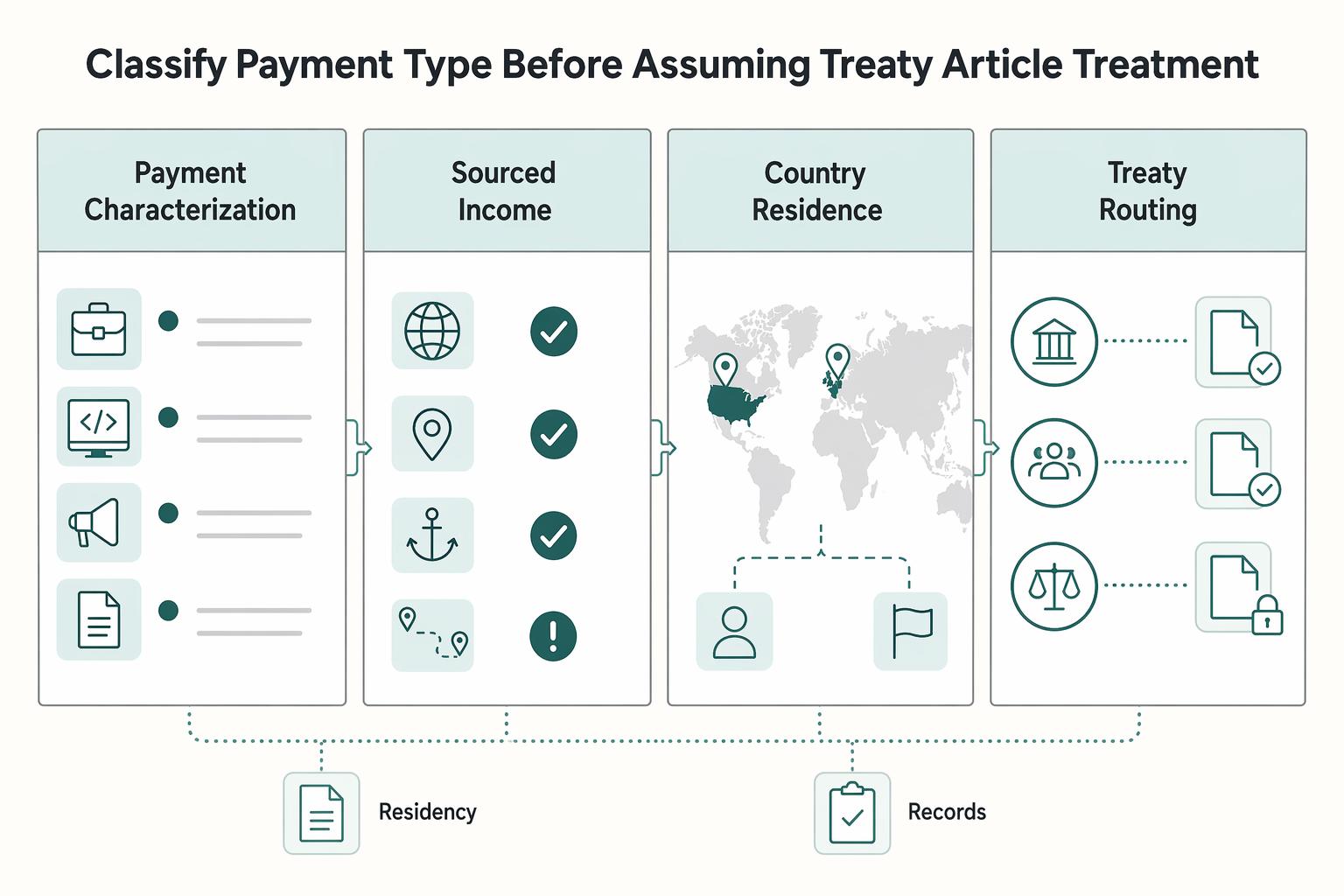
US-UK Tax Treaty Withholding Controls for Contractor Payment Platforms
For US-UK contractor payouts, the main risk is usually not a lack of treaty awareness. Your team creates risk when it approves reduced or zero withholding before you confirm income source, payment type, and treaty-status documentation. A UK label on its own does not support the treatment.
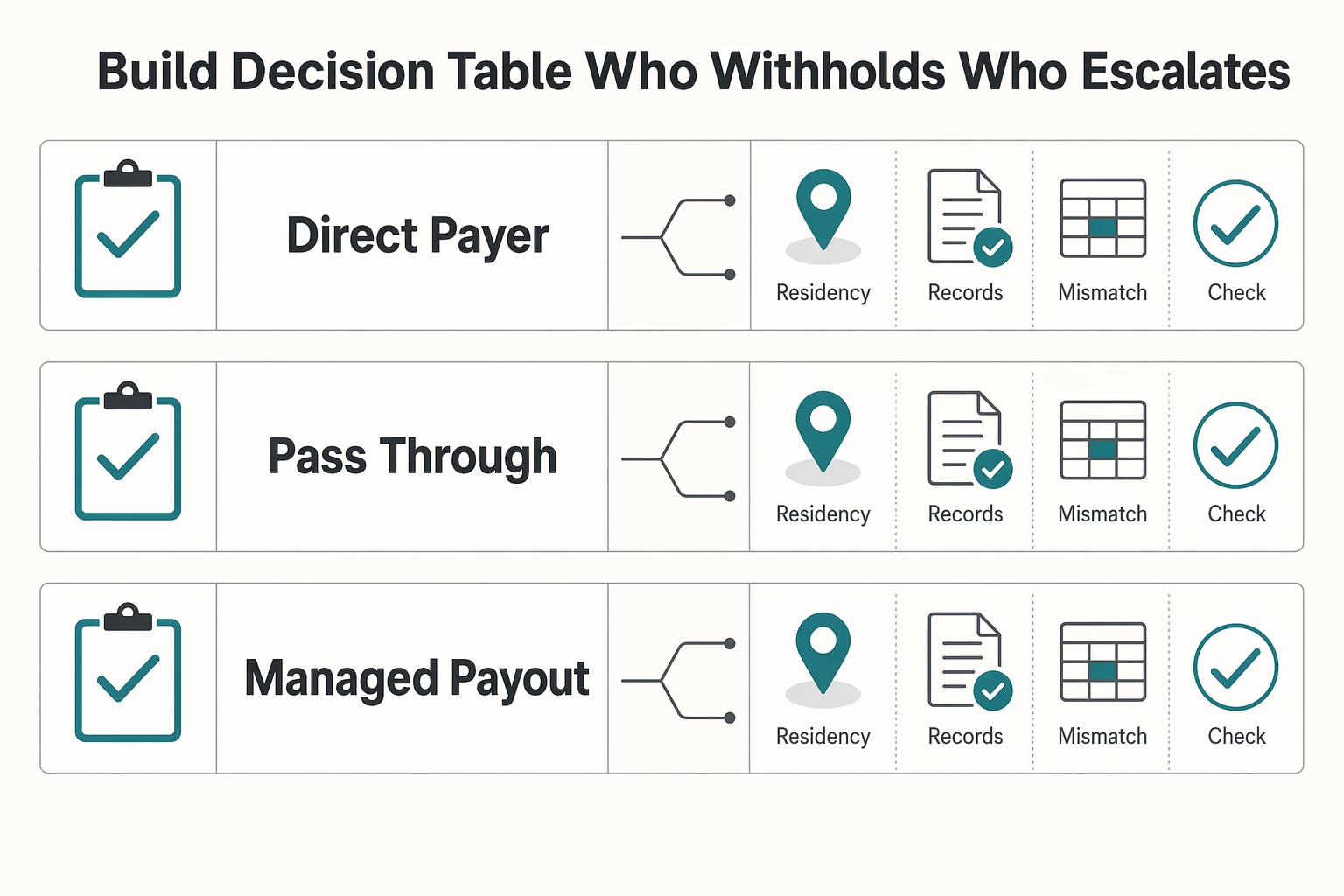
US-Germany Treaty Withholding Decisions for Contractor Platform Payouts
For U.S.-Germany contractor payouts, the safest starting point is simple: do not force a single withholding answer when payment characterization or treaty access is unclear. The hard part is usually not finding treaty text. It is deciding what your team can defend before funds move in a platform-mediated payout.
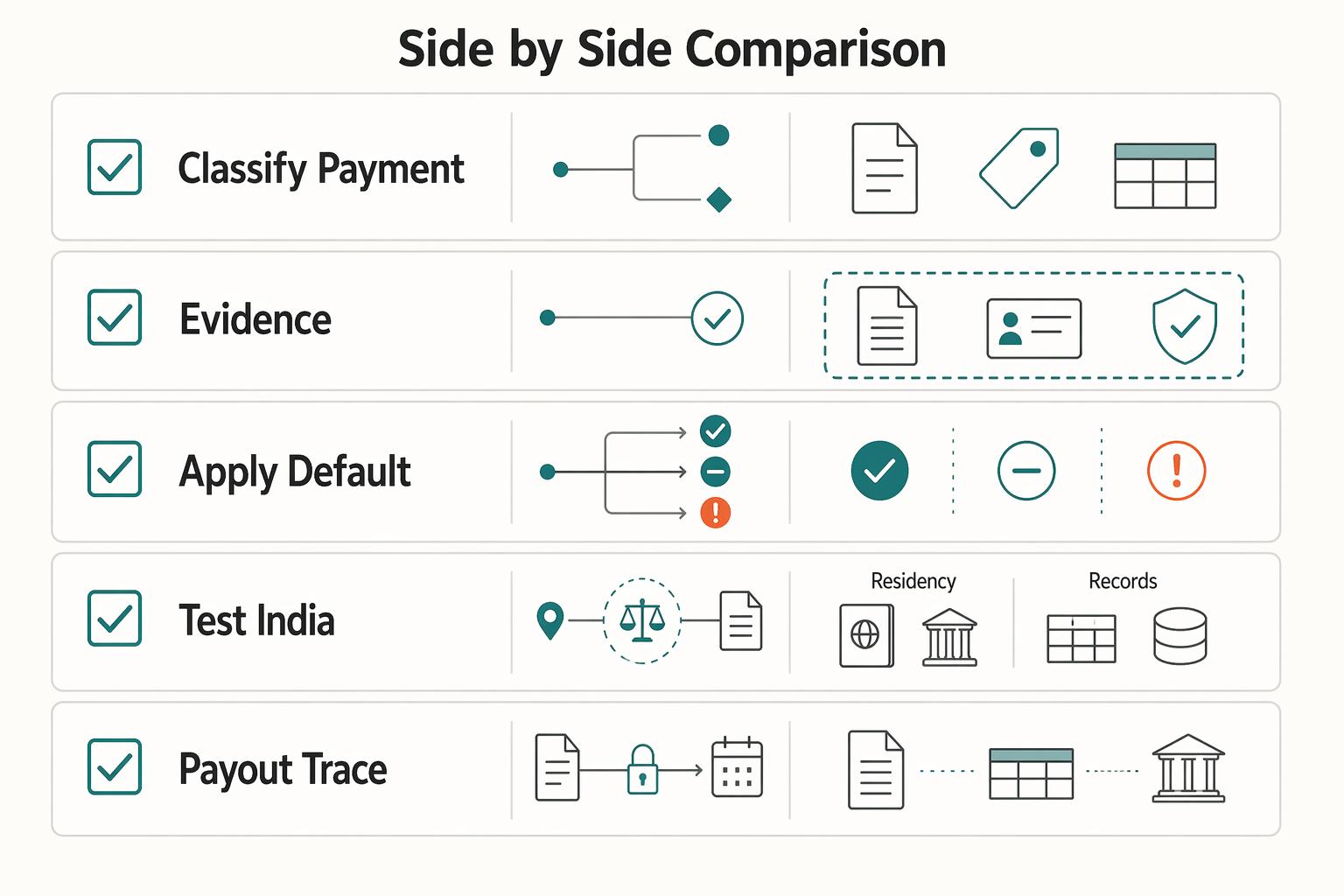
US-India Contractor Payment Withholding Decisions for Platforms
US-India withholding failures often start with misclassification, not rate selection. When contractor services, royalties, and fees for included services are treated as interchangeable, the payout file can carry the wrong payment character before anyone applies a rate.