
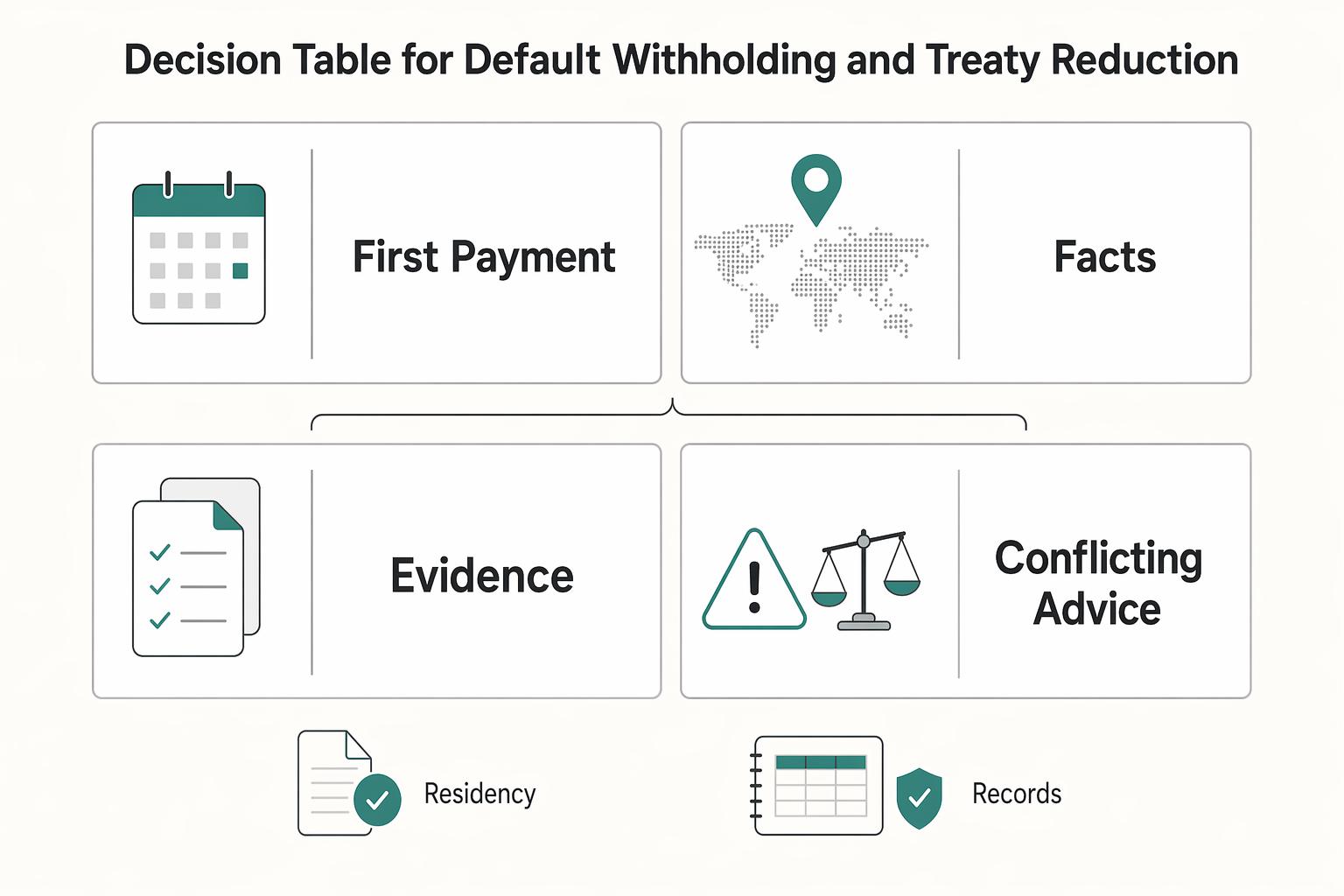
Quick Answer
If a contractor payment may be subject to NRA withholding and reduced treatment is not fully supported, default to 30% withholding before release. For U.S.-source personal-services income paid to a nonresident alien, apply a treaty reduction only after payee status, source, and documentation are validated, typically including Form 8233 for personal-services claims. If facts conflict or remain incomplete, hold or escalate the payout.
When the 30% withholding rule applies#
Start with the default. If a payment is in scope for NRA withholding and you cannot support reduced treatment, withhold 30% and escalate unresolved cases before release.
That is the stance behind this guide to contractor payments, the 30 percent rule, and treaty reductions. It is written for platforms handling high volumes of contractor, seller, or creator payouts, where withholding decisions can happen too late and create rework across ops, finance, and reporting.
The IRS framing is the baseline. NRA withholding refers to withholding under IRC sections 1441, 1442, and 1443. The IRS describes this regime as requiring 30% withholding on U.S.-source income, with Form 1042 and Form 1042-S reporting. For compensation for personal services performed in the United States, payers generally must withhold at 30% for nonresident alien individuals unless an exemption applies.
In practice, a common risk is a payout decision made on partial records. A payee may be foreign, but you may still lack support for NRA status, U.S.-source characterization, or treaty eligibility. If you apply a reduced treaty rate without supportable facts, you increase withholding-agent risk and complicate downstream reporting. Form 1042-S can still apply even when no tax is withheld because of a treaty or Code exception.
Before applying reduced or exempt treatment, verify both the payment facts and the payee claim. If a payor knows, or has reason to know, that treaty eligibility is not valid, the treaty rate must not be applied.
Think of this guide as a working playbook for compliance, legal, finance, and ops teams that need defensible release rules, clear evidence standards, and escalation points tied to Chapter 3 withholding.
In the sections that follow, you will get:
- A decision table for default 30% treatment, treaty-path consideration, and pre-payout escalation
- A practical definition of when documentation is complete enough for reduced treatment
- Escalation triggers for common failure modes, including missing forms, conflicting residency facts, and unclear U.S.-source characterization
- Filing checkpoints tied to Form 1042 and Form 1042-S so reporting issues are caught before year-end
Terms and Scope You Must Lock Before Any Payout#
If you cannot confirm payee status, income source, and your withholding role, you do not have a release-ready payout decision. Treat the case as unresolved and do not apply reduced withholding treatment.
- Nonresident alien (NRA): an individual who does not meet the green card test or the substantial presence test
- U.S.-source income: for NRAs, U.S. tax scope generally depends on whether income is U.S.-sourced
- Withholding agent: a U.S. or foreign person with control, receipt, custody, disposal, or payment of foreign-person income subject to withholding
For many foreign contractor payouts involving U.S.-source FDAP, the core regime is Chapter 3 withholding under IRC 1441 to 1443. That is the NRA withholding regime for U.S.-source FDAP paid to foreign persons. Chapter 4 under IRC 1471-1474 is FATCA, a separate withholding and reporting regime, not a substitute for Chapter 3 analysis.
"Contractor payment" is only a business label. It does not, by itself, establish NRA status, U.S.-source treatment, or eligibility for reduced withholding. Under IRS withholding rules, including Publication 515, those facts control the outcome. For personal-services income, the key sourcing fact is where the services were performed.
Set a hard boundary before release. If sourcing or eligibility facts are unclear at payment time, withhold enough to protect at least the 30 percent baseline rather than applying reduced treatment.
If you want a deeper dive, read How to Handle a US-Sourced 1099 as a Non-Resident Alien.
Decision Table for Default Withholding and Treaty Reduction#
For U.S.-source income, the operating default is 30% NRA withholding under Chapter 3 (IRC 1441-1443). Do not release at a reduced rate unless treaty eligibility is validated.
| Payee profile | Documentation state | Default action | Exception path | Escalation owner | Release gate | Pub. 515 verification check |
|---|---|---|---|---|---|---|
| First payment to foreign individual for U.S.-source personal services | No treaty claim on file, or documentation not yet reviewed | Withhold 30% before release | None at payout stage unless required treaty documentation is submitted and validated | Tax/compliance reviewer | No reduced-rate release until payee status, source, and documentation are complete and tied to the payee record | Confirm foreign-person payment treatment and withholding-agent obligations in IRS Publication 515 before payout |
| First payment to foreign individual with treaty claim for personal services | Form 8233 submitted, but not yet validated against payee facts and treaty position | Hold reduced-rate request and default to 30% if payment must proceed | Validate Form 8233, confirm claimed residence and income type, then review the actual treaty provision if the claim is not straightforward | Tax/compliance, with legal review for nonstandard claims | Release at reduced rate only after the treaty claim is verified and associated to the payment record | Use Publication 515 as the operating check, then confirm the actual treaty article because treaty benefits vary by country and income type |
| Existing payee with prior approved treatment, but facts changed | Country of residence, service location, or other material payee facts changed | Stop prior treatment and revert to 30% pending re-review | Re-review the file from the new facts forward. Apply a reduced rate only if the new facts still support it | Tax owner with ops case support | No release on the old approval after a material fact change | Check Publication 515 for withholding-agent duties and re-test source and documentation under current facts |
| Foreign payee with missing or un-associable tax documentation | Required tax form is missing, incomplete, or cannot be tied to the current payee/payment | Apply 30% under presumption-rule handling where documentation is required | None until valid documentation is received and matched | Ops first, then tax/compliance if payment is urgent or already queued | Release blocked unless valid documentation is on file and linked to the account and payment | Use Publication 515 as the workflow guide; if documentation is missing or un-associable, apply presumption rules and do not grant a reduced Chapter 3 rate on presumed status |
| Payee claiming treaty benefits with conflicting facts | Claim conflicts with residency data, service facts, or other records, or you know or have reason to know the claim is wrong | Do not apply treaty rate. Withhold 30% | Review supporting evidence and the actual treaty text. Legal review if conflict cannot be resolved quickly | Tax/legal | Release only after the contradiction is resolved and treaty eligibility is documented | Use Publication 515 as the operating guide and apply the IRS "must not apply the treaty rate" standard where ineligibility is known or suspected |
Hard rule: if treaty eligibility is unverified, withhold under NRA withholding and do not release at a reduced rate.
Before you release funds, confirm two points. First, whether the payment is treated as U.S.-source personal-services income. Second, whether treaty documentation is usable, not just present. A form that cannot be matched to the payee, payment, and claimed country is not release-ready.
Treat material payee fact changes as a fresh review event, not a continuation of prior approval. Use treaty tables for orientation, but for nonstandard or conflicting claims, verify against the actual treaty provision.
Keep this table scoped to Chapter 3. Chapter 4 (IRC 1471-1474) is separate and does not replace Chapter 3 withholding decisions. Reporting for these payments still runs through Form 1042 and Form 1042-S.
Related: US-UK Tax Treaty and Contractor Payments: What Platforms Should Know About Withholding.
Documentation Packet Required Before Releasing Funds#
Do not release a reduced-rate payment until the treaty file is complete, validated, and defensible by the withholding agent.
Minimum packet for treaty-rate consideration#
For U.S.-source personal-services payments, your pre-disbursement packet should include:
- the payee's treaty claim documentation, which for personal-services compensation is Form 8233
- required taxpayer identification information when treaty treatment depends on proper documentation
- linked payee and payment data showing the form matches the right person, withholding agent, tax year, and income type
- internal review evidence showing who reviewed the claim, whether it was accepted, and what withholding rate was applied
A Form 8233 must be completed separately for each tax year, each withholding agent, and each income type.
What "documentation complete" means in practice#
"Documentation complete" means all of the following are true:
- the form is properly executed
- the claim facts are internally consistent with your payee and payment records
- withholding-agent review is complete, including acceptance handling for Form 8233 and forwarding to the IRS within 5 days of acceptance
- records are retained so the withholding decision can be supported in later reporting
This matters even when withholding is reduced to zero, because the payment may still require Form 1042-S reporting.
Order of operations before any payout attempt#
Collect and validate tax documentation before disbursement. If documentation is missing or incomplete when you are ready to release, do not apply treaty reduction and route the payment through withholding at the maximum applicable rate, generally 30% for most U.S.-source income paid to foreign persons.
Do not treat post-release backfilling as routine. If your policy allows post-payment correction, keep it as a tax/compliance-controlled exception.
Storage and audit readiness#
Keep withholding certificates and supporting records in internal files. They are not attached to Form 1042. Retain copies of each Form 1042-S for the statute-of-limitations period tied to the related Form 1042.
Your file should let you trace each payment decision to the underlying documentation, reviewer action, withholding result, and final Form 1042-S record. Because each filed Form 1042-S must have a unique identifying number, store that identifier in a searchable way.
Payment Lifecycle Controls From Onboarding Through Disbursement#
Make withholding status a hard release gate. If tax treatment is unresolved at payout time, do not release on a reduced rate.
Stage the controls in payment order#
Run controls in sequence: onboarding, tax profile capture, withholding decision, release, then reporting reconciliation. The main failure mode is timing: a payment becomes payable before the treaty claim is validated.
| Stage | Primary control objective | Release gate | Suggested owner | Evidence to retain |
|---|---|---|---|---|
| Onboarding | Establish payee identity, account linkage, and baseline foreign-person status data | Payee record is complete enough to proceed to tax review | Ops or onboarding, with compliance oversight | Payee profile, status review result, country and legal status fields |
| Tax profile capture | Collect withholding documentation and source-of-income facts | Required tax form is received and matched to payee and payment type | Tax or compliance review | Form 8233 where treaty claim is made, taxpayer identification details if needed, record of completeness checks |
| Payout eligibility | Decide default 30% or reduced treaty rate | Withholding decision is recorded before payment is releasable | Tax/compliance approver | Rate decision, basis for decision, reviewer identity, timestamp |
| Release | Execute payment using approved withholding result | No release if tax review is unresolved or contradictory | Payments or treasury | Gross amount, withheld amount, net paid, payment ID linked to decision record |
| Post-payment reconciliation | Prepare reporting and confirm ledger alignment | Transaction is mapped for Form 1042 and Form 1042-S workflows | Finance with tax support | Ledger posting, reporting classification, 1042-S linkage |
That ownership split is an operating design choice, not an IRS-prescribed team model. The legal anchor is that the withholding agent is liable for tax required to be withheld, so someone must clearly own the tax gate before funds move.
Put the gates in a fixed sequence#
If your platform runs KYC/KYB for fraud, sanctions, or marketplace policy, keep it before tax review so the payee record is stable. But those checks do not determine Chapter 3 withholding.
For U.S.-source nonemployee compensation to a nonresident, default withholding is 30% unless a treaty-reduced rate applies. For independent personal services, that reduced treaty claim is made through Form 8233. Before you move a payment from pending to payable, confirm the documentation is complete and aligned with the payee and payment facts.
If valid documentation cannot be established, apply presumption rules. Operationally, that means incomplete or questionable files do not move through a reduced-rate path pending later cleanup. They stay in review until support is defensible.
Design for the predictable failure mode#
The failure mode to design around is not an edge case. It is the everyday sequence where the payment is queued first, the form arrives late, the reduced rate is assumed, and funds are released before review closes.
Build a hard checkpoint for that event. If payout enters queue before treaty validation is complete, route it to hold and use the default 30% path pending review. Release at a reduced rate only after the file is complete and accepted.
Two practical hold triggers:
- payee profile and tax form conflict on identity, residency, or income-type facts
- payment is marked treaty-reduced but no accepted Form 8233 or review record is attached
These are not minor data issues. They show the reduced-rate decision is not yet supportable.
Keep Chapter 3 evidence usable for reporting#
The same controls that protect payout decisions should also produce records finance can use for Form 1042 and Form 1042-S. Payments subject to NRA withholding are reported on Form 1042-S and returned on Form 1042. Form 1042-S can still apply even when compensation is fully treaty-exempt.
At minimum, capture payment amount, withholding rate, decision basis, payee identifier, reviewer, decision date, and reporting-scope flag. Track Chapter 3 and Chapter 4 separately. They are different regimes and should not share one generic status field.
Before year-end close, reconcile released payments in scope for this workflow against the population flagged for Form 1042-S preparation. March 15 filing readiness is strongest when payout-stage controls are correct at release time rather than reconstructed at year-end.
We covered this in detail in How MoR Platforms Split Payments Between Platform and Contractor.
Reporting Duties and Year End Filing Checkpoints#
Once release controls are in place, ask a simple question: do they leave you filing-ready? For amounts subject to NRA withholding, the withholding agent must handle both withholding and annual reporting on Form 1042 and Form 1042-S. Finance and compliance need shared status visibility well before March 15.
Form 1042 is the annual return for tax withheld on certain income of foreign persons. Form 1042-S is the payment-and-withholding information return, and it may still be required even when compensation is fully treaty-exempt. A key risk is treating "no tax withheld" as "nothing to report" when Chapter 3 reporting can still apply.
Filing readiness depends on classification quality at release. If a payment is treated as U.S.-source compensation under Chapter 3 withholding, the record should already show foreign status, rate applied, and support for any treaty reduction. A practical control is to confirm that each in-scope foreign-person U.S.-source payout has both a 1042-S reporting flag and retained payee documentation in the same record.
Use internal checkpoints so exceptions surface before filing close:
Month-end checkpoints
- Reconcile released in-scope payments to the population marked for Form 1042-S.
- Review zero-withheld treaty-claim items and confirm documentation is complete.
- Investigate any Chapter 3 payment with missing reporting code or missing payee-status support.
Year-end checkpoints
- Lock the annual in-scope population and clear unresolved source or residency disputes.
- Confirm Form 1042 and Form 1042-S counts tie to ledger totals.
- Plan extensions separately from payment obligations: a filing extension does not extend time to pay withheld tax, and Form 1042-S extension requests use Form 8809.
Keep adjacent regimes separate. FATCA is Chapter 4, not Chapter 3, and may require reporting such as Form 8966. Form 8938 is a taxpayer return attachment, not a withholding-agent substitute. FBAR is FinCEN Form 114, filed with FinCEN through the BSA E-Filing channel, not with the IRS. Mixing these tracks can push year-end checklists off target.
For a step-by-step walkthrough, see The Future of Contractor Payments: AI Automation and Instant Settlement.
Failure Modes That Trigger Default Withholding and Escalation#
Do not try to solve weak or contradictory facts at payout time. For any payment you are treating as U.S.-source income, apply the default 30% withholding rule and escalate to tax/legal review.
Run one pre-release check for these red flags:
- no valid treaty claim form on file: Form W-8BEN or Form W-8BEN-E, or Form 8233 for personal-services treaty claims
- material mismatches across documentation and reporting data, including treaty-country claims that do not align with reporting-country data
- conflicting residency claims
- unclear source characterization, since personal service income is generally sourced where the services are performed
Use the IRS "reason to know" standard as your decision rule. If a reasonably prudent reviewer would question the claim, treat the documentation as unreliable, do not apply a reduced treaty rate, and obtain new documentation before reduced-rate treatment.
Data error or legal uncertainty#
A data error is a record-level documentation defect, such as a missing country code, inconsistent identifying data, or incomplete treaty documentation. The action is to correct the record and collect valid documentation before releasing at a reduced rate.
A legal uncertainty is a facts-and-interpretation problem, such as unclear source determination or treaty eligibility your team cannot confidently interpret under the Internal Revenue Code (IRC). In that case, ops should not improvise. Under IRC sections 1441, 1442, and 1443, if material facts are not known at payment time, withhold by default and do not exceed 30% of the amount paid, pending specialist review.
In practice, recurring withholding failures often point to process and system gaps, not just isolated mistakes. Weak intake, validation, or release controls can turn small record defects into tax exposure and reporting rework.
Related reading: The Department of Labor's New Independent Contractor Rule (2026).
Treaty Operations Across Markets Without Creating Control Sprawl#
Do not build country-specific treaty logic until the baseline control is stable. For most teams, that means defaulting to the 30% withholding rule on most U.S.-source payments to foreign persons unless valid treaty documentation is complete, consistent, and supportable.
A withholding agent can apply reduced treaty treatment only when eligibility is supportable. If eligibility is doubtful, IRS guidance says withholding agents should consult the actual treaty provisions for the payee and payment, not rely on assumptions or summary-only handling.
| Design choice | Where it fits | Required validation | Main failure mode |
|---|---|---|---|
| Global baseline policy | Early-stage or multi-country programs with uneven documentation | Apply default withholding unless treaty documentation is valid and consistent | Reduced treatment is applied before eligibility is proven |
| U.S.-UK Tax Treaty branch | High-volume UK corridor with repeat fact patterns | Verify the correct income article, payee status, and treaty conditions before applying reduced treatment | UK claims are handled as generic and fact-specific conditions are missed |
| U.S.-Germany Tax Treaty branch | High-volume Germany corridor with stable recurring profiles | Verify the treaty text and technical explanation, plus anti-abuse conditions such as Limitation on Benefits | Another country's logic is copied and Germany-specific requirements are missed |
The tradeoff is straightforward. Broader treaty automation may reduce operational friction, but each new branch increases validation, evidence, and monitoring workload. Treaty treatment depends on the income article, payee facts, and whether all treaty requirements are met.
For personal-services claims, the IRS says the payee files Form 8233. Treat "form received" as the start of review, not the approval signal. Check that the claimed article and conditions align with the operational fields highlighted in Tax Treaty Table 2, such as presence, required payer or employer, compensation limits, and article citation.
A practical rollout sequence is to start with the baseline, pilot one high-volume corridor, and expand only after documentation defect rates and exception queues are stable. If mismatched residency data or incomplete forms are still common, adding more country branches can multiply rework.
How to confirm treaty claims safely#
- Confirm the payment is the correct income type and is U.S.-source income.
- Confirm the exact treaty text, and technical explanation where relevant, for that country.
- Confirm whether anti-abuse rules, including Limitation on Benefits, affect eligibility.
- Confirm whether procedures differ by treaty partner laws and practices before operationalizing reduced withholding.
You might also find this useful: US-Germany Tax Treaty and Contractor Payments: Withholding Rates and Platform Obligations.
Audit Ready System Design in Gruv#
Audit-ready design starts with one principle: every payout action should trace back to one withholding decision. That matters because the withholding agent is personally liable for tax required to be withheld.
Make payout decisions replayable#
In Gruv, retries should replay the existing withholding decision unless a recorded review changes it. If the approved treatment is "withhold 30% on the gross amount" under NRA withholding, an idempotent retry should keep that treatment instead of recalculating from changed profile data or late documents.
Use hold and release states where configured to enforce that control in operations. Hold when documentation is missing, inconsistent, or under review. Release only after the decision record is complete. Escalate exceptions when you have reason to know a treaty claim is not valid, because in that case the payor must not apply the treaty rate.
Store the evidence you will actually need later#
Your internal record is the audit file, since withholding certificates and similar statements are generally not attached to Form 1042. In Gruv terms, that means keeping retrievable logs and document references for each decision path.
| Evidence output | Why it matters |
|---|---|
| Decision timestamp | Shows which facts existed when treatment was applied |
| Documentation reference | Identifies the support reviewed |
| Reviewer or service actor | Distinguishes manual approval from automated handling |
| Final NRA withholding treatment | Links payout behavior to the applied withholding and reporting outcome |
| Payout event ID and retry linkage | Helps show retries replayed control logic instead of creating inconsistent decisions |
For personal-services treaty claims, keep the linked Form 8233 record with the decision trail. If processors, agents, or sub-agents are involved, keep records accessible end to end. The withholding agent remains liable for agent actions.
Reconcile product records to filing outputs#
Your reconciliation pack should bridge payout events to reporting outputs for Form 1042 and Form 1042-S, including reportable cases where withholding was zero. A control gap to avoid is exporting only withheld tax instead of all reportable U.S.-source amounts and their final treatment.
The filing dependency is straightforward. If Form 1042-S is required, Form 1042 is also required. The annual return is due by March 15 following the payment year. If those totals cannot be rebuilt from system exports and decision records, the design is not audit ready.
Pre Launch Checklist for Compliance Finance and Ops#
Before go live, lock policy definitions first and test controls second. If you launch payouts before agreeing on what counts as U.S.-source income, when treaty treatment is acceptable, and when the default 30% withholding baseline applies, the system will scale mistakes.
Freeze the policy definitions before anyone touches payouts#
Set and approve the decision boundary for NRA withholding under IRC 1441 to 1443 before launch. Most U.S.-source income paid to a foreign person starts from a 30% baseline, and reduced or exempt treatment can apply when an Internal Revenue Code provision or treaty supports it. If sourcing or treaty facts are unresolved at payment time, document a one-sentence fallback and apply it consistently.
Share that policy across compliance, finance, ops, and engineering, and state what it does not cover. The IRS notes this area does not include every foreign-payment regime, including section 1445 withholding. Avoid a single "foreign payee" branch that mixes unrelated rules and misroutes cases into the Chapter 3 withholding path.
Use a short approval record with named owners for:
- your U.S.-source income definition for supported payment types
- the treaty eligibility standard your team will accept
- the default gross-payment withholding fallback when evidence is missing or inconsistent
Test the blocking logic, not just the happy path#
In test mode, confirm payout release depends on the recorded withholding decision, not late profile changes. If your process relies on Form 8233 for a claim, test the missing-form path end to end. Under your policy, payout should remain blocked, the claim should not be applied, and the case should route to the correct reviewer. Form 8233 instructions include the handoff step of giving the form to the withholding agent, so your control should capture that checkpoint.
Also test the default branch directly. Verify statutory treatment is applied when documentation is incomplete, contradictory, or late. As a failure-mode drill, change payee facts after payout is queued and confirm the item returns to hold or review instead of silently retaining a reduced rate.
Confirm reporting can be built from your records#
Before launch, prove each payment can feed Form 1042 and Form 1042-S outputs, not just ledger totals. The IRS ties NRA withholding to these forms, and Publication 515 separately lists "Forms 1042 and 1042-S Reporting Obligations," so your reporting map should be explicit pre-launch.
At minimum, verify each reportable payment has a stable payee identifier, payment date, gross amount, final withholding treatment, and linked decision-document reference. Assign clear owners for extract preparation, classification review, correction approval, and filing-calendar ownership.
Dry-run the cases that usually break teams after launch#
Run a tabletop exercise for late documentation, corrected payee status, and adjustment scenarios reviewed against IRS Publication 515 and your internal policy. You do not need full automation on day one, but you do need a written rule for who stops payout, who reassesses withholding treatment, and what evidence stays in the file.
Finish with a classification-drift check. Publication 515 separates Chapter 3 Withholding Requirements and Chapter 4 Withholding Requirements, so test cases should show which branch each payment entered and why. If that path cannot be explained from record exports, the launch controls are not ready.
Before rollout, map each checklist control to your system owner and evidence field, then validate the workflow shape in the Gruv docs.
Conclusion and Next Step#
Default conservatively at payment time. If a reduced rate is not supportable, apply NRA withholding and release only after the treaty file is complete and reviewable. In practice, that means 30% on the U.S.-source amount unless valid documentation supports a lesser treaty rate.
This is as much a reporting control as a payout control. The withholding agent is responsible for Form 1042 and Form 1042-S. Those filings are generally due March 15 of the following year, or the next business day if March 15 is a weekend or legal holiday. Weak payment-time decisions can become filing-time exceptions.
Treaty reductions are evidence decisions. To claim a reduced withholding rate, provide a valid Form W-8BEN or Form W-8BEN-E. For personal-services treaty claims, the beneficial owner may claim the lesser treaty rate by filing Form 8233. If you have reason to know a claim is ineligible, do not apply the treaty rate.
Use release gating to reduce late-certainty failures. If documentation is incomplete, hold payment, record reviewer and rationale, and document whether treatment changed. If payment has already been made, route it as an exception with a named owner.
Keep one final reporting point in view: Form 1042-S may still be required even when compensation is fully treaty-exempt. The goal is aligned classification, withholding, and reporting so filing outcomes stay consistent with payment-time decisions.
- Put the checklist into your payout flow with a hard stop before disbursement when treaty evidence is incomplete.
- Test the decision table against real queued scenarios.
- Assign escalation ownership now: who approves default-withholding release decisions, and who owns exceptions affecting Form 1042 and Form 1042-S.
If you want a second pass on your payout-control design and escalation model across markets, contact Gruv.
Frequently Asked Questions
When does a contractor payment to a nonresident alien default to the 30% withholding rule?
It defaults when the payment is in scope for withholding and you cannot rely on valid documentation for a different treatment. For personal services, source is generally determined by where the services were performed, so foreign status alone is not enough. If source or treaty facts are unresolved at payment time, use the default path and escalate.
Can an income tax treaty reduce withholding, and what proof should a platform require before payout?
Yes, but only when the treaty covers the income item and the withholding agent can rely on valid documentation. The article says platforms should require the relevant form, typically Form W-8BEN or Form W-8BEN-E, and Form 8233 for personal-services claims. If you have reason to know the claim is invalid, do not apply the treaty rate.
What should we do if treaty paperwork arrives after a payout is already scheduled?
Use payment timing as the control point because withholding is required when payment is made. If the payout is queued but not released, hold it and finish document review before finalizing withholding. If payment already went out, escalate and document the timing, reviewer, and outcome instead of assuming late paperwork fixes the original treatment.
Which teams should own Form 1042 and Form 1042-S accuracy in a platform operating model?
The IRS assigns legal responsibility to the withholding agent, not to a required internal team structure. Internally, the article recommends clear owners for document capture, classification and exception review, and filing readiness. If a payment is reportable on Form 1042-S, Form 1042 is also required.
How do we separate Chapter 3 withholding decisions from Chapter 4 and FATCA related checks?
Keep them as separate decision paths. Chapter 3 covers NRA withholding on U.S.-source FDAP paid to foreign persons under IRC 1441 to 1443, while Chapter 4 is FATCA under IRC 1471 to 1474. FATCA, Form 8938, and FBAR checks are not substitutes for Chapter 3 classification or Form 1042 and Form 1042-S reporting.
How should we handle cases where payee facts suggest both U.S. source and non-U.S.-source elements?
Make an accurate allocation between the U.S.-source and non-U.S.-source portions based on records you can support at review time. Do not rely on assumptions. If you cannot support the allocation before disbursement, escalate rather than forcing one-source treatment.
Researched and edited by the Gruv editorial team. Gruv builds cross-border billing, payouts, and finance-operations software for global businesses.
Sources
Educational content only. Not legal, tax, or financial advice.
Related Posts

The Freelance Payment Penalty: A Modeled Audit of Platform Fees, FX Spreads, and Payout Delays
The money rarely disappears through a single, easy-to-spot fee. The real loss is stacked. A marketplace takes its commission, a processor adds a charge for international cards, a bank or payment company converts the currency at a spread, a platform holds the funds before release, and a wire sheds a little to intermediaries on the way in. Each layer looks defensible on its own, but the worker feels the combined result as a smaller deposit and a later payday.

How to Respond to a Subpoena for Business Records
Move fast, but do not produce records on instinct. If you need to **respond to a subpoena for business records**, your immediate job is to control deadlines, preserve records, and make any later production defensible.
A US Expat's Guide to Investing in UCITS ETFs to Avoid PFIC Issues
The real problem is a two-system conflict. U.S. tax treatment can punish the wrong fund choice, while local product-access constraints can block the funds you want to buy in the first place. For **us expat ucits etfs**, the practical question is not "Which product is best?" It is "What can I access, report, and keep doing every year without guessing?" Use this four-part filter before any trade: