
Quick Answer
The 2026 DOL action remains identified as a proposal as checked 5 October 2026; comments closed 28 April 2026. Keep the 2024 CFR interpretation, WHD investigation guidance and court law separate. Assess actual independence under each applicable wage, tax and state test, preserving evidence and correcting classification when required rather than relying on contract labels.
DOL contractor classification in 2026: proposal, regulation and enforcement#
Status checked 5 October 2026: DOL’s official page still identifies the February 2026 action as a proposal, and says its comment period closed on 28 April 2026. The NPRM, published 27 February under RIN 1235-AA46, proposes replacing the 2024 FLSA interpretation with a modified 2021-style analysis and using the analysis for FMLA and MSPA. A proposal is not a final rule with an effective date.
Keep three legal layers separate. The 2024 interpretation remains in 29 CFR part 795 as checked against the current eCFR. WHD investigation policy changed in May 2025: investigators were directed not to apply the 2024 analysis in covered enforcement matters. Courts apply the statute and relevant precedent; an agency’s enforcement choice does not eliminate private claims or determine every court’s result.
The operational question is whether the worker is in business for themself or economically dependent on the hiring business under the applicable test. Evaluate actual control, opportunity, investment and the whole relationship. Contracts and payment records help explain those facts, but they cannot turn an employee into a contractor by wording alone.
Monitor final text, effective date and relevant litigation separately from the expired comment deadline. Record the rulemaking page, CFR and enforcement guidance consulted with the review date, then update the assessment when an actual legal change occurs.
The rest of this article follows that same logic. First, get clear on the test you are actually managing against. Then make sure the contract, delivery habits, and evidence file all tell the same story.
Status checkpoint#
Use the DOL rulemaking page, current CFR and 2025 investigation guidance as distinct references. Do not say comments remain open or that the 2024 rule is the sole investigation baseline. A proposed amendment and an enforcement bulletin have different legal effects.
Review the actual engagement before changing its paperwork:
- Identify the worker’s location and the wage, tax, state and any cross-border rules that may apply.
- Record who actually sets schedule, methods, rates and access to other work.
- Assess genuine business initiative and investment; do not invent expenses or nominal subcontracting rights to create a contractor appearance.
- Use scope, acceptance and change-order terms that accurately describe the work, with the contractor-status clause as supporting language.
- Keep a per-engagement assessment and the evidence behind it, including facts that point toward employment.
- If the facts indicate employment, review classification and any past obligations with counsel rather than merely revising the SOW.
Change operating terms only when the intended independent business arrangement is lawful and real. Replacing a weekly schedule with a milestone label while keeping the same supervision does not correct misclassification.
Once you have that baseline, the next step is to get clear on the test itself. If your team shares a practical model of control, business risk, and how the relationship functions in practice, the rest of the decisions get easier.
Build your mental model of the economic reality test#
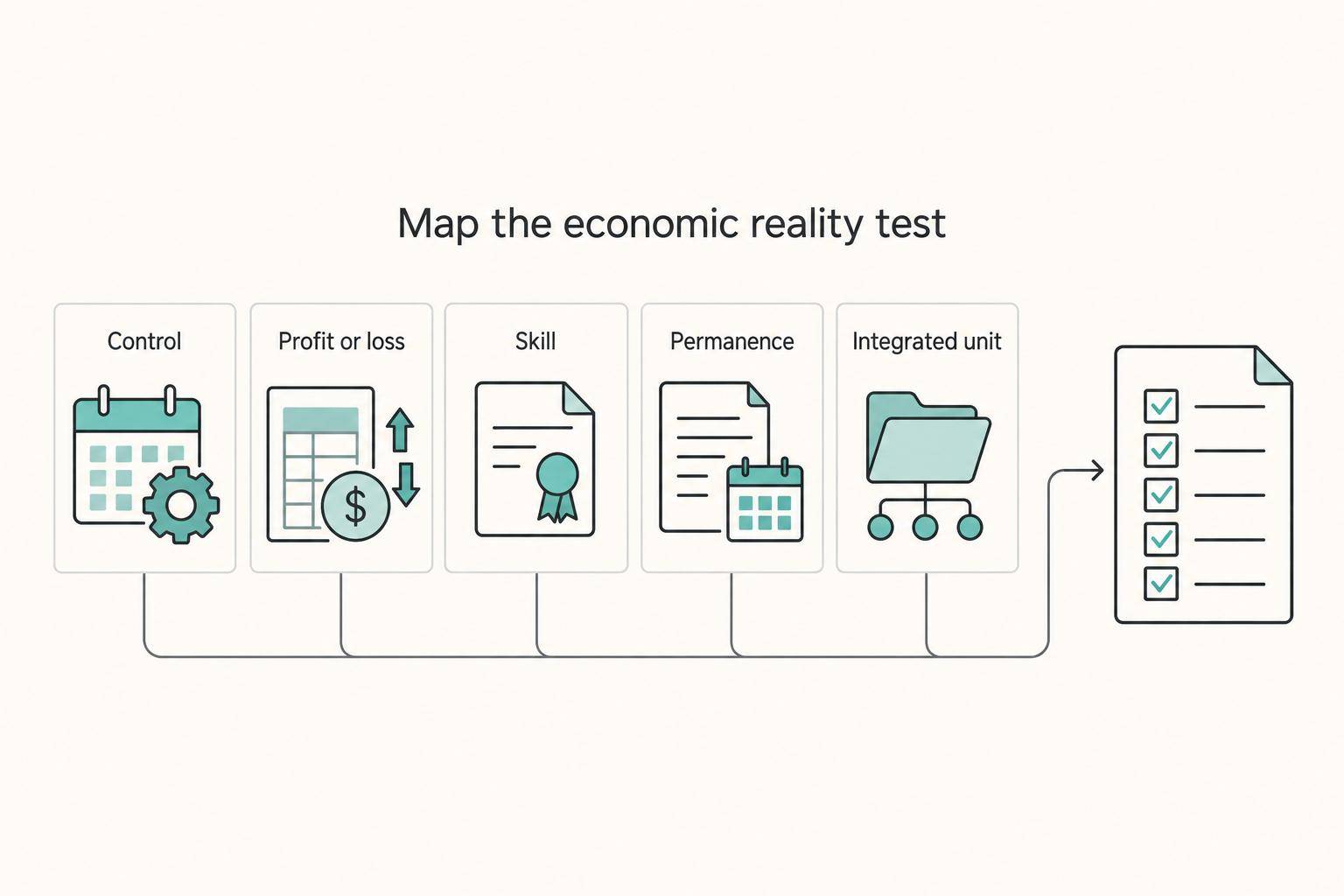
The 2024 CFR interpretation uses six factors in a totality-of-the-circumstances inquiry; no factor or subset is necessarily decisive. The 2026 proposal instead emphasizes control and profit or loss as two core factors, with skill, permanence and integrated production also considered. Keep those frameworks distinct, and check WHD policy and controlling court precedent for the issue being assessed.
Control includes actual and, under the 2024 interpretation, reserved power over the work and its economics. Schedule setting, methods, supervision, rates and restrictions on other clients can matter. A legitimate security requirement needs context; not every required meeting or tool settles the result.
Profit or loss asks whether managerial or business decisions can change the economics: negotiating rates, marketing, selecting work or making entrepreneurial decisions can matter. Working more hours at a fixed rate is not necessarily managerial initiative. Neither hourly pay nor fixed-price milestones determine status on their own.
The existing diagram summarizes the five named factors in the 2026 proposal; it is not the complete 2024 framework. Under the 2024 CFR, worker and employer investment is a separate factor, skill must involve business initiative, and integral work concerns the function’s importance to the business rather than just access permissions. Review all applicable factors rather than treating the last three as tie-breakers only.
A usable mental model needs a behavior check and a document check for each factor. That way you are not relying on legal vocabulary alone. You are checking whether the paperwork and the operating habits line up.
| 2024 CFR factor | Actual-fact check | Evidence to preserve |
|---|---|---|
| Opportunity for profit or loss | Can genuine managerial choices change profit or loss, rather than only hours worked? | Negotiated rates, marketing, accepted/declined work and business decisions |
| Worker and employer investments | Are investments entrepreneurial and business-building, rather than imposed costs for one job? | Investment purpose and context, not only receipt totals |
| Permanence | Is duration or exclusivity consistent with an independent business? | Actual renewal pattern and ability to serve other clients |
| Control | Who controls schedule, methods, prices and access to other work, including reserved rights? | Agreement plus actual instructions and supervision |
| Integral part of the business | Is the function critical, necessary or central to the hiring business? | Business model and function performed, not only repository permissions |
| Skill and initiative | Does the worker use skill with business initiative, or depend on client training? | Actual commercial practice and training arrangements |
Revisit the assessment when work changes. A scoped project can become an indefinite supervised role; preserve the actual history and review whether classification should change. Updating the document alone cannot erase how earlier work was performed.
That is the real purpose of the test. It is not something you apply once during intake. It is the lens you use to spot drift while there is still time to correct it.
Quick self-check before you sign#
Before you sign, run a short pass on the points that fail most often in practice. This is not a theoretical review. You are checking whether the engagement is set up to operate like a project with an outside business, or like a role with a supervisor.
- Control: identify actual and reserved authority over schedule, methods, prices and other work; investigate employee-like direction.
- Profit/loss and investment: identify genuine managerial opportunity and entrepreneurial investment; a nominal right or a tool receipt is not enough by itself.
- Permanence: review actual continuity and exclusivity, not just the printed end date.
- Integral work / skill: assess the business function and initiative, not whether the worker has narrow system access.
- Outcome: record the applicable test, supportive and contrary facts, and the classification decision or questions for counsel.
A failed independence check is a reason to review the relationship, not to add a token “initiative lever.” If the work genuinely needs employee-style direction, employment may be the appropriate route. Use the self-assessment checklist to collect facts, and the subcontractor guide only when subcontracting is a real and permitted business choice.
When a counterparty pushes back, keep your response grounded in operations rather than ideology. Acceptance criteria improve clarity. Milestone billing improves predictability. Method control belongs with the party delivering the outcome. That framing usually produces a better contract conversation than arguing labels.
Once this self-check is in place, the next question is narrower: what has actually changed, and what has not, while the 2026 proposal is still pending?
What changes versus the 2024 independent contractor rule#
As checked in October 2026, the 2026 action remains labelled a proposal on DOL’s page, while the 2024 interpretation is still displayed in the CFR. WHD’s changed investigation policy is a separate development. Do not collapse those facts into “nothing changed” or “the proposal is already law.”
| Date | WHD action | Why it matters now |
|---|---|---|
| 10 January 2024 / 11 March 2024 | 2024 final interpretation published / effective | Six-factor framework appears in current 29 CFR part 795 |
| 1 May 2025 | WHD Field Assistance Bulletin 2025-1 | Investigators directed to use specified earlier guidance in covered matters, not the 2024 analysis |
| 27 February 2026 | NPRM RIN 1235-AA46 published | Proposes a modified 2021-style framework; not final merely because published |
| 28 April 2026 | Comment period closed | Historic deadline, not an open submission window |
| 5 October 2026 | Editorial status check | DOL page still proposal; monitor final action and relevant court decisions |
The dates answer different questions: publication and effectiveness for the 2024 rule, an investigation-policy change in 2025, and proposal/comment milestones in 2026. Keep those dates in the file so a later reviewer can identify which guidance informed an assessment.
What you cannot know yet matters just as much. No one can assume final wording, factor emphasis, or effective date from proposal text alone. The practical move is to keep your current contract package defensible under existing law, while preserving version control so updates are easy if final action posts.
Keep accurate version history when a project changes. If the client begins directing daily work or restricting other clients, record the change and review its legal significance. Avoid cosmetic phases or rewritten exhibits that conceal continuity.
A clean interim posture looks like this:
- Keep statements of work anchored to outputs and acceptance criteria.
- Keep contract language aligned with practice, not labels that conflict with delivery.
- Preserve evidence of initiative and financial risk, including pricing records, subcontractor records, and tool-spend records.
- Record the latest rulemaking, enforcement-policy and court-law check, and review on meaningful updates.
This approach does two things at once. It avoids unnecessary churn now, and it keeps you from scrambling later if final action differs from the proposal. For a clause-level refresher, see Independent Contractor Status: The Most Important Clause for Avoiding Misclassification.
With that baseline in mind, the most useful next step is a short operating review you can run this week. The goal is not to perfect your theory. It is to see whether your current files would hold up if someone looked at them today.
Self-assessment checklist you can run this week#
Use the review to collect real facts under the applicable legal framework. The 2024 CFR, WHD’s investigation guidance and the pending 2026 proposal are different references; the public comment period has already closed. Wage-law, tax and state-law status may also differ.
Escalate when actual supervision, restricted outside work, continuous integration or economic dependence conflicts with the contractor assessment. Consider employment and any prior-period obligations; adding a change-order template is not a substitute for that review.
Start with the operating facts that most often drift:
- Control: compare the contract’s reserved rights with actual directions on schedule, methods, rates and other clients.
- Opportunity and investment: preserve real pricing, marketing and entrepreneurial decisions, distinguishing them from imposed job costs.
- Permanence: record actual duration, exclusivity and renewal behavior; short renewals can still form a continuous relationship.
- Business function and skill: identify the function performed, its role in the hiring business and the worker’s business initiative.
- Decision evidence: retain scope, assessment, relevant communications, billing records and contrary facts; route unresolved status to counsel.
End with a dated assessment: applicable law and policy, actual facts, decision, open questions and the next review trigger. Do not keep an April comment deadline as the next action on an October file.
If you want this to fit into one week, split it into three passes. The first pass is document review: SOW, exhibits, billing terms, and renewal language. The second pass is delivery simulation: how work will be approved, how scope changes will be priced, and how access will be controlled. The third pass is evidence review: whether every major decision has a matching artifact in the file. This rhythm keeps the review practical and helps you spot polished paperwork that does not match execution.
It also gives you a clean handoff into contract revisions. Once you know where the facts are weak, you can tighten the agreement without bloating it. For a guided version of the same checkpoints, use Are You an Employee or a Contractor? A Self-Assessment Checklist. If you need a fast scope draft while you sort through the 2026 proposal, try the SOW generator.
Contracts that reinforce independence without slowing deals#
A good contractor agreement should make the right operating pattern easier, not harder. If the terms force daily oversight or vague approvals, you lose status clarity and deal speed at the same time. The better design is plainly commercial and project-based: discrete outputs, objective acceptance, and clear price adjustments when scope changes.
The proposal is not a drafting safe harbor. Use terms the parties will actually follow, and review status independently. A methods clause contradicted by daily instructions makes the record less reliable.
This is also where many negotiations are easier than people expect. When each clause maps cleanly to how the work will be done, clients spend less time arguing abstractions and more time confirming concrete checkpoints.
Clause map that supports independence#
The safest clause package is one that lines up with the way the engagement actually runs. Start with the clauses that most directly shape control, scope movement, and payment logic.
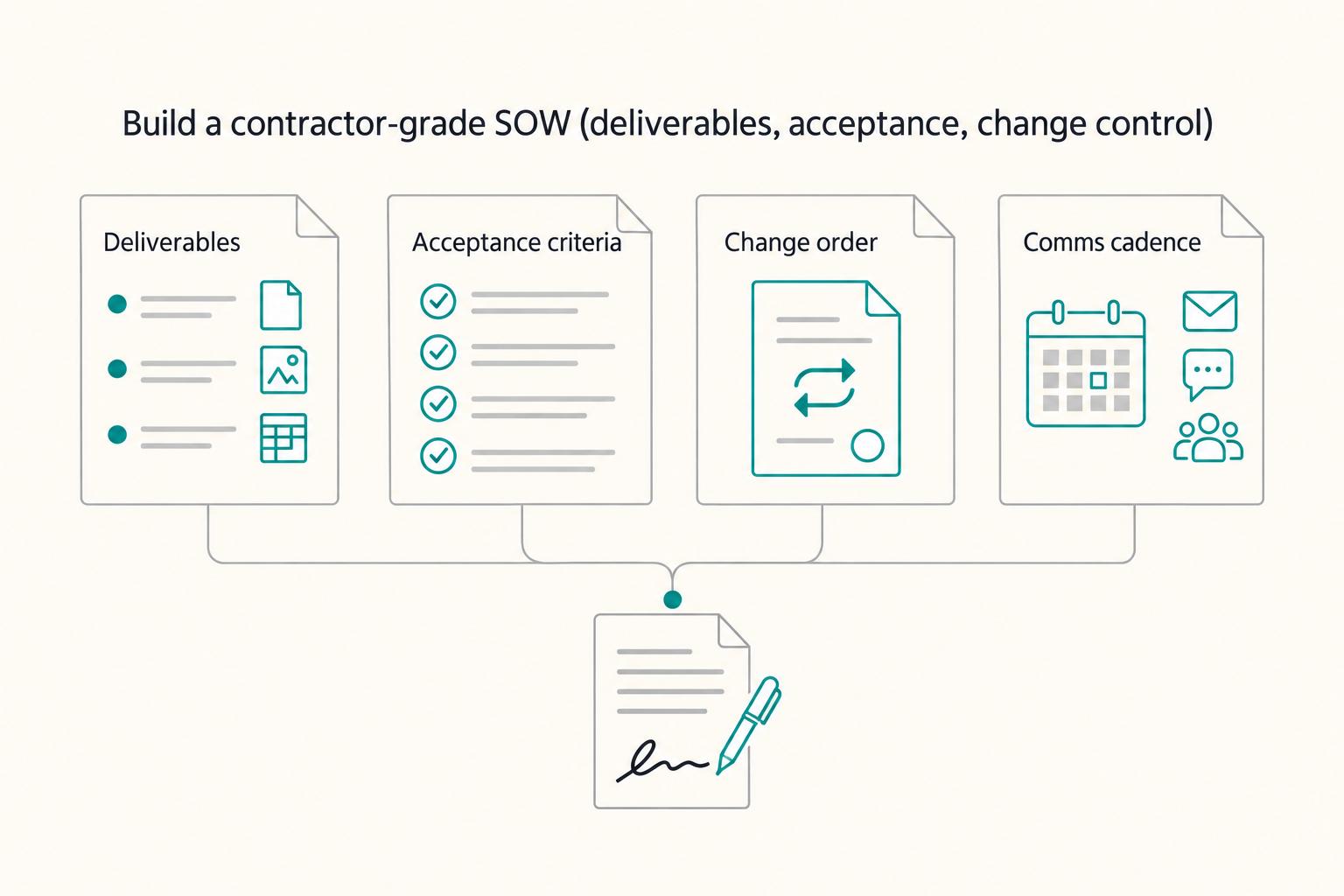
Termination and Dispute Resolution: Set term completion and breach triggers around project obligations, with explicit renewal for later phases. Keep dispute steps commercial, such as negotiation, mediation, then arbitration or court.- Scope and acceptance: define deliverables and review criteria for genuine project work; use the agreed deposit, progress or final-payment triggers rather than assuming all invoices require final acceptance.
Change-order exhibit: Require written scope, price, and date updates before extra work starts. This keeps profit or loss tied to your pricing decisions instead of informal hourly drift.- Payment structure: choose hourly, fixed-price, retainer or milestone terms that fit the work. Payment method alone does not determine FLSA status, and billing records must accurately reflect the arrangement.
Methods and tools: State that you control methods, sequencing, and tooling, subject only to defined data access and security conditions needed for project execution.
Read the package against actual work. A fixed-price milestone with detailed daily direction can still point toward employment; an hourly independent business is not automatically an employee. Clear acceptance rules prevent commercial disputes but do not decide classification.
If a client requires employee-style supervision, address the classification question directly. Where independent project delivery is appropriate, define useful progress and acceptance checkpoints. Do not promise that those checkpoints remove all worker-status risk.
Risk controls and venue that mirror practice#
Risk clauses should read like a services agreement between businesses, not employment paperwork. That principle matters more than any single sentence.
Limitation of Liability and Indemnification: Match caps and allocations to project risk. Use carve-outs for intentional misconduct and assign third-party claim responsibility to the party controlling that risk.Governing Law and Jurisdiction: Pick one venue you can support operationally and keep it consistent with insurance and registrations.- Federal scope: distinguish the pending 2026 proposal from current CFR text and WHD investigation policy; check separate FMLA/MSPA coverage requirements where relevant.
- Benefits and policies: record actual benefits and onboarding requirements. Keep necessary safety, conduct and security obligations where appropriate; removing a document does not remove an entitlement or determine status.
Vendor onboarding can legitimately include security, safety and confidentiality requirements. Review their substance and actual application, rather than stripping every policy acknowledgment to improve appearances. Employee benefits and employee-like direction need an honest classification assessment.
Before signature, compare proposed scope and payment terms with the expected daily work. If the client will supervise methods or schedule, ask whether the role should be employment. For independent project work, define objective acceptance and progress reporting, while retaining accurate time records where billing or law requires them.
Once the contract can support the operating pattern, the next task is evidence. A clean agreement helps, but you still need a file that shows the relationship worked the way the agreement said it would.
Evidence pack that stands up to WHD review#
The evidence file should support an honest assessment, including facts that cut against contractor status. It should show how the relationship actually operated, not just the independent-business story the parties hoped to tell.
Think of this as a per-engagement folder you could hand to counsel, finance, or an investigator without much explanation. If the reviewer needs extra narration just to understand how the project functioned, the file is probably missing something important.
That is why timing matters. Build the file before the first invoice, then keep it current as the engagement changes. Waiting until the end almost guarantees gaps, especially around scope changes, access changes, or informal approval habits that never made it back into the paperwork.
What to include and why#
The easiest way to keep the file useful is to save artifacts that connect decisions to outcomes. Each item should answer a practical question about how the project was structured, run, approved, and billed.
- Business evidence: marketing, other-client activity and investment purpose where relevant. A client roster is not itself the FLSA test, and imposed costs for one job are not automatically entrepreneurial investment.
Contract artifacts: Signed SOW with deliverables and acceptance tests, plus a change-order log. Include termination language tied to project events, not employee policy triggers.Financial artifacts: Pricing worksheets, scope revisions, and any subcontractor invoices or payments. These show how margin changed with your decisions.Operating log: Short dated entries recording method choices, tooling choices, access decisions, and acceptance events linked to deliverables or acceptance emails.
Then run two short checks while the project is still active:
- Invoice check: does billing follow the actual agreed deposit, time, progress or acceptance terms, with correct supporting records?
Consistency check: Do email threads, tasking behavior, and access controls match what the contract exhibits say?
If daily direction conflicts with the assessment, preserve the instructions and escalate classification before the next phase. A new exhibit may describe a genuine prospective change, but it does not rewrite earlier conduct or resolve past liability.
Traceability should be part of delivery quality, not a separate compliance chore. If someone asks why scope changed, why timeline moved, or why margin shifted, your file should answer in one step with the change order, acceptance event, and invoice record sitting together. That standard helps in a review, but it also makes renewals smarter because you can see what actually drove effort and cost.
For related self-audit prompts, see Are You an Employee or a Contractor? A Self-Assessment Checklist.
Scenario contrasts you'll actually recognize#
Use the contrasts to identify facts for assessment, not as instructions to make a supervised role look like a vendor project. Some roles require employment; legitimate independent businesses can also have long relationships, hourly billing or necessary client-system access.
Use the contrasts below as decision aids, not a one-time checklist. The point is to recognize common patterns early enough to redesign them.
| Scenario contrast | Better structure | Why it helps | Risk to watch |
|---|---|---|---|
| Fixed-hour onsite support | Milestone web build with acceptance criteria and progress invoices | Changes the operating facts only if independent output delivery is genuine | Hour blocks can drift into daily oversight and tool mandates |
| Long retainer with daily standups | Quarterly project cycles with renewal checkpoints and clear termination triggers | Creates a commercial review point; short phases do not erase actual continuity | Continuous cadence can read like an internal role |
| Client laptop with always-on SSO | Your stack by default, with project-only access when needed | Limits data access; device ownership or access alone does not decide classification | Core operations access can blur into integrated production |
| HR-style onboarding in a contractor engagement | Assess actual benefits, direction and necessary policies; determine the lawful classification | Accurate records support a status review | Removing forms cannot cure an employee relationship |
When additional work arrives, use a real change order or revised scope if that fits the arrangement. Preserve how the client directed the change and how price was agreed. Splitting continuous supervised work into named phases does not make the worker an independent business.
Worked example: real margin decisions, not a classification score#
Hypothetical design business quotes $6,000 for a defined project. It estimates $1,200 subcontracting, $300 software and $2,000 of its own time as a planning cost: contribution after those assumed costs is $2,500. If its chosen workflow reduces its time cost by $500, contribution rises to $3,000. That illustrates a managerial choice, not a legal threshold or guaranteed contractor outcome.
Contrast a worker paid $40 an hour who follows the client’s daily assignments, cannot market services or negotiate rates, and earns more only by working more hours. Renaming those hours “milestones” does not create the same business opportunity. Both examples still require review of control, investment, permanence, business function, skill and the applicable legal test.
Finance treatment should support this structure, but it does not replace the legal analysis. Employers generally withhold income, Social Security, and Medicare taxes from employee wages and pay matching payroll and unemployment taxes. Independent contractor payments generally are not withheld in that way. Use that as a coherence check for invoicing and documentation, not as the classification test itself.
That distinction leads directly to the next issue. Even if your federal file is clean, state tests and cross-border realities can still change the practical posture you need to take.
Federal proposal vs. state tests and cross-border realities#
Do not run federal analysis in isolation. The 02/27/2026 NPRM is a federal proposal tied to FLSA status and proposes parallel use for FMLA and MSPA. It does not automatically align state standards, and in practice state rules can still drive the result.
Review the applicable federal and state standards separately against actual practice. If a relationship requires employee classification under an applicable law, address that classification and its obligations; changing the contract alone cannot make the standards agree. A genuine lawful redesign needs review of both the new facts and any existing liability.
Apply each relevant test rather than choosing a convenient one. For example, California’s ABC guidance includes an outside-the-usual-course-of-business requirement, subject to statutory exceptions. Milestones and narrow access do not themselves satisfy that requirement. If a governing test points to employment, review the engagement and obligations accordingly.
For cross-border work, first check which country’s employment law and tax rules apply and whether the US statute covers the work. A US client does not automatically make every overseas engagement subject to the same FLSA analysis. Necessary security controls should remain; assess whether their actual use becomes work supervision.
Commercial venue and dispute clauses do not waive statutory worker protections. Keep necessary onboarding obligations, document the real relationship and review the separate tax-status analysis with appropriate advisers.
Pre-sign checklist#
Before signature, confirm that the main gates are actually green rather than assumed to be green:
- Federal review: record current rulemaking, CFR, investigation-policy and relevant court-law checks.
- State/local review: apply the actual governing tests and exceptions; do not assume paper milestones satisfy them.
- Contract review: scope, prices, payment triggers and reserved rights match the planned relationship.
- Security review: retain necessary controls and assess how they operate in practice.
- Decision review: preserve supportive and contrary facts; consider employment where required, with counsel for unresolved issues.
If a gate fails, investigate before signing. Correct classification and the resulting obligations where required, or obtain advice on a genuine lawful redesign of the working arrangement. Accurate terms should reflect the result rather than conceal employee-like practices.
What to do next#
Start with the actual worker relationship and the applicable laws. Document the October status check, preserve real scope and supervision evidence, and review unresolved classification with counsel. Do not delay a required employment correction while waiting for a proposal to become final.
The immediate priority is coherence. Scope, acceptance, billing, access controls, and evidence records should all tell the same story without extra explanation. If one part of the file says "project-based contractor" while the delivery habits say "supervised role," the weak point will not stay hidden for long.
A focused first-pass review#
Use a focused hour to identify issues and assemble records; it is not a promise that a classification review can be completed in 60 minutes:
- Record worker location, applicable legal tests and current rulemaking/enforcement references.
- Compare scope and reserved rights with actual schedule, methods and supervision.
- Reconcile billing to the agreed deposit, hourly, progress or acceptance terms.
- Document genuine business decisions and investment purpose, plus contrary facts.
- Retain necessary access/security requirements and the way they operate.
- List unresolved questions and arrange counsel review or a classification correction when needed.
If employee-like supervision appears, assess status instead of just replacing attendance reporting with an acceptance label. Any prospective redesign must change actual work and remain lawful; preserve the history.
Quarterly renewal routine#
Set a review cadence suited to the engagement, with earlier checks when duties, supervision, exclusivity or applicable law changes. Do not wait for the next quarter after a material change.
- Review all applicable classification factors against actual delivery.
- Record changes in duration, duties, control and economic opportunity without hiding continuity.
- Archive actual deliverables, billing records, significant instructions and scope changes.
- Check for final rulemaking, enforcement-policy updates and relevant court decisions; the April 2026 comment window is past.
End with an assessment rather than a single acceptance-billing test: which laws apply, what the facts show, what remains unresolved and who owns the next action. Use the contractor-status clause guide for supporting language, and a qualified employment adviser for the classification decision.
Frequently Asked Questions
What is the DOL's 2026 independent contractor proposal under FLSA, and how does it relate to FMLA and MSPA?
It is DOL’s February 2026 NPRM proposing to revise its employee/contractor interpretation under the FLSA and apply the analysis to FMLA and MSPA. As checked 5 October 2026, DOL still calls it a proposal. Each statute’s coverage requirements remain a separate question. For planning, treat it as a direction signal, not as proof that new requirements are already in force. Keep current contracts and operations aligned with existing law while you monitor docket updates.
Does the NPRM rescind the 2024 independent contractor rule, and what is the current status?
The NPRM proposes replacing the 2024 interpretation with a modified 2021-style analysis. Its comment period closed 28 April 2026. DOL’s page still identifies it as proposed as checked 5 October 2026; the current CFR still displays the 2024 interpretation, while WHD has separate investigation guidance. Check final publication and an effective date separately from the expired comment deadline. Agency investigation policy does not eliminate private FLSA claims or controlling judicial precedent.
What are the two core factors in the economic reality test, and why do they matter?
In the 2026 proposal, the two emphasized core factors are control and opportunity for profit or loss based on initiative and/or investment. Other relevant factors still matter. The 2024 CFR does not make those two factors decisive; it uses a six-factor totality analysis. Translated into delivery terms, your documents and behavior should point to output-based approval, pricing discretion, and contractor control over methods.
Which additional factors can tip a close call?
The proposed 2026 framework also considers skill, permanence and integrated production, with other relevant facts. The 2024 CFR separately identifies investment, and uses six factors without a predetermined decisive subset. Do not mix “core” proposal terminology with the 2024 rule. Assess the applicable framework in full. A short contract, specialist skill or limited repository access does not settle status without the rest of the relationship.
When does the proposal take effect, and what remains unknown about timing?
A proposal does not take effect by itself. The comment period closed 28 April 2026; no new effective date was identified in the official proposal materials checked 5 October 2026. Monitor final action and litigation rather than using the old comment date as a future deadline. Because timing is open, use calendar checkpoints and review your templates after major docket events rather than guessing a publication date.
How can a freelancer show profit or loss opportunity without inflating risk?
Record genuine managerial decisions such as negotiated pricing, marketing, accepted work and entrepreneurial investment. A priced scope change or subcontracting choice can be relevant when real; imposed costs, nominal rights or fixed-price billing alone do not establish independence. Do not create unnecessary financial exposure just to manufacture a factor. The goal is not aggressive risk-taking. The goal is a clear file showing that your choices, not client supervision, drive the economics.
What contract clauses help reinforce independent status?
Use terms that match actual scope, control, payment and business decisions. Acceptance and change-order provisions help commercial clarity, but do not guarantee independent status. Keep necessary policies and statutory rights; seek a classification assessment where facts conflict with the contractor label. The strongest clause package is the one your team can execute consistently. If a clause sounds right but your process cannot support it, revise the clause or the process before signing.
Watch
Historical video: DOL Independent Contractor Rule 2024 Explained
Try a related tool
Researched and edited by the Gruv editorial team. Gruv builds cross-border billing, payouts, and finance-operations software for global businesses.
Sources
- dir.ca.gov/dlse/faq_independentcontractor.htmtrusted
- dol.gov/index.php/agencies/whd/flsa/misclassificatio...trusted
- dol.gov/sites/dolgov/files/WHD/fab/fab2025-1.pdftrusted
- ecfr.gov/current/title-29/subtitle-B/chapter-V/subcha...trusted
- govinfo.gov/content/pkg/FR-2026-02-27/pdf/2026-03962.pdftrusted
- irs.gov/businesses/small-businesses-self-employed/in...trusted
Educational content only. Not legal, tax, or financial advice.
Related Posts

Independent Contractor Status for Cross-Border Freelancer Contracts
An independent-contractor clause describes the intended arrangement; it does not decide legal status. Control over working methods matters, but the applicable test can also consider financial independence, permanence, the business relationship and the work’s place in the client’s business. Identify the worker’s location and the relevant tax and labor laws before drafting.

Hiring a Subcontractor for the First Time Without Costly Surprises
Hiring your first subcontractor works best when you can describe the job, review the result and afford the coordination time. Agree on scope, authority and payment terms before handing over client work, then pay according to those terms.
Are You an Employee or a Contractor? A Self-Assessment Checklist
Forget the label. Classification turns on the relationship you actually run, not the title you typed into the contract. It is also much easier to fix before you sign.