
Quick Answer
Recognize contractor services received by cutoff even if the invoice or payout comes later. Amounts invoiced or formally agreed can be trade payables; received-service amounts still requiring an estimate generally belong in accrued expenses. An invoice-controlled AP workflow can require validation for processing without postponing an existing liability. Clear or remeasure the original accrual when the invoice arrives, and keep payment holds separate from the accounting assessment.
Why This Distinction Breaks or Fixes Your Close#
For platform finance teams, this is a close-quality issue, not a naming issue. If your team lets "paid," "ready to pay," and "owed" collapse into one status, you can record the right economics in the wrong period.
The cutoff hinge is the obligation and its support. Under IAS 37’s distinction, trade payables relate to goods or services received or supplied whose amounts have been invoiced or formally agreed with the supplier. Accruals cover received goods or services not yet paid, invoiced, or formally agreed. At Period-End Close, a missing invoice does not mean no liability; it also does not automatically exclude a formally agreed amount from trade payables.
That split affects both the Balance Sheet and the Income Statement because accrual accounting recognizes expenses when incurred, not when cash moves. Service delivery, invoice receipt, payment approval, payout release, and final cash completion can be separate events. If you wait for an invoice or payout to recognize an existing pre-close obligation, you risk understating expense and liabilities. Document how trade-payable presentation maps to your invoice-controlled AP subledger rather than treating the two as identical.
Both categories often form part of Current Liabilities and working capital. Under the IAS 1-aligned current-liability criteria, normal-operating-cycle trade payables and operating accruals remain current even when settlement is more than twelve months away. Other criteria include trading purpose, settlement due within twelve months, or no reporting-date right to defer settlement for at least twelve months. Assess those criteria, not the invoice label alone.
Near cutoff, control quality matters most. We recommend making your evidence threshold explicit because estimation-heavy balances can carry higher misstatement risk:
- Proof the service was received or accepted.
- Proof of whether an invoice was received or formally agreed as of the close date.
Investigate missing support and assign an owner. A review or payment hold does not justify omitting an obligation that exists at cutoff. Finance should assess recognition, measurement, and any material disclosure while the missing document is pursued.
What fixes the close is a clear sequence with clear ownership. Define cutoff rules, separate accounting events from cash events, assign evidence validation, and keep verification checkpoints that stand up to audit review. For a deeper look at accrual decisions, read Accrued Expenses for Freelancers: Better Close Decisions.
At-a-Glance Comparison for Contractor Liability Classification#
At close, establish whether the service was received and whether the supplier amount is invoiced or formally agreed. Received service still requiring an estimate generally belongs in Accrued Expenses; an invoiced or formally agreed amount can be a trade payable. Your invoice-controlled AP workflow can require invoice validation for processing without postponing recognition of an existing liability.
| Criteria | Accrued Expenses | Accounts Payable | Misclassification consequence |
|---|---|---|---|
| Trigger event | Received service; amount not yet invoiced or formally agreed | Received goods or services; amount invoiced or formally agreed | Liability can be recorded in the wrong bucket, reducing cutoff reliability |
| Close support (policy-defined) | Service was completed by period end, with support for the estimate under your policy | Invoice or formal-agreement support; validated invoice where the AP workflow requires it | Weak support can create review friction and post-close rework |
| Timing basis | Recognize when incurred, regardless of payment date | Recognize the obligation; classify trade payable from invoice or formal agreement | Waiting for payout or cash can understate period expense and liabilities |
| General Ledger impact | Debit Expense Account, credit accrued Liability Account | Debit Expense Account if not already recognized, credit AP Liability Account | Wrong posting path creates reclasses, duplicates, or omissions |
| Reporting behavior | Not invoice-backed, so it should generally stay out of invoice aging | Invoice-backed items feed invoice aging; reconcile other supported trade payables separately | Mixing accruals into AP can distort the Accounts Payable Aging Report |
| Close risk | Includes estimation risk; later invoice matching is important | Invoice or formal agreement still requires completeness and validity checks | Errors can delay close; material errors may require retrospective correction |
That evidence split is the control point. For accruals, support the service period and reasonable estimate. For trade payables, retain the invoice or evidence of the amount formally agreed with the supplier. If your AP subledger accepts only validated invoices, document the ledger mapping and monitor agreed-but-uninvoiced payables separately.
Posting should follow the same logic. If you accrue first and receive the invoice later, reconcile or reclass from accrued liability into AP instead of booking expense twice. That keeps liability balances clean and avoids duplicate open items.
Not every misclassification becomes a restatement, and materiality cannot be judged only by a numeric cutoff. Even nonmaterial errors still create avoidable cost: a slower close, extra journals, harder reconciliations, and aging outputs that no longer represent unpaid invoices cleanly. Related: Accounts Payable Automation for Dummies for Platform Operators.
Classification Rules at Period Cutoff#
At Period Cutoff, recognize contractor services already received under the applicable accounting rules. Use Accrued Expenses when the amount remains uninvoiced and not formally agreed; use trade-payable treatment when the amount is invoiced or formally agreed. Keep required Contractor Invoice validation as a separate AP-processing and payment checkpoint.
Expense timing follows when service is incurred, not when cash is paid. Invoice receipt often triggers processing in an invoice-controlled AP system, but an existing obligation and a formally agreed supplier amount can precede that event.
| Cutoff scenario | What to book | Minimum support to verify | Main risk if mishandled |
|---|---|---|---|
| Service received before close; amount neither invoiced nor formally agreed | Accrued Expenses | Evidence service was rendered by cutoff, plus estimate support under policy | Expense understated and liability missing at close |
| Service received before close; amount invoiced or formally agreed | Accounts Payable | Invoice or formal agreement tied to service period, amount, and supplier | Accrual left open or duplicate expense recognition |
| Invoice arrives after close for prior-period service | Reclass or true-up with an Adjusting Entry linked to the original accrual | Invoice date, service period, original journal ID, vendor match | Duplicate expense or stale accrued liability carryforward |
| Invoice or work is disputed | Assess and recognize any existing obligation; document uncertainty and retain required payment holds | Dispute record, service acceptance status, resolution owner | Valid liability omitted, unsupported amount recorded, or disputed payment released |
The late-invoice rule#
If an invoice arrives after close for prior-period service, review it against the original accrual. Then post a reversing or true-up Adjusting Entry based on your policy and system setup, with documented linkage to the original journal. Your support should let reviewers trace service evidence, accrual entry, invoice, and final AP posting without gaps.
The dispute gate#
Separate the dispute’s accounting effect from its payment hold. An invoice alone does not establish every claimed obligation, but a dispute does not automatically erase an existing payable. Assess the service received, enforceable amount, and uncertainty; retain any required payment block while finance determines the appropriate payable, accrual, provision, or disclosure.
For a genuinely uncertain obligation, apply the relevant recognition and measurement rules. IAS 37 distinguishes a recognized provision from a contingent liability using the obligation, likelihood of outflow, and reliable measurement. Do not use an exception-queue status as the accounting conclusion.
Why this protects the close#
These rules protect P&L timing by keeping period expense in the correct close window. They also separate financial-statement liability classification from invoice approval and payment selection. Service receipt, invoice or formal agreement, measurement uncertainty, and payout authorization each answer a different question.
Posting Sequence From Work Completion to Cash Out#
Once cutoff classification is set, the next control objective is straightforward: keep liability recognition and cash movement connected, but separate. In a typical accrual workflow, recognize the obligation when the expense is incurred and classified, then release payout after the required checks. A completed payout batch does not fix a classification error.
A practical sequence that holds up in review#
Start with service acceptance evidence, then classify, post, pay, confirm completion, and review for close. If you follow that sequence, payout status stays an operations signal instead of becoming a substitute for accounting classification.
| Stage | What you confirm | Accounting implication | Cash implication | Join you should retain | Main failure if skipped |
|---|---|---|---|---|---|
| Service acceptance | Evidence of service received by cutoff; acceptance or dispute reviewed separately | Opens accrual or AP decision | No payout release yet | Service record ID | Liability missed or disputed work paid |
| Liability classification | Obligation, measurement, and invoice or formal-agreement support | Determines Accrued Expenses or Accounts Payable path | No cash-completion event yet | Service ID plus invoice or formal-agreement reference | Wrong liability bucket at close |
| GL posting | Journal created in the General Ledger | Liability recognized on the Balance Sheet | Cash unchanged | Journal ID and journal line reference | Unrecorded or duplicate liability posting |
| Payout release | Payment approved for execution | No new recognition decision | Outgoing payment initiated | Payout reference or payout batch ID | Payment launched against unresolved or unposted liability |
| Bank confirmation | Rail or bank confirms completion | May trigger clearing or payment posting updates | Cash movement completed | Confirmation reference linked to payout reference | "Paid" shown without proof of completion |
| Close review | Records tie across operations and finance | Exception review and rollforward support | Open vs completed items confirmed | Service, invoice, journal, payout, confirmation chain | Reconciliation breaks and stale balances |
Under accrual accounting, recognition can precede payment. A common accrual entry pattern is debit expense and credit accrued liability. For invoice-backed items in systems that enforce invoice validation, keep validation as an explicit checkpoint before the relevant AP processing or payment step; recognize any existing obligation through the appropriate ledger path while an invoice-validation exception is pending, and route validation exceptions to hold queues.
Do not let payment status stand in for accounting truth#
Initiated and completed are different states. Settlement depends on the actual provider, rail, schedule, destination, and bank calendar. Retain the provider’s status and completion record instead of applying a generic ACH or card timing promise to every contractor payout.
The operating rule is simple: a correctly recognized liability with an in-flight payout is normal. A completed payout with missing or incorrect liability classification is a control failure.
The joins that make Reconciliation auditable#
For each item, keep a durable chain across the service record, invoice record when present, ledger journal ID, and payout or bank-confirmation reference. Without that chain, close review turns into manual matching, and duplicate or stale items become harder to detect.
Journal-level reconciliation references should map back to the originating obligation. Where enabled in Gruv, tie invoice and payment states, ledger journals, and Payout Batch status updates with stable identifiers. Use dashboard states for operations. Use journal IDs and payout references for close sign-off.
Retry discipline is not optional#
Retries must be idempotent. Otherwise you risk duplicate liability postings and duplicate payout attempts. Safe-retry patterns are designed to prevent repeated side effects during webhook or batch replays.
Use one stable idempotency key per economic event, not per network attempt: one for liability journal creation and another for payout initiation. Replays should return the original result or no-op, not create a second liability credit or a second payout release.
As a control pattern, classify first, post second, pay third, and require references that survive retries and completion lag. If any handoff drops the service record, invoice link, journal ID, or payout reference, stop and repair the chain before close.
Edge Cases That Cause Silent Misstatements#
Silent misstatements often come from mixed approval or dispute status, missing invoices, payment lag, and accruals not properly cleared or reassessed. Treat each as its own accounting decision.
| Edge case | Correct treatment | Silent misstatement risk | What to verify before close |
|---|---|---|---|
| Partial acceptance or dispute | Assess accepted and disputed portions separately for recognition and measurement. Retain required payment holds without automatically omitting a liability. | Teams either push the full invoice into AP or block everything and miss a valid liability. | Line- or schedule-level acceptance evidence, dispute status, and whether your ERP blocks full-invoice payment when one line varies. |
| Service received; amount neither invoiced nor formally agreed | Record Accrued Expenses using a documented best estimate, then update when the invoice arrives. | Expense is missed at cutoff, or duplicated when the invoice is later booked without clearing the accrual. | Estimate support such as hours, rates, milestones, accepted service, and invoice-to-accrual matching evidence. |
| Liability recognized before cash settles | Keep liability recognition separate from cash-completion timing. Use payout status for operations and bank confirmation for cash timing. | Teams treat platform "paid" status as settled cash at period end and misread Working Capital. | Journal date, payout release date, and confirmed completion date by rail. |
| Accrual not properly cleared or reassessed | Use the configured reversal, direct reclassification, or true-up path; retain any remaining unpaid obligation at the next cutoff. | Duplicate expense, stale balance, or an obligation omitted after auto-reversal. | Original journal, clearing or reversal link, invoice match, and remaining-obligation assessment. |
Partial acceptance is where all-or-nothing logic breaks#
Mixed-status work often needs split handling. Payment policy may block the disputed portion or an entire invoice, depending on your ERP. Finance must still assess the incurred obligation for each portion; payment approval alone does not determine which liabilities are recognized.
Where your stack supports line-level separation, link accepted and disputed portions to their accounting assessments and payment holds. Otherwise, use a documented manual bridge between the ledger and the blocked AP workflow. Do not let an all-or-nothing payment state omit a valid liability.
Missing invoices need estimation, then true-up#
If service is incurred before cutoff and the amount is neither invoiced nor formally agreed, record an accrual using a documented reasonable estimate. If the amount is already formally agreed, assess trade-payable treatment even while awaiting the invoice. Refine or reconcile the balance when the invoice arrives.
Keep the evidence pack simple: accepted service record, rate basis, approved hours or milestone completion, and the estimate calculation tied to the journal. Then require an invoice-to-accrual true-up task when the invoice arrives.
Settlement timing can skew period-end interpretation#
Recognition timing and cash-completion timing are different events. Working Capital can move when liability is recognized before bank completion, and that can be timing rather than a classification error.
For period-end explanations, compare recognition date, payout release date, and confirmed completion date. For example, Stripe Connect distinguishes a payout still pending at Stripe from one in transit to an external account; schedule and settlement availability vary by account configuration. That operational state does not decide when the contractor cost was incurred.
Uncleared accruals can distort the next close#
Automatic reversal is one workflow, not a requirement for every accrual. Princeton’s year-end process illustrates an auto-reversing setup. Another system may directly reclass the accrued liability into AP and post any difference. Whichever method you use, avoid duplicate expense and retain an unpaid obligation in the closing balances.
For each cutoff accrual, trace the chosen reversal, reclassification, or true-up path. Investigate failed scheduled reversals and duplicate invoices. If an auto-reversed item remains uninvoiced and unpaid at the next cutoff, reassess and recognize the remaining obligation; reversal alone does not settle it.
Ownership Model Across Finance, Ops, and Product#
This works only if duties are clearly separated and documented. Finance can set and sign off the classification policy, ops can maintain evidence readiness, and product can enforce the workflow in system states. That split is an operating model, not a mandated legal template, but it aligns with control design that separates authorization, recording, review, and asset handling.
Recommended role split#
| Role | Practical decision right | What this team should verify | What it should not own alone |
|---|---|---|---|
| Finance | Classification policy for Accrued Expenses vs Accounts Payable, cutoff rules, and close sign-off on Current Liabilities | Whether invoice or formal agreement supports trade-payable treatment, whether an estimate-based obligation remains accrued, and whether the ledger ties to supporting records | Service-delivery evidence collection or payment execution |
| Ops | Evidence completeness and first review of exceptions | Supporting documentation completeness, invoice presence where applicable, and missing-document follow-up | Final accounting classification policy or ledger override rights |
| Product | System enforcement and status surfaces | Whether required fields and links exist so users can drill from balances to journals and underlying subledger transactions | Final approval of accounting treatment |
The exact labels can vary. What matters is that your team does not prove, record, and pay the same item without review, and that ownership is visible in the close evidence you retain.
RACI checkpoints that matter#
Use named checkpoints, even if your matrix is lightweight. For example, at Period Cutoff, define who is accountable for classification, who is responsible for evidence readiness, and who is consulted when mapping issues block review. At invoice approval, separate evidence completeness and dispute handling from final accounting classification.
For exception queues, assign clear ownership so unresolved Contractor Liabilities do not sit through close without action. This is a control choice, not a fixed external requirement, but it improves follow-through.
Before you sign off on Current Liabilities, require both checks:
- Each liability traces to invoice or formal-agreement support, or an accrual calculation.
- Balances drill down from account totals to journals and underlying subledger transactions.
Escalation when reconciliation breaks#
Escalate when AP aging no longer ties to the AP General Ledger balance, or when liability balances cannot be traced to source evidence. Those conditions point to a reconciliation break between classification and recorded transactions.
If workflow statuses or mappings change near close, finance should revalidate the accounting mapping before relying on those statuses for classification.
Reconciliation Pack You Should Be Able to Produce on Demand#
You should be able to produce a close pack that traces contractor liability balances from the Balance Sheet total to source evidence on demand. We recommend building it like workpapers: show what was done, what evidence was reviewed, and the conclusion for each liability bucket.
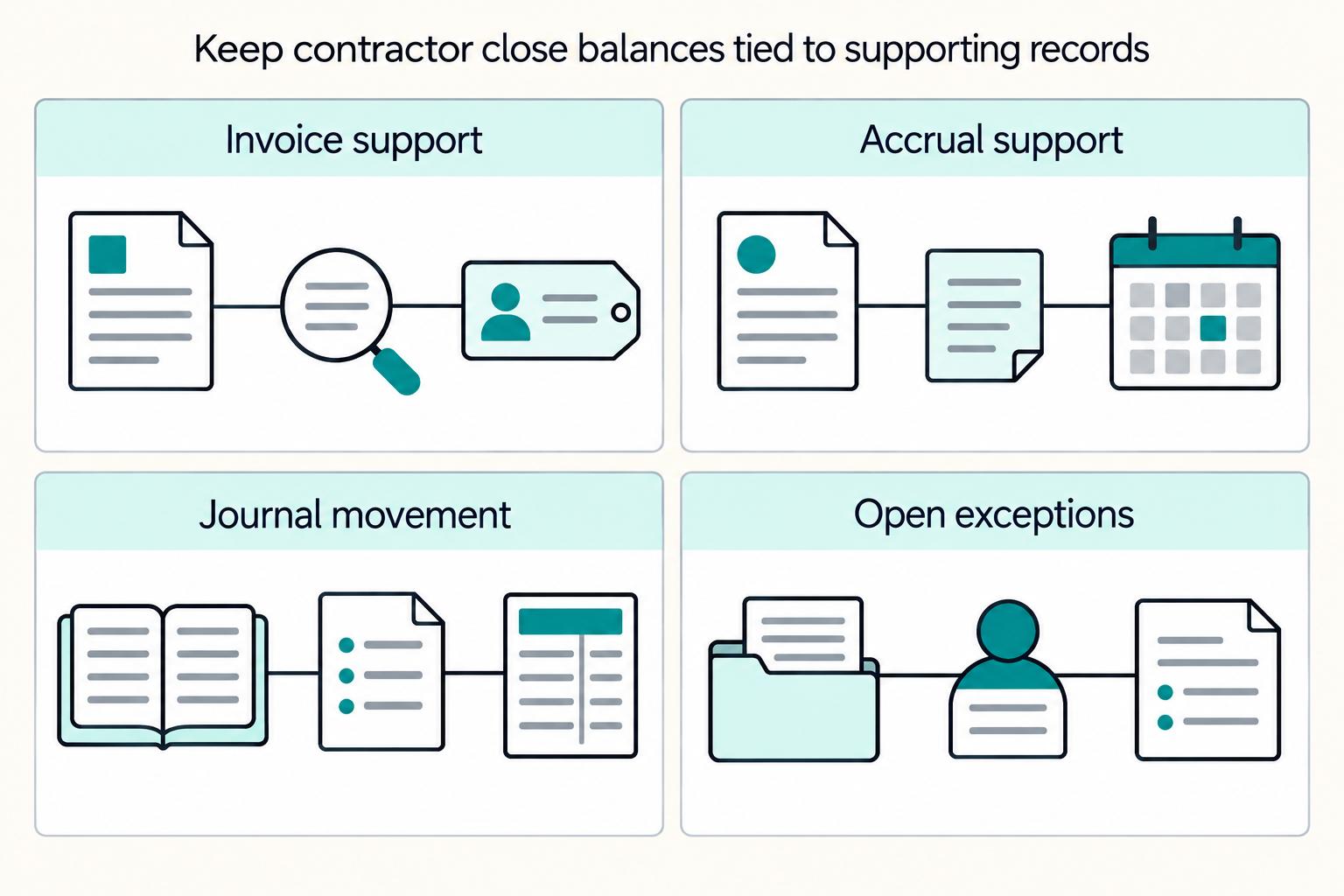
For this operating model, keep six items together for each Period-End Close: liability register, invoice log, accrual support, journal export, payout status log, and unresolved exceptions log. These labels are an operating recommendation, not a universal mandated template.
| Pack component | What it proves | Key tie-out or review step | Red flag |
|---|---|---|---|
| Liability register | Full population of contractor liabilities at close | Sum to the closing Liability Account balance | Items with no source reference or close-period tag |
| Invoice log | Which balances are invoice-backed and belong in Accounts Payable | Match approved invoices to AP entries and invoice dates | Missing invoice support where required by the invoice-controlled workflow; other trade payables not reconciled separately |
| Accrual support | Why a non-invoice liability was recognized | Show service incurred before cutoff and estimate basis | No service evidence or no true-up linkage after invoice receipt |
| Journal export | What posted to the General Ledger | Tie journal totals to period liability movement | Manual journals not traceable to support |
| Payout status log (operational) | Whether cash-release timing differs from liability recognition | Use as a timing cross-check against booked liabilities, not as AP/accrual classification proof | Payout released with no matching liability support, or liability cleared with no settlement support |
| Unresolved exceptions log | Items that are incomplete, contradictory, or still under review | Record the accounting treatment and operational hold or disposition of each material exception; do not omit an existing obligation | Only clean items shown; disputes omitted |
Tie-outs that matter#
Run three tie-outs every close. First, Balance Sheet contractor-liability totals should match the closing Liability Account balance. Second, invoice-backed balances should reconcile from AP subledger detail to the General Ledger, not just to a spreadsheet rollup. Third, your payout reporting should explain post-recognition cash timing, not determine classification.
Keep the timing rule explicit: recognition follows the incurred obligation, while invoice entry controls the relevant AP workflow. Trade payables may also include formally agreed supplier amounts. Payout release status proves neither classification nor liability clearance.
Aging review by liability type#
Use aging logic that matches your records. Invoice-backed liabilities should reconcile to the Accounts Payable Aging Report. Track estimate-based accruals in a separate rollforward. Formally agreed but uninvoiced trade payables need their own traceable due-date view or an explicitly supported place in the subledger.
For an invoice-only AP aging report, every line should map to an invoice. Reconcile any formally agreed but uninvoiced trade payables separately rather than automatically relabeling them accruals. For deeper aging workflow detail, see Accounts Payable Aging Report for Platforms: How to Track Overdue Contractor Payments.
Sign-off artifacts you should retain#
Retain sign-off evidence for every Period-End Close pack: preparer, reviewer, and review date. Include open-exception disposition so contradictory or unresolved items remain visible in the review trail.
Use the close pack before final sign-off. Investigate unexplained tie-out differences and missing support; material unresolved issues need correction or a documented accounting treatment. Keep supported settlement delays and other open exceptions visible rather than requiring every operational item to be completed.
Turn this section into an operator checklist and map each artifact to your live workflow in the Gruv docs.
KPIs and Control Thresholds for Month-End Stability#
Month-end stability comes from catching classification drift and evidence-control gaps early, not just from closing faster. Track accrual conversion lag, AP exception age, and post-close repair volume together. If they worsen, treat that as a control-remediation issue.
| KPI | What it tells you | Verification checkpoint | Red flag and response |
|---|---|---|---|
| Accrual-to-invoice conversion lag | Whether accruals are clearing through invoice entry instead of lingering | For sampled accruals, link the original accrual journal to later invoice entry and confirm the journal path to expense and accrued liability | Older accruals without a clearing plan or current estimate. Investigate support and supplier follow-up. |
| AP exception unresolved days | Whether invoice-backed items remain unresolved | Review the Accounts Payable Aging Report with the exception log, including days past due and reason | Aging rises with no clear owner. Assign a named remediation owner and due date. |
| Post-close Adjusting Entry volume | How much liability cleanup happened after Period-End Close | Review post-close entries and tie each to a documented break or late evidence item | Rising volume is a control-quality signal, not routine close noise. |
| Reconciliation breaks and reopen incidents | Whether sign-off may have happened before liability tie-outs were stable | Match reopen tickets and break logs to the liability register | Repeat breaks can indicate an incomplete close pack or weak review. |
| Evidence-pack completion rate before close | Whether liabilities were fully supported before sign-off instead of patched later | Review invoice or formal-agreement support, accrual calculations, journal links, and any relevant payout or exception status | Investigate support gaps; material unresolved recognition issues need correction or documented treatment before sign-off. |
For accrual lag, verify both the estimate and its later clearing or remeasurement path. An uninvoiced balance can remain a valid obligation. For AP exceptions, document the unresolved reason, accounting assessment, payment status, and owner rather than relying on aging alone.
Set internal KPI thresholds and breach actions. If the backlog exposes missing liability support or unreliable release controls, hold the affected discretionary payouts while those controls are repaired. A growing backlog or adjustment count calls for investigation; it does not by itself establish a material weakness or require a platform-wide freeze.
For a step-by-step walkthrough, see Accounts Payable Automation ROI for Platforms That Need Defensible Results.
Applying the Rules in Gruv Payment Operations#
In Gruv payment operations, treat the General Ledger as the book of record for contractor-liability accounting. Wallet, balance, and payout views are operational projections. If they disagree, treat that as a reconciliation break to resolve, not a reason to reclassify the liability.
Which record wins#
| View | Use it for | Do not use it as | Verification checkpoint |
|---|---|---|---|
| General Ledger journals | Financial reporting, cutoff, liability classification, close sign-off | A live payout monitor | Confirm each contractor liability ties to a journal ID and expected account path before cash release |
| Wallet or balance view | Cash-position and funds-movement context | Authoritative proof that a liability was correctly booked | Match balance activity back to the journaled liability and related payout reference |
| Payout and completion statuses | Operational state such as processing, posted, failed, returned, or canceled | A substitute for invoice or accrual evidence | Confirm status changes trace to an API request or event record and link back to the payout reference |
Settlement timing can move funds from pending to available based on location and sometimes payment method. Accrual accounting ties expense recognition to when the expense is incurred, not when cash moves. A posted payout is not proof that the original classification was correct.
Controls worth wiring in#
Where supported in your Gruv setup, place policy gates before payout initiation and keep audit traces for retries and state changes. Use idempotency keys so retries behave as replays, not duplicate payout actions or duplicate liability clearing.
For a payout sample, retain the request log, event record, originating request ID, payout reference, and linked GL journal together. A payout can fail after appearing in transit, so define the return and liability-reinstatement path before month-end. Use the actual provider’s failure status and bank evidence; do not promise a universal two- or three-day return window.
Where enabled means exactly that#
Confirm the product and account configuration you actually use. Country, account type, requested capabilities, verification status, and payout method can affect availability. Map the provider’s required checks and your platform’s applicable legal obligations separately before enabling the affected funds flow.
For invoice-backed bottlenecks, pair these controls with the Accounts Payable Aging Report guide. For vertical process design checks, review healthcare AP automation and manufacturing AP automation.
30-Day Rollout Plan for Teams Moving Off Spreadsheet Logic#
Use this four-week sequence as a planning example: policy, ownership, parallel validation, then controlled go-live. Scope and legacy exceptions may require more time.
| Week | Primary objective | What must exist by week end | Red flag that means you are not ready |
|---|---|---|---|
| 1 | Define cutoff policy | Written matrix for Accrued Expenses vs Accounts Payable at Period Cutoff, including received or accepted work with missing invoices | Recognition still follows cash movement, payout timing, or invoice arrival alone |
| 2 | Standardize postings and owners | Documented posting templates, exception queues, and explicit owners for Contractor Liabilities | Items remain unassigned, or teams apply different posting logic |
| 3 | Validate with a parallel close | Old and new close outputs compared, mismatches logged, Adjusting Entry handling tested with record-level support | Differences are explained verbally instead of traced to records |
| 4 | Move to controlled monthly operation | Monitoring dashboard, reconciliation review cadence, and evidence-pack sign-off | Close sign-off proceeds without linked journals, support, and exception status |
Week 1. Lock the classification rules before the tooling#
Start by locking the classification rules, not the tooling. Under accrual accounting, expenses are recognized when incurred, not when cash moves, so your matrix should clearly separate accrual treatment from AP treatment at cutoff. Include explicit handling for work received and accepted when invoices are still missing at period end.
Week 2. Document posting procedures and exception routing#
Turn policy into repeatable execution with documented posting procedures and exception routing. Assign clear ownership for each exception queue so unresolved items do not drift across teams. Keep segregation of duties in place: separate evidence and completeness responsibilities from classification and posting control responsibilities.
Week 3. Run the legacy and new close in parallel#
Run the legacy close and the new close in parallel before cutover. Parallel operations let production continue while you correct defects in the new process. Compare record-level outputs across liability detail, journal results, unresolved exceptions, and period-end Adjusting Entry activity.
Week 4. Go live when the close produces a complete evidence pack#
Go live when the new process reliably supports recognition, payment controls, reconciliation, and review of material exceptions. Open items can remain if their accounting treatment and operational handling are documented. Supporting records must be linked and reviewable; avoid requiring every payout to have settled before the close can work.
Make Classification a Control System, Not a One-Off Judgment#
Reliable contractor-liability accounting comes from a control process, not a definitions quiz. We recommend using explicit cutoff rules, named ownership, and repeatable verification before you sign off on the close.
Under accrual accounting, recognition follows the incurred obligation. Invoice or formal-agreement status helps distinguish trade payables from estimate-based accruals; invoice validation controls the AP workflow. Payout completion is a separate event and should not shift an existing contractor cost out of its service period.
What good control looks like in practice#
Use your earlier comparison table as an operating rule at close. Require the same decision checks for every contractor liability:
- Was the service incurred before the Period Cutoff?
- Is the amount invoiced, formally agreed, or still estimated?
- Which invoice, agreement, or estimate worksheet supports the amount?
- Which Liability Account should the entry hit now?
For estimate-based accruals, the common entry is debit expense and credit accrued liability. For an invoiced or formally agreed payable, use the appropriate payable account; if expense was already accrued, reclass or true up instead of duplicating it. Payment release follows its own approval controls.
The verification step#
Before you sign off, run the same reconciliation pack every close: liability register, invoice log, accrual support, journal export, and unresolved exceptions. Then tie contractor-liability balances to both account movement and the records that explain why each item is accrual or A/P.
Review invoice-backed items against the Accounts Payable Aging Report. Reconcile formally agreed but uninvoiced trade payables separately or through your documented subledger configuration, and keep estimate-based accruals in their rollforward. If aging is part of your monthly review, this AP aging guide is a practical companion.
One policy, one owner per exception#
Document one classification policy and assign clear responsibility for each exception path. Shared queues without named owners can leave accruals lingering and invoice-backed items delayed in A/P.
Apply the documented policy consistently and review whether its controls work: recognition, supporting records, payment authorization, reconciliation, and exception ownership. Use the control and reporting requirements that apply to your entity rather than treating every platform as an SEC registrant.
When you are ready to enforce classification rules through payout execution, review Gruv Payouts for policy-gated, traceable flows where supported.
Frequently Asked Questions
What is the difference between Accrued Expenses and Accounts Payable for contractor payments?
For received contractor services, Accrued Expenses generally cover amounts not yet paid, invoiced, or formally agreed. Trade payables cover amounts invoiced or formally agreed with the supplier. An invoice-controlled AP subledger may require a validated invoice for processing, so document how agreed-but-uninvoiced trade payables are recorded and monitored.
Are both Accrued Expenses and Accounts Payable classified as Current Liabilities?
Often yes. Normal-operating-cycle trade payables and operating accruals are current even if they settle more than twelve months after the reporting period. Other current-liability criteria include trading purpose, settlement due within twelve months, or no reporting-date right to defer settlement for at least twelve months. Apply the relevant criteria rather than assuming that every AP or accrual balance is current.
When should a contractor cost be accrued instead of booked to AP?
Accrue received pre-cutoff service when the amount is neither invoiced nor formally agreed and requires an estimate. If invoiced or formally agreed, assess trade-payable treatment. Keep invoice validation and payment authorization separate from recognizing the incurred obligation.
How does Period Cutoff policy affect the Income Statement and Net Income?
Under accrual accounting, expenses are recognized when incurred, not when cash is paid. Your cutoff policy determines whether the Income Statement and Net Income reflect the expense in the correct period. If an Adjusting Entry is missed at close, the expense can be left out of the period and the related liability can be omitted from the Balance Sheet.
What evidence is required before moving an accrual into Accounts Payable?
Retain evidence of received service and the invoice or supplier amount formally agreed, plus the original accrual calculation and journal link where applicable. Your invoice-controlled AP system may still require a validated invoice for processing. Reclass or true up the original liability without recording the same expense twice.
Why can payout completion and liability classification disagree in timing?
Recognition follows the incurred obligation, while invoice processing, payout release, and bank completion can occur later. An in-flight payout does not postpone expense recognition. Link the cash and clearing entries to the obligation using the actual settlement evidence.
Which report should finance monitor to catch overdue invoice-backed liabilities?
Use the Accounts Payable Aging Report for invoice-backed liabilities. It is built to show unpaid invoices by overdue buckets, often 0-30, 31-60, 61-90, and older than 90 days. That makes it the primary report for spotting overdue items recorded in A/P.
Researched and edited by the Gruv editorial team. Gruv builds cross-border billing, payouts, and finance-operations software for global businesses.
Sources
Includes 2 external sources outside the trusted-domain allowlist.
- docs.stripe.com/connect/payouts-connected-accountstrusted
- finance.princeton.edu/budgeting-financial-management/month-and-yea...trusted
- standards.aasb.gov.au/aasb-101-dec-2022-0trusted
- ifrs.org/content/dam/ifrs/meetings/2025/july/iasb/ap1...external
- ifrs.org/issued-standards/list-of-standards/ias-37-pr...external
Educational content only. Not legal, tax, or financial advice.
Related Posts

The Freelance Payment Penalty: A Modeled Audit of Platform Fees, FX Spreads, and Payout Delays
The money rarely disappears through a single, easy-to-spot fee. The real loss is stacked. A marketplace takes its commission, a processor adds a charge for international cards, a bank or payment company converts the currency at a spread, a platform holds the funds before release, and a wire sheds a little to intermediaries on the way in. Each layer looks defensible on its own, but the worker feels the combined result as a smaller deposit and a later payday.

How to Respond to a Subpoena for Business Records
Move fast, but do not produce records on instinct. If you need to **respond to a subpoena for business records**, your immediate job is to control deadlines, preserve records, and make any later production defensible.

A US Expat's Guide to Investing in UCITS ETFs to Avoid PFIC Issues
The real problem is a two-system conflict. U.S. tax treatment can punish the wrong fund choice, while local product-access constraints can block the funds you want to buy in the first place. For **us expat ucits etfs**, the practical question is not "Which product is best?" It is "What can I access, report, and keep doing every year without guessing?" Use this four-part filter before any trade: