
Quick Answer
Do not market pass-through coverage unless the bank structure, recordkeeping, and disclosures support it. The practical test is whether beneficial-owner records and custodial account setup would let FDIC coverage be determined cleanly if the bank failed.
FDIC pass-through coverage attaches to the bank, not the wallet app#
If your wallet holds user funds, even briefly, set the insurance boundary before launch. Pass-through protection can apply only after funds are deposited at an FDIC-insured bank under qualifying conditions. The wallet itself is not FDIC-insured.
Before you describe wallet balances as protected, review the FDIC's pass-through deposit insurance coverage guide and the CFPB's payment-app insurance report.
Step 1 Set the boundary before you design the feature#
Start with this baseline: deposit insurance attaches to deposits at an FDIC-insured bank, not to a nonbank app. Pass-through deposit insurance is a method for funds placed at a bank through a third party. It is not a separate ownership category, and it does not appear automatically because a product shows a stored balance.
Timing and placement matter too. Funds sent to a nonbank are not eligible until they are deposited at an FDIC-insured bank and other conditions are met. Begin with a flow trace that shows where money sits at each step and when it reaches the account structure your counsel and bank partner treat as pass-through eligible.
Step 2 Scope the product around real coverage, not the badge#
For nonbank app setups, "it depends" is the default. The real product question is not whether you can mention FDIC. It is which balances, in which flows, with which records, could qualify.
If your wallet mixes stored funds with pending payouts, returns, or reserves, do not assume the full visible balance is covered. A familiar number like $250,000 can still mislead users if funds are still with a nonbank operator rather than deposited at an FDIC-insured bank. Stored funds on nonbank payment platforms can be exposed to loss if that operator is distressed or fails.
Use one plain-language test before launch: can your team say, in one sentence, what is insured, what is not, and who holds the deposit?
Step 3 Gather proof before launch, not after support tickets start#
You need evidence, not branding. Before launch, be ready to verify:
- the bank relationship behind the wallet
- the account structure used for customer funds
- the ownership records showing who owns the money and each person’s amount
That recordkeeping is part of what supports pass-through treatment. This guide walks through decision checkpoints, implementation steps, failure drills, and launch checks so your claims and operations still match under scrutiny.
You might also find this useful: How to Handle Shareholder Distributions in an S-Corp.
Decide whether pass-through is worth the product complexity#
Treat this as a product architecture decision first. If users are likely to hold funds beyond a quick transfer window, pass-through deposit insurance design should usually be in core scope, not buried in a help-center disclaimer.
This works only when funds are actually deposited at an FDIC-insured bank and your records can show who owns what. If you cannot support that, a narrower wallet with narrower claims is the safer choice.
Step 1 Compare the three paths before you write copy#
The UI can look similar across options, but the obligations and user expectations are not.
| Path | When it fits | What you can honestly say | Main burden or risk |
|---|---|---|---|
| No insured storage | Wallet is mainly a transit layer for quick pay-ins and payouts | Funds are not presented as insured stored deposits unless and until they reach a bank deposit product | Users may assume visible balances are protected when they are not; stored funds at a nonbank can be at risk if the operator fails |
| Insured deposit path through an FDIC-insured bank | Users may hold cash balances and you can maintain beneficiary-level ownership records | Eligible deposits placed at the named bank may qualify for pass-through coverage, subject to FDIC rules and records | Bank integration, account structure, reconciliation, disclosures, and proof of ownership become core scope |
| Mixed wallet with separate deposit products and non-deposit products | You want insured cash storage plus features like rewards, stored value, or crypto-related services | Cash deposits at the bank may be insured; non-deposit products are not | Highest risk of user confusion if labels, balances, and support language blur together |
Pass-through is not a separate ownership category, and the familiar $250,000 limit applies to deposits at an insured bank, per depositor, per bank, per ownership category. A visible wallet balance is not, by itself, proof of coverage.
Before choosing the insured path, confirm your team can produce records showing each user, that user’s ownership amount, and the account structure holding those funds.
Step 2 Treat held balances as a product requirement, not a footer disclaimer#
If users are expected to hold balances, you are designing stored value, not just money movement. Users may compare that experience to a bank account whether your copy invites that comparison or not.
Stored funds on nonbank payment platforms can be exposed to loss if the operator is distressed or fails, and pre-failure verification of pass-through claims is difficult. If the product cannot answer "what is insured?" directly, it is not ready for broad insurance claims.
Use this rule: if your model benefits from users leaving cash in the wallet, include insurance design, recordkeeping, and disclosure governance in launch scope. If it does not, keep the wallet narrow and avoid implying protection tied to a more complex deposit setup.
Step 3 Separate crypto and other non-deposit features from cash deposits on day one#
Keep this line hard. Deposit insurance does not cover non-deposit products, including crypto assets. It does not protect against insolvency or default of nonbank entities.
If you offer crypto exchange, broker, or custodian features, separate those balances and disclosures from insured cash flows from day one. Keep separate ledger treatment, labels, disclosures, and support scripts. A single blended "available balance" creates avoidable confusion when some value is non-deposit.
Users should be able to tell from the balance screen which funds are bank deposits and which are not.
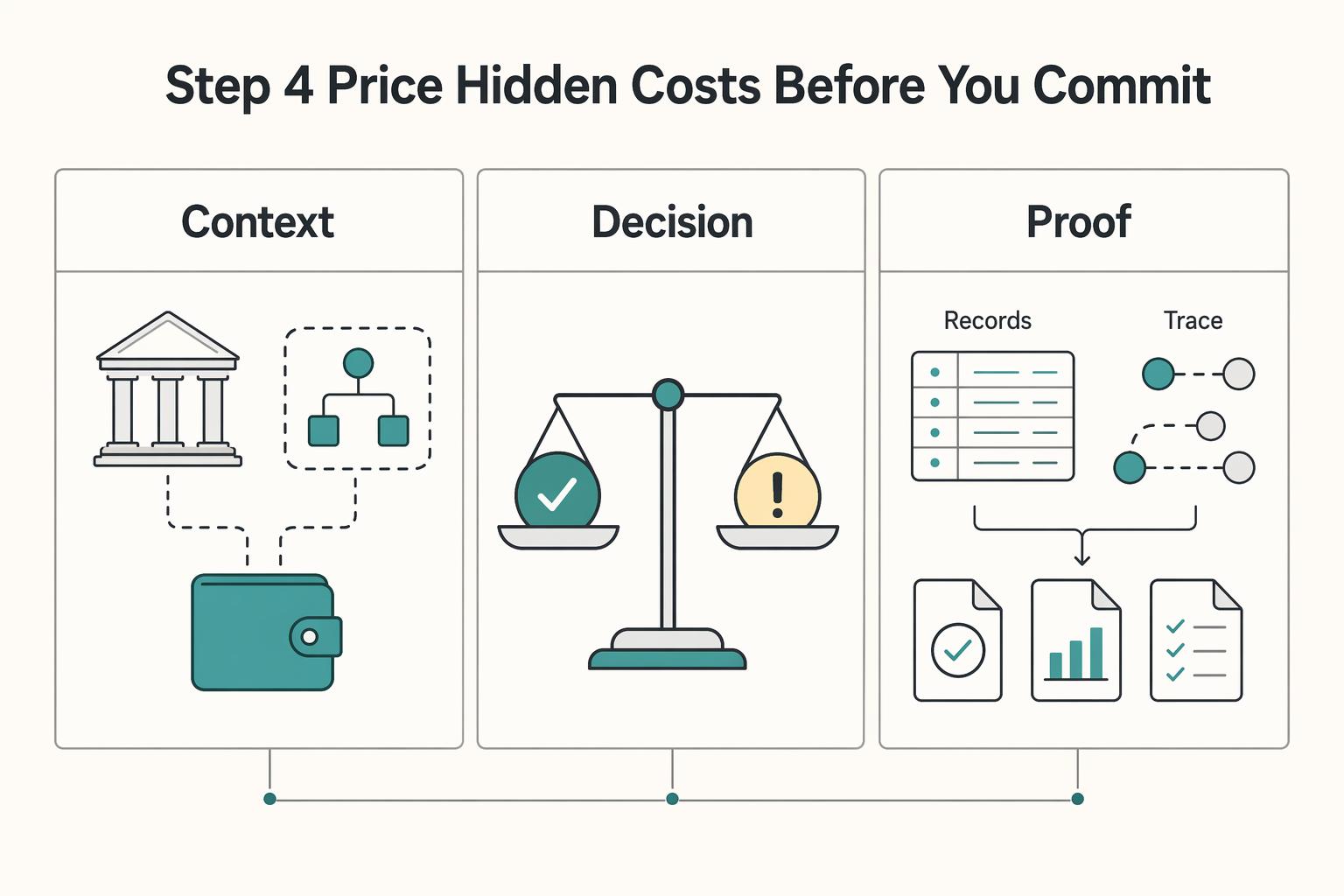
Step 4 Price hidden costs before you commit#
The ongoing burden is evidence quality, not badge placement. Third-party deposit programs can depend on partners for core deposit and transaction records, and banks remain responsible for compliance even when third parties operate parts of the stack.
Include these cost centers in initial scope:
- legal review of account structure, disclosures, and claim language
- bank-partner integration and operational dependency management
- ledger traceability to beneficiary ownership
- support scripts for insured versus uninsured scenarios
- ongoing disclosure governance as product flows change
Choose the architecture that supports the narrowest truthful claim you can operate every day. It is usually easier to expand claims later than to unwind an overly broad "FDIC insured" impression after launch.
For a step-by-step walkthrough, see How to Automate Pass-Through Expense Tracking from Clients in QuickBooks.
Define the coverage boundary in plain English#
Make this copy rule non-negotiable: FDIC coverage applies to deposits at an insured depository institution, not to your wallet company’s solvency. Put that boundary into product copy, support macros, and legal review notes before you discuss badge placement.
Step 1 Name the protected event correctly#
State the trigger directly: FDIC insurance protects eligible deposits if the FDIC-insured bank holding those deposits fails. It does not protect users from the default, insolvency, or bankruptcy of a nonbank entity, including a wallet provider or neobank.
Use this check on every insurance sentence: it should name the bank, or clearly refer to the insured depository institution holding the funds. If replacing the bank name with your brand still sounds true, the claim is probably too broad.
Step 2 Separate covered deposits from everything else#
Use a strict covered versus not covered test:
- Covered: eligible deposit funds are placed at an FDIC-insured bank, and that bank fails.
- Not covered: a nonbank entity (for example, a wallet provider or neobank) fails.
- Not covered product: crypto assets or any other non-deposit product.
When wallet balances, bank deposits, and non-deposit features get blended into one promise, users may assume the app itself is protected.
Step 3 Anchor internal language to Part 330#
For compliance and counsel review, anchor language to 12 C.F.R. § 330.5 and 12 C.F.R. § 330.7. Section 330.5 ties fiduciary recognition to express disclosure in the insured bank’s deposit account records. Section 330.7 says principal-owned funds in agent, custodian, or nominee accounts can be insured as if deposited in the principals’ names.
Product copy rule: do not imply the wallet itself is FDIC-insured. Say deposits may be eligible for pass-through coverage at the named bank, subject to FDIC rules and records.
For another coverage-boundary example, see AirCover Is Backup for Hosts, Not Your Primary Insurance Plan.
Prepare prerequisites and your evidence pack before implementation#
Do not ship pass-through language until your documents and records could hold up in an FDIC failure-time review. FDIC determines whether pass-through requirements are satisfied when the insured depository institution fails, so your evidence pack needs to prove the setup, not just describe it.
Step 1 Assemble a launch packet that matches the account structure#
Build one packet that shows what the account is, who owns the funds, and what your team can say publicly. Include the bank agreement, an account-structure memo for the pooled or custodial setup, disclosure drafts, and approved support language.
Under 12 C.F.R. § 330.5, fiduciary treatment depends on express disclosure in the bank’s deposit account records. Those records include bank-held ledgers and related account documents. Confirm the bank record itself reflects the fiduciary or custodial relationship, not just your internal docs.
Step 2 Define exact ownership data before writing product copy#
Set ownership fields before launch. FDIC pass-through materials require records that identify principals and their ownership interests, so beneficiary mapping cannot be approximate.
For each owner, define and store at least:
- legal name or stable customer identity key
- relationship to the pooled account
- ownership interest or principal amount attributable to that owner
- event history your team uses to reconcile balances
Produce an export listing all end parties and principal amounts. If internal systems disagree on who owns a balance, treat that as a launch blocker.
Step 3 Build a claim-to-source matrix for every user-facing sentence#
Every insurance statement in UI, help docs, onboarding, and support should map to a verified source and approver. Use this matrix to catch overbroad insurance copy and misleading FDIC name or logo usage before launch.
| Claim or disclosure | Source to verify against | What to check |
|---|---|---|
| Funds may be eligible for pass-through coverage at the named FDIC-insured bank | FDIC pass-through guidance, counsel sign-off | Names the bank and does not imply your nonbank is insured |
| Wallet provider is not itself FDIC-insured | FDIC consumer resource on third-party apps | Statement is explicit and easy to read |
| Non-deposit products are not FDIC-insured | FDIC sign and advertising rule materials | No name/logo usage implies uninsured products are covered |
| User agreement explains where funds are held | CFPB payment-app advisory | Terms are not murky or silent on custody location |
Step 4 Keep an unknowns log and review it with the bank and counsel#
Track unresolved points instead of smoothing them over in copy. FIL-16-2022 is inactive or rescinded, and FDIC has said further guidance is expected, so older interpretations should stay logged as open items, not treated as settled assumptions.
Also keep proposal context separate from effective requirements. FDIC’s September 17, 2024 custodial-account proposal discusses stronger recordkeeping, including beneficial-owner records and daily reconciliation, but do not present proposal items as final rules. Tie each unknown to an owner, decision date, and copy impact so claims stay narrow until resolved.
Related: Usage-Based Billing for LLM API Platforms: Token Metering and Cost Pass-Through.
Choose the account architecture and banking model#
Choose the model your team can prove with bank records at failure time, not the one that reads best in a product spec.
Step 1 Match the legal form to the real funds flow#
Start with how funds actually move through your wallet. If funds are held at an FDIC-insured bank through an agent, custodian, or similar fiduciary setup, that relationship has to appear in the bank’s deposit account records.
Under 12 C.F.R. § 330.7, funds owned by principals can be deposited in an agent or custodian account and insured as if held in the principals’ names. A pooled trust or custodial structure can fit this, and FDIC guidance contemplates commingled accounts for multiple principals. But pooled does not mean automatically covered.
Records must disclose the fiduciary relationship. If there are multiple layers, each layer must be disclosed. If disclosure requirements are not satisfied, insurance applies to the broker, not end users.
Have your bank partner show the exact account title and related account documents at the insured depository institution that identify the fiduciary or custodial relationship.
Step 2 Compare pooled, segregated, and hybrid by operational burden#
Treat this as an operations choice, not a naming choice. Score each option against onboarding friction, reporting burden, reconciliation load, and support impact in your own environment.
| Architecture | Operational focus | Main burden to score | User outcome to score |
|---|---|---|---|
| Pooled trust or custodial account | Shared external account structure | Continuous beneficiary mapping, exception handling, reconciliation discipline | Payout handling when returns or delays occur; statement clarity when funds are in a shared structure |
| Segregated per-user accounts or clearer subaccount separation | More direct user-level separation | More account setup and administration steps | Transparency of where funds sit; potential onboarding or maintenance friction |
| Hybrid model | Mix of pooled and separated flows | Two control paths, two disclosure paths, classification risk | Flexibility with higher support complexity when balances behave differently |
If your team cannot explain in one sentence why a user is in one model rather than another, expect that explanation to show up in support tickets.
Step 3 Pressure-test the model against failure-path user outcomes#
Before you finalize the structure, test delayed payouts, returned transfers, and balance disputes. The practical checks are simple: can you identify the affected beneficial owner quickly, restate available balance without manual reconstruction, and explain whether funds are deposit products or non-deposit products?
This matters because FDIC has cited Synapse-related disruptions where consumers could not access placed funds for months. CFPB has also warned that stored app balances can face nonbank platform failure risk and may lack individual deposit insurance. Design support macros and statement text for that moment, not only for normal flow.
Failure mode to test now: a credit posts to the pooled account, but beneficiary mapping is delayed or wrong. If ownership is not continuously identifiable, payout timing, available-balance accuracy, and insurance representations can all degrade together.
Step 4 Narrow claims until records are continuously reliable#
If you cannot maintain beneficiary-level accuracy continuously, do not market pass-through protection. Keep claims limited to what you can prove, such as: funds are held at a named bank, and pass-through treatment depends on account structure and recordkeeping.
Under 12 C.F.R. § 330.5, beneficial interests in commingled custodial deposits may be determined on a fractional or percentage basis, but only if your ledger can produce those allocations cleanly. This connects directly to the $250,000 limit, which FDIC applies by aggregating deposits owned by the same depositor in the same ownership capacity.
For context, use known analogs like IOLTA and UTMA or UGMA arrangements. The core principle is the same: legal form and disciplined ownership records drive treatment, not labels in the app.
This pairs well with our guide on Choosing Creator Platform Monetization Models for Real-World Operations.
Build ledger and ownership records that survive an audit#
Once you choose pooled or hybrid custody, recordkeeping becomes the main product risk. If you support pass-through treatment (not a separate ownership category), your records should let an outsider trace each dollar from the bank’s records to a named beneficial owner in the platform wallet without rebuilding history from ad hoc notes.
Step 1 Make the ledger the source of truth for ownership#
Use the internal ledger, not the app balance cache, as the authoritative record for credits, holds, returns, fees, adjustments, and payouts. Keep a clean chain from external event to ledger entry to beneficiary balance so disputes and failure scenarios do not depend on manual reconstruction.
That is the practical standard because FDIC ownership determinations start from the insured bank’s deposit account records. Under 12 C.F.R. § 330.5, FDIC presumes ownership matches those records and may consider other evidence only if records are unclear.
Implementation pattern: use append-only balance events with stable timestamps, source references, and resulting ownership amounts. If a webhook says funds are available but bank placement is unresolved, keep separate states instead of collapsing everything into one "available" balance.
For one user, trace the current balance backward to source events, then forward to the same ending balance with no manual edits.
Step 2 Store identity and relationship mappings that do not drift#
For pass-through attribution, user ID plus amount is not enough. You need point-in-time records of principal identity and ownership interest in the deposit, with fiduciary relationships clearly represented where applicable.
For FDIC recognition of fiduciary-based claims, fiduciary capacity must be expressly disclosed in the bank’s deposit account records, and records should identify principals and each principal’s ownership interest. Your system should preserve a durable history of legal identity, effective dates, account relationship, and ownership method. Immutability is an engineering choice, not a quoted FDIC requirement. It is still one of the clearest ways to show ownership was not rewritten after the fact.
Watch account merges, profile edits, and entity changes. Historical ownership at the time of deposit and payout must remain provable. For any balance, you should be able to produce the point-in-time beneficial owner, ownership amount, and relationship to the pooled account.
Step 3 Add daily breaks and explicit exception ownership#
Run daily controls: reconcile ledger totals for funds placed at partner banks, maintain an unmatched deposit queue, and assign each exception to a named owner with a due time.
These are operational controls, not quoted FDIC mandates. They still align with the direction of scrutiny. In September 2024, FDIC proposed custodial-account changes that included daily per-owner reconciliation language, and the comment deadline was extended to January 16, 2025. In the materials provided here, that proposal is not final.
Treat growing unmatched exceptions as a coverage and support risk, not just an ops nuisance. If you cannot identify owner and owned amount after bank placement, both your coverage posture and your user messaging weaken. By end of day, each open break should have a reason code, named owner, and expected resolution time.
Step 4 Make replay and retry behavior evidence-safe#
Incident recovery should not change ownership history. Webhooks can be delivered more than once, and providers like Stripe may resend undelivered events for up to three days. Duplicate posting or in-place mutation during replay can break your evidence trail.
Use duplicate-safe inbound processing and, as an operational control, idempotent outbound payout requests. One payout attempt should keep one stable operation ID across retries. On inbound events, store the external event ID, processing result, and linked ledger entry so you can prove replay did not create a second ownership claim.
Replay a day of webhook traffic in recovery testing. Ending balances, ownership allocations, and payout states should match the original run exactly.
Related reading: How to Choose a Beneficiary for Your Life Insurance and Retirement Accounts.
If you are mapping beneficiary ownership, retries, and reconciliation controls, review the implementation surfaces in Gruv Docs.
Write disclosures users can understand and regulators can defend#
Once your ledger can prove ownership, disclosure copy becomes the next failure point. If users can read your app and infer that the wallet company, a crypto feature, or the full balance is insured, your controls will not fix that later. Keep one consistent coverage boundary across key moments like onboarding, the balance view, and withdrawal or transfer flows.
Step 1 Put one insured-deposit statement in key moments that matter#
Use onboarding to set the rule, the balance view to keep it visible, and money-movement flows to restate it. When funds are held as a deposit, name the specific bank and state that coverage applies to deposits there, subject to applicable requirements and limits.
Keep the scope explicit: coverage is tied to bank failure, not broad protection for the platform or app. If you mention pass-through treatment, do not present it as automatic. FDIC materials make clear that conditions must be satisfied.
Click through one insured-cash journey and confirm the same bank name, coverage statement, and limit language appear across those surfaces.
Step 2 Separate deposit products from non-deposit products in both words and layout#
Do not let one "wallet balance" label blur insured cash with uninsured assets. Part 328 defines non-deposit products broadly, including securities and crypto-assets, and FDIC consumer guidance says non-deposit investment products are not insured even when purchased from an FDIC-insured bank.
Your UI should reflect that classification. If you offer cash storage and crypto-linked features, show them as separate rows, cards, or tabs with separate labels and disclosures. "Cash held at [Bank Name]" and "Crypto balance" should not share one insurance icon, one subtotal, or one generic badge.
A practical wording pattern is to describe cash as a deposit product only when it is one. Describe crypto or investment features as non-deposit products that are not FDIC-insured.
Step 3 Add fast negative statements, especially for non-bank failure scenarios#
Put short negative statements where decisions happen. The July 29, 2022 FDIC advisory states: "By federal law, the FDIC only insures deposits held in insured banks and savings associations (collectively, 'insured banks') in the unlikely event of an insured bank's failure. The FDIC does not insure assets issued by non-bank entities, such as crypto companies."
Translate that into plain in-product warnings:
- Not FDIC-insured if the balance is a crypto asset or other non-deposit product.
- FDIC coverage does not protect against losses caused by failure of the wallet provider or another non-bank entity.
- Not a claim that the app itself is FDIC-insured.
CFPB reporting highlights related risk: stored funds on nonbank payment platforms can face loss risk if the nonbank operator is in financial distress.
Step 4 Review each disclosure against your evidence pack before release#
Treat each disclosure sentence as a product claim that needs support. For each claim, keep the backing record in your launch packet: bank agreement, account-structure memo, counsel-approved language, and the exact UI state where the claim appears.
If the product changes, such as by adding a conversion rail or crypto feature, re-check classification before older insurance copy carries into new flows.
Final checkpoint: for one test account, capture onboarding, balance, and withdrawal-flow screenshots, then compare them against actual ledger state and the bank holding the deposit. If they do not align, soften or remove the insurance claim until they do.
Implement payout and treasury controls around insured balances#
Treat payout release as the final insurance boundary, not just another transfer step. If you cannot show that funds are still an eligible deposit product at a bank at release time, do not auto-release.
Step 1 Gate payout release on settled ownership and classification#
Release payouts only from funds that have passed your internal identity, sanctions or compliance, and ledger-finality checks. That is an internal control choice, not an FDIC rule requirement, but it can help prevent mixing potential pass-through deposit funds with exception-state or unsupported-rail funds.
The legal anchor is still the record trail: 12 C.F.R. § 330.5 ties fiduciary recognition to express disclosure in deposit account records, and 12 C.F.R. § 330.7 ties coverage to the principal’s ownership as if the principal deposited directly. Operationally, your payout service should read the same ownership record used in reconciliation, not a projected balance cache or a generic "available funds" field.
Before release, confirm the payout maps to a settled credit, includes beneficial-owner mapping, is still classified as a deposit product, and has not been rerouted into a non-deposit path.
Step 2 Keep conversion and FX paths fully traceable#
Conversion is a classification boundary, so make it explicit. If insured-bank cash is converted into a crypto asset, tokenized balance, or another non-deposit product, the coverage story changes.
FDIC materials state that deposit insurance does not apply to non-deposit products, including crypto assets, and that risks rise when nonbank crypto offerings are paired with insured-bank deposit products. Do not treat FX or conversion as a silent treasury action.
As an internal control, log the pre-conversion asset type, post-conversion asset type, rate source, timestamp, and disclosure version. If classification changes mid-flow, update disclosures and consider collecting a fresh user acknowledgment before execution.
Step 3 Route holds, returns, and unmatched receipts into an exception queue#
Exception handling is a common failure point in insured-balance operations. Use explicit statuses for hold, return, reversal, and unmatched receipt, and require operator reason codes plus timestamps for events outside the normal posting flow.
This is an operational safeguard, not a prescribed queue design. Recent third-party failures showed that reconciliation and data-access breakdowns can block customer fund access for months. The September 17, 2024 FDIC custodial-recordkeeping proposal also points toward stronger per-owner daily reconciliation and standardized records.
For each exception, retain the inbound receipt reference, ledger event IDs, beneficial owner ID, bank posting status, operator action, and final resolution time.
Step 4 Fail closed when coverage classification is unclear#
As an internal control, if you cannot clearly classify funds as still within the insured-deposit path, stop automation and route the case to manual review before releasing contractor funds. This matters most when UI labels, treasury actions, and ownership reconciliation are temporarily out of sync.
The CFPB risk lens supports that caution: stored funds on nonbank payment platforms can be exposed to loss if the nonbank operator enters financial distress. When classification is ambiguous, a documented delay is safer than releasing funds you cannot tie back to clean deposit records and supportable disclosures.
Run failure drills and go-live verification#
Before go-live, treat insurance-risk incidents as data, timing, and classification failures first, not just bank-failure events. If your platform wallet UI, support answers, and audit exports cannot answer the same balance question the same way, hold launch.
Step 1 Simulate the failures that can break your coverage claims#
Run drills for bank-partner outages and processing/data-sync failures (for example, posting delays, duplicate-event handling, or stale balance display in the platform wallet UI). These scenarios are operational tests, but they directly pressure the conditions that determine whether funds are actually deposited at an FDIC-insured bank and tied to the correct owner.
For each drill, verify you can still show:
- who owns the money
- the specific amount each person owns
- whether funds have been deposited at a bank or are still in transit or pending
Use a simple pass or fail check:
- ledger status and bank posting status agree
- beneficiary records still identify each owner and amount
- duplicate or replayed events do not create a second payable balance
- stale UI balances are hidden or marked pending, not spendable
Step 2 Test support scripts with conditional, approved language#
Support should answer balance-insurance questions conditionally, not absolutely. For "Is my balance FDIC-insured?", the baseline in third-party app flows is: it depends on whether funds were deposited at a bank and whether records identify owner and amount.
For "What happens if the wallet company fails?", be direct: the nonbank company itself is not FDIC-insured, and deposit insurance does not apply when a nonbank payment company fails. It is also fair to say outcomes may be unclear in that scenario, so your messaging must clearly separate bank-failure coverage from wallet-company failure risk.
Reject any script that implies the wallet company is FDIC-insured. Deposit-insurance communications should be clear and conspicuous.
Step 3 Verify claim-to-control alignment before launch#
Do not treat go-live as complete until finance, legal, and ops can review the same exports and reach the same conclusion. For each drill sample, confirm the record set includes disclosure version, timestamps, beneficial owner ID, amount, bank posting status, payout status, and any exception or manual-review flag.
Your evidence should show:
- when UI says funds are insurance-eligible, logs show bank deposit status plus correct ownership mapping
- when UI says pending or unavailable, logs show the unresolved outage, delay, or duplicate-event handling
- when support gives a conditional answer, account evidence shows why that condition applies
If legal-approved language cannot be reproduced from operational records, hold launch. Stored funds can be at risk in platform distress or failure, and product-condition differences can amplify consumer confusion. Your records should reduce that confusion, not add to it.
Handle common mistakes and recover without trust damage#
If drills expose copy, ledger, or record defects, pull back insurance claims until the evidence is clean. Trust can drop quickly when broad insurance language stays live while deposit status and ownership mapping are still uncertain.
Step 1 Remove app-wide insurance badges#
Remove any blanket "FDIC insured" badge across the app, wallet home, or marketing header. A nonbank company is not itself FDIC-insured, and funds sent to a nonbank are not eligible until they are deposited at an FDIC-insured bank and coverage conditions are met.
Recover narrowly, not cosmetically: show insurance language only on the balance or flow that actually routes to a deposit product. Check that the wallet UI, help copy, and support macros all describe the same covered balance, not the app or company.
Step 2 Separate crypto and cash everywhere users can see it#
If you offer crypto and insured-bank deposits in one product, split the narrative immediately. Confusion risk rises when nonbank crypto offers and insured deposit offers sit together, and deposit insurance does not apply to crypto or other non-deposit products.
Make the split in ledgers, UI labels, and support replies at the same time. Avoid a single blended total balance across crypto and insured-bank cash.
Step 3 Pause claims when beneficiary records are weak#
If owner-and-amount mapping is incomplete, pause new insured-balance claims until records are fixed. Pass-through coverage depends on records that identify who owns the money and the specific amount each person owns, and FDIC determinations rely on insured bank deposit records.
Backfill mappings, reconcile to bank posting status, and relaunch only after sample exports show owner ID, amount, and deposit status align. If you cannot reproduce that evidence on demand, keep product language narrower.
Step 4 Put legal review on a calendar#
Treat legal review as recurring operations, not a launch checkbox. FDIC digital-channel disclosure and signage expectations have continued to evolve, including rule changes published January 29, 2026, effective March 2, 2026, with compliance required by April 1, 2027.
Set a recurring review cadence for policy, product copy, support scripts, and bank-program changes, and rerun review when partner-bank setup, asset mix, or account structure changes.
If you want a deeper dive, read How to Handle Tax on Platform Wallet Interest: FDIC Pass-Through and Income Reporting.
Conclusion#
Treat pass-through deposit insurance as a control system, not a marketing label. If your disclosures, bank setup, and beneficiary records do not stay consistent, your coverage claim may be weaker than your app copy.
- Confirm coverage boundaries everywhere users see balances.
Say FDIC insurance applies to eligible deposits at an FDIC-insured bank, and that protection is tied to failure of that insured bank. State your company is not an insured bank, name the insured bank(s) where relevant, and separate deposit products from non-deposit products. Remove any app-wide "FDIC insured" language that could spill into mixed or uninsured balances. If you run a compliance calendar, include review of current 12 C.F.R. 328.4 and 328.5 requirements and compliance dates.
- Prove beneficiary ownership records reconcile to the ledger.
Pass-through treatment depends on record structure, not intent alone. The fiduciary relationship must be expressly disclosed in deposit account records, and agency or nominee treatment depends on principal ownership mapping. For any date, you should be able to produce beneficiary name, ownership interest, and balance, then reconcile that to bank-facing records. If disclosure requirements are not met, coverage may be recognized at the broker level instead of the customer level.
- Keep insured cash paths separate from crypto or other non-deposit paths.
FDIC insurance does not apply to non-deposit products, including crypto assets, even when purchased through an insured bank. Use separate ledgers, labels, funding routes, and support language so one claim is not read across the whole wallet. If funds move into a non-deposit path, require fresh disclosure and user confirmation.
- Run internal failure drills and lock support scripts before scaling stored balances.
The operational goal is consistency: finance, ops, and support should describe the same coverage boundary during incidents. Test outage and posting-error scenarios, and verify support does not imply the wallet itself is insured or that nonbank failure is covered by FDIC insurance. Keep this tight because users are often unclear about where app-held funds are actually held.
- Maintain an open unknowns log and review it after program or rule changes.
Track unresolved items such as account titling, beneficial-owner data gaps, returned-funds exceptions, and disclosure text awaiting counsel or bank approval. Revisit the log when your bank program changes or guidance shifts. Also update policy docs for current guidance, including the change that rescinded FIL-16-2022.
If you can pass these checks, you can offer stored balances with clearer, defensible coverage claims. If not, narrow the claim first, then fix the records.
Need the full breakdown? Read Health Insurance for Freelancers in France During Your First Year.
Before launch, align your bank-program assumptions, payout flow classification, and disclosure language with your exact setup by talking with Gruv.
Frequently Asked Questions
Is a `platform wallet` itself FDIC-insured?
No. FDIC insurance applies to insured deposits at an FDIC-insured bank, not to a wallet company, app, or other nonbank entity. Keep product and support language tied to the specific covered deposit balance, because false or misleading deposit-insurance representations are prohibited.
What does `pass-through deposit insurance` cover in a contractor wallet setup?
It can cover a contractor’s interest in funds deposited at a bank through a third party, if required conditions are met. Pass-through treatment depends on fiduciary disclosure in the failed bank’s deposit account records and records showing each beneficiary’s identity and ownership interest. If you cannot produce that owner-and-amount mapping, do not present pass-through coverage as settled.
What losses are not covered, even if a partner bank is `FDIC-insured`?
FDIC insurance does not cover non-deposit products, and crypto assets are in that excluded category. It also does not protect customers from the default, insolvency, or bankruptcy of a nonbank entity such as a wallet provider, broker, exchange, or custodian. An insured partner bank does not make every adjacent product or company insured.
Does FDIC insurance protect users if the wallet provider or `neobank` becomes insolvent?
Not by itself. FDIC insurance does not apply upon the failure of a nonbank, including entities that appear bank-like but are not banks. If funds were actually placed as insured deposits at a partner bank, the relevant protection is tied to the bank-failure scenario.
Are balances linked to a `crypto exchange`, `crypto broker`, or `crypto custodian` FDIC-insured?
Not as a category. Crypto assets are non-deposit products, so they are outside FDIC deposit insurance. If your product includes both crypto features and insured-bank deposits, separate balances and disclosures so one claim is not read across both.
Why do two apps with similar wallet UX have different insurance outcomes?
Because coverage is determined by account structure and fund placement, not by interface similarity. The CFPB notes that apps can use different business models, investment strategies, and risk profiles, and disclosures are often unclear about where funds are held. Validate the bank relationship, account structure, and beneficiary-level records before treating similar UX as similar protection.
What should product and support teams say in-app to avoid misleading users?
State the partner bank and the specific balance that is an eligible deposit product. Explain limits in plain terms: generally up to $250,000 per depositor, per insured bank, per ownership category. Also say what is not covered, including crypto and losses from nonbank failure. Then align help content, tooltips, and support macros to that same language so claims stay consistent.
Researched and edited by the Gruv editorial team. Gruv builds cross-border billing, payouts, and finance-operations software for global businesses.
Sources
- consumerfinance.gov/data-research/research-reports/issue-spotlig...trusted
- consumerfinance.gov/about-us/newsroom/consumer-advisory-your-mon...trusted
- ecfr.gov/current/title-12/chapter-III/subchapter-B/pa...trusted
- ecfr.gov/current/title-12/chapter-III/subchapter-B/pa...trusted
- fdic.gov/financial-institution-employees-guide-deposi...trusted
- fdic.gov/consumer-resource-center/2024-06/banking-thi...trusted
- federalregister.gov/documents/2024/10/02/2024-22565/recordkeepin...trusted
Educational content only. Not legal, tax, or financial advice.
Related Posts

The Freelance Payment Penalty: A Modeled Audit of Platform Fees, FX Spreads, and Payout Delays
The money rarely disappears through a single, easy-to-spot fee. The real loss is stacked. A marketplace takes its commission, a processor adds a charge for international cards, a bank or payment company converts the currency at a spread, a platform holds the funds before release, and a wire sheds a little to intermediaries on the way in. Each layer looks defensible on its own, but the worker feels the combined result as a smaller deposit and a later payday.

How to Respond to a Subpoena for Business Records
Move fast, but do not produce records on instinct. If you need to **respond to a subpoena for business records**, your immediate job is to control deadlines, preserve records, and make any later production defensible.

A US Expat's Guide to Investing in UCITS ETFs to Avoid PFIC Issues
The real problem is a two-system conflict. U.S. tax treatment can punish the wrong fund choice, while local product-access constraints can block the funds you want to buy in the first place. For **us expat ucits etfs**, the practical question is not "Which product is best?" It is "What can I access, report, and keep doing every year without guessing?" Use this four-part filter before any trade: