
Quick Answer
Start by confirming who is responsible for your health coverage, then keep gap protection in place until reimbursements are active. For health insurance freelancers france planning, registration alone does not confirm usable public benefits, and Carte Vitale timing can lag behind eligibility. Track acknowledgments and document requests in one dated log, use early claim outcomes to decide mutuelle timing, and keep any cross-border proof in writing before ending home-country arrangements.
What this guide helps you do before and after you move#
This guide helps you sequence health coverage so you stay protected while French enrollment catches up. In France, coverage is split between public insurance and private top-up cover, so your Carte Vitale and reimbursements may not go live quickly.
The practical order is simple: cover the gap before you move, start public enrollment once you are in scope, then decide whether extra top-up cover is worth adding. That sequence matters because patients often pay upfront and get reimbursed afterward, so timing affects both access and cash flow.
Before you move#
Your first decision is gap coverage, not the cheapest long-term plan. If public coverage will still be pending, keep interim or expat insurance active for the wait.
Use a simple pre-move checklist. Keep proof of your France entry date, copies of any home-country coverage documents, and a clear record of when temporary cover ends. If you may rely on transition documents from another system, treat them as a verification task. Confirm the coverage period, end triggers, and required proof in writing.
After you arrive#
For many movers, the first real checkpoint is the 3-month mark. One relocation guide says this is when expats may access public healthcare through PUMA and apply through Assurance Maladie, but it also warns to expect delays.
| Checkpoint | Timing | Grounded note |
|---|---|---|
| PUMA access and application | 3-month mark | One relocation guide says this is when expats may access public healthcare through PUMA and apply through Assurance Maladie |
| Full enrollment | Another 3 to 6 months | Applied is not the same as fully active, and the same source estimates 3 to 6 more months for full enrollment |
| Total wait | About nine months | Plan for months, not days, and do not end interim cover before reimbursements are actually live |
"Applied" is not the same as "fully active." Expect another 3 to 6 months for full enrollment, with a total wait of about nine months. Plan for months, not days, and do not end interim cover before reimbursements are actually live.
Keep a dated record of every submission receipt, follow-up request, and account update. If your file stalls, that record helps you show exactly where the process stopped.
Where public cover ends#
Public coverage is the foundation, not always the full solution. France's system is commonly described as split between public and private coverage, and supplementary cover helps pay costs the public side does not fully reimburse.
If your care use is light, you can wait to see your early claims pattern before adding it. If you expect regular consultations or recurring care, review top-up options earlier.
The two tricky branches#
Low-income periods and cross-border overlap need closer handling. Keep PUMA on your decision map, but do not guess contribution outcomes from informal sources. Review that question once your residence and income picture is clear.
If you still have home-country social security ties, verify responsibility and dates explicitly. For transitions between systems, confirm who covers you, when coverage starts and ends, and keep proof.
Start with the right entry path into French health coverage#
Once you know the timing risk, the next step is making sure you are on the right entry path. Start with one checkpoint: are you actually inside the French health system yet, or still in a gap period that needs temporary cover? Business registration alone is not proof that your public coverage is active.
Do not confuse registration with active public cover#
Treat registration as an admin step, not proof of automatic entry to L'Assurance Maladie. France's statutory system is employment-based, with tax-financed coverage for unemployed residents, so the practical test is whether entry into public coverage is confirmed.
If entry is still pending, keep interim insurance in place. Temporary cover is described for newcomers for up to 12 months while they have not yet entered the French system. Do not cancel private or expat cover until your public-side status is clearly no longer pending.
Confirm your status before relying on statutory affiliation#
Before you rely on state cover, confirm that your entry is recognized in the French system. Do not rely on forum advice or legal form alone.
If your status is still unclear, keep temporary or private cover active. Qualifying expatriate residents are described as needing to contribute to state health insurance to benefit from it.
Let health admin influence your company choice#
If you are deciding on a company structure, include health administration in the decision, not just tax and liability.
A useful filter is simple: which setup gives you the clearest path to prove and track health affiliation? If you are not yet affiliated, longer-term private cover may be needed; once affiliated, private top-up cover can help with costs the public side may not fully reimburse.
For a step-by-step walkthrough, see A guide to 'health insurance portability' when moving between countries.
Build your first 90 days timeline from registration to active reimbursements#
In the first 90 days, do not focus on the card. Focus on coverage jurisdiction. Start by deciding whether you are entering French social security or using a valid exemption document tied to another country.
Under the U.S.-France totalization framework, that decision changes your path. If you are self-employed and work only in France, the agreement assigns French coverage. If an exemption from French social security taxes applies, you cannot use French health-system benefits and must arrange private health insurance before that exemption applies.
Start with the coverage decision, not the card#
French administrative steps can vary by case. Do not assume there is an exact French week-by-week sequence, so do not plan care access around fixed week targets.
If you may qualify for a U.S.-linked exemption, file the Certificate of Coverage request early and keep the control number. The SSA portal lets you check request status, and Received means the request was received for processing.
Use this default rule: if you freelance only in France, assume the French coverage path unless you have document-backed grounds for exemption. A certificate request supports an exemption decision. It does not activate French reimbursements.
Use one tracker for both sides#
A simple tracker keeps the French and U.S. sides from getting mixed together when offices ask for repeats.
| Stage | What you are waiting for | Tracker label | Proof to save |
|---|---|---|---|
| French business setup | Filing accepted | submitted | filing receipt, submission date, business ID (when issued) |
| SSA certificate request (if relevant) | SSA logs the request | submitted -> Received | control number, status screenshot |
| French health-file handling | Any written movement | document requested / under review | emails, letters, portal messages |
| Temporary written proof (if issued) | Interim document in hand | temporary proof received | PDF/letter copy, issue date |
| Card process | Card not yet delivered | card pending | any written processing confirmation |
| SSA follow-up window | Time threshold reached | follow-up eligible after 90 business days | dated status-check log |
| SSA certificate mailed | Issued document in transit | issued / mailed | certificate copy, delivery date notes |
Treat attestation as possible, not guaranteed#
You may hear that an Attestation de couverture sante can bridge access while a Carte Vitale is pending. In this section's grounding, that fallback is not guaranteed, so treat it as case-specific until you have written confirmation.
Ask for written proof of any temporary coverage document available to you, and keep it ready for appointments. If no temporary proof has been issued yet, keep interim private cover active.
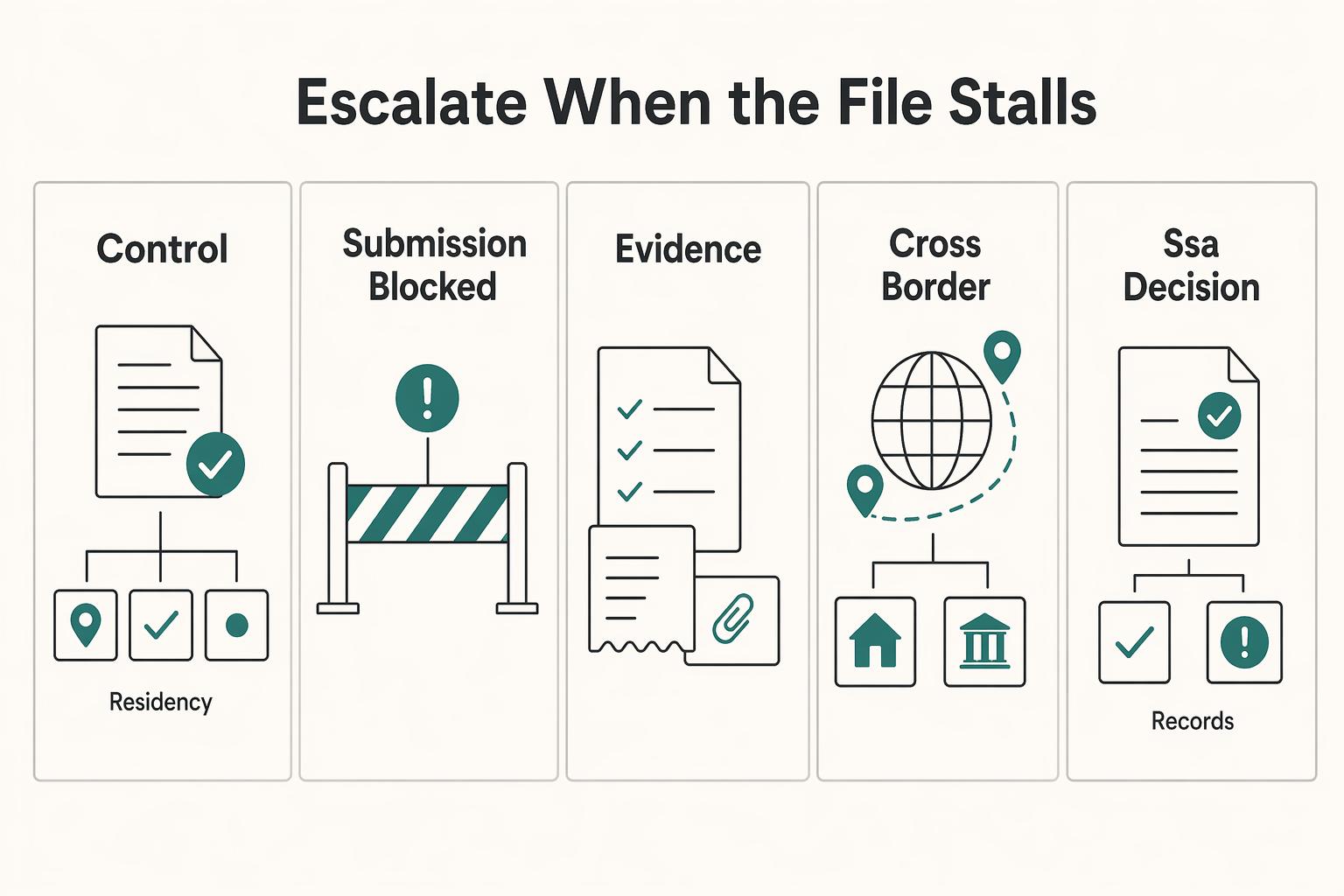
Escalate when the file stalls#
When the file stops moving, escalate from evidence, not memory. Use a short sequence:
| Situation | What to do | Grounded detail |
|---|---|---|
| No movement after submission | Confirm you have an acknowledgment or control number | For SSA requests, check status first |
| Submission blocked | Complete required fields | SSA does not transmit incomplete required fields |
| Repeated document requests | Resend with prior submission dates and earlier acknowledgment details | Include the earlier acknowledgment details in the resend |
| Cross-border scope issue | Keep certificate or exemption questions separate from French local-file questions | Follow the contact instructions in the latest notice for each process |
| No SSA decision yet | Wait 90 business days before follow-up | If issued, allow up to two weeks for mailing |
Keep the first 90 days document-driven: receipts, control numbers, status checks, requests, and temporary proof. In this phase, records are what keep the case moving.
Related reading: How to Get Health Insurance in Mexico as a Temporary Resident.
Prepare the document pack that prevents repeat requests#
Most repeat requests come from three problems: incomplete submissions, inconsistent core details, or messy resubmissions. The cleanest fix is to build two document bundles and a submission log from day one.
Build two bundles with different jobs#
Keep one bundle for core identity and civil-status records used across your filings. Prepare it before you submit anything, and treat it as your master set.
Keep a second bundle for later corrections or follow-on updates, but only after you have written proof that your file is moving.
Do not guess at a universal France checklist. Reuse one clean core set, export submission-ready files from it, and avoid editing the same document over and over after submission.
Track every submission like evidence#
Log each submission, no matter the channel: portal, email, upload form, or mail. Use the same fields every time:
- submission date
- channel used
- receiving office or portal
- exact file name sent
- purpose
- acknowledgment, screenshot, or reference number
Use clear, purpose-based filenames so corrections are obvious, for example 2026-03-22_identity_passport_initial.pdf and 2026-04-05_birth-record_correction.pdf. If you resend a file, label it clearly as a correction, duplicate, or amendment in your own records and cover note.
If you are using the SSA certificate request system, complete every required field before submitting. Then track status checkpoints (Received, Pending, Completed), allow 90 business days before following up, and allow up to two weeks for mailing after issuance.
Run one consistency check before each new submission#
Before sending anything, verify the same core data across every form and account:
- full name format
- date of birth
- place of birth
- current address
- contact email and phone
- any reference number already assigned
If you are also pursuing a U.S. exemption path, keep that track separate from your local health-administration file. A Certificate of Coverage supports social security tax exemption status. Under the U.S.-France agreement, that exemption can mean no access to free French health care services, so private health insurance must be arranged before the exemption applies.
Understand what basic coverage pays before you add top-up insurance#
Before you compare private top-up plans, get clear on the public layer. Basic French public coverage is partial, not full: Assurance Maladie or CPAM reimburses part of eligible care, and the top-up layer is separate insurance for some of what remains.
Separate the public layer from the top-up layer#
The public layer comes first. Under PUMa, legal residents can access state health coverage, but reimbursement varies by type of care. Private top-up cover does not replace CPAM. It pays part of the leftover amount after public reimbursement.
Reimbursements are calculated against the tarif de convention (reference tariff), not your total real-world spend. The practical takeaway is straightforward: public affiliation gets you into the system, but it does not mean every consultation or hospital cost is fully covered.
Expect reimbursement flow, not all-in-one payment#
Plan for reimbursement flow, not guaranteed direct payment. In many cases, you pay upfront and get reimbursed later. With a Carte Vitale, CPAM and top-up payments are usually transmitted electronically. Without it, you may need paper feuilles de soins and manual processing, which can be slower.
In some cases, tiers payant means the provider is paid directly, so you do not advance the full amount. But it does not apply in every situation, and some providers may still require upfront payment if your Carte Vitale is not yet active. Before first appointments, do three things:
- ask whether tiers payant applies in your case
- if your card is pending, confirm exactly which paper proof or claim form to keep
- save the invoice and any feuille de soins the same day
Where the gaps usually show up#
The usual surprise is the leftover share, not a total absence of coverage. One GP example uses a €30 official fee: 70% reimbursed (€21), minus a €1 participation forfaitaire, leaving the rest for you or your top-up plan. Another example uses €25, so do not anchor your budget to one consultation price.
| Item | Grounded example | What it shows |
|---|---|---|
| GP consultation example 1 | €30 official fee; 70% reimbursed (€21) minus a €1 participation forfaitaire | A leftover share remains for you or your top-up plan |
| GP consultation example 2 | Another example uses €25 | Do not anchor your budget to one consultation price |
| Dental, optical, and hearing care | Often poorly reimbursed or not reimbursed by the state | Gaps are often more visible here |
| Hospital stay example | 80% reimbursed; 20% still payable plus a daily forfait hospitalier (around €20/day) | Public coverage can still leave a patient share |
Gaps are often more visible in dental, optical, and hearing care, which are often poorly reimbursed or not reimbursed by the state. Hospital stays can also leave a patient share: one example is 80% reimbursed, with 20% still payable plus a daily forfait hospitalier (around €20/day). Some plans also cover extras such as a more comfortable hospital room.
That is why top-up coverage is widespread in France, with one cited estimate saying only around 5% have no extra coverage. If uneven reimbursements or upfront payments would strain your cash flow, supplemental cover is usually worth evaluating. Just do not assume it reimburses everything, because some statutory charges are not reimbursed by these plans.
Decide if and when a mutuelle is worth it for your freelance setup#
For many freelancers, extra top-up cover becomes worth it when repeated reimbursement gaps start hitting your budget, not automatically on day one. Start with expected care use and cash flow, then add or upgrade once the public layer is clearly too thin for your pattern.
Under PUMA, when residency conditions are met, public coverage gives access to care but usually reimburses only part of eligible costs, often cited in the 30 to 70% range. Private supplemental cover is what pays toward what remains.
| Path | Best fit | Reimbursement gaps you keep | Monthly budget tolerance | Expected care usage | Admin complexity with your Organisme sante |
|---|---|---|---|---|---|
| Basic-only French health system | You want the lowest fixed monthly cost and expect light usage | You keep uncovered shares of consultations, procedures, medicines, and possible hospital daily charges | Lowest fixed cost | Occasional visits and limited prescriptions | Lowest extra admin beyond public affiliation |
| Entry-level top-up plan | You want partial protection from routine gaps | Some leftovers may still remain by care type and plan limits | Moderate; provider examples often cite €30-€80/month for freelancers | Regular visits or recurring prescriptions | Moderate, with a private contract added to public cover |
| Higher-coverage top-up plan | You expect regular gaps or want stronger protection from recurring out-of-pocket costs | Fewer leftovers, but not full reimbursement of every cost | Higher fixed cost; freelancers pay 100% of premiums | Ongoing care or low tolerance for billing surprises | Highest, because plan terms need closer checking |
Use your first claims cycle as the trigger#
If you are early in setup, wait until your public rights are active, then decide from real claims. A practical checkpoint is receiving your attestation de droits. Once public affiliation is confirmed, review what still comes out of pocket.
If leftovers are small and care use is low, staying basic-only for now can be reasonable. If you repeatedly pay uncovered shares of consultations, medicines, or hospital-related charges, upgrade sooner.
Match plan level to cashflow reality#
Choose the level you can carry consistently, not the level that feels safest in theory. €30-€80/month can be manageable, but as a freelancer you pay the full premium yourself.
At the same time, basic-only can get expensive if your usage is regular. Cited examples include around 30% of doctor costs, 35% of prescribed medicines, and €15-€20/day for hospital treatment still paid by the patient. These are examples, not universal tariffs, but they show the shape of the risk.
Keep admin clean before upgrading#
Before you add private cover, make sure your public records are active and accurate so reimbursements are easier to track. Keep your attestation de droits, policy documents, premium proof, and first reimbursement statements together from the start.
In plan discussions, treat tax labels as prompts to verify details, not automatic benefits. The grounded point here is narrower: some eligible BNC/BIC freelancers may deduct premiums under the Madelin regime, and eligibility depends on profile and provider terms.
If you are setting up under the micro-entrepreneur route, this review is especially useful while your revenue and care usage are still stabilizing.
If you're comparing mutuelle costs against your real freelance budget, add a residency checkpoint. That keeps tax and admin decisions in sync: Track your status with the Tax Residency Tracker.
Handle low-income years without losing predictability#
Low-income years can make health admin less predictable, so treat them as a planning issue, not just a top-up budget cut. Keep a separate PUMA review branch. Freelancers are in France's general social scheme, but exact PUMA contribution formulas and thresholds are not always clear in public summaries.
For Micro-entrepreneur revenue swings, set a quarterly checkpoint instead of waiting for year-end. At each review, check your latest turnover declarations, confirm your coverage status is still active, and keep dated records of activity and affiliation. If income has changed sharply since the last declaration cycle, flag it early as a review point rather than assuming how contributions will be recalculated.
This risk is documented at a system level. A 2024 EU workshop on social protection access noted that self-employed and non-standard workers can face greater access difficulty, and that voluntary or supplementary insurance involves tradeoffs rather than a universal fix. In practice, keep your records organized so you can answer file questions quickly, and do not guess PUMA formulas or thresholds.
If the low-income period follows recent salaried work or job loss, also check whether ARE can support the transition while income stabilizes. ARE is replacement income for eligible people creating a business, not an automatic freelancer benefit. One published checkpoint is 130 days (or 910 hours) in the last 24 months, or last 36 months for those over 55. Eligibility follows the rules in force at the date of last contract termination. Since April 1st 2025, ARE is paid monthly on a fixed 30-day calendar basis.
Manage cross-border transition when home-country coverage overlaps#
Cross-border overlap needs a dated handover, not assumptions. Track social-security assignment, tax-exemption proof, and French local setup as separate items. Use a short transition tracker so you do not rely on memory:
| Item | What to record |
|---|---|
| Coverage basis | Which country currently assigns your social-security coverage |
| Proof in hand | Certificate, letter, or portal confirmation |
| Review date | Next date you will re-check whether the basis still holds |
| Stop date | Last date you will rely on this setup without fresh written confirmation |
For a U.S.-to-France move, the U.S.-France Social Security agreement, in force since July 1, 1988, is a key reference point for overlap. Totalization agreements are designed to prevent dual Social Security taxation, assign coverage to one country, and help fill benefit-coverage gaps for people splitting careers across countries.
If U.S. coverage applies, request and track the Certificate of Coverage (COC) online. Use SSA's status checkpoints: Received, Pending, Completed. If the request is incomplete, it cannot be transmitted. Missing information can prevent an accurate and timely decision. Keep your submitted copy, status captures, and final certificate together. SSA asks for 90 business days before follow-up, and mailing after issuance can take up to two weeks.
For S1, specific transition rules are not established. Do not assume it carries over unchanged; re-check current applicability with the issuing side and the French side handling your file, and keep the response in writing.
For EHIC/GHIC, how they interact with French residency setup is not defined here. Confirm current applicability and limits in writing with the issuing side and the French side handling your file.
Set one hard stop date for overlap assumptions, tied to written evidence, for example the end date on your current proof or a written instruction to switch. If that date is close and your French file is still unclear, escalate before you need care.
Complete post-activation admin so reimbursements actually land#
Once activation happens, shift from getting into the system to keeping a clear paper trail. Focus on records you can prove in writing, and confirm any unclear reimbursement-routing details directly with the authority handling your file.
Lock down your evidence trail#
Keep a dated folder with the latest coverage documents and notices, and retain older versions instead of overwriting them. If your transition involved U.S. coverage under the U.S.-France totalization framework, keep your Certificate of Coverage materials in that same folder.
For SSA certificate requests, keep the status trail:
- Received: request has been received for processing.
- Completed: processing is finished, and a decision notice is sent by mail or email.
Also keep the timing expectations with the file: SSA asks for 90 business days before follow-up, and if a certificate is issued, mailing can take up to two weeks.
Treat unresolved reimbursement details as verify-in-writing items#
For French post-activation operations, do not rely on assumptions or old forum guidance. Confirm specific portal steps, automatic dependent linkage rules, and any required reconciliation process in current written instructions from your managing body or insurer.
Fix the delays that stall carte vitale delivery#
A delayed Carte Vitale is expected in many cases during enrollment. For newcomers, guidance says to apply for public coverage at around 3 months, expect delays, and plan for another 3 to 6 months for full enrollment, about nine months total.
Treat this as a documentation and follow-up problem:
- confirm what is already active in your file, including any temporary social security number and your current attestation
- keep care moving if you can use your attestation, and keep backup coverage in place while you wait for full public coverage
- protect cash flow records, because care is often paid upfront and reimbursed later, so keep invoices, proof of payment, and reimbursement notices together
- if you do not hear back, run a follow-up step and request a written status update on the current blocker and next action
If a provider handles an attestation differently from the card in practice, your dated paperwork is what keeps reimbursement follow-up manageable.
The practical next step for your move#
The next step is not product comparison. It is confirming your coverage basis. First work out whether your case is assigned to French coverage or non-French coverage under the agreement, because that decision drives everything that follows.
For U.S. freelancers, use the U.S.-France Social Security agreement as the first checkpoint. Under that agreement, self-employed workers who work only in France are assigned French coverage, while self-employed workers who work only in the United States are assigned U.S. coverage. If your facts place you in French coverage, plan your next French admin steps accordingly. If your case is under non-French coverage, build and keep the proof trail for that status.
Confirm the coverage basis before you chase the card#
Do not treat the Carte Vitale as the starting point. Your starting point is the legal coverage basis.
If you are claiming exemption from French social security taxes under the bilateral agreement, keep written proof and arrange private health insurance before relying on the exemption. Also account for the tradeoff: exempt status under the agreement does not provide benefits under the French health insurance system.
Use checkpoints for the pressure points#
Focus on three checkpoints:
- Cross-border proof: if you expect home-country coverage, confirm whether you need a Certificate of Coverage and track the request status.
- PUMA/legal basis: ask the relevant authority which legal basis applies to your case instead of assuming.
- Mutuelle: treat this as a second-layer decision after your core coverage basis and reimbursement path are clear.
Keep one admin trail from first filing to first reimbursement#
To reduce avoidable delays, keep one folder with submissions, confirmations, screenshots, and document versions, using consistent identity details.
If a certificate request is part of your move, track it tightly. In SSA's process, "Received" means your request has been received for processing, but missing required fields prevent transmission. For timing, SSA asks requesters to allow 90 business days before follow-up, and if a certificate is issued, mailing can take up to two weeks.
If you are still choosing your business setup, align that choice with your coverage path so they do not conflict. If helpful, pair this step with A Guide to France's Micro-Entrepreneur Regime for Freelancers.
Related: Can Digital Nomads Claim the Home Office Deduction?.
Once your France health setup is in motion, simplify how you invoice and get paid across borders during the move: Explore Gruv for freelancers.
Frequently Asked Questions
Do freelancers in France get health insurance automatically after business registration?
No. You should not assume registration alone means health coverage is active. The grounded evidence here does not support automatic enrollment at registration. Confirm your status directly with the relevant authority and rely on written confirmation.
Is French freelance health coverage free, or do you still pay upfront and get reimbursed later?
Do not plan on one payment model without checking your actual setup. Verify the payment flow with your insurer and care provider before appointments.
What is the difference between basic public coverage and a mutuelle?
Verify what is included, excluded, and reimbursed before you choose, and ask for written benefit terms if anything is unclear.
When should I expect to receive a French social security number and a Carte Vitale?
There is no guaranteed, one-size-fits-all timeline in the approved evidence for this section. Plan with buffer time and confirm progress directly with the authority handling your file. If your case includes cross-border Certificate of Coverage paperwork, track request status and keep records of each checkpoint.
What should I do if my business income is low and PUMA may apply?
Do not rely on assumptions about thresholds from this section, because specific PUMA trigger amounts are not grounded here. Ask which legal basis your case is being assessed under and what documents are required. In EU coordination cases, authorities may need to consider insurance, residence, or employment periods completed in other EU countries.
Can I keep home-country coverage for a period while moving to France?
Sometimes, but only in specific cross-border scenarios. For temporarily posted self-employed workers in the EU, home-country coverage can continue. If you move to the country where you work, coverage is handled there using the S1 form. Under totalization agreements, coverage is assigned to one country, and a Certificate of Coverage is the proof used for exemption in the other country.
What can I use for appointments if my Carte Vitale is still pending?
Confirm accepted proof directly with the provider before the visit instead of assuming one document will always work. Keep written confirmation of what they accept so you can avoid preventable delays.
Try a related tool
Researched and edited by the Gruv editorial team. Gruv builds cross-border billing, payouts, and finance-operations software for global businesses.
Sources
- bu.edu/historic/hs/janfeb06.htmltrusted
- ec.europa.eu/social/BlobServlettrusted
- europa.eu/youreurope/citizens/health/when-living-abroa...trusted
- oecd.org/content/dam/oecd/en/publications/reports/200...trusted
- opts.ssa.gov/strusted
- pmc.ncbi.nlm.nih.gov/articles/PMC10946187trusted
- ssa.gov/international/CoC_link.htmltrusted
- ssa.gov/international/Agreement_Pamphlets/france.htmltrusted
Educational content only. Not legal, tax, or financial advice.
Related Posts
Freelance Crypto Payments That Protect Cashflow and Reduce Disputes
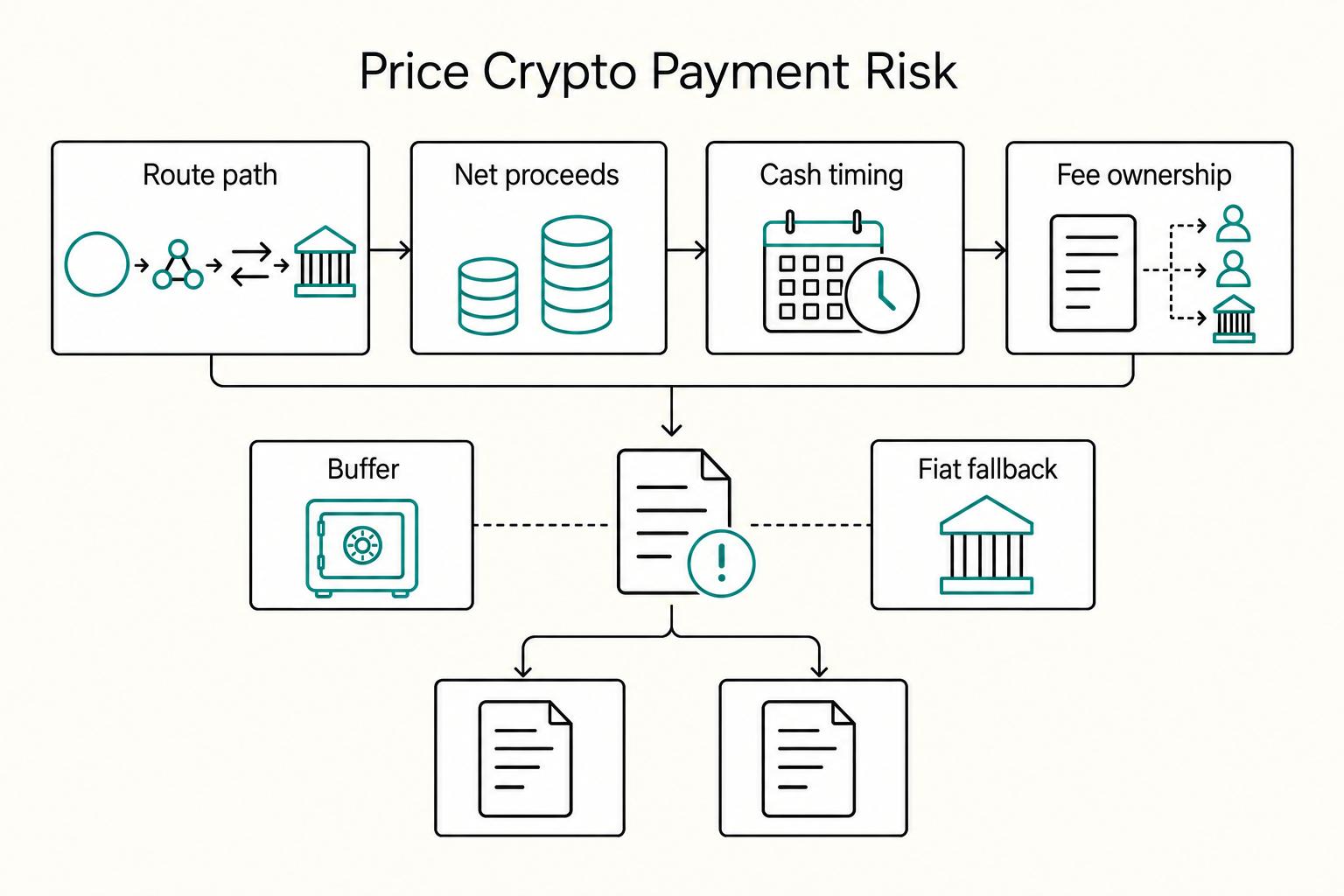
Crypto payments make sense only when they improve how reliably you get paid after you plan conversion, compliance, and recordkeeping up front. They can reduce friction in some international setups where traditional platforms add fees, restrictions, or extra steps. They also move risk onto conversion timing, exchange-fee exposure, and documentation quality, so use a simple acceptance test before you agree:

Can Digital Nomads Claim the Home Office Deduction?
Claim the deduction only when your facts and records can carry it. With the home office deduction for digital nomads, the real decision is usually a three-way call: claim it, do not claim it, or pause and get help because your file is not ready.

How Freelancers Can Decide on France’s Micro-Entrepreneur Regime
Low-stress compliance starts with one question: does the Micro-entrepreneur regime match your real setup right now? It is often presented as a simplified option for lower-revenue activity, so use it as a fit test, not a shortcut.