
Quick Answer
Start by checking the beneficiary designation on each IRA, 401(k), life insurance policy, and TOD account with the institution that holds it. Add both primary and contingent recipients, then save dated acceptance proof. For cross-border recipients, confirm withholding treatment and whether the payer requires Form W-8BEN before a treaty claim. If you run a solo business, pair personal designations with a business continuity directive so client handoffs, invoicing, and account access are not left to guesswork.
Treat Beneficiary Planning as Risk Control#
Treat beneficiary planning as risk control, not form-filling. If a designation is outdated, missing, or invalid, transfers can be delayed, handled under plan defaults, or, for some assets, routed through probate.
Step 1. Define the control points#
A beneficiary designation is the instruction you file with the account provider naming who receives the asset. Probate is the court-supervised administration of an estate after death. Compliance risk is the risk of financial harm from violating or failing to conform to laws, rules, regulations, or prescribed practices.
For many account types, the provider record drives the outcome. IRA beneficiary records can take precedence over will or trust instructions. Brokerage TOD beneficiary documents can supersede a will. Retirement-plan death benefits are typically paid to the designated beneficiary in the payout form allowed by that plan. Start by verifying each account's current beneficiary record, not just your estate documents.
Step 2. Check where generic advice breaks#
Generic beneficiary advice often breaks once your life spans borders or your business depends on you. You may hold accounts in different jurisdictions, name a beneficiary in another country, and face different transfer rules depending on the account and provider.
For foreign recipients of certain U.S.-source income, default withholding can be 30%, but treaty or code exceptions may change that result. Transfer mechanics also vary because state law and firm policy can affect whether TOD-style transfers are available and how they work. Another common failure point is having no named beneficiary, where IRA custodian defaults may direct assets to another designated beneficiary or to your estate. Some retirement plans also limit who you can name.
| Decision area | Generic advice | Globally aware planning |
|---|---|---|
| IRA or 401(k) | Add a name once | Confirm plan rules, named beneficiary status, and current provider record |
| Brokerage account | Assume your will controls | Confirm whether TOD is available and how local law and firm policy apply |
| Owner-dependent income/business value | Focus only on personal accounts | For owner-dependent businesses, plan personal asset transfer and business continuity as linked risks |
Step 3. Preview the transfer, continuity, and review sequence#
Use this sequence: secure personal asset transfer, address business continuity where value depends on you, then run a recurring review cadence. That is how to treat beneficiary planning as an operating decision rather than a one-time admin task.
If your accounts or beneficiaries cross borders, check each account individually and keep current beneficiary confirmations with your estate records. Related: A Guide to Superannuation for Australian Freelancers.
Domain 1: How Do You Secure Your Personal Global Assets?#
Start with the provider record, not your will. For retirement accounts, brokerage accounts with TOD registration, and some life insurance contexts, the payout instructions on file often control the transfer. An outdated designation can conflict with your estate-plan intent and create avoidable delay.
Step 1. Confirm account type, then confirm the controlling rule#
Sort accounts by type before you change anything, because transfer rules, required paperwork, and failure points differ by account.
| Account type | Control point | Extra check |
|---|---|---|
| Retirement account or plan (IRA or employer plan) | The beneficiary designation must follow the plan's procedures, and the provider record often controls transfer | If you are married and updating an employer retirement plan, verify whether written spousal consent is required |
| Life insurance policy | Payout instructions on file often control the transfer | Death-benefit processing commonly requires a completed claim form, certified death certificate, and policy contract |
| Brokerage account | A TOD or similar beneficiary document can supersede your will | Confirm whether TOD is available and how local law and firm policy apply |
A beneficiary is the person or entity you name to receive an account or policy benefit. For retirement plans and IRAs, that designation must follow the plan's procedures. For brokerage accounts, a TOD or similar beneficiary document can supersede your will.
Review each account separately before making updates:
- retirement account or plan, such as an IRA or employer plan
- life insurance policy
- brokerage account, with or without TOD
This sort matters because transfer mechanics and paperwork depend on account type and ownership. If you are married and updating an employer retirement plan, verify whether written spousal consent is required. Some plans require it, and missing it can prevent the change from being accepted.
Your completion check is not "form submitted." It is "provider confirmation received and stored." Keep that confirmation with your estate records. If you use TSP, follow its validity rules, including the timing rule that a designation must be received within 365 calendar days of your most recent signature.
Step 2. Set designation layers so assets do not fall into default order#
Do not stop at naming one person. Set a primary and at least one contingent beneficiary, then make sure there is a clear fallback path. Otherwise, assets can move under a statutory order of precedence.
| Designation layer | What it does | Data to collect now | Friction it prevents |
|---|---|---|---|
| Primary | First recipient if alive and eligible | Full legal name, date of birth, relationship, address, country of residence, percentage share | Misidentification, claim disputes, provider rework |
| Contingent | Backup recipient if primary cannot inherit | Same fields, plus confirmed allocation method | Statutory fallback, provider rework |
| Final fallback | Last-resort recipient path, if supported, or equivalent setup via multiple contingents or trust | Trust legal name and trustee contact, or organization legal name and address | No valid recipient on file, avoidable payout delay, ambiguity |
If your provider does not offer a third tier, create the same practical result with multiple contingents or a trust designation where allowed. FEGLI, for example, permits naming a trust.
Also plan for the claim process. Death-benefit processing commonly requires a completed claim form, certified death certificate, and policy contract, and providers may require additional documents.
Step 3. Run a cross-border risk screen for each international beneficiary#
If a beneficiary lives outside the United States, treat that as a separate control check. Common payout friction points include withholding, documentation, and local inheritance-law conflicts.
| Check | What to confirm | Documentation note |
|---|---|---|
| U.S. withholding treatment | Plan distributions to foreign payees generally require 30% withholding unless valid documentation supports different treatment | Record a placeholder such as: "Current treaty article and withholding rule verified on the verification date" |
| Status documents with the payor | IRS guidance recognizes forms including Form W-9 and Form W-8BEN | If documentation rules are not met, payment is presumed made to a foreign person |
| Local inheritance-law conflicts | In EU cross-border succession, applicable national law can determine beneficiaries and reserved shares | Authorities can refuse some chosen-law provisions on public-policy grounds |
Use this screen:
- Check likely U.S. withholding treatment. Plan distributions to foreign payees generally require 30% withholding unless valid documentation supports different treatment. Record a placeholder such as: "Current treaty article and withholding rule verified on the verification date."
- Confirm status documents with the withholding agent, meaning the payor. IRS guidance recognizes forms including Form W-9 and Form W-8BEN. If documentation rules are not met, payment is presumed made to a foreign person.
- Check local inheritance-law conflicts. In EU cross-border succession, applicable national law can determine beneficiaries and reserved shares, and authorities can refuse some chosen-law provisions on public-policy grounds.
Do not treat an international designation as complete until all three checks are documented.
Step 4. Choose the right minor-beneficiary structure#
For minors, choose the structure first, then make the account forms match it. In practice, that usually means a trust versus a UTMA or UGMA custodial setup.
| Structure | When to use | Control tradeoff |
|---|---|---|
| Trust | You want staged distributions, purpose limits, or longer-term oversight | More control over timing and use, with added setup and administration |
| UTMA/UGMA custodial account | You want a simpler transfer without creating a formal trust | Irrevocable gift; custodianship generally ends at age of majority, with state-law variation |
The alignment rule is simple: your beneficiary forms and estate documents should point to the same structure. If they conflict, providers often follow the beneficiary designation or account record at payout.
You might also find this useful: How to Choose a Trustee for Your Trust.
Domain 2: What Should Your Business Continuity Directive Cover?#
Handle business continuity separately from your personal beneficiary forms. Beneficiary designations determine who receives certain assets, but they are not operating instructions for finishing client work, sending final invoices, or managing digital access. They also do not replace IRS closeout steps such as filing a final return and closing an EIN or IRS business account.
Step 1. Start with essential functions#
Start with what keeps the business running or lets it wind down cleanly. That means mission-critical assets and functions, not just the most valuable assets.
Your list should cover what keeps work moving or supports an orderly shutdown: active clients, in-flight projects, billing, cash accounts, core tools, and digital access points.
Use this working definition in your records. A business continuity directive is a written instruction set for keeping the business operating through death or incapacity, or winding it down in an orderly way. It is separate from a personal beneficiary designation and should state where each asset is, who can act, and what happens first.
Step 2. Assign authority before tasks#
Assign authority before you assign tasks. If no one is clearly positioned to act, the checklist will not help when it matters.
Your designated operator in this section is the person you appoint to carry out the business directive in practice. This is an operational role, not a standardized legal title. It may differ from your legal executor or another fiduciary role.
Name who acts, who supports client communication, and what trigger activates authority. Use explicit triggers such as death, or documented incapacity plus whatever legal authority the account or platform requires.
Step 3. Put transfer and wind-down actions in one checklist#
Put transfer and wind-down actions into one checklist so the person stepping in is not forced to improvise. For this section, treat digital assets as electronic records in which you have rights or interests, including domains, platforms, source files, payment accounts, cloud storage, and credential vaults.
| Area | What your directive should state | Verification step |
|---|---|---|
| Operations access | Where domains, hosting, cloud files, payment accounts, and credential vaults are managed; who gets emergency access; what trigger activates it | Confirm emergency-access settings are enabled and accepted where required |
| Client handoff | Active clients, current status, deliverables due, and handoff or completion rules | Match against your live project tracker and signed agreements |
| Invoicing and obligations | Draft and final invoices, recurring obligations, contractor payments, tax records, and who handles final IRS closeout actions | Reconcile against accounting records and deadline calendar |
| Vendor tools | Registrar, software subscriptions, payment tools, and cancellation or transfer order | Verify renewal dates and billing owner on each account |
| Reputation protection | Client notice templates, out-of-office language, website update steps, and spokesperson control | Store approved language with the directive |
For major platforms, document limits up front. Google Inactive Account Manager can notify or share data with up to 10 people. Apple Legacy Contact can request access to Apple Account data after death, but it cannot access Keychain items such as passwords, payment information, and passkeys. Do not assume full email or message access. Under RUFADAA-type rules, access to electronic communications can be restricted without explicit consent, and some states give online-tool directions priority over conflicting estate documents.
Step 4. Confirm where each instruction lives#
Confirm where transfer instructions actually live for each account. If a bank offers POD-style setup on a deposit account, decide account by account. Then align the recipient with your continuity directive so control of cash and operational duties do not split.
Finish with verification at each institution: confirm what transfer option is available, confirm what beneficiary or recipient is recorded, and store that confirmation. For brokerage accounts, TOD availability is firm-dependent and state law governs registration. Even with TOD, recipients still must complete administrative transfer steps.
If you want a deeper dive, read Japan Digital Nomad Visa 2026 Planning Runbook.
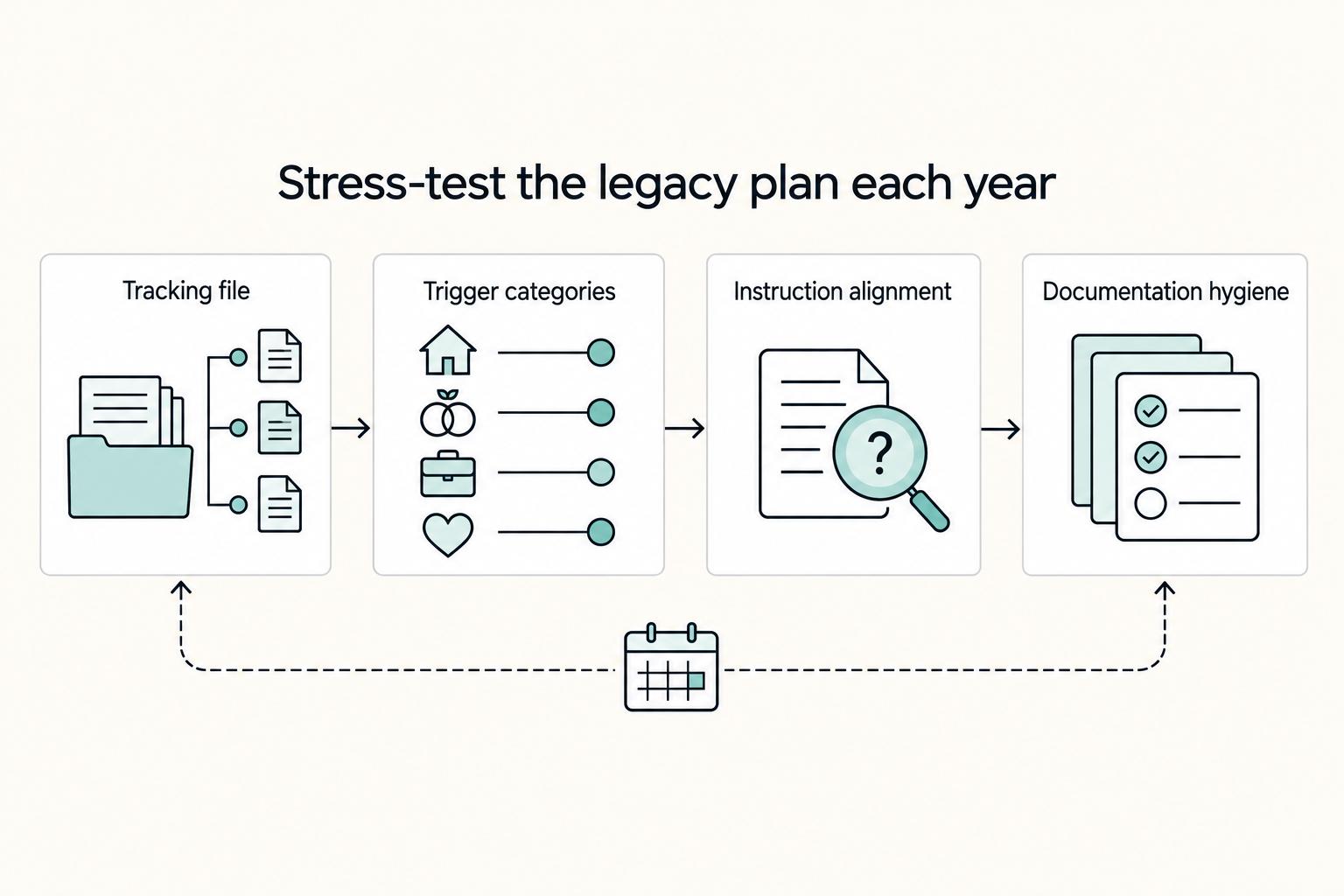
Domain 3: How Do You "Stress-Test" Your Legacy Annually?#
Run this like an operating routine: assign one owner, use the same review cycle each time, and rerun it after meaningful changes to your records. The goal is simple: catch drift between what you intended and what institutions have on file.
Before You Start#
Set one accountable owner for the review and gather the current records in one place. Work from documents, not memory.
Step 1. Reuse one tracking file#
Use one tracking file and keep reusing it. Repetition is what makes the review reliable.
Include one row per record with:
- Institution and record name
- Current designated recipient and any contingent designation (if used)
- Related supporting document
- Last confirmation that the institution accepted the submitted change
Treat completion risk as operational, not theoretical. Systems and data handoffs can fail, and complex notices can leave updates half-finished. Your verification standard is a dated confirmation record, such as portal proof, a PDF, an email acknowledgment, or equivalent, not recollection.
Step 2. Use trigger categories#
Use trigger categories so each change leads to a defined update instead of a vague reminder. The matrix below is a practical control, not a legal mandate.
| Trigger category | What to review/update | Documents affected | Verification checkpoint |
|---|---|---|---|
| Identity or status changes | Names, relationship/status details, core contacts, successor details | Primary records, summary notes, contact sheet | Confirm updates were received and processed |
| Account and asset changes | Opened, closed, moved, or retitled records | Inventory, submitted forms, confirmation log | Confirm updates were received and processed |
| Business structure shifts | Ownership/authority changes, new operating accounts or tools | Continuity directive, authority records, inventory | Confirm updates were received and processed |
| Cross-border residency changes (you or beneficiaries) | Address or residency details reflected in records | Primary records, summary notes, continuity directive | Confirm updates were received and processed |
Step 3. Check alignment across instructions#
Check alignment across instructions and resolve conflicts immediately. The longer you leave a mismatch in place, the more likely it is to create processing errors or delays.
| Alignment check | What to verify | Action if mismatched |
|---|---|---|
| Name consistency | Names and identifying details match across your records and instructions | Resolve now; mismatches can create processing errors or delays |
| Role clarity | Receiving assets and handling operations may be different roles, but that split should be explicit | Make the split explicit before closing the cycle |
| Asset mapping | Each major account or asset is clearly tied to the governing instruction set | Confirm what the institution currently has on file and align your documents before closing the cycle |
Run three checks:
- Name consistency: names and identifying details match across your records and instructions.
- Role clarity: receiving assets and handling operations may be different roles, but that split should be explicit.
- Asset mapping: each major account or asset is clearly tied to the governing instruction set.
If records conflict, treat that as an ambiguity to resolve now. Stop, confirm what the institution currently has on file, and align your documents before closing the cycle.
Step 4. Finish with documentation hygiene#
Close the cycle with documentation hygiene, because this is what turns a review into something another person can actually execute.
- Confirm acceptance: verify every submitted change is received and processed.
- Capture proof: save the final form or version, send date, acceptance date, and any reference number.
- Refresh access packet: keep a current packet for the person who may need to execute your plan, including inventory, document locations, and first actions.
If you're working through how to choose a beneficiary, this is the step where intent becomes execution.
For a step-by-step walkthrough, see How to Choose a Niche for Your Freelance Business.
Turn your annual review into a repeatable process by tracking residency changes and cross-border triggers in one place with the Tax Residency Tracker.
Lock In Current Records, Usable Instructions, and Recurring Review#
To make this hold up in real life, lock in three outcomes now: your beneficiary records are current, your continuity instructions are usable, and your plan is reviewed on a recurring schedule. That is the practical core of estate planning: a structured process for managing assets and decisions if you are incapacitated or after death.
Step 1. Finalize your beneficiary records#
Start with your current account paperwork and confirm it matches your broader estate documents. A beneficiary is a person or entity chosen to receive assets.
Use a full asset-and-liability inventory as your checkpoint, then match each account to the latest record. If anything is blank, outdated, or inconsistent with your broader estate documents, pause and escalate to legal counsel before you finalize the rest.
Step 2. Write continuity instructions#
Document how someone else can locate key information and handle immediate next actions if you cannot.
Keep it concrete: where contracts are stored, how invoices are tracked, who should be contacted first, and which advisor or executor to call. An executor is the person named in your estate documents to administer the plan after death. This matters because estate planning is broader than asset transfer and can also include financial affairs, healthcare decisions, guardianship, and personal values.
Step 3. Run a recurring review#
Set a fixed review checkpoint and treat it as a real operational task.
Review the same core documents and records each time: inventory, beneficiary details, executor naming, powers of attorney, and advance healthcare directives (documents that record treatment preferences if you cannot communicate them).
If you have minor children, review guardianship documentation during the same cycle. Without proper documentation, a court may decide who raises your children.
| Task | Why it matters | Owner | Status |
|---|---|---|---|
| Complete asset-and-liability inventory | Creates the baseline for all planning decisions | You | [ ] |
| Confirm current beneficiary records on each account | Verifies recipient names are current in account paperwork | You | [ ] |
| Draft or update continuity instructions | Makes handoff steps usable under pressure | You | [ ] |
| Review will, trust, executor, POA, and healthcare directives together | Helps spot conflicts before they become legal problems | You + advisor | [ ] |
| Verify jurisdiction-specific legal and tax requirements | Local rules still need professional confirmation | Advisor | [ ] |
For related business setup decisions, see How to Choose a Jurisdiction for Your European Subsidiary.
If your personal beneficiary plan and freelancer cashflow operations feel disconnected, simplify the business side with clearer payout and record workflows through Gruv for Freelancers.
Frequently Asked Questions
What are the tax implications if your beneficiary lives in another country?
A nonresident beneficiary is someone treated as a nonresident alien for U.S. tax purposes. If that person receives U.S.-source retirement distributions, the IRS FDAP framework can apply, with a default 30% tax rate unless a treaty rate is verified. Life insurance death proceeds are generally excluded from gross income, but interest paid on those proceeds is generally taxable. If this applies to you, confirm the recipient’s tax residency, ask the payer which withholding rule they apply now, and verify whether they require Form W-8BEN for any treaty claim.
Can you name a non-US citizen as a beneficiary for your 401(k) or IRA?
A beneficiary designation is the form filed with the custodian that names who inherits the account. A beneficiary can be a person or entity, but for cross-border cases you should still treat eligibility and payout handling as institution-specific. If this applies to you, ask the plan administrator or IRA custodian for written requirements on documents, tax forms, and payout options before you rely on the designation.
How should you handle business-related assets if you are a freelancer or solo owner?
A POD/TOD account transfers funds at death under the account agreement, and a living trust is a revocable trust commonly used for estate planning. For business-related assets, pick the transfer method by account type instead of assuming one document will cover everything. | Transfer method | When to use it | Key tradeoff | |---|---|---| | Beneficiary form | Use when that specific account has a custodian-issued beneficiary designation process | Efficient when available, but some operating business assets may require a different transfer path | | POD/TOD | Use for eligible financial accounts only if the institution offers POD/TOD registration | Can simplify transfer at death, but availability depends on institution and account type | | Living trust | Use when you need coordinated control across harder-to-transfer assets | More setup and retitling work, and account-level records still must align | If this applies to you, separate personal and business assets, then verify in writing which exact method each institution accepts.
Does your will override your IRA, 401(k), or life insurance beneficiary form?
A contingent beneficiary is your backup recipient if your primary beneficiary cannot or does not receive the asset. For many retirement accounts, custodians state that the beneficiary designation on file generally controls over conflicting will instructions. If this applies to you, update designations directly with each institution and keep dated acceptance proof for every change.
What happens if you do not name a beneficiary?
Probate is the court process that authorizes transfer of a deceased person’s property. If you leave a designation blank, some assets may go through probate, while some employer plans may follow plan rules. For IRAs, IRS rules also include a “no designated beneficiary” category that can change payout timing, including a 5-year deadline in some cases. If this applies to you, name both a primary and contingent beneficiary now, or confirm the consequences first if you intentionally want the estate, a charity, or a trust to receive the asset.
Try a related tool
Researched and edited by the Gruv editorial team. Gruv builds cross-border billing, payouts, and finance-operations software for global businesses.
Sources
- ecfr.gov/current/title-5/chapter-VI/part-1651/section...trusted
- fdic.gov/financial-institution-employees-guide-deposi...trusted
- investor.gov/additional-resources/information/seniors/tra...trusted
- irs.gov/retirement-plans/plan-participant-employee/r...trusted
- irs.gov/faqs/interest-dividends-other-types-of-incom...trusted
- macpac.gov/wp-content/uploads/2019/01/Enrollment-in-Int...trusted
- opm.gov/frequently-asked-questions/domestic-partner-...trusted
Educational content only. Not legal, tax, or financial advice.
Related Posts

Japan Digital Nomad Visa 2026: Six-Month Planning Runbook
Treat this as your operating model: identify the right mission first, commit to one route, and keep dated records before you make irreversible plans. That is what keeps the rest of your timeline, paperwork, and decisions coherent.
Life Insurance for Freelancers With Variable Income
Make this decision in one sitting. Pick policy type, set a death benefit tied to real obligations, and prepare your application details before you shop. A single sitting matters because it forces tradeoffs into the open. If you split the call across weeks, it is easy to keep toggling between products without locking anything in.

A Guide to Superannuation for Australian Freelancers
**Treat superannuation for freelancers australia as a repeatable operating decision, not a guess you make under invoice pressure.** As the CEO of a business-of-one, your job is to turn fuzzy compliance questions into a simple system you can run on demand. Freelance income moves, contract terms shift, and one wrong super call can squeeze cashflow or create a compliance problem you only notice later.