
Quick Answer
Choose a billing structure you can prove in production, not one that only looks simple on a pricing page. For LLM API usage-based billing, start by selecting a primary meter, define whether cost pass-through or bundled overage carries volatility, and require an evidence trail from request record to rated line item. The article’s practical checkpoint is replayability: if a disputed charge cannot be traced through token counts, applied rates, and ledger posting, the model is not ready to scale.
How to Approach Token Metering and Cost Pass-Through#
LLM API billing looks tidy on a pricing page and much messier in production. Once real traffic shows up, the hard part is not pricing theory. It is choosing the right meter, reconciling charges across providers, and producing invoices you can explain line by line when a customer pushes back.
Meter reality#
A token is a unit a language model uses to represent text, while an API call is one request sent to the model. Those are not interchangeable billing units. Rough English character-to-token estimates can help with planning, but they vary by model, language, and content; invoice from the provider’s reported usage categories, not word counts. One customer can send a small number of very large requests while another sends many small ones. Those patterns can produce different revenue and cost shapes.
Provider mix changes the job#
A single-model setup is easier to reason about than a multi-provider stack. Adding providers means juggling APIs, authentication, logging formats, and cost structures. Keep input, output, cache, and paid tool usage distinct where the provider prices them separately. Claude’s pricing documentation, for example, separates token categories and charges for some server-side tools. Tools that normalize access can help: Amberflo describes its AI Gateway as a single interface to 100+ models using the OpenAI API format. A common request format still does not remove the need to rate usage correctly or explain charges clearly.
The operator goal is narrower than it sounds#
This article is for teams that need a model they can actually ship: predictable margins and invoices they can explain. The examples assume large language model APIs with token-heavy workloads, especially where provider mix adds operational friction. A practical checkpoint is simple: can you trace a customer charge back to a specific request record, token count, and invoice line? A common failure mode is treating all usage as one opaque total, then discovering too late that model mix, request shape, or per-call fees changed the economics.
That is why the sections that follow focus on decision rules, not abstract pricing advice. You need to know when direct token metering is worth invoice volatility and when a base fee plus usage is easier to explain. If your usage data, invoice logic, and provider costs do not line up, billing disputes get harder to resolve.
How to choose a billing model that fits your market reality#
Choose for cost volatility and invoice explainability first, not pricing-page neatness. If your revenue can swing with input tokens, output tokens, or API calls, use this path. If your model is mostly seat-based with stable per-user behavior and limited variable model cost, simpler pricing may fit better.
Confirm you actually have a usage-pricing problem#
Use consumption-based pricing when charges truly move with usage. In LLM APIs, billing is commonly tied to how much text is processed in and out, not only request count. If prompts and completions materially change your cost base, usage pricing is usually the more honest operating model.
Score each option on four operator criteria#
Evaluate every option with the same scorecard: margin stability, customer bill clarity, dispute-handling ease, and fit with your market compliance posture (KYC/KYB/AML where applicable). Variable bills can make buyers uneasy, so predictability and explainability matter as much as unit economics.
Pressure-test billing promises against provider mechanics#
Before offering monthly invoicing or prepaid credits, verify the upstream payment mechanics. xAI’s billing documentation says monthly invoicing is disabled by default and must be requested from sales. Bank-transfer credit purchases take 2–3 business days, with credits applied after completion. Optional auto-top-ups have a $5 minimum, a configurable balance threshold, and a monthly top-up maximum. xAI shows a warning on the API spend management card at 80% of your configured total monthly limit. With the default monthly limit of zero, requests are rejected once prepaid credits run out; an account enabled for monthly invoicing can instead charge usage beyond its prepaid balance up to its limit. A warning or top-up cap is not a customer-facing hard usage cap.
Compare with available data, then prove the billing path#
Use the data available now to propose a model: sketch expected usage, identify the three likeliest failure modes, and label gaps that could change the choice. Before collecting live usage charges, test sample requests through usage event -> rated charge -> invoice line -> journal entry, including corrections and delayed events. If you cannot replay a disputed charge from event data, fix that billing path before charging for it.
If you want a quick rule, favor predictability for budget-sensitive buyers and direct metering for customers who expect transparent pass-through.
If you want a deeper dive, read Usage-Based Billing for Platforms: How to Meter and Charge for API Calls Storage and Seats.
The 5 LLM billing models worth considering#
Start with the model that matches how your costs move and how buyers budget. For many teams, that means pure token billing for technical buyers or a base fee with included usage for finance-led buyers. Use the other models when you need a specific control, not just a cleaner pricing page.
The tradeoff is volatility versus simplicity. For a hypothetical rate card of $1 per million input tokens and $5 per million output tokens, a period with two million input tokens and half a million output tokens costs $4.50 before any separately priced cache or tool usage. A change in the output share changes that total even if request count stays flat. Decide up front who absorbs that risk and retain the actual rate version for every charge.
| model | best for | key pros | key cons | typical failure mode | required controls |
|---|---|---|---|---|---|
| Pure token billing | API-native buyers | Granular usage pricing; pass-through or markup can be explicit | Invoice volatility | Bills swing with longer prompts or completions | Separate billable token categories, rate-version history, replayable usage logs |
| Base fee + included usage + overage | Budget-sensitive B2B teams | Predictable monthly floor, procurement-friendly | Cliff effects near limits | Small overage creates a much larger-than-expected bill | Visible included balance, overage alerts, clear reset dates, explicit overage terms |
| Blended unit across input and output | Faster quoting and simpler sales | One number is easier to sell and buy | Margin risk on output-heavy workloads | Output-heavy tenants become unprofitable | Output-input ratio monitoring, margin guardrails, repricing triggers |
| Hybrid tokens + API calls or compute gates | Abuse-resistant operations | Better protection against expensive request patterns | Harder customer education | Disputes over which meter caused charges | Separate invoice lines per meter, event schema for token and call counts, customer usage dashboard |
| Prepaid credits with token burn-down | Spend-control workflows | Pre-funded spend; a hard cap when request authorization enforces it | Top-up friction | Service interruption when balance runs low | Credit reservation, concurrency and late-usage handling, low-balance alerts, explicit top-up and burn-down rules |
Pure token billing#
Use this when you want billing to mirror token metering. Charging input and output separately keeps invoices close to underlying cost and is usually easiest to explain to technical buyers. Token pricing can pass costs through or include a markup; state which you use, and separate cache or tool categories when they have their own rates.
Base fee plus included usage, then overage#
Use this when buyers need a predictable base charge. Included usage helps planning, but overages can still raise the total. Publish the allowance, reset date, overage rates, and any agreed spending cap so a monthly floor is not mistaken for a maximum bill.
Blended pricing across input and output#
Use this when sales simplicity is the priority. It shortens quoting, but you must actively monitor output-heavy mix shifts because output tokens can price very differently from input tokens.
Hybrid billing with tokens plus API calls or compute gates#
Use this when one meter does not capture real cost or abuse patterns. It is stronger operationally, but only works if customers can clearly see which meter drove each charge.
Prepaid credits with token burn-down#
Use this when you need spend control. To enforce a hard cap, reserve credits before allowing requests, account for concurrent requests and delayed usage, and define what happens when the remaining balance cannot cover a request. Low-balance alerts and optional top-ups help continuity, but they do not enforce that cap by themselves.
Before launch, run one audit check: replay a real usage event from raw meter data to rated charge to invoice line with the exact rate version applied. If you cannot show whether the charge came from input tokens, output tokens, API calls, or credit burn, the model is not ready for production.
For a step-by-step walkthrough, see Subscription Billing Platforms for Plans, Add-Ons, Coupons, and Dunning.
How to pick your meter without breaking trust or margin#
Pick the meter that best reflects real, observable activity and that your customer can understand. In practice, that usually means using a unit that tracks how usage actually changes, then pressure-testing it against your own cost behavior before rollout.
Start with observable activity, not pricing theory.#
Pricing guidance for AI agents consistently frames this as hard and recommends tying charges to measurable behavior while staying flexible as the market evolves. Treat your first meter choice as a working hypothesis, not a permanent rule.
Use variability as your reality check.#
Small prompt or model changes can alter response length and cost. Test the same representative customer tasks with short and long prompts, cached and uncached context, and bounded and open-ended completions. Record the resulting usage categories and cost rather than assuming request count will predict spend.
Choose the simplest meter that still matches cost movement.#
Start with fixed, usage-based, or hybrid pricing according to your own cost distribution and buyer needs. If a single unit hides too much of your real cost shape, test a hybrid structure instead of forcing false simplicity.
Validate cost understanding before you lock in.#
Use early estimates to compare models, then validate the chosen meter against representative usage before charging customers. Your team should be able to explain how measured usage and the agreed rate produce each invoice line.
When cost pass-through is smart and when to avoid it#
Cost pass-through is strongest when customers can handle usage volatility, while bundled tiers are stronger when they need predictable spend. The decision is less about philosophy and more about fit: tolerance for variance, billing maturity, contract clarity, and margin goals.
| Criterion | Pass-through fits | Bundle fits |
|---|---|---|
| Volatility tolerance | Buyers accept that usage can swing sharply month to month | Buyers need a number they can forecast in advance |
| Customer maturity | Teams can read and act on usage drivers, including different input and output token pricing | Customers want simplicity over granular cost exposure |
| Contract flexibility | Commercial documents define the provider/model basis, token basis, and how changes or corrected usage are handled | Billing treatment would otherwise be unclear before disputes appear |
| Gross-margin targets | Transparency-first accounts such as power users and internal R&D | Teams test allowances and stepped rates against their own workload and margin targets |
Volatility tolerance#
Choose pass-through when your buyers accept that usage can swing sharply month to month. In consumption-based models, a user might generate 100 words one day and 10,000 the next, so invoices can move quickly with behavior. If your buyers need a number they can forecast in advance, a bundle with included usage and controlled overage is usually easier to run.
Customer maturity#
Pass-through works best for teams that can read and act on usage drivers. That is especially important when input and output tokens are priced differently and charges are computed in token units. If customers want simplicity over granular cost exposure, package usage into tiers and surface overage only after included usage is exhausted.
Contract flexibility#
If you pass through provider exposure (including OpenAI or Anthropic), make pricing terms explicit in your commercial documents. Define the provider/model basis, token basis, and how changes or corrected usage are handled so billing treatment is clear before disputes appear. A practical check is whether you can trace any invoice line to the contract version, model identifier, token class, and rate version used at rating time.
Gross-margin targets#
If you need tighter margin control across a mixed customer base, test tiered packages against flat linear pricing using your own usage distribution. A fixed access fee and stepped token rates can change the margin by segment, but do not assume they improve profit automatically. Pass-through fits transparency-first accounts such as power users and internal R&D; bundled tiers fit buyers who prefer allowances and clearly defined overages.
The useful test is a side-by-side quote for the same workload: provider cost, customer price, included allowance, and overage. Make the margin and customer’s exposure visible under both options.
Build internally or buy a billing platform#
Build internally when billing logic is part of your product economics and finance controls. Buy a platform when the priority is shipping usage billing faster with less operational overhead.
Usage-based billing makes this choice consequential because usage can swing sharply, forecasting is harder, and invoice disputes are more likely if records are unclear. In consumption billing, period totals are calculated from measured usage and priced per unit, so your metering and pricing trail must hold up under scrutiny.
| Criteria | Build in-house | Buy a billing platform | What to verify before you commit |
|---|---|---|---|
| Implementation time | Usually slower up front because you design and operate metering, rating, and invoicing flows | Usually faster if core ingestion and billing flows are already available | Define first live invoice date, shadow-billing window, and remaining custom work |
| Metering fidelity | Strong fit when rating logic depends on proprietary unit economics | Strong fit for standard event metering with configurable rules | Validate event coverage and rate versioning for your real usage patterns |
| Credit handling | Fully flexible, but exception handling can grow quickly | Often includes built-in credit and adjustment workflows | Test credit grants, expiries, adjustments, and invoice presentation |
| Invoice logic | Maximum control for custom pricing structures | Faster for common usage-based invoice patterns | Review draft invoices for typical and correction scenarios |
| Auditability | Can be strong if you own a complete event-to-invoice evidence trail | Can be strong if history and revisions are transparent | Trace one invoice line to raw usage event, applied rate, and contract version |
| Maintenance burden | Increases as pricing models and provider mix evolve | Lower for common cases, with possible platform limits at the edges | Estimate ongoing change load, not only launch effort |
Build in-house#
Build when your rating logic is a differentiator and needs tight integration with your internal systems, including ledger journal events. This is the better fit when standard billing abstractions would hide or distort how you actually monetize usage. The advantage is control over how raw usage becomes billable revenue evidence.
Buy a billing platform#
Buy when tested ingestion and lower billing operations load matter more than total design freedom. Confirm the product fits your event volume, rating rules, credits, and correction workflow. For an existing Stripe Billing Meters integration, meter events are processed asynchronously, so summaries and upcoming invoices may lag recent events. Stripe currently recommends Metronome for new usage-based integrations; compare the appropriate product rather than treating Billing Meters as an instant spending-limit service.
Set non-negotiables either way#
Treat idempotent event handling, customer-visible usage reporting, and replay procedures as requirements before live billing. Stripe’s Billing Meters API guidance calls for idempotency when retrying usage submissions and handling asynchronous errors. Keep your own event identifiers and reconciliation trail so a retry does not create another billable event and rejected usage can be corrected and resent. Use a separate authorization or credit-reservation path if requests must stop at a spending limit.
For a broader pricing backdrop, see A Guide to Usage-Based Pricing for SaaS.
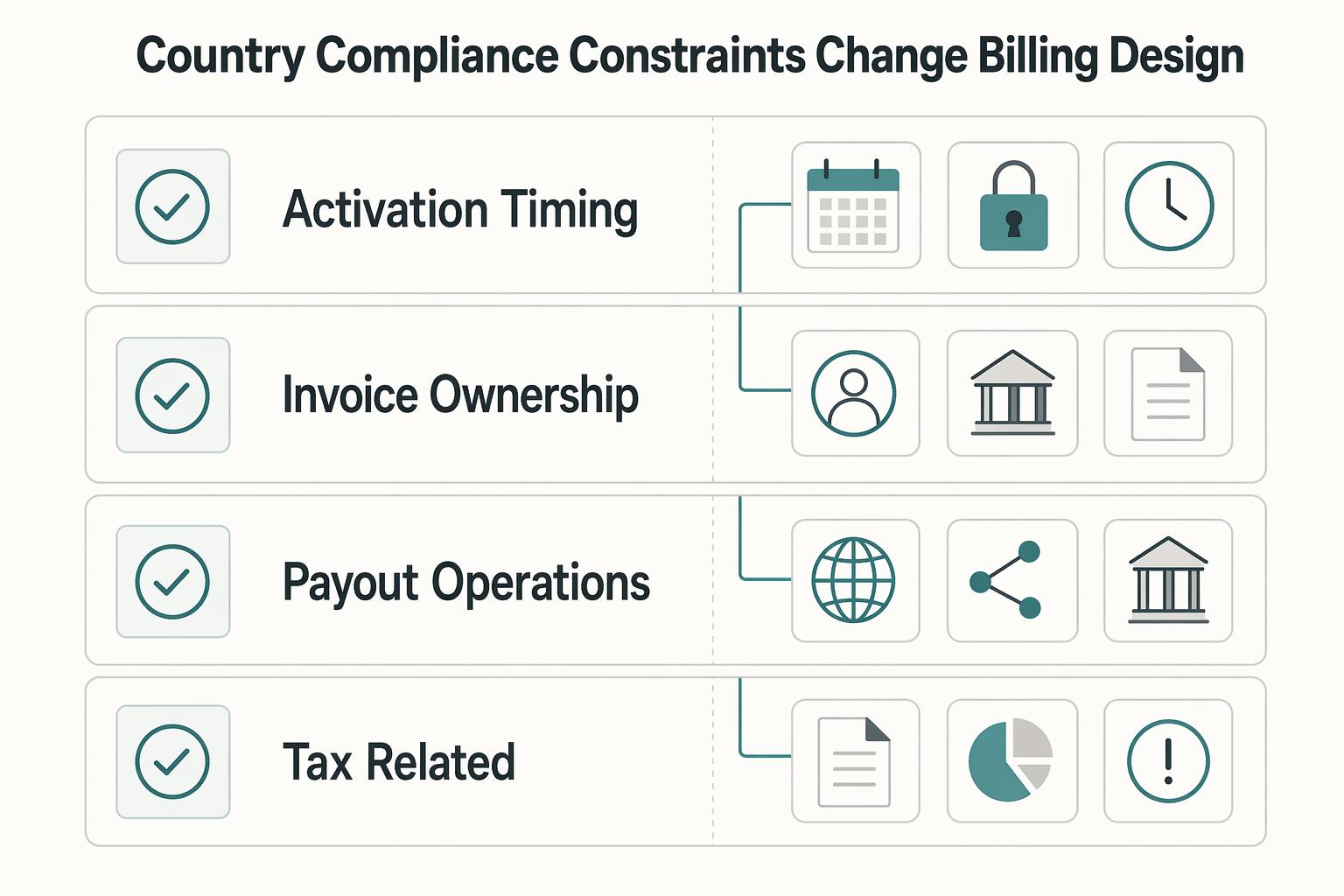
How country and compliance constraints change the billing design#
Country and compliance constraints change billing design mostly through timing, invoice ownership, and tax workflow boundaries, not through your metering math alone.
| Area | What to define | Specific detail |
|---|---|---|
| Activation timing | Separate account created from billing activated in product logic and contract language | Hold restricted transactions for the approval actually required; define lawful sandbox and free-trial access separately |
| Invoice ownership | Define which entity invoices and who owns tax handling in each market | Keep evidence for that decision, the customer tax status captured at onboarding, and a sample invoice per market |
| Payout operations | Map cash timing separately from usage timing | If you use virtual accounts or payout batches, confirm when funds are available, when credits can be issued, and which refund path applies after payout files are already created |
| Tax workflows | Assign customer tax-status validation and invoice/credit-note ownership | Collect identifiers and retain decisions relevant to the actual market and transaction; route separate payout reporting through finance |
Activation timing must be explicit#
If a provider or applicable rule requires approval before a particular transaction, separate account created from that transaction’s activation state. Test that restricted charges, transfers, or withdrawals wait for the required approval. Define separately whether lawful sandbox access, free product trials, or nonfinancial usage can begin earlier; they do not all share a universal KYC gate.
Invoice ownership has to be decided up front#
Before you roll out in a country, define which entity invoices and who owns tax handling in each market, including where validation steps happen in your flow. Keep evidence for that decision, the customer tax status captured at onboarding, and a sample invoice per market so sales, finance, and procurement records stay aligned.
Payout operations affect credit and refund behavior#
For payout-heavy products, map cash timing separately from usage timing. If you use virtual accounts or payout batches, confirm when funds are available, when credits can be issued, and which refund path applies after payout files are already created.
Tax workflows need clear product boundaries#
For each market, decide who determines customer tax status, validates identifiers where required, and issues invoices or credit notes. Store the applicable status and decision with the invoice. If a separate payout relationship requires tax forms or information reporting, route it through that specific finance workflow rather than assuming that token usage itself creates the requirement. Customer onboarding should request the information relevant to the actual transaction.
You might also find this useful: Usage-Based Billing Explained: How Consumption Pricing Works for B2B SaaS Platforms.
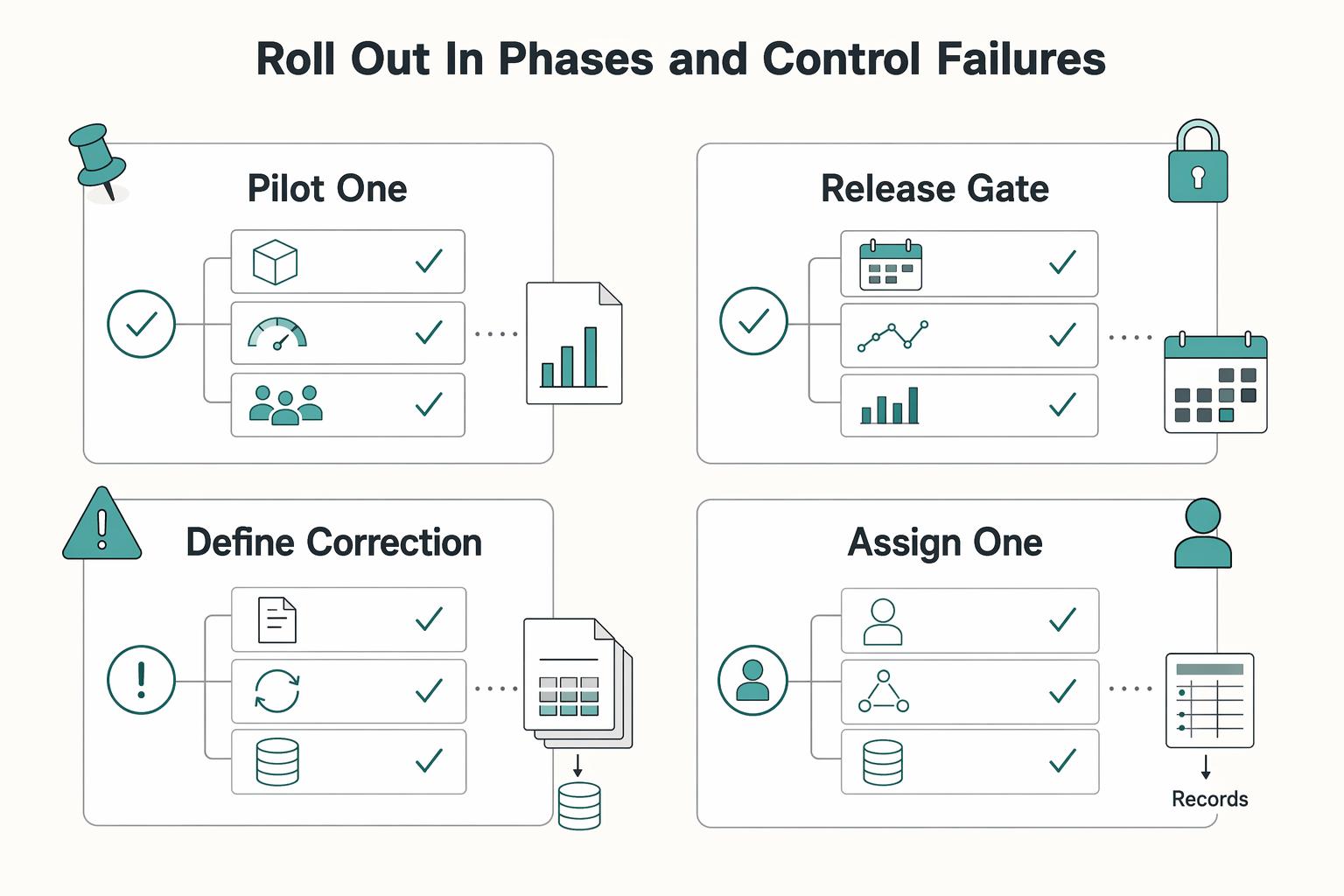
Launch checklist for the first 90 days#
Use the following 90-day schedule as an example rollout, adjusting the timing to your integration and sales cycle. The goal is accurate, explainable bills before you scale volume; initial comparisons can start with sample data and labelled gaps.
| Phase | Timing | Focus | Core check |
|---|---|---|---|
| Lock the billing unit and metering record | Week 1 to 2 | Freeze the unit you invoice on and track input and output tokens separately | Each API call records processed tokens in a way you can reliably reconcile later |
| Run shadow invoices before charging | Week 3 to 6 | Generate invoices in parallel without collecting payment | Reconcile representative scenarios or shadow traffic; test period boundaries, corrections, and delayed usage |
| Publish customer-visible usage and overage views | Week 7 to 10 | Show input tokens, output tokens, included usage, and overage logic in plain language | If customers only see a blended total, spend changes become harder to trust and explain |
| Run a market readiness checkpoint | Week 11 to 13 | Confirm each launch market's activation, invoicing, and tax workflow is operationally ready | Billing start conditions match what customers were told |
Week 1 to 2: lock the billing unit and metering record#
Define the unit you invoice on before live charging and version later changes explicitly. Keep input, output, and separately priced cache or tool usage distinct. Use the unit on the actual rate card—such as per million tokens—rather than assuming every provider quotes per thousand. Each request should retain its reported usage and the rate version needed for reconciliation.
Week 3 to 6: run shadow invoices before charging#
Generate invoices without collecting payment, using representative scenarios or a full period of shadow traffic when available. Compare independently calculated and generated totals, then test late events, corrections, allowance resets, and rounding at period boundaries. A simulated period can exercise those boundaries before you have a month of production data; resolve material discrepancies before live charging.
Week 7 to 10: publish customer-visible usage and overage views#
Show customers the same usage breakdown your team uses internally: input tokens, output tokens, included usage, and overage logic in plain language. If customers only see a blended total, spend changes are harder to trust and explain.
Week 11 to 13: run a market readiness checkpoint#
Before broader rollout, confirm each launch market's activation, invoicing, and tax workflow is operationally ready so billing start conditions match what customers were told.
Conclusion#
If you take one decision rule from this article, make it this: choose the billing model your team can prove, not the one that only looks clean in a pricing slide. In production, spend often goes beyond token price alone. It can include integration complexity and team cost. So the real winner is the model you can meter, explain, reconcile, and defend when a customer challenges an invoice.
Pick the meter you can audit#
Start with one primary unit and keep it stable long enough to learn from it. For LLM usage, that often means tracking input and output usage separately and keeping a clear replay path from billable events to invoice lines. If you cannot reconstruct one disputed invoice from source usage through rated lines, you are not ready to scale across more accounts or markets.
Be explicit about where cost risk sits#
Your pass-through stance should be visible in contracts, dashboards, and invoice lines, not buried in finance logic. If buyers want budget certainty, use a base fee with included usage and clear overage terms. If they accept volatility and understand model-side exposure, cost pass-through can work. The red flag is mixing the two stories: promising predictable spend while quietly exposing customers to output-heavy spikes or opaque blended charges they cannot verify.
Treat launch sequencing as part of pricing design#
A market launch is not just a sales event. It is also an operational readiness check for how usage is measured, how cost variance is explained, and how exceptions are handled. If coverage differs by market or program, say so up front and reflect that reality in contract language, customer dashboards, and support procedures instead of patching exceptions later.
One practical reminder sits underneath all three points: controllable economics often come from product design as much as from rate cards. NEC's June 2024 paper reported 37% to 68% lower LLM API cost versus RAG in its experiments when using LeanContext, a compact query-aware context approach, while maintaining accuracy under the stated conditions. NEC also reported accuracy gains versus summarizer-reduced RAG context in that evaluation setup. You should not assume those gains will transfer directly to your stack, but the operator lesson is strong. If enterprise context is inflating prompts, reduce context volume before obsessing over headline model prices.
Keep the first version narrow: one meter strategy, clear pricing terms, and a replayable billing trail. Start comparison work with available samples, then expand live billing after shadow scenarios reconcile, material disputes are resolved, and your team can explain each bill line.
Frequently Asked Questions
How does LLM API usage-based billing work end to end in production?
In production, billing usually starts when a request is logged and metered against what text the model processes. For large language model APIs, charges are often driven by both input tokens and output tokens, not just the fact that an API call happened. Because provider charging logic can differ, keep the metering and invoice logic provider-specific and clearly traceable.
Should we bill by tokens, API calls, compute, or a hybrid model?
Bill by tokens when prompt and response length drive cost. Bill by calls when a request is a useful commercial unit, with limits or rates that cover different request sizes. Use a hybrid when separate measurable activities affect your economics. Provider input, output, cache, and paid tool categories can have different rates; keep their costs distinct even if you sell customers a simpler unit. Word-count heuristics are planning estimates, not invoice quantities.
When should we use cost pass-through instead of bundled pricing?
Use cost pass-through when customers accept variable spend and you want charges to follow measured provider costs under explicit contract terms. Token-based pricing alone does not guarantee pass-through: disclose any markup. A base subscription with included usage and overages gives buyers a predictable floor, while a fixed maximum also needs an agreed cap or another limit on additional charges.
What are the biggest failure modes in token metering and invoicing?
Common failures include double-counting cached input, applying the wrong rate version, losing late events, or billing retries twice. Calculate token cost as the sum of each billable category’s quantity multiplied by its applicable rate and divided by that rate’s unit size. For example, per-million rates require division by 1,000,000. Once token quantities are aggregated, do not multiply that total by API-call count again. Add per-call or tool charges only where separately priced, then apply the customer’s contracted fees, credits, allowances, and rounding rules.
How do we decide build vs buy for usage-based billing infrastructure?
This depends on how custom your pricing model needs to be and how quickly you need to launch. Compare options based on whether they can represent your chosen billing units clearly (tokens, API calls, or hybrid) and explain charges transparently to customers. Either way, keep metering definitions and invoice math explicit.
What minimum controls must be live before we launch in a new market?
Before live billing, define the units, rate versions, allowance resets, corrections, and invoice presentation, then reconcile representative usage to rated lines. Enforce any promised spending cap before authorizing requests; asynchronous billing summaries alone cannot do that. Decide invoice ownership and the tax or provider approval requirements that apply to the actual market and transaction. Sandbox exploration and preliminary quotes can proceed with labelled gaps while those live-billing requirements are being resolved.
Try a related tool
Researched and edited by the Gruv editorial team. Gruv builds cross-border billing, payouts, and finance-operations software for global businesses.
Sources
Includes 4 external sources outside the trusted-domain allowlist.
- docs.stripe.com/billing/subscriptions/usage-based/recording-...trusted
- docs.stripe.com/billing/subscriptions/usage-based/recording-...trusted
- amberflo.io/blog/introducing-amberflo-ai-gatewayexternal
- docs.x.ai/console/billingexternal
- nec.com/en/global/techrep/journal/g23/n02/230219.htmlexternal
- platform.claude.com/docs/en/about-claude/pricingexternal
Educational content only. Not legal, tax, or financial advice.
Related Posts
Usage-Based Billing for Platforms That Holds Up at Month-End Close
Usage-based billing connects measured consumption to a price and an invoice. The difficult cases are specific: a retry counted twice, storage sampled with the wrong unit, an allowance deducted in two places, or a late event arriving after the invoice is final. This guide shows how to define API-call, storage and seat charges, then reconcile their different records at month-end.

SaaS Usage-Based Pricing for Predictable Cashflow and Fewer Disputes
If you are considering **saas usage-based pricing**, treat it as an operations and collections decision first. Pricing works best when the usage unit can be measured, shown on the invoice, and explained by someone outside your product team.

Usage-Based Billing for B2B SaaS Platforms That Teams Can Operate
Usage-based billing works best when customer value rises with measurable consumption rather than with a fixed license. It can improve pricing fit, but only if pricing logic, billing data, and finance controls are designed together from the start.