
Quick Answer
Define the unit and aggregation, apply allowances once and retain stable usage identities. Verify asynchronous processing before issue. Reconcile usage, rated charges, invoices, receivables and settlement through separate linked checks. Use a supported correction for finalized bills and preserve accounting timing differences.
Make the billable unit explainable before automating it#
Usage-based billing connects measured consumption to a price and an invoice. The difficult cases are specific: a retry counted twice, storage sampled with the wrong unit, an allowance deducted in two places, or a late event arriving after the invoice is final. This guide shows how to define API-call, storage and seat charges, then reconcile their different records at month-end.
The provider examples use Stripe documentation checked on October 3, 2026. They illustrate concrete behavior rather than rules for every vendor. Your customer agreement, selected meter and accounting policy determine the actual charge and posting treatment. No single billing platform, webhook contract or sequence automatically proves the entire close.
Step 1: Define the unit, aggregation and exclusions#
Write a meter specification with the customer/account key, unit, qualifying activity, aggregation, period boundary and exclusions. State which service owns the authoritative usage record. Distinguish a repeated submission of one recorded action from a new customer action that happens to have the same values.
| Meter | Definition to choose | Common mistake |
|---|---|---|
| API requests | Which completed or attempted actions count; how client retries are treated | Counting a delivery retry as a second billable action |
| Storage | Peak, end-of-period or time-weighted usage; GB versus GiB and time unit | Summing repeated capacity snapshots as if each were newly consumed storage |
| Seats | Provisioned, active or peak seats; proration and change dates | Treating every login as another seat |
For example, under a hypothetical storage rule, 10 GB retained for 12 hours is 120 GB-hours. Two snapshots of 10 GB do not by themselves establish 20 GB of billable storage. Capture the interval and use the agreed time-weighting rule. A peak-storage plan or a month-end snapshot plan would deliberately calculate a different quantity.
Stripe meter configuration supports Sum, Count and Last. Raw events remain separate; pre-aggregated hourly/daily ingestion instead uses the most recently received event in the interval. Its UTC boundaries and replacement behavior matter: sending a corrected cumulative total is different from sending another increment. Keep the contributing records and choose the configured behavior deliberately.
A pilot can begin with one clear meter, but multiple charges can be valid. API activity, retained storage and access seats may represent distinct priced services. Explain which metrics are additive, included or informational; avoid claiming that every plan must have one dominant variable meter. Exclude internal jobs or tests according to the actual offer, rather than assuming all retries or failures are universally free.
Step 2: Apply allowances and pricing once#
Document the base fee, included quantity, unit rates, tiers, caps and credit eligibility with effective dates. Identify whether ingestion supplies total qualifying consumption or an already calculated overage. Apply each allowance exactly once and preserve the rated quantity used for the invoice.
A plan that includes 10,000 calls usually still needs evidence of total qualifying consumption. If its configured price subtracts the allowance, send total usage to that calculation. Sending only the excess and then applying the included tier again underbills. Sending net overage can work in a deliberately designed alternative, but label it as net and do not deduct the allowance again.
Distinguish graduated tiers, where units in each band get that band’s rate, from volume pricing, where the selected band affects the applicable quantity. A cap also needs an agreed consequence: stop charges, stop service, or obtain approval for more use. Do not infer a product entitlement from the fact that the invoice stopped increasing.
Worked example: one allowance, a duplicate and a late arrival#
Assume a monthly plan charges $100 including 10,000 qualifying API calls, then $0.002 per additional call. Storage and seats are included in this example; tax and credits are excluded. The trusted activity record contains 25,000 calls. The overage is 15,000 × $0.002 = $30, so the invoice should be $130.
| Record or event | Expected handling | Amount consequence |
|---|---|---|
| 25,000 qualifying calls | Apply the 10,000 allowance once | $100 base + $30 overage = $130 |
| Replay of 500 of those same calls | Recognize the original identities; do not count again | Invoice remains $130 |
| 1,000 genuine late calls for the same period | Determine the approved cutoff and correction treatment | Correct period quantity would be 26,000; additional charge is $2 |
| 5,000 truly duplicated calls found after issue | Confirm erroneous quantity and correct the affected charge | Correct quantity is 20,000 and invoice $120; difference is $10 |
The late-arrival and post-issue duplicate rows are separate scenarios starting from the original $130 invoice. Do not combine them silently. Keep the original period, event references, price version and adjustment linked. If an invoice is still a draft, approved recalculation may update that draft; an issued invoice needs the supported correction procedure and customer communication.
Stripe billing credits apply to eligible subscription line items linked to meter prices, with grant scope and timing. That is a particular product feature, not a definition of all commercial credits. A prepaid credit grant, an included usage allowance, a customer credit balance and a credit note on an overbilled invoice serve different purposes. Decide which one you intend before subtracting an amount.
Step 3: Preserve event identity and verify processing#
Capture customer, meter, quantity, unit, occurrence time, source event identity and schema version. Validate the mapping and retain accepted, rejected and unresolved records. Use the provider’s supported retry mechanism and a durable usage register so replays do not become new consumption.
Internal usage events and a provider’s outbound webhooks can use different schemas. Map their meanings and identifiers rather than demanding one identical contract for both. A webhook may report a billing-object change or an ingestion error; it is not automatically the original billable activity. Preserve occurrence time separately from arrival time and explicitly route invalid records for correction.
Stripe’s usage API guide documents asynchronous meter processing, event identifiers, past/future timestamp acceptance and error notifications. An accepted submission does not mean the invoice summary updated immediately or every event was valid. Check processing outcomes and the intended period before finalization; do not diagnose a temporary summary lag as missing usage and resend with new identities.
For an uncertain request result, retain the original identity and use the documented retrieval or retry path. Stripe idempotency is time-bounded request protection, not permanent storage of every usage identity. Protect the underlying billing action after that retention window as well. Changing a key to force a retry can create a second operation; separate a legitimate correction from a repeated old submission.
Stripe webhooks can arrive more than once and out of order. Verify signatures and safely retain deliveries before processing. Deduplicate the delivered event and protect its business side effect, while permitting genuine later object changes. A blanket object-ID/type suppression forever can drop legitimate updates. Check the authoritative object and reconcile missing updates using the selected provider’s recovery process.
Step 4: Review the invoice and make corrections traceable#
Compare trusted qualifying usage to the processed meter total, independently recalculate the price and review the invoice line’s quantity, period, unit and amount. Resolve or explicitly disposition material exceptions before issue. Link later corrections to the original invoice and accounting records instead of silently overwriting history.
Stripe meter adjustments have specific limits: cancellation applies to events sent within the last 24 hours and does not update a finalized invoice for canceled usage. Negative quantities can correct recorded usage, but a negative cycle is displayed as zero usage. Those mechanisms are not a substitute for correcting a customer’s already-issued bill.
Stripe credit notes decrease open or paid invoices without replacing the original. On an open invoice they reduce the amount due; paid-invoice treatment can involve a refund or customer credit. A future credit alone does not necessarily correct the original receivable or document. Choose the supported treatment for overbilling and underbilling, with the applicable accounting and invoicing requirements.
A credit note reducing an open invoice balance to zero can also mark it paid without recording a payment. Therefore “paid” is not universal proof of cash receipt. Retain the credit, receipt and status transition separately. For a billing error, investigate enough to correct it accurately, but do not delay a justified customer remedy until every engineering root-cause task is complete.
Step 5: Reconcile usage, receivables and settlement separately#
Prepare linked usage, pricing, invoice/adjustment and accounting records for the period. Reconcile quantities to quantities, rated amounts to invoice amounts, receivables to the general ledger, and processor activity to bank receipts through their respective bridges. Explain timing, fees, credits and unpaid amounts rather than expecting usage, invoices and cash to be equal.
The usage check explains the qualifying quantity and exclusions. The rating check explains the monetary charge from that quantity and the price version. Invoice checks add base fees, taxes, discounts and adjustments as applicable. The receivables roll-forward explains what was billed, credited, collected or otherwise adjusted and what remains due. Settlement reporting explains payment fees, refunds, timing and transfers to the bank; it cannot prove that product activity was complete.
A close example with unpaid receivables#
Assume opening receivables of $500, new invoices of $130, a $10 credit against that billing, and a $400 customer payment. With no other adjustments, closing receivables are $500 + $130 − $10 − $400 = $220. If the processor retains a hypothetical $5 fee, the corresponding bank receipt is $395. The $400 receivable reduction, $5 expense and $395 receipt must remain distinguishable.
These figures illustrate a reconciliation bridge, not a required journal template or revenue-recognition rule. Revenue recognition can depend on service delivery and the applicable accounting policy; it does not automatically occur only when an invoice is sent or cash arrives. Keep required accruals, deferred balances and approved timing differences visible. An unpaid invoice alone is not a reason to leave an accounting period open indefinitely.
Choose materiality, exception ownership and sign-off requirements with finance. A sample customer demonstrates the path, while whole-population totals and exception reports establish whether the period is complete enough to close. Retain explained differences and follow-up deadlines. Do not claim that four generic error buckets capture every refund, tax, FX or settlement variance.
Step 6: Pilot the actual failure and migration cases#
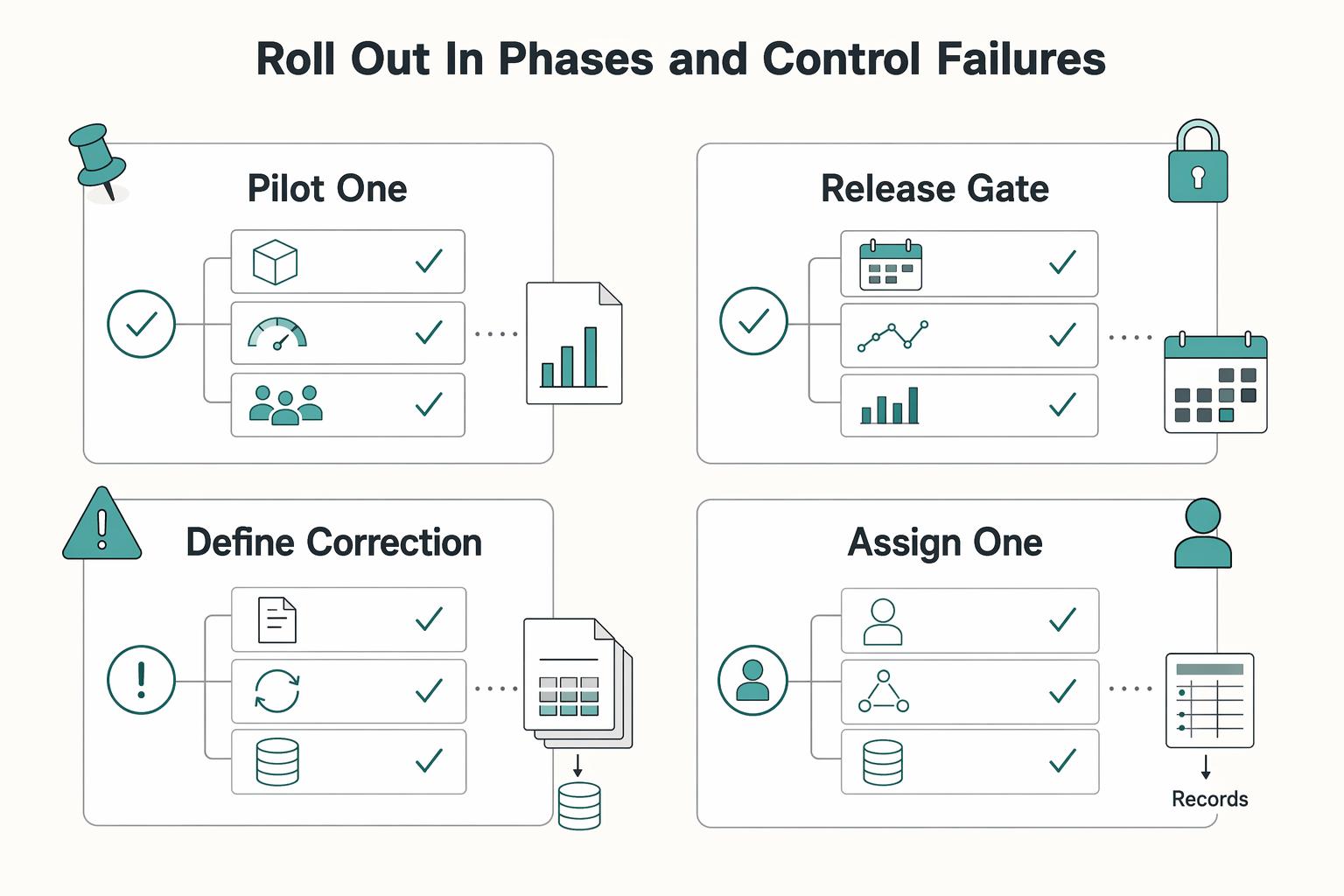
Run a small cohort through a billing period using agreed expected quantities and amounts. Check replays, late arrivals, price changes, allowance resets, corrections and downstream posting failures. Expand after the records reconcile and responsibilities are clear; preserve old billing history and define which system owns each period at cutover.
The rollout diagram summarizes a narrow pilot, a release decision, correction handling and one incident owner. Product defines the priced behavior, engineering owns event completeness and retry recovery, and finance approves billing and close treatment. Those responsibilities can sit with a small team; a dedicated mediation product or a spreadsheet-free architecture is not mandatory.
| Evaluation case | Evidence to request |
|---|---|
| Repeat the same source event | One qualifying quantity and one intended financial side effect |
| Delay an event until after cutoff | Documented period/correction treatment with the original reference |
| Change a price mid-period | Correct effective version and agreed proration |
| Send a cumulative storage update | Expected configured snapshot or interval behavior |
| Find an overbill after payment | Original document, approved remedy and accounting/receipt references |
| Migrate historical usage | Cutover ownership and no rebilling of previously invoiced activity |
Compare vendors using your actual offer and data, including export access, supported corrections, processing lag, ingestion limits and connector responsibilities. A vendor can supply billing while your finance system supplies journals; require the connection to be explainable rather than demanding every product create ledger entries itself. Review signed service commitments, exclusions, remedies and escalation paths for your selected service.
A controlled export or documented reconciliation workbook can be a practical part of a small operation. The risk is unexplained manual transformation or missing references, not the file format itself. For disputes, record the specific invoice, meter, reason and applicable response deadline. Do not substitute a generic “7–21 days” range for the current deadline on the actual notice.
For offer design, see A Guide to Usage-Based Pricing for SaaS. For token-specific units and cost treatment, see Choosing Token Metering and Cost Pass-Through for LLM API Billing.
Frequently Asked Questions
What should we meter first for usage-based billing: API calls, storage, or seats?
Choose a unit that customers can verify and that your source records can measure reliably. Define request eligibility, storage time/aggregation or seat activation and proration before billing. A narrow first pilot helps, but multiple distinct meters can be valid when their charges and included scope are explicit.
How should hybrid pricing work if we need predictable revenue and fair consumption charges?
Specify the base fee, allowance, overage rate and reset period. If pricing deducts included units, supply total qualifying usage rather than subtracting the allowance at ingestion and again during rating. Retain the price version, quantity and invoice calculation. Credits and caps need their own defined treatment.
What systems are required to run metered billing without manual spreadsheets?
You need a reliable usage source, validation and aggregation, effective pricing, invoice generation, monitoring and a connection to accounting. These can be integrated products or separate systems. Controlled exports or workbooks can help; the requirement is traceable calculations and recoverable errors, not banning spreadsheets or mandating a mediation product.
How do we keep usage invoices transparent and dispute-resistant?
Show the usage period, billable unit, qualifying quantity, included allowance, rate/tier and adjustments. Preserve source-to-invoice references and applicable price versions. Explain a correction against the original document and use the actual dispute deadline rather than a generic network response range.
What are the most common failure modes in usage-based billing operations?
Check repeated submissions, invalid customer/meter mappings, late events, wrong aggregation, double allowance deductions, rate drift and failed accounting updates. Submission acceptance and asynchronous processing are separate. Use provider-supported retries, durable identities and reconciliation; webhook retry windows are provider-specific.
What checklist should we use to evaluate a usage billing platform before migration?
Demonstrate your priced cases from qualifying activity to invoice and accounting evidence. Include duplicate replay, late arrival, rate changes, corrections after issue and cutover history. Verify export access and integration ownership. A vendor does not have to supply every accounting component, but the overall flow must remain traceable.
Which critical details are often missing from vendor pages when comparing platforms?
Ask about processing lag, limits, event identity and retention, aggregation/replacement semantics, cutoff behavior, credit scope and finalized-invoice corrections. Verify who owns journal integration and recovery. Test the selected implementation and review signed service commitments rather than assuming every provider shares Stripe’s behavior.
Where Gruv fits
See recurring billing operations
Launch recurring billing, manage plan changes, and configure failed-payment recovery as the billing model grows.
See reconciliation and mismatch review
Compare ledger entries, provider payment records, and statement rows to see what matches and what finance needs to review.
Researched and edited by the Gruv editorial team. Gruv builds cross-border billing, payouts, and finance-operations software for global businesses.
Sources
Educational content only. Not legal, tax, or financial advice.
Related Posts
Choosing Token Metering and Cost Pass-Through for LLM API Billing
LLM API billing looks tidy on a pricing page and much messier in production. Once real traffic shows up, the hard part is not pricing theory. It is choosing the right meter, reconciling charges across providers, and producing invoices you can explain line by line when a customer pushes back.

SaaS Usage-Based Pricing for Predictable Cashflow and Fewer Disputes
If you are considering **saas usage-based pricing**, treat it as an operations and collections decision first. Pricing works best when the usage unit can be measured, shown on the invoice, and explained by someone outside your product team.

Usage-Based Billing for B2B SaaS Platforms That Teams Can Operate
Usage-based billing works best when customer value rises with measurable consumption rather than with a fixed license. It can improve pricing fit, but only if pricing logic, billing data, and finance controls are designed together from the start.