
Quick Answer
Pay reasonable compensation through payroll for shareholder services before non-wage distributions, and record genuine owner distributions separately. Stock basis—not debt basis—determines non-dividend distribution taxability; excess generally creates capital gain. Prior C-corp earnings can change the rules. Keep shareholder basis and payout records.
Step 1: Set a Defensible Salary - Your Compliance Foundation#
Start with one rule: classify each owner transfer clearly, then keep enough records to test distribution taxability against stock basis later. In an S corporation, income, loss, deductions, and credits flow through to shareholders and are taxed on shareholders' personal returns. Whether a non-dividend distribution is taxable depends on stock basis, not debt basis. Schedule K-1 reports the non-dividend distribution amount, but it does not tell you the taxable amount.
Apply three checks before you lock the pay decision#
A shareholder who works for the company must receive reasonable compensation for services rather than using distributions to avoid employment taxes. Document duties, training and experience, time spent, comparable pay and how revenue is produced. There is no universal salary-to-distribution percentage. Review the IRS compensation guidance against the actual work performed.
- Classification check
Pass: owner transfers are consistently labeled in your books, with matching support. Fail: transfers are mixed in one catch-all owner account.
- Basis-visibility check
Pass: you can show current stock-basis tracking and distribution totals, and you track debt basis separately. Fail: you cannot show how distributions map to stock basis, or you rely on debt basis for distribution taxability.
- Year-end reporting check
Reconcile distribution totals to Schedule K-1 inputs. For loss deductions, review limitations separately: stock and debt basis, at-risk rules, passive-activity rules and the excess-business-loss limitation. A K-1 loss is not automatically deductible.
| Check area | Strong evidence | Weak evidence | What to retain | Cleanup risk if missing |
|---|---|---|---|---|
| Classification | Consistent labels per transfer and matching support | Mixed transfer types in one owner bucket | Ledger detail plus transfer support | Reclassification work at year end |
| Basis visibility | Stock-basis tracking tied to distributions, with debt basis tracked separately | No basis tie-out or debt basis used for distribution taxability | Basis workpapers and period tie-outs | Taxability analysis can fail late |
| K-1 readiness | Records tie to K-1 inputs and loss limits are reviewed in order | Reliance on K-1 alone for taxability or loss claims | Reconciliation notes and limitation review file | Filing delays or correction cycles |
Build the file in sequence#
Keep the setup simple and deliberate. Start with a short memo that explains your compensation rationale and classification policy. Then add a dated internal decision record so the amount, timing, and classification approach are explicit. Next, align your accounting setup to that decision and verify the first period posts correctly. If anything is still unresolved, mark it as pending verification instead of guessing.
It also helps to keep support in chronological order. That makes later review faster because you can see whether the books actually followed the documented approach.
Clear the gate before Step 2#
Move to Step 2 only when all of these are true. If classification is mixed, basis support is incomplete, or K-1 readiness depends on guesswork, stop and fix Step 1 first.
- compensation rationale and transfer classification are documented
- owner transfers are separated cleanly in the books
- stock-basis tracking is current enough to evaluate distribution taxability
- K-1 preparation inputs are traceable from your records
- unresolved items are flagged, not assumed
Related: How to Structure an S-Corp for a Husband and Wife Partnership.
Step 2: Make Each Distribution a Separate, Controlled Event#
The IRS says S corporations must pay reasonable compensation to shareholder-employees for services before making non-wage distributions. Within that requirement, choose a consistent bookkeeping cadence: review cash and obligations, reconcile payroll and authorize a genuine distribution as a separate event. The exact monthly or quarterly workflow is an internal policy, not a universal IRS-prescribed accounting sequence.
Run the same sequence every period#
- Cash is available
Use cleared business cash, not projected receipts. Before any owner transfer decision, review open bills, the next payroll cycle, payroll tax pulls, and other near-term debits.
- Payroll is complete
For this cadence, treat payroll as complete when the run is processed, payroll-liability entries are posted, and the payroll register aligns with provider confirmation or bank movement.
- Distribution is a separate event
Record the distribution with its own authorization note, its own bank transfer, and its own ledger line to a dedicated distribution or equity account.
If you follow that order every month or every quarter, your records are usually easier to review. If you skip the order, that exception can create cleanup work later because the owner transfer purpose may be less clear.
| Sequence behavior | What happens in practice | Reconciliation impact | Documentation risk |
|---|---|---|---|
| Cash in -> payroll complete -> separate distribution | Payroll records, bank movement, and distribution ledger entry align | Typically cleaner period close and fewer year-end cleanup passes | Stronger support trail |
| Owner transfer before payroll is fully complete | Cash moves to owner while payroll is still unresolved | Harder to show what cash was available after wage obligations | More reclassification questions |
| One mixed transfer labeled later | One payment is treated as multiple purposes after the fact | Manual cleanup and weaker traceability | Weakest support trail |
Pre-distribution control gate#
Before you release a distribution, confirm all five items:
| Control | What to confirm |
|---|---|
| Payroll reconciliation | Register, provider or bank confirmation, and ledger postings agree |
| Near-term obligations | Open bills, next payroll, payroll tax pulls, and scheduled drafts are covered |
| Retained buffer | Cash remains for routine operations and known obligations |
| Ledger coding | Distribution or equity account is ready, not payroll or miscellaneous expense |
| Basis note | Verify basis treatment before release is present where relevant |
If one item fails, do not force the payout through and promise yourself you will fix the records later. Pause the transfer, note what is missing, and clear that item first. A short delay is usually easier to manage than a later reclass with incomplete support.
Keep special mechanics separate#
Treat property distributions, shareholder loans and equity reinvestment as separate transactions requiring tax and governing-document review. Property distributions can have consequences at both corporate and shareholder levels; a cash-distribution workflow does not resolve those cases.
Review rights to distributions and liquidation proceeds across owners. S corporations must have one class of stock; differences in voting rights are permitted, but differing economic rights can threaten eligibility. Do not import a generic dividend-reinvestment plan without reviewing the S-corp rules and any prior C-corp earnings and profits.
If you want a deeper dive, read Sole Proprietorship vs. LLC: The Definitive Guide for Global Freelancers.
Step 3: Keep a Traceable Distribution Record#
If Step 2 gives you a clean cadence, Step 3 is what makes it hold up later. At this point, the main risk is record quality: can you show who approved each payout, what it was, and how the cash and books match?
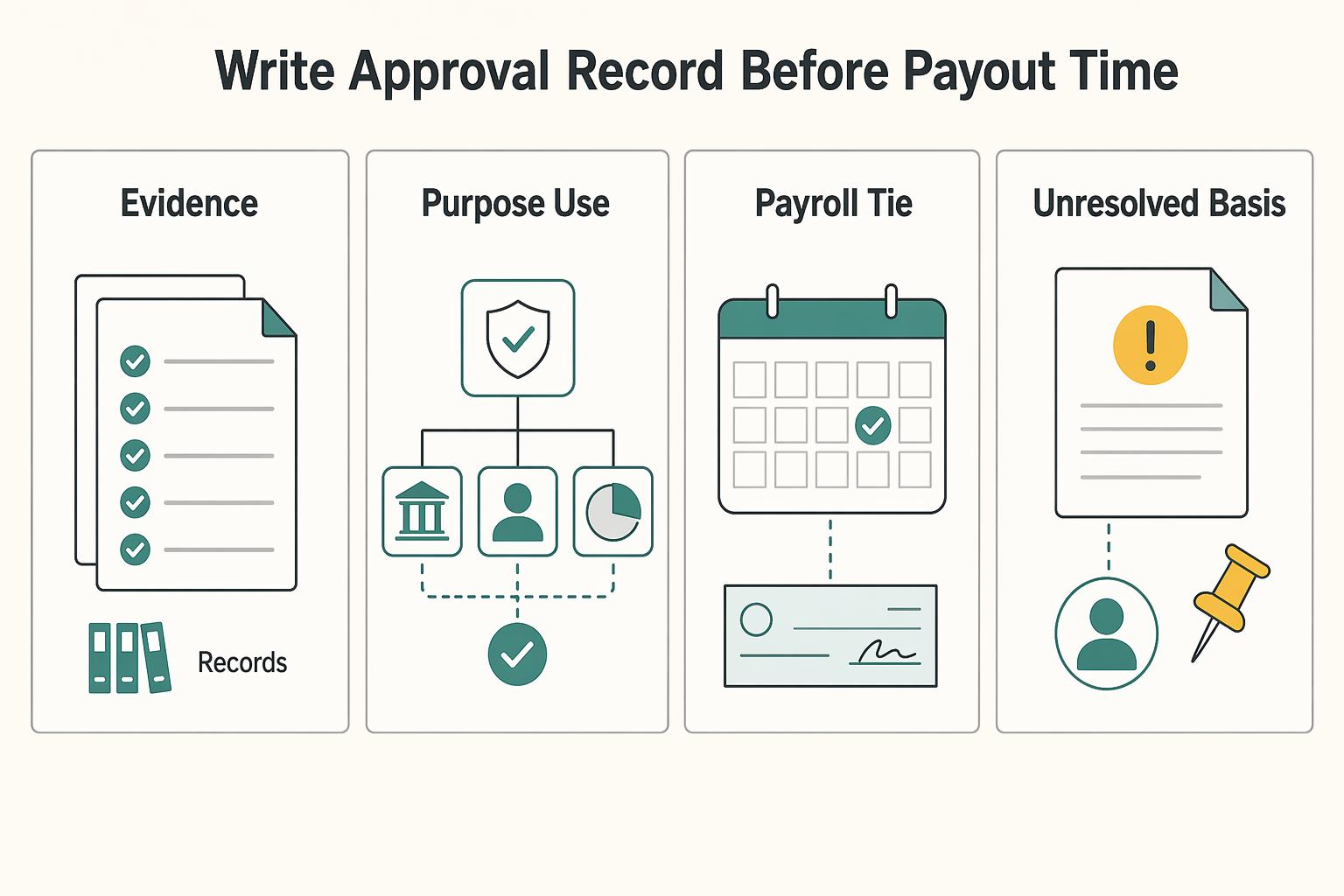
3.1 Write the approval record before or at payout time#
Capture the approval when the distribution is authorized, then add transfer proof and the matching ledger entry. Identify any unresolved basis or earnings-and-profits question for tax review; documentation supports the analysis but does not by itself establish tax-free treatment.
| Approval item | What to record |
|---|---|
| Date | Record the date for each payout |
| Amount | Record the payout amount |
| Recipient | Record the recipient |
| Purpose | Use a plain-language purpose |
| Approver | Record the approver |
| Payroll tie | If it is tied to a completed payroll cycle, say so |
| Unresolved basis item | Mark the item as pending advisor review instead of guessing |
Treat the approval record as an internal control record, and have your advisor confirm legal form under your governing documents. For each payout, record at least the date, amount, recipient, plain-language purpose, and approver. If it is tied to a completed payroll cycle, say so. If a basis item is unresolved, mark it as pending advisor review instead of guessing.
If you use a short dated memo for a one-owner S-corp, treat it as an internal control record and confirm acceptability with your advisor. The control goal is contemporaneous evidence, not ceremony. Someone reviewing the file later should be able to tell what you intended at the time of payment without having to infer it from a bank statement alone.
3.2 Keep ledger coding and cash evidence aligned#
Good documentation breaks down fast when the ledger and the bank trail do not match. Use a consistent, clearly named ledger account and memo convention for payouts, and keep transfer proof with the same record. If an entry lands in the wrong account, correct it in period while the activity is still easy to trace.
| Record element | Clean approach | Risky approach |
|---|---|---|
| Ledger label | Consistent, clearly named ledger account with a clear memo | Expense, wages, loan, or uncategorized label with no review |
| Transfer path | Single clearly traceable business-to-owner transfer path when practical | Multiple mixed transfers bundled after the fact |
| Approval proof | Dated minutes, written consent, or signed memo saved with payout file | Approval recreated later or missing |
| Source-document linkage | Bank confirmation or check image linked to the ledger entry | Ledger line with no transfer evidence |
Keep the record standard tied to the actual distribution: authorization, shareholder, amount, date, purpose, bank evidence and accounting entry. Transfer-pricing methods for controlled services do not determine S-corp distribution approval records.
3.3 Prefer one payout path when practical#
This habit helps prevent cleanup work later: keep each payout traceable through one identifiable business-to-owner transfer when practical. Keep personal and business spending separate, and avoid patterns that force reconstruction after the fact.
If classification is unclear, fix it immediately with a same-period correction, reclass, or reversal and note why. Keep one evidence pack per payout: approval record, transfer proof, ledger entry, and a short tie-out note for anything unusual, including unresolved basis items or other open questions. If you split the money flow across several transfers, make sure the file explains the sequence clearly enough that another person could trace it without asking you what happened.
3.4 Hand off a year-end package your accountant can use fast#
By year end, your accountant should not need oral history to understand what happened. Send a reconciled package, not just a total, so each payout can be traced from approval to transfer to ledger. Include the following:
- full-year distribution ledger export with clear labels and miscoding corrected
- transfer support for each payout, or a reconciled statement map to ledger lines
- any internal allocation support used during multi-owner periods
- notes for unusual items: reversals, reclasses, returned transfers, and unresolved basis items pending review
A short cover note that ties the annual distribution total in the ledger to the support you are sending can save a round of questions. The goal is a handoff that lets return prep start from organized records instead of reconstruction.
You might also find this useful: How to Revoke an S-Corp Election. If you want your payout workflow to mirror this same audit-ready discipline, review how Gruv Payouts handles policy gates, status tracking, and traceable records where supported.
Conclusion: Keep Records Clean and Track Basis Every Cycle#
Keep the core rule simple: keep your distribution records clean, track stock basis consistently, and do not treat a non-dividend distribution as tax-free until your basis records support that conclusion.
Schedule K-1 reports non-dividend distributions without determining each shareholder’s taxable amount. In the ordinary non-dividend case, distributions reduce stock basis; amounts above available stock basis generally create capital gain. Debt basis does not shelter distributions. A prior C-corp earnings-and-profits balance can change the ordering and dividend treatment, so review that separately.
Run this every-cycle close checklist#
Use this checklist at each close:
| Step | Checklist |
|---|---|
| 1. Confirm period records are complete | Go if owner transfers and related entries for the period are processed and supported in your records. Stop if cash moved without support or period records are incomplete. |
| 2. Reconcile and classify the period | Go if bank movement and equity postings tie to the same period. Stop if owner transfers are miscoded or unsupported. |
| 3. Update basis before calling any payout tax-free | Go if stock basis tracking is current. Remember that Schedule K-1 shows the non-dividend distribution amount, not the taxable amount, and debt basis is not used to determine whether a distribution is taxable. Stop if basis is unresolved and mark the treatment as pending review instead of estimating. |
| 4. Release distribution and save the payout file | Keep approval, transfer proof, and the equity entry together so year-end treatment is traceable, including cases where one distribution creates multiple tax consequences. |
| Area | Doing it right now | Cleanup later |
|---|---|---|
| Compliance risk | Clear basis tracking and distribution classification | Higher chance of incorrect distribution tax treatment |
| Bookkeeping effort | One clean close cycle | Backtracking through mixed entries |
| Tax filing friction | K-1 and return prep starts from organized records | Harder to determine distribution taxability |
If your facts cross entities or jurisdictions, add one control point before changes: confirm the rule that applies to your exact case. If you need the mechanics, start with How to Run Payroll for an S-Corp with a Single Employee (Yourself).
For a step-by-step walkthrough, see The Best Way to Manage Shared Finances in a Business Partnership. If your owner-pay process is cross-border or spans multiple entities, use Contact to confirm market coverage and compliance gating before you change operations.
Frequently Asked Questions
How do you set a reasonable salary?
Set reasonable compensation from the services performed, time spent, experience, responsibilities and comparable pay. Document the rationale and use payroll for wages. A fixed percentage or low wage chosen solely to maximize distributions is not a substitute for that analysis.
What order should you pay yourself?
The IRS requires reasonable compensation for shareholder-employee services before non-wage distributions. Use payroll for wages and record genuine distributions separately. The exact monthly or quarterly reconciliation routine is your internal control choice; it cannot replace the compensation requirement.
What is the difference between salary, a distribution, and a dividend?
Wages pay for services and belong in payroll. A genuine shareholder distribution is an owner payment whose tax treatment depends on the S-corp distribution rules and shareholder stock basis. A dividend can arise from accumulated earnings and profits, often from a prior C-corp period; calling a payment a dividend does not determine its treatment.
How should you document a distribution?
Document each payment so it is clear whether it was compensation for services or a non-wage owner payment. Keep wage and non-wage classifications separate in your books. If something is miscoded, correct it promptly so the record stays clear.
What if there are multiple owners?
Assess reasonable compensation separately for each working owner and track each shareholder’s basis separately. Check the governing distribution and liquidation rights against the one-class-of-stock rule. Unequal actual cash payments do not alone establish a second class, but differing economic rights and unexplained balances need review.
Try a related tool
Researched and edited by the Gruv editorial team. Gruv builds cross-border billing, payouts, and finance-operations software for global businesses.
Sources
Educational content only. Not legal, tax, or financial advice.
Related Posts

Sole Proprietorship vs LLC for Global Freelancers in 2026
For most freelancers in 2026, the practical default is still simple: use the simplest structure you can run cleanly, then formalize when risk actually rises. If your work is still in validation mode and the downside is contained, a sole proprietorship is often the practical starting point. When contract exposure, delivery stakes, or dispute risk starts climbing, forming an LLC deserves earlier attention.

The Freelance Payment Penalty: A Modeled Audit of Platform Fees, FX Spreads, and Payout Delays
The money rarely disappears through a single, easy-to-spot fee. The real loss is stacked. A marketplace takes its commission, a processor adds a charge for international cards, a bank or payment company converts the currency at a spread, a platform holds the funds before release, and a wire sheds a little to intermediaries on the way in. Each layer looks defensible on its own, but the worker feels the combined result as a smaller deposit and a later payday.

How to Respond to a Subpoena for Business Records
Move fast, but do not produce records on instinct. If you need to **respond to a subpoena for business records**, your immediate job is to control deadlines, preserve records, and make any later production defensible.