
Quick Answer
Audit your payout platform by locking scope, owners, and evidence first, then testing traceability from request to final status. A strong internal payout audit checklist also verifies approvals, compliance gates, reconciliation to internal records and external confirmations, duplicate and retry controls, and clear exception severity, escalation, and closure evidence. The goal is reviewer-ready artifacts, not manual reconstruction.
Trace payout controls from request to reconciliation#
Payout audits usually break for operational reasons: volume rises, edge cases multiply, and evidence ends up scattered across spreadsheets and other manual records. This guide gives finance teams a control checklist, not a policy memo.
What works at a few hundred transactions can crack at thousands. Manual checks and spreadsheet-led reviews get slower, less reliable, and harder to defend, especially when reconciliation has to tie internal records to external statements for a reliable close. A quick reality check: take one completed payout and see whether you can trace it from request to final status without rebuilding the story across teams.
Success here is operational and evidence-based, not wording-based. You are aiming for reviewer-ready artifacts that stand on their own, cleaner record history, and stronger exception follow-through during close review. At minimum, key payout events should show who approved, when status changed, what exception occurred, and what evidence supports the final outcome.
This guide is for platform finance, ops, and product owners who run payout execution, reconciliation, exception handling, and release decisions. The scope is intentionally limited to internal payout controls. Compliance controls and processes are in scope, but full external reporting requirements vary by market and program. Set audit scope by risk rather than calendar habit so you test the controls tied to the highest exposure.
For a step-by-step walkthrough, see Spend Analysis for Platform Finance Teams to Categorize and Benchmark Vendor Payments.
Gather the documents and data before you test any control#
Start by locking scope and organizing evidence before testing begins. Prep problems usually come from the same places: missing documentation, approval gaps, and duplicate or conflicting records.
| Prep item | What to gather | Purpose |
|---|---|---|
| Operating data to trace | Core transaction export and related system reports | Trace activity end to end across internal records and external references |
| Policy and approval artifacts | Approval workflow, hold and release policy, exception SOP, and Segregation of Duties or Dual Approval artifacts if used | Explain movement decisions and keep approval evidence out of scattered chats and inboxes |
| Prepared-by-Client (PBC) request folder | A simple structure for data exports, policies, approvals, exceptions, and open questions | Keep evidence in one place before requests begin |
| Scope window and population | Date range, exclusions, and source reports | Define what is in scope and what is out of scope before mid-test changes |
-
Pull the operating data you will trace. Start with the core transaction export your team already uses, then add the related system reports needed to trace activity end to end. Quick check: confirm you can trace one completed transaction across internal records and external references without ad hoc evidence requests.
-
Collect the policy and approval artifacts that explain movement decisions. Gather your approval workflow, hold and release policy, and exception SOP. If your program uses
Segregation of DutiesorDual Approvalcontrols, include those artifacts too. Documentation, record-keeping, and approval workflows are core audit prep areas, so keep these artifacts out of scattered chats and inboxes. -
Set up a starter
Prepared-by-Client (PBC) requestfolder before requests begin. Keep a simple structure for data exports, policies, approvals, exceptions, and open questions so evidence lands in one place. This cuts confusion when similar files start circulating during testing. -
Confirm scope window and population now, not mid-test. Define what is in scope and what is out of scope using risk assessments, prior findings, regulatory mandates, and business priorities. Make sure the audit coordinator can clearly state the date range, exclusions, and source reports.
If you also need the CFO case for tighter process design, see How to Make the Case for AP Automation to Your CFO: A Platform Finance Team Playbook.
Define audit scope and control owners before touching transactions#
Do not test transactions until each control has a clear objective, one owner, and documented evaluation criteria. That keeps the audit focused on control quality instead of late evidence chasing, where issues can stay hidden until audits, cash flow problems, or vendor disputes surface.
1. Set control objectives by risk lane#
Start with risk, not reports. A practical control check is whether each stage is explicitly structured, with a clear path from received to reviewed to approved to paid.
For payment processes, define objectives under the risk lanes your team already uses. Keep each objective short and testable so reviewers do not have to interpret intent during fieldwork.
2. Map each objective to the standards your team already uses#
Use your existing control language instead of creating a new taxonomy just for the audit. If your team already uses internal labels, mirror those labels in the scope sheet for consistency.
Map controls to the applicable policy or control family before sampling. Document a new or unmapped control so the audit can test its purpose and evidence.
3. Assign one owner to each decision point#
Assign ownership to each decision point instead of leaving accountability diffuse.
The non-negotiable is single-point accountability at each checkpoint. If no owner can explain the control, evidence source, and exception path without handoffs, ownership is not ready.
4. Write pass or fail rules before you pull samples#
Define pass or fail criteria before selecting samples, and document the evidence needed to evaluate each control.
State required evidence fields up front so testing stays objective. For each control, document the control statement, owner, policy mapping, expected extract, and exception notes.
Select finance reporting evidence using Real-Time Reporting Metrics Platform Finance Teams Can Actually Control.
Map the payout path from request to final state#
Your map is audit-ready when a reviewer can trace one payout from request to close without interpretation. Once owners and pass or fail rules are set, build that trace so controls, owners, and evidence paths are explicit at each step.
1. Build one canonical path, then branch only where control or evidence changes#
Start with the base payout flow as a clear sequence: request creation, approval, compliance checks, external submission, status updates, and close. Give each step one row, and record the system of record, owner, and evidence path used to prove completion.
Add variants only where the control, owner, or evidence source actually differs. If you support multiple payout lanes, branch the map where the route to final state or proof set changes. A single merged flow can hide gaps when teams assume the same evidence exists across lanes.
Use a simple branching rule: split when ownership changes, evidence source changes, or the transaction can reach the same final state by a different route.
2. Add evidence links so tracing works without guesswork#
For each step, document the records that connect it to the next step. In many environments, that means some combination of an internal identifier, an external confirmation reference, and related ledger entries. Do not assume universal fields. Define what is expected in your environment and where it is retrieved.
For each row, name the exact artifact a reviewer should pull, whether that is an export, event log, or reconciliation view, and who can produce it. A control map without evidence paths is not testable.
Run a quick linkage check in both directions:
- From external confirmation, can you find the internal transaction and corresponding journal entry?
- From journal line, can you find the originating payout request?
If either direction fails, linkage is incomplete.
3. Mark asynchronous risk points directly in the map#
Asynchronous handoffs can become failure points, especially as volume grows. Delayed status updates, drift between internal and external records, and unmatched confirmations should be mapped as explicit risk points, not buried as generic exceptions. For each step, include expected latency based on your own policy or operating expectation, a failure signal, and an escalation trigger.
| Step | Main evidence link | Owner | Expected latency | Failure signal | Escalation trigger |
|---|---|---|---|---|---|
| Request creation | Internal transaction ID | Ops or product | At intake | Request exists with no traceable source or duplicate request record | Owner cannot show originating record |
| Approval | Approval record linked to transaction ID | Finance or approver group | Before release | Submission appears before approval, or approval link is missing | Any payout progresses without approval evidence |
| Compliance checks | Compliance decision record linked to transaction ID | Compliance or ops | Before submission | No check result, stale decision, or unresolved hold state | Payout advances while check status is unclear |
| Provider submission | External reference linked to internal transaction | Payments ops or platform | At release to provider | Submission marked sent with no external reference or no acknowledgment path | Owner cannot prove handoff occurred |
| Status updates | Status updates mapped to transaction and external reference | Engineering plus ops | Within your defined async window | Internal status differs from external state, or status update delivery gaps appear | Drift persists beyond your review window |
| Close | Ledger entries and close evidence tied back to transaction and external record | Finance | Before period close or batch signoff | Open exceptions remain, or journal linkage is incomplete | Transaction cannot be tied across all required records |
4. Prove the map with forward and reverse tracing#
Test the map on real payouts from each active variant before sampling. Trace one forward from request to close, and one backward from external confirmation to the originating request and related journal entries.
If a step can only be explained verbally, the map is incomplete. If one payout takes multiple handoffs to reconstruct, ownership or evidence paths are still weak. A complete map reduces audit friction because controls, owners, and evidence are already linked before transaction testing begins.
If your team also needs enablement support, see Upskilling Platform Finance Teams for Payments Compliance and Automation.
Test approvals and compliance gates on live-like samples#
Policies alone do not prove a control works. Transaction behavior and auditable records do. Use live-like samples to test approved, rejected, and, where applicable, held outcomes. Use a clear escalation rule: if approval or compliance checks appear bypassable without traceable justification, treat that as a high-severity control gap and remediate before expanding that payout lane.
1. Pull matched approved and rejected samples#
Start with transaction testing, not screenshots. The objective is to verify that approval and compliance policies are followed in practice.
At minimum, pull:
- approved payouts that reached release
- rejected payouts that should remain blocked under your policy
- if your controls define hold scenarios (for example KYC, KYB, or AML review), held payouts for those scenarios
For each sample, gather the request record, approval history, compliance decision record if present, and related history export. If evidence is spread across spreadsheets, emails, and shared drives, treat that as a control-evidence risk.
2. Verify approval controls and Segregation of Duties from records#
Test identity and sequence from records. Verify required approvals occurred before release. Where policy requires dual approval, check two distinct authorized approvers; where it requires initiator/approver separation, check that distinct role condition separately. Verify automated approvals and permitted exceptions against their actual authorized design.
For rejected samples, confirm the request stayed blocked and the record history shows who rejected it, when, and why. If testing shows role conflicts or overrides without traceable justification, classify that as a control failure.
3. Challenge compliance gates with scenario-based samples#
Where KYC, KYB, or AML gates are configured, test scenario outcomes directly instead of checking only for populated fields. Use at least one sample per configured scenario and verify the transaction followed the expected path.
Your checkpoint is behavior plus evidence:
- held decisions are recorded
- any change from hold to release appears as a separate, traceable decision event
If the record cannot show whether the payout was blocked, released, or bypassed, the control is not auditable.
4. Confirm the audit trail is usable, then decide lane status#
For each tested policy decision, confirm a durable record exists with actor, timestamp, and reason code, or an equivalent justification field. Prefer repeatable, machine-readable evidence over manual reconstruction.
Use an Evidence Pack mindset: keep one complete evidence set per sample so a reviewer can audit without interpretation. If approval or compliance checks appear bypassable without traceable justification, treat that as a high-severity finding and prioritize remediation before expanding that payout lane. For deeper control design, see Internal Controls for Payment Platforms: Segregation of Duties Dual Approval and Audit Trails. For a broader audit response playbook, see Responding to a Regulatory Audit as a Payment Platform.
Reconcile every payout batch from ledger to provider confirmations#
Use a repeatable AP audit checklist to review each payout batch across internal records and any external confirmations available. Treat unexplained mismatches as control risk that needs documented follow-up. The goal is not a near match. It is a traceable record of what matched, what did not, and what happens next.
1. Freeze the audit population and evidence pack#
Define the exact population first, then freeze the records you will use for review. Record the cutoff window, pull times, and filters so reviewers can see exactly what was tested and avoid confusion from later data changes.
2. Reconcile internal records and run a risk assessment on mismatches#
Tie batch totals to your internal records in one working file that keeps both summary and exception detail. Keep enough detail to trace each exception, then run a risk assessment on any mismatch instead of accepting a small net difference as close enough.
3. Compare external confirmations where available and keep exception evidence#
Compare provider or bank evidence against internal records for the scope being tested. If independent evidence cannot be obtained, document the missing evidence and resulting audit limitation; an internal ledger tie-out alone does not prove external settlement. Keep unresolved items traceable with owner and follow-up.
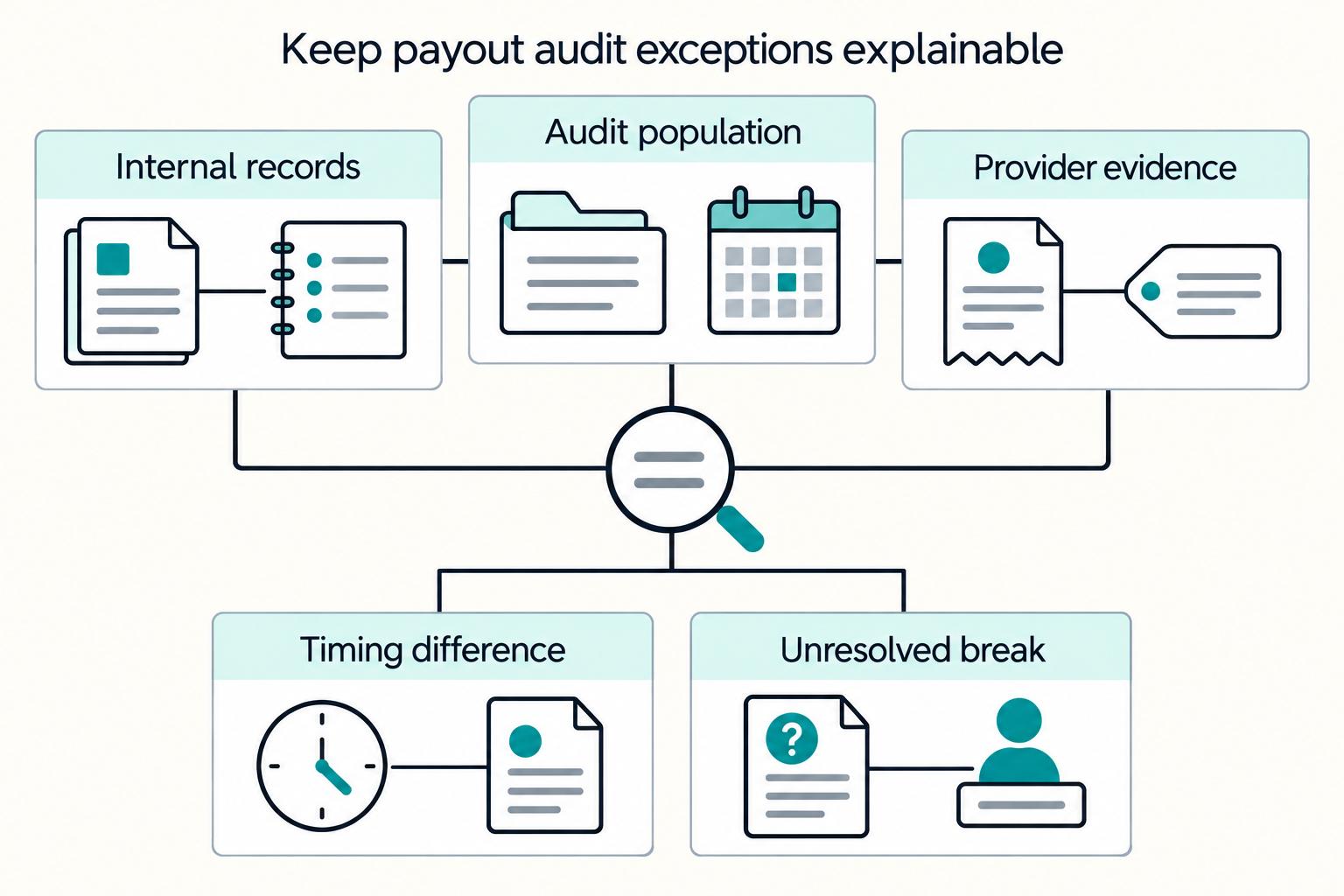
4. Separate timing differences from true breaks and age exceptions#
Classify exceptions into timing differences versus unresolved breaks, and track owner plus aging in a visible register. If an item remains unresolved, escalate it through your normal control review path rather than carrying it forward without a clear resolution record.
Before you lock your reconciliation SOP, review the event and status patterns in the Gruv docs. Where your flow uses ledger entries, provider references, or webhook events, map them consistently every cycle.
Prove retries are safe and duplicates are blocked#
After reconciliation, answer this directly: can one payout request be retried without creating a second payout? If you cannot show that with evidence, treat it as a control gap. Silent endless retries and webhook-driven duplicate events are known failure patterns audits should detect.
1. Define the retry cases you expect to be safe#
Document the retry scenarios before sampling so the test is repeatable. For example, include a client retry after an apparent failure, a network timeout where first delivery is unclear, and a delayed Webhooks update that arrives after internal status has drifted.
Your design checkpoint is documented retry behavior, not a verbal claim that the platform is idempotent. Retry behavior should be defined alongside resiliency targets, so missing design notes are a control-design weakness before transaction testing starts.
For each case, predefine evidence to collect:
- internal request ID
- idempotency key or equivalent dedup token, if used
- first API response and second API response
- resulting
Provider References - related
Webhooksdelivery log entries - status-change entries with actor or service identity
2. Re-submit the same request and inspect replay behavior#
In a controlled test environment or approved nonduplicating test procedure, replay the same logical payout instruction using its original operation ID and provider-supported idempotency key. Verify that replay resolves to the existing outcome rather than a second payout. Test duplicate callbacks and ledger posts separately, and cover provider retention limits and ambiguous outcomes; do not send a replacement live payout merely to see whether deduplication works.
Verify this in the event history: whether there is a second external settlement identifier and whether there is a second ledger obligation for the same business event. A new provider reference, a second payable, or two successful outcomes for one obligation are high-risk signals that need investigation.
For an uncertain timeout, preserve the original instruction ID and query the provider or reconcile external evidence before deciding whether a new execution is permitted. Keep late responses and webhook evidence in the same record. A provider key can expire, so durable internal outcomes must prevent unsafe replacement after its retention window.
3. Compare duplicate-risk signals across the audit trail#
Use combined signals, not one field, to detect likely duplicates. A practical lens can include the same beneficiary, the same amount, a close submission window, and reference collision or near-collision in the record history.
Use that as a detection lens, not a universal rule. For each flagged pair, decide whether it maps to one obligation or two, then confirm the ledger still reflects the actual payment obligation.
Also check for silent endless retries. Even when duplicates are blocked, endless retries can hide the true first attempt and weaken review quality.
4. Contain confirmed duplicates and assign the fix#
When a duplicate is confirmed, document immediate containment and ownership. Do not leave it as a passive exception note. Record what was done to contain impact, recovery status where relevant, and a root-cause owner and target date in the exception register.
Keep one evidence pack with the duplicate pair, containment decision, financial impact, and post-fix retest, tied to the same history export used for detection. If this step keeps failing because event history is thin, strengthen traceability with the companion guide on audit trails and approvals.
We covered the classification side in detail in Accrued Expenses vs. Accounts Payable: How Platform Finance Teams Classify Contractor Liabilities.
Build the audit evidence pack external reviewers actually ask for#
Build one reviewer-facing pack before fieldwork ends. It should be complete, linked, and usable in one pass.
1. Assemble the core evidence set in one place#
Assemble the reviewer-requested artifacts in one place, tied to the same sample window and transaction population used in testing. For each sampled payout, make sure the record trail can be followed end to end, including any related reconciliation result and exception handling.
2. Prepare a usable request index#
Use the request index as a map to final artifacts, not a file dump. For each requested item, link the artifact, name the owner, and record whether it is complete for the audit window. If multiple drafts exist, clearly mark the final reviewed copy and keep drafts out of the main pack.
3. Add tax context only when in scope#
Include payment-specific tax and withholding evidence only where applicable to the payer, recipient, income type and service location. A recipient's personal foreign-earned-income exclusion and Form 2555 claim are ordinarily outside a platform payout-control audit. Missing optional recipient-return support is not a universal payout-release defect; document actual withholding, reporting or provider requirements separately.
Set exception severity and escalation rules your team can execute#
Set these rules before close week so exception handling stays consistent under pressure. A practical approach is to use a defined severity scale tied to impact, then define how each level is handled at close and who owns escalation.
1. Define severity by impact#
At the information-gathering and preliminary-risk-assessment checkpoints, classify exceptions by control impact and audit risk. For each exception, name the impacted risk area, the affected transaction population, and the audit window so classification is reproducible.
| Severity | Definition | Notes |
|---|---|---|
| High severity | Exposure that could significantly affect control outcomes | Includes unauthorized or duplicate transaction risk |
| Medium severity | Control weakness with contained exposure | Still needs tracked remediation |
| Low severity | Limited process or documentation gap | No clear current control or execution impact |
Record the rationale for each severity assignment with the affected population and owner.
2. Write close treatment in if-then rules#
Use explicit if-then rules so decisions are not improvised during close. Define what happens when high-, medium-, or low-severity items are still open, and what documentation is required at each decision point.
This matters most in high-volume, manual, multi-approver workflows. In those environments, mistakes, duplicate payments, and unauthorized transactions can go unnoticed until they create later operational or audit impact.
3. Assign escalation by function, then level#
Route escalation first to the function that can fix the issue, then to higher management if it remains unresolved and starts to threaten close. Define this path in advance, and keep one current remediation owner and one sign-off owner for every open exception.
4. Require closure evidence before status changes#
Mark exceptions resolved only when the record includes clear remediation and verification evidence. Keep that evidence linked in the exception register and related audit deliverables so issue resolution is traceable. If a reviewer cannot trace the issue, owner, action taken, and verification outcome in one pass, keep the exception open.
Common audit failures in payout operations and how to recover fast#
After severity rules are set, recovery should be mechanical: restore traceability first, then rerun the control where it actually failed.
| Failure mode | Recovery action | Review focus |
|---|---|---|
| Required approval identity or governing rule cannot be traced | Identify the required human approver or authorized automated service/rule; retest the actual policy-specific approval design | Where policy requires distinct initiator and approver, verify separation; verify any authorized exception and its evidence |
| Ledger balances look right but provider states differ | Rekey reconciliation using Provider References and the provider payout identifier, then rerun tie-out on the related Payout Batches | Each payout-linked transaction should map from your ledger to the matching provider record |
| Webhook and status events are treated as instant truth | Add a timing window, an undelivered-event replay check, and a status reconciliation checkpoint before final failure classification | Replay and deduplication evidence should be visible in the exception record |
| Tax and compliance evidence is scattered | Consolidate applicable recipient-status, withholding and reporting evidence into one PBC structure | Match each form to the payer, recipient and payment; do not require every W-8/W-9/1099 for every payout |
1. Rebuild approver identity before you trust an approval#
For required human approvals, identify the authorized individual and action from the record. For an authorized automated decision, identify the service, governing rule and relevant human oversight. A status label alone proves neither approval path.
Retest the selected approval design against the same sample. Where policy requires dual authorization or initiator/approver separation, verify distinct authorized people and their action records. Review approved exceptions against the policy and retain justification. For automated decisions, verify the service identity, authorization and governing rule separately from required human approvals.
2. Rekey reconciliation by provider identifiers#
If ledger balances look right but provider states differ, batch totals are not enough. Rekey reconciliation using Provider References and the provider payout identifier, then rerun tie-out on the related Payout Batches.
The core check is transaction-level traceability for that payout population: each payout-linked transaction should map from your ledger to the matching provider record. This is where missing postings can surface, including items tied to refunds and chargebacks.
3. Add timing windows and replay controls for asynchronous events#
Separate a definitive provider-reported failure from a timeout or missing callback whose outcome remains unknown. Query the provider and reconcile current external state before retrying or replacing the instruction. Apply documented timing and replay rules while retaining late-event evidence.
During recovery, control duplicate risk explicitly. Replay windows and recovery queries are time-limited, so replay and deduplication evidence should be visible in the exception record.
4. Centralize tax and compliance evidence into one review set#
Consolidate applicable recipient-status forms, withholding decisions and information-return evidence in one PBC-ready structure. Explain why each requirement applies or does not apply to the sampled payment; avoid treating every tax form as a universal pre-release checklist.
Use form purpose and eligibility as the anchor: W-9 supplies a U.S. person's TIN and certification; W-8BEN or W-8BEN-E documents relevant foreign status, with other forms needed for some income or recipient types. Form 1099-NEC applies only to reportable nonemployee payments. Check current instructions, threshold and weekend/holiday-adjusted filing deadline for the actual tax year; reporting support and payment release are separate decisions.
Test rejected-payment recovery with Bank-Rejected Contractor Payout Recovery for Platform Teams.
If you want this checklist to run as a repeatable operating lane, evaluate how Gruv Payouts can support compliance-gated batches, status tracking, and traceable payout records where supported.
Use this copy paste checklist for your next internal payout audit#
Use this checklist as an execution tool, not a formality: lock scope, ownership, and evidence expectations first so testing does not turn into disputes about missing records or unclear accountability.
1. Confirm scope, owners, and objectives before sampling#
Start only after scope, control objectives, and named owners are documented and agreed. Keep the setup cross-functional so finance, compliance, IT, and leadership are all represented to reduce blind spots.
For each control in scope, define:
- one owner
- one evidence source
- one pass or fail rule
If any control is missing an owner or evidence source, log it as a design gap before fieldwork.
2. Verify approvals and compliance gates on both pass and fail cases#
Test approvals on successful and exception samples, not just happy-path flow. Approval breakdowns are a known audit failure mode, so confirm clear approval records and documented handling for rejects.
For compliance gates (including KYC, KYB, and AML where applicable), keep testing risk-based: verify your control design matches your organization's risk appetite or tolerance and that gaps are addressed quickly. If a gate can be bypassed without traceable evidence, keep it as a high-concern exception.
3. Reconcile payout records end to end and review duplicate risk#
Reconcile sampled records in a consistent order across internal records, ledger entries, and available external confirmations. Keep a documented mapping for sampled items and a clear explanation for differences, including timing differences versus true breaks.
Review duplicate-risk cases in the same pass. Duplicate submissions are a recognized audit concern, so test against your documented duplicate-handling controls and leave suspected duplicates open when the team cannot show containment or a clear explanation.
4. Produce the evidence pack reviewers will actually use#
Build the Prepared-by-Client (PBC) request pack during the audit, not at the end. Include approval evidence, reconciliation support, exception logs, and source documentation used for testing.
Use one quality check: another reviewer should be able to trace a sample from selection to conclusion without asking where evidence lives. If not, the package is not ready.
Next reads include:
- Internal Controls for Payment Platforms: Segregation of Duties Dual Approval and Audit Trails
- Month-End Close for Payment Platforms: A Step-by-Step Checklist for Finance Teams
- How to Build an Internal Payment Audit Trail: Logging Approvals and Changes for Compliance
5. Classify exceptions, assign accountability, and retest fixes#
Close the loop before sign-off: classify each exception by impact area, assign an owner, and set a remediation timeline with explicit accountability. Prioritize effective controls over adding layers that do not improve outcomes.
Do not close findings on intent alone. Retest remediated controls before final sign-off and keep closure evidence with the original finding. If behavior is not proven to have changed, keep the finding open.
Compare automation costs with Measure AP Automation ROI for Payment Platform Finance Teams.
Frequently Asked Questions
What should an internal payout audit checklist include at minimum?
Define scope, objectives, owners, and the transaction set under review first. At minimum, verify transactions and liabilities are properly recorded in the general ledger, review supporting documentation, and trace sampled items through the audit trail. If a control has no clear evidence or owner, log it as a finding.
How do finance teams test `Segregation of Duties` and `Dual Approval` without slowing payouts?
Inspect approval histories against the selected policy. Where initiator/approver separation or dual authorization is required, verify distinct authorized people; separately check authorized exceptions and automated-rule decisions. Sample existing durable records, then test changes in a controlled environment so audit work need not hold every ordinary payout.
How do you reconcile `Payout Batches` against `Ledger Journal Events` and `Provider References`?
Join internal instruction and batch IDs to ledger entries, provider payout IDs and bank/provider evidence using a documented mapping. Trace in both directions and compare transaction states, amounts, currencies, fees and cutoff timing. Keep missing external evidence or an unexplained mismatch as an open exception.
How do you detect duplicate payouts caused by retries or delayed `Webhooks`?
Trace one economic obligation through its durable instruction ID, provider attempts, duplicate callbacks and ledger postings. Test replay within and beyond provider key retention in a controlled environment. Similar beneficiary, amount and time are investigation signals, not proof of duplication; resolve ambiguous provider outcomes before authorizing another execution.
What evidence should be retained for audit readiness and a `Prepared-by-Client (PBC) request`?
Keep scope/population extracts, policy versions, sampled approval histories, provider/bank evidence, reconciliation workpapers, exception decisions, remediation and retest results in an indexed review set. Link each finding to its original sample and final reviewed artifact.
What is the difference between daily payout controls and month-end control checks?
Daily controls can identify unauthorized releases, duplicate attempts, failed payouts and unresolved mismatches quickly. Month-end controls tie balances and cutoff treatment to accounting records and assess aged exceptions or misstatement impact. Set the actual cadence by risk and operating model, with owners and evidence for each control.
When should a team pause a payout lane instead of remediating after close?
Escalate suspected unauthorized release, uncontrolled duplicate execution or unreliable settlement evidence immediately under your incident policy. The responsible owner decides a proportionate lane pause or containment while addressing contractual obligations and already-earned payments. Track remediation and retest before expansion.
Researched and edited by the Gruv editorial team. Gruv builds cross-border billing, payouts, and finance-operations software for global businesses.
Sources
Educational content only. Not legal, tax, or financial advice.
Related Posts

The Freelance Payment Penalty: A Modeled Audit of Platform Fees, FX Spreads, and Payout Delays
The money rarely disappears through a single, easy-to-spot fee. The real loss is stacked. A marketplace takes its commission, a processor adds a charge for international cards, a bank or payment company converts the currency at a spread, a platform holds the funds before release, and a wire sheds a little to intermediaries on the way in. Each layer looks defensible on its own, but the worker feels the combined result as a smaller deposit and a later payday.

How to Respond to a Subpoena for Business Records
Move fast, but do not produce records on instinct. If you need to **respond to a subpoena for business records**, your immediate job is to control deadlines, preserve records, and make any later production defensible.

A US Expat's Guide to Investing in UCITS ETFs to Avoid PFIC Issues
The real problem is a two-system conflict. U.S. tax treatment can punish the wrong fund choice, while local product-access constraints can block the funds you want to buy in the first place. For **us expat ucits etfs**, the practical question is not "Which product is best?" It is "What can I access, report, and keep doing every year without guessing?" Use this four-part filter before any trade: