
Quick Answer
Make the case by showing how the new AP process improves controls, exception handling, auditability, and reconciliation with evidence your CFO and Controller can inspect. Build a verified baseline from ERP exports and exception logs, separate process problems from tool limits, name control owners, and ask for approval only with clear go or no-go gates and a phased pilot plan.
What Your CFO Needs to See Before Backing AP Automation#
Manual AP can become a problem before it becomes a budget item. What stalls the work is often not the backlog itself, but the case you bring to the CFO and Controller. If the proposal reads like a feature list instead of a control and execution plan, approval often stops there.
AP automation can handle invoice capture, routing, matching and payment preparation. The case for buying it should show which tasks and controls improve, what the change costs, and who will manage exceptions. Faster routing alone is not enough if incomplete records or unclear approval authority still stop invoices.
Build the case around your own invoice sample. This guide helps finance, product and engineering turn that sample into a cost model, a control test and a specific funding request the CFO can assess.
Use verified evidence and mark unknowns early. Before you discuss ROI, confirm where work is manual, where approvals break, and which records prove policy compliance, including whether controls such as three-way matching are consistently evidenced. Some benchmark resources are access-limited, so if a metric definition or source detail is incomplete, treat it as context, not proof.
Use this rule throughout the playbook. If a claim cannot be tied to an artifact your CFO or Controller can review, treat it as an assumption, not a conclusion.
Gather the evidence package before you ask for approval#
Bring the CFO a packet, not a story. Without a clean baseline, the AP automation case can sound like opinion instead of a control plan.
Build a baseline from current records#
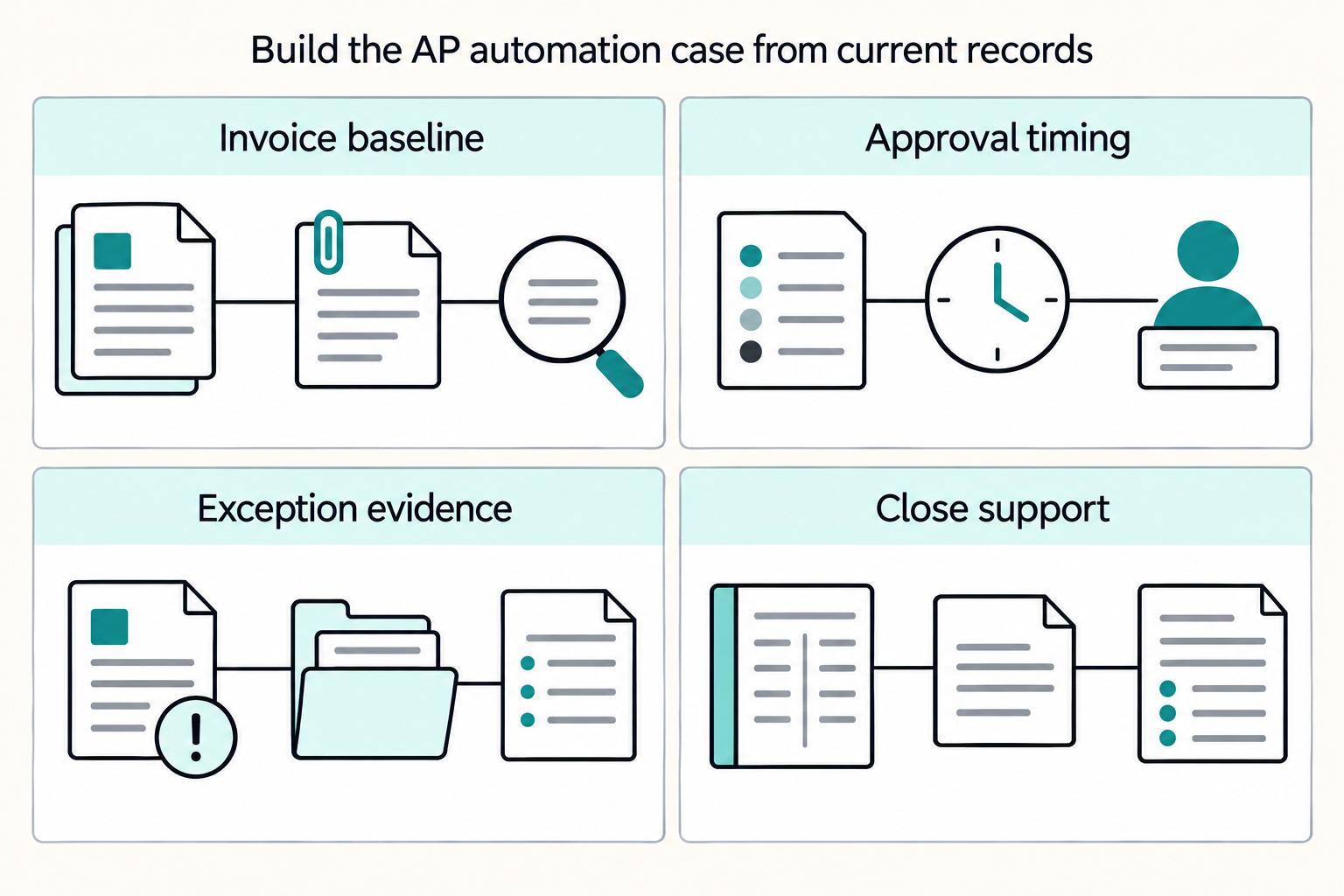
Start with a current-state AP baseline you can verify from existing records. Include invoice volume, actual approval paths by invoice type or entity, exception logs, and month-end close pain points from your finance team. If you include AP cost per invoice, calculate it from your own records rather than a generic benchmark.
Use one test for every headline claim: can you tie it to an artifact? Support "approval delays are common" with queue or approval timestamps, and support "matching breaks" with three-way match or vendor bill exception records.
Pull ERP exports instead of relying on memory#
Use ERP and system exports, not recollection. In NetSuite, that can mean saved-search CSV exports for vendor bills, approval status, exception flags, and aging views by approver or subsidiary. If discrepant bills are a stated issue, show the records flagged for exception and routed for review. Keep anecdotes separate from system evidence, because one untraceable estimate can weaken confidence in the rest of the memo.
Add close-control evidence, not just throughput#
If AP delays affect close, attach the unresolved invoice and receipt reports used for accruals, the reconciliation backlog, and the dates those items were cleared. Distinguish time spent resolving AP items from other causes of a slow close.
Set pre-CFO reviewers and ownership#
Set explicit pre-CFO reviewers for each section so ownership is clear. Keep the review cross-functional by involving Finance, AP operations, Procurement, and IT.
If you cannot assemble a reviewable baseline quickly, treat that as a data hygiene risk. Clean, structured data is a prerequisite for effective automation, so resolve data-quality gaps before treating the evidence pack as approval-ready.
If you need a plain-English overview before building the business case, see Accounts Payable Automation for Dummies for Platform Operators.
Measure current-state AP drag in operational terms#
Turn your baseline into operating drag the CFO can inspect. Show where invoices stall, what that does to controls and visibility, and which issues are process design versus tooling limits.
Map breakpoints from receipt to payment#
Map breakpoints across the full path from invoice receipt to payment release. Keep this focused on specific failure points, not general frustration with manual work. Start with three checks:
| Breakpoint | What it looks like | Verify with |
|---|---|---|
| Manual routing points | Invoices are moved by email, chat, or spreadsheet because ownership is unclear | ERP exports and exception logs |
| Broken approval paths | Invoices have the wrong approver, get stuck after role changes, or pass through too many handoffs | ERP exports and exception logs |
| Missing invoice verification | Required purchase-order, receipt, contract or expense evidence is absent or exceptions are unapproved | Invoice sample, configured policy and exception records |
Three-way matching checks the purchase order, supplier invoice and receipt within configured tolerances. Use it where receipt evidence is appropriate. Services and non-PO invoices may require contract, milestone or authorized expense evidence instead. Show the control required by your policy, including permitted exceptions and who may approve them.
Use ERP exports and exception logs to verify each breakpoint. At minimum, confirm you can trace receipt, coding, approval, exception, and payment timestamps on the same invoice sample. If you cannot, document that as a visibility gap, not just a speed issue.
Quantify the impact in operating terms#
Quantify the impact in operating terms the CFO can evaluate.
| Impact category | What to measure now | Evidence to attach |
|---|---|---|
| Delayed approvals | Time from invoice receipt to approved-for-payment; separately track scheduled payment date and payment completion | ERP timestamps, approval queue export |
| Rework | Exception rate: what share of invoices need manual intervention due to errors, missing data, or approval bottlenecks | Exception log, rejected invoice records |
| Payment errors | Invoice errors and duplicate payments that required correction | Payment error log, vendor dispute tickets |
| Lost visibility | Open invoices without clear status, accrual uncertainty, late spend visibility | AP aging, month-end hold reports, accrual adjustment notes |
Frame this as finance control risk, not AP inconvenience. Delays and exceptions can reduce confidence in accrual completeness and near-term spend visibility. Keep claims tight: AP automation can improve visibility and control, but do not present it as a standalone fix for cash-flow forecasting. External benchmarks can provide context, but your own cycle time and exception rate should do the real work.
Separate process flaws from tool limits#
Separate process issues from tooling issues before you assign value to automation.
If invoices sit because no one owns the approver matrix after an org change, that is a process and ownership issue. If receiving confirmation is inconsistent, that is upstream operating design. If the ERP cannot reliably route by entity, amount, or exception type, that is likely tooling.
Use a simple rule: if the problem would still exist with faster routing, classify it as process first. Then tag each issue as policy, ownership, upstream data, or tooling. If most drag sits in the first three categories, fix those before you over-credit automation.
Capture one documented finance ops failure#
Capture one documented finance ops failure narrative to make the risk concrete.
Use a real internal case with dates, invoice ID, approval delay, payment consequence, and downstream handling. In a platform workflow, that may be a payment run that missed its release window, triggered manual catch-up work, or required extra review before release.
Keep the wording precise: "In this incident, AP delay contributed to payout timing risk." Do not generalize beyond the documented case. If no documented case exists, use a verified payment miss and mark broader downstream impact as a hypothesis to test later.
Related: Measure AP Automation ROI for Payment Platform Finance Teams.
Draw the line between AP automation and broader finance outcomes#
Keep the CFO promise narrow: AP automation improves AP execution, not the whole finance system. It can strengthen invoice capture and verification, speed approval routing, and make control behavior more consistent through clearer exceptions and audit trails.
Start with the near-term gains you can defend in your environment. Validate them on real invoices: capture status, approval timestamps, exception handling, and traceability from receipt through payment release. If extraction looks strong in a demo but exception history or approval traceability is weak in production, treat control improvement as unproven.
Then state the boundary just as clearly. AP manages outflows, while AR performance drives inflows, so AP automation alone cannot stabilize AR predictability. For the same reason, it is not a complete working-capital strategy and cannot by itself deliver full cash-flow forecasting quality.
Use a hard decision rule before approval. If leadership expects AP automation to fix AR volatility or collections-driven forecast misses, either expand scope to include AR work or reset expectations in writing before procurement. Put the caveat directly in the memo: AP efficiency is valuable, but AP efficiency without strong AR performance leaves a blind spot.
Build the CFO decision memo with hard go or no-go criteria#
If this memo cannot survive a Controller read-through, it is not ready for the CFO. The goal is not to argue that AP automation sounds useful. It is to show, with retained evidence, that AP execution can improve without adding control or reconciliation risk.
Show capacity value separately from cash savings#
Consider this hypothetical case: 2,000 invoices a month take 12 minutes each to process today and 5 minutes in a tested pilot. The difference is about 233 staff hours a month. At a $40 loaded hourly cost, that represents roughly $9,333 of capacity value, not $9,333 of cash saved unless payroll, overtime or contractor spend actually falls.
Suppose software costs $3,000 a month and ongoing support costs $1,000, with $24,000 of setup and training. If capacity is the only gain and spending does not fall, the case has no cash payback. If the team can separately substantiate $6,000 a month of avoided overtime and contractor spend, the recurring net cash benefit is $2,000 and simple payback is 12 months after those benefits begin. Show ramp time and downside assumptions; do not add the same hours again as both capacity value and avoided spend.
Use a five-part memo structure#
Use five sections: current pain, target operating model, financial impact, implementation risk and the approval request. This is a practical memo structure; each section should answer a decision rather than list features.
In current pain, include only what you can prove from AP logs, ERP exports, and finance ops incident history. If delays are the issue, show approval timestamps. If exception handling is weak, show reopen rates, manual reroutes, or payment-hold incidents. Do not mix process design issues with tool issues and then assume software fixes both.
Define who prepares, approves, releases and reconciles transactions. Separate incompatible duties where possible. If a small team cannot separate every task, have the Controller approve and test a compensating review, including who reviews the preparer’s work and what evidence is retained.
Set explicit go or no-go gates#
Set explicit go or no-go gates as operating conditions the CFO and Controller can approve. This is not a universal legal-signature claim. It is an auditable approval framework with clear ownership.
| Gate | Go only if | Check or note |
|---|---|---|
| Control coverage | Approval routing, exception handling, audit trail, and role separation are designed and testable in the new process | Controller approves the critical control tests and any unresolved gaps before rollout |
| Reconciliation readiness | Reconciliation is assigned with an independent or approved compensating review | The Controller can review a sample reconciliation path from invoice receipt to payment release using retained records |
| Integration effort | Finance, product, and engineering agree on the real integration scope and dependencies | Red flag: demo-quality invoice capture with no production mapping for ERP exports, payment status, and exception states |
| Change-management capacity | The team absorbing the change has the time and capability to do it | Named owners provide capacity estimates for training, support and exception handling |
Map every claim to retained evidence#
Map each claim to retained evidence. For SEC registrants subject to Item 308, management’s ICFR assessment has specific documentation requirements. A private-company AP proposal should follow its own control policy and audit needs; those public-company requirements are not a universal procurement rule.
| Business case claim | Required evidence artifact | Verification check |
|---|---|---|
| Approval cycle will improve | AP log export with approval timestamps before change | Date range matches baseline period and outliers are visible, not removed |
| Exception handling will be more consistent | Exception queue export or incident history showing reroutes, holds, or manual overrides | Exception reason codes are defined and tied to owners |
| Reconciliation will be cleaner | ERP export showing current posting and reconciliation steps | Reviewer traces the sample and tests the independent or compensating review required by policy |
| Control coverage will improve | Role matrix, approval path screenshots, and documented audit trail design | Controller confirms separation of duties and retained evidence points |
| Finance effort will drop in specific tasks | Time or incident records from current AP handling, not memory-based estimates | Named owner confirms baseline method and sample size |
Add the owner, date range and file location to the appendix. Check completeness and accuracy whether the evidence is an ERP export or a compiled spreadsheet. Keep source totals, transformations and review records so another person can reproduce the result.
Show phased launch versus full replacement#
Present phased launch and full replacement side by side so the decision is about tradeoffs, not optimism.
A phased launch can create earlier controlled learning by validating approval routing, exception handling, and reconciliation on a limited scope first. The tradeoff can be uneven control depth during transition and temporary parallel processes.
A full replacement can deliver faster end-state consistency if design maturity and team capacity are already in place. The tradeoff can be higher delivery risk because integration errors, role confusion, or reconciliation gaps affect the full AP function at once.
End with a specific approval request#
Close with a specific approval request: approve phased launch, approve full replacement, or defer pending missing evidence. Avoid vague asks like "approve vendor selection" without naming the gating assumptions.
Final test: can the CFO trust but verify the memo? If verification depends on verbal reassurance, pause and tighten the evidence pack before escalation.
For a deeper dive, read AP Automation ROI Calculator: How to Build the Business Case for Your Finance Team.
If your memo is approved but integration risk is still unclear, review the implementation surfaces and control patterns in Gruv Docs.
Compare solution paths with platform constraints first#
Pick the path that protects audit trail, reconciliation evidence, and control depth in your real operating setup, not the one that demos fastest.
Start with the production constraint most likely to fail#
Start with the constraint most likely to fail in production: ERP control fit or cross-border payout complexity.
If AP runs in one ERP and one approval model, evaluate an ERP-native route first. If approvals are fragmented across entities, business units, or ERPs, evaluate an AP suite. If the core pain is tracing payouts to bank movements across countries, evaluate a payment-infrastructure-aligned route early, because country coverage and regional feature differences are hard constraints.
Cross-border coverage must be checked for the sending entity, supplier country, currency and payment route. Separate the ability to send a payment from the ability to approve an invoice and reconcile its effects. A coverage page does not establish those controls for your workflow.
Verification point: map the current state on one sheet before vendor comparison: ERP, legal entity, payout countries, payout mode, approval path, and reconciliation owner.
Score every path on the same criteria#
Score all three paths on the same criteria, and keep unknowns explicit.
| Path | When to consider it | Evidence to test | Cost questions |
|---|---|---|---|
| ERP-native | One ERP already supports the required AP workflow | Configured invoice classes, matching tolerances, role permissions, holds and ledger exports | Required modules, configuration, migration and support |
| Dedicated AP suite | Workflow or entity needs exceed the current ERP configuration | ERP object mapping, approval trail, exception ownership and reconciliation exports | Subscription, implementation, integration maintenance and training |
| Payment infrastructure with an AP layer | Supplier payment execution or tracing is the main gap | Invoice-to-instruction mapping, payment status, failure handling and bank reconciliation | AP-layer cost plus payment, FX and operational support fees |
Validate evidence flow before ranking options#
Validate evidence flow before ranking options. If the Controller cannot trace invoice to payment with retained records, the path is not decision-ready.
For an ERP-native option, run a representative invoice through the configured match, approval, hold and release rules. For a dedicated suite, request its exported audit trail and test ERP mapping. For a payments layer, test your actual account and payout mode: settlement reporting is not proof that supplier invoice approvals are covered.
If financial-reporting controls are in scope, use SOC 1 as a practical screen for control relevance, not as a standalone selection decision.
Prioritize control depth when cross-border complexity is high#
Apply one hard rule: when cross-border payout complexity is high, prioritize control depth and audit trail over fastest demo-to-live timing.
ERP-native paths can be simpler when process and approvals are stable inside one ERP. AP suites can be stronger when approval flexibility across entities or ERPs is the bottleneck, but only if reconciliation outputs are proven in your environment. Payment-infrastructure-aligned paths fit when payout traceability is the core gap. They should not be assumed to replace AP approvals, three-way matching, and finance-owned exception handling.
Write unknowns directly into the memo. Unclear pricing, unverified deployment effort, and performance claims without methodology stay out of the core business case until validated.
Assign ownership across finance, ops, product, and engineering#
Name control owners before procurement. If ownership is unclear, gaps can show up in invoice holds, approval routing, and month-end reconciliation.
Assign owners by control#
Assign ownership by control, not by vendor. One practical split is finance owning policy and control design, with operations, product, and engineering explicitly assigned workflow behavior, integrations, data movement, and reliability responsibilities.
Document each control with a responsible owner, backup, approval authority, retained evidence and escalation target. Identify incompatible duties and the independent or compensating review required by your policy. Map the roles to configured permissions and limits.
Define exception ownership before launch#
Define exception ownership before launch. Invoice holds and approval failures can occur in normal operations, so each failure type needs an explicit first responder, override authority, retained record, and escalation path.
Set this for at least:
- broken approval routing or missing approver
- matching or policy failures
- invoice hold release
- ERP-AP sync failures
- posted payments pending reconciliation
Use timing rules, not just names. For example, define reminder and escalation intervals in advance so exceptions do not sit until close week.
Use sign-off as a release gate#
Use governance sign-off as a release gate for risk-bearing decisions. As an operating practice, set a finance approval gate for reconciliation design before go-live and an executive finance approval gate for business-case assumptions before procurement.
Reconciliation sign-off should confirm the trace from invoice to payment to ledger evidence. Business-case sign-off should confirm assumptions, expected impact categories, and known unknowns, since a decision-ready case needs governance clarity and measurable indicators, not just ROI language. If you are SEC-reporting, this discipline aligns with officer internal-control certification responsibilities.
Stop if a critical control has no owner#
If a critical control is marked "shared" but has no named owner, consider treating that as a stop signal for procurement until ownership is assigned. This is a practical control gate, not a universal legal mandate.
Do not assume vendors own your exception decisions, reconciliation review, or evidence retention after launch. Pressure-test ownership with one scenario before the CFO review: invoice on hold, inactive approver, payment date approaching. If your team cannot name one DRI and one escalation path immediately, fix ownership first.
Related reading: How to Find Vendors for Your Platform and Vet Third-Party Providers at Scale.
Roll out AP automation in phases with verification checkpoints#
A phased rollout is useful when integration or control behavior still needs proof. The sequence below shows how to limit exposure while learning. A full cutover can be considered when the design is proven, migration is controlled and the team can support the whole scope.
Define phases before production#
Define phases before production, for example: baseline and design, limited-scope pilot, controlled expansion, then full operating cadence. Use each phase to confirm matching, approval routing, payment origination, reconciliation, and reporting under live conditions.
Set each phase boundary around a slice you can observe clearly, such as one business unit, geography, or module. If risk tolerance is low, start by location or business unit.
In your design pack, define the evidence you will retain for each phase. Include sample invoices, purchase orders, and receipts for three-way matching, approval logs, exception logs, reconciliation output, issue tracking, escalation, and named role ownership.
Verification point: you can name the pilot population, retained evidence, and the person who can stop expansion if controls break.
Pilot one narrow slice first#
Pilot one narrow slice first to test control behavior, not convenience. Keep the pilot small enough to inspect transaction by transaction, but real enough to surface exceptions.
For PO goods invoices, test three-way matching and configured tolerances with both matching and discrepant documents. For services or non-PO invoices, test the required alternative evidence. Confirm that holds block payment as designed and only authorized staff can release them with a recorded reason.
If your AP system suggests invoice-to-receipt matches before approval, review suggested matches manually during the pilot.
Verification point: for each pilot invoice, you can trace approval status, match result, hold status, if any, and reporting output.
Set pass or fail checkpoints before the pilot starts#
Set pass or fail checkpoints before the pilot starts so decisions stay consistent.
| Checkpoint | Pass condition |
|---|---|
| Control adherence | Approvals follow intended routing, holds and hold releases are performed by authorized owners, and records are retained |
| Exception rate trend | Exception patterns are understood and manageable, not escalating |
| Reconciliation cycle quality | Invoice-to-payment-to-ledger trace is complete and reliable |
| Team adoption | Users and approvers are using the new workflow as designed |
Treat control or reconciliation failure as a failed phase, even if other metrics improve.
Expand one dimension at a time#
Expand only after the pilot passes, and change one dimension at a time. Add one business unit, one geography, or one module per phase instead of stacking changes.
Phases can be organized by business unit, geography, or module. Choose the next slice with the least added risk. Carry the same checkpoints forward and hold the same standard during expansion.
Verification point: before each expansion, confirm prior-phase issues are closed, decision logs are updated, and cross-functional owners sign off.
Define rollback and recovery actions#
Define fix-forward and rollback actions before deployment. A rollback restores workflow or configuration; it does not undo payments already sent. Preserve the transaction history and reconcile completed, pending and uncertain payment instructions before resuming.
At minimum, define:
- rollback path for the affected rollout slice
- exception and hold-release intervention protocol, including authorization and retained evidence
- root cause corrective action review with process owners after failed checkpoints
If controls or reconciliation fail, stop expansion and contain the affected flow. Restore the prior process only after confirming which instructions have already been sent or completed. Resume under approved controls so a recovery action does not create duplicate payments.
Avoid the mistakes that derail CFO approval#
Once you have pilot evidence, protect the approval memo from credibility loss. CFO and Controller reviews can stall when AP automation is presented as a feature pitch with broad ROI language and no proof pack.
Lead with evidence, not generic ROI language#
In a high-scrutiny review, claims like "saves time," "improves efficiency," or "drives visibility" are too weak unless you attach supporting artifacts.
If your memo claims faster approvals or fewer exceptions, include the baseline export, exception log, and pilot result behind each statement. Treat this as a hard rule: every financial or operating claim needs a named source, owner, and pull date. If you cannot point to the file, do not put the number in front of the CFO.
Keep AI benefits as pilot assumptions until measured. Track extraction corrections and exception review time as well as straight-through processing: faster capture may move work into review rather than eliminate it.
Verification point: each memo claim maps to one evidence artifact and one owner who can defend it.
Treat vendor features as hypotheses until live tests pass#
Treat vendor features as hypotheses until your controls pass live tests. "Invoice AI," approval routing, or global payment processing can be useful, but feature availability is not proof of operational fit.
Controller review should focus on authorized transactions, accurate records, and traceability in reasonable detail. Test each feature claim against your real process: reviewed and released suggested matches with retained records, intended approval routing, and clean invoice-to-payment-to-ledger traceability without manual patchwork. If the best answer is still "we think so," you are not ready for approval.
Verification point: each major feature claim has one live test result or pilot artifact proving control behavior.
Keep AP and AR separate in the business case#
Keep AP and AR separate in the business case. AP covers short-term liabilities to suppliers and creditors. AR covers funds expected from customers and partners.
They both affect the cash operating cycle, but they move through different drivers and risks. Frame AP benefits precisely: invoice capture, approval speed, exception handling, and control consistency. Do not imply AP automation alone fixes AR predictability, working-capital strategy, or full cash-forecast quality. If leadership expects that, reset scope before the meeting.
Verification point: the request states which cash outcomes are in scope now and which require separate AR or treasury work.
Budget for change management and operating load#
Budget change-management and operating load up front. A strong business case does not guarantee rollout success if the people side of execution is thin.
Include retraining, engineering support, approver onboarding and early-cycle exception handling in the estimate. These costs may arrive before savings do. Ask each owner for expected hours and show which other work must move to make room.
Name ownership in the memo: who updates approval rules, who handles integration defects, who trains approvers, who owns reconciliation defects, and what work is deprioritized during adoption. Unnamed ownership is unmanaged risk.
Verification point: the memo includes named owners for training, integration support, exception handling, and reconciliation support in the first operating period.
For a deeper ROI model you can defend internally, read AP Automation ROI for Platforms That Need a Defensible Business Case.
Report the first 90 days in CFO language#
Report control stability and the assumptions in the purchase case during the first 90 days. Explain which gains are measured, which remain uncertain, and whether recurring costs or adoption effort differ from the approved budget.
Track a short KPI set with fixed definitions#
Track a short KPI set and keep definitions fixed across all three months (for example: approval cycle stability, exception resolution speed, reconciliation completeness, and control adherence).
Keep the same metric names, calculation logic, source export, pull date, and owner each month. If definitions drift, the discussion can shift from operating performance to report disputes.
Verification point: month 1, month 2, and month 3 use the same metric definitions, source files, and named owners.
Translate results into conservative business language#
Translate AP results into business language, but keep cause-and-effect claims conservative.
Report the nearest effect your internal data can support, and separate that from broader outcomes you cannot isolate to AP. If evidence is mixed, state uncertainty directly rather than stretching the claim.
Failure mode to avoid: turning AP process gains into broad forecasting or working-capital claims without a defensible evidence chain.
Use one monthly scorecard the Controller trusts#
If you use a monthly scorecard, keep one version that the platform finance team and Controller can align on before it goes to the CFO.
One compact format can be: current status, month-over-month trend, known unknowns, and corrective actions with owners. For each corrective action, note what changed, who owns it, and when you will review results.
Verification point: the Controller agrees with the control interpretation, and finance ops confirms metric output matches operating conditions.
Use this copy-paste execution checklist#
Before you ask for signatures, run four yes-or-no checks. If any answer is no, pause procurement and close the gap so the business case stays credible after the CFO meeting.
Confirm the prerequisite pack is complete#
Your AP automation business case should show three evidence-backed elements: documented AP pain points, quantified upside, and a clear target-state AP vision. Keep source artifacts with each claim, such as ERP exports, exception logs, approval-path screenshots, and a named owner.
Use a simple RACI chart so accountability is explicit across finance, product, and engineering stakeholders. Verification point: every critical control, integration, and exception path has one named owner and one source document. Red flag: a polished memo with no attached evidence pack can mean the team is still arguing from memory.
Confirm the selection table uses verified facts#
Confirm the selection table is filled with verified facts, not vendor shorthand.
| Path | When to consider it | Evidence to test | Cost questions |
|---|---|---|---|
| ERP-native | One ERP already supports the required AP workflow | Configured invoice classes, matching tolerances, role permissions, holds and ledger exports | Required modules, configuration, migration and support |
| Dedicated AP suite | Workflow or entity needs exceed the current ERP configuration | ERP object mapping, approval trail, exception ownership and reconciliation exports | Subscription, implementation, integration maintenance and training |
| Payment infrastructure with an AP layer | Supplier payment execution or tracing is the main gap | Invoice-to-instruction mapping, payment status, failure handling and bank reconciliation | AP-layer cost plus payment, FX and operational support fees |
Test candidate workflows against your actual invoice classes and configuration. For each option, record required modules, exceptions, export quality, implementation effort and the quoted total price. A product demo is a starting point for these tests.
Confirm the pilot and recovery path are documented#
Confirm the pilot is bounded and the recovery path is documented. Start with one entity, one approval chain, or one invoice class to validate technical and user readiness before broader rollout. Define pass-or-fail checkpoints for control adherence, exception handling, reconciliation quality, and adoption.
Document who authorizes recovery, which configuration or workflow can be restored, and how existing payment instructions are tracked. Any manual fallback must preserve approvals, holds, instruction identifiers and reconciliation; check uncertain payments before resubmitting them.
Confirm first-90-day reporting is already scheduled#
Schedule reporting against the original assumptions with fixed definitions and the same baseline population where practical. If you use an external benchmark, record its methodology and population; do not change your internal calculation to chase a headline comparison.
Treat this as a final readiness check before approval. If the reporting plan cannot test the original assumptions, the launch is not decision-ready yet.
Frequently Asked Questions
How do I make the case for AP automation to a CFO in a platform business?
Show a measured AP baseline, a pilot result, a cost model and the controls required for rollout. Separate released staff capacity from cash savings. Attach exports, exception logs and approval evidence, then request a specific budget and scope with named owners.
What KPIs should a platform finance team show first to prove progress?
Measure processing cost per invoice, receipt-to-approved time, exception rate and reconciliation completeness. Track approval time separately from payment date, since terms and scheduled payment runs affect the latter. Fix the population, period, cost categories and calculation before comparing baseline and pilot.
What does AP automation fix quickly, and what does it not fix at all?
AP automation can improve invoice capture, routing, coding, and matching workflows. It does not, by itself, fix AR volatility, DSO, or full cash-flow forecasting. Keep scope explicit: AP is what you owe suppliers, while AR is what customers owe you.
Who should own approval workflows, exceptions, and reconciliation across teams?
Split ownership by function, but make decision rights explicit. Define which function owns policy and control intent, which owns approval behavior and user rules, and which owns integrations and reliability. For each approval chain, exception type, and reconciliation output, assign one decision maker, one escalation path, and one evidence source.
How should we choose between an ERP-centered approach and a dedicated AP suite?
Use an ERP-centered path when your current ERP already supports the controls that matter most, especially invoice workflow automation and three-way matching. Choose a dedicated AP suite when flexibility or integration needs exceed what the ERP can support cleanly. A hybrid model can also work: core ERP plus best-of-breed cloud apps, with pricing and deployment effort treated as unknown until tested and quoted.
When should we run a phased rollout instead of a full switch?
Phase the rollout when scope is broad or control behavior remains uncertain. Set tests for approval routing, matching, reconciliation and adoption before expansion. The recovery plan must retain already-sent payments and reconcile uncertain instructions before retries; switching back to a prior workflow does not reverse payment effects.
Researched and edited by the Gruv editorial team. Gruv builds cross-border billing, payouts, and finance-operations software for global businesses.
Sources
Includes 1 external source outside the trusted-domain allowlist.
Educational content only. Not legal, tax, or financial advice.
Related Posts

The Freelance Payment Penalty: A Modeled Audit of Platform Fees, FX Spreads, and Payout Delays
The money rarely disappears through a single, easy-to-spot fee. The real loss is stacked. A marketplace takes its commission, a processor adds a charge for international cards, a bank or payment company converts the currency at a spread, a platform holds the funds before release, and a wire sheds a little to intermediaries on the way in. Each layer looks defensible on its own, but the worker feels the combined result as a smaller deposit and a later payday.

How to Respond to a Subpoena for Business Records
Move fast, but do not produce records on instinct. If you need to **respond to a subpoena for business records**, your immediate job is to control deadlines, preserve records, and make any later production defensible.

A US Expat's Guide to Investing in UCITS ETFs to Avoid PFIC Issues
The real problem is a two-system conflict. U.S. tax treatment can punish the wrong fund choice, while local product-access constraints can block the funds you want to buy in the first place. For **us expat ucits etfs**, the practical question is not "Which product is best?" It is "What can I access, report, and keep doing every year without guessing?" Use this four-part filter before any trade: