
A CFO should measure AP automation ROI by tying every claimed gain to verifiable records across approval, settlement, payout status, ledger posting, and reconciliation, then subtracting one-time and ongoing costs. Faster processing counts only if month-end close stays complete and accurate, reconciliation closes cleanly, failed payouts and exceptions do not rise, and the audit trail remains easy to retrieve.
AP automation ROI is credible only if the gains still hold at month-end close. A CFO can defend the investment in budget and audit review when the value is tied to evidence that the books stay complete and accurate, reconciliation closes cleanly, payouts execute reliably, and the audit trail is easy to retrieve.
That bar is higher than a labor-saved slide. You have to weigh AP automation against implementation and operating costs, not just manual effort removed. Close is still a manual pain point for many finance teams, and a strong close is judged on completeness and accuracy. Faster invoice handling helps, but not if it leaves exceptions unresolved until close.
For payment platform teams, start with operational proof across each financial checkpoint:
At each checkpoint, ask:
Proof can include payout status records, bank statement matches, general ledger journals, and exported audit logs. If a checkpoint has no evidence artifact, the benefit claim is still soft.
Reconciliation deserves extra weight because it is a control process, not back-office housekeeping. It verifies that recorded payments match the underlying transactions and the books, which protects financial record integrity. That is why this guide emphasizes book-to-bank tie-outs, settlement accuracy, and exception aging, not cycle time alone. A shorter approval-to-payment interval is a real gain only if the related settlement can still be matched, posted, and closed without added rework.
You also need to measure failure states, not just the best-case path. A payout can be initiated and still fail if the receiving bank rejects it, and incorrect bank details are a common cause. When that happens, apparent speed gains can be offset by exception handling and delayed reconciliation. If payout speed improves while failed payouts, mismatches, or manual investigation hours rise, you may have shifted work instead of creating durable ROI.
This guide is for finance, operations, and product owners who need ROI numbers that hold up under scrutiny. For U.S. public companies, the bar is explicit. Management must establish and maintain adequate internal control over financial reporting and report on its effectiveness under 17 CFR 229.308. Audit readiness is part of the economics, not a separate compliance track. Where examples refer to Gruv-style controls or modules, treat them as implementation patterns when enabled and where applicable, not blanket product claims.
You might also find this useful: Real-Time Reporting Metrics Platform Finance Teams Can Actually Control.
Set the measurement boundary before you model savings, or your ROI can drift away from what AP actually controls. The goal is to measure one workflow once, with traceable evidence, instead of mixing domains or cost types.
Define what AP owns now, not what you might automate later. A practical AP scope includes invoice receipt, coding, approval routing, payment, and reconciliation. In a payment-platform workflow, include additional platform-specific steps only when those steps are currently owned by your AP process. Use one check for each in-scope surface: one owner, one source system, and one exportable record.
Lock the boundary between AP, AR, and the general ledger before assigning benefits. AP is what you owe suppliers, AR is credit sales owed by customers, and the general ledger is the transaction record by account. They connect, but they are different value domains.
Count each benefit once. If two teams claim the same status event or the same time reduction, assign it to one domain and remove duplicates.
Separate one-time implementation effort from recurring automation gains so comparisons stay honest. Keep setup effort in a one-time bucket and ongoing operational improvement in a recurring bucket.
Apply one decision rule throughout: if a claimed gain cannot be tied to a verifiable record or audit-trail artifact, treat it as unproven. Defensible ROI requires traceability from the original transaction to the related records or reports.
Related: AP Automation ROI Calculator: How to Build the Business Case for Your Finance Team.
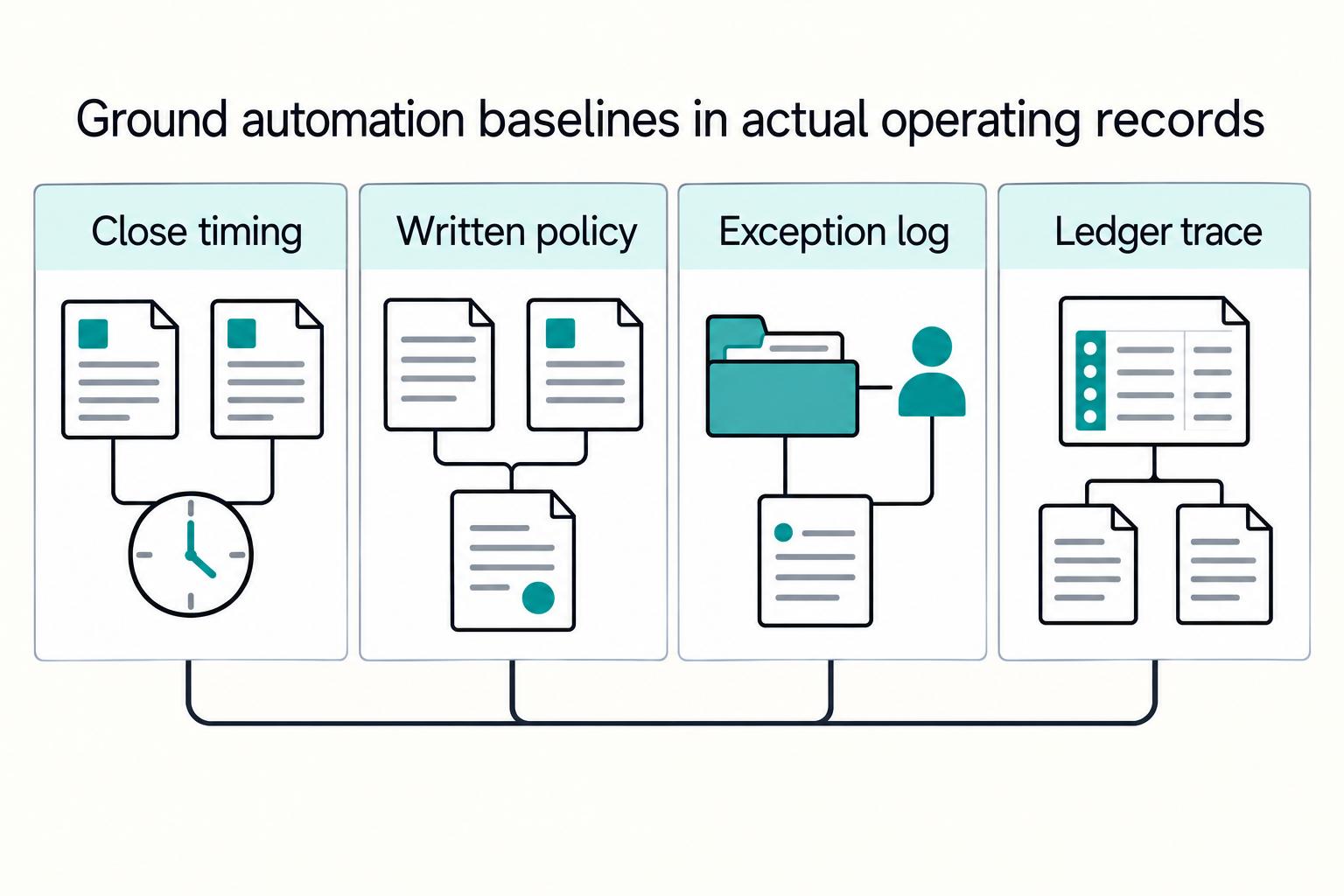
Freeze your baseline with records, not memory. Use recent close cycles your team can still verify so you capture repeat friction without turning baseline work into a project of its own.
Anchor close timing to one definition: elapsed time from the initial trial balance run to completed consolidated financial statements. Then pull AP-side records for each selected close: cycle-time reports, reconciliation issue lists, settlement delay logs, and payout batch failure records.
Keep the original team labels so every item traces back to a ticket, provider reference, or queue record. Include only items with a date stamp, an owner or queue, and a clear link to the affected general-ledger period.
Build one evidence pack that shows both design and execution: current SOPs, approval policies, exception logs, and exported audit-trail records tied to the general ledger. Your baseline is credible only when documented procedures and transaction-level records agree.
Compare policy to trace data directly. If policy says one path and logs show overrides, backdating, or off-process handling, record that gap as rework or control friction.
Count compliance gates only where they add real operational effort. Include identity verification, AML due-diligence controls, and legal-entity beneficial-owner checks, including work some teams track as KYB-related, when those gates can pause payments, hold supplier records, or force manual review.
For each gate, keep three artifacts: written policy, queue or case log, and sample records showing the gate in practice. Validate BOI assumptions against current policy before treating BOI handling as standing cost.
Add tax-document workload only where your team owns it. Typical items are W-9 collection, TIN follow-up, 1099 classification and corrections, and cross-border documentation support handled by finance.
Keep threshold-driven work explicit when it applies. That includes nonemployee compensation reporting at $600 or more, Form 1099-NEC generally due by January 31, e-filing at 10 or more information returns, and FBAR as a separate regime with a $10,000 aggregate threshold and April 15 due date, with automatic extension to October 15. Treat FEIE and Form 2555 requests as context-dependent and track them separately if they reach finance.
Need the full breakdown? Read Accounts Payable Automation for Dummies for Platform Operators.
Treat AP savings as provisional until each step has a named owner and one record that proves it happened. Use your baseline records to build a control chain from transaction initiation through reporting so finance, ops, and audit can test real improvement against hidden rework.
Map the path your team actually runs, then adjust it to your environment: invoice received, approval granted, settlement initiated, payout batch sent, provider status received, ledger posted, reconciliation closed. Use this as a working map, not a universal sequence, and keep the manual gates that still create effort or risk.
Keep each checkpoint narrow: what changed, and how do you know. In manual flows, that often means approvals, transaction reviews, reconciliations, and follow-up on reconciling items. In automated flows, keep initiation, recording, processing, and reporting visible.
Do not collapse gating steps into larger buckets. If invoice validation is required before payment or accounting-entry creation in your AP stack, keep validation as its own checkpoint.
For each checkpoint, document the owner, source system, expected status event, and most likely failure mode.
| Checkpoint | Primary owner | Expected proof artifact | Common failure mode |
|---|---|---|---|
| Invoice received | AP intake queue | Audit-trail record with receipt timestamp | Duplicate capture or missing fields |
| Approval granted | Approver or approval queue | Audit-trail approval record | Off-policy override, backdating, or stalled approval |
| Settlement initiated | Payments ops or AP execution queue | Provider reference or initiation log | Retry without duplicate protection |
| Payout batch sent | Payments ops | Batch submission record tied to provider reference | Partial batch failure or missing records |
| Provider status received | Integration or finance ops queue | Webhook or provider event log | Missed, delayed, or mis-mapped async update |
| Ledger posted | Accounting or ledger service owner | General ledger journal or subledger posting record | Duplicate or incomplete journal entry |
| Reconciliation closed | Reconciliation owner | Payout reconciliation report and close record | Reconciling items carried forward without follow-up |
For provider updates, define the exact event field your platform uses and the success condition. Provider schemas vary, so avoid generic labels like "status received."
Document retry behavior for retriable steps: what can be retried, who can retry it, and which key prevents duplicate execution. This is where idempotent requests matter: they let you retry safely without executing the same operation twice.
Validate with one real prior timeout or delayed-update case. Confirm that the same request key did not create a second settlement, payout instruction, or journal entry. If you cannot prove that from the records, treat reduced exception handling as an unverified benefit.
Assign one primary proof artifact per checkpoint. Typical choices are event logs for asynchronous provider changes, provider references for settlement initiation, GL journals for posting, and payout reconciliation reports for settlement-batch matching.
Treat audit-trail quality as part of ROI credibility. Your records should allow chronological reconstruction, and journal-entry checkpoints should show control over initiation, authorization, recording, and processing across the ledger and supporting systems. If a checkpoint has no clear owner or no evidence artifact, treat its ROI impact as unproven for now.
Once owners and proof artifacts are mapped, use a metric stack that rewards improvement without hiding reconciliation damage. In practice, track cost, time, control quality, and real capacity shift together, because faster processing is not ROI if close quality or audit evidence gets weaker.
Separate direct savings from indirect gains first, then total them. This keeps hard-dollar changes, such as lower processing effort or fees, from getting blended too early with harder-to-quantify benefits like capacity or audit support.
APQC's benchmark structure is a practical model: cost, quality, and timing together. Build your stack the same way, and keep indirect value visible even before you monetize it.
| Metric family | What to measure first | Primary proof artifact | Red flag |
|---|---|---|---|
| Direct cost | AP handling effort, exception effort, rework volume, avoidable external processing costs | Time logs, queue exports, fee records, exception logs | Savings claim without queue or fee evidence |
| Time | Approval-to-settlement, settlement-to-ledger lag, reconciliation completion, month-end close duration | Timestamped event logs, ledger posting records, close calendar | Faster step time but slower reconciliation |
| Cash and risk | Settlement timing variance, reconciliation exception trends, audit-trail completeness, control exception trends | Provider references, payout reports, audit-trail exports, exception records | Missing events or rising exception patterns |
| Strategic capacity | Hours reallocated to forecasting, AR collections, or control improvement | Named owner, documented hour shift, delivered output | "Freed time" with no reassigned work |
Keep denominators consistent from baseline through post-rollout so the trend line stays credible.
Time metrics count only when they are tied to recorded status events in your payment and ledger flow. Measure approval-to-settlement, settlement-to-ledger posting lag, reconciliation completion, and close duration using the checkpoint artifacts you already defined.
Be explicit about event fields. If you cannot point to approval, settlement initiation, provider status, ledger posting, and reconciliation close timestamps, treat the time claim as unproven.
Track close speed separately. Reported benchmark coverage shows that 50% of finance teams take 6+ business days to close. Reconciliation and data quality are key constraints, and the same coverage reports 20 to 50 hours per month on reconciliation, with many teams using 3 to 5 systems. That is why cycle-time gains should be evaluated alongside reconciliation outcomes, not in isolation.
If you operate in always-on rails, define the business day by operational cycle, not calendar date. FedNow, for example, uses a cycle day that generally runs 7 p.m. to 7 p.m. ET.
Include cash and control signals with cost and speed from the start: settlement timing variance, audit-trail completeness, and control exception trends. If you also track failed payout batches or policy-gate breaches, treat them as internal baselines and trend them across comparable close cycles rather than as external benchmarks.
Treat audit-trail completeness as value, not overhead. AP automation ROI includes the value of rigorous audit trails, and ICFR effectiveness is tied to reasonable assurance in financial reporting reliability. If speed improves while evidence quality declines, the operating result is weaker, not stronger.
Use a simple trace test: confirm that a reconciled settlement can be followed through provider reference, status event, ledger posting, and reconciliation close record. Mark missing links as incomplete.
Count capacity gains only when the reassigned work is visible in output. Automation can reduce routine effort, but capacity claims are often overstated when demand for decision support rises faster than teams can absorb.
Use a strict test before recognizing capacity value: named owner, documented hour shift, and a new or improved deliverable, for example forecast support, AR follow-up, or control remediation. Validate across multiple stable close cycles before you monetize it.
We covered this in detail in AP Automation ROI for Platforms That Need a Defensible Business Case.
ROI is durable only when speed, reconciliation quality, and audit evidence improve together. Build the model in two passes: calculate net benefit, then apply control gates that can veto a gain.
Calculate gross benefit by metric family first, then subtract full costs for a net view. Keep direct cost, time, cash and risk, and strategic capacity separate until each line is tied to documented evidence and reconciliation records. Then total them.
Subtract both one-time implementation costs and steady-state operating costs. For multi-period cases, use net present value so expected net benefits after costs are discounted rather than compared as raw totals. If a benefit or cost line has no owner or source document, leave it out.
Use three bands: conservative, expected, and stretch. Set each band from variance you actually observed in recent close cycles, and prioritize the variables that materially change net benefits. Treat stretch as high performance you can defend from operating history, not as a best-case assumption.
Make this rule explicit: if reconciliation error rate rises while cycle time drops, classify the result as risk transfer in your internal model, not ROI improvement. Faster upstream processing is not a gain if it creates more discrepancy work downstream.
Use a reviewer-verifiable reconciliation check: completion should be clear to an external reviewer, and aged breaks should be actively resolved, including the 30 to 60 day window used in reconciliation practice.
Apply a second gate to payout speed: if payout timing improves but audit-trail completeness degrades, pause scale-up until controls recover. Internal control over financial reporting is about reasonable assurance of reliable financial reporting, so missing trace evidence should be treated as a potential control weakness, not a tradeoff to ignore.
Run a trace test before expanding volume: follow a reconciled settlement through payout batch, provider status, ledger posting, and reconciliation close. If any link is missing or not exportable for review, hold scale and fix traceability first.
Related reading: Accounts Payable Automation ROI for Platforms That Need Defensible Results.
If you are turning these decision rules into implementation requirements, use the Gruv docs to map status events, retries, and audit-trail fields before rollout.
Control work has to be priced into the ROI model, not treated as background overhead. If AP gets faster while review load, exception handling, or evidence retrieval gets worse, that is cost and risk transfer, not better ROI.
Add explicit control-cost lines instead of one blended "compliance overhead" bucket. Include customer due diligence and beneficial ownership review where required. Include ongoing suspicious-transaction monitoring and investigation work where your regulated entity or banking partner requires it, policy-exception handling, and investigation time for unmatched settlement events before close.
If your team uses KYC or KYB labels, keep them, but map each label to the actual CDD or beneficial-ownership activity and source record. The requirement is written procedures to identify and verify beneficial owners of legal entity customers, including the ownership prong tied to 25 percent or more where applicable. Model one-time onboarding work separately from ongoing monitoring, because ongoing monitoring is recurring work and can grow with transaction and exception volume.
Tie each cost line to evidence: queue exports, case logs, approval records, or tickets with reviewer, timestamp, and disposition. If you cannot show who investigated an unmatched settlement event and how it was resolved, your cost estimate may be understated.
Count avoided downside only when control execution and evidence retrieval are actually better. Relevant lines include less audit-support scramble and faster retrieval of review evidence when you can demonstrate those improvements.
For covered SEC registrants, management must provide an annual report on internal control over financial reporting under 17 CFR 229.308 and cannot conclude ICFR is effective if one or more material weaknesses exist. Use audit documentation as the practical test: records of procedures performed, evidence obtained, and conclusions reached. In SEC audit and review retention context, relevant records are retained for seven years.
If your process makes it faster to pull a reconciled settlement, approval history, provider reference, ledger posting, and exception-resolution evidence, treat that as value. If the same chain is now spread across inboxes, chats, and screenshots, treat the extra support effort as cost.
Run a retrieval drill: pick one reconciled settlement and have a reviewer pull the full evidence chain without operator help. If they cannot do it quickly and cleanly, control economics are not improving.
Document each control as automated, manual, or automated with human approval still required. This is where ROI cases can fail: AP touch time drops, but the work reappears in policy exceptions, suspicious-transaction review, or manual evidence gathering.
For each control, record the trigger, owner, evidence artifact, and escalation path. A flag is not a completed investigation, and an automated settlement-to-ledger match is not approval for an out-of-policy payment.
Keep control quality as a veto gate. If cycle time improves but exceptions rise, unmatched-settlement investigations increase, or SOX support gets harder for covered registrants, do not present it as ROI. Faster AP is not a gain when control quality weakens.
This pairs well with our guide on How Platform Operators Control Employee Expenses with Automation.
Only count working-capital upside when an AP change creates a measurable AR or cash outcome. If timing shifts inside AP or AR ledgers but customer settlement visibility, collections effort, or cash availability stay the same, treat it as timing noise, not new ROI.
AP timing can affect AR outcomes when settlement data is clear enough to support collections decisions. DSO measures average collection time after a sale, so weak or missing settlement references can block customer-level or invoice-level reconciliation and increase manual reconciliation and investigation work.
Before claiming DSO benefit, run one hard test: sample recent settlements and have an AR analyst match each item to the customer or invoice using only the reference trail, status events, and ledger records. If they cannot, the AP change is not yet improving AR performance.
Keep the cash-conversion math explicit: CCC = DIO + DSO - DPO. DSO is the AR collection lever, and DPO is the AP payment-timing lever. If CCC moved because payables timing changed, that is a DPO effect, not proof of better collections.
Review three timestamps together: bank cash date, provider settlement timestamp, and general-ledger posting date. If only posting timing changed while the bank cash date did not, classify it as accounting timing unless collections effort or cash access also improved.
Model Virtual Accounts as a separate lane. They can connect payables, receivables, and liquidity, and transactions can post to both the master account and the relevant virtual ledger, which can support clearer attribution. Evaluate settlement visibility, reconciliation speed, and collections handoff quality for that lane on its own.
Model Merchant of Record (MoR) flows separately as well. The MoR is legally responsible for processing customer payments and carries financial, legal, compliance, and indirect-tax duties. Do not blend MoR outcomes into standard AP or AR ROI claims if you need a defensible CFO model.
If you want a deeper dive, read Lean Finance and the Modern CFO: How Payment Platform Leaders Evolve from Cost Center to Strategic Driver.
Use the first 90 days as a control-validation window, not just a deployment sprint. Time savings are not proven ROI if reconciliation quality, settlement evidence, or month-end close performance degrades.
Lock a baseline before go-live so changes can be measured cleanly. Keep metric definitions fixed across the window, including AP cycle time, reconciliation performance, settlement-to-ledger traceability, payout exceptions, and month-end close duration.
Approve the checkpoint map up front with cross-functional owners so each gate has a clear owner and evidence artifact. If a checkpoint has no owner or no proof artifact, fix that before rollout.
Make instrumentation a day-30 gate. Confirm that you can produce records for approvals, settlement status changes, ledger posting, reconciliation outputs, and payout batch outcomes.
Prevent baseline drift in this phase. If routing or ledger logic must change during rollout, document the change, revise the baseline when needed, and keep results attributable.
Run limited-scope automation first so exceptions and ledger outcomes can be inspected end to end. The goal is controllability and evidence quality, not maximum coverage.
Use ongoing monitoring inside normal operations: reconciliations, comparisons, and trend checks throughout the period. If AP cycle time improves while control exceptions increase, treat the lane as blocked until controls recover.
At each checkpoint, sample transactions from invoice receipt through payment transmission and verify a complete reference trail: approval evidence, settlement status, journal posting, and reconciliation closure.
Expand coverage only when both ongoing monitoring and a separate point-in-time evaluation show controls are still effective in design, implementation, and operation. Use three expansion gates:
| Gate | What to verify | Red flag |
|---|---|---|
| Settlement accuracy | Provider events, bank activity, and ledger outcomes align | Rising unmatched or late-posting items |
| Payout batch reliability | Failed and retried states are visible and resolved | Hidden retries, missing status transitions, unexplained reversals |
| Month-end close | Close duration and reconciliation effort hold steady or improve | Faster execution but slower close |
For SEC filers, keep ICFR implications explicit: effectiveness cannot be concluded if material weaknesses exist. Do not scale a lane that creates persistent evidence gaps or unresolved ledger-control issues.
Use cross-functional sign-off on both efficiency gains and control integrity before expansion. If either is weak, revise the baseline, remediate, and run another monitored period before broadening rollout.
If AP looks faster but reconciliation, ledger tie-out, or compliance queues are getting worse, treat ROI as unproven and pause expansion.
When cycle time improves while exceptions grow, the work may have shifted downstream into cleanup and month-end pressure. Consider holding the lane at current volume, then fix the largest exception categories before scaling.
Use a short defect register organized by cause: unmatched settlement items, missing provider references, failed or retried payouts, missing journal postings, and approval-evidence gaps. If exceptions cannot be mapped to checkpoint categories, instrumentation is still too weak for a defensible ROI claim.
Verify with transaction samples from invoice receipt to reconciliation closure. Each sample should show approval evidence, settlement initiation, provider status history, journal posting, and reconciliation closure. If approvals are faster but aged exceptions rise, do not count the speed gain as realized value.
Ledger mismatches after asynchronous provider updates can point to duplicate handling, ordering, or replay-control failures. Recover by validating retry safety and event handling before any scale-up.
For Stripe-backed lanes, confirm the documented mechanics. The same idempotency key returns the original result. Already processed webhook events are ignored and acknowledged. Undelivered events are resent for up to three days. Manual replay returns events from the last 30 days. Chronological replay uses ending_before with auto-pagination.
Use a replay test pack, not only code review. Prove that you can:
If any test fails, hold the lane and fix replay controls before expansion.
When compliance gates become bottlenecks, start with clearer policy routing and explicit ownership, not bypassing controls. Assign a named owner for queue age, evidence quality, and disposition timing.
This is also a control requirement: 31 CFR 1020.210 calls for ongoing compliance controls, designated day-to-day compliance responsibility, and ongoing monitoring to identify and report suspicious transactions. Throughput changes must preserve that monitoring quality.
Verify each blocked item with a clear trail: triggering policy rule, current reviewer, case age, requested evidence, and final disposition. If items lack a named owner or explicit evidence requirements, the bottleneck is governance, and paper ROI is likely to fail in production. Unresolved discrepancies can create late nights, endless reconciliations, material variances, and unexplained items.
Pick the platform that makes money movement traceable, explainable, and recoverable in failed states, not just fast on the best path. If a demo looks strong on approvals but weak on payout failures, reconciliation exports, or provider references, plan for manual cleanup work later.
Start with the accounting record. Prioritize platforms that provide a ledger-style transaction record and let finance trace each entry to the underlying payment object with native identifiers. For Stripe, check that balance transactions include a source field tied to the related Stripe object and that each balance transaction row does not change after creation.
Verification point: export sample data and confirm that one transaction can be followed from settlement activity to the general ledger using platform-native IDs. If IDs are missing, historical rows change, or evidence depends on screenshots, traceability is weak.
Reconciliation should map bank payouts to settled transaction batches, not just show net totals. Stripe's payout reconciliation report is built for that mapping and supports CSV downloads by report section. Adyen documents both transaction-level settlement details and batch-level aggregate settlement details for reconciliation.
Test a failure path, not just a successful payout. For Stripe, a Trace ID is a payout-level identifier, and if it cannot be retrieved after 10 days it is marked unsupported. Ask the vendor to walk through a delayed or failed payout with status history and reference fields.
Ask for evidence you can actually operate with: non-mutating transaction records where documented, provider references, and event visibility across payout-state transitions. Stripe supports webhook tracking for connected-account payout activity and emits payout.failed when a payout cannot be completed.
Verification point: request one incident pack with the event log, provider reference, journal impact, and reconciliation closure.
Treat "supported" as unproven until the evidence is retrievable and exportable in operations. For U.S. contexts where these rules apply to covered financial institutions, CIP identity verification is risk-based, and CDD beneficial-owner verification is also risk-based, so teams need usable identity evidence tied to the record.
Apply the same standard to tax workflows when enabled. Form W-9 provides a correct TIN for information returns. Form W-8 BEN is provided by a foreign beneficial owner. Form 1099-NEC is used to report nonemployee compensation, with a January 31 filing deadline per IRS instructions. If the platform cannot show where these artifacts live, who provided them, and how finance exports them, do not count compliance efficiency in ROI.
For a step-by-step walkthrough, see How to Build a Deterministic Ledger for a Payment Platform.
AP automation ROI is defensible only when gains are proven with retained operational evidence, not in a model alone. Tie each claimed improvement to proof across reconciliation, settlement, and audit-trail quality, and include payout batch execution when it is in scope. In 2025 and 2026 planning cycles, hold pilot, close, and scale decisions to the same evidence standard.
Define AP, AR, and general-ledger scope before you calculate ROI. AP covers supplier payment processing costs and activities, while AR covers customer payment processing and does not include invoice generation. If a benefit crosses those boundaries and you cannot isolate the AP portion, treat it as unproven instead of counting it in AP ROI.
This is where overstatement starts. AP changes can influence AR or reporting, but if you cannot show where AP impact ends, you are mixing categories and risking double-counting.
Lock a baseline before comparison so ROI has a defensible starting point. Include manual processing, labor, error correction, missed-discount costs, month-end close cycle time, and general-ledger reconciliation hours. For close timing, keep one definition: calendar days from the trial balance run to completion of consolidated financial statements.
As a reference point, CFO.com reports an APQC median monthly close of 6.4 calendar days across 2,300 organizations. Use that as a measurement anchor, not a required target, and retain supporting documentation such as reconciliation reports, close calendars, audit exports, and current SOPs.
ROI claims hold up only when every AP step has a named owner, expected status event, and evidence artifact. Cover invoice receipt, approval, settlement initiation, ledger posting, and reconciliation close. In Gruv payout workflows, also map payout batch send and provider status receipt. Internal-control design requires assigned responsibility and delegated authority.
Use the audit trail as your proof spine. If an independent reviewer cannot reconstruct one transaction from source document to journal entry to reconciliation close without side-channel explanations, the measurement case is weaker than it appears.
Treat control quality as the gate and speed as secondary. ICFR is about reasonable assurance of reliable external reporting, and close acceleration should not reduce accuracy. If cycle time improves while reconciliation effort rises, classify it as work transfer, not ROI.
The same applies at close. If tracing entries back to source documents gets harder, throughput gains are not enough.
Scale only after repeated checks show durable performance under real volume: ledger tie-outs clear, reconciliations close cleanly, settlement status remains observable, and evidence retrieval works under close pressure.
If one lane looks faster but exceptions grow or close quality slips, cap volume and fix the root cause before expanding. Operational proof comes first. Scale follows, and when you are ready to pressure-test payout batch reliability and exception visibility against your ROI model, review Gruv Payouts.
Measure it as total business value, not just labor savings. Separate direct ROI, such as tangible AP savings, from indirect ROI, such as harder-to-value gains. Count benefits only when they are supported by verifiable process evidence and usable audit-trail support.
Start with AP cost per invoice, first-time-error-free disbursements, and cycle time from invoice receipt to payment transmission. Then check whether each payment outcome is backed by usable audit-trail artifacts. Speed alone does not give a complete ROI view.
Direct AP savings are tangible reductions that fit standard ROI math more cleanly. Strategic capacity gains are indirect ROI from time freed for higher-value finance work after manual AP effort drops. Count capacity only when the time is actually redeployed.
Use operating evidence, not workflow screenshots alone. Core checkpoints are stable first-time-error-free disbursement performance, usable audit-trail artifacts, and sustained control quality. Faster cycle time is not enough if control quality weakens.
Models can reward speed and reduced touches while missing control gaps. That can shift work into cleanup and close pressure. Throughput alone is not a sufficient success signal.
There is no single authoritative 30/60/90 AP ROI standard. A practical plan moves from baseline measurement to limited production use to scaled rollout only when error-free performance and audit-trail quality hold. Treat each phase as a verification gate, not just a deployment milestone.
Track DSO separately as an AR metric and do not automatically credit AP changes for DSO movement. Count an AP impact only if AR performance actually improved. For a combined working-capital view, use CCC = DIO + DSO - DPO so AP and AR effects stay separated.
Yuki writes about banking setups, FX strategy, and payment rails for global freelancers—reducing fees while keeping compliance and cashflow predictable.
Educational content only. Not legal, tax, or financial advice.

The hard part is not calculating a commission. It is proving you can pay the right person, in the right state, over the right rail, and explain every exception at month-end. If you cannot do that cleanly, your launch is not ready, even if the demo makes it look simple.

Step 1: **Treat cross-border e-invoicing as a data operations problem, not a PDF problem.**

Cross-border platform payments still need control-focused training because the operating environment is messy. The Financial Stability Board continues to point to the same core cross-border problems: cost, speed, access, and transparency. Enhancing cross-border payments became a G20 priority in 2020. G20 leaders endorsed targets in 2021 across wholesale, retail, and remittances, but BIS has said the end-2027 timeline is unlikely to be met. Build your team's training for that reality, not for a near-term steady state.


