
Quick Answer
Use a traceable ROI model: assign owners for Fully-Loaded Cost, invoice volume, exception timing, and integration effort, then compute Net Annual Savings, Total Initial Investment, and payback. Include hidden lines like late payment fees, rework, and missed early-payment discounts, and label any benchmark as directional until definitions match your process. For platform teams, include payout batches and reconciliation effort; otherwise the case can pass review on paper but fail during rollout.
What a defensible AP automation business case looks like#
If you want approval for AP automation, you need a business case, not a promise that it "saves money." It has to be strong enough for finance, product, and engineering to defend. The assumptions should be visible, the tradeoffs named, and the operating reality clear.
That matters even more for platforms than for a simple back-office tool purchase. Many vendor calculators rely on benchmarks tied to company size and bill volume. That is useful for a first pass, but it is not enough if your payables flow also touches payout ops, supplier onboarding, reconciliation, or other controls.
In a platform environment, AP is often more than invoice entry and approval. It can sit inside a wider finance and operations cycle, from onboarding through payment reconciliation, and that changes both the cost picture and the implementation effort.
The common failure mode is simple. A generic ROI sheet often assumes invoices go in, savings come out, and every company works roughly the same way. Your reality may include payout batches, which are grouped high-volume transactions processed together, plus additional controls and engineering work that make two "similar" AP projects behave very differently.
If your real bottleneck is batch payout handling or reconciliation quality, a generic AP labor benchmark can understate the value of deeper integration. It may also understate the work needed to get there.
Before you start#
Use this guide as a transparent model, not a black box. It separates known inputs from estimated inputs, shows where benchmark portability is weak, and keeps assumptions explicit enough that a CFO can challenge them without collapsing the whole case. Some figures will stay directional until you verify them against your own operating data, and that is fine as long as you label them clearly.
Start with one hard rule. If a savings claim cannot be traced to an owner, an operating metric, or an implementation assumption, do not carry it into the final deck. Every major line item needs a home. Finance should be able to defend the cost baseline, operations should recognize the exception and approval reality, and engineering should agree that the integration estimate reflects the real surface area.
This guide stays inside real limits. It does not assume benchmark outputs travel cleanly across different payout architectures, and it does not sell a universal ROI percentage. It gives you a way to document pain points, quantify upside, and describe a credible future-state AP operation. That is what turns AP automation from a hopeful purchase into a business case people can sign off on.
Gather the inputs before you touch the ROI formula#
Assign an owner to every input before anyone opens the model. If a number has no owner or no backing data, leave it out.
| Owner | Named inputs | Why it matters |
|---|---|---|
| Finance | Fully-loaded cost; invoice volume | Defends the cost baseline |
| Ops | Exception rate; approval timing | Reflects the exception and approval reality |
| Engineering | Integration effort | Confirms the integration estimate reflects the real surface area |
Step 1. Set owner accountability. Use a practical split: Finance for fully-loaded cost and invoice volume, Ops for exception rate and approval timing, and Engineering for integration effort. If an input has no owner, it does not enter the ROI case.
Step 2. Pull the minimum AP baseline pack. Start with current AP cost, then include cycle-time and cash-impact inputs: current approval cycle time, late payment fees paid, and early payment discounts captured. For baseline math, start with current AP staff hours, hourly rate, and annual invoice volume, then move from labor-only figures to fully-loaded cost so savings are not overstated.
Step 3. Scope compliance before sizing implementation. Do not assume KYC, KYB, AML, and VAT validation apply everywhere; confirm what applies in your target markets and product setup. In covered U.S. financial institution contexts, customer identification procedures are part of AML program requirements. Where EU VAT checks are relevant, VIES is used to query member-state VAT databases.
Step 4. Lock assumption governance. Define one analysis window and clear rules for how assumptions are added, changed, and versioned so leadership reviews one decision baseline. Every major assumption should include owner, date, and definition; if definitions shift midstream, your single source of truth breaks.
If you want a deeper dive, read Accounts Payable Automation ROI: How Platforms Calculate the Business Case for Payables Technology.
Build the current-state baseline with hidden costs included#
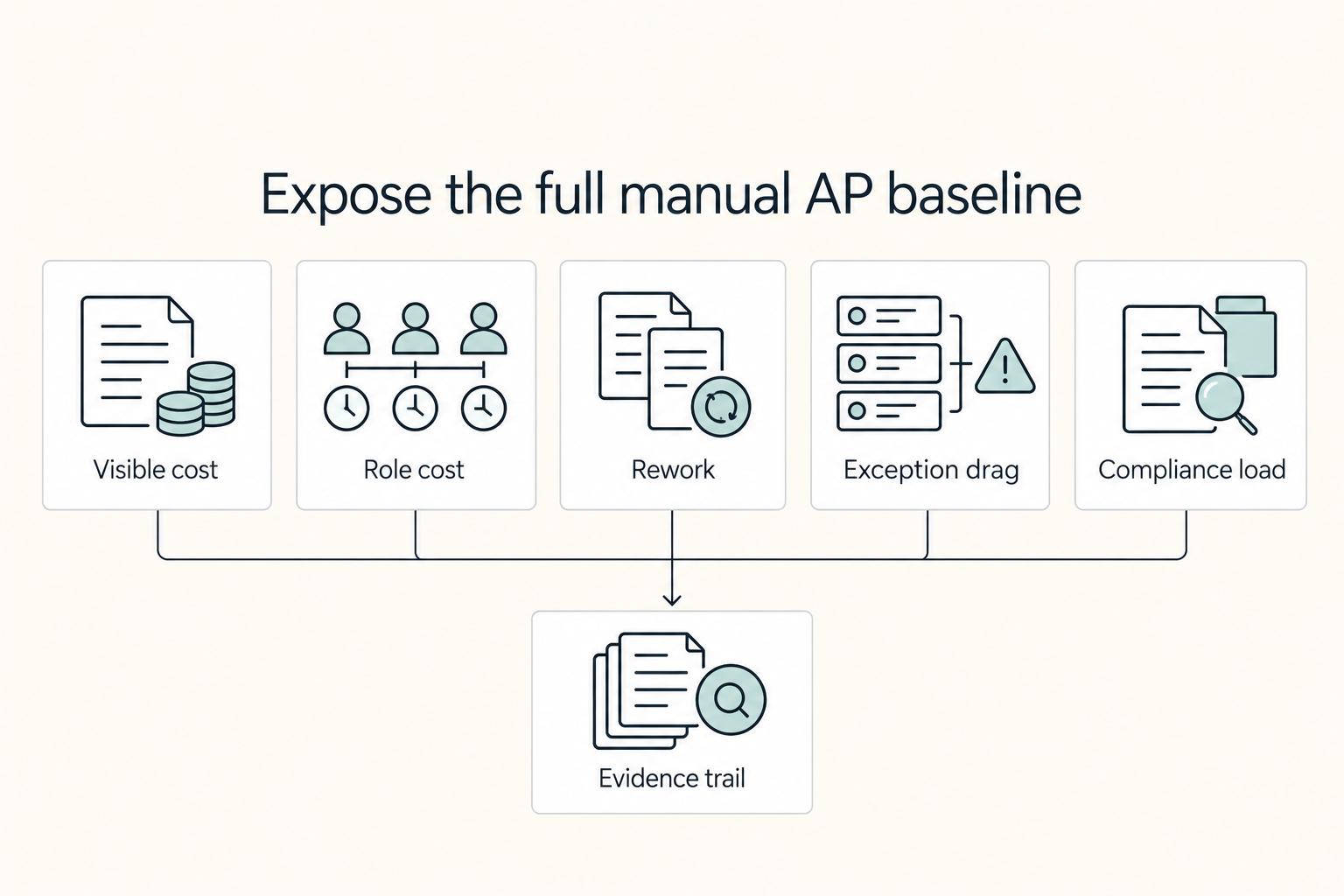
Build this baseline as if you need to defend each line in a budget review: visible AP spend plus the hidden losses manual work creates.
Step 1. Start with visible AP costs, then add hidden loss lines. Use total AP cost per invoice processed as your anchor KPI, but do not stop at payroll and tool spend. Include manual-loss lines tied to data entry, paper invoices, rework after errors, and late payment fees. If those are missing, your current state will look artificially cheap.
Tie each loss line to evidence in finance records or queue history. Late fees should map to actual fee spend, and rework should map to rejection logs, reopened invoices, or ticket volume.
Step 2. Normalize labor into true Fully-Loaded Cost by role. Model loaded hourly cost, not base salary, for each role involved in invoice processing (for example, AP analyst, approver, manager, and shared finance support). Use the same Finance-owned Fully-Loaded Cost method across all roles so effort is measured consistently.
Your check is simple: each role has annual loaded cost, productive hours, loaded hourly rate, owner, and date.
Step 3. Quantify exception drag using Invoice exception rate and time-to-resolution. Invoice volume alone is not enough. Price exception work as: annual invoice volume × Invoice exception rate × average time-to-resolution × loaded hourly cost for the people involved.
If exceptions move across multiple teams, count those touches explicitly. If timing data is weak, sample recent exceptions and split simple fixes from multi-touch cases so you do not undercount rework.
Step 4. Add tax and compliance handling overhead where it applies. If your workflow includes tax-document handling, price that effort directly. Form W-9 is used to provide a correct TIN, Form W-8BEN is provided by a foreign beneficial owner to a payer or withholding agent, and Form 1099-NEC is used to report nonemployee compensation.
For international overhead, treat FBAR as an explicit workload where relevant: reporting is on FinCEN Form 114, can be triggered when aggregate foreign financial accounts exceed $10,000 at any point in the calendar year, is due April 15, and has an automatic extension to October 15. Handle FEIE checks as conditional, not default: qualification depends on facts such as foreign earned income and a foreign tax home.
Related: AP Automation ROI Calculator: How to Build the Business Case for Your Finance Team.
Calculate ROI with transparent formulas and scenario bands#
Once the baseline is defensible, make the ROI model equally traceable: if a reviewer cannot tie Net Annual Savings and Total Initial Investment to named assumptions, the number is not approval-ready.
Step 1. Put the core math in plain form before scenario work. Use the same formulas in the model and the deck so finance is reviewing one logic path.
- Net Annual Savings = annual labor savings + annual exception-cost reduction + annual early payment discount capture + other avoided annual costs minus new annual operating cost
- Total Initial Investment = implementation fees + internal engineering time + finance and ops setup time + training and change cost + one-time data cleanup
- Return on Investment (ROI) = Net Annual Savings / Total Initial Investment
- Payback period = Total Initial Investment / average monthly net savings
Keep the time window explicit and consistent. If you report first-year ROI, use first-year savings; if you report a three-year return, label it clearly and keep denominator treatment aligned. Each line should map to the baseline, a Fully-Loaded Cost owner, or an approved vendor quote.
Step 2. Build three scenario bands by changing only real AP drivers. Use conservative, base, and upside cases, and vary throughput gains, exception reduction, and early payment discount capture instead of changing everything at once.
Conservative should reflect slower adoption and lower gains. Base should match the operating plan you are prepared to staff. Upside can assume stronger straight-through processing and faster approvals only when integration, approval rules, and supplier readiness support that case. If discount leakage is not proven in payment history, keep discount capture out of conservative and base.
Watch for double counting. If exceptions fall and processing gets faster on the same invoices, do not claim full savings twice under both exception reduction and labor compression.
Step 3. Run sensitivity so the review focuses on the assumptions that matter most. Scenario bands show combined outcomes; sensitivity shows which single inputs move ROI and payback.
| Assumption | Typical impact on ROI/payback | Verification checkpoint | Unknown if definitions differ |
|---|---|---|---|
| Exception reduction | High | Use the same exception-rate and time-to-resolution method as the baseline | Vendors may define "exception" differently |
| Labor compression | Medium to high | Tie saved hours to role-based Fully-Loaded Cost, not base salary | Some models count avoided hires; others count cash savings |
| Implementation cost | Medium on ROI, high on payback | Include internal engineering and finance setup, not only vendor services | Quotes often exclude internal time |
| Discount capture | Medium, sometimes high | Use realized discount history and current approval timing | Availability and eligibility vary by supplier mix |
If the model only works under aggressive labor compression, state that directly. If exception reduction drives most value, put targets and owners there.
Step 4. Add confidence notes and comparability flags inside the model. Use standard finance methods for formula structure, payback, scenario analysis, sensitivity, and assumptions, then separate that from outcome claims.
Treat vendor ROI ranges, including 300 to 500% over three years, as directional until definitions are normalized to your model. There is no universal benchmark. Mark unknowns in the assumptions table: annual vs cumulative ROI, whether software fees are netted out, whether "savings" means headcount reduction or redeployed capacity, and how exception reduction was measured. That is why "it saves money" is not a business case.
You might also find this useful: How Platforms Are Using AI to Automate Payment Operations: Use Cases and ROI.
Translate AP savings into platform operating outcomes#
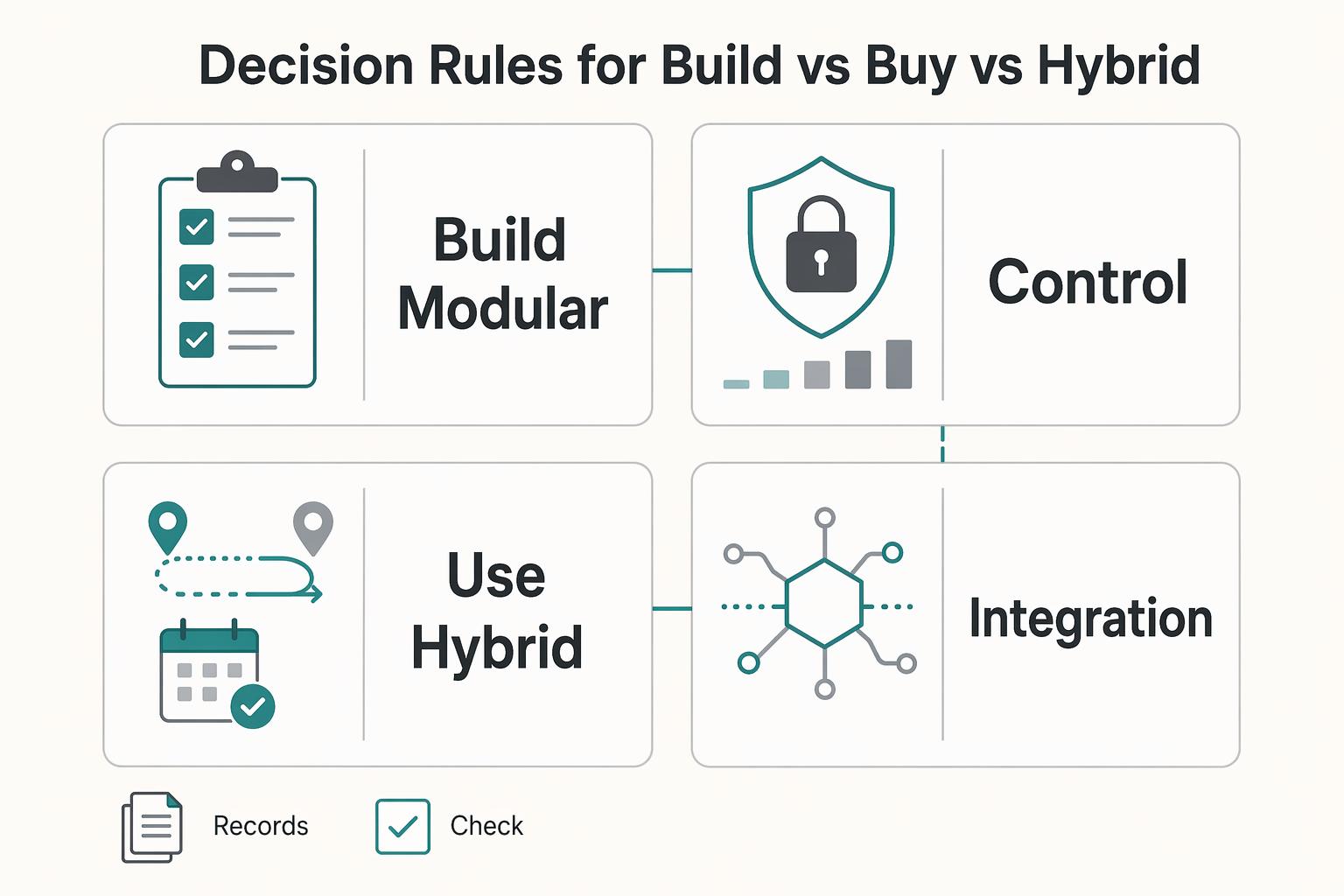
AP savings belong in the business case only if they improve platform operations, not just AP metrics. If your bottleneck is payout ops complexity, prioritize integration depth. If your bottleneck is AP throughput, prioritize AP workflow lift first.
Faster invoice cycles can reduce late-fee exposure and improve confidence in payment timeliness and AP data accuracy as volume grows. For payout batches, that should show up as fewer timing disruptions, cleaner reconciliation, and less strain as batch volume increases. If those outcomes do not move, do not count them as platform-level savings.
Use the architecture that matches your bottleneck:
| Bottleneck | Better first move | Why |
|---|---|---|
| AP workflow throughput and internal AP accuracy | Standalone AP tool | Improves AP timeliness without forcing a broader payment-stack change |
| Cross-team payout exceptions, reconciliation drag, and fragmented payment operations | Deeper integrated stack (where supported) | Can increase transparency and automate reconciliation across connected payment operations |
A Merchant of Record (MoR) is the entity legally responsible for processing customer payments. Where supported, Virtual Accounts can support both receivable and payable flows and improve reconciliation. This is often more relevant when you already run multi-provider payment stacks for international reach and local payment needs.
The tradeoff is straightforward: deeper integration usually requires more initial engineering and finance setup, and in-house orchestration can become resource-intensive as complexity grows. So do not assume integrated architecture automatically wins on year-one ROI; compare implementation effort against long-run exception handling across finance and ops.
Score vendors with operator-grade comparison criteria#
Score vendors on testable controls, not demo polish. If a vendor cannot show critical control behavior in realistic failure states, treat projected ROI as unproven.
Review the control surfaces your team will actually use#
Focus first on the controls your team will use under pressure: audit trail depth, exception workflows, and policy gates for KYC, KYB, and AML. You need traceability that clearly shows who changed an approval, payout, or record, when it changed, and why.
For KYC and KYB, require operational proof, not generic claims. Ask where customer identification rules are configured, how beneficial ownership is captured for legal entities, and what reviewers see when a case fails. Use a practical checkpoint: can finance or ops see whether a block is missing data, manual review, or a failed rule without vendor support?
Do not score only the happy path. AML controls are meant to help detect and report suspicious activity, and customer identification is risk-based. If a vendor cannot show how controls behave with incomplete or disputed records, you are not testing production reality.
Verify tax and compliance scope by naming the artifacts#
Name exact artifacts and boundaries in the evaluation. Ask specifically about VAT validation through VIES, Form W-9, Form W-8BEN, and 1099 series information returns. For FEIE and FBAR, make the vendor separate what the product handles from what stays with your tax team.
| Artifact | Use or trigger | Limit or note |
|---|---|---|
| VIES | Queries member-state VAT databases and can confirm cross-border EU VAT registration status | Does not cover every VAT obligation |
| Form W-9 | Provides a correct TIN | Name it explicitly in scope if relevant |
| Form W-8BEN | Provided by a foreign beneficial owner to a payer or withholding agent | Name it explicitly in scope if relevant |
| Form 1099-NEC | Used to report nonemployee compensation | Name it explicitly in scope if relevant |
| FBAR / FinCEN Form 114 | Can be triggered when aggregate foreign financial accounts exceed $10,000 at any point in the calendar year | Due April 15 with an automatic extension to October 15 |
| FEIE checks | Qualification depends on facts such as foreign earned income and a foreign tax home | Treat as conditional, not default |
Treat broad global tax claims as incomplete until proven. VIES can confirm cross-border EU VAT registration status, but it does not cover every VAT obligation. FBAR is tied to whether qualifying U.S. persons exceeded the $10,000 aggregate foreign-account threshold during the calendar year, with an annual due date of April 15 and an automatic extension to October 15. If your ROI model assumes compliance labor drops here, require proof of exactly where work is removed.
Require evidence artifacts before you score a vendor#
Before you call a vendor viable, ask for evidence artifacts:
| Evidence artifact | Review focus | Why it matters |
|---|---|---|
| Sample audit exports and reconciliation outputs | Request real exports and outputs | Checks auditability and reconciliation evidence |
| Failed transaction examples with status history | Review realistic failure cases and status history | Shows behavior outside the happy path |
| Async event handling for duplicates and out-of-order delivery | Walk through detection, retry behavior, record updates, and final reconciliation output | Payment events can be asynchronous, duplicated, and out of order |
| Redacted manual-review case showing release after a policy hit | Review a case from policy hit through release | Shows how manual review is handled in practice |
Payment events can be asynchronous, duplicated, and out of order. Give the vendor a failure scenario and have them walk through detection, retry behavior, record updates, and final reconciliation output. If they can only explain it in slides, do not accept ROI claims at face value.
Avoid the mistakes that make ROI models fail in approval#
If your ROI case cannot survive a line-by-line review, it is not ready for the C-suite. The models that stall in approval are usually not mathematically wrong; they are undocumented, incomplete, or based on benchmarks that do not match your operating context.
-
Publish assumptions, not just output. A black-box calculator is hard to trust because no one can test what moved the result. For each driver, show the assumption, owner, refresh date, and scenario label (conservative, base, upside). Then have Finance, Ops, and Engineering each trace one line to a source report; if they cannot, the model is not approval-ready.
-
Count Net Annual Savings beyond labor. Labor savings matter, but they are only part of the business case. Include the loss lines you actually manage: error correction, approval delays, compliance handling, and missed early-payment discounts. Keep indirect ROI in the model, but label it clearly as indirect.
-
Include implementation friction in Total Initial Investment. Add integration effort, training, and change-management costs before presenting. Change-management cost varies by project size and complexity, so treat common heuristics, including the often-cited around 10% for large programs, as directional rather than universal. Use one practical checkpoint: Engineering and the rollout owner sign off on the same implementation cost lines.
-
Normalize external benchmarks before using them. Claims like manual AP costing "four times more per invoice" are directional, not plug-and-play. Keep them labeled that way unless metric definitions match your invoice mix, company size, and process scope. If you cannot reconcile definitions against a source like the APQC benchmarking glossary, remove the benchmark from the core approval case.
For a step-by-step walkthrough, see How to Calculate the Cash Conversion Cycle for a Service Business.
Execute a 90-day rollout with verification checkpoints#
A 90-day rollout can work if you keep scope tight, verify each phase before advancing, and avoid a big-bang cutover. Do not move faster than your ability to reconcile differences, roll back safely, and track results against the approved business case.
- Step 1. Finalize the design and freeze scope.
Lock requirements for AP automation, invoice exception handling, approval routing, and payout operations tied to payout batches. Define which invoices should pass straight through, which conditions trigger approval policy gates, and which exceptions must block payout or require finance review. Checkpoint: Finance, Ops, and Engineering sign a design pack with required fields, approval rules, expected audit outputs, and invoice-to-payout handoff points.
- Step 2. Build integrations and test failure behavior, not just happy paths.
Implement integrations, then test retries, approval gates, and audit outputs under failure conditions. Retry logic should be idempotent, so transient failures can be retried without duplicate side effects. Checkpoint: Finance verifies policy gates fire on the right conditions, Engineering verifies duplicate requests do not create duplicate operations, and both teams review audit outputs. If you still need spreadsheet reconciliation to explain outcomes, controls are not ready.
- Step 3. Validate in parallel until deltas are reconciled.
Run old and new processes in parallel, compare transaction data daily, and reconcile every difference before progressing. This validation window can range from 15 days to 1, 2, or 3 months, which can fit inside a roughly 90-day plan. Checkpoint: Confirm KPI movement in STP Rate (share completed without manual intervention) and Invoice exception rate (invoices requiring manual handling due to errors or discrepancies). If STP rises by pushing exceptions into off-process workarounds, treat that as a false gain.
- Step 4. Launch in waves with rollback criteria and weekly ROI reviews.
Move cohorts in waves, plan several waves ahead, and revise based on feedback from each wave. Set rollback criteria before launch, such as unreconciled reporting deltas, duplicate operations after retry, broken approval gating, or KPI movement that conflicts with business case assumptions. Checkpoint: Review weekly results against the approved case, especially Net Annual Savings drivers tied to exception reduction and throughput. If a cohort misses the model, pause the next wave and fix the variance source before broad rollout.
Related reading: How to Choose the Right Business Structure for Your Freelance Business.
Conclusion#
The winning case is not the one with the biggest projected savings. It is the one your Finance lead, Ops owner, engineering team, and C-suite can inspect line by line and still accept. If your AP automation business case depends on vendor averages, vague labor assumptions, or untested compliance claims, it is not ready for approval.
Validate the baseline and publish the math#
Close the model only after Finance and Ops agree on both visible AP costs and the hidden costs you surfaced during the baseline work. That means fully loaded labor, exception handling effort, fee leakage, and any ongoing operating cost that reduces Net Annual Savings. Keep the denominator equally explicit. Total Initial Investment should include the implementation and change effort you expect to pay up front, not just subscription pricing.
Verification point: each major input should have an owner, a source artifact, and a refresh date. If nobody can show where a number came from, move it into an assumptions note or remove it from the approval version.
Verify compliance and tax scope before you count savings#
A platform rollout can look attractive on AP savings and still stall on verification, tax, or payout controls. Confirm early whether your target flow requires KYC and AML controls (and KYB where applicable), whether VAT number checks are needed for cross-border EU activity, and which tax documents are actually in scope, such as W-9, 1099-NEC, or W-8BEN. For VAT validation, a practical check is whether the vendor can show a VIES result that returns valid or invalid status, but do not treat that alone as full VAT compliance.
This is also the place to test legal boundary assumptions. If a provider handles identity verification, that does not automatically satisfy any independent legal KYC duties you still own. If payment activity may create money services obligations, the AML question is not cosmetic. The requirement is a written, risk-based program, so if that applies in your context, make it part of go or no-go, not a post-launch cleanup item.
Approve thresholds and rollout checkpoints#
Before final signoff, define what success has to look like in operational terms, not just in the slide headline. You want explicit go or no-go thresholds, named checkpoint owners, and a rollback path if the platform does not hit the expected execution markers. That keeps the business case tied to delivery reality instead of turning into a promise nobody can audit later.
Use this copy-and-paste closeout checklist:
- Baseline costs and hidden costs validated by Finance and Ops
- ROI model published with Net Annual Savings and Total Initial Investment assumptions
- Vendor claims verified with evidence artifacts, not slides
- Compliance/tax scope confirmed for KYC/AML (and KYB where applicable), VAT validation, and tax docs
- Go/no-go thresholds and rollout checkpoints approved by the C-suite and implementation owners
Frequently Asked Questions
How do you calculate AP automation ROI quickly?
Start with a fast screen, not a final approval model: ROI = (Annual savings - Annual cost) / Annual cost × 100. Then split the savings line into labor, fewer late fees, and any early payment discount improvement. If most of that line is still guesswork, label the result directional only.
What data do we need before we present an AP automation business case?
At minimum, bring the inputs that drive savings and spend: current invoice volume, current AP labor effort, fully-loaded cost by role rather than wage only, invoice cycle time, late payment fees, and realized early payment discounts. You also want evidence, not just estimates: reports that show fee patterns and timing data from your current approval and payment process. If you cannot show where each input came from, treat the case as directional rather than decision-ready.
What counts as hard-dollar savings vs soft-dollar benefits in AP automation?
Hard-dollar savings are the items you can track directly through standard ROI math, usually reduced processing costs and fewer late fees. Soft-dollar benefits are still real, but harder to price exactly, such as better auditability, more timely information for managers, and cleaner compliance support. If you cannot show the valuation method, keep it in a separate soft-benefit section instead of folding it into Net Annual Savings.
How should we estimate payback period when assumptions are uncertain?
Use three cases: conservative, base, and upside, then show what changes across them. A commonly cited payback range is 6 to 12 months. Treat that as a directional benchmark, not a promise. If your model is highly sensitive to one assumption, such as discount capture or labor compression, call that out clearly and show the break point where payback stops looking acceptable.
What are the most common AP automation ROI mistakes and how do we fix them?
Common errors include using wage-only labor numbers, counting soft benefits as hard savings, and importing benchmark claims like 33% of manual costs or four times more per invoice without normalizing for your invoice mix and operating model. Fix that by rebuilding the model line by line with source data, owners, and refresh dates. Another common failure mode is skipping payment-timing effects, which hides both late-fee reduction and early payment discount upside.
How do we make an ROI case credible to finance, product, and engineering leaders?
Present it as clear savings-versus-spend logic, with each assumption owned by the team that can verify it. Finance, product, and engineering should each validate the inputs and constraints they own so cycle-time, cost, and delivery assumptions stay explicit. The model becomes credible when every major input has an owner, a data source, and an audit trail.
Try a related tool
Researched and edited by the Gruv editorial team. Gruv builds cross-border billing, payouts, and finance-operations software for global businesses.
Sources
Includes 2 external sources outside the trusted-domain allowlist.
- ecfr.gov/current/title-31/subtitle-B/chapter-X/part-1...trusted
- ecfr.gov/current/title-31/subtitle-B/chapter-X/part-1...trusted
- europa.eu/youreurope/business/taxation/vat/check-vat-n...trusted
- gao.gov/products/gao-20-195gtrusted
- irs.gov/businesses/small-businesses-self-employed/re...trusted
- irs.gov/forms-pubs/about-form-w-9trusted
- apqc.org/resource-library/resource-collection/account...external
- apqc.org/resource-library/resource-listing/apqc-open-...external
Educational content only. Not legal, tax, or financial advice.
Related Posts
Accounts Payable Automation ROI for Platforms That Need Defensible Results
Most AP projects do not miss ROI because the spreadsheet was wrong. They miss it when real costs show up in exception handling and post-go-live process work. If you are evaluating AP automation, the useful question is not whether automation can create value. It can. The question is whether that value survives contact with your actual process.
AP Automation ROI Calculator: How to Build the Business Case for Your Finance Team
If you need a CFO-ready case for AP automation, start with transparent math and explicit assumptions. A defensible model is more useful than a bigger headline ROI claim.
How Platforms Are Using AI to Automate Payment Operations: Use Cases and ROI
Start narrower than your ambition. In payment operations, early ROI often comes from improving one high-volume process with a measurable baseline, not from trying to automate everything at once.