
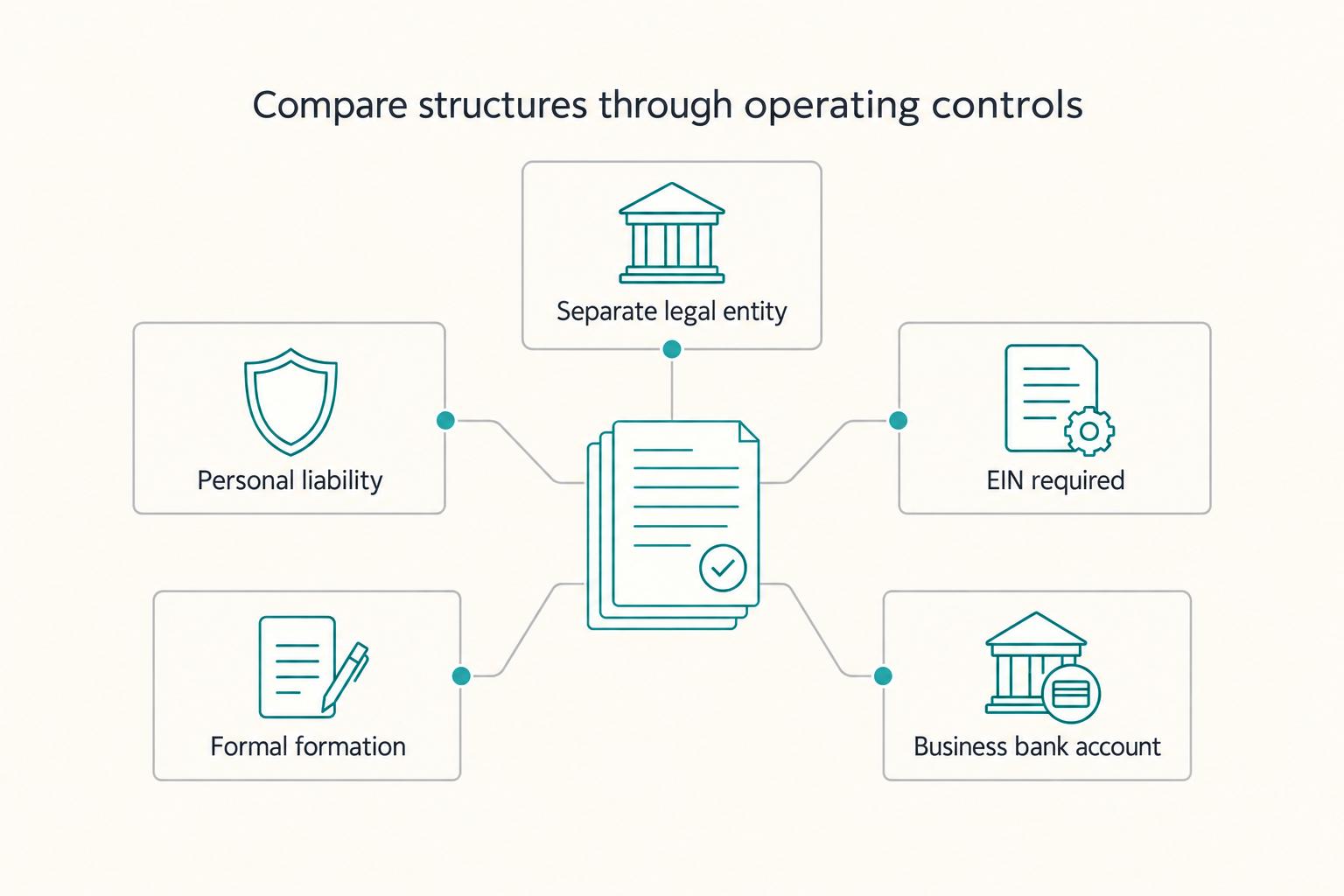
Quick Answer
Choose the legal structure and tax treatment separately. A sole proprietorship can suit one owner and can hire; an LLC may help manage business liability but does not automatically change federal income tax. Consider an S election only if eligible and the complete tax benefit exceeds its payroll and compliance costs.
Choose the legal structure and tax treatment separately#
For a US freelance business, compare the work’s liability exposure, ownership, expected profit and the ongoing administration you can support. A sole proprietorship is often a practical starting point for one owner. An LLC can provide a separate legal entity, while an S corporation election changes the federal tax treatment of an eligible entity. Neither forming an LLC nor making a tax election is an automatic requirement when you gain a large client or hire help.
Start with two decisions: who will enter the contracts and own the business, and how that business will be taxed. State law governs entity formation and much of the liability framework; federal tax classification is a related but distinct question. The SBA structure guide compares these choices and notes that state rules, liability and filing requirements can differ.
Compare the ordinary solo-freelancer options#
| Setup | Legal position | Ordinary federal tax treatment | Added work or tradeoff |
|---|---|---|---|
| Sole proprietorship | One individual owns an unincorporated business; no separate liability entity | Business income/expenses generally on Schedule C; applicable self-employment tax on Schedule SE | Simple entity setup, but owner bears business obligations personally |
| Single-member LLC with default individual-owner treatment | State-created entity with liability protections subject to applicable law and facts | Disregarded for income tax; ordinary business activity generally on the owner’s return | Formation, state compliance and entity records; no automatic federal income-tax saving |
| Eligible LLC/corporation with S election | Underlying LLC or corporation supplies the legal structure | Income/loss generally passes through; working shareholder compensation involves payroll; Form 1120-S and shareholder reporting | Eligibility, election timing, reasonable wages, payroll, state treatment and added accounting |
| C corporation | Separate corporate entity with governance requirements | Corporation pays tax on its income; shareholders can also owe tax on dividends | Corporate administration and possible double taxation; can suit specific ownership/capital plans |
A corporation is not automatically unsuitable for every independent professional, and an S election is not automatically better. Choose for a real ownership or financing need and the expected tax result. If a co-owner joins, review partnership and multi-member entity options rather than continuing to call the business a sole proprietorship.
A sole proprietor can hire employees or engage contractors. The IRS sole-proprietorship guidance includes employment-tax and employee-reporting forms. Hiring changes classification, payroll and reporting work; it does not itself compel LLC formation.
Match liability decisions to the actual contract#
List what could go wrong in your work: an incorrect financial model, a security incident, infringement, a missed deliverable or a supplier debt. Then read the proposed liability cap, indemnity, warranty, insurance and guarantee terms. A $5,000 project with an uncapped indemnity can deserve more attention than a larger project with a clear, appropriate risk allocation.
An LLC can help separate business obligations from the owner’s assets, but formation is not a universal shield. Consider the effect of your own wrongful conduct, any personal guarantees, professional rules and the state’s liability exceptions. As a concrete example, Delaware’s LLC statute, section 18-303, protects members/managers from company obligations solely by their status while expressly allowing them to agree to personal liability. Review the law that governs your own business rather than assuming another state’s rule decides every dispute.
Use several controls together: an appropriate entity, negotiated contract terms, suitable insurance and good delivery practices. A personal guarantee can put the owner back on the hook for a debt. Forming an LLC does not rewrite an earlier personal contract or guarantee. For sensitive professional work, confirm any licensing or professional-entity restrictions before filing.
For example, a solo developer receiving an enterprise contract should first identify the required counterparty and review the indemnity and liability cap. If the client accepts a sole proprietor, there is no enterprise-client formation rule to satisfy. If its procurement policy requires an incorporated vendor, decide whether forming and maintaining an eligible entity is worthwhile for that contract. In both cases, assess the actual exposure; an entity label alone does not resolve it.
Treat changes as review points, not automatic upgrades#
| Change in the business | Decision to review | What would justify action |
|---|---|---|
| A larger or riskier contract | Entity protection, insurance and contract allocation | Material exposure that the current arrangement does not manage well |
| First employee or subcontractor | Worker classification, registrations, payroll or contractor obligations | Actual hiring/reporting duties; entity change only if its benefits justify it |
| Consistently higher profit | S election eligibility and net economic effect | A defensible salary and tax model that outweigh ongoing costs |
| A client requests formation documents | Its genuine vendor policy and acceptable alternatives | A required counterparty type and enough business value to support the cost |
| A new co-owner or investor | Ownership, governance and tax structure | Clear rights, decision authority and an entity suitable for the owners |
Review before signing new obligations or changing ownership. A short, written decision is enough to start: the current setup, what changed, the costs and benefits considered, and what would cause another review. Keeping a sole proprietorship can be a deliberate choice rather than evidence that a business has failed to grow up.
Calculate tax effects without a flat percentage shortcut#
A default single-member LLC with an individual owner generally does not change ordinary federal income-tax treatment from that of a sole proprietor. The IRS single-member LLC guidance also distinguishes employment and covered excise-tax obligations from its income-tax treatment.
The ordinary self-employment tax rate includes 12.4 percent Social Security and 2.9 percent Medicare, but that does not mean 15.3 percent of every dollar of business profit. IRS Topic 554 describes the general 92.35-percent calculation, the annually changing Social Security earnings limit and Medicare treatment. Other wages, special rules and Additional Medicare Tax can change the calculation.
For an illustrative ordinary case with $100,000 net business profit, no other wages, no special exemption and earnings below the Social Security limit, the 92.35-percent step produces $92,350. Applying 15.3 percent gives $14,129.55 before return rounding. That illustrates the ordinary SE calculation, not the complete income-tax bill or an estimate for every freelancer. Use the appropriate year’s Schedule SE and personal facts for a real return.
A C corporation has a separate income-tax layer, and dividends can be taxed again to the shareholder. An S corporation generally passes income through, but distributions are not automatically tax-free: shareholders can owe income tax on pass-through income whether or not cash is distributed. Some entity-level taxes and state differences can apply. Compare the complete result rather than choosing from one advertised tax rate.
Check S election eligibility before modeling savings#
The IRS S corporation requirements include domestic status, allowable shareholders, no more than 100 shareholders, one class of stock and no disqualifying corporation type. Nonresident-alien shareholders are not allowed. A US LLC owned by a nonresident individual therefore cannot assume an S election is available simply because the LLC was formed in the US.
The IRS reasonable-compensation guidance requires reasonable compensation for a shareholder-employee’s services before non-wage distributions. Consider duties, time, experience and comparable compensation. A token salary selected only to maximize distributions is not a reliable tax strategy, particularly when the business’s receipts primarily come from the owner’s own work.
Prepare a complete model with expected profit, defensible compensation, employer and employee payroll taxes, state taxes, income-tax effects, benefits and incremental administration. In a hypothetical sensitivity test, an adviser estimates a tax benefit between $2,300 and $4,500 before $3,000 of incremental annual payroll/accounting costs. The result ranges from a $700 disadvantage to a $1,500 benefit before other factors. Those are illustrative estimates, not published fees or an IRS savings promise. A narrow upside may not justify the workload.
Form 2553 has election timing and consent requirements. Confirm the intended effective tax year and the applicable filing deadline with the current instructions before submitting. Do not turn an entity decision made late in the year into an assumed retroactive election.
Keep tax identifiers and payment records aligned#
Identify the legal contracting party, the taxpayer reporting the income and the holder of the receiving account. They can differ for a disregarded entity. The useful record set includes contracts, formation documents where applicable, the relevant tax form, bank/provider details and any authority to sign or receive payment.
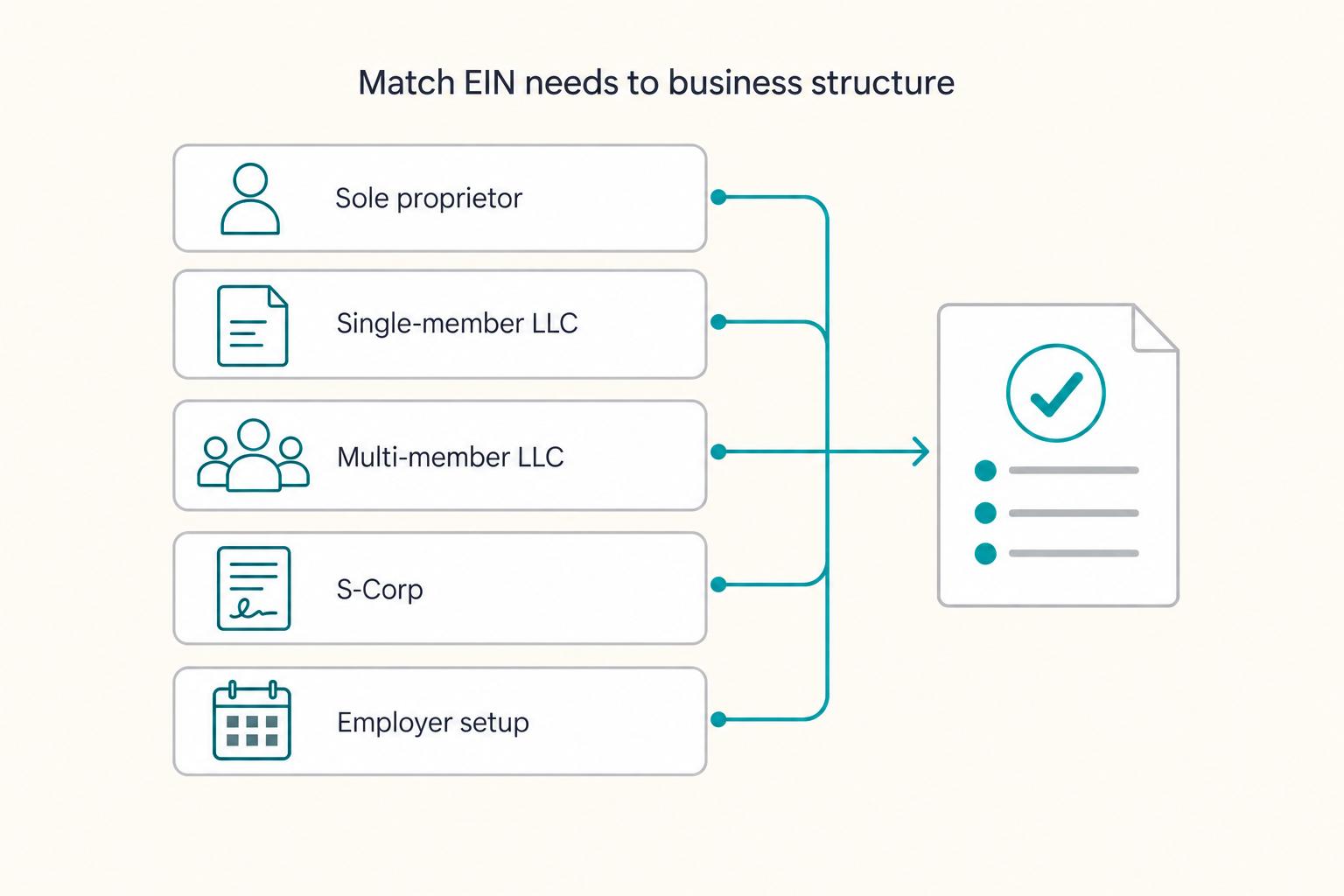
For a disregarded single-member LLC’s income-tax W-9, generally enter the owner’s name and SSN or owner EIN, with the LLC name on line 2. The LLC’s own EIN can serve employment/excise obligations or requested banking purposes. A sole proprietor’s EIN can be optional when no EIN-triggering obligation applies. See the freelancer EIN guide for the application and identifier distinctions.
A dedicated account makes business activity easier to reconcile. For an entity, maintain banking and records consistent with that entity and document contributions, reimbursements, loans and distributions. An owner’s draw is not an employee wage merely because it is recurring. For S treatment, handle wages through payroll and distinguish other permitted shareholder payments in the books.
Foreign clients do not automatically create an FBAR or Form 8938 filing obligation. Foreign accounts and assets, filer status and the applicable rules determine those separate reports. Entity formation also does not resolve tax residence, work authorization, local licensing or tax obligations in another country. Review those facts when your work or business location changes.
Plan an entity change around existing obligations#
- Confirm the state of operation, any additional registration or professional requirements, ownership and intended tax treatment.
- Compare formation and recurring state costs, accounting, insurance, payroll if applicable and any financing requirements.
- Form the entity through the appropriate state process, obtain an EIN where needed and make only the elections actually intended.
- Arrange contracts or permitted transfers to the new counterparty from an explicit effective date. Identify obligations that remain with the individual or old entity.
- Set up the correct bank/provider and tax records; test one invoice-to-reconciliation cycle before moving all client instructions.
- Keep old-account records and resolve pending payments, receivables, taxes and guarantees before closing or dissolving anything.
A new bank account does not assign an old contract automatically. Nor should a missing payment be replaced because the receiving entity changed: trace the original attempt first. Keep the old and new counterparties and balances distinguishable so the transition does not duplicate income, expense or collections.
Choose a setup you can maintain#
Select the structure whose liability, ownership and tax treatment fit the work you do now. Maintain the contracts, banking and records that support it, then revisit the decision when those facts change. A well-kept simple structure can be more useful than a complex one whose payroll or filing requirements are neglected.
Frequently Asked Questions
Can a sole proprietor hire employees?
Yes. Hiring introduces worker-classification, employment-tax, payroll and other applicable duties, but does not by itself require LLC formation. Review the actual obligations and whether an entity would help manage the business’s risks.
Does forming an LLC reduce federal tax automatically?
No. An individual-owned single-member LLC with default disregarded treatment generally reports ordinary business activity through the owner, much like a sole proprietor. A separate eligible tax election changes the analysis and adds its own requirements.
Does an indemnity clause mean I must form an LLC?
No. Review the clause, liability cap, insurance and applicable state law. An LLC may help manage business obligations, but personal guarantees, personal conduct and professional or statutory exceptions still need attention. Formation alone does not rewrite an existing agreement.
When should a freelancer consider an S election?
When the entity and owners meet the eligibility rules and a complete model supports the added payroll, accounting and state-tax workload. Use reasonable compensation for services and compare net benefit after costs; there is no universal profit threshold that makes the election best.
Try a related tool
Researched and edited by the Gruv editorial team. Gruv builds cross-border billing, payouts, and finance-operations software for global businesses.
Sources
Educational content only. Not legal, tax, or financial advice.
Related Posts
Do Freelancers Need an EIN? Requirements, W-9s and Applying
An Employer Identification Number is a nine-digit federal tax identifier issued by the IRS. A solo US freelancer operating as a sole proprietor often can use an SSN without obtaining an EIN. Employees, corporate or partnership tax classification, certain excise-tax filings and other specific obligations can change that answer. A bank’s account-opening requirement is a separate reason to obtain one.

The Freelance Payment Penalty: A Modeled Audit of Platform Fees, FX Spreads, and Payout Delays
The money rarely disappears through a single, easy-to-spot fee. The real loss is stacked. A marketplace takes its commission, a processor adds a charge for international cards, a bank or payment company converts the currency at a spread, a platform holds the funds before release, and a wire sheds a little to intermediaries on the way in. Each layer looks defensible on its own, but the worker feels the combined result as a smaller deposit and a later payday.

How to Respond to a Subpoena for Business Records
Move fast, but do not produce records on instinct. If you need to **respond to a subpoena for business records**, your immediate job is to control deadlines, preserve records, and make any later production defensible.