
Quick Answer
Calculate CCC = DIO + DSO − DPO. Use matched average inventory, trade receivable and trade payable balances; period cost of sales and net credit sales; and the same period’s day count. For services, track billable milestone-to-invoice delay and invoice-to-cash timing separately, with still-open balances visible.
What CCC measures—and the service delays to track alongside it#
If you run a service business, the standard CCC formula can miss one important delay in your cash cycle: the time between doing the work and sending the invoice. The formula is still useful, but its inventory-centered logic does not fully capture service delivery on its own.
Start with the textbook model, CCC = DIO + DSO - DPO.
- DIO measures inventory relative to the period’s cost of sales.
- DSO measures receivables relative to the period’s credit sales.
- DPO measures trade payables relative to the chosen cost-of-sales convention.
Balance-sheet DSO is not simply a stopwatch that starts when an invoice is sent. It depends on the receivables recorded under your accounting policy. An invoice-date aging report may omit some unbilled amounts; inspect that population before deciding how much pre-billing delay is missing.
| CCC component | Product business workflow | Service business workflow | What you can observe directly |
|---|---|---|---|
| DIO | Goods are purchased, held, then sold | Often limited traditional inventory, though some service models still hold materials | Stock, parts, job materials, purchase records |
| DSO | Receivables arise from credit sales | Recorded receivables may differ from the issued-invoice population | AR ledger, credit sales, invoice dates, payment allocations, and unbilled classifications |
| DPO | Supplier invoices paid on terms | Supplier invoices paid on terms | Bill date, due date, payment date |
The missing piece is the unbilled delivery window, the time between performing or delivering work and issuing the invoice. When billing happens after services are provided, that window is often where cash pressure begins.
Unbilled work is not automatically a contract asset. Under the IFRS 15 distinction, a right conditional on something beyond the passage of time is a contract asset; an unconditional right to payment is a receivable. Classification depends on the contract and accounting framework, not merely whether you have sent an invoice. Confirm your treatment with the accountant; KPMG’s IFRS 15 handbook explains this distinction.
So the answer is not to abandon CCC. It is to adapt it so the metric matches how your service business actually turns work into cash. Related: What is 'Working Capital Management'?.
Measure How Long Cash Stays Tied Up in Operations#
If you want one operating cash-timing number, use the cash conversion cycle (CCC). It shows how long money used in day-to-day operations stays tied up before it comes back as customer cash.
Step 1 Set the clock points#
Use workflow checkpoints you can actually pull from your systems.
- Supplier payment timing: how long it takes you to pay suppliers.
- Production/inventory and sale timing: how long it takes to create and sell what you deliver.
- Customer collection timing: how long it takes to collect payment from customers.
For an inventory-free service firm, set DIO to zero only when inventory is genuinely absent. If cost of sales is zero, an inventory ratio is undefined rather than automatically zero. Track contract assets, unbilled work, payroll timing, and customer advances separately where they matter.
Step 2 Read each component like an operator#
Read each component as a delay point, not just a formula term.
| Component | What it measures | Where delays usually show up |
|---|---|---|
| Supplier payment timing | Time to pay suppliers | Paying before cash is collected from customers |
| Production/inventory and sale timing | Time to create and sell output | Longer delivery or sales cycles |
| Customer collection timing | Time to collect after sale | Slow collections or longer payment terms |
Step 3 Verify inputs before managing the number#
Use the same account populations and period conventions before comparing months, quarters, or years. A growing firm can show a rising ratio even when individual invoices are paid on time, so read balances and workflow evidence together.
A lower cycle is usually more efficient, but a very low or negative result can also come from leaning on supplier credit. That may support cash flow, but it is different from improving operating speed.
Calculate the ratios, then locate the workflow delay#
Once you have the right formula, the next job is to locate the delay. Use this diagnostic to find out whether cash is getting stuck in inventory (if applicable), before invoicing, after invoicing, or in your bill-payment timing.
Step 1 Pull one clean period of source data#
Start with one closed period. Pull dates from the systems that own them, not from memory or dashboard rollups.
| Lever | Pull from | Capture | Tool note |
|---|---|---|---|
| Period ratios | Closed ledger and sales/cost reports | Opening/closing or more frequent inventory, receivable and trade-payable balances; credit sales; cost of sales; calendar days | Reconcile balance populations and exclusions. |
| Service billing lag | Project/milestone tracker | Billable milestone date, contractual billing trigger, invoice issue date and amount | Separate delivery duration from delay after billing eligibility. |
| Collection timing | Invoice and payment allocations | Invoice amount, payment dates and amounts, credits, open balance and as-of date | Do not restrict the risk view to fully paid invoices. |
| Supplier timing | Bills and payment allocations | Bill date, due date, agreed terms, payment date and outstanding balance | Keep contractual term use separate from lateness. |
If you use Xero, remember that Aged Receivables Detail and Aged Payables Detail are as-of-date views, so run them to the same cutoff as the rest of your source data.
Trace a sample end to end across milestone, invoice, credit, allocation, vendor bill and bank records. Investigate payment-before-invoice dates: genuine deposits and prepayments can be valid, while incorrect dates need correction. Do not rewrite a real advance payment just to make the dates follow a preferred order.
Step 2 Calculate the levers with consistent rules#
Use one rule set and keep it consistent across periods: CCC = DIO + DSO - DPO
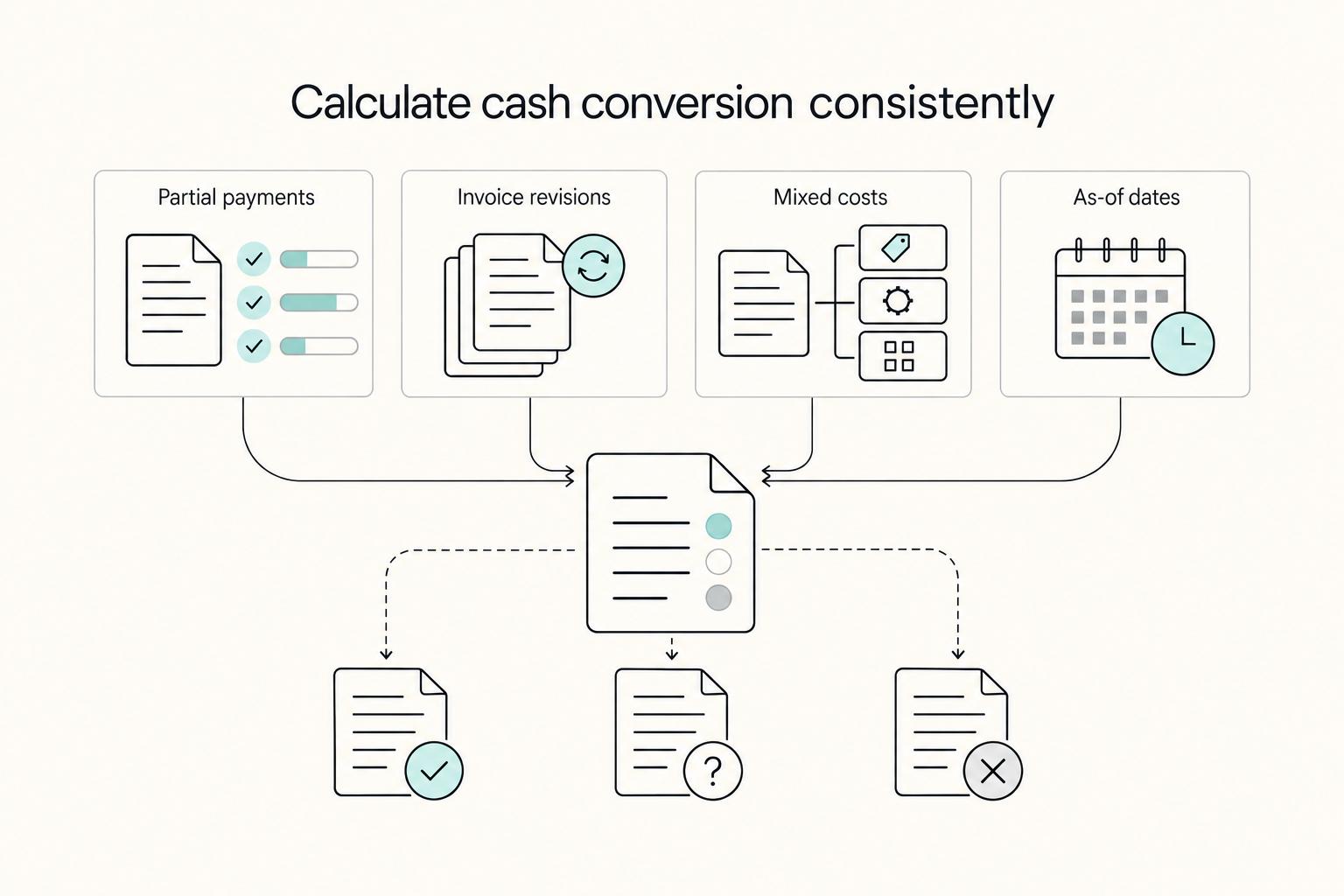
| Data issue | Instruction |
|---|---|
| Partial payments | Allocate each receipt to the correct invoice; leave unpaid balances open. The first receipt does not make the whole invoice collected. |
| Invoice revisions | Account for credit notes, voids, and reissues |
| Mixed cost categories | Avoid blending direct costs with unrelated expenses in DPO inputs |
| Mismatched as-of dates | Run receivables and payables views to the same cutoff date |
| Measure | Period formula or diagnostic | What to investigate | First move |
|---|---|---|---|
| DIO | Average inventory ÷ period cost of sales × days in period | Stock held before sale | Review actual materials and inventory needs; use zero only for genuinely no inventory. |
| DSO | Average trade receivables ÷ period net credit sales × days in period | Receivable funding relative to credit sales | Review old balances, disputed invoices, and billing completeness. |
| DPO | Average trade payables ÷ period cost of sales × days in period | Supplier financing under this reporting convention | Inspect cost/population fit and due dates before treating a rise as improvement. |
| Billing lag diagnostic | Invoice issue date minus the defined billable milestone date | Delay between billing eligibility and issuance | Fix handoff, approval, or invoice creation; track delivery duration separately. |
Average balances can be (opening + closing) ÷ 2. For volatile or seasonal activity, use more frequent balances consistently. Use 30 for a 30-day month or the actual days in your chosen quarter—not 365 with a monthly sales denominator. State whether balances and sales exclude tax and use a consistent currency and accounting basis.
The ratio convention above follows CFI’s CCC explanation and DPO formula. In a payroll-heavy service firm, trade payables may finance only a small share of cost of sales. Do not include payroll accruals, loans or taxes in trade AP. If you instead divide selected supplier payables by matching credit purchases or vendor costs, label that as a separate supplier-payment diagnostic and disclose its denominator; do not compare it directly with the cost-of-sales DPO.
Averages of elapsed days for settled invoices or bills are separate cohort diagnostics, not interchangeable replacements for the balance-sheet ratios. Show the sample definition, amounts, open balances, and credits. An unpaid invoice has no final collection date; report its age as of the cutoff rather than dropping it from the risk view.
Worked example: a 30-day service period#
Assume no inventory, positive cost of sales, opening trade AR of 20,000 and closing trade AR of 40,000, net credit sales of 60,000, opening trade AP of 8,000 and closing trade AP of 12,000, and cost of sales of 30,000. Use the same currency and tax-exclusive basis throughout. Average AR is 30,000 and average AP is 10,000. DSO = 30,000 ÷ 60,000 × 30 = 15 days; DPO = 10,000 ÷ 30,000 × 30 = 10 days; DIO = 0. CCC = 0 + 15 − 10 = 5 days.
Five days is a period ratio estimate, not proof every job turns into cash in five days. Suppose one job reaches its billable milestone on day 0, is invoiced on day 10, and is paid on day 35. That job has 10 days of billing lag and 25 days from invoice to cash, for 35 days from milestone to cash. Do not add this single-job lag to the 15-day company DSO and call it a measured company cycle.
For a 1,000 invoice, assume 400 is received 10 days after issue and 600 is received 30 days after issue. The amount-weighted elapsed collection time for this fully collected invoice is (400 × 10 + 600 × 30) ÷ 1,000 = 22 days, while full settlement took 30 days. If the second payment is still outstanding at a day-20 cutoff, record 600 open and 20 days old; do not report the invoice as collected in 10 days. A credit is a balance reduction, not cash collection.
A stable-sales scenario with average AR falling from 30,000 to 24,000 lowers DSO from 15 to 12 days and CCC from 5 to 2 if other inputs stay fixed. That corresponds to 6,000 less average receivable exposure, not guaranteed immediate cash savings. Explain whether the change came from actual receipts, lower sales, credits, write-offs, or a changed account population.
Step 3 Classify the result before you change anything#
Do not jump straight from calculation to action. First, classify the result against verified internal history or peer benchmarks, not universal cutoffs.
| Status | What it means | Check first |
|---|---|---|
| Healthy | Cycle and component trends sit within your verified range or peer band | Check DSO against the payment terms you actually sell on |
| Watchlist | One lever is worsening across two periods, even if total CCC still looks stable | Look for flat CCC because higher DPO is offsetting weaker DSO |
| Urgent | The cycle is lengthening quickly, receivables risk is concentrating, or DPO is rising because bills are slipping late | Inspect oldest unbilled work, oldest receivables, and payables nearing late-payment risk first |
Act on the component or workflow causing the stretch. The next section maps unbilled work, collections, and supplier timing to practical corrective moves.
Three Levers That Shorten Your Cash Cycle#
Work on billing triggers, collection execution, or supplier-payment scheduling according to the evidence. If your team uses DWIP for a service-work diagnostic, define the start/end dates and amount population explicitly; do not silently substitute it for accounting inventory.
Before you start#
Use one verified closed period and keep the source records open while you work. Profit can look healthy while cash is tight, so anchor decisions in invoice dates, payment dates, and bill due dates.
| Lever | Primary risk reduced | First operational move | Common implementation mistake to avoid |
|---|---|---|---|
| Billing lag | Billable work sits unbilled | Add a billing trigger to your contract template before work starts | Waiting until full project completion when milestone, weekly, or monthly billing is possible |
| DSO | Cash arrives too slowly after invoicing | Standardize your payment term across contract, invoice, and reminders | Tightening terms on paper while invoices still go out late or with errors |
| DPO | Cash leaves faster than needed | Schedule payments to agreed terms instead of paying everything on receipt | Treating late payment as a strategy and damaging vendor trust or critical services |
Step 1 Rewrite your contract and billing trigger#
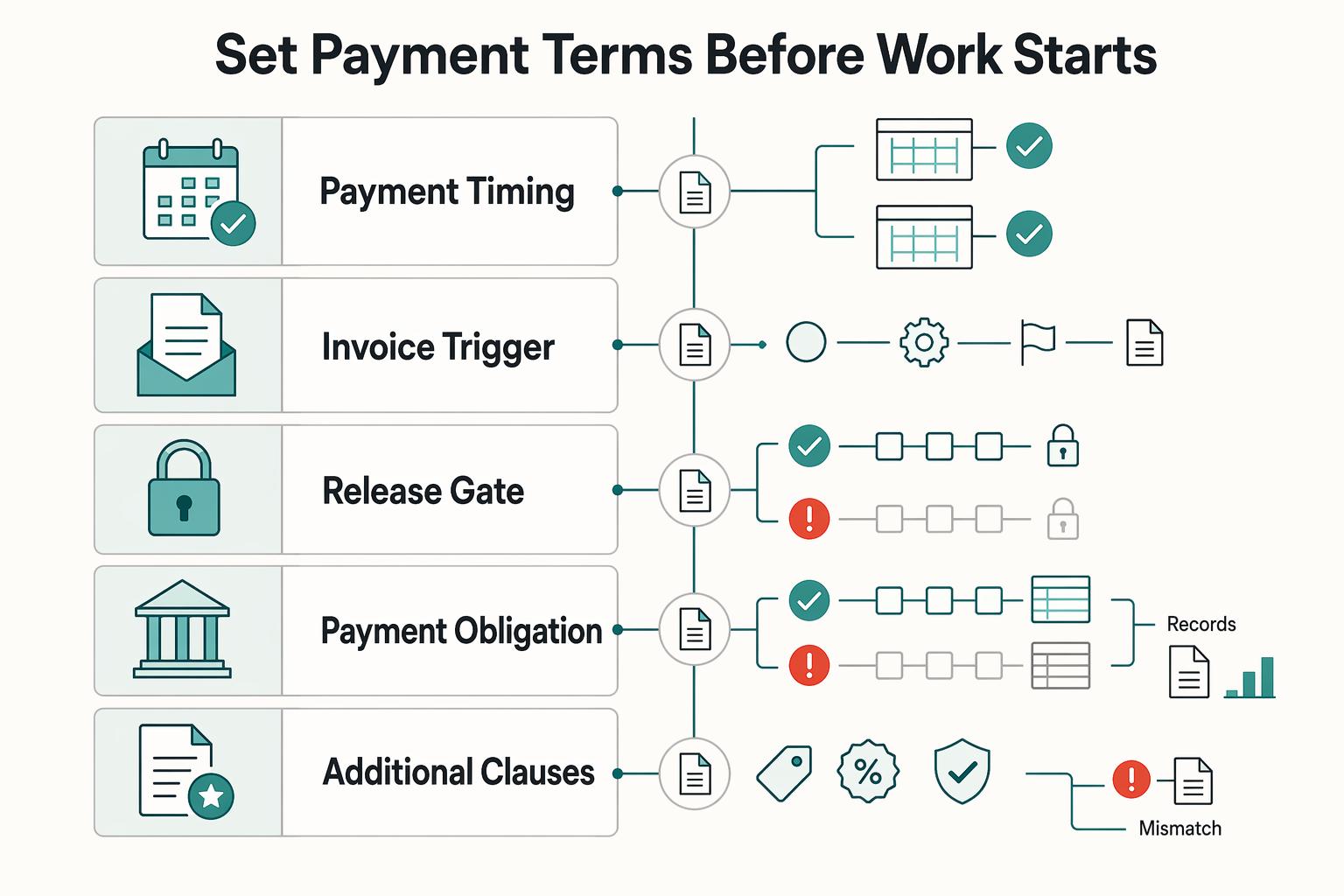
Start with the billing trigger. If work starts without a defined billing event, the delay risk is built in. Update your template so each new engagement states a clear invoice trigger tied to a milestone, weekly cutoff, or monthly cycle.
Then review active jobs and confirm three fields for each: billable start date, next invoice trigger, and invoice owner. If you cannot identify the next invoice date quickly from the agreement and project record, that job is exposed to unbilled drift.
Step 2 Tighten the path from invoice to cash#
For collections, fix process consistency before you escalate. Set one default term and use it in the contract, invoice, and reminders until you deliberately change it.
Run one end-to-end test: issue a live-format invoice, verify due-date population, and confirm reminder timing. Then review recent late invoices for avoidable friction such as the wrong billing contact, missing required info, unclear line items, unresolved credits, or partial-payment handling issues.
Step 3 Schedule payables with discipline, not delay#
Use payables timing as planned execution within agreed terms, not as informal lateness. Group open bills by agreed terms, vendor criticality, and service dependency. Then schedule payments near the end of the agreed window when appropriate, so you are not paying earlier than necessary.
Keep one guardrail: if a payment date falls outside agreed terms, that is late payment, not optimization. Protect vendors tied to delivery continuity and critical services first to avoid unnecessary disruption.
Use a rolling cash forecast with actual payroll, supplier and expected customer dates. Choose a horizon that covers upcoming obligations and revise it regularly. Ratio CCC does not capture every cash outflow or guarantee enough cash for next week’s payroll.
If your biggest delay is slow invoicing, use a reusable template to bill at kickoff and milestones. That can help cash enter your cycle earlier: Free Invoice Generator.
Turn the calculation into billing and payment decisions#
Treat cash timing as a process you run, not a result you discover later. Once you calculate your cycle, move from tracking it after the fact to setting clear operating rules before delivery begins.
Start at contract setup with explicit ground rules and assumptions. Use a defined work structure so each stage has a billing decision point and a clear handoff. If a stage has no invoice trigger, cash timing can drift.
For collections, decide the payment path early and follow it consistently. For payables, record due dates when bills arrive and pay within agreed terms based on plan, not habit. That gives you a clearer operating baseline when client timing shifts.
| Lever | Reactive cash flow habit | Controlled cash flow habit | What to do next |
|---|---|---|---|
| Work structure | Deliver work, then decide how to bill | Define stage-based billing triggers before work starts | Add one explicit invoice trigger to every delivery stage |
| Collections | Issue invoices and chase later | Confirm and follow the agreed payment path from the start | Verify payment workflow details before first invoice |
| Payables | Pay whenever bills surface | Schedule payments against recorded due dates | Log due dates on receipt and queue payments by term |
Then run a recurring drift review using actual dates across work start, invoicing, collections, and payables. Compare what was supposed to happen with what actually happened, and update your process when the two drift apart. Keep the review on a fixed cadence so this stays a routine control.
For outgoing payments, keep execution and reconciliation connected to the forecast: Explore Gruv Payouts. Evaluate its fit for your actual payment workflow; the CCC calculation still comes from your accounting records.
Frequently Asked Questions
How do I calculate the cash conversion cycle for a service business?
Calculate CCC = DIO + DSO - DPO with matched average balance populations, period credit sales and cost-of-sales denominators, and days in that same period. For an inventory-free firm, DIO may be zero, but track unbilled work and cash obligations separately. Keep actual invoice-to-payment elapsed days as a distinct diagnostic rather than inserting a paid-only average into the ratio.
Why replace DIO with DWIP?
Keep inventory DIO in the formal ratio. A service-specific unbilled-work measure can help locate delivery or billing delays, but define its dates and amounts separately. Before adding it to DSO, check whether the relevant unconditional unbilled receivables already sit in the AR balance so you do not count the same exposure twice.
How do I reduce the cycle once I have the number?
Start with the lever that has worsened most across recent closed periods, not just the largest raw value today. Compare DIO, DSO, and DPO against your own baseline trend, then against similar firms where models and terms are comparable. Change one process step at a time so you can see which adjustment actually improves cash timing.
What if I am profitable but still short on cash?
Profit and cash can diverge because income may be recorded before payment is collected. Check your statement of cash flows, receivables aging, unbilled work, and unpaid bills schedule to find the timing gap. Then fix the matching lever: speed up billing and collections where possible, and manage payables timing within agreed terms.
What is a good CCC for a freelance or small service business?
There is no single day-count benchmark that fits every model. Read your number against your own trend first, then compare it with similar firms only when billing model, project length, and payment terms are comparable. A shorter cycle is usually better for liquidity when it comes from healthy billing and collection practices.
Is a negative CCC good for a service business?
Sometimes, but not automatically. A negative cycle can reflect efficient cash timing, and it can also signal stress. Check payables discipline first, because pushing payments too far can damage supplier relationships.
Try a related tool
Researched and edited by the Gruv editorial team. Gruv builds cross-border billing, payouts, and finance-operations software for global businesses.
Sources
Includes 7 external sources outside the trusted-domain allowlist.
- assets.kpmg.com/content/dam/kpmgsites/xx/pdf/ifrg/2025/isg-h...external
- central.xero.com/0/article/Aged-Receivables-Detail-report-Newexternal
- central.xero.com/0/article/Payable-Invoice-Detail-report-New-USexternal
- corporatefinanceinstitute.com/resources/accounting/cash-conversion-cycleexternal
- corporatefinanceinstitute.com/resources/accounting/days-sales-outstandingexternal
- financialprofessionals.org/glossary/cash-conversion-cycleexternal
- openstax.org/books/principles-finance-2e/pages/19-1-what-...external
Educational content only. Not legal, tax, or financial advice.
Related Posts
Working Capital Management for Freelancers Who Invoice Clients
Protect your working capital before cash gets tight. In practice, that means balancing short-term assets and obligations so you have enough cash to cover near-term bills and keep operations steady.

The Freelance Payment Penalty: A Modeled Audit of Platform Fees, FX Spreads, and Payout Delays
The money rarely disappears through a single, easy-to-spot fee. The real loss is stacked. A marketplace takes its commission, a processor adds a charge for international cards, a bank or payment company converts the currency at a spread, a platform holds the funds before release, and a wire sheds a little to intermediaries on the way in. Each layer looks defensible on its own, but the worker feels the combined result as a smaller deposit and a later payday.

How to Respond to a Subpoena for Business Records
Move fast, but do not produce records on instinct. If you need to **respond to a subpoena for business records**, your immediate job is to control deadlines, preserve records, and make any later production defensible.