
Quick Answer
Preserve the original payout reference and classify the payment outcome before recovery. Retrieve unknown attempts rather than issuing a replacement. An exact supported idempotent replay recovers the original result; a new attempt needs confirmed non-payment or cancellation, reconciled funding, verified destination and approval under the same obligation. Close only when all attempts and accounting movements reconcile.
Recovering Bank-Rejected Contractor Payouts#
Bank rejections happen in contractor payouts, but your response cannot be improvised. A payout can fail and be voided before completion, or it can be returned after failing to reach the recipient. In either case, your team still needs an explicit decision on liability, ledger state, and next action.
Separate a rejected request, a confirmed failed payout, a returned payout and an unknown outcome. Incorrect destination details need correction, but a replacement must wait until the original attempt is conclusively unpaid or canceled and any return/funding treatment is reconciled.
Why a controlled response matters. The main risk is duplicate payouts and reconciliation drift when teams react to provider updates without one recovery record. Blind retries create noise, confuse contractor communications, and force manual cleanup later.
Verify webhook authenticity, durably record each event and acknowledge receipt before asynchronous processing. Deduplicate events and business effects; serialize or version-check updates because delivery can be repeated or out of order. Stripe live webhook delivery may retry for up to three days; that is event delivery, not authority to resend money.
The controls that actually keep you safe. For Payments Ops, Finance Ops, and engineering owners, the controls are straightforward and work best together:
- One durable disbursement ID, with a separate provider request key for each authorized attempt and exact replay of that attempt.
- Explicit payout states such as
failed,returned,voided,reissued, andsettled. - Ledger checkpoints before and after any retry or reissue.
- One incident record linking payout ID, provider reference, and event timeline.
Before any reissue, confirm three things in one place: which attempt failed, whether funds were voided or returned, and whether internal liability is still open. If you cannot answer all three, do not retry yet.
Idempotency protects only the documented endpoint, scope and retention window. Stripe may prune keys after 24 hours; maintain a durable operation record beyond that window. Unknown outcomes require lookup and provider investigation, not a fresh identifier or an assumed-safe late replay.
What this guide will help you do. This guide gives platform teams a practical path to triage a rejection, decide whether to void or reissue, correct destination details, and close the incident without duplicate payments or reconciliation drift.
If you own operations, you get decision rules. If you own engineering, you get state and idempotency checkpoints for duplicate-safe handling. If you own finance, you get closure checks before an incident is truly resolved. For related reconciliation issues between collection and payout, see Understanding Payment Platform Float Between Collection and Payout.
What a bank rejection means in platform payout operations#
A bank rejection tells you one thing for certain: the transfer attempt failed. If an Electronic Funds Transfer (EFT) is rejected, treat it as a bank or provider outcome, not proof that your contractor obligation is resolved or that the same payout route is safe to retry.
Separate payout movement from accounting state. Start by separating payout movement from accounting state. A payout can be failed, returned, or voided at the provider layer while your internal payable or contractor balance may still need an explicit decision.
Interpret the actual provider product’s statuses. In Stripe Global Payouts, posted means funds left the FinancialAccount and does not guarantee recipient receipt; returned has a separate return transaction. Its documented typical 2–3 business-day return can take longer by country. Keep the case open until actual status and fund movements are reconciled.
Treat the rejection reason as a diagnosis clue. Incorrect destination details are a common cause of returned payouts, and account closure is another documented cause.
If the reason points to bad details, correct or invalidate those details before any reissue. Do not treat a data-quality failure like a transient outage by replaying the same route. If the failure reason is unclear, do not guess from a single status label. Capture the reason text or code, the payout-method snapshot, and the provider reference for the failed attempt.
Use a controlled correction order: establish the original attempt’s outcome, verify any return or cancellation and funding, correct destination details, obtain approval, then submit a linked replacement. An accounting void alone does not cancel an external transfer.
Map cancellation and reissue to the chosen provider and rail. Some payments cannot be canceled or reversed. Keep the contractor obligation open until the payment outcome and ledger treatment resolve it.
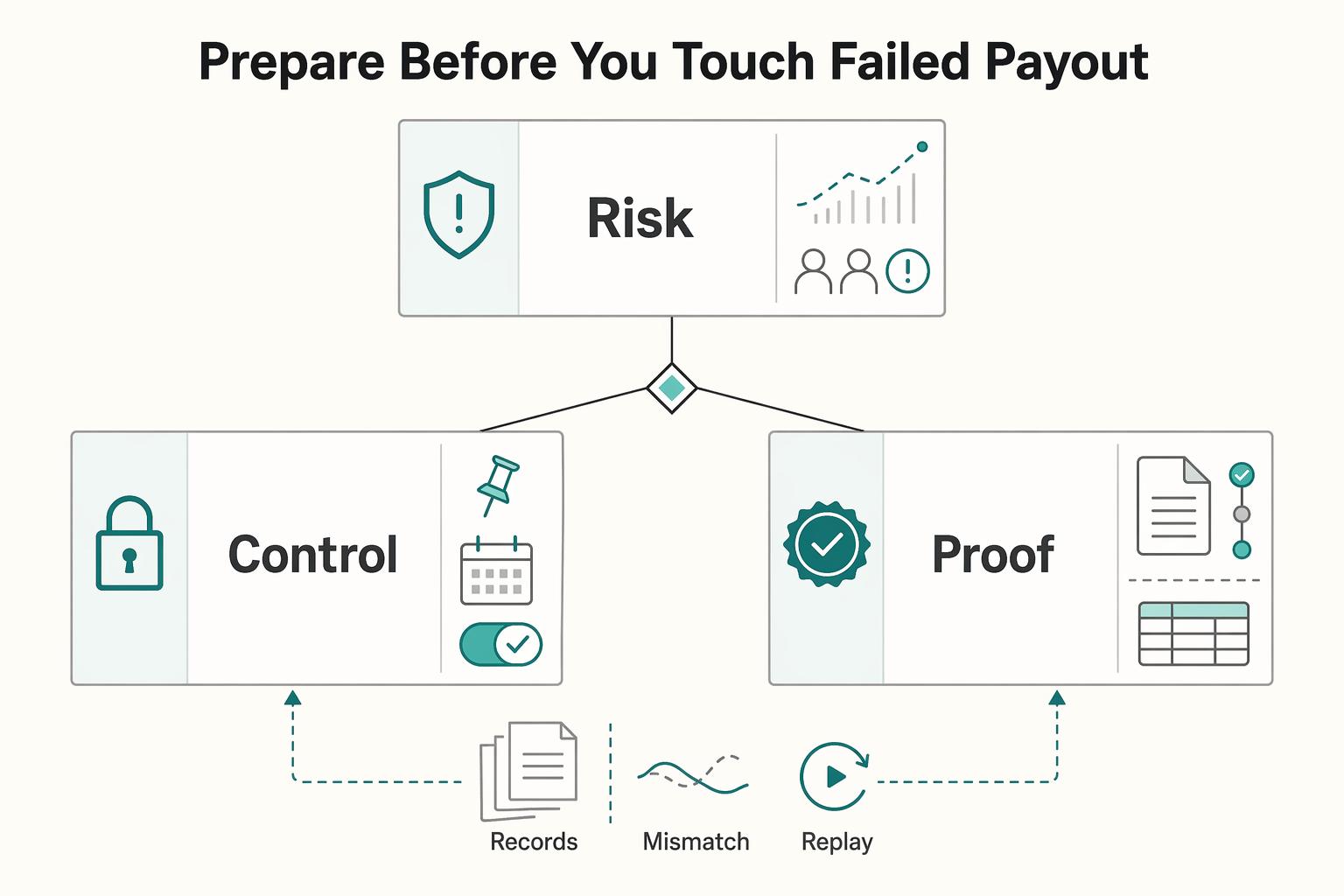
What to prepare before you touch the failed payout#
Before anyone voids, retries, or reissues, freeze the case so every team is working from the same failed-attempt record.
Anchor the incident to the rejected payout. Capture the payout ID, full webhook or event timeline, and the related batch record when the payout was batched. In some payout APIs, webhook events are required for status monitoring, so this timeline is core evidence, not optional context.
Then verify that the same payout identifier appears in the provider lookup, internal incident ticket, and batch record. If those do not match, stop and reconcile first so you do not investigate the wrong transaction.
Build a minimal evidence pack. Save the rejection timestamp, reason text, and reason code exactly as returned, plus any destination details shown at failure time. Depending on provider, this may appear as failure_code or fields such as ResultCode and ResultMessage.
Preserve machine-readable return or correction files and link each item to the original payout reference. An imported accounting correction does not by itself prove that an external payment stopped.
Set decision ownership and retry safety. Set decision ownership before recovery starts, even in a small team. One workable split is Payments Ops for the recovery path, Engineering for idempotency and event-safety checks, and Finance Ops for ledger closure and QuickBooks Online alignment.
Also confirm retry safety before you replay any failed request. Idempotency reduces duplicate-operation risk, but key handling can be time-bound. Stripe notes keys can be removed after they are at least 24 hours old. If the request is older, do not assume a replay is still treated as the same operation.
Run a compliance pre-check when it matters. In connected-account API flows, payout capability depends on KYC readiness, and requirement statuses can change over time. If your onboarding model includes KYB collection for business recipients, confirm status is still current.
Confirm the requirements applying to the actual regulated party and program. Covered US money services businesses have AML-program duties, while legal-entity customer due-diligence rules apply to specified covered financial institutions and include exceptions; do not treat them as identical duties of every platform. Re-check applicable recipient/provider requirements when the profile or destination changes.
Classify the rejection and choose the recovery path#
Once the incident record is frozen, classify the rejection before you choose the next move. The key control is simple: do not retry a payout to a destination you already know is bad.
Start with provider reason metadata. A practical triage split is invalid destination details, closed or incompatible account, and unknown provider or bank reason. Use the provider fields, such as ResultCode and ResultMessage, together with the payout-method snapshot from failure time.
Keep invalid details separate from closed or incompatible accounts. Invalid details point to a mismatch with bank records. Closed or incompatible accounts can still fail even when the details are correctly formatted. If reason text is vague or missing, keep the case in unknown until you can prove otherwise.
Before you move on, reconcile the reason text across provider history, the incident ticket, and the frozen payout record. If those conflict, stop and resolve the mismatch first.
For invalid details, correct and verify before any replacement. Quarantine the bad method, then collect a valid destination. Reissue only after the original attempt is conclusively unpaid or canceled, return/funding entries are reconciled, and the replacement is authorized.
Retire or quarantine the failed payout method until updated details are collected and verified as materially different from the failed snapshot. That prevents cosmetic fixes that still route to the same failing destination.
Do not close the incident merely because a replacement was created. Close only after the failed or returned attempt, the successful replacement and all related accounting movements reconcile.
For an unknown outcome, investigate the original attempt. Retrieve it with the existing provider reference, review events and funds, and contact the provider where needed. A missing reason and an unknown payment outcome are different: a conclusively failed, funded-back attempt can proceed to approved recovery even if the root cause remains unclear.
An exact request replay is permitted only within the provider’s supported idempotency rules, with unchanged parameters. It can recover a response, but Stripe-style reuse returns the original result, including failures. It does not restart a completed failed object. Keep unknown outcomes under investigation; do not switch rails or pay externally until the original attempt is conclusively unpaid or canceled.
Choose the reissue rail deliberately. Choose the reissue rail based on verified availability, urgency, and submission risk. Standard bank payout can be appropriate when details are corrected and urgency is normal.
Use FedNow or RTP only when your U.S. program and participating institutions support them and urgency justifies the path. FedNow is offered through participating U.S. depository institutions and is designed for 24x7x365 processing. RTP is The Clearing House instant-payments network. Once submitted, the sender FI cannot revoke or recall the payment.
| Rejection type | Immediate action | Primary owner | Evidence required | Close criteria |
|---|---|---|---|---|
| Invalid destination details | Quarantine invalid method; verify corrected details; authorize replacement only after original non-payment/cancellation and funding are proven | Payments Ops | Reason code or text showing invalid or mismatched data, failed method snapshot, updated details | Original and replacement outcomes, return/funding and accounting reconcile |
| Closed/incompatible account | Stop current account, request a new receivable destination, verify alternate rail does not depend on the same unusable account | Payments Ops | Provider message indicating closed or incompatible status, recipient confirmation, new payout-method record | Original and replacement outcomes, funding and accounting reconcile; any transferred unpaid obligation remains open with its new owner |
| Unknown provider or bank reason | Retrieve and investigate original; exact response replay only within supported idempotency rules | Payments Ops with Engineering | Event or webhook timeline, idempotency key, original request context, provider reason fields or missing-reason evidence | Payment outcome and funds reconcile; recovery completes or an unpaid obligation remains explicitly open. Unknown root cause may have a separate investigation owner. |
Known bad data requires correction. An unknown payment outcome requires investigation. A new or alternate-rail attempt also requires proof that the original cannot still pay, appropriate funding and recipient/program eligibility.
Can you retry the same payout after a bank rejection#
Distinguish retrying an API request from issuing another payment attempt. An exact supported idempotent replay can recover the original result after a timeout. A conclusively failed or returned payout may require a new authorized attempt under the same contractor obligation, after funding and any destination correction are reconciled.
Verify the actual provider outcome. Use structured status, reason and fund-movement records. A rejected request before execution may be retryable after a transient condition is fixed; a completed failed payout object is a different case. Known invalid or disabled destinations require verified correction. Unknown outcomes stay under investigation.
Also check whether the failed payout disabled the external account. If it did, further payouts to that account are blocked until the details are updated.
Keep retries and replacements separate. Reuse the same key and unchanged parameters only for an exact supported request replay. A material change requires a new attempt identifier, but is not permission to submit: first conclusively resolve the original, funding and approval under the durable obligation record.
Keep the retry window in mind. Some providers may remove idempotency keys after 24 hours, so late replays can create a new payout object instead of returning the original result.
Stop at the documented retry limit and investigate. Define attempt and elapsed-time caps for eligible request retries. When the outcome is unknown or protection has expired, stop automatic submission and retrieve or trace the original payment.
A retry ceiling triggers investigation, not automatic fallback. Correct known defects and choose an alternate supported rail only after duplicate-prevention, outcome, funding and authorization gates pass.
Execute recovery in 10 steps across ops, engineering, and finance#
When a same-request retry is no longer appropriate, run recovery as one controlled sequence across operations, engineering, and finance.
- Lock the incident. Open a single incident record and preserve core identifiers before payout data changes. Capture core references such as the payout ID, provider reference, destination snapshot, rejection reason text or code, idempotency key, and webhook timeline. Success check: ops, engineering, and finance are all working from the same event history.
- Classify the rejection reason. Classify the case, for example, as bad destination data, closed account, transient failure, or unknown. If the rejection points to incorrect or unusable destination details, treat it as correction plus reissue, not something to retry later. If the reason is unclear, mark it unknown instead of guessing.
- Disable the bad payout method. If destination details are invalid, inactivate that payout method immediately so it cannot be used again. This prevents a second failure while the incident is still open. Locking the ticket without disabling the bad method is not enough control.
- Decide response replay versus a new attempt. Exact supported request replay uses the original key and unchanged payload to recover its result. A new attempt requires confirmed non-payment/cancellation, reconciled funding and approval under the same obligation; a transient label or changed field alone does not authorize it.
- Verify prerequisites before replacement. Confirm the original cannot still pay, reconcile return/funding, verify corrected destination and applicable recipient checks, and record who authorizes the new attempt.
- Submit one authorized replacement. Keep the durable obligation ID, allocate a new linked attempt/key and atomically claim execution so another operator cannot also reissue. Record any accounting void separately from external cancellation.
- Verify provider outcome and webhook handling. API acceptance is not closure. Verify signed events, persist before acknowledgement and deduplicate before applying versioned state changes; retrieve current provider records when needed. Stripe live-mode events may be retried for up to three days, but the selected provider has its own delivery rules.
- Reconcile the internal ledger. Provider success is necessary but not sufficient. Your ledger should clearly show the failed attempt, any void or reversal handling, and the corrected payout linkage by reference IDs. If finance cannot trace that chain end to end, keep the incident open.
- Match downstream accounting and notify stakeholders. Reconcile downstream accounting or export records against payout and bank records so the corrected payout, not the failed one, is what closes reporting. Then send a factual status update to the contractor and internal owners: failed method disabled, corrected payout reference, and current settlement state.
- Close the financial incident and retain follow-up work. Confirm every linked attempt, fund movement and accounting entry reconciles, and the payable is satisfied or remains explicitly open with an assigned owner. Track unknown root cause separately with its own investigation and prevention action.
Related reading: Contractor Onboarding Optimization: How to Reduce KYC Drop-Off and Get to First Payout Faster. Before you automate this runbook, align your retry, webhook, and status-state implementation with Gruv Docs.
Prevent duplicate payouts with idempotency and event-state controls#
Once you know whether the case is a retry or a reissue, duplicate prevention becomes the central control. One intended disbursement should map to one stable internal identity. Every API call, webhook, and bank-return update should resolve to that identity before money or ledger state moves.
Assign a stable obligation identity and separate attempt IDs. Keep one durable internal record for the contractor amount owed. An exact API replay uses the original attempt’s provider key. An approved replacement uses a new attempt/key linked to the same obligation, after the original is conclusively unpaid or canceled and fund movements reconcile. Atomically authorize one active payment attempt so two operators cannot create competing replacements.
Keep the retry-versus-reissue boundary strict. Stripe-style idempotency stores the first outcome for a key and returns that same result on reuse, including server errors. Stripe also notes keys can be removed after 24 hours, so do not assume an old key still protects you. Verification: you should be able to answer both questions separately, "what liability are we paying?" and "which API request represented each attempt?"
Make webhook handling replay-safe. Treat webhooks as asynchronous and replayable by default. Duplicate deliveries happen, and in some provider models a payout can appear executed and later fail if returned by a bank. Your consumer should log processed event IDs and block duplicate ledger postings.
Use a blunt test in lower environments: replay the same event and confirm the second delivery makes no financial change. At most, it should update audit metadata, such as a delivery count.
Add internal state guards. Use an internal lifecycle with guarded transitions so ops and engineering are reading the same story. You can use an internal policy sequence (for example, rejected -> voided -> reissued -> settled), but provider payout lifecycles are provider-specific and should be mapped explicitly.
Guard money movement against unresolved originals and concurrent replacements. Record an accounting void separately from provider-confirmed cancellation or return. Map provider-specific states explicitly, retain earlier posted/returned history, and do not let a local label authorize a replacement before external outcome and funding are resolved.
Parse bank-return files deterministically. For ACH-style returns, use deterministic parsing and validation before applying payout state changes. ACH records are fixed-width, 94 characters, and ordered, so reject files that fail structure checks.
If your correction flow resembles a Process Bank Corrections File pattern, treat it as a controlled transform-and-load path rather than an ad hoc manual edit. Operator check: every parsed row should resolve to a known payout reference. Rows with bad format or unmatched references should fail import instead of patching live data. For a step-by-step walkthrough, see Building a Monthly Payout Reconciliation Process for a 1000-Contractor Platform.
Close the books with reconciliation and audit checks#
Do not close a rejected-payout incident until three records agree: the provider payout record, your internal ledger, and the accounting export. If one still disagrees, the incident is still open.
| Record | Check | Close gate |
|---|---|---|
| Provider payout record | Confirm the final status on every attempt tied to the disbursement | Identify the paid replacement and preserve earlier posted/returned history; prove no original still payable |
| Internal ledger | Show the same sequence as the provider, including reversal/refund and reissue events | If finance cannot trace the chain end to end, the incident is still open |
| Accounting export | Match recorded entries to statements | In QuickBooks Online, the close target is a Difference of $0.00 |
| Audit log | Confirm who changed records, what changed, and when | QuickBooks Online audit-log events are available for two years |
| Virtual Accounts or wallet balances | Check that the derived balance matches the ledger after corrections settle | Pause closure and fix timing or mapping drift before the next payout cycle |
Match the provider record to the intended outcome. Start at the provider layer and confirm the final status on every attempt tied to the disbursement. Payout records are status-driven, such as pending, paid, failed, and canceled, so closure starts with proving which attempt settled and which did not.
Keep original, cancellation or return, and replacement references under one obligation. Preserve actual prior settlement and reversal history rather than rewriting a returned payment as never posted. Confirm which attempt ultimately satisfied the amount owed and that no other attempt can still pay.
Trace the accounting chain end to end. Next, make sure your ledger tells the same sequence as the provider for that incident, including reversal/refund and reissue events when they occur. Do not collapse that into one net adjustment line, even when the contractor outcome is correct.
Reference discipline is the control: internal disbursement ID to provider payout ID to accounting export ID, without guesswork. In QuickBooks Online, reconciliation means matching recorded entries to statements, and the close target is a Difference of $0.00. If you export payout-clearing or journal entries, confirm the reversal/refund entry is posted before treating a reissue as final. Red flag: the replacement payout appears in QuickBooks Online, but the original failed attempt was never properly reflected in the books.
Review the audit trail before period close. Before period close, review the audit trail for who changed records, what changed, and when. In QuickBooks Online, use the audit log to confirm user and change date across ops, finance, and engineering touchpoints.
Treat this as a close gate, not a cleanup task. Period close comes after review and reconciliation. Also account for retention limits. QuickBooks Online audit-log events are available for two years, so keep a separate incident evidence pack if you need a longer history.
Reconcile Virtual Accounts or wallet balances back to the ledger. If you use Virtual Accounts or internal wallets, run a final balance check after corrections settle. Virtual Accounts are sub-ledger structures linked to a physical bank account, and transactions post to that linked physical account.
Use the ledger as the source of truth. After the failed payout and any reversal/refund or reissue are reflected, the derived wallet or Virtual Accounts balance should match the ledger balance for that contractor or clearing bucket. If it does not, pause closure and fix the timing or mapping drift before the next payout cycle.
Handle compliance and tax blockers before reissue#
Reissue after the outcome, funding, authorization and applicable provider/compliance gates are resolved. A tax or verification issue needs the legally required handling for that payer, recipient and program; it does not create a universal right to indefinitely withhold earned compensation.
| Item | When relevant | Article note |
|---|---|---|
| Form W-9 | US-person payee where the payer requires US tax identification | Provides taxpayer identification information for information returns |
| Appropriate W-8 form | Foreign payee status and actual income type | Relevant form provided to the payer or withholding agent |
| Form 1099-NEC | U.S. nonemployee compensation | Confirm reporting mapping is still correct |
| Form 1042-S | Specified US-source income and other payments covered by Form 1042-S instructions | Confirm reporting mapping is still correct |
Re-check payout eligibility, not just the destination. Confirm that the recipient is still eligible for payouts in your provider or program before you retry. In connected-account models, payout enablement depends on required verification data, and unresolved requirements can limit capabilities.
If you pay businesses, re-check KYC, KYB, and related AML compliance status tied to the recipient and route. A corrected bank account can still be held if provider verification requirements are still due or become due again. Before you reissue, verify that no provider-side requirements are still due and that the payout method is available for that country and currency under your contract.
When legal name, classification or country changes, review the applicable tax documentation and approved withholding/reporting treatment. Form W-9 is for the relevant US-person payee; a foreign person may need an appropriate W-8 form, with W-8BEN for individuals and different forms for entities or other capacities. A bank-detail correction alone does not establish a new tax status.
When the tax profile changes, confirm applicable documentation, withholding and reporting for the actual payer, payee and source of income. Foreign status alone does not make every payment reportable on 1042-S: the form principally reports specified US-source income to foreign persons and other reportable payments under its instructions. Determine service location and applicable exceptions. Preserve old/new profile snapshots and the approved treatment; keep reporting obligations separate from an unsupported blanket payment hold.
Write policy language that matches real coverage. Use "where supported" and "when enabled" language in policy documents. Payout method availability depends on country, currency, and provider commercial terms, and compliance expectations can vary by institution and account context.
Avoid universal wording such as "always collect X" or "every reissue requires Y" unless it is truly universal in your program. State the exact program, jurisdiction, or product scope so your operations team can execute against rules that match real coverage.
Common failure modes and when to escalate fast#
Once compliance is clear, avoidable loss usually comes from retrying the wrong thing or trusting unclear state. Use failure data to choose the next move, and escalate when you cannot prove where the funds are.
Quarantine invalid destinations before another attempt. Use the chosen provider’s documented reason and required correction path. Do not assume another provider’s error code applies to your flow.
Disable the failed destination, require a verified update, and capture what changed in the bank details before you reattempt. If bank name, account number, or account-holder name changed, do not allow another attempt based on memory alone.
Reconstruct status before trusting webhook-driven state. When payout state is unclear, rebuild the timeline before taking action. Some providers can resend undelivered webhook events for up to three days, so consumers need replay-safe handling that ignores already processed events and still returns success.
Reconstruct it from records: payout creation time, idempotency key, provider reference, webhook receipts, and internal state transitions. If you use Stripe-style idempotency semantics, watch key age. Keys may be pruned after 24 hours, and a reused key after pruning is treated as a new request.
Escalate unknown or missing funds to the provider. Trace the original reference and account movements. Do not infer automatic cancellation or immediate refund from a generic failed label; obtain the product-specific evidence before another payment.
For a posted payment that the contractor cannot locate, use the provider trace reference and recipient-bank investigation. A delivery delay is not proof that sending a replacement is safe.
Keep unknown outcomes in an owned investigation queue. Preserve the original request, reference and evidence, and assign the next lookup or provider follow-up. A new payment or external fallback requires a confirmed non-paying original and the same funding and approval gates.
Improve your system after each rejection incident#
A rejected payout should improve the system, not just close a ticket. The four controls that matter most are reason tracking by rail, destination validation, risk-aware scheduling, and regular checks that vendor guidance still matches your own incident data.
Track rejects by the actual outbound rail and reason. Preserve ACH credit return reasons where applicable and the chosen provider’s payout codes. SEPA Direct Debit collection codes are a different workflow from contractor disbursement.
For payout rails, store provider status and money-movement outcome together. Distinguish failed from returned. A returned payout means funds did not arrive and were sent back in a separate transaction. Keep the raw reason code or text, rail, country, destination snapshot, and final resolution path in each incident.
Turn repeat causes into product controls. When a cause repeats, turn it into a product control. Stripe states incorrect destination information causes most returned payouts, and support guidance calls for matching account number, routing number, and account-holder name to bank records.
Improve structured destination entry, account and recipient checks, and verification of material changes. Use the actual outbound rail’s documented reasons rather than borrowing collection-product codes.
Isolate risky payouts in your scheduler. Separate risky payouts from routine payouts so a few bad destinations do not block the full run. In your scheduler, or in Payout Batches where supported, isolate payouts with prior returned-payout history or unresolved destination-data checks.
Separate confirmed return transactions from unresolved payment outcomes and retain their references. Actual return timing depends on the provider, rail and country; do not unlock a replacement merely because an estimated interval elapsed.
Compare current provider guidance with your actual incidents. Keep controls that address the outbound product and destination you use, and distinguish collection failures from payout failures.
Review the current provider and outbound-rail rules on a named cadence. A change to the integration or recipient population should also trigger a check of error mapping, outcome definitions and recovery limits.
Final takeaway and copy-paste incident checklist#
Use a consistent sequence every time, and close only when provider outcome, internal ledger, and accounting records all agree.
1. Confirm the rejection reason and assign one owner.#
Name the incident manager and record the actual provider status, reason code or text and any confirmed bank-return transaction. Confirm the meaning against the selected provider product rather than inferring returned funds from a similar event name.
2. Freeze references and the event timeline.#
Capture payout ID, provider reference, any originalReference, webhook event IDs, timestamps, amount, currency, and the exact destination snapshot used. The incident should be reconstructable from one ticket.
3. Disable the destination if data looks wrong.#
If the rejection indicates a bank-detail mismatch, stop using that destination until it is corrected so no one accidentally triggers another failed attempt.
4. Choose retry vs reissue with explicit rules.#
Replay an exact request only within supported idempotency scope and retention. Reissue only after the original cannot still pay, funding is reconciled, any invalid destination is corrected and the new attempt is authorized.
5. Reissue with idempotency controls and linked references.#
Preserve the obligation ID across recovery and link original and replacement attempt IDs. Use a stable key for an exact supported replay and a new key for an authorized replacement. Provider key expiry does not erase the local duplicate-prevention record or permit resending an unknown payment.
6. Verify webhook and state handling, then confirm final provider status.#
Treat API acceptance as receipt, not success. Build closure from final provider records plus webhook-confirmed state transitions, and process webhooks as duplicate-safe because the same event can be delivered more than once.
7. Reconcile provider, ledger, and accounting records.#
Match the failed attempt, any returned funds, and any reissue across provider records, internal ledger entries, and accounting export. If references do not tie end to end, keep the incident open. For process design, see QuickBooks Online + Payout Platform Integration: How to Automate Contractor Payment Reconciliation.
8. Recheck compliance and tax gates after recipient-detail changes.#
If destination details changed, perform the checks applicable to the actual program, such as required sanctions screening. If the tax profile changed, verify the appropriate documentation and approved withholding/reporting treatment: W-9 for the relevant US-person case, or the appropriate foreign-person documentation. Keep these duties separate from an unsupported blanket hold on earned pay.
9. Record the financial outcome and own prevention work.#
Document impact, mitigation and the confirmed financial outcome. Assign an owner and due date to any unresolved root-cause investigation rather than inventing a cause or hiding an unpaid obligation. Review Gruv Payouts when planning the recovery workflow and its evidence trail.
Frequently Asked Questions
What does a bank rejection actually mean for a contractor payout status?
Treat it as a failed payout attempt, not a completed payout. Providers can move a payout to FAILED and send a webhook, and API acceptance alone does not confirm success. Keep the contractor obligation unresolved until you confirm the final outcome and reconcile what happened.
What should we do first in the first hour after a payout is rejected?
Lock the incident record before any retry. Capture the payout ID, provider reference, webhook timeline, rejection text or code if present, and the exact destination details used for that attempt. Then verify the final webhook outcome and whether funds are being returned.
Can we retry the same payout, or should we always void and reissue?
Use exact supported idempotent replay to recover an original API result; it does not restart a terminal failed payout. For a new attempt, confirm the original is conclusively unpaid or canceled, reconcile return/funding and obtain approval. Correct known destination problems first. ACH R02/R03/R04 examples require rail-specific handling, not a generic replay.
When should we switch rails instead of retrying on the same rail?
Use an alternate rail only after the original attempt is conclusively unpaid or canceled, fund movements reconcile, and the new route is authorized and eligible. FedNow and RTP require participating US institutions and accurate destination details; instant-payment finality makes unresolved-original replacement especially risky.
How do we prevent duplicate payouts when webhooks arrive late or out of order?
Keep one durable contractor obligation and distinct linked attempt IDs. Atomically allow one authorized active attempt, use provider keys within their actual scope/retention and investigate unknown outcomes before reissue. Verify signed events, store them durably, deduplicate event and business effects, and serialize or version-check state updates.
Which records do finance and engineering both need before we close the incident?
Both teams need one linked chain: incident ID, original payout ID, any reissue payout ID, provider reference, final webhook outcome, and underlying transaction records such as BalanceTransaction entries. They also need audit history showing who changed what and when. If those records do not tie end to end, the incident is not closed.
What is verified versus unknown when provider rejection detail is incomplete?
Verified means what provider or bank records prove: status, timestamps, amount, destination and whether funds returned. Record an unknown root cause separately from an unknown payment outcome. A conclusively failed original with reconciled funds can proceed through authorized recovery even if its precise cause is still under investigation. An unresolved payment outcome or unpaid obligation stays open; it cannot be closed by merely documenting an exception.
Try a related tool
Where Gruv fits
Plan and approve payout batches
See how payee status, approval rules, route review, and exception handling sit in one payout workflow.
See reconciliation and mismatch review
Compare ledger entries, provider payment records, and statement rows to see what matches and what finance needs to review.
Researched and edited by the Gruv editorial team. Gruv builds cross-border billing, payouts, and finance-operations software for global businesses.
Sources
- docs.stripe.com/api/idempotent_requeststrusted
- docs.stripe.com/global-payouts/manage-payoutstrusted
- ecfr.gov/current/title-31/subtitle-B/chapter-X/part-1...trusted
- ecfr.gov/current/title-12/chapter-X/part-1005/subpart...trusted
- federalreserve.gov/paymentsystems/fednow_about.htmtrusted
- federalreserve.gov/paymentsystems/fednow_faq.htmtrusted
- irs.gov/businesses/small-businesses-self-employed/re...trusted
- irs.gov/forms-pubs/about-form-w-9trusted
Educational content only. Not legal, tax, or financial advice.
Related Posts
QuickBooks Online + Payout Platform Integration: How to Automate Contractor Payment Reconciliation
For platform operators, this is an operations design problem. You need a reliable path from each payout event to a bank-matched close in QuickBooks Online, with controls finance can trust and automation engineering can replay safely.

FedNow vs RTP for Gig Platform Contractor Payouts
You are not choosing a payments theory memo. You are choosing the institution-backed rail path your bank and provider can actually run for contractor payouts now: FedNow, RTP, or one first and the other after validation.
Flexible Contractor Payout Calendars: Cutoffs, Funding and Close
A flexible payout calendar defines when an approved contractor balance is released and how long it is expected to take to arrive. Weekly batches, milestone payments and optional faster withdrawals can coexist, provided each obligation has one execution owner and the funding path can support the promise.