
Operator playbooks for cross-border payments, tax, and compliance execution.
Step-by-step guidance for finance, product, and ops teams to launch faster, reduce payout friction, and keep reconciliation clean across borders.

Best Accounting and Tax Advisors for U.S. Expats: Pick the Right Support Level
**Pick the support level that matches your compliance surface area, then evaluate providers on written scope and form coverage.** The common failure mode for most U.S. expats is not "forgetting to file." It is hiring the wrong help model, under-scoping what you actually need, and finding the gap when IRS filings and related reporting obligations hit the critical path. You run a business-of-one, and your tax workflow is part of the system.
Read more →
A Guide to Invoice Factoring for Freelancers
**Treat your unpaid invoices as an operating risk first, then choose a funding method that preserves client trust and contract control.** As a business-of-one, your job is to keep cash flow predictable without handing the client relationship to someone else's process.
Read more →
How to Create a Professional-Looking Invoice
**Treat your invoice like a system for getting paid, not a one-off design artifact.** You are the CEO of a business-of-one, and invoicing is part of how you protect cashflow without adding more admin to your week. Once you stop optimizing for "make it look nice," you can focus on what often drives resend requests and payment delays: unclear information, fuzzy terms, and sloppy records.
Read more →
The Best Ways to Handle Late-Paying Clients
If you run a business of one, you need a repeatable system you can actually use.
Read more →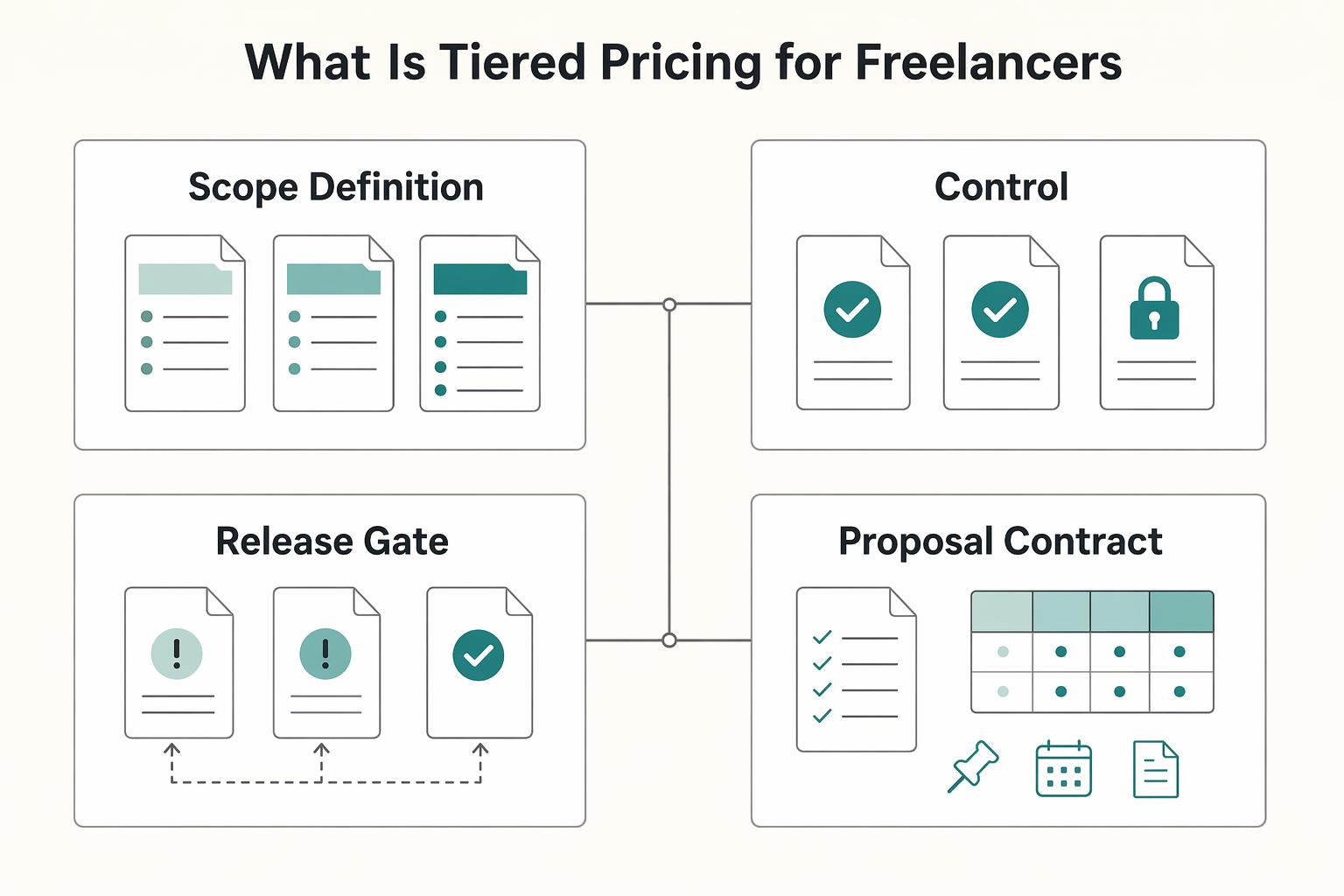
Tiered Pricing for Freelancers That Protects Cashflow
If you use freelance tiers well, you are not giving clients random price points. You are giving them policy bundles that help control scope, payment risk, and decision speed. That matters because a common margin leak is undercharging, over-delivering, and then trying to negotiate boundaries after the work has already moved.
Read more →
How to Set Up a Retainer Agreement with a Client
Set up retainer documents so they behave like a system: clear scope, clear boundaries, and operational steps that keep recurring revenue clean month after month. You're the CEO of a business-of-one, and the paperwork is part of the system, not an afterthought. Once you get the verbal yes, or the "send the paperwork," the next move decides whether this retainer becomes stable revenue or a slow leak of free work.
Read more →
The Best Ways to Ask for a Deposit or Upfront Payment
You already know why you need to ask for a deposit. You feel it the moment you ship a draft, reserve time on your calendar, or turn down other work, then the client goes quiet on the **Deposit Invoice**.
Read more →
How to Negotiate a Higher Rate with a New Client
When you try to **negotiate higher rate new client** work, do not treat it like a confidence test. Treat it like deal design. The uncomfortable part is rarely saying your number out loud. The real damage usually shows up later, when you agree to a loose setup and your effective rate gets squeezed by avoidable rework, delays, and misalignment.
Read more →
How to Write a Follow-Up Email That Closes the Deal
**Run every freelance follow-up email like a mini sales process that turns uncertainty into one clear next step.** As the CEO of a business-of-one, your job is to turn messy inbox threads into clean decisions you can actually plan around.
Read more →
The Best Proposal Software for Freelancers and Agencies
**Pick proposal software based on your ability to produce a clear, retrievable "what was sent and what got accepted" record, not on how pretty the template looks.** As a business-of-one, your proposal process is not admin. It is a control system for scope, timing, and cash.
Read more →
How to Handle Sales Objections as a Freelancer
When you hear an objection in cold outreach, treat it as a risk signal, not an immediate "no." A simple loop can help: clarify the risk, choose one next step, write down what was agreed, and confirm timing.
Read more →
How to Build a Sales Pipeline for Your Freelance Business
Before you turn this into a detailed freelance pipeline playbook, pause for a source-quality check. The available evidence here is a [Scribd listing](https://www.scribd.com/document/958783827/The-FP-a-Handbook) for **FP&A Handbook: Financial Planning Guide**, not a verified, fully reviewed operations standard.
Read more →
Freelance Sales Qualifying That Protects Your Time and Pipeline
You do not need to become more persuasive to stop bad-fit projects from taking over your week. You need a repeatable way to decide who gets your time, who gets a proposal, and who gets a polite no. That's what freelance sales qualifying is for. It protects your calendar and pipeline value by stopping low-fit leads earlier.
Read more →
How to Calculate ROI on Your Freelance Marketing Efforts
If you want ROI to help you decide what to keep, fix, or pause, stop treating it like a one-off formula. You need a repeatable habit you trust because the stakes are practical. Cash flow, calendar capacity, and client quality all sit downstream of these numbers.
Read more →
The Best CRMs with Sales Pipeline Features for Freelancers
If your follow-up lives across email, a notes app, calendar reminders, and memory, the issue is not effort. It is control. You do not need the **best crm with sales pipeline** on paper. You need a tool you will update in the moment and review regularly, because that is what keeps deals moving.
Read more →
A Freelancer's Guide to Retargeting Campaigns
**Run retargeting for freelancers like a system, not a pile of ad tweaks, so you control budget, reputation, and measurement.** You are not here for a fuzzy definition. You are here for a workflow that makes the next decision obvious, even when the data looks noisy. As the CEO of a business-of-one, your job is to turn paid acquisition into a controlled process, not a recurring surprise.
Read more →
How to Use LinkedIn Ads to Target Your Ideal Clients
You are not here for vibes; you're here for a repeatable system you can run.
Read more →
The Best Paid Advertising Channels for Freelancers (Google Ads
**Treat paid advertising as a cashflow system you can run weekly, not a one-off "channel test" you hope works.** If you are starting from zero, or dealing with inconsistent referrals, your real job is to choose and operate channels that do not break your follow-up, your measurement, or your bank balance. Judge channels by execution reliability, not hype.
Read more →
How to Set Up Your First Google Ads Campaign
Google Ads doesn't "punish beginners" so much as it punishes ambiguity. If you build a campaign by clicking through prompts without making a few foundational choices first, you feed the system messy signals. Then you spend your first week "optimizing" noise.
Read more →
How to Conduct an SEO Audit of Your Freelance Website
**Run a fundamentals-first SEO audit to prove what Google can access, understand, and rank. Then capture what you find in a way you can actually use.** If you run solo, you're the CEO of a business-of-one, and your website is one of your core operating assets. A site can look fine and still underperform. You need a workflow that forces reality. Not opinions, not tool scores, not vibes. Measurable checkpoints.
Read more →