
Quick Answer
Local SEO for freelancers works best when you run it as a clean operating system, not a tactic list. Set one defensible local positioning, align your Google Business Profile and core website pages, and build trust through real proof like reviews, case studies, and process visibility. Then execute weekly with a simple plan and change log so you improve visibility and client fit without creating messy, conflicting claims.
Local SEO for Freelancers: a clean, audit-ready operating system (not another messy checklist)#
Run local SEO for freelancers like an operator: build one defensible local entity across Google Business Profile, your website, and your proof, then tighten it over time instead of spraying tactics. As the CEO of a business-of-one, you are not collecting "marketing tasks." You are building an asset you can maintain and defend. The goal is stable visibility and trust, not constant fiddling.
At a practical level, local SEO comes down to a few levers you can actually control: Google Business Profile optimization, reviews, and showing up in Maps.
A common framing puts it plainly: "Complete Google Business Profile optimization, win more reviews, rank higher in Maps, and turn local searches into sales." That is the backbone. Localo also states that "8 out of 10" consumers search for local businesses online each week. That helps explain why this channel keeps paying rent even when you serve clients remotely.
What "audit-ready" means for a freelancer (simple governance, low regret)#
Audit-ready does not mean complicated. It means you can explain what you published, and you can back it up.
| Area | What it means | Default |
|---|---|---|
| One set of claims | What you do, who it's for, where you serve, and how clients reach you | Keep it consistent across your site and Google Business Profile |
| One owner, clean access | Who controls the Google Business Profile login, where credentials live, and how you recover access | Treat it like any other business asset |
| Proof-first execution | Only what you can back up with real work, real photos, and real client outcomes | Let proof lead, then optimize |
If account access is loose, fix that first. Treat credentials like any other business asset. (A Guide to Creating a 'Digital Will' for Your Online Assets) Everything else should follow proof: add only what you can back up with real work, real photos, and real client outcomes.
A useful mental model: one guide describes "Search in 2026" as three connected pillars, local results and the Map Pack, your website, and AI-powered experiences. Treat those as connected surfaces that must stay coherent, not separate strategies.
Three freelancer realities (and the safe default approach for each)#
| Your reality | What to optimize for | What to avoid |
|---|---|---|
| Home-based (you may not want your personal address front-and-center) | A presence that's clear without oversharing, strong proof | Over-sharing personal info, improvising rules you found on Reddit |
| Hybrid local + global clients | One local trust layer plus one global positioning layer | Conflicting promises between your website and Google Business Profile |
| Multi-city expansion | Repeatable proof and operations before you expand footprint | Copy-paste "city pages" and premature multi-location sprawl |
Example: you do web design and you can serve globally, but your best referrals come locally. Keep one tight local positioning, publish proof that matches it, then expand pages or locations only when your portfolio can carry the claim.
Bottom line: confirm gray-area rules using official Google Business Profile guidance and whatever in-product prompts you see, when available, not hearsay from r/localseo threads. Keep the system clean, and it compounds.
The Local Visibility Stack: definitions + the mental model before tactics#
Treat local visibility as a system you control, not a bag of tricks you chase.
With an audit-ready approach, one coherent business identity, clean access, and proof-first execution, you need crisp working definitions so every edit stays consistent across platforms, your site, and your reputation.
Working definitions (use these so your claims stay defensible)#
Don't argue about textbook definitions. Pick usable ones that keep you consistent, defensible, and easy to explain to yourself six months from now.
Instead of debating what terms "really" mean, define them for your workflow, then sanity-check them against whatever the current platform UI and official help docs say. Rules and labels can change.
| Term | Practical meaning for a freelancer | What you should do with it |
|---|---|---|
| Local visibility | How clearly your services, location coverage, and credibility show up when someone searches for help with local intent. | Decide what you will claim (service + area), then publish matching proof. Don't "keyword your way" out of weak positioning. |
| Business listing profile | Your managed listing on a major platform (for example, a search engine's business profile) where core details about your business appear. | Treat it like a business asset: one owner, tight permissions, and changes logged. Keep it consistent with your website and proposals. |
| Service area | The locations you actually serve, regardless of where you work from. | Make a deliberate privacy and scope choice, then only publish location language you can back up. Don't take policy advice from random threads. |
Example: you run local marketing projects, but you work from home and meet clients on Zoom or at their office. Set expectations clearly, where you serve and how work happens, then publish only location language you can back up across your site, listings, and onboarding.
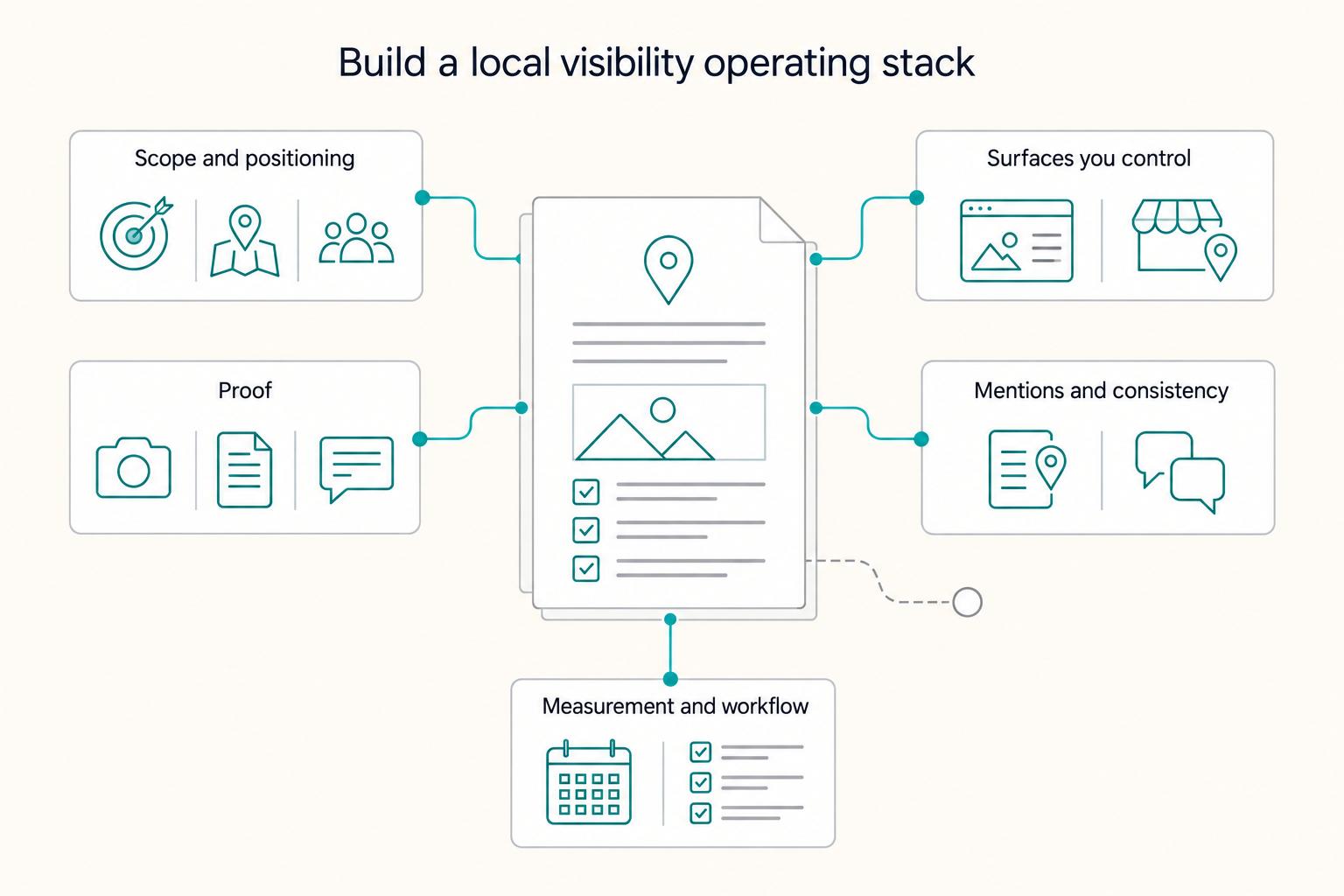
The system you're building (components, not chaos)#
Think in components you can maintain weekly without breaking your day.
- Scope and positioning: One core offer, one primary area of focus, one clear "who it's for." This prevents conflicting messages across your pages and profiles.
- Surfaces you control: Your key website pages plus your business listing details on the platforms you choose to use. Keep them saying the same thing, in plain language.
- Proof: Portfolio artifacts, photos, and reviews you earn ethically. Proof reduces sales friction and makes your marketing claims believable.
- Mentions and consistency: Directory listings and community mentions you can defend. Quality beats volume. Keep your name and contact info consistent where you choose to publish it.
- Measurement and workflow: A short weekly check that tracks inputs (proof added, reviews requested, profile updates) and outcomes (inquiries, calls, fit).
What market should you pick - and how narrow is "narrow enough"?#
Pick one primary market and one primary offer you can prove, deliver, and defend. Narrowing forces coherence. Coherence creates trust.
Write a simple scope memo (two decisions, no fluff)#
Do this as a one-paragraph memo you can paste into your notes and reuse in proposals.
- Market (primary): One geography, industry, or client type you can realistically serve. Call it your default, not your limit.
- Offer (primary): One service you want to be hired for (for example, "local marketing strategy" or "website SEO audits," not "digital marketing").
This keeps generic positioning from collapsing under scrutiny. It also lines up with how niche selection actually works.
Creative Juicer defines a niche as: "The intersection of these questions, where your experience and interests overlap - this is your niche." Start there, then pressure-test it against the market. Carol Tice also advises considering the market when choosing your niche. And given competition, choose a niche that helps you cut through the noise.
Use a constraint rule so you don't overclaim (and don't sprawl)#
Before you publish your services or write market-specific copy, validate three constraints. If you cannot confidently say "yes" to all three, narrow your market or tighten your offer.
| Constraint | Check | If not |
|---|---|---|
| Responsiveness | Can you respond and deliver in a way that matches client expectations (availability, time zones, turnaround)? | Narrow your market or tighten your offer |
| Portfolio proof | Can you show relevant work that matches the offer? | Narrow your market or tighten your offer |
| References | Can someone credibly vouch for you in that lane (past client, collaborator, employer)? | Narrow your market or tighten your offer |
If one of those breaks, tighten before you publish.
Example: you offer "SEO" broadly, but your strongest proof sits in a specific type of work for a specific type of client. Choose that as the offer, pick the market you can support consistently, and stop describing yourself as a full-stack agency.
For demand signals, stay honest. Pay attention to the questions real prospects repeat in calls, emails, and communities, then match those criteria with proof on your site, not promises.
Finally, ignore "rank fast" threads on Reddit. Sanity-check any category or service claim against reputable, well-sourced guidance before you lock it into your positioning.
If you want a broader client acquisition frame beyond local, use How to Use SEO to Attract High-Quality Freelance Clients.
Does local SEO matter if I also serve clients globally?#
It can, especially if you still want to attract clients from a specific geographic area. Local SEO is about optimizing for a set location, while global SEO is typically about reaching customers around the world.
In practice, you can separate how people evaluate you, often through local signals and trust, from how you deliver, which can be remote. Local positioning can act as a credibility layer without limiting your delivery model, as long as what you claim matches what you actually do.
Run a two-lane positioning system (one brand, two messages)#
Operate two lanes, but keep them aligned under one brand so your messaging does not fragment. If you use a Google Business Profile, keep it consistent with your real-world setup.
| Lane | What the buyer wants | What you should show | Where it lives |
|---|---|---|---|
| A: Local trust | "Are you real, nearby, responsive?" | City/region focus, local proof, in-person availability (only if true) | Homepage, local service page, GBP (if you have one) |
| B: Global delivery | "Can you ship outcomes remotely?" | Specialization, outcomes, remote process, async delivery norms | Core service page, process page, proposals |
Example: you live in Austin, and you run audits for ecommerce brands everywhere. Keep Austin as a trust anchor with clear contact and community proof. Then sell the audit as a remote, standardized process with defined inputs and outputs. Same brand, two evaluation paths.
Use local setup and proof in ways that fit a remote business#
If you do not want your home address public, Byword recommends claiming your Google Business Profile as a Service Area Business to hide your home address while still appearing in local searches.
For content, Byword also argues that generic "how-to" blogs are too competitive and that local-specific content can help establish you as a community authority.
And for trust signals, Byword claims local clients may trust Google reviews more than portfolio screenshots because reviews are harder to fake. Treat that as guidance, not a guarantee.
Don't create conflicting promises (especially in GBP)#
Make sure what you present in your Google Business Profile, if you use one, and on your site is something you can defend.
If most of your proof and delivery is remote, avoid writing as if you only do "local-only" work. If you primarily serve a region, avoid positioning yourself like a neighborhood-only provider in one place and "worldwide" in another. The goal is simple: reduce buyer confusion.
Governance tip at the operator level: keep a one-page claims ledger. Track what you do, who it's for, where you serve by default, what proof you have, and where each claim appears: site, GBP, and proposals. It stops drift and keeps your acquisition engine audit-ready.
Should you put your home address on Google Business Profile - or run a Service Area Business?#
If customers do not visit you at your business address, set your Google Business Profile up as a service-area business and remove your address from your profile.
If you want local trust without sacrificing privacy, this is the clean default. Google's own guidance stays simple: if you don't serve customers at your business address, remove your address from your Business Profile and use a service area instead.
A service-area business is a business that visits or delivers to customers directly but doesn't serve customers at their business address. Your service area shows customers where you can provide your products and services, and Google notes that setting it helps people find your profile.
The decision tree (use this, then commit)#
Make the call once, then keep your story consistent across Google Search, your website, and proposals.
| Decision point | If "Yes" | If "No" | Operator move |
|---|---|---|---|
| Do customers visit your location during business hours? | Consider showing an address (only if true in practice). | Lean service-area business. | Follow Google's direction to remove the address when you do not serve customers there. |
| Can you complete Google's required setup and verification steps while keeping your home address private to the public? | Proceed, but keep privacy as a first-class requirement. | Choose a service-area business setup and keep your address off the profile. | Use Google's official flows and prompts inside GBP. |
| Do you feel tempted to create multiple profiles for multiple areas? | Stop. | Stop. | Google says service-area businesses can only have one profile for the whole area they serve. Pick one and make it clean. |
Example: you run local marketing services from home. Clients never come over. Set a service area for the metro you actually support, remove your address, then let your website reinforce the same geography with clear service-area language.
Don't outsource this decision to "someone said on r/localseo." Use the official Google Business Profile help docs and whatever your dashboard asks you to do during setup.
How many local pages should you create - and what should be on them (without city-page spam)?#
Create a small set of high-conviction local landing pages you can keep accurate, prove, and defend, instead of mass-producing city variants.
With your business info aligned across your site and listings, your website has a simple job: reinforce the same geography and offer in a way Google Search and real buyers trust.
A local landing page is a page designed to convert searchers from a specific location with a specific service intent. It does not work like a template where you swap city names and call it strategy.
BrightLocal puts it bluntly: "On-page SEO is key to the success of your local search strategy." That "key" part comes from clarity and consistency, not volume.
Start lean: a small page set you can keep audit-ready#
Use a simple rule: if you cannot keep it updated and accurate, and prove it, do not publish it.
| Page | Purpose | What it must answer fast | Proof to include |
|---|---|---|---|
| Homepage | Brand + primary offer + primary city/region trust | "What do you do, who is it for, where do you serve?" | One credible testimonial (ideally local), photos that look like you |
| Core service page | Service intent + local marketing fit | "What's included, how it works, what it costs (range or starting point), how to start" | A case study or project snapshot tied to your service area |
| Proof page (case studies or industries) | Reduce risk for the buyer | "Have you done this before, and what happened?" | Verifiable outcomes, screenshots, client-approved context |
Example: you sell a productized local SEO setup for freelancers. Publish one "Local SEO Setup" page anchored to your metro, then add one case study that matches that same service-area language. Skip "Neighborhood A" and "Neighborhood B" clones until you earn real proof there.
On-page signals that matter (and the traps to avoid)#
Lock in local signals you can keep consistent:
- NAP and contact consistency (as applicable): keep what you show on your site consistent with your listings and profiles. BrightLocal explicitly calls out NAP data as an on-page local SEO topic.
- Service area language: write what you actually serve, and avoid "serving everywhere" claims you cannot operationally support.
- Project proof: add a local testimonial you can verify, a local collaboration, or a locally relevant outcome. Do not invent location credibility.
Avoid over-optimization traps by keeping your pages honest and proof-backed:
- Do not fake office locations.
- Do not copy boilerplate from tools or generic pages that read like filler.
- Do not spin up dozens of thin city pages "to cover the metro." Operators ship fewer pages with tighter conversion and real proof.
To structure each page, mine People Also Ask for the sections buyers scan: pricing, timeline, what's included, and what you need from them. Then answer with your real constraints and process.
If you want the broader system beyond local pages, use How to Use SEO to Attract High-Quality Freelance Clients.
What proof signals move the needle fastest for freelancers (and how to collect them ethically)?#
Build proof in layers (identity, outcomes, then social validation) so Google and humans both see a real operator with real results.
With lean, defensible pages in place, proof is what makes your site and your Google Business Profile believable. For local SEO, trust can be the difference between a click and a call.
A simple "trust and proof stack" (in the order you should build it)#
Treat this like a system. Start with what you control today, then compound.
| Layer | What it proves | Fastest assets to ship | Where it shows up |
|---|---|---|---|
| 1) Identity proof | You exist, you operate, you match your listings | Consistent Google Business Profile details, real photos of you, your workspace, your process | Google Business Profile, branded search, on-page trust |
| 2) Outcome proof | Your work creates measurable change | Portfolio artifacts, before/after screenshots, "what changed" bullets, approved client quote | Service page, case studies, snippets people scan |
| 3) Social proof | Other people will vouch for you publicly | Google Reviews, credible third-party mentions (communities, partners, directories) | Map pack context, conversion trust |
In practice, one local SEO write-up notes that local visibility grows when your GBP, location pages, and reviews align with nearby intent. So don't collect proof randomly. Align it.
Keep your categories and services consistent, keep your NAP data accurate (name, address, phone), and keep your profile fresh with photos, Q&A, and service updates.
Build a review engine without getting sloppy#
You want consistency, not heroics.
| Practice | What to do | Notes |
|---|---|---|
| Ask every satisfied client | Use one script, one link, and send it at a predictable moment | Right after a win, or right after sign-off |
| Avoid incentives or review filtering | Confirm your approach inside Google Reviews policies and any local rules that apply before you systematize it | Rules vary by region and platform |
| Log your asks | Track date, client, project, link used, and whether they approved a public quote | Keeps your process clean |
Keep the cadence boring on purpose: ask after a win or sign-off, use the same link every time, and log what you sent.
A simple script you can reuse: "If you felt good about the result and the process, would you leave a Google review using this link? Two sentences helps a lot. If you prefer, I can also pull a short quote for approval instead."
Localize proof without faking it. If you serve clients globally, show local process proof instead of pretending every client lives nearby. Use photos from real workshops, coworking days, or community talks. Skip stock imagery.
Finally, run a portfolio template per project: problem → approach → outcome → client quote → location context (only if approved). That structure turns your proof into scannable copy real decision-makers trust.
Local authority without spam: citations, partnerships, and community mentions that won't backfire#
Local link building is about signaling local relevance to Google, so you can reach more nearby customers. Google is trying to show results that match intent and location, so the local part matters.
Konker puts it plainly: "It lets Google know that your business matters in local searches, helping you reach more nearby customers." The goal is not to manufacture buzz. It's to make your real-world presence easier for search engines to understand.
One reality check: ranking well is ongoing work, and it starts with the basics. As Jennifer Bourn notes, getting a page ranked number one "isn't exactly easy" and takes a website "built with search engines in mind" with "a solid technical foundation and a clean design."
If you're sanity-checking what to pursue, keep it simple: prioritize mentions and links that reflect real relationships and real participation in your market, and skip anything you wouldn't be comfortable explaining to an actual customer.
If you want a structured way to find the right people to learn from as you build, use: How to Find a Mentor as a Freelancer.
Your realistic 90-day local SEO plan (foundation → momentum → scaling) + measurement governance#
Run local SEO for freelancers like an operator: lock the foundation first, then build momentum with repeatable work, and only then scale what already converts.
With the basics handled cleanly, you need a 90-day rhythm that prevents random acts of marketing. The win condition is a defensible local presence, your site plus your business listings where relevant, consistent proof that you deliver, and measurement that maps back to client acquisition.
90-day sequencing template (foundation → momentum → scaling)#
Use this as a template, not a law. Adjust the pace to your workload and your category's competitiveness.
| Phase (by month) | Primary objective | Focus tasks (safe defaults) | "Done" definition |
|---|---|---|---|
| Month 1: Foundation you can defend | Make your identity and offer unambiguous | Establish baseline KPIs that actually matter (not vanity metrics). Do a quick technical audit, tighten core on-page fundamentals, and make sure your key pages match real search intent (keyword research and intent mapping). | You can explain what you do, where you do it, and how to contact you in under 15 seconds (on-site and in your key local surfaces). |
| Month 2: Momentum that compounds | Ship improvements that stack | Implement prioritized fixes from Month 1. Keep building trust signals (proof, clarity, and consistency) and start deliberate off-page work appropriate for your market. | Your site answers objections clearly, and your tracking/logs show what you changed and what moved. |
| Month 3: Scale without chaos | Improve conversion, then expand cautiously | Iterate based on results: refine messaging, improve conversion paths, address page speed/Core Web Vitals where it's a bottleneck, and expand only what you can maintain (new pages, new topics, new areas) without diluting quality. | You convert more of the attention you already earned, and you have a repeatable process you can run again. |
Example: you serve a metro area. In month two, you turn a recent win into a tight case study. Then you reuse the same language on your website and in outreach to relevant partners. One asset, multiple surfaces, consistent claims.
Measurement governance (no fake precision)#
You do not need a dashboard empire. You need a weekly ritual and a change log.
- Lead outcomes: track inquiries and booked calls, plus simple quality notes (fit, deal size, close/no-close).
- Visibility and intent coverage: monitor a small set of priority queries and the pages meant to win them, and note directional movement week over week.
- Site performance signals: keep an eye on the basics that affect real users (indexing issues, major technical regressions, and meaningful speed/UX bottlenecks).
Control variance with process: set KPIs that matter, change one thing at a time, document edits to key pages and local surfaces, and keep rollback notes when you touch anything fragile.
For broader SEO beyond local, pair this with How to Use SEO to Attract High-Quality Freelance Clients.
Conclusion: run local SEO like an operator - tight scope, clean proof, weekly cadence#
Win at local SEO by running a small, defensible system that compounds trust, not by stacking tactics. The work is operational: publish proof you can stand behind, prioritize clarity, and keep a cadence you can sustain alongside client delivery.
The operator model (what you actually manage)#
Local SEO is about improving visibility in local results and Maps. The operator move is to prioritize transparency and clarity over cleverness across the places people find you.
One credible framework puts it plainly: "Transparency fosters trust, both with search engines and your target audience." Treat that like a standard.
Use this decision lens when you feel the urge to "optimize":
| Operator move (compounding) | Tactic chasing (fragile) |
|---|---|
| Keep one clear offer and one clear service area you can fulfill | Claim every service in every nearby city |
| Publish proof you can verify (real work, real process, real outcomes) | Publish generic pages that you cannot defend |
| Improve visibility with consistent off-page signals (including citations) | Blast low-quality listings and hope it sticks |
| Run a weekly check-in and adjust one change at a time | Do one big audit, then go dark for a month |
Here's the cadence principle to keep on your calendar: live or die by repeatable weekly actions, not one-off audits. Also remember: more data does not automatically create better decisions. Track less, act more.
Do this this week (safe defaults)#
Pick actions that reduce uncertainty fast:
- Make your offer plain. Describe who you help and what you deliver in language you can reuse across your site and public profiles.
- Make contact frictionless. A simple reminder matters here: "Display your contact details prominently on your website." Then mirror that same contact path anywhere you maintain a public profile.
- Set up a review workflow you can run consistently (request, link, follow-up, log). Do not "campaign." Build a process.
- Create one weekly proof shipment: a case-study writeup, a before/after, or photos that show how you actually work.
Example: you serve a metro area remotely. You stop trying to look like a multi-location agency, tighten your service definition, publish proof-heavy content you can defend, and spend Fridays turning one finished project into one public artifact. That is how authority accumulates.
If you want the broader strategy beyond local intent, use How to Use SEO to Attract High-Quality Freelance Clients to connect your local system to your full client acquisition pipeline.
Frequently Asked Questions
Does local SEO matter if I also serve clients globally?
Yes. Some industry sources suggest a large share of Google searches have local intent (often cited as 46%), so local visibility can still build trust even if you deliver work remotely. Treat local SEO as one trust channel, then support it with clear global delivery language on your service and process pages. Keep your messaging consistent across your website and any business listings you manage.
Should a freelancer use a home address on Google Business Profile?
Default to privacy. Many freelancers choose not to publicly display a home address, especially if clients do not visit in person. Confirm the current options and requirements inside your Google Business Profile dashboard and help resources, because requirements can vary by category and location.
What should I do first in local SEO as a solo freelancer?
Lock your claims first: what you do, who it’s for, and where you actually serve. Then make sure your key online profiles and listings reflect that accurately and completely. Finally, align your homepage and one core service page to the same language so search engines and buyers see one coherent entity.
How many local pages/service pages should I create to start?
Start with the minimum set you can keep accurate and proof-backed. If you cannot keep a page fresh with real proof (projects, testimonials, process), do not publish it yet. Avoid city-page spam because it creates dozens of near-duplicate claims you cannot defend.
What proof signals matter most for local trust as a freelancer?
Prioritize proof that reduces perceived risk quickly: real photos, specific case studies, and credible reviews from real clients. Make your proof match your delivery model. If you serve clients remotely, emphasize process proof and outcomes instead of pretending every client sits in your city.
What is a realistic local SEO plan for one person?
Run it in phases: foundation first, then momentum, then scaling. Foundation means your listings and core pages are consistent. Momentum means you keep publishing proof and requesting reviews consistently. Scaling means you expand only after you see what converts and you can back the expansion with proof.
How do I measure local SEO progress without getting lost in vanity metrics?
Track actions that correlate with revenue: qualified inquiries, booked calls, and closed deals, not just impressions. Review your visibility for a small set of relevant queries periodically for directional movement, not constant fluctuations. Keep a change log so you can connect improvements (or drops) to specific edits.
Try a related tool
Researched and edited by the Gruv editorial team. Gruv builds cross-border billing, payouts, and finance-operations software for global businesses.
Sources
Includes 7 external sources outside the trusted-domain allowlist.
- byword.ai/resources/local-business-seo/freelancingexternal
- localo.com/blog/local-seoexternal
- mullerconsulting.ca/blog/small-business-seo-2026-without-in-hous...external
- mullerconsulting.ca/blog/small-business-seo-2026-without-in-hous...external
- searchengineland.com/guide/site-redesign-seo-checklistexternal
- seoplus.com/seo/seo-local-freelancersexternal
- seoplus.com/seo/seo-local-freelancersexternal
Educational content only. Not legal, tax, or financial advice.
Related Posts

How to Use SEO to Attract High-Quality Freelance Clients
**Build your *seo for freelancers* around qualified leads, not raw traffic: tighten who you target, what you prove, and how you gate inquiries.** You're the CEO of a business-of-one. Your marketing job isn't "get more attention." It's "get the right work, predictably, without turning your calendar into a sorting machine."

A Guide to Creating a 'Digital Will' for Your Online Assets
**Treat your digital assets and online accounts like a business continuity control, because losing access can stall operations when timing matters.** Digital assets can include social accounts, messages, and cloud-stored documents, and even basic questions like "What will happen to your Facebook account when you die?" are not always operationally clear in the moment.
How to Find a Mentor as a Freelancer
If revenue is uneven, delivery feels messy, or your pipeline has gone soft, do not start by chasing the most visible advisor you can find. Start by naming the one business constraint that is costing you money or time right now, then choose support by role.