
Quick Answer
To set up a retainer agreement with a client, write down the core rules, scope, caps and workflow. A separate SOW can keep changing scope distinct from stable contract terms; a single agreement can work too. Define your service unit, included vs excluded work, payment terms, overage approvals, unused-time policy, and termination steps in writing. Then operationalize it with e-signature, consistent invoicing, and a monthly intake-and-delivery rhythm.
Agree on the service and capacity before drafting the retainer#
Set up retainer documents so they behave like a system: clear scope, clear boundaries, and operational steps that keep recurring revenue clean month after month. You're the CEO of a business-of-one, and the paperwork is part of the system, not an afterthought. Once you get the verbal yes, or the "send the paperwork," the next move decides whether this retainer becomes stable revenue or a slow leak of free work.
Retainers fail when you treat them like a vibe. The client hears "ongoing support," you hear "predictable capacity," and nobody writes down what happens when requests spike, priorities change, or payment gets delayed.
The fix is simple: pair a Retainer Services Agreement (the rules) with a tight Statement of Work (SOW) (the map). Think of the SOW as the project roadmap: who does what, when, and for how much. That is what keeps miscommunication and scope creep down.
Step-by-step: build the retainer system in one pass#
Step 1: Choose the unit you sell. Pick one primary unit for the retainer agreement: hours, deliverables, or access. This choice drives everything downstream, including boundaries, request intake, and how you talk about capacity.
| Step | Main decision | What to write or do |
|---|---|---|
| 1 | Choose the unit you sell | Pick one primary unit: hours, deliverables, or access |
| 2 | Draft the SOW first | Write Included and Excluded in hard nouns; define request intake and who approves changes |
| 3 | Draft the Retainer Services Agreement | Add Payment Terms, Termination, and what document wins if something conflicts |
| 4 | Define reality clauses | Pre-decide overages, pauses, non-payment, and handoff |
| 5 | Operationalize signing and storage | Use e-signature and store the executed agreement and SOW in one place with a simple naming convention |
Step 2: Draft the SOW first (yes, first). Write "Included" and "Excluded" in hard nouns. Define how requests enter your queue and who approves changes. Use the SOW to cap capacity, not your goodwill.
Step 3: Draft the Retainer Services Agreement as the rulebook. Add Payment Terms, Termination, and what document wins if something conflicts (agreement vs SOW vs email). Do not rely on "we'll figure it out" language.
Step 4: Define "reality clauses" before you need them. Pre-decide how you handle overages, pauses, non-payment, and handoff. You do not need aggressive language. You need unambiguous language.
Step 5: Operationalize signing and storage. Use e-signature for speed, then store the executed agreement and SOW in one place with a simple naming convention.
Template vs system (what actually protects you)#
| Approach | What you get | How it fails | Safe default |
|---|---|---|---|
| "Retainer template" | Generic legal text | Unclear scope and undefined change mechanics | Use only as a shell |
| Retainer system | Core terms + scope + workflow, in one document or an agreement and SOW | Needs consistent approvals and version tracking | Use a document structure that fits how often scope changes |
Hypothetical scenario: a client starts slipping "quick asks" into chat, then calls them "included." If your SOW defines intake and exclusions, you can point to process, log a change, and protect the relationship without making it personal.
Prepare your offer before discussing price#
Prepare your evidence, offer shape, and decision boundaries before you talk price. Once you commit to a system, not a flimsy template, you need inputs that make the SOW easy to write and easy to enforce.
A retainer agreement reserves ongoing services or access in exchange for an agreed fee. Set the scope and billing schedule around the work you actually sell. An advance monthly payment is one option; it does not make every deliverable a work made for hire.
You also need to choose whether you sell pay for work (ongoing work within a defined scope) or pay for access (access to your expertise). Then reflect that choice in the Retainer Services Agreement and SOW.
Step-by-step: prep your inputs (so the SOW writes itself)#
Step 1: Audit recent work for patterns, not stories. Pull a slice of your most recent work with this client, or similar clients, and categorize it. You want receipts you can turn into scope language and caps.
| What to capture | Example of what it reveals | How you'll use it in the SOW |
|---|---|---|
| Task types | "Reviews" vs "new builds" vs "strategy calls" | Populate Included and Excluded lists |
| Request sources | Email, meetings, chat drive-bys | Define the intake channel and what counts as a request |
| Turnaround expectations | Same-day pings vs scheduled cycles | Set realistic response and delivery windows |
| Outcomes | Risk reduced, time saved, decisions unblocked | Justify why a retainer fits the pricing model |
Step 2: Choose your retainer model and the unit you will operationalize. Decide between pay for work or pay for access. Then pick a unit that matches reality, for example time blocks, deliverable bundles, or office hours, and write one sentence that defines the cap.
If you already run repeatable bundles, tighten this further using How to Create a Productized Service for Your Freelance Business.
Step 3: Draft your "unlimited" prevention line. Write a boundary sentence you can reuse: "This retainer covers (unit and cap). Anything outside that scope runs through a written change approval." You will paste that into the SOW and reference it in negotiation.
Step 4: Set your scope and approval boundaries#
Write down your non-negotiables in plain language. Cover what's in, what's out, and how you'll handle changes when reality does not match the original scope.
Hypothetical scenario: a client asks for "just one more" item right before month-end. If you already defined your cap and change approval rule, you can respond procedurally, not personally.
Step 5: Make your agreement easy to reference. Decide how you'll get the Retainer Services Agreement and SOW signed, and where you'll keep the current versions so you can pull them up quickly during a call.
Which retainer model should you choose (hours vs deliverables vs access)?#
Choose the model you can operationalize and enforce in your Statement of Work (SOW). With your evidence and boundaries ready, pick a structure that keeps capacity predictable and prevents "unlimited" by accident.
Step 1: Pick the model using the safe-default framework#
At base, a consulting retainer is a monthly fee for ongoing work or access to your expertise. In practice, most retainers fall into two families: Pay for Work (hours or deliverables) and Pay for Access (advisory availability). Use this decision table:
| If the work looks like... | Choose this retainer model | What you promise (capacity) | Where you lock it |
|---|---|---|---|
| High variability (requests change weekly) | Hours retainer | "Up to X hours/month" plus when you work | SOW (cap + availability window) |
| Repeatable, same-shaped outputs | Deliverable bundle retainer | "Up to Y deliverables/month" with a tight definition of "deliverable" | SOW (deliverable spec + acceptance) |
| Advisory or leadership support | Access retainer | "Up to X touchpoints" or agreed availability (and any response-time expectations you choose to set) | Your agreement + SOW |
A retainer usually reserves "up to" a certain amount of time, deliverables, or access to you. Put that "up to" in writing, not just in your head.
Define capacity, overages and renewal#
1) Define the capacity promise. Write one sentence you can paste into the SOW: "Client reserves up to (X hours or Y deliverables) per month, usable during (availability window)." Verification point: you can point to a single line and answer, "Are we at capacity yet?"
2) Pre-empt the classic failure mode. Make it explicit that the retainer has a cap, and decide how you'll handle work beyond it. For example: "This retainer covers up to (cap). Requests outside scope or above the cap require written approval before work begins." Hypothetical scenario: the client slips in "one quick extra" on a Friday. You route it through your approval process instead of eating it.
3) Choose renewal posture that matches procurement. Retainers are often structured as longer-term contracts with a fixed monthly fee, for example quarterly to annual commitments. Pick a term that matches how the client actually buys, then spell out termination and notice so you can plan capacity.
What are the non-negotiable clauses when you set up a retainer agreement (and what each one protects)?#
A retainer agreement sets ongoing service and payment expectations. Use it to define scope, fee, term and billing cadence so the client knows what capacity the fee reserves.
Before you start (so you do not negotiate blind)#
A retainer agreement functions as a longer-term work relationship, with stable payments and often payment in advance for professional work to be determined as you go. That structure only holds if the paperwork manages expectations.
Use the agreement to manage expectations, explain terms, and avoid misunderstandings before they turn into scope fights or payment fights.
Clause-by-clause checklist (what each term protects)#
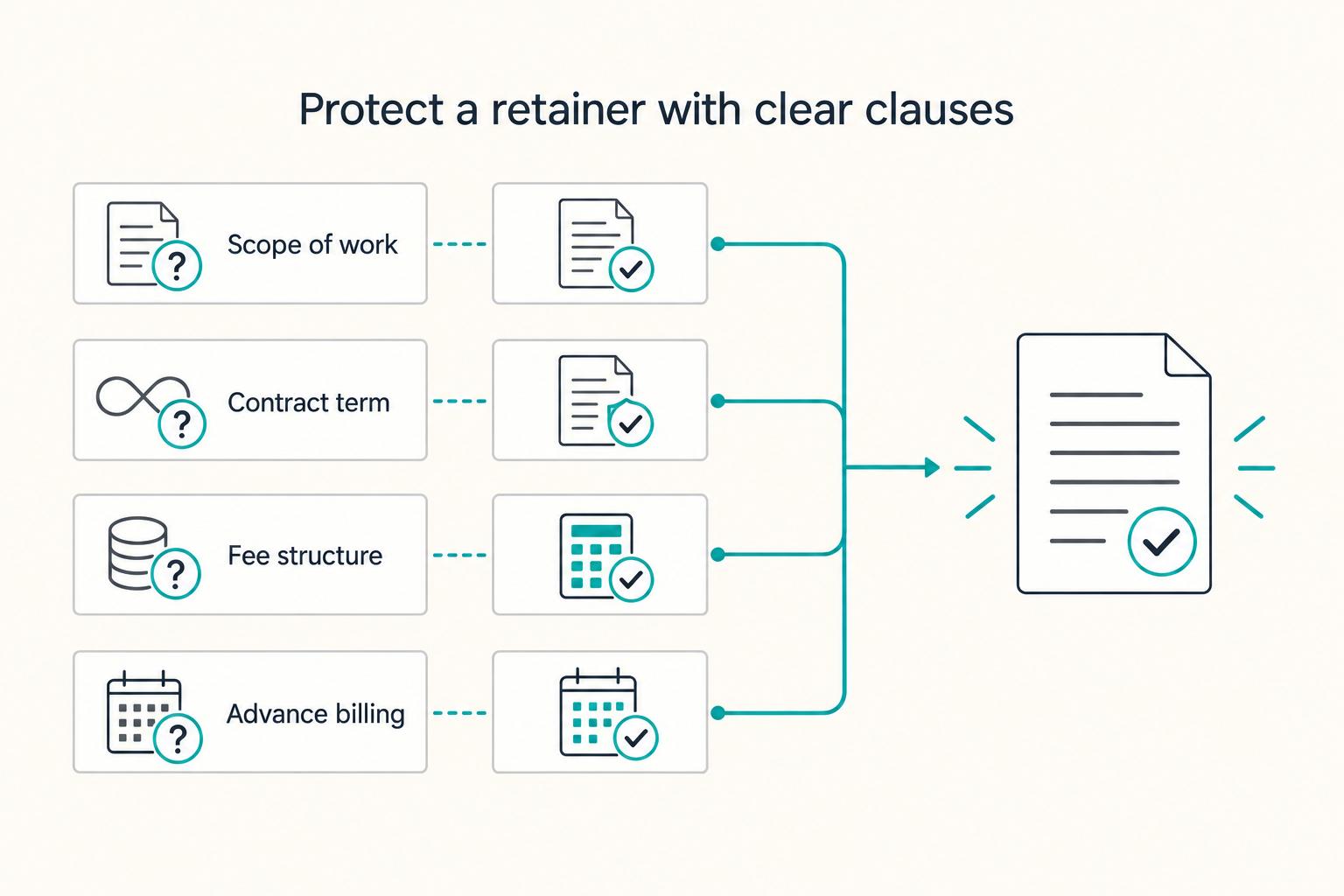
Step 1: Define scope (what the retainer covers). A retainer agreement can set forth the scope of work. This protects you from "we assumed that was included" misunderstandings and keeps the relationship workable over time.
Step 2: Set the contract length (how long the relationship runs). A retainer agreement can set the length of the contract. In practice, some retainer relationships run anywhere from six months to several years, so writing the term down protects both sides from fuzzy expectations about how long support lasts.
Step 3: Spell out the fee structure (what you're paid for). A retainer agreement can set the fee structure. This protects you from fee ambiguity and protects the client from surprise pricing.
Step 4: Make advance billing and cadence explicit (when money changes hands). One common structure is monthly or quarterly payments, with the provider billing in advance for services. This protects cash flow and reduces confusion about whether you are "on retainer" before payment is made.
| Term to cover | Protects you from | Your "safe default" decision rule |
|---|---|---|
| Scope of work | Misaligned expectations about what's included | Write down what's in-scope (and what isn't) |
| Contract length | Open-ended commitments | State the term clearly (and whether it continues) |
| Fee structure | Fee ambiguity | Define how fees are calculated and what they cover |
| Advance billing + cadence | Confusion about when payment is due | State whether billing is in advance, and whether it's monthly or quarterly |
How do you define scope caps, unused time, and overages so clients can't overrun the retainer?#
Define the cap, the queue, and the "what happens next" rules in writing. With the core clauses in place, you now translate them into boundaries a client can follow without guessing.
Step by step: build scope boundaries that hold up in real life#
Step 1: Write "Included" and "Excluded" in the Statement of Work (SOW) using hard nouns. Avoid "support," "help," or "as needed." Use concrete tasks and outputs.
Example pattern: "Included: landing page copy updates, ad headline variations, monthly performance summary." "Excluded: net new brand strategy, new website IA, paid media buying."
Step 2: Set the monthly cap and the delivery expectations inside the Retainer Agreement. Pick one unit, hours, deliverables, or access, and state the cap clearly. Aim for the same level of clarity on reserved capacity, turnaround expectations, any limited rollover, and an explicit overage rate. You want that level of detail even if your numbers differ.
Step 3: Choose one intake channel and make it the only source of truth. Put it in the SOW as an operational rule, not a preference: requests arrive via email or a ticketing tool, not Slack drive-bys. If a request would change scope or exceed the cap, pause and confirm the next step before you proceed.
Step 4: Pick an unused time policy and write it into your terms. Do not leave rollover to "we'll be reasonable."
| Policy | What you tell the client | What it protects |
|---|---|---|
| Use it or lose it | "Unused time does not carry forward." | Clean capacity planning and fewer end-of-month rush requests |
| Limited rollover | "A small, specific amount rolls into the next period, then expires." (Example: "1 hour rollover") | Flexibility without turning your retainer into a growing debt |
Step 5: Define overages as a priced option, not an accident. One common pattern is work billed beyond reserved hours at a stated overage rate, for example "$60/h overage." Your default: state the overage rate, and spell out how you'll handle over-cap work, for example whether you'll bill it on the next invoice and how you'll get the client's go-ahead.
Step 6: Put revision boundaries where retainers bleed out (in the SOW). Define revision rounds, the client review window, and what you do when feedback arrives late. Hypothetical: if a client disappears for approval, you stop holding the queue indefinitely and reschedule based on availability.
Copy and paste negotiation scripts (verbatim)#
- Scope cap script: "Our retainer covers the Included items in the SOW up to the monthly cap. If a request falls outside the SOW, I can quote it separately or we can agree on an add-on."
- Overage approval script: "We are at the cap for this period. If you want me to continue, reply to confirm and I'll proceed at the overage rate in the terms."
- Rollover policy script: "To keep planning clean, unused time follows the rollover rule in the SOW. Anything beyond that expires, and we reset at the start of the next period."
How to implement the retainer operationally (invoice → get paid → reconcile → deliver) without chaos#
Run your retainer like a closed-loop system: clear scope, clean billing, and a repeatable delivery rhythm. If your contract is the policy, operations are enforcement.
Before you start: set your record-keeping rule#
Decide how you'll consistently store, and link, executed documents, invoices, payment confirmations, and your Change Order log. You want accuracy, auditability, and predictable accounting flows.
Build for that from day one, especially if you deal with cross-border payments later.
Step-by-step: the operational runbook#
Step 1: Send the offer as a package, not a thread. Deliver the Retainer Services Agreement and Statement of Work (SOW) together, then route them through a signature process that leaves a clean audit trail. Practical check: clarify who will handle approvals on their side and where change requests should go.
| Stage | Action | Proof or output |
|---|---|---|
| Offer | Send the Retainer Services Agreement and Statement of Work (SOW) together through a signature process | Executed documents and a clean audit trail |
| Billing | Invoice on a consistent schedule and make the invoice mirror the SOW | Invoice with the period covered, the cap, and the overage rate |
| Payment tracking | Keep payment confirmations, remittance references, and invoice status changes tied to the invoice record | Traceable payment record linked to the invoice |
| Delivery kickoff | Send a kickoff message with the cap, the current priority list, and the request intake channel | Shared monthly priorities and intake path |
Step 2: Set billing to eliminate chasing and ambiguity. Invoice on a consistent schedule and make the invoice mirror the SOW so procurement has fewer reasons to kick it back. A sloppy invoice does not just delay payment; it can trigger a procurement-level red flag.
Practical check: include the period covered, the cap (hours or deliverables), and the overage rate. Match the language to the SOW.
Step 3: Make payments traceable (especially cross-border). Keep payment confirmations, remittance references, and invoice status changes tied to the invoice record. Use one place as your ledger-style hub so you can reconcile later without hunting across email threads.
| Artifact | What it proves | Where to store it |
|---|---|---|
| Executed Agreement + SOW | Scope and rules | Client folder |
| Invoice + invoice number | Amount and period | Billing system |
| Payment confirmation | Payer-reported transfer details; receipt must be verified against the receiving account or provider record | Linked to the invoice record |
| Change Order approvals | Overage consent | Change Order log |
Step 4: Operationalize delivery with a monthly kickoff. Send a kickoff message that restates the cap, the current priority list, and the request intake channel. Identify a client point of contact for day-to-day coordination and approvals when needed.
Hypothetical: a stakeholder drops "one quick request" in a group chat. You respond with the intake link, confirm priority, and flag that a Change Order may be needed if the request pushes you over the cap.
What changes in a cross-border retainer (and what is jurisdiction-dependent)?#
Cross-border work does not break the retainer model. It punishes vague assumptions, so tighten the parts that tend to drift and flag what you need to verify locally. Cross-border retainers raise the cost of ambiguity.
Before you start: label what you know vs what you must verify#
Split decisions into two buckets: what you can control in the freelance contract, and what local law controls no matter what you write. Use this rule: write the clearest workable default, then ask local counsel to confirm enforceability where the stakes justify it.
Step-by-step cross-border adjustments (safe defaults)#
Step 1: Decide how disputes will be handled (without pretending a clause fixes everything). Many retainers spell out how disputes are handled and what law/process the parties intend to use, but enforceability and practical impact can be jurisdiction-dependent. Write a clear default you can live with, and get it checked when the risk is real. Verification point: both parties can point to one paragraph that answers, "How do we handle disputes if something goes sideways?"
| Area | What to make explicit | Caution |
|---|---|---|
| Disputes | How disputes are handled and what law/process the parties intend to use | Enforceability and practical impact can be jurisdiction-dependent |
| Data handling | Whether you need separate data-processing terms and what security expectations go in the Confidentiality Clause or an NDA | Local rules can apply if you touch personal data |
| IP | Who owns what, when, and any assignment or licensing steps | Work for Hire rules and outcomes can vary by jurisdiction |
| Payment traceability | What was billed, what was paid, when it landed, and what it was for | Make it an operational habit, not a compliance claim |
Step 2: Make data handling explicit, because "confidential" means different things to different teams. If you touch personal data, do not guess. Consider whether you need separate data-processing terms, and document security expectations in the Confidentiality Clause or an NDA, depending on what you are actually doing and what local rules apply. Practical check: write down which tools store or process client data (Drive, Notion, ticketing, email) so you can represent handling truthfully in writing.
Keep one distinction clear: confidentiality is not the same thing as privilege, and the roots and exceptions are different. That matters if you serve law firms or in-house legal teams, because they may ask what stays confidential versus what qualifies for legal privilege.
Step 3: Define ownership and permission to use the work. A retainer label does not establish copyright ownership. In the United States, work made for hire applies to employee work within the employment scope or qualifying commissioned categories with the required signed agreement. For other work, describe the assignment or license, pre-existing materials and when any agreed transfer takes effect. Check that structure against the applicable law.
Step 4: Build payment traceability as an operational habit (not a compliance claim). Keep your invoices and payment records consistent and easy to reconcile: what was billed, what was paid, when it landed, and what it was for. Keep status and transaction records in a format you can export and reconcile later.
Hypothetical: a client pays from a parent company in another country. You record who paid, save any remittance message or reference you received, and close the loop without a week of back-and-forth.
The failure modes and the recovery steps for each one#
Treat retainer failures like operational incidents: keep something useful alive, explain what's happening, and keep the right decision-maker reachable. The time to decide your moves is before you are annoyed, not after.
Step-by-step recoveries for the common breakdowns#
Step 1: Stop "unlimited retainer" behavior at the first boundary breach. Restate what sits inside scope versus outside, using the language you already agreed to, for example your Retainer Agreement and SOW. If the client wants extra work, route it through whatever written approval or change process you've agreed on, so the next step is unambiguous. Verification point: one written thread clearly captures (a) what's included, (b) what's not, and (c) the decision being requested.
Step 2: Install an approval checkpoint the moment you notice drift. When requests start stacking up, make the next step explicit: "Here's what's queued, here's what it means for scope, timing, or cost, and here's the approval I need to proceed." If overages already happened, you can still summarize what occurred and ask the authorized contact to confirm how they want to handle it going forward (rules and enforceability can vary by agreement and jurisdiction).
Hypothetical: a client starts slipping "quick tweaks" into Slack. You respond with a plain-language checkpoint: what you logged, what it impacts, and the yes or no decision you need.
Step 3: Break the slow-pay normalization loop immediately. Follow the payment terms you agreed to, and make your continuation conditions explicit in plain language. If your contract includes remedies or a defined notice process, use that process rather than improvising in the moment. Verification point: you tie service continuation to a clear, specific action, not promises.
Step 4: Offboard like an operator, not like an ex. Run a clean closeout checklist: confirm what you delivered, what remains, what access changes happen, and what confidentiality expectations still apply. If your agreement conditions deliverable release or rights transfer on payment, follow that structure carefully and communicate it plainly. Verification point: you can show what you delivered (and when), what you withheld (if anything), and the agreed basis for it.
Step 5: Keep legal threats in the agreed lane. If your agreement specifies a dispute process, follow it and reference the relevant provisions when you communicate. Keep language plain, especially when details are uncertain. Plain communication matters more when the situation is already tense.
| Failure mode | Your move | The line you hold |
|---|---|---|
| "Unlimited" expectations | Re-clarify scope + route extras through your agreed approval process | "Happy to do it. Let's confirm it's outside the current scope and get approval." |
| Unapproved overages | Plain-language recap + forward-looking checkpoint before more work proceeds | "Before we continue, I need a clear yes on how you want to handle these." |
| Slow-pay | Follow your agreed payment terms and notice process; state continuation conditions plainly | "We can continue once the agreed payment step is completed." |
| Messy breakup | Closeout checklist + access/confidentiality hygiene | "We close cleanly and securely." |
| Legal threat | Stick to the agreement's dispute process; keep communication plain | "We will follow the agreement process." |
Check the agreement against one month of actual work#
You're done when your retainer setup is clear on paper and easy to run in real life - scope boundaries, payment terms, change rules, and termination steps your client can actually follow.
Your retainer agreement is the contract that sets the service terms and compensation. Use the checklist below as your final operator pass so the deal does not depend on memory, vibes, or back-and-forth when pressure hits.
Copy/paste checklist#
- Choose retainer model (hours / deliverables / access) and write the cap into the Statement of Work (SOW)
- Draft the Retainer Services Agreement with: Payment Terms, Termination, Dispute Resolution, Governing Law, Jurisdiction
- Add risk controls: Limitation of Liability, Indemnification, Force Majeure
- Define ownership, licenses and any assignment of rights, including its effective time and treatment of pre-existing materials; assess work-made-for-hire eligibility separately
- Set confidentiality/data documents: Confidentiality Clause, NDA (if needed), and DPA when your processing role and applicable law require one
- Define overages + approvals: require written approval and log as a Change Order
- Define unused time policy (expire / limited rollover) in Payment Terms
- Implement signing workflow via Electronic Signature (eSign) and store executed PDFs
- Set invoicing + reconciliation process (spell out timing, due dates, and what records you'll keep)
- Run a monthly kickoff + request intake process to prevent scope drift (and enforce it)
Verification rules (the operator test)#
Use this table as your "done means done" gate. If you cannot answer "Yes" for every row, you still have a fragile retainer setup.
| Checklist item | What it prevents | Verification point (fast test) |
|---|---|---|
| SOW cap + retainer model | "Unlimited requests" expectations | You can point to one sentence that states the cap and the unit (hours, deliverables, or access). |
| Payment Terms + work gating | Payment confusion and stalled work | Your agreement states when you invoice, when payment is due, and what happens operationally if they do not pay. |
| Change Order approvals | Surprise overages and resentment | You have a single approval path in writing and a place to log it. |
| Termination + offboarding | Messy endings and IP disputes | You have a written offboarding checklist that maps to the Termination clause. |
| Confidentiality + data docs | Data mishandling risk | You know which tools touch client data and whether you need an NDA or DPA. |
Hypothetical: a client starts treating your access retainer like on-call production. You do not debate. You route the request through intake, point to the SOW cap, and offer a Change Order for anything outside it.
Frequently Asked Questions
What are the non-negotiable clauses when you set up a retainer agreement?
There is no universal, one-size-fits-all checklist of "non-negotiables" that applies to every retainer. What matters is that the agreement clearly documents the relationship and expectations so you avoid free work and "but I thought" arguments. In practice, that usually means being explicit about things like how documents relate to each other (for example, agreement vs SOW), what's in and out of scope, how payment affects work starting or continuing, how changes get approved, and how termination works. Then make it runnable by naming the single approver and the single intake channel. The job of the agreement is to manage expectations, explain terms, and avoid misunderstandings.
How do I define scope and time caps so clients cannot overrun the retainer?
Make the scope unmissable: list Included and Excluded work in your Statement of Work (SOW), and define how you’ll measure the retainer (for example, time, deliverables, or access). Then write down a clear process for anything outside scope (for example, a change request with explicit approval) so extra asks do not quietly become obligations. If it helps operationally, stick to one intake channel (email or tickets) so requests are trackable and approvals are easy to prove later.
What should happen to unused hours or deliverables each month?
Do not leave this implied. Decide what happens to unused time or deliverables (if anything), and write it into the retainer agreement so you’re not renegotiating every month.
How should overages be approved and billed?
Agree in advance on how work outside the retainer is approved and priced, and make that approval process explicit in the agreement or SOW. Operationally, the key is to confirm approval before you start additional work, and to keep a clean paper trail of the request and the client’s go-ahead.
How do I end a retainer cleanly without payment disputes or scope fights?
Follow the agreed notice and final-invoice process, and list the files, account access and documentation to hand over. Use a written assignment or license to define any payment condition on rights transfer. Work-made-for-hire ownership has a different legal basis, so it should not be treated as an automatic transfer held until payment.
What changes in a cross-border retainer setup, and what is jurisdiction-dependent?
Cross-border retainers add complexity, and the details can be jurisdiction-dependent. Spell out governing law/jurisdiction and dispute handling up front, and do not rely on “standard practice” for things like data handling or IP: write the assumptions into the agreement so everyone is working from the same page.
Should I use a Retainer Services Agreement plus an SOW, or keep everything in one document?
A Retainer Services Agreement plus an SOW can help when scope changes while the main terms remain stable. A single document can also work if it clearly defines scope and a written amendment process. In either case, record each approved change and identify which version governs the next service period.
Try a related tool
Researched and edited by the Gruv editorial team. Gruv builds cross-border billing, payouts, and finance-operations software for global businesses.
Sources
Includes 3 external sources outside the trusted-domain allowlist.
Educational content only. Not legal, tax, or financial advice.
Related Posts

How to Create a Productized Service for Your Freelance Business
If your recent client work produces similar results from similar inputs, you may be ready to turn it into a defined offer. The shift is operational, not cosmetic. You are deciding what you sell, what the client gets, what it costs, and how delivery happens, instead of rebuilding every job from scratch.

The Freelance Payment Penalty: A Modeled Audit of Platform Fees, FX Spreads, and Payout Delays
The money rarely disappears through a single, easy-to-spot fee. The real loss is stacked. A marketplace takes its commission, a processor adds a charge for international cards, a bank or payment company converts the currency at a spread, a platform holds the funds before release, and a wire sheds a little to intermediaries on the way in. Each layer looks defensible on its own, but the worker feels the combined result as a smaller deposit and a later payday.

How to Respond to a Subpoena for Business Records
Move fast, but do not produce records on instinct. If you need to **respond to a subpoena for business records**, your immediate job is to control deadlines, preserve records, and make any later production defensible.