
Quick Answer
Use a fixed method: calculate freelance marketing roi with one consistent formula, one stable revenue rule, and a complete marketing cost ledger that includes time as well as spend. Then run the same review cadence each period, label attribution confidence when source data is partial, and make a clear lane decision for every channel. This turns ROI from a noisy snapshot into an operating routine you can defend and improve.
You don't need "better marketing." You need an ROI operating system you can trust.#
If you want ROI to help you decide what to keep, fix, or pause, stop treating it like a one-off formula. You need a repeatable habit you trust because the stakes are practical. Cash flow, calendar capacity, and client quality all sit downstream of these numbers.
For many freelancers, the first problem is not the math. It is the decision. One channel looks busy, another looks cheap, and a third feels promising. None of that tells you whether the work is profitable once you count real costs.
Lock your metric definitions before you judge a channel#
ROI usually breaks in three places. First, definition drift. You use ROAS for paid ads, ROI for content, and some gut-feel version for referrals, then compare them as if they answer the same question. They do not. ROAS measures revenue generated per advertising dollar spent. ROI is broader and evaluates profitability across all marketing-related costs, not just ad spend.
Second, incomplete cost capture. If you count ad spend but ignore other marketing costs, your return is inflated before you even open the spreadsheet.
Third, attribution noise. A deal may touch multiple channels before it closes. If attribution rules are loose, channels can look stronger than they are.
| Metric | What it tells you | Typical formula or format | Best decision use | Blind-comparison risk |
|---|---|---|---|---|
| ROAS | Ad efficiency | Revenue from ads ÷ Cost of ads, often shown as 4:1 or 400% | Optimize paid campaigns and ad creative | Ignores non-ad costs, so it can look strong while the business return is weak |
| ROI | Overall profitability | Broad profitability formula such as (Net Profit ÷ Total Investment) × 100 | Decide whether a channel is worth your money and time | Not directly comparable to ROAS because the cost base is wider |
| CPA | Acquisition efficiency | Cost per acquired customer | Check whether acquisition cost is rising or falling | Does not show overall profitability on its own |
Do not compare these blindly. A 4:1 ROAS and a positive ROI are not competing scores. One answers, "did the ads work efficiently?" The other answers, "did this effort improve the business after real costs?"
Simple checkpoint: if two people on your team would calculate a different answer for the same channel, your definitions are still loose.
Build a starter setup you can run this month#
Start simple, but make it strict enough to survive a messy month. Fix one definition for the period: what counts as revenue, what counts as marketing investment, and what time window you are reviewing. Set one consistent attribution rule so weak source tracking does not turn into guesswork. Keep a cost ledger that is consistent enough to trace where spend went and what outcome it was tied to. If tracking is weak for a channel, mark that readout as lower confidence.
End every review with a keep, fix, or pause call tied to acquisition cost (CPA) and lead quality, not return alone. That matters because a channel can show decent return and still be wrong for you operationally. Paid results can flatter you in the short term because when the spend stops, the flow can stop with it. Efficiency is not the same as durable return.
Verify one noisy channel before you scale it#
If LinkedIn feels active but your pipeline is inconsistent, do not guess. Check your CRM/source notes first: how often LinkedIn appears in the path, and how often those leads move forward. Then check your cost ledger: time and spend tied to that channel.
Then make the call. If LinkedIn appears to generate leads but CPA is climbing, move it to FIX or PAUSE even if activity looks strong. If source tracking is messy but deal notes repeatedly point to LinkedIn, keep it for one more period with a lower-confidence read, then clean up tracking before you invest more.
If you do not already have one KPI sheet you trust, that is the next action, not another marketing experiment. Start here: How to Set and Track KPIs for Your Freelance Business.
For a step-by-step walkthrough, see Build a Freelance Marketing Plan You Can Run Every Week.
Prerequisites: what to prepare before you start (so your numbers aren't fiction)#
Start by making your workload trackable and your costs auditable. ROI math comes after that.
Narrow your channel scope and name it consistently#
For your next review window, pick a small channel set and label it the same way everywhere you track leads. A practical setup is one primary channel and one support channel per deal so attribution stays usable without turning into guesswork. Keep this as an operating convention, not a universal law, and apply it consistently in your CRM/tracker and analytics stack (including tools like Google Analytics).
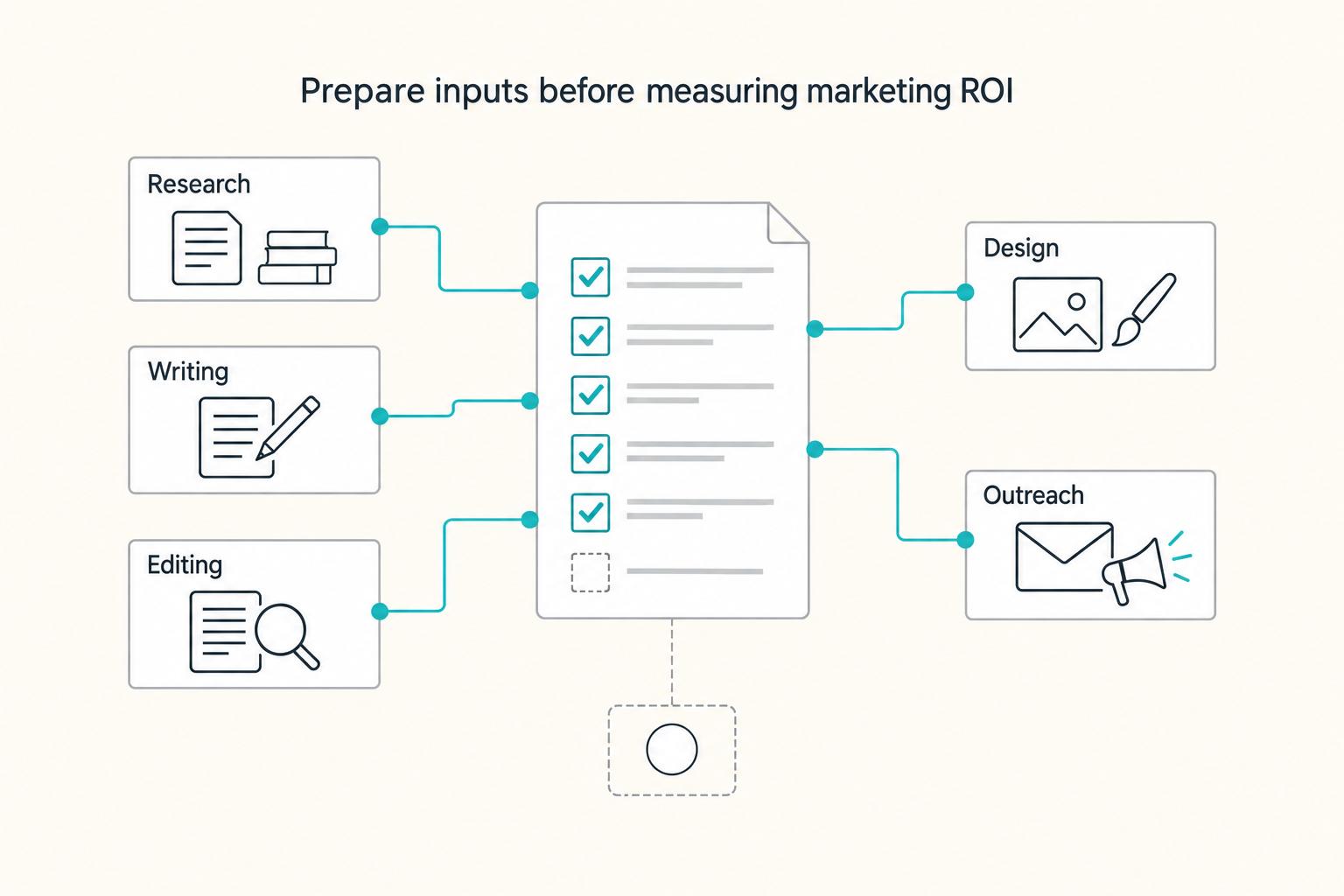
Inventory the work before deciding what to outsource#
Build a task inventory first, then decide ownership.
| Task | Owner | Handoff artifact | Quality standard |
|---|---|---|---|
| Research | In-house or contractor | Brief or source doc | Facts and positioning are usable for drafting |
| Writing | In-house or contractor | Draft | Message is clear and on-brief |
| Editing | In-house or contractor | Edited draft | Structure, clarity, and consistency are checked |
| Design | In-house or contractor | Approved asset/file | Asset is publish-ready for the channel |
| Outreach | In-house or contractor | Outreach copy/log | Messaging and targeting match the plan |
Use one decision filter for in-house vs outsource so your choices are explicit: cycle time, specialist skill needs, error risk, and how clearly the cost will appear in your ledger.
Make external spend reconcilable from day one#
If you want a real view of total investment, each external spend item needs traceable records. Log channel tag, cost category, vendor, amount, date, and a proof record (invoice, platform receipt, or accounting entry). When evaluating vendors, prioritize evidence you can verify directly: relevant portfolio work, process fit, communication cadence, and invoice traceability across your spreadsheet, accounting software, or contractor platform.
Step 1 - Choose your ROI formula (and stop switching definitions mid-quarter)#
Choose one formula now and keep it fixed for your full review window. If you change definitions mid-cycle, your trend stops being comparable.
Use this as your default: ROMI = (Attributed Revenue - Marketing Investment) / Marketing Investment. If you want a percentage view, multiply the result by ×100.
Definition lock (put this in your KPI sheet)#
Use one written note so anyone calculating from the same data gets the same result.
| Definition | What the article says |
|---|---|
| Revenue | closed, invoiced work you can reasonably attribute to the channel you are reviewing |
| Marketing Investment | full channel cost, not ad spend alone; include ad spend plus other logged marketing costs tied to that work |
| Exclude from ROI math | pipeline value, draft proposals, clicks, impressions, and traffic with no revenue link |
- Revenue: closed, invoiced work you can reasonably attribute to the channel you are reviewing. Pull amounts from your CRM or invoicing tool, then confirm source details in your analytics or lead notes.
- Marketing Investment: full channel cost, not ad spend alone. Include ad spend plus other logged marketing costs tied to that work, for example software, content, or contractor spend.
- Exclude from ROI math: pipeline value, draft proposals, clicks, impressions, and traffic with no revenue link.
If attribution is weak, label confidence as low instead of treating the result as precise.
| Metric label (for this article) | Formula format | Best use case | Common failure mode |
|---|---|---|---|
| ROMI | (Attributed Revenue - Marketing Investment) / Marketing Investment | Channel-level profitability decisions | Incomplete costs or weak revenue linkage |
| ROI | (Return - Cost) / Cost | Broader investment comparisons | "Return" is defined differently across reports |
| ROAS | Ad-attributed revenue relative to ad spend | Paid-ad efficiency checks | Compared directly to ROMI as if they measure the same thing |
Verification checkpoint: document your exact formula and input definitions in the KPI sheet before you calculate. If you change any definition later, start a new comparison period.
Step 2 - What counts as "Revenue" from your marketing as a freelancer?#
Count revenue only after you decide what qualifies. For core ROMI, include only closed, invoiced revenue you can trace to a marketing touchpoint using the same rule every month.
Set a written attribution policy before you calculate anything:
- Revenue event: the exact event that counts, for example closed and invoiced work
- Attribution window: the fixed lookback period you will apply
- Accepted evidence sources: the source artifacts you will treat as valid, for example
CRM source,UTM, intake form answer, or call note - Exclusions: what never enters core ROMI, for example proposals, verbal yeses, or unattributed pipeline
Treat delayed channels like content and referrals as a separate measurement problem, not a reason to blur totals. A post published in January can rank in April and convert in July, so keep two labeled buckets:
- Directly attributable revenue: closed, invoiced work with traceable source evidence under your policy
- Assisted pipeline value: influenced opportunities and touchpoints logged separately and reviewed next to core results, not merged into them
| Model | Use it when | Main bias risk |
|---|---|---|
| First-touch | You want to measure what created initial awareness | Overcredits discovery and undercredits closing influence |
| Last-touch | You need a simple rule with limited tracking depth | Overcredits the final interaction |
| Weighted/multi-touch | Several touches consistently influence deals | Becomes subjective if weights are not documented |
Use a consistent decision flow on multi-touch deals: assign primary credit with your chosen model, record other meaningful touches as assisted value, and write one attribution note explaining why.
Audit checkpoint: reconcile channel-attributed revenue against closed sales, invoices, and margin reality. If a revenue line cannot be traced to a source artifact, mark it unverified and exclude it from core ROMI until evidence is added.
You might also find this useful: Use the Reciprocity Principle in Your Freelance Marketing.
Step 3 - Cost isn't just ad spend: build a real "Cost of Marketing Effort" ledger#
Your ROI will mislead you if you track only ad spend. Use one monthly ledger that captures both money out and time spent, then apply the same rules every review cycle.
Use three mutually exclusive cost buckets:
- Direct cash: money paid for one channel only, for example ad spend, a contractor invoice, or a sponsored placement.
- Direct time: your time or team time spent on one channel only, valued at your chosen internal hourly rate.
- Shared allocated cost: tools, subscriptions, or effort that support multiple channels and must be split using one fixed rule with a short allocation note.
Build the ledger so each line is usable and auditable#
| Field | What you enter | Include / exclude rule |
|---|---|---|
| Date | When the cost happened or the time was spent | Include only if it falls in the review month |
| Channel | One channel name (or shared) | Exclude until channel scope is clear |
| Bucket | direct cash, direct time, or shared allocated | Exclude if it fits more than one bucket; fix classification first |
| Line item | Specific activity or purchase | Exclude vague labels like "misc" |
| Amount | Currency amount or hours (consistent format) | Exclude if unit is missing or inconsistent |
| Impact note | One sentence: what pipeline activity this funded | Exclude if you cannot tie it to pipeline activity |
| Allocation note | Required for shared costs: split rule used | Exclude shared items with no split note |
If a line is unclear, flag it and keep it out of ROMI/CAC until clarified.
Allocate shared costs once, then keep the rule stable#
| Method | Use it when | Tradeoff to watch |
|---|---|---|
| Usage-based | You can observe usage by channel, for example sends, seats, or tracked usage hours | Breaks quickly if usage logging is inconsistent |
| Effort-based | Shared support is roughly proportional to tracked effort by channel | Gets subjective when time tracking is loose |
| Primary-channel assignment | One channel clearly drove most of that month's shared work | Can overstate one channel and hide spillover value |
Pick one method per shared line item and document it. If you change split logic after a good or bad month, your trendline stops being comparable.
A practical failure pattern is logging only the visible invoice and missing the execution time around it. Example: you pay for one blog edit, then spend hours distributing the post, replying to inbound messages, and doing follow-up that creates sales conversations. If you log only the invoice, that channel appears cheaper than it is, CAC looks artificially low, and you can end up favoring lead volume because the dashboard rewards it instead of checking outcome quality.
Use this checklist before a line enters your ROI model:
- Capture the cost or hours in the same month you review.
- Assign one channel, or mark it as
shared allocated. - Add a one-line allocation note for every shared item.
- Flag unclear lines before they enter ROMI or CAC.
Step 4 - How do you calculate ROI when you can't track revenue directly?#
When revenue does not tie cleanly to one channel, you can still calculate ROI. Use a documented estimate, label confidence clearly, and separate what you observed from what you assumed.
Use a simple proxy so your method stays consistent month to month. At minimum, work from your channel lead volume, your observed conversion behavior, and your typical closed deal value. This gives you an estimated attributed revenue figure without pretending attribution is exact.
Estimate attributed revenue, then run your normal ROI formula#
Start from one source of truth before you calculate. Then run the same sequence each review period:
| Step | Action | Article detail |
|---|---|---|
| 1 | Count leads by channel | Start from one source of truth before you calculate |
| 2 | Apply your observed conversion behavior | If you must use judgment, mark it as an assumption |
| 3 | Apply your typical closed value | Based on closed deals |
| 4 | Estimate attributed revenue by channel | Use the same sequence each review period |
| 5 | Apply your existing ROI formula | Run your normal ROI formula |
| 6 | Confirm marketing investment includes full costs from Step 3 | Not just ad spend |
- Count leads by channel.
- Apply your observed conversion behavior; if you must use judgment, mark it as an assumption.
- Apply your typical closed value based on closed deals.
- Estimate attributed revenue by channel.
- Apply your existing ROI formula.
- Confirm marketing investment includes full costs from Step 3, not just ad spend.
This approach is less rigorous than direct attribution, but it is still decision-useful when your assumptions are explicit and reviewable.
Weight attribution evidence before making channel decisions#
| Evidence type | What it looks like | Confidence use |
|---|---|---|
| Tracked source fields | CRM source fields, intake source fields, campaign/UTM capture | Highest confidence |
| Documented conversation evidence | Email/call/DM/proposal notes that name the source | Medium confidence |
| Self-reported source only | A source claim without supporting record | Lowest confidence |
Set one internal logging standard: one attribution note per closed deal. Keep the same fields every time so notes are auditable across periods: closed date, selected channel, evidence type, where the evidence lives, and what was assumed, if anything.
If these estimates still feel unstable, tighten your input definitions first in How to Set and Track KPIs for Your Freelance Business.
Step 5 - Time-window discipline: the 30-minute monthly ROI review that keeps you sane#
Use fixed review windows and the same close process every period so your channel decisions come from comparable data instead of weekly swings. Once you rely on proxy revenue and attribution notes, this is what keeps your ROI trustworthy.
Keep a short view and a long view separate. The short view shows whether execution is working now. The long view shows whether the channel is still worth it when revenue lands later.
Use three views for three different decisions#
ROI remains your core profitability metric, whether you use net increase in sales over marketing cost or your existing formula, (Attributed revenue - Total cost) ÷ Total cost. Add payback period when cash timing matters.
| View | Decision use | Common misread | Action trigger |
|---|---|---|---|
| Short-window ROI | Execution monitoring in the current close period | Treating one close or one quiet week as a full channel verdict | Fix execution this period: message, targeting, distribution, or follow-up |
| Long-window ROI | Strategy validation for slower-payoff channels | Cutting a channel before delayed deals can appear | Keep, refine, or deprioritize only after several comparable periods |
| Payback period | Cash-recovery planning when spend and revenue timing are misaligned | Confusing profitable with fast to recover | Pace spend, stage investment, or protect cash while recovery is slow |
Short-window ROI answers, "Is execution healthy right now?" Long-window ROI answers, "Does this channel compound?" Payback period answers, "Can your cash flow tolerate the wait?"
Run the close in the same order every period#
Do not change method after seeing results. Run this sequence in order:
| Order | Action | Article detail |
|---|---|---|
| 1 | Lock the period | Stop back-editing rows unless you log the correction date and reason |
| 2 | Finalize lead inputs | Pull from your source-of-truth sheet; if you run outbound, reconcile top-of-funnel first, including delivered emails (sent minus bounces) |
| 3 | Freeze the conversion method | Keep the same conversion logic for the full period set |
| 4 | Allocate full costs | Include direct cash, direct time, and shared allocations using the same rule each period |
| 5 | Recognize revenue or proxy revenue | Use closed-won attributed revenue where available; otherwise use your documented proxy and label confidence |
- Lock the period. Stop back-editing rows unless you log the correction date and reason.
- Finalize lead inputs. Pull from your source-of-truth sheet. If you run outbound, reconcile top-of-funnel first, including delivered emails (sent minus bounces), then track the path through replies, meetings, opportunities, and closed-won.
- Freeze the conversion method. Keep the same conversion logic for the full period set.
- Allocate full costs. Include direct cash, direct time, and shared allocations using the same rule each period.
- Recognize revenue or proxy revenue. Use closed-won attributed revenue where available; otherwise use your documented proxy and label confidence.
Carry one consistency rule across all locked periods: same formula, same revenue policy, same cost-allocation method. If you improve the model later, annotate the change and apply it forward, rather than silently rewriting earlier periods.
Use hold, watch, and act for low-signal periods#
Low-signal periods can look falsely great or falsely weak. Use a simple guardrail before you cut or scale a channel.
- Hold: Signal is too thin to judge, whether because of low volume, weak attribution evidence, or long lag still playing out.
- Watch: Direction is visible, but evidence is still incomplete. Keep the channel live and review another comparable period.
- Act: The pattern repeats, or one break is clearly visible in the funnel, for example strong replies but weak meetings, or healthy meetings but weak opportunities.
Keep the "efficient but thin" diagnostic. If ROI looks strong but volume is weak, protect efficiency first, then run a volume plan before scaling: expand distribution, sharpen the offer, or improve stage-to-stage conversion.
Need the full breakdown? Read How to Apply the Long Tail Theory to Your Freelance Niche.
Step 6 - What is a "good" ROI for your freelance channels? (benchmarks + safe defaults)#
A good ROI is your operating threshold, not a public benchmark. A channel is only "good" when it pays back your full Cost of Marketing Effort and brings work that fits your business. If ROI looks strong only because hours or lead quality were ignored, treat it as incomplete.
Set your threshold from outcomes, not activity#
Use one question for every channel: for every dollar and hour you invested, what revenue or business value came back? That keeps decisions tied to outcomes, not activity metrics that never connect to pipeline or closed-won results.
For credibility, keep the chain visible: channel activity -> pipeline movement -> closed-won contribution. If that chain is weak, mark the ROI as provisional and avoid aggressive decisions.
| ROI state in this review window | What it means with full cost included | Quality check before deciding | Default decision state |
|---|---|---|---|
| Negative return | Not paying back cash + time/effort yet | Is the signal weak because of attribution gaps, short window, or one fixable bottleneck? | Pause if no clear fix; otherwise narrow scope and retest |
| Near break-even | Effort is mostly being exchanged for output | Are lead fit, follow-up, or targeting issues suppressing conversion? | Improve before adding volume |
| Clearly positive | Paying back full effort and adding surplus value | Do leads match your offer and stay healthy through to closed-won? | Maintain and repeat consistently |
| Unusually strong | Outperforming your other channels right now | Does quality hold across comparable periods, not just one spike? | Scale with checks, not immediately |
High ROI is not a win if lead quality is poor. Strong top-of-funnel activity without revenue linkage, or leads that absorb selling time but do not become good clients, should not be treated as channel success.
Add a capacity gate before you scale#
Different channels mature differently. Paid channels can produce faster, more predictable results, but returns can stop when spend stops. Content and referral channels often show delayed influence across touchpoints, so short windows can understate their contribution.
Before you increase investment, run this gate:
- Fit: Are these leads aligned with your offer and pricing?
- Workload stability: Can you deliver more of this work without harming current delivery?
- Onboarding load: Does new-client setup stay manageable, or is it quietly eroding margin?
If any check fails, keep the channel in maintain or improve mode until the operating issue is fixed.
Write floor, ceiling, and redesign rules#
Do not auto-scale from one strong period. For each channel, keep three written rules in your sheet:
- Floor: Minimum evidence required before you make a hard keep/pause call.
- Ceiling: Maximum volume you can absorb without damaging delivery quality.
- Redesign trigger: Early signal that performance is becoming unhealthy, for example weak closed-won linkage or rising low-fit leads.
This keeps "good ROI" tied to what matters: profitable client acquisition your business can absorb over time.
Related: How to Create a Content Flywheel for Your Freelance Business.
Step 7 - The keep/fix/pause decision gates (so ROI turns into action, not spreadsheets)#
After you calculate ROI, make a decision for each channel: keep, fix, or pause. Give each channel one lane and one next action for the next review period.
Use this discipline because attribution can be delayed across touchpoints. If you skip a clear lane decision, you are more likely to scale too early or keep funding work you cannot defend.
Put each channel into one decision lane#
| Lane | Enter this lane when | One allowed next action |
|---|---|---|
| KEEP | You can credibly show value versus full cost in this review window, and your attribution method is stable enough to trust | Repeat the current motion with the same tracking rules |
| FIX | Results are weak or mixed, but you can name one bottleneck and one testable reason performance could improve | Change one variable only |
| PAUSE | The channel is consuming time or spend, return is not defensible, and you do not have a testable next change | Stop new effort for one review cycle |
Your verification check is simple: compare generated value against cost, then confirm movement through the same chain each month: traffic -> engagement -> conversions -> revenue.
For fix, define one measurable change#
If a channel is in fix, ship one measurable change and name the signal you expect to move:
- Lead quality
- Conversion
- Deal value
- Cycle speed
One change per period is the rule that keeps month-to-month comparison usable when attribution is delayed.
Keep a compact decision record#
Use the same four fields for every channel each review cycle:
| Field | What to record |
|---|---|
| Attribution method | Direct source capture or proxy |
| Confidence | High, Medium, or Low |
| Change shipped | The single variable you changed |
| Expected signal | Lead quality, conversion, deal value, or cycle speed |
If you cannot point to supporting artifacts in your own tracking, lower confidence and treat the result as provisional.
Add a capacity guardrail before scaling#
Separate channels that are high-efficiency but low-volume from channels that can absorb more volume. A channel can stay in keep because it is efficient without being a scale candidate yet.
Also match the decision window to channel behavior. For content marketing, consistent results can take 6-12 months, so an early pause call may be premature.
End every review with one checkpoint: What is the next test, and which signal should move if it works? If you cannot answer that clearly, default to fix or pause, not keep.
Step 8 - Common ROI mistakes (and how to recover without nuking your pipeline)#
Before you lock a keep, fix, or pause decision, run this check. Most ROI mistakes come from inconsistent inputs, not weak strategy.
| Mistake | What you will notice | Immediate recovery for the next review cycle | Decision risk if ignored |
|---|---|---|---|
| You undercounted costs | ROI looks strong in your sheet, but cash and workload feel worse than the report | Backfill all costs for the last closed period, including software, personnel/contractor work, your own hours, and maintenance work (like fixing broken tags or sync issues). Then recalculate with (Attributed Revenue - Total Cost) / Total Cost * 100. | You keep or scale a channel that is only "profitable" because real cost was omitted. |
| You changed attribution rules midstream | Reported revenue jumps, but the result does not line up with what actually landed | Lock one attribution approach for forward periods and mark older periods instead of rewriting them. If a tool can claim credit after an open 29 days later, verify with deal evidence before treating tool totals as final. | You compare unlike periods and misread tracking changes as performance gains. |
| You scaled before checking delivery capacity | A channel looks efficient, then delivery quality slips and scope pressure rises | Before scaling, validate client fit, scope control, and delivery load. If one is weak, fix qualification, boundaries, or onboarding first, then recheck the same channel with unchanged definitions. | You convert apparent ROI into low-margin work and pipeline instability. |
| You overreacted to a thin sample | One weak period makes you want to kill a channel, especially content-led work | Keep the same measurement window and definitions for the next cycle, and change only one variable. Do not judge channel performance from a period where source capture or timing rules also changed. | You pause channels with delayed payoff and create avoidable future pipeline gaps. |
Cost completeness is usually the first miss. If you skip expense lines, ROI inflates. Ongoing maintenance is part of cost, including data upkeep and plumbing fixes; even 5-10 hours monthly of maintenance time can materially change the result.
Platform totals also need verification. A reported revenue number is not enough on its own. Tie claimed movement to concrete deal evidence such as source capture, intake responses, CRM fields, or sales notes.
Use this monthly verification checklist before acting:
- Confirm each channel includes full cost, not just media spend.
- Confirm attribution rules, source definitions, and revenue timing stayed the same for the period.
- Confirm any ROI movement ties to one shipped operational change.
- Confirm any strong ROI signal still passes fit, scope-control, and delivery-load checks.
- Confirm the action decision you shipped last cycle (keep/fix/pause) matches the outcome you observed this cycle.
If you cannot tie a result to stable definitions and a shipped action, treat it as provisional and avoid scaling or cutting the channel yet.
This pairs well with our guide on How to Calculate Client Lifetime Value (CLV) for Your Agency.
Conclusion: stable definitions, traceable notes, and one decision per channel#
You do not need perfect attribution for ROI to be decision-useful. You need stable definitions, traceable notes, and one recurring review you actually keep. If your formula, cost rules, and review window stay fixed, the numbers become useful even when discovery happens across several channels.
Keep the mindset simple. Consistency beats cleverness. A weak but documented attribution note is more useful than a confident guess you cannot defend next cycle. Every channel review should end with a decision that respects delivery capacity, not just spreadsheet output.
Copy/paste checklist#
- Lock the period and update your source tabs.
Close the period in Leads, Deals, Costs, and ROMI before you start interpreting anything. Your checkpoint is simple: every closed deal should have a channel, close date, invoice amount, and one source note.
- Recalculate channel return using the same formula and revenue rule.
Do not change what counts as revenue, cost, or attribution halfway through because one channel had a messy period. A common failure mode is weak linkage between subscription spend and pipeline outcomes, so if you pay for outreach or prospecting tools, make sure that cost can be tied to pipeline activity instead of sitting in a generic software bucket.
- Record what evidence supports each deal.
Use your own tracked signals: UTM capture, intake form answer, CRM source field, email thread, intro message, or call note. If a prospect found you through multiple touchpoints, write the attribution assumption beside the deal instead of pretending there was one clean source. A practical verification check is whether you can show a clear path from spend to meetings set, then from meetings to closed revenue.
- Make one KEEP, FIX, or PAUSE call per channel.
Tie the decision to ROMI, CAC, lead quality, and current delivery load. If a channel looks efficient but would overload onboarding or push you into bad-fit scopes, keep the channel but tighten qualification before increasing volume.
| Evidence quality | What you can point to | Decision posture | Operator takeaway |
|---|---|---|---|
| Clear trace | Logged intro, form capture, message thread, or CRM source that matches the deal | KEEP or FIX with confidence | You can test budget or effort changes carefully |
| Partial trace | Client self-report plus some supporting notes, but not a full path | Usually FIX before scaling | Improve tracking first and expect more variance |
| Weak trace | Mixed or unknown source with no hard artifact | PAUSE large changes or hold steady | Treat this as a measurement problem before a channel verdict |
Your output each cycle should be tangible: an updated channel ledger, one evidence note per closed deal, one decision per channel, and one next test for the next period. Run this on one channel first, then expand after one clean review cycle. If you want a stronger scorecard around your business metrics, read How to Set and Track KPIs for Your Freelance Business.
Related reading: How to Automate Your Freelance Sales Process.
Frequently Asked Questions
What formula should I use to calculate freelance marketing roi?
Use one formula and keep it fixed for the whole review window: (Sales Growth - Marketing Cost) / Marketing Cost. If you change what counts as revenue or cost halfway through, you did not improve the analysis. You broke comparability. Write the formula and your revenue and cost rules at the top of your sheet so every channel review uses the same definition.
What costs belong in marketing investment for a solo business?
Count the full cost of getting business, not just ad spend. That usually means software, contractor invoices, paid distribution, and your own marketing labor. Audit your last closed period and add every missing line item to your Costs tab before you recalculate.
How do I estimate ROI when attribution is incomplete?
Treat weak attribution as an evidence problem first. Use the best records you have for each closed deal, then make a conservative attribution assumption and document it beside the deal. Add one attribution note to every newly closed deal so next period is easier to defend than this one.
How often should I review ROMI and CAC together?
Review them on the same fixed cadence you can actually maintain, and do not switch windows whenever results get uncomfortable. If you already run a regular close cycle, check both there so you can catch rising cost with flat or weakening channel return before it turns into a bigger margin problem. Pick one recurring review date and keep the window length unchanged for at least the next cycle.
What should I do when a channel has high ROI but low lead volume?
Do not kill it, but do not let one efficient channel carry your whole pipeline. High return with thin volume can still be useful, but it is less stable, so check whether lead quality, close rate, and delivery fit still hold as volume changes. Mark it keep, then test one specific volume increase without changing your pricing or qualification rules at the same time.
How do I compare referrals, content, and paid ads fairly?
Use the same revenue timing, the same cost categories, and the same attribution rule across all three. Then look past ROI alone, because inconsistent metrics and platform-reported results can look strong on paper but miss true business value. | Channel | Use the same basis for comparison | Decision checks beyond ROI | |---|---|---| | Content | Revenue recognized in the same review window, plus full time and tool cost | Lead volume trend, close lag, evidence quality | | Referrals | Revenue recognized in the same review window, plus follow-up and relationship time | Lead quality, close rate stability, capacity fit | | Paid ads | Revenue recognized in the same review window, plus ad spend, tools, and management time | Conversion quality, margin after delivery | If one channel uses platform-reported totals while another uses confirmed deals, the comparison is not fair. Standardize channel categories and run one keep, fix, or pause decision using the same comparison table for every channel.
Try a related tool
Researched and edited by the Gruv editorial team. Gruv builds cross-border billing, payouts, and finance-operations software for global businesses.
Sources
Includes 6 external sources outside the trusted-domain allowlist.
- egrove.olemiss.edu/cgi/viewcontent.cgitrusted
- publishing.vt.edu/books/33/files/b85e4a8e-a61c-4878-955c-d5e34...trusted
- askneedle.com/blog/how-to-calculate-marketing-roiexternal
- attributionapp.com/blog/ppc-roiexternal
- cometly.com/post/calculate-true-marketing-roiexternal
- contra.com/p/2FFF7b3g-a-freelancers-guide-to-digital-ma...external
- digitaldawn.in/roi-vs-roas-vs-cpa-marketing-metricsexternal
- doubleyourfreelancing.com/value-price-or-value-anchorexternal
Educational content only. Not legal, tax, or financial advice.
Related Posts

Digital Nomad Health Insurance Comparison for Long-Stay Moves
Use focused time now to avoid expensive mistakes later. Start with a practical `digital nomad health insurance comparison`, then map your route in [Gruv's visa planner](/tools/visa-for-digital-nomads) so we anchor policy checks to your real plan before pricing pages pull you off course.

How to Set and Track KPIs for Your Freelance Business
Better decisions matter more than more metrics. The practical goal is to finish each review knowing what to change next, who owns that change, and when you will verify whether it worked.

How to Create a Content Flywheel for Your Freelance Business
If you sell expert work, your first marketing decision is not the channel. It is whether your pipeline relies on constant replacement or is designed to build momentum over time. A funnel is designed to capture leads and move them toward conversion. A flywheel emphasizes momentum, long-term growth, and client participation in growth. For a solo business, that distinction matters because capacity is usually limited.