
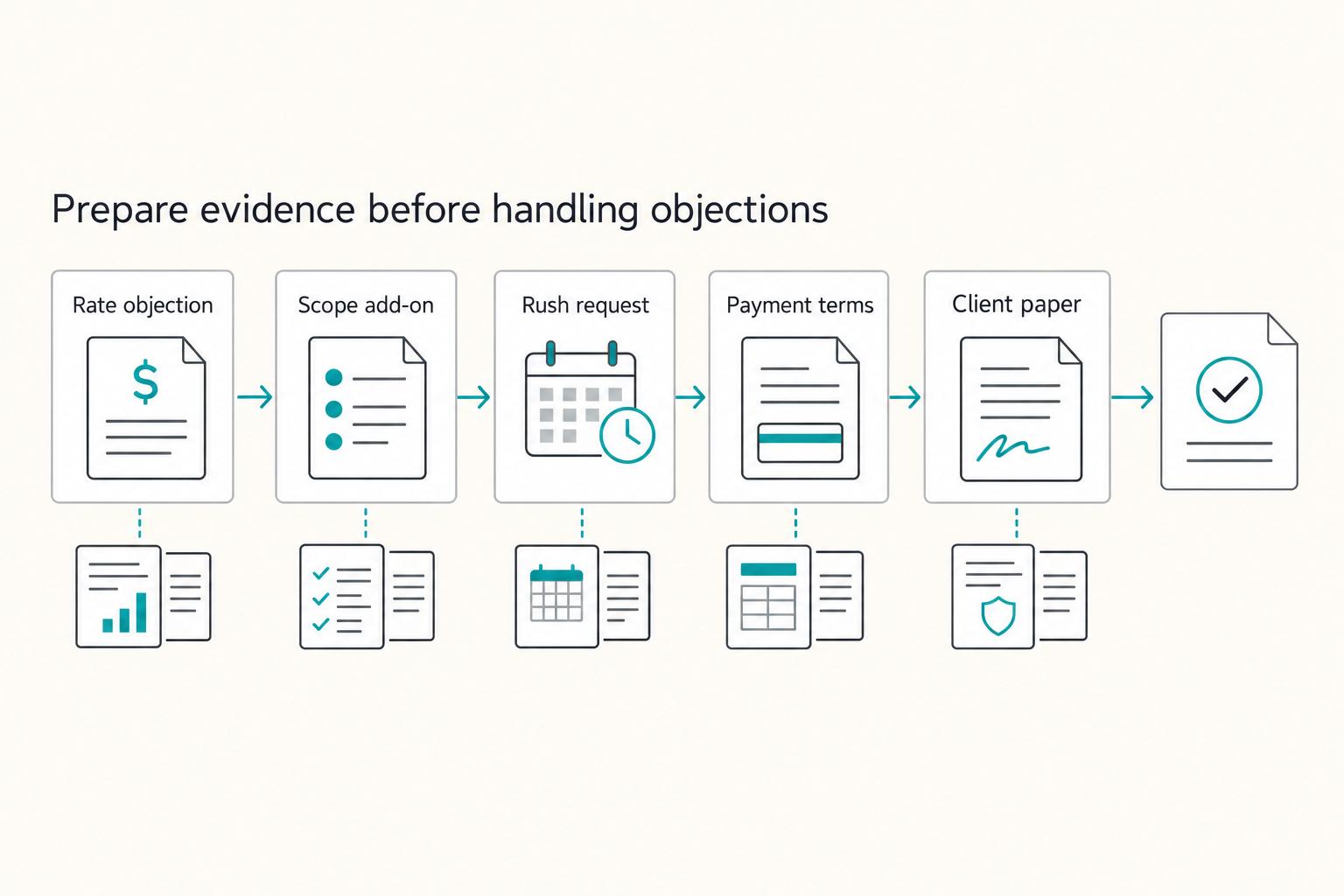
Quick Answer
Handle objections by treating them as risk signals, not automatic noes. Clarify whether the blocker is trust, timing, access, scope, payment, or process, then choose one lane: educate, re-scope, hold firm, or walk away. Update the proposal, SOW, contract draft, or payment schedule the same day and close with one dated next step in writing.
Sales objections don't mean "no" - they mean "risk": build your freelancer objection operating system#
When you hear an objection in cold outreach, treat it as a risk signal, not an immediate "no." A simple loop can help: clarify the risk, choose one next step, write down what was agreed, and confirm timing.
That matters in cold sales. With small physical businesses, outreach can be rejection-heavy: owners may get dozens of unsolicited calls a day, and gatekeepers can block access before the owner hears your pitch. In that setting, objections often map to trust and timing more than your actual service.
Instead of defaulting to high-volume "smile and dial," focus on context and access. Meeting owners in person during off hours, when possible, can create a better opening than another generic call.
| Buyer objection | Likely underlying risk | First clarifying question | Default response lane |
|---|---|---|---|
| "We get calls like this all day." | Low trust in unknown outreach | "Makes sense - are you open to a short, specific proposal, or is now not a fit?" | Clarify fit first |
| "Email me something." | Timing is unclear | "Happy to. Are you the right person to review it, and when will you realistically read it?" | Confirm owner + timing |
| "Talk to the front desk." | Gatekeeper filter | "Understood - when is the best off-hour window to reach the owner directly?" | Adjust approach |
The loop is simple, but it only works if you apply it consistently.
- Clarify the real issue. Restate what you heard in one sentence and ask one focused question. Confirm whether the objection is mainly trust, timing, or access.
- Choose one response lane. Pick one next move: follow up with a short proposal, revisit at a better time, or pause. A narrow starter offer can help in some cases, even if it costs you time or money in the short term.
- Document the decision. Send a same-day recap so both sides have the same next step in writing.
- Close with a dated next action. Ask for one concrete commitment with a date.
Keep the follow-through tight:
- Pre-call: prepare a short offer and a concise recap draft.
- In-call: capture the exact objection and the one next step you agreed.
- Post-call: send a same-day recap with owner, action, and deadline.
A simple example: you stop by a local business during off hours after initial outreach, and the owner says, "We get calls like this all day. Email me something." Do not pitch harder. Treat it as trust and timing, send a one-page proposal with a narrow starter offer, and close conditionally: "I'll send proposal v2 today. If the scope looks right, can you confirm by Thursday so I can hold Tuesday for kickoff?"
If you want a deeper dive, read A Freelancer's Guide to Sales Qualifying.
Prerequisites: what to prepare before you handle objections live (10-minute setup)#
Prepare your objection workflow before the call, not during it. You will sound more consistent and make safer decisions when your responses come from documented artifacts instead of memory.
Step 1: Build a pre-call pack and keep it in one place#
Keep a compact pack in one central location (CRM, client folder, or shared drive) so you can update terms quickly after the call.
| Pack item | Noted detail |
|---|---|
| Proposal template | Reusable |
| SOW template | Reusable |
| Pricing guardrails | For common offer shapes |
| Payment-terms options | You are willing to offer |
| Recap email draft | Placeholders for scope, timeline, payment, owner, and next date |
| Scope-boundary sheet | Included work, excluded work, change-request path, and acceptance criteria |
Make that scope-boundary sheet explicit. Include fields for included work, excluded work, change-request path, and acceptance criteria so scope objections route straight to a written field.
Quick check: could someone else follow your pack and produce the right proposal edit, SOW update, and recap email? If not, tighten it. Weak documentation is where leads slip and quoting becomes inconsistent.
Step 2: Set commercial boundaries before the buyer tests them#
Decide your response rules in advance with three lanes: hold firm, trade, and no-go.
| Decision lane | Use it for | What you protect |
|---|---|---|
| Hold firm | Terms that prevent uncontrolled risk | Margin, scope control, payment clarity |
| Trade | Structural changes that do not quietly expand risk | Phasing, reduced deliverables, milestone timing, payment structure |
| No-go | Requests that remove basic control or payment certainty | Open-ended deliverables, unclear approval path, vague payment terms |
If legal terms come up, classify your position before the call: acceptable, needs redline, or no. Some contracts include broad compliance language and ongoing notice obligations during the contract term, so route those points to written review instead of agreeing live.
If your pricing guardrails are weak, tighten them first with How to Calculate Your Billable Rate as a Freelancer.
Step 3: Pre-map common objections to documents and response lanes#
Prewrite responses for repeat objections so each one maps to a document, a default lane, and a verification check.
| Objection signal | Document you reference | Default response lane | Verification check before you proceed |
|---|---|---|---|
| "Your rate is too high" | Proposal and pricing guardrails | Educate or re-scope | You can show what changes in deliverables, phases, or payment structure |
| "Can you add this too?" | Scope-boundary sheet and SOW | Re-scope | Included work, excluded work, and change-request path are updated in writing |
| "We need it faster" | Timeline section and milestone plan | Re-scope or hold firm | Delivery date and review responsibilities are both named |
| "We can only pay on our terms" | Payment-terms options and contract draft | Hold firm or trade | Invoice trigger, due date, and approver are clear |
| "Legal needs our paper" | Contract draft and redline notes | Educate, hold firm, or walk away | You have identified which clauses are acceptable, which need edits, and who reviews them |
Final pre-call check: test one recent objection against your pack and confirm you can produce a clean written update quickly. If you cannot, the process still depends on improvisation.
Are objections a bad sign or a buying signal? Use this diagnostic before you answer#
Do not label the objection as good or bad first. Treat it as a decision filter: identify the type, test whether it is resolvable in your current deal structure, then choose to continue, reframe, or exit.
Step 1: Classify the objection before you negotiate#
Use three working labels:
| Label | What it means |
|---|---|
| Value | They do not yet connect scope or deliverables to the outcome they want. |
| Risk | They are concerned about exposure in scope, timing, payment, or contract terms. |
| Process | An internal step is blocking progress (for example, review or approval flow). |
Checkpoint before any concession: if you cannot restate the blocker in one sentence tied to scope, timeline, or payment, stay in diagnosis.
Step 2: Translate soft language into hard terms#
Map broad phrases to document fields so the conversation becomes practical.
| Buyer phrase | Attach it to | One forcing question |
|---|---|---|
| "We need flexibility" | Scope, change request path, or termination conditions | Do you mean flexibility to change deliverables, or flexibility to end early? |
| "Your price is too high" | Scope, milestone structure, or payment terms | Is the blocker total cost, or invoice timing? |
| "We need it faster" | Timeline, review cycle, and approval path | Is the date fixed, or is review/approval speed the real constraint? |
| "Legal will want changes" | Contract draft and clause review path | Which clause or policy is most likely to hold this up? |
| "We need buy-in internally" | Approval owner and sign-off step | Who approves this, and what do they need to approve it? |
Use one forcing question at a time, then pause.
Step 3: Test resolvability, then choose one lane#
Choose one lane only after the issue is clear and writable into your deal docs.
| Lane | Use it when | Output |
|---|---|---|
| Continue (Educate) | The issue is mainly understanding, and current structure still works | Clarify and keep core terms intact |
| Reframe (Re-scope / Hold firm) | The issue is real, but solvable by changing structure without blurring boundaries | Update scope, timeline, or payment terms in writing |
| Exit (Walk away) | The blocker stays open-ended on scope control, payment clarity, or contract exposure | Decline and close the loop cleanly |
Keep the rule strict: no one-sentence diagnosis linked to scope, timeline, or payment means no negotiation yet.
Run the objection loop: diagnose, decide, document, close#
Use this loop to turn hesitation into a concrete next step. When a prospect sounds positive but the deal keeps stalling, you need a specific blocker, a specific document change, and a specific commitment.
1. Diagnose. Validate without conceding: restate the objection in plain language, map it to one artifact, then ask one forcing question before you discuss any concession. Example: "If I'm hearing you right, this is about invoice timing, not total scope. Is that right?" Checkpoint: you should be able to point to exactly where this lives (proposal, SOW, payment schedule, NDA, or DPA).
2. Decide. Pick one lane only so your tradeoff stays clear.
| Objection type | Default response lane | Document field to edit | Boundary to protect |
|---|---|---|---|
| Price or budget fit | Re-scope or educate | Proposal options, SOW deliverables, milestone plan | Margin and acceptance criteria |
| Timeline pressure | Re-plan | Milestones, review windows, kickoff date | Quality bar and client-side approval timing |
| Legal or data concern | Hold firm or clarify | NDA, DPA, contract draft | Liability, ownership, undefined obligations |
| Payment friction | Re-structure terms | Payment schedule, invoice triggers | Cash exposure and vague pay-on-completion terms |
3. Document. Send the recap in the same thread and attach or link the updated artifact. Include:
- Owner for each open item
- Assumptions and client dependencies
- Acceptance criteria or approval points
- Next decision trigger with a date
4. Close. Ask for conditional commitment tied to the updated document: "If I send the revised SOW and payment schedule today, can you confirm approval by Thursday?" Treat verbal alignment as non-final until the artifact is updated and the next action is confirmed in writing.
Related reading: How to Handle a Client Who is Micromanaging Your Project.
"What do I say next?" Scripts + decision trees for the 6 objections freelancers actually face#
Once you name the blocker, stop improvising and run one repeatable talk track. Your goal is control and traceability: one clarified risk, two routes, and one written update.
Step 1. Use a live script to confirm the real blocker#
Use this live script first: "I hear the concern. Let me confirm the real blocker. If that is the issue, we have two ways to handle it. If I update the document today, can you confirm by Thursday?"
Avoid saying "I can probably make that work" before you define what changes. In live calls, one lukewarm signal can make you concede too early, so slow down and diagnose before you concede.
Step 2. Run each objection through one branch, then update the artifact#
Run each objection through one branch, then tie it to a specific artifact update.
| Objection signal | Likely underlying risk | Best clarifying question | Safe concession boundary | Required artifact update |
|---|---|---|---|---|
| "Your rate is too high." | Budget fit or weak scope-value alignment | "Is the issue total budget, scope, or uncertainty about outcome?" | Do not discount and expand scope at the same time | Update proposal pricing/options or SOW deliverables/acceptance criteria |
| "Can you also add this?" | Scope drift | "Is that inside the original outcome, or is this a new outcome?" | New work requires a scope tradeoff or a change order | Update SOW scope section or issue a change order |
| "We need it sooner." | Timeline compression risk | "What must be true for that date to work?" | Protect quality bar and review windows | Update milestones/timing in the proposal or SOW |
| "We're not fully confident yet." | Decision-risk or trust gap | "What would reduce risk enough to start?" | Start smaller, not vaguer | Update phased option in the proposal or first-phase scope in the SOW |
| "Can we pay at the end?" | Cash-flow exposure | "What invoice trigger works in your process?" | Avoid vague pay-on-completion terms | Update payment schedule and invoice triggers |
| "Legal is reviewing." | Procurement delay or one-sided terms | "What is mandatory versus preference?" | Hold firm on undefined liability or ownership terms | Update contract redline items in writing |
Step 3. Close every branch with one explicit next action#
Close every branch with one explicit next action: "I'll send the revised SOW and payment schedule by 4 p.m. If those match what we agreed, can you approve tomorrow?" If they will not commit to a document review date, treat that as a continue-or-quit checkpoint instead of extending the call.
When should you push back, adjust scope, or walk away? (the freelancer triage model)#
Once the blocker is clear, choose one lane and tie it to one document before the call ends. Push back when risk is expanding, adjust scope when budget is the real constraint, educate when the issue is process confusion, and walk away when exposure or payment terms still cannot be bounded in writing.
| Objection signal | Underlying risk type | Default lane | Required written artifact | Single next action |
|---|---|---|---|---|
| "Can you include this too?" or recurring add-ons | Scope expansion | Push back | SOW or change order | Confirm what is included vs excluded, then send updated scope boundaries |
| "We need full rights" but rights are undefined | Ownership/use ambiguity | Push back | Contract redline or proposal terms | Ask for the exact rights needed and write them explicitly |
| "We can't do that price" | Budget fit | Adjust scope | Proposal or SOW | Offer scoped options (not a vague discount) |
| "Why do we need this process?" | Process confusion | Educate | Proposal, SOW, or onboarding note | Send the start sequence in writing |
| "We only pay at the end" or no clear invoice trigger | Payment exposure | Walk away if unresolved | Payment schedule | Request a defined trigger; if it stays unbounded, pause and close out |
If you push back, confirm four boundaries in writing: scope boundary, ownership/use rights, liability boundary, and acceptance criteria. Keep the discussion specific by asking them to point to the exact contract or policy section they want applied, especially when terms overlap across multiple agreements.
If you adjust scope, trade shape before price. Your clean trade paths are deliverables, timeline, review rounds, and support window. Set package caps so included work is explicit, then offer an upgrade path if they need more.
Use the educate lane when the work is not the issue but the sequence is. Explain your start conditions plainly, then send them the same day so nothing depends on memory or chat alone.
Walk away when, after one clear attempt, exposure or payment terms still cannot be bounded in writing. At that point, pause escalation, exit professionally, and send a short close-out note that records what could not be bounded, what written option you offered, and that work will not begin without updated documents. Keep the record complete, including emails, ticket IDs, screenshots, and relevant IDs, in case the dispute later affects revenue, reputation, or access.
How do you prevent recurring objections before the proposal stage? (qualification gates that save hours)#
Prevent recurring objections by qualifying before you draft: no full proposal until budget, authority, decision path, and ops readiness are clear in writing. The goal is simple: avoid spending hours on opportunities that are still too vague to buy.
Step 1. Pick the right qualification method for the call#
Use BANT for a fast fit check, and use SPICED when you need deeper decision context. They work best as complementary tools, not as an either/or debate.
| Method | Use it when | Capture this signal | Pause proposal drafting if | Artifact to update |
|---|---|---|---|---|
| BANT | You need a quick can-they-buy check | Budget, authority, need, timeline | Budget ownership or decision authority is unclear | Discovery notes + same-day recap email |
| SPICED | The deal has more complexity or stakeholder risk | Situation, pain, impact, critical event, decision path | Problem is clear, but decision path or critical event is still unclear | Discovery notes + scope assumptions |
| BANT -> SPICED | Early call starts simple, then process complexity appears | Fast fit first, then deeper decision context | Interest is high, but buying steps stay fuzzy | Recap email + explicit hold note before proposal |
If they can describe goals but not how a decision gets made, switch to deeper discovery before scoping.
Step 2. Run four live gates before scoping#
Keep the questions light, then make a clear pass/fail call.
| Gate | Live question | Outcome described |
|---|---|---|
| Budget gate | What budget range is allocated for this outcome? | Pass: they can share a range or explain approval path. Fail: your proposal would be the first budget test. |
| Authority gate | Who makes the final decision, and who influences it? | Pass: a decision-maker is named, or the path to one is clear. Fail: your contact cannot identify who can approve. |
| Decision-process gate | What needs to happen between this call and a yes? | Pass: they can outline the decision steps. Fail: the only answer is "send something over." |
| Ops-readiness gate | Before kickoff, what legal, procurement, finance, or security/data-access steps are required? | Proceed: owner and sequence are clear. Pilot-first scope: steps exist but access/approvals are still uncertain. Hold: no owner for required internal steps. |
Before drafting, write one sentence that names the buyer, buying path, budget shape, and any internal readiness blockers.
Step 3. Run the pre-proposal sequence in order#
Use this sequence every time: send recap, confirm buying path, confirm scope-fit price range, then draft. Do not skip written alignment to "keep momentum"; qualifying the wrong opportunity is expensive.
We covered this in detail in How to Write a Follow-Up Email That Closes the Deal.
What should be documented after an objection call to reduce disputes later? (audit-ready recap)#
Document the call outcome in two parts: what is agreed now, and what is still open. Then move agreed changes into the document that governs that part of the deal, so decisions do not stay as chat fragments.
Step 1. Send a short recap with agreed vs open items#
Keep it skimmable and specific. If a term changed, ask for written confirmation before you act on that change.
| Decision made | Unresolved item | Owner | Deadline | Next binding action |
|---|---|---|---|---|
| Scope stays within current package caps (what is included vs not included) | Whether extra work is needed now | Client | Set after verification | Client confirms keep current package or upgrade |
| Timeline remains as discussed | Access/start dependency still unclear | Client | Set after verification | Client shares access/start details |
| Payment approach unchanged | Exact payment dates still pending | You + Client | Set after verification | Confirm updated schedule in writing |
If the objection touched scope, restate boundaries clearly. If requested work goes beyond current limits, offer a clear upgrade path instead of a vague "we can figure it out."
Step 2. Update your source-of-truth artifacts#
Use chat for coordination, but keep final terms in your working records. In practice, that usually means updating the scope document, the active contract draft, and the payment record you rely on for execution. Conversations win work; written updates preserve what was decided.
Step 3. Keep an internal objection log you can learn from#
Track each objection with: category, likely root cause, concession boundary, final outcome, and the artifact version/reference you updated. Over time, this makes repeat friction visible and easier to prevent earlier in the sales process.
Quick audit test: someone who missed the call should be able to reconstruct current scope, responsibilities, payment status, and next action from the written trail alone.
Common mistakes that lose deals (or create disputes) - and how to recover fast#
The fastest way to lose control on an objection call is to react before you understand the real issue. Use a simple professional standard instead: pause, clarify, avoid on-the-spot commitments, and document decisions so both sides can give informed agreement.
Step 1. Pause, clarify, then respond#
If you answer too quickly, you risk solving the wrong problem. Keep your live sequence tight:
- Pause instead of filling silence.
- Name the objection category: scope, price, timeline, terms, or payment process.
- Ask one narrowing question about the specific item in dispute.
- Restate the issue in one factual sentence and confirm you got it right.
- Set the handoff: any change is confirmed in writing after review, not committed live.
If you cannot restate the concern clearly, keep clarifying before you negotiate.
Step 2. Recover with the right document, not more talk#
| Mistake pattern | Immediate risk created | Recovery move | Exact artifact to update |
|---|---|---|---|
| You discount before clarifying the concern | You cut margin without fixing the blocker | Replace discounting with a scoped trade: reduced deliverables, phased delivery, or adjusted start timing | SOW or proposal |
| You say "we can be flexible" on terms | Vague commitments and possible fee/charge surprises | Reopen the point, review terms and conditions, then send a written redline | Contract redline |
| You agree to "sort payment later" | Billing delay and disagreement on payment triggers | Define invoice timing, acceptance point, and relevant fees/charges before work starts | Payment schedule |
| You make a verbal promise and leave it in chat | Memory drift and version conflicts | Send a same-day recap and move the change into the governing file | Recap note plus SOW, contract redline, or payment schedule |
Step 3. Trade value for value, not relief for relief#
When you concede, make it an exchange. If budget is tight, reduce scope. If timing is compressed, reduce review rounds or split into phases. If terms review is slow, keep scope and price stable and agree a dated redline cycle.
This keeps you from giving away price or terms loosely, and it keeps every trade decision documentable.
Step 4. Run this in-call recovery checklist before moving forward#
Before ending the call, confirm:
- Objection category: what issue this is
- Agreed boundary: what changes and what does not
- Next-step owner: who does what next
- Written source of truth: SOW, contract redline, payment schedule, or recap note
If one is missing, you are still in clarification mode, not close mode.
For a step-by-step walkthrough, see How to Take a Real Vacation as a Freelancer.
Close with control: the freelancer objection system you can run on every call (+ copy/paste checklist)#
Run the same four-step sequence on every objection call: Diagnose, Decide, Document, Close. Near close, objections often shift into risk checks such as scope clarity, approval path, timeline risk, and payment terms, so your job is to keep decisions specific and traceable.
Step 1 Diagnose#
Start with one open clarifying question before you respond: "When you say this is a concern, what specifically needs to change for approval: scope, timeline, payment terms, or review process?"
Then restate the issue in one sentence and tie it to the right document: "So this is a review-round issue in the SOW," or "This is a contract timing issue, not a scope issue." Keep it focused. If you ask too many follow-ups, the call can stall.
Step 2 Decide#
Choose one lane only: educate, re-scope, hold firm, or walk away.
- Educate when the issue is missing context and current terms still work.
- Re-scope when the outcome still matters but budget or timing cannot support the current version.
- Hold firm when requested changes make scope, acceptance, milestones, or payment terms too unclear.
- Walk away when you still do not have a workable approver, timeline, or payment path after clarification.
Use the lane that matches the blocker. If the blocker is procurement timing, do not solve it with discounting.
Step 3 Document#
Convert call decisions into written artifacts the same day. Update the SOW when scope, roles, timelines, deliverables, milestones, or payment terms change. Send a contract redline for legal language changes. Update the proposal or payment schedule for commercial changes.
Use one documentation standard every time: decision, next step, owner, date. Put it in your recap email and action log so follow-through is explicit.
Step 4 Close#
Ask for one dated commitment: "If I send the revised SOW with the milestone dates and payment terms we agreed, can you confirm signature by Thursday?"
Then confirm next actions in plain language: "I'll send Version 3 today. You'll review with Priya and reply by Thursday." If there is no date, owner, or approval path, treat the deal as not ready to close.
| Phase | Action you take | Proof you save |
|---|---|---|
| Before | Open the current SOW, proposal, pricing options, and your boundary rules before the call starts. | Latest SOW/proposal version and prep notes showing flexible vs. non-negotiable points. |
| During | Clarify the objection, pick one response lane, and confirm one next action with owner and date. | Call notes with the real blocker, chosen lane, owner, and deadline. |
| After | Send recap, update governing document, and log follow-up tasks. | Revised SOW/proposal/redline, recap email, and action log entry with owner and due date. |
Sometimes the objection is about your business setup, not your service. If clients ask which entity is contracting or invoicing, treat that as deal-risk context because structure can affect taxes and personal risk exposure. If you are in the UK and this is surfacing in procurement or contract review, use A Guide to Setting Up a Limited Company in the UK as background. If the answer depends on your country, tax position, or legal context, get local professional advice or contact Gruv for market-specific support.
Related: How a German Freelancer Can Handle US Sales Tax with a US LLC.
Frequently Asked Questions
How do you handle “your rate is too high” without discounting immediately?
Do not cut price first. Clarify whether the real issue is total budget, scope, timeline, or the expected outcome, then offer written options such as reduced deliverables or phased work. Keep your pricing logic grounded in scope and structure, not feelings.
When should you hold firm on terms versus re-scope the work?
Hold firm when key terms like acceptance or payment are still unclear after clarifying questions. Re-scope when the client still wants the outcome but cannot support the current scope or timeline. Choose one lane only, then update the matching written artifact.
What should you write in a same-day objection recap email?
Keep it short and operational. List what was decided, what is still open, who owns the next step, and the date, then point to the governing document and attach or link the update. If no written change exists, treat the change as unconfirmed.
How do you spot a deal you should walk away from early?
Walk away when budget, authority, need, or timeline still cannot be clarified after you ask follow-up questions. If you cannot identify the decision-maker or the process stays vague, stop revising the proposal. Pause the deal or send a polite no-fit note.
Which objection signals belong in your qualification checklist?
Log recurring objections you hear before the proposal stage, especially around budget, authority, need, and timeline. Turn each one into a discovery question and a written checkpoint. This helps you respond faster and qualify earlier.
Try a related tool
Researched and edited by the Gruv editorial team. Gruv builds cross-border billing, payouts, and finance-operations software for global businesses.
Sources
Includes 2 external sources outside the trusted-domain allowlist.
- contractsfinder.service.gov.uk/Notice/Attachment/fe727ee1-250e-4a30-92bc-dc...trusted
- hbs.edu/ris/Publication%20Files/26-029_64229d1d-cb43...trusted
- hed.nm.gov/uploads/documents/CCNS_Catalog_V38.pdftrusted
- irs.gov/businesses/small-businesses-self-employed/bu...trusted
- sba.gov/business-guide/launch-your-business/choose-b...trusted
- scholar.law.colorado.edu/cgi/viewcontent.cgitrusted
- alexberman.com/start-consultingexternal
- choice.com.au/shopping/consumer-rights-and-advice/your-rig...external
Educational content only. Not legal, tax, or financial advice.
Related Posts
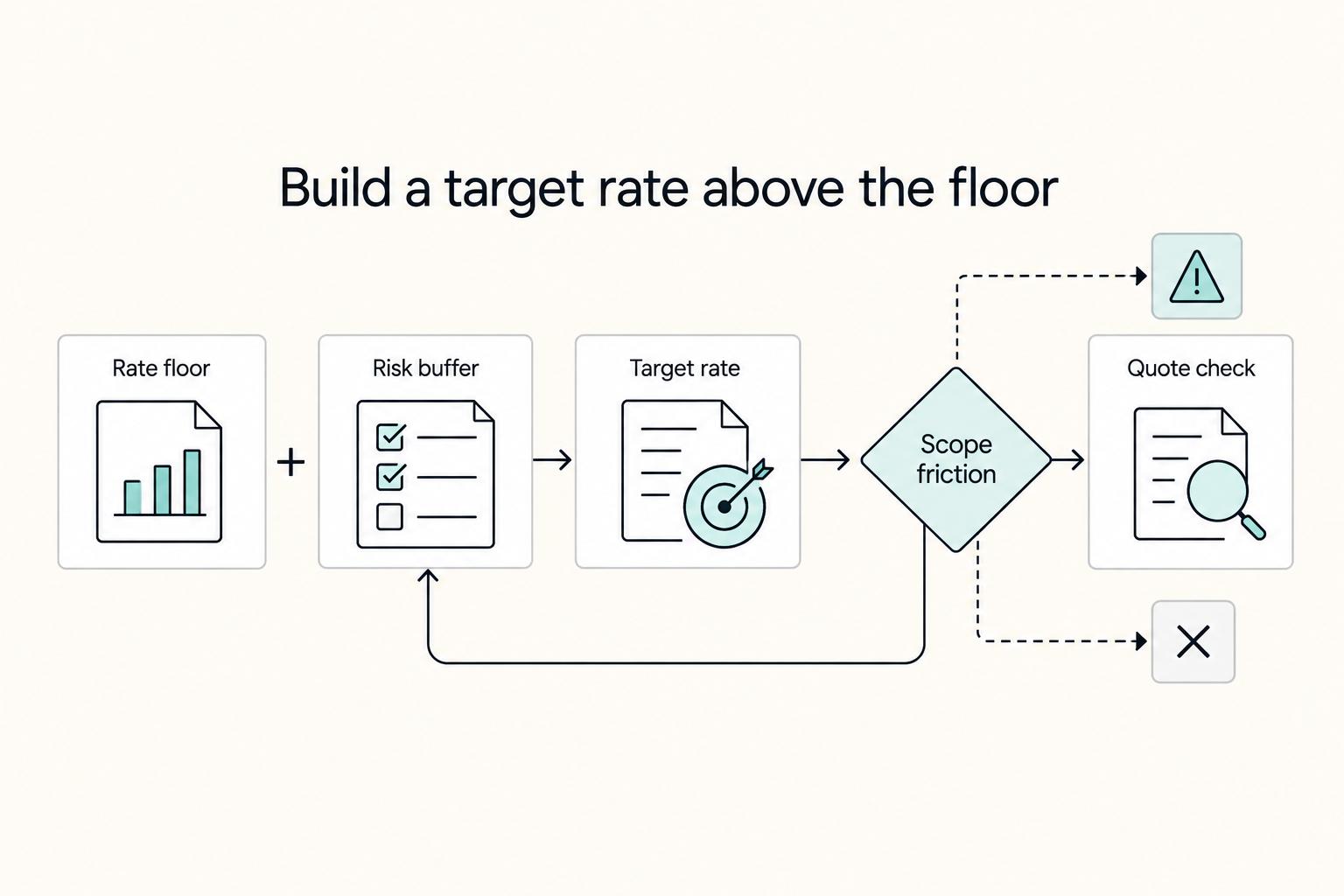
How to Calculate a Freelance Rate You Can Actually Get Paid On
A workable rate is not the neat number a calculator produces. It is the number that still works after you account for real billable capacity, non-client time, scope drift, and the gap between sending an invoice and receiving cleared cash. Start with hourly math even if you do not plan to bill hourly, then turn that number into a quote with clear `payment terms`.
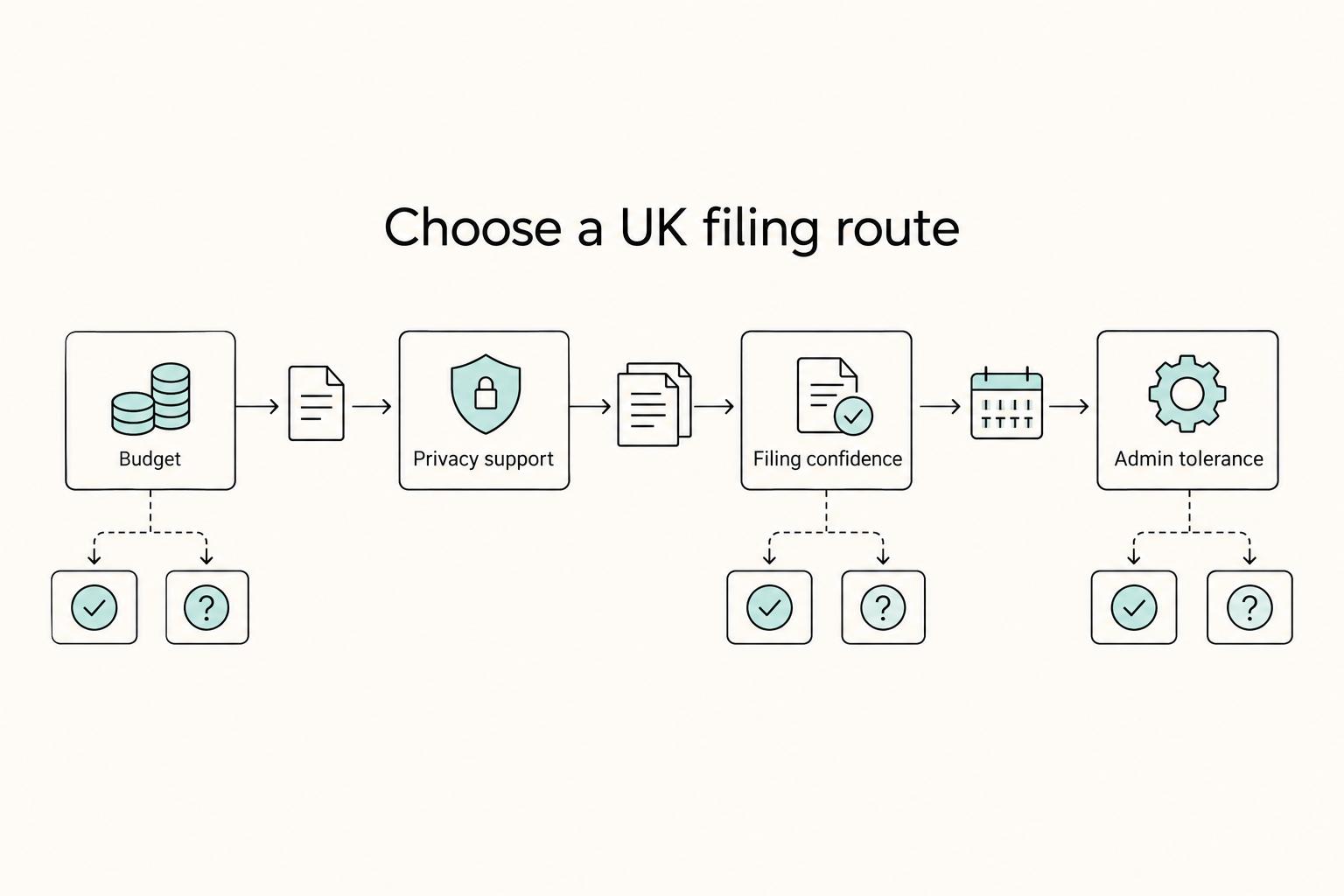
Setting Up a UK Limited Company for Freelance Work
You are not just deciding how to file paperwork. You are deciding whether to run your work through a company that is legally separate from you. That choice affects your liability exposure, how credible your business looks, and how ready your operations are as you grow. The real question is whether this structure fits your business now and whether you can run it properly after formation.

The Freelance Payment Penalty: A Modeled Audit of Platform Fees, FX Spreads, and Payout Delays
The money rarely disappears through a single, easy-to-spot fee. The real loss is stacked. A marketplace takes its commission, a processor adds a charge for international cards, a bank or payment company converts the currency at a spread, a platform holds the funds before release, and a wire sheds a little to intermediaries on the way in. Each layer looks defensible on its own, but the worker feels the combined result as a smaller deposit and a later payday.