
Quick Answer
Use a few distinct service tiers and keep the same terms from Quote to Proposal to Contract/SOW to Invoice. Define countable scope units, revision caps, approval gates, and turnaround class for each package, then route extra requests to a change order or tier upgrade. Pair that with risk-based billing: deposit before kickoff, invoices triggered by signing, delivery or acceptance as agreed, and pause-work rules when payment is late. This structure protects cashflow better than price labels alone.
Define service tiers with clear scope and payment terms#
If you use freelance tiers well, you are not giving clients random price points. You are giving them policy bundles that help control scope, payment risk, and decision speed. That matters because a common margin leak is undercharging, over-delivering, and then trying to negotiate boundaries after the work has already moved.
A package-based approach helps clients choose by fit instead of forcing every project into a custom quote. The practical shift is simple: stop defining tiers with vague labels like "basic" or "premium," and define them with rules you can point to when the project changes. Proposal quality is part of that discipline. If your proposal cannot show what is included, what triggers extra work, and how the client approves progress, your price is not protecting much.
A tier is a policy bundle#
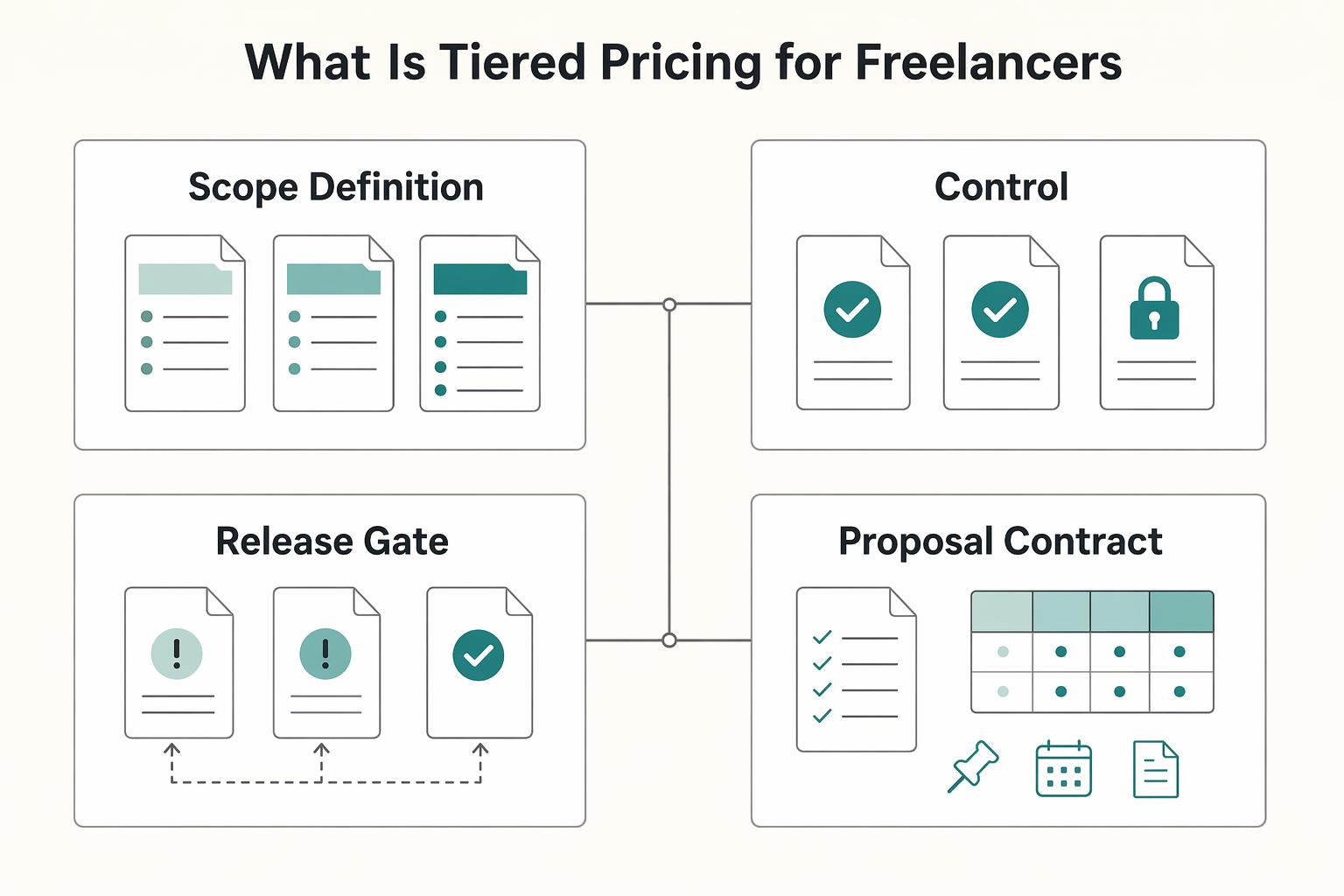
Your tiers should change the operating terms of the engagement, not just the amount of polish. Each option should define clear boundaries around scope, revisions, response expectations, approvals, and add-ons.
| Policy lever | What to define in writing for each tier |
|---|---|
| Scope unit caps | The countable scope unit and the limit for that tier |
| Revision handling | What counts as a revision and the revision boundary |
| Turnaround class | Expected timeline and any priority conditions |
| Communication cadence | Checkpoint rhythm and response expectations |
| Approval gates | Required sign-offs by milestone |
| Add-on path | When to use an add-on, change order, or tier upgrade |
This is why the middle option can matter. Some pricing commentary says buyers avoid the extremes and settle in the middle, but that only helps if the middle tier is a clean match for the work most clients actually need.
How to respond when scope changes#
When a client asks for "one more thing," do not improvise. Use the same response pattern every time so you are not negotiating scope in the moment:
- Map the request to the current tier's written scope unit, revision rule, and approval stage.
- If it fits, confirm it in writing and note any timeline effect.
- If it does not fit, offer either a change order or a tier upgrade.
- Record the choice in the proposal or SOW language so the invoice later matches the agreed path.
A useful sentence is: "That request sits outside the current scope cap, so I can price it as an add-on or move this project to the next tier."
Check four things before you send a proposal#
Before any proposal goes out, verify four things so the price can actually protect you:
| Check | What to verify |
|---|---|
| Measurable scope | Every deliverable is countable by unit, format, or milestone. |
| Out-of-scope trigger | The document states what kind of request becomes an add-on, change order, or upgrade. |
| Client responsibilities | Inputs, feedback deadlines, and approval duties are named clearly enough to prevent "waiting on client" from becoming your unpaid delay. |
| Upgrade path | Each tier has an obvious next step so you are not renegotiating from zero. |
Once those rules are set, calibrate the numbers with your economics using How to Calculate Your Billable Rate as a Freelancer. Pricing comes second. Policy design comes first.
Related: How to apply 'Game Theory' to your freelance pricing and negotiations.
What tiered pricing changes in a freelance engagement#
Tiered pricing means offering a few package options that differ in service terms, not just price. If your "budget," "most popular," and "premium" options all run the same after kickoff, they are mostly labels.
A small set of distinct options can help clients compare scope and delivery terms. Treat faster selection and preference for the middle tier as hypotheses to test in your own proposal results, not guaranteed buyer behavior. Clear boundaries still help you identify what was sold and which changes need approval.
| What changes | Price-only tiers | Policy-bundle tiers |
|---|---|---|
| Scope definition | Broad "more value" language | Clear deliverables, limits, or milestones |
| Revision control | Implied or negotiated later | Revision rounds or feedback windows stated upfront |
| Approval checkpoints | Usually not explicit | Review/sign-off points defined in the offer |
| Proposal / contract / SOW / invoice carry-through | Hard to restate consistently | Easier to repeat with the same terms across documents |
This is the operator model: each tier is a policy bundle you can describe the same way on your pricing page, in your proposal, in your SOW, and on your invoice. If a client cannot quickly explain the difference between options, tighten the package terms before you send them.
A common failure mode is price-only packaging that drifts into custom haggling, especially if you already underquote hourly work. Start with a manageable number of tiers, watch how clients actually self-select, and refine after real project feedback.
Build a 3-tier offer architecture that changes scope (not vibes)#
Build three tiers that change scope and delivery conditions, not just price labels. If the differences are not explicit in your Proposal and SOW, you will drift back into custom haggling.
Three distinct levels are a workable starting structure when each solves a different scope or service need. Two clear offers are better than a third padded with vague benefits. Keep the commercial differences explicit and use your own delivery costs and capacity to set prices.
| What must change by tier | Tier 1 | Tier 2 | Tier 3 |
|---|---|---|---|
| Scope units | Lowest included unit count | More units or an added phase | Broadest unit count or multi-phase work |
| Revision workflow | Narrower review room | More review room | Deepest review room, still capped |
| Turnaround class | Standard queue | Priority scheduling | Fastest turnaround you can reliably deliver |
| Support channel | Basic communication path | More direct contact | Highest-touch communication |
| Approval gates | Fewer checkpoints | More formal sign-offs | Full milestone approvals and handoff |
| Usage rights | Narrowest allowed use | Broader business use | Widest rights you are willing to sell |
Here is a hypothetical website-copy matrix: Starter includes 3 pages and one consolidated revision round for $900; Standard includes 5 pages and two rounds for $1,600; Expanded includes 8 pages, two rounds and a handoff workshop for $2,600. All use the same named client approver and exclude design and implementation. Prices illustrate structure rather than a market rate.
Start with the smallest scope unit you can count#
Define the smallest billable unit for your service, for example: pages, screens, ad variants, articles, workshop hours, or editing passes. For each tier, write a clear included list and excluded list.
If your work has phases, name the boundary directly. "Design phase only" and "engineering implementation excluded" avoids assumptions and keeps scope enforceable.
Then mirror the same wording across Proposal, Contract, and SOW. If Tier 2 includes "10 screens and one prototype," keep that exact phrasing in all documents and in invoice line items.
Put guardrails in writing before kickoff#
Set these rules before work starts:
| Guardrail | Written rule |
|---|---|
| Out-of-scope trigger | Any request outside listed deliverables, unit caps, timeline class, or usage rights pauses that item until a change order or revised SOW is approved. |
| Milestone acceptance rule | Use named review points and acceptance criteria. Later requested changes may be new work; correcting a defect against the original agreed specification is not automatically an extra charge. |
| Handoff definition | If a tier includes a structured developer handoff, name the handoff artifact. If it does not, do not imply it. |
Use one decision protocol for common change requests#
When a client asks for more work, faster timing, or broader rights, choose one path:
- Keep scope and decline the extra request.
- Trade scope by replacing one included item with another.
- Upgrade tier when the request changes complexity, speed, support, or rights.
Document the choice in a proposal update, contract addendum, or revised SOW. For rights/licensing, keep the business use case explicit and verify the jurisdiction-specific clause through legal review before finalizing the agreement.
For a step-by-step walkthrough, see A Guide to Usage-Based Pricing for SaaS.
Which payment terms belong in each tier (so you stop financing clients)?#
Set payment terms by risk, not preference: the more schedule pressure, scope uncertainty, or priority access a tier includes, the earlier and tighter your payment checkpoints should be.
Use these terms consistently in your documents:
- Deposit (initial fee): upfront payment before work begins.
- Milestone billing: split the fee into 2-3 chunks defined in the contract.
- Final invoice: remaining balance due at completion.
- Acceptance-triggered billing: payment due when a named stage is approved.
If your agreement requires a deposit, invoice it after signing and confirm receipt before the corresponding work starts. Choose the percentage from cash exposure, cancellation risk and applicable rules; there is no universal 25%–50% standard. Completed milestones may have separate delivery or acceptance triggers.
| Tier | Payment trigger | Billing cadence | Approval dependency | If payment is late |
|---|---|---|---|---|
| Tier 1 | Deposit before kickoff; final invoice at completion | 2 payments | Low dependency on staged approvals | Pause new work; hold final delivery until paid |
| Tier 2 | Deposit before kickoff; staged invoices at named milestones | 2-3 chunks | Milestones tied to written approval/checkpoints | Pause at the next milestone until payment clears |
| Tier 3 | Deposit before schedule reservation; milestone payments before priority work continues | 2-3 chunks, front-loaded where possible | High dependency because speed/priority increases your risk | Priority slot can shift if payment is late |
For the $1,600 Standard example, agree $640 on signing, $480 on first-draft delivery and $480 after written acceptance, each with its own due date. Those invoices total $1,600; do not issue another $1,600 final invoice. If one extra page is approved for $250, record whether it is a separate invoice or a line on the final invoice; total authorized billing becomes $1,850. Track approval, invoicing and receipt separately, so an issued or accepted invoice is not mistaken for collected cash.
The key difference between tiers is not just cadence. It is the schedule consequence when money is late. If a client wants urgency, keep urgency tied to the agreed payment trigger.
How to answer pushback without improvising#
Some clients, especially larger ones, may have fixed payment policies and may not negotiate. Use the same response framework each time:
- Confirm the request: "Yes, we can support that timeline."
- Restate the trigger: "To reserve it, I need the deposit first, then the next payment at the SOW milestone."
- Offer options: "If your policy is pay-on-completion, we can shift to a lower-priority timeline or reduce scope."
That keeps the conversation operational: terms match risk.
Put cashflow seatbelts in the contract#
Add explicit controls for when execution breaks:
- Late-fee path (if you use one).
- Pause-work rule when invoices are unpaid.
- Kill-fee clause with clear trigger and amount.
- Written change-order requirement before extra work starts.
For cancellation, state the amount owed for completed work, committed costs and any lawful agreed cancellation charge, avoiding double counting. A hypothetical 50% charge is a negotiated example, not a default legal entitlement; define its trigger, deposit credit and limits before signature.
Implementation checklist (before you send)#
- Proposal includes selected tier, total fee, deposit, milestone names, and final payment trigger.
- Contract/SOW repeats the same schedule and the same approval checkpoints.
- Contract/SOW includes pause-work, kill-fee, and change-order language.
- Invoice line items use the same milestone labels as the SOW.
- Client-facing delivery notes match the agreed completion and remaining balance trigger.
Related reading: Value-Based Pricing for Strategic Consultants Under Real Payment Risk.
How do you tailor tiers for new vs repeat clients - and cross-border clients?#
Tailor tiers by applying the same prewritten term bundles to verified risk signals, not instinct. No single pricing approach fits every situation, so let the project, client, and payment setup drive which terms you use.
Use verified trust signals, not client labels#
Treat "new" and "repeat" as context, not automatic risk ratings. Repeat work can be more stable in some contexts, but you still need proof from how this client operates with you.
| Criterion | If signals are strong | If signals are weak or mixed |
|---|---|---|
| Payment history quality | You can consider lighter friction within your existing tier structure | Keep stricter payment protections in place |
| Approval speed | You can keep delivery flow simpler | Tighten milestone gates and pause-work language |
| Scope stability | You can keep billing mechanics simpler | Keep tighter scope controls and change-order discipline |
| Admin complexity | You can reduce avoidable process drag over time | Keep stricter terms until payment operations are proven |
The common failure mode is reusing the last concession because it feels easier. Before you relax terms, review prior invoices, approvals, and scope-change history.
If you grant an exception, document it in all three places: proposal, SOW, and invoice terms. If it only lives in email or memory, it becomes silent precedent.
Set cross-border payment mechanics before timeline promises#
For cross-border work, define payment logistics first, then commit to schedule expectations.
| Item | Decision to make | What to verify or record |
|---|---|---|
| Currency | Invoice and expected receipt currency | Confirm the client can pay through the selected rail |
| Settlement timing definition | What event counts as "paid" for schedule purposes | Write one clear definition into proposal and SOW |
| Transfer fees | Who absorbs transfer costs | Put fee handling in writing |
| Payment rail availability | Which rail is actually usable for this client/corridor | Confirm current provider capability and fee policy with the provider |
| Conversion risk | Who bears FX movement risk | State the rule in writing if currencies differ |
Before you send the proposal, verify your chosen rail and terms for that exact client corridor. If a client asks for weaker protections while scope or payment handling is still unclear, route the work to stricter tier terms or decline. That decision protects cashflow.
For a deeper dive on performance-based pricing, read How to Use Performance-Based Pricing for Your Freelance Services.
Run the execution workflow: Quote → Proposal → Contract/SOW → Invoice → escalation#
Use one fixed document chain for every client: Quote -> Proposal -> Contract/SOW -> Invoice -> escalation. This keeps offer and acceptance, performance, and payment triggers aligned, instead of getting renegotiated in scattered messages.
Do not assume an email, verbal discussion or conduct produces the same enforceable agreement in every jurisdiction. Use a signed, readable agreement with documented performance; applicable law can require writing or impose payment protections. For example, NYC freelance worker rules require written terms for covered engagements and protect timely payment. Your document chain cannot override mandatory law.
| Document | Purpose | Required fields to confirm before sending | Failure risk if skipped or vague | Exact handoff to next document |
|---|---|---|---|---|
| Quote | Quick commercial snapshot so the client can react to scope and price | Client name, selected tier, headline deliverables, price or range, timing assumption, validity note (if you use one) | Client "approves" a loose summary and expects work you did not price | Convert the chosen option into a Proposal with the same tier, scope boundaries, and pricing logic |
| Proposal | Commercial offer and acceptance checkpoint | Final tier, included deliverables, exclusions, milestone structure, price, assumptions, payment triggers, acceptance path | Misalignment between what was sold and what gets contracted | Draft Contract/SOW using the same terms, labels, and milestone wording |
| Contract / MSA | Relationship-level legal and payment guardrails | Parties, payment terms, IP ownership, confidentiality, dispute resolution, termination rights, any pause-work rights you use | You have delivered work, but weaker footing on late payment, stoppage, ownership, or disputes | After signature, issue the project SOW under this agreement |
| SOW | Project-level source of truth for performance | Deliverables, timeline, milestones, pricing, revision limits, acceptance criteria, exclusions, change process | Work starts from verbal/email alignment without a signed SOW, so "done" is disputed later | Create invoices from SOW milestone labels and payment triggers |
| Invoice | Payment request tied to agreed performance | Invoice number/date, exact milestone label, amount due, due date per signed terms, payment method, client billing details | Harder to enforce because the bill does not map cleanly to signed scope and accepted work | If unpaid, escalate by referencing signed terms, SOW milestone, invoice, and proof of performance |
Tighten milestone acceptance before you bill#
Follow the invoice trigger in the signed agreement. A deposit can be billed before delivery; a completed-work milestone may require delivery or acceptance. A review window expiring counts as acceptance only when a valid agreed clause expressly says so and its notice/delivery conditions were met. Otherwise escalate missing feedback without inventing approval or restarting the payment clock.
| Acceptance check | What to confirm |
|---|---|
| Milestone label | Confirm the milestone label matches the SOW exactly. |
| Delivered scope | Confirm what you delivered matches listed scope, not extra unapproved work. |
| Delivery proof and acceptance message | Save delivery proof and acceptance message together. |
| Change requests | Log change requests separately from included revisions. |
| Invoice label | Issue the invoice with the exact SOW milestone label. |
If your SOW says Milestone 2: homepage copy and wireframe approval, invoice that exact label. This is not a universal legal requirement, but it makes offer/acceptance, performance, and payment-trigger evidence much clearer.
Escalate from signed terms, not emotion#
When payment is overdue, start by identifying the obligations that actually exist in your signed documents. Then escalate in that order, using the timing and steps already defined in those terms.
- Send a friendly reminder that resends the invoice, payment method, and milestone reference.
- If your signed terms allow it after the applicable window, send a pause-work notice citing that clause and invoice.
- If still unresolved, send a formal demand that ties together contract term, SOW milestone, invoice, and proof of performance.
Do not jump to threats while your records are incomplete. Your core evidence set is: signed Contract/MSA, signed SOW, delivery record, acceptance record, invoice, and approved changes.
Do this on your next client#
- Send a Quote only when you can state selected tier and exclusions clearly.
- Convert accepted commercial terms into a Proposal without changing labels or scope wording.
- Get Contract/MSA and SOW signed before work starts.
- Bill each deposit or milestone when its agreed trigger occurs, using matching invoice line items.
- If payment slips, follow your signed escalation path and timing.
Keep scope, acceptance and payment evidence together#
You are not done when you send the work. You are done when your agreement, change history, acceptance evidence, and payment records are complete and retrievable from one client source of truth.
Treat that record trail as delivery work, not admin cleanup. If scope, approval, or payment is challenged, your response should come from records, not memory or inbox search. Use one operating minimum record set per client, and update it as the project moves.
| Record | Dispute use case | Tax or compliance use case |
|---|---|---|
| Signed agreement version | Shows the parties, payment terms, and core rights you are relying on | Supports cleaner, more defensible books tied to the agreed terms |
| Current SOW + approved changes | Shows what was included, excluded, and added later | Supports defensible billing records when amounts or timing are reviewed |
| Approval trail + delivery proof | Shows what you delivered and what the client approved under your agreed process | Improves record quality when your books or allocations are questioned |
| Invoice, payment trail, and tax-compliance docs | Shows what you billed, what was paid, and what remains overdue | Helps keep records defensible and outcomes more predictable in filing or review |
Loose records are the failure mode. Weak support, unsupported allocations, or mismatched books can force arguments over basic facts and lead to numbers that do not reflect business reality. Clean books improve defensibility and predictability, but they do not remove the underlying tax rule.
Before you commit to any cross-border job, verify jurisdiction-specific invoicing and tax-document requirements from official sources for your location and the client's before promising timeline or net payout.
File records at each handoff: signed agreement at kickoff, SOW updates at every scope change, approval and delivery proof at each milestone, and invoice/payment records when cash moves. Before project close, run one completeness check, owned by you or the person sending the final invoice or handing records to bookkeeping.
The quarterly iteration loop: measure what protects cashflow, then tighten#
Use a short quarterly review to tighten terms that affect margin and cashflow. Retain accounting or legally required metrics even when they do not lead to a template change; remove optional dashboard noise that does not help a decision.
Pull the last quarter of client files and review four signal categories by tier:
Demand: accepted vs declined proposals, plus repeated objections to a tier.Scope: change requests and places where the SOW needed clarification after kickoff.Cashflow: late-payment follow-ups, partial payments, and invoices that required chasing.Expectation: approval delays, rework triggers, and disputed deliverables.
When rework recurs, compare the request to the agreed deliverables before assigning blame. Track whether the cause was an unclear scope, a changed client need, an input delay or a delivery defect; use those actual cases to adjust the tier. An unverified dispute percentage is not a pricing threshold.
| Signal | Likely root cause | Policy change | Document to update first |
|---|---|---|---|
| Repeated objections to one tier | Tier boundaries are unclear, so decisions stall | Rewrite inclusions, exclusions, and contrasts between tiers | Proposal |
| Frequent change requests after kickoff | Base scope is too loose | Tighten deliverable definitions, revision limits, and change-order handling | SOW |
| Milestones approved late, then timelines slip | Approval ownership or timing is vague | Add approval windows and consequence language | Contract |
| Invoices need repeated follow-up | Payment timing or invoice terms create friction | Simplify due dates, milestone billing language, and reminders | Invoice |
Keep this loop lightweight: if interpretation takes hours of dashboard work, your pricing decisions are too slow. After each review, update templates, version your defaults, and apply new terms to new proposals; for in-flight work, change terms only when both sides agree. Then validate whether the update improved margin and cashflow quality using your rate math in How to Calculate Your Billable Rate as a Freelancer.
Conclusion: Use tiers to enforce clarity, not to "sound premium"#
The point of tiers is not to make your offer look expensive or polished. It is to make scope, approvals, and payment rules visible early enough that you do not end up renegotiating them under pressure. If your packages are working, each one can act like a policy bundle. It should cover deliverables, revision limits, turnaround assumptions, client responsibilities, payment timing, and change handling that mean the same thing across your core documents.
That alignment is operational discipline, not hype. If one document uses one milestone name and another uses a different one, you create room for delay and confusion. A good final check is blunt: if you cannot copy the core terms across those documents without rewriting or "explaining later," the offer is not ready to send.
Set up your starter version in this order. First, choose tier labels that help the client compare scope, not status. Second, choose one payment structure for each offer type and reuse it consistently. Third, define the shared terms you want on every job, such as revision caps, approval checkpoints, pause-work language, cancellation handling, and change orders. Where local law or invoicing rules matter, verify the exact language from official sources or contract records before finalizing.
Before you send any proposal, run a pass-fail check:
- PASS: Each tier has distinct deliverables, revision caps, and turnaround assumptions. FAIL: The differences are mostly tone or vague "support" language. Rewrite the scope.
- PASS: Your core documents use the same scope units, milestone names, and payment triggers. FAIL: The wording changes from document to document. Align it before sending.
- PASS: Client duties are written down, including required inputs, feedback timing, and approval checkpoints. FAIL: Your schedule depends on actions the client never agreed to. Add them.
- PASS: Change-order, pause-work, cancellation, and escalation terms are written in advance. FAIL: You plan to explain them only if there is a problem. Draft the general clause now, and verify any jurisdiction-specific wording from source records or legal review before use.
- PASS: You know what evidence will show approval, delivery, and invoice status. FAIL: Acceptance lives in scattered chats and file links. Create one record trail before kickoff.
- PASS: Your process includes any required acceptance checkpoint, for example terms acknowledgment, before work proceeds. FAIL: Critical acceptance steps are implied but not explicit. Add the checkpoint.
- PASS: You have a follow-up step after sending. FAIL: You send the proposal and wait silently. Missing follow-up can lose interested leads even when the offer is solid.
If you use a tool such as Gruv, use it for visibility, compliance checks, and audit-trail discipline, not as a substitute for clear terms. Then keep your discipline simple: apply the same matrix, documents, and checks to every new client unless you formally update the terms.
Frequently Asked Questions
What is tiered pricing for freelancers?
You are not just listing three prices. You are giving clients a choice between clearly different scope and risk levels, so the decision becomes which service level to buy, not only yes or no. If a prospect asks for price before the work is scoped, clarify scope first, or give only a rough minimum-investment ballpark to screen fit.
How many pricing tiers should I offer?
Start with three if you can make the options meaningfully different in deliverables, revisions, turnaround, or support. That creates enough contrast for a client to compare without turning the proposal into a long menu. If clients keep asking for something "between" two options, tighten the boundaries of the existing tiers before adding more.
What should be included in each tier?
Write the parts that change the work, timeline, and expectations. At minimum, define deliverables, revision caps, turnaround assumptions, client approval responsibilities, and billing timing, then keep those terms aligned across the Proposal, Contract/SOW, and Invoice. If one of those items is vague, that gap can become a dispute later.
How do I set package prices without undercharging?
Build your price from your costs, your capacity, and the outcome value, not from guesswork or a competitor screenshot. Include non-delivery costs like taxes, bookkeeping, marketing, and insurance, and start with your bare-bones income target before you layer on margin. Then sanity-check your numbers with How to Calculate Your Billable Rate as a Freelancer. If the middle package sells but crushes your capacity, the issue is often scope or assumptions, not just price.
What payment terms should I use with service packages?
Match payment terms to cash exposure and delivery risk. Write the deposit, milestone amounts, invoice triggers, due-date trigger, payment method and lawful pause/cancellation rules in the agreement. A deposit can be invoiced on signing while later milestones depend on delivery or acceptance; no universal percentage or split fits every engagement.
How do I reduce late payments with tiered pricing?
Late-payment prevention starts before invoicing: keep scope and pricing terms clear, and keep Proposal, Contract/SOW, and Invoice language aligned. If a payment is late, follow the signed terms and documented acceptance points. Specific late-fee amounts, interest rates, and statutory deadlines are jurisdiction-specific, so confirm them for your jurisdiction rather than assuming a default.
How do tiered packages work for cross-border clients?
Keep the commercial terms explicit: billing currency, payment method, processing-time assumptions, and who absorbs transfer friction if your agreement covers that. Your Proposal, Contract/SOW, and Invoice should say the same thing so the client is not approving one set of terms and paying against another. If tax treatment, GST/VAT, or local invoicing rules are unclear, pause and verify the rules for your jurisdiction and the client's before kickoff. If you operate in Singapore and need a starting point, see A Guide to Singapore's GST for Freelancers.
Watch
How to Price Freelance Services with Tiers
Try a related tool
Researched and edited by the Gruv editorial team. Gruv builds cross-border billing, payouts, and finance-operations software for global businesses.
Sources
Educational content only. Not legal, tax, or financial advice.
Related Posts
How to Calculate a Freelance Rate You Can Actually Get Paid On
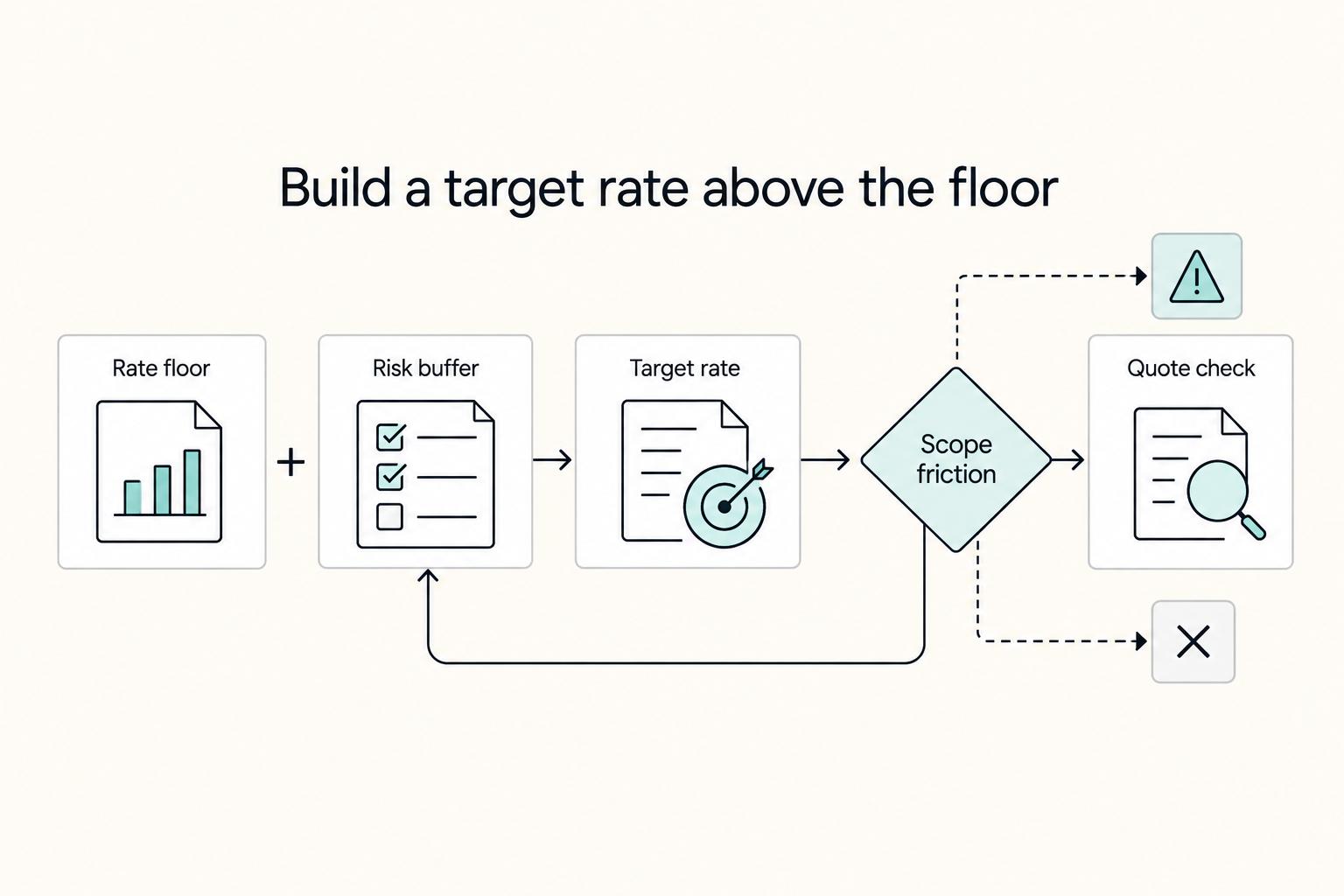
A workable rate is not the neat number a calculator produces. It is the number that still works after you account for real billable capacity, non-client time, scope drift, and the gap between sending an invoice and receiving cleared cash. Start with hourly math even if you do not plan to bill hourly, then turn that number into a quote with clear `payment terms`.

Singapore GST for Freelancers: Threshold, Registration, Invoicing, and Filing
Before you get close to registration, put four controls in place: turnover monitoring, separate handling for tax cash, invoice readiness, and consistent revenue classification. Those basics do most of the work. They help you count taxable turnover correctly, spot issues early, and avoid a rushed cleanup later.

The Freelance Payment Penalty: A Modeled Audit of Platform Fees, FX Spreads, and Payout Delays
The money rarely disappears through a single, easy-to-spot fee. The real loss is stacked. A marketplace takes its commission, a processor adds a charge for international cards, a bank or payment company converts the currency at a spread, a platform holds the funds before release, and a wire sheds a little to intermediaries on the way in. Each layer looks defensible on its own, but the worker feels the combined result as a smaller deposit and a later payday.