
Quick Answer
Retargeting for freelancers works best as a controlled follow-up system for people who already showed interest. Start when you can define a clear signal, one next action, and measurable outcomes in-platform. Use one channel first, launch with tracking and QA gates, and manage weekly with stop/scale rules so budget, reputation, and results stay under control.
Retargeting for freelancers: run it as a controlled, documented system#
Run retargeting for freelancers like a system, not a pile of ad tweaks, so you control budget, reputation, and measurement. You are not here for a fuzzy definition. You are here for a workflow that makes the next decision obvious, even when the data looks noisy. As the CEO of a business-of-one, your job is to turn paid acquisition into a controlled process, not a recurring surprise.
A lot of freelancers do not struggle with paid advertising because they missed a "growth hack." They struggle because they run experiments without governance. They change multiple variables at once, forget what they changed, and then argue with their own data.
A playbook helps by turning retargeting into a documented system. It is similar to how some small-business marketing systems use staged plans (like a 30-60-90 plan) to force sequencing and accountability.
The controlled system (what "professional" actually looks like)#
Treat your retargeting like a small internal process, even if you work solo. That means you ship decisions with receipts.
- Documented assumptions: who you target, what "intent" means, and what counts as success.
- Approvals: even if you approve your own work, you still "sign off" before spending.
- Traceable decisions: you keep a simple change log so learning compounds.
Use this simple artifact stack (one page each, max) to keep your freelance marketing clean:
| Asset | Purpose | "No-surprises" rule |
|---|---|---|
| Assumptions sheet | Defines audience, offer, promise | Write it before you open an ad platform |
| Tracking plan | Defines what you will measure | Don't spend until measurement looks believable |
| Creative brief | Aligns message to intent | Match ad promise to landing page promise |
| Change log | Records what changed and why | Change one variable per cycle |
The framework you can execute without chaos#
Here's the four-phase flow you'll use throughout this guide:
| Step | What to do | Guardrail |
|---|---|---|
| Decide if retargeting makes sense now | Check whether you can measure outcomes yet | If you can't measure outcomes yet, it's hard to optimize |
| Pick the first channel | Match it to your real demand source | Search intent may fit a search ads platform; B2B expertise may fit a professional network |
| Launch with a pre-launch checklist | Confirm targeting, creative, landing page, and conversion tracking setup | Do this before you increase spend |
| Operate weekly with simple stop/scale guidelines | Review weekly | Pause when signals break, and scale only when results repeat |
- Decide if retargeting makes sense now (if you can't measure outcomes yet, it's hard to optimize).
- Pick the first channel that matches your real demand source. If you already run search intent, you might start with a search ads platform. If you sell B2B expertise, you might prioritize a professional network.
- Launch with a pre-launch checklist: confirm targeting, creative, landing page, and conversion tracking setup before you increase spend.
- Operate weekly with simple stop/scale guidelines: you pause when signals break, and you scale only when results repeat.
Example: you notice people hit your services page, then disappear. Retargeting and conversion optimization become your "second chance" system, but only if you track, document, and review like an operator, not a gambler.
If you want help choosing a starting platform, use this companion guide: The Best Paid Advertising Channels for Freelancers.
If you want a deeper dive, read The Best Paid Advertising Channels for Freelancers (Google Ads).
The mental model: what retargeting is (and what it is not)#
Retargeting for freelancers is follow-up to prior interest, not a way to introduce yourself to strangers. To keep your results clean, you need a hard boundary between follow-through and discovery. Otherwise, you will mix funnel stages, mix messages, and then blame the platform for confusion you created upstream.
A straightforward way to hold the line is this definition of retargeting: "a marketing strategy...to engage customers based on their previous shopping activities." Translate "shopping activities" into freelance marketing and you get the same idea. Prior interaction creates the signal, and you re-engage based on that signal. In practice, this concept can show up in email and even as dynamic targeting while a visitor is still exploring a website.
Retargeting vs top-of-funnel (don't confuse jobs)#
Retargeting reacts to existing interest. Top-of-funnel creates new interest.
Seer Interactive frames top-of-funnel this way: "Investing at the top of the funnel expands your audience, bringing in net new users you can nurture into future converters." Use that as your boundary line.
| Concept | Primary intent | Who you reach | What "success" looks like |
|---|---|---|---|
| Retargeting | Re-engage prior interest | People who already interacted | A meaningful next step happens (reply, inquiry, booking flow progress) |
| Top-of-funnel | Expand awareness | Net-new people | More qualified traffic you can later nurture |
Operator rule: if you need discovery, lean on awareness plays. If you need follow-through, retargeting and conversion optimization carry more weight.
Remarketing and the words you'll hear#
Teams often use retargeting and remarketing interchangeably. Don't litigate vocabulary. Document what you mean inside your own system.
Keep your safe default simple. If you cannot clearly explain what user action creates the audience (visited a page, started a form, requested a consult), you do not have a stable retargeting strategy yet.
Example: someone reads your case study, checks your pricing page, then disappears. Retargeting lets you re-enter the conversation, but only after you define (1) the proof-of-intent step you react to and (2) the single next step you want them to take.
When should a freelancer start retargeting - and when should you wait?#
Start retargeting when you can name a repeatable interest signal, choose one next step, and measure it consistently in-platform. Retargeting works best when you can define what "prior interaction" means and what new message you want to send based on that past action.
Retargeting targets people based on specific interactions they already had with you in a set time frame. That means you need a minimum viable signal, not perfect attribution.
If you cannot see reliable page-based audiences or action signals inside the platform you plan to use, you will end up optimizing vibes instead of outcomes.
The "minimum viable signal" gate (so you don't buy guesswork)#
Use this as your pre-spend gate for paid advertising and remarketing:
| Gate | Requirement | Article detail |
|---|---|---|
| Signal | "Visited pricing page," "Viewed case study," or "Started contact form." | Define what prior interaction creates the audience |
| Next step | One action you want next | Book a call, request proposal, or start an application |
| Measurement | More than clicks | Observe an on-site action in the ad platform's reporting |
| Funnel reality | Visitors often don't buy on their first visit | They may need multiple visits before they convert |
- Define the signal: "Visited pricing page," "Viewed case study," or "Started contact form."
- Define the next step: one action you want next (book a call, request proposal, start an application).
- Confirm measurement in-platform: you want more than clicks. You want an on-site action you can actually observe in the ad platform's reporting.
- Sanity-check your funnel reality: visitors often don't buy on their first visit, and may need multiple visits before they convert. Retargeting exists for that gap.
Example: a prospect reads your flagship case study, checks your pricing, then disappears. If you can retarget "pricing visitors" with proof-heavy creative that points to a clean booking flow, you can help recapture otherwise lost business.
When to wait (protect your budget and your learning)#
Delay launch if any of these stay true:
- Your offer and messaging aren't stable enough to keep ads and landing pages aligned long enough to learn.
- Your "signal" pages do not map to intent (for example, most traffic hits generic blog posts with no clear next step).
- You cannot answer: What page did they hit, and what should they do next? If you cannot connect that journey clearly in your funnel and measurement, fix conversion optimization first.
Here's a simple go or no-go view:
| Decision | Start retargeting now if... | Wait if... |
|---|---|---|
| Signal | You can name 1-2 high-intent pages or actions | You cannot define meaningful intent |
| Measurement | You can observe the signal inside the ad platform | You only see clicks, not outcomes |
| Messaging | Your offer and messaging stay stable | Your offer and messaging keep shifting |
| Funnel | You expect multiple visits before action | You do not have a clear "next step" page |
Which platform should you pick first: Google Ads, Facebook, or LinkedIn?#
Start with the platform that matches how your prospects behave, then retarget people who've already shown a clear signal of interest. Platform choice is not a philosophical debate. It is a fit question: are people searching for a solution, or discovering you while they scroll?
At a behavior level, Google and Facebook start from different places. LeadEnforce puts it plainly: "They're built on very different user behavior."
Google Ads targets users "actively searching for something (a product, service, or solution)." Facebook Ads targets people based on "interests, behaviors, and demographics," and "they're scrolling through content, and your ad appears along the way." That difference matters because it changes what your retargeting message should do.
Platform fit, in operator terms (what to expect and how to use it)#
Use this table as your safe-default map:
| Platform | How intent shows up | What retargeting tends to support | Safe first audience to build |
|---|---|---|---|
| Google Ads | Search-driven intent (people actively look for a solution) | Follow-up that matches search-driven interest and keeps the next step simple | Visitors to your core service page(s) and pricing page |
| Facebook Ads (Meta) | Feed-driven discovery (interests, behaviors, demographics, engagement history) | Repetition and recall while people scroll. Strong for credibility assets that reduce uncertainty | Visitors to case studies, about page, or portfolio (then send to a clear next step) |
| Not covered by the sources in this section | Not covered by the sources in this section | If you plan to use it, validate that you can build usable retargeting audiences before you commit |
Note: Facebook Ads can run across Facebook, Instagram, Messenger, and the Audience Network, so you can stay consistent where your prospects already spend time.
A simple decision rule (no spreadsheets required)#
Make the call based on how the original intent shows up:
- If prospects find you by searching for a service, start with Google Ads retargeting.
- If prospects discover you while scrolling social content, start with Facebook (Meta) retargeting.
- If you're considering LinkedIn, treat it as a separate evaluation. This section's sources do not support specific LinkedIn retargeting guidance.
Example: a prospect reads your case study, checks pricing, then goes quiet. If that visit came after a search, your Google follow-up can stay tightly "solution now." If it came from social scrolling, your Meta follow-up should lean heavier on proof and clarity, then move them to one clean booking step.
The minimum setup before you spend $1 (tracking, pages, and QA gates)#
Treat tracking as your budget safety system. Before you spend on retargeting, make sure you can measure what "success" means. No matter the channel, shaky measurement turns every optimization decision into a guess.
The Digital Cauldron frames analytics as foundational: "But measuring alone isn't enough. Precise, insightful analytics are the engine of informed decision-making." They also cite large performance gaps for teams that use customer analytics heavily.
You do not need enterprise tooling to act on the underlying point. You need clean definitions and a QA habit.
1) Your "retargeting-ready" flow (one offer, one next step)#
Before you touch remarketing spend, build a single landing flow that eliminates decision noise:
- One offer page that says who it's for, what they get, and what happens next.
- One primary action (book, apply, purchase, or submit).
- One clear confirmation step (a thank-you page or an equivalent "success" state) so you can count outcomes consistently.
Example: a prospect clicks your retargeting ad and lands on a page with three competing actions. Even if performance improves, you will not know whether the ad worked or the page simply scattered attention.
2) QA gates (pre-launch checklist you actually run)#
Run these gates before you spend the first dollar. Keep it boring. Keep it repeatable.
| QA gate | What "good" looks like | What to do if it fails |
|---|---|---|
| Conversion definition exists | Your team has one defined outcome you plan to optimize for | Pause launch. Define the outcome first |
| End-to-end test | You can complete the intended action yourself and see it recorded where you plan to optimize | Simplify the flow. Retest until it records consistently |
| One conversion definition | Everyone on the project agrees what counts as a conversion (lead, booked call, purchase) | Write a one-sentence definition and use it everywhere |
Governance tip: keep your conversion definition written down somewhere everyone can find it, and update it when you change it.
Campaign structure that doesn't waste money: segments, sequencing, and message-match#
Build campaigns around observable behavior so you pay for relevance, not repetition. Once tracking is stable, structure is what keeps spend from leaking. Your goal is simple: segment by what they did, tailor the message to that behavior, and keep your next step clear.
LeadsBridge defines the core job plainly: Facebook retargeting ads "re-engage people who have visited your site or interacted with your brand in the past." They also note that "Visitors rarely buy the first time they visit your site." Your structure should assume return visits happen, then make those return visits productive.
Segment by intent (behavioral beats vibes)#
Behavioral retargeting uses actions as intent signals. LeadEnforce puts it directly: "Behavioral retargeting looks at users' actions: how long they stayed on your site." They add, "These behaviors suggest intent."
This is different from interest-based targeting, which is about casting a wider net using things like profiles, page likes, and content engagement. Retargeting structure gets tighter when it's anchored to what someone actually did.
Build separate audiences based on actions, not guesses. A practical starting template:
| Segment (behavior) | What it usually means | Ad angle to test | Landing page to send them to |
|---|---|---|---|
| High-intent visitors | They evaluated a decision step | Next step clarity, removing friction | A focused decision or conversion flow |
| Proof/credibility consumers | They're looking for reassurance | Outcomes, process, "here's how it works" | A relevant proof or explainer page |
| Light engagers (time on site, video engagement, key clicks where available) | Interest, unclear readiness | Simple value prop, what happens next | Your best explainer, not your hardest sell |
Example: someone reads a service page and bounces. Retarget them with proof and a clear next-step CTA that fits what they looked at, not a generic "we do everything" brand ad.
Sequencing + system thinking (so ads do less work)#
Sequencing means you control what people see next, instead of showing the same thing on repeat. Used well, it keeps frequency useful and helps different intent levels move forward at their own pace.
ClicksGeek calls out the real scope here: marketing includes "landing page optimization, conversion tracking, audience segmentation, retargeting campaigns, and continuous testing." You win by distributing work across systems and testing continuously, not by trying to brute-force performance from one audience or one ad set.
DIY vs hire: the freelancer decision framework (and how to manage specialists without losing control)#
DIY retargeting only if you can keep tracking QA, segment-specific creative, and weekly governance consistent. Campaigns do not fail because you did not know what to do. They fail because nobody consistently does the basics on schedule.
The DIY test (3 capabilities, no excuses)#
DIY works when you can do these three things consistently:
| Capability | What consistent looks like | Article note |
|---|---|---|
| Install and QA the pixel and events | Confirm the right tags fire on the right pages, and conversions show up inside your ad platform | If you cannot QA, you cannot trust results |
| Write 2-3 strong ads per segment | Create one credibility ad, one "what happens next" ad, and one direct CTA per audience | Retargeting and remarketing reward clarity |
| Review metrics weekly without procrastinating | Block time, open your ad platform, and make one controlled change | If you skip weeks, you burn learning and confuse optimization |
If you want an external sanity check, MJ Marketing frames four Google Ads management options (complete DIY, DIY with tools or courses, freelancer, agency). They associate "DIY with tools/courses" with a meaningful time commitment. Use that as a reality check, not a badge of honor.
When to hire (and how to keep control anyway)#
Hire when your opportunity cost exceeds your learning cost. If billable client work is the constraint, pay for expertise so you protect focus.
ClicksGeek makes an operational point worth taking seriously. Acquisition stacks can include landing pages, conversion tracking, retargeting, email follow-up, and continuous optimization. When those pieces drift, budget leaks through gaps nobody owns.
Use spend frameworks as context, not laws. Different sources give different ranges:
| Model | When it tends to fit | Example ranges cited by sources |
|---|---|---|
| DIY | You have time, low spend, and high tolerance for learning | Under €1,000 (MJ Marketing). Under $500/month (Marketing Magnitude). |
| Freelancer specialist | You want an individual specialist with direct contact and flexible scaling | €1,500-5,000 (MJ Marketing). $500-$1,000/month (Marketing Magnitude). |
| Agency | You need a professional team and established process | €3,000+ (MJ Marketing). $1,000-$10,000/month (Marketing Magnitude). |
Non-negotiable: keep ownership of accounts, pixels, audiences, and creative. Never let a specialist run your retargeting inside their accounts where you cannot audit history or retain assets.
Use a specialist scope that protects you:
- Setup + QA + first campaign build (for your ad platform)
- A short optimization window (so you see how they think)
- A reusable reporting template (plus a simple change log)
Where to hire: marketplaces and packaged services can work if you enforce deliverables. Either way, you still need full visibility into what they change.
Example: you hire a retargeting specialist. You give them admin access to your ad account, ask for proof of tag verification, insist on naming conventions, and review one weekly report. You stay the operator. They supply the hands.
Related: How to Create Your Own Online Course.
Compliance and risk controls: privacy, policy variation, and safe defaults#
Treat retargeting as a data and reputation workflow first, and a paid advertising tactic second. This is not about legal theater. It is about being able to answer, clearly and calmly, what you track, why you track it, and what a user can do about it.
Conversations about retargeting and remarketing often pull in identifiers and tracking terminology that people recognize (and sometimes distrust). Browser cookie often refers to a small piece of data stored in a browser. Pixel often describes a vendor "tag" that reports site actions back to another system. JavaScript describes a common way teams implement those tags on websites.
You do not need to obsess over the jargon. You do need to treat transparency as non-negotiable.
A practical anchor: Gun.io frames the purpose of a privacy policy as helping users "UNDERSTAND HOW WE TREAT YOUR PERSONAL INFORMATION AND WHAT CHOICES AND RIGHTS YOU HAVE." That mindset forces you to write what you actually do, not what a template claims you do.
Low-drama compliance steps you can actually maintain#
You cannot outsource accountability to platform defaults. Build a simple, auditable routine:
- Update your privacy policy so it clearly discloses advertising and measurement practices (including any retargeting-related tools you use). Keep it readable enough that a buyer can skim it without feeling tricked.
- If you use a cookie/notice/consent banner, pick a tool that matches your market and risk posture. Do not assume it works. Click through your own banner choices and confirm the site behavior matches your intent.
- Maintain a change log for tracking and data sharing settings. Record the date, what changed, why you changed it, and who approved it. Gun.io displays a "last updated" date (July 10, 2024) on its privacy policy. Copy the habit, not the exact wording.
Here's a clean operator table you can use immediately:
| Risk | Control | What to record |
|---|---|---|
| You cannot explain your tracking | Privacy policy disclosure | Policy link + last update date |
| "We didn't mean to collect that" | Banner QA (if you use one) | Screenshots of settings + your test notes |
| Mystery performance swings | Tracking change log | Tag/settings changes + approver |
Example: you hire a contractor to "improve conversion optimization" and they toggle a data-sharing setting inside an ad platform. Your change log catches it quickly, you update disclosures if needed, and you avoid weeks of confused reporting.
Brand risk control: protect reputation like an asset#
Freelance marketing runs on trust. Use frequency caps, exclude converters, and avoid sensitive or "creepy" audience definitions. If your ads start to feel like stalking, prospects will remember that longer than they remember your portfolio.
Measurement that keeps you in control: KPIs, review cadence, and stop/scale rules#
Run retargeting like a system: define success, enforce reliable events, review a small KPI stack, then change one variable at a time. Measurement is your control surface. Without it, you will do what most teams do: argue about attribution, second-guess spend, and keep "optimizing" in circles.
Directive Consulting describes "disciplined programmatic ad management" as "tightening the signals you feed platforms, controlling exposure, testing creative with intent, and measuring impact." That maps cleanly to freelance marketing. You do not need more dashboards. You need one definition of success and events you can trust.
A freelancer-friendly KPI stack (primary, secondary, guardrails)#
Start with a stack that answers three questions: did we buy outcomes, did the page do its job, and did exposure stay sane?
| KPI tier | What you track | Why it matters | What you do with it |
|---|---|---|---|
| Primary | Cost per lead or cost per booked call (by channel like Google Ads or LinkedIn) | Your business runs on profitable conversions, not clicks | Decide pause, continue, or scale decisions |
| Secondary | Landing page conversion rate (your Conversion Rate Optimization lever) | If ads get attention but the page leaks, retargeting cannot save you | Prioritize page fixes before you "fix targeting" |
| Guardrails | Frequency, spend pacing, and time-to-convert | Prevent overexposure and over-crediting retargeting | Diagnose fatigue, attribution lag, and budget drift |
Two measurement rules that keep you honest:
- Keep one primary conversion. If you track everything, you optimize nothing.
- Protect event quality. Directive warns that "When goals are vague or events are messy, even the smartest bidding algorithms can't steer toward meaningful outcomes."
Review cadence + stop/scale rules (anti-waste by design)#
Block a recurring review window and follow the same checklist every time:
- Spend pacing: confirm you stay within your budget cap in-platform (Google Ads, Facebook, LinkedIn).
- Conversion volume and cost: compare actuals to your target, then ask "what changed?"
- Audience size trend: shrinking pools usually mean your funnel dries up upstream, not that remarketing "stopped working."
Stop or pause fast when:
- Tracking breaks: you see zero conversions plus broken tag or pixel signals. Fix the JavaScript implementation and QA before you spend again.
- Frequency climbs but conversions stay flat: assume ad fatigue or message mismatch. Refresh creative or tighten the audience. Do not just raise bids.
Scale only after performance holds steady across multiple reviews, not after one lucky day.
Finally, keep reporting boring: export a simple snapshot each review cycle (spend, conversions, cost, frequency, notes). If you later want dashboards, use whatever reporting setup fits your workflow after the campaign stabilizes.
One-page habit that compounds: maintain a change log (what you changed, when, why). AdManage.ai puts it plainly: "reporting is trusted because tracking standards are actually enforced." Your log is how you enforce them.
Example: you swap landing page headlines to better match a Conversion Rate Optimization service page, and conversions improve. Your change log captures the single variable, so you can repeat the win instead of "testing" the same idea again three weeks later.
The close: your retargeting operating checklist (launch + weekly)#
Run retargeting for freelancers like an operator: set up reliable measurement, ship campaign-ready ads, then review on a fixed cadence with clear next steps. This is the part most people skip. Not because it is hard, but because it is boring. Boring is also how you keep paid advertising accountable.
A structured advertising strategy focuses on targeting, continuous optimization, and performance tracking because that structure drives scalable growth. Treat your retargeting campaign the same way, even if you run it solo.
Safe-default launch checklist (one working session)#
Use this as a pre-flight gate before you spend.
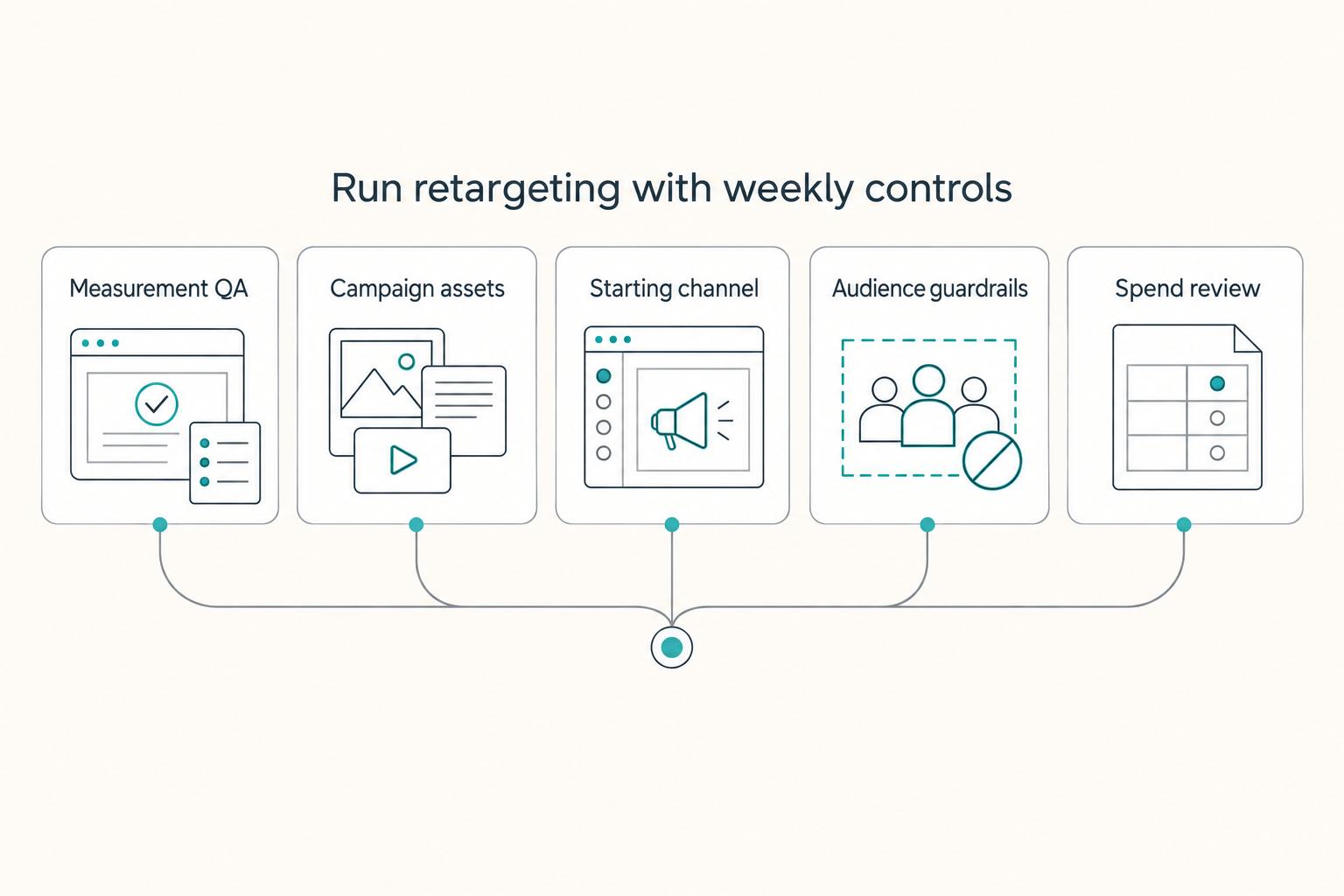
- Measurement QA (do not skip): Confirm your setup records the actions you care about on the pages that matter (for example, a confirmation page after a form submit). Verify real actions show up in your reporting, not just clicks.
- Plan, generate, ship: Use a simple 3-step flow to plan the campaign, generate the assets, and ship campaign-ready designs.
- Pick a starting channel you can actually run: If you are juggling too much, start with one place so your workflow stays manageable.
- Define targeting and guardrails: Decide who you want to reach and what "not a fit" looks like, so you are not paying for obviously wrong impressions.
- Write down your spend comfort zone and how you will judge it: Decide what "good," "unclear," and "not working" look like based on the outcome you track.
| Phase | Your goal | Output |
|---|---|---|
| Launch | Reduce unknowns | Verified measurement + campaign-ready assets + clear evaluation criteria |
| Weekly or biweekly | Compound learning | Ongoing optimization + tracked results |
Weekly checklist (keep it boring, keep it profitable)#
Pick a fixed day and time.
- Review performance and spend: Track what you spent and what you got back from it so you can maximize returns.
- Make one deliberate improvement: Adjust what you are running based on what the data is telling you.
- If it helps, keep a quick note: A simple line in a doc is enough to remember what you changed and what happened.
Example: outcomes flatten. You refresh the message to better match the landing-page promise and keep monitoring to see if results recover.
Final rule: treat retargeting and remarketing as a governed system. When you run it with structure and review discipline, you turn freelance marketing into an asset instead of a recurring surprise.
If you're building a bigger operation, apply the same mindset across positioning and operations with A Freelancer's Guide to Building a Personal Monopoly.
Frequently Asked Questions
What is retargeting for freelancers, in one sentence?
Retargeting for freelancers means you show ads to people who already interacted with your site or social profile, using that prior action to decide who sees what next. Disruptive Advertising defines retargeting as targeting specific segments of your audience based on specific interactions, then sending new messaging based on that past action. Practically, it is how you follow up with existing interest instead of paying to start from zero.
Is retargeting for freelancers top-of-funnel or conversion-focused?
Retargeting can support different funnel stages, depending on what you say and what you ask people to do next. You can run direct "next step" messages, or lighter credibility messages for people who are interested but not ready. The funnel stage is determined by the offer and the destination, not just the targeting method.
When should a freelancer start retargeting?
Start when you can (1) name a repeatable interest signal and (2) point that person to one clear next step (book a call, request a proposal, join your list). GoDaddy notes that many first-time site visitors leave without purchasing anything, and retargeting can help bring some of those people back. If you are still changing your offer every week, stabilize that first so your ads and landing page can stay aligned long enough to learn.
Should freelancers run retargeting themselves or hire a specialist?
Run it yourself if you can consistently handle measurement checks, write segment-specific creative, and do regular reviews without slipping. Hire when the basics are not happening reliably, because small gaps can waste spend (unclear goals, mismatched messaging, or not noticing when performance changes). Either way, keep control by writing down your conversion goal and audience rules before you spend.
Which platform should freelancers choose first: Google, Facebook, or LinkedIn?
Choose the platform based on where your prospects already interact with you and where you can reliably reach people who have already engaged. Pick one platform first so you can learn cleanly, then expand once your messaging and measurement are stable.
What minimum setup is needed before launching retargeting?
You need (1) a clear conversion action, (2) a page or flow that matches the ad’s promise, and (3) a reliable way to build audiences from prior interactions and measure outcomes in your advertising system. Mailchimp frames remarketing as ads or follow-up emails you get after you check out a site but do not purchase, so you also need a plan for what you will say the second time around. Keep the first launch narrow so you can QA quickly and iterate with control.
How do freelancers know when to pause or scale a retargeting campaign?
Pause when your measurement stops being trustworthy or when outcomes no longer justify the spend. Scale only after results hold steady across multiple reviews, not after one spike. Expect iteration: remarketing is built for people who check out a site but do not purchase, so your job is to tighten message-match and measurement until follow-through is consistent.
Try a related tool
Researched and edited by the Gruv editorial team. Gruv builds cross-border billing, payouts, and finance-operations software for global businesses.
Sources
Includes 6 external sources outside the trusted-domain allowlist.
- sec.gov/Archives/edgar/data/2039096/0001493152250089...trusted
- web-docs.stern.nyu.edu/marketing/Website/Marketing%20Science%20Prog...trusted
- neilpatel.com/blog/effective-retargeting-strategiesexternal
- neilpatel.com/blog/effective-retargeting-strategiesexternal
- retargeter.com/what-is-retargeting-and-how-does-it-workexternal
- retargeter.com/what-is-retargeting-and-how-does-it-workexternal
- upwork.com/hire/retargeting-freelancersexternal
- upwork.com/hire/retargeting-freelancersexternal
Educational content only. Not legal, tax, or financial advice.
Related Posts

The Best Paid Advertising Channels for Freelancers (Google Ads
**Treat paid advertising as a cashflow system you can run weekly, not a one-off "channel test" you hope works.** If you are starting from zero, or dealing with inconsistent referrals, your real job is to choose and operate channels that do not break your follow-up, your measurement, or your bank balance. Judge channels by execution reliability, not hype.

How to Create Your Own Online Course
If you want this to become a real revenue line, treat it like a product decision, not a content project. This guide helps you make the important calls in the right order: define the offer, choose the platform that fits it, and move from outline to published course without avoidable rework.
A Freelancer's Guide to Building a Personal Monopoly
Start by defining one narrow buyer problem before you polish your bio. If a buyer cannot tell what you solve, more visibility can just spread ambiguity.