
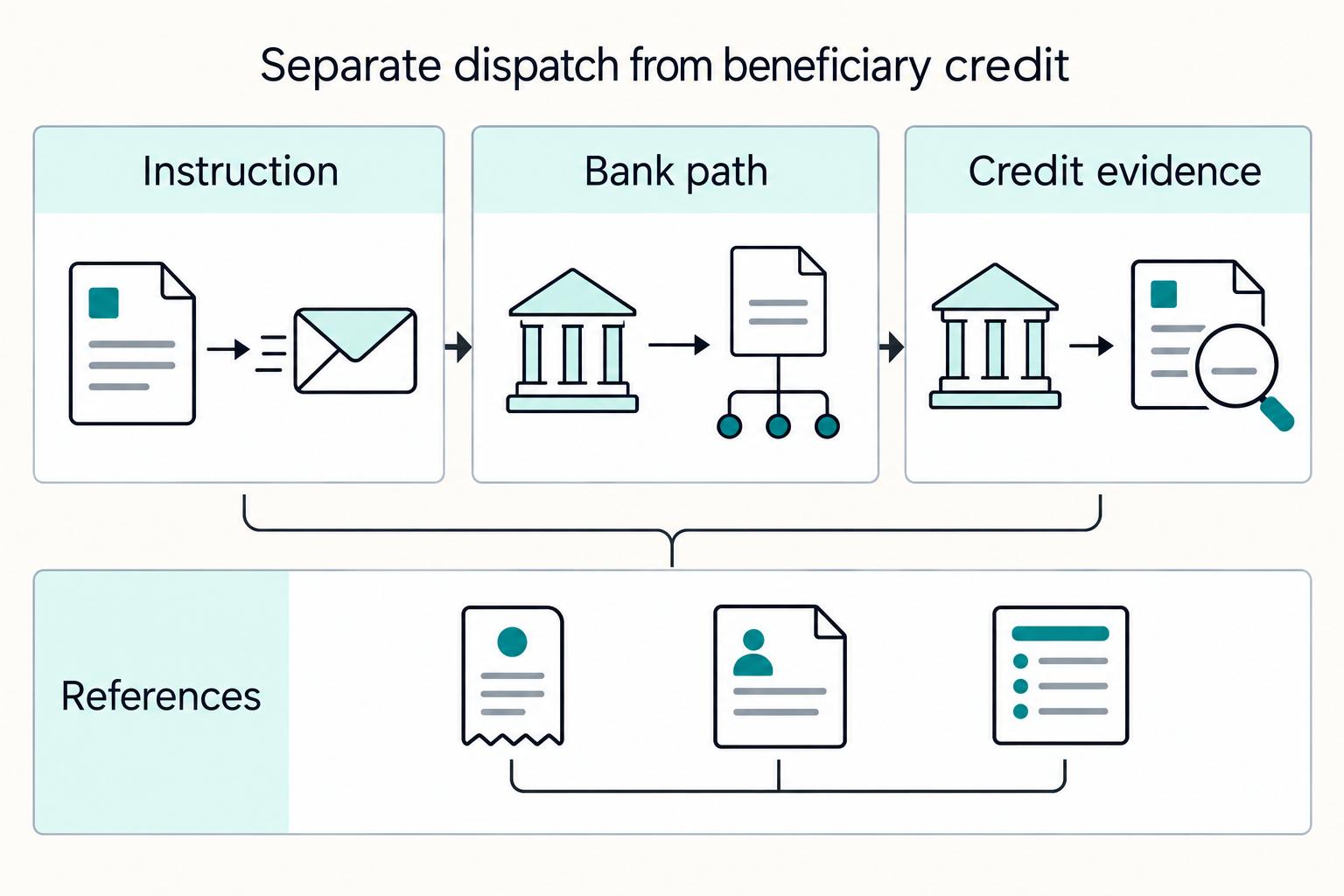
Quick Answer
SWIFT payments use a secure messaging network to send cross-border payment instructions, while funds actually move through correspondent and intermediary banks. For platform teams, timing, cost, and traceability depend on the corridor, routing path, participants, and operating controls, not the message alone. Use SWIFT when bank interoperability matters more than local-rail simplicity, and use local rails when corridor behavior is a better fit.
SWIFT payments for platform teams without the usual blind spots#
For platform teams, SWIFT is a production payout path, not just a generic "wire" label. SWIFT is a secure messaging network, while funds move through correspondent and intermediary banks, so the real outcome depends on routing, participants, and operating controls, not the message alone.
Cross-border payouts still often run on SWIFT messaging even as domestic and regional rails get faster. That makes rail choice a corridor decision. Use SWIFT when cross-border bank interoperability is the priority, and prefer local rails such as SEPA when local coverage and operating behavior are a better fit. The point is not that one rail always wins. Settlement models differ, from batch windows to instant flows, and your delivery promise needs to match the rail you actually use.
This guide focuses on production reality: initiation, routing, status tracking, failure handling, and the checks worth doing before you put a corridor under real volume. The practical takeaway is simple: SWIFT can provide broad cross-border interoperability, but it usually comes with more moving parts.
When SWIFT is the right rail#
Use SWIFT when cross-border interoperability across banks matters more than local-rail simplicity, especially where local schemes are not the best fit for that corridor. It is also the practical path when your provider's cross-border setup depends on bank messaging and correspondent relationships.
Use local rails when corridor coverage and operating behavior line up better with your payout goals. SEPA is a clear example for euro-area credit transfers. Choose the rail for how it behaves, then align product messaging and support playbooks to that behavior.
What to validate before launch#
Before moving a corridor into production, make sure all three of these are true:
- Routing logic is configured for the selected rail and fallback path.
- APIs and payout states reflect that rail's actual behavior.
- Operations and compliance have reviewed downstream impacts.
This is where hidden risk shows up. A rail rollout can change downstream systems, controls, and compliance workflows that looked fine during implementation and then surface once live volume starts.
Set the production bar early: support can trace payout status, finance can reconcile outcomes cleanly, and product can distinguish instruction sent from funds credited. If those controls are missing, the risk is operational, not just technical.
The outcome you are aiming for. The goal is to reduce avoidable failures and support escalations, clarify timing and cost expectations, and keep audit trails finance and operations can trust. In some setups, GPI features can improve speed, tracking, and cost transparency, but you should still plan for variance.
That thread runs through the rest of this guide. Treat SWIFT as a multi-party production path, and decisions about rail choice, traceability, and launch readiness get much easier.
For a step-by-step walkthrough, see How Platforms Choose International EFT Payments Across Borders.
SWIFT is messaging and correspondent banking is money movement#
SWIFT sends standardized payment instructions, but it does not move funds. Money moves through correspondent accounts or clearing systems, sometimes with intermediary banks in the chain.
That distinction matters operationally. A message can be accepted and routed while settlement is still in progress. Keep instruction sent and beneficiary credited as separate states across product, finance, and support.
A BIC identifies a business party, commonly a bank in a payment instruction, rather than the beneficiary account. It has eight characters, with an optional three-character branch identifier. Valid format alone does not establish that the bank supports the route or that the account belongs to the intended beneficiary.
For in-scope cross-border interbank payment instructions, the MT/ISO 20022 coexistence period ended on 22 November 2025. Swift now requires ISO 20022 for those instructions. A corporate channel, legacy record or provider-generated view may still expose MT103-style data; confirm the actual message and trace artifacts rather than assume every new wire creates an MT103.
Prepare for the upcoming CBPR+ address change on 14 November 2026. Swift requires structured or hybrid postal addresses for applicable parties, including town and country in their designated fields; entirely unstructured addresses are being removed. Check the detailed message and party exceptions in the official guidance. Preserve other required address data as well; town and country alone are not a universal complete beneficiary record.
If you want a deeper dive, read Correspondent Banking Explained: Why Your International Wire is So Slow and Expensive.
The payment data that must be right before you send anything#
Treat routing data, account data, and instruction data as separate release-critical inputs. Avoidable failures can start with mixed fields, incomplete beneficiary details, or instructions buried in free text.
| Item | Article description | Operational note |
|---|---|---|
| BIC (Business Identifier Code) | For institution routing, not account identification | Eight characters plus optional three-character branch identifier; validate the actual bank |
| IBAN (International Bank Account Number) | Identifies the account in markets and programs that use IBAN | Keep BIC and IBAN in distinct fields |
| For Further Credit (FFC) instruction | If part of your flow | Capture it in a dedicated field or object, not a generic memo box |
Use each identifier for its actual job#
A BIC, or Business Identifier Code, has an eight-character business-party identifier and an optional three-character branch element. Keep it separate from account identifiers. Validate the exact bank and branch against authoritative routing data in addition to checking format.
An IBAN (International Bank Account Number) does a different job. It identifies the account in markets and programs that use IBAN. Keep BIC and IBAN in distinct fields so ops can quickly tell whether a failure is routing-related or account-related.
Capture instructions explicitly#
If For Further Credit (FFC) instruction is part of your flow, capture it in a dedicated field or object, not a generic memo box. Free-text handling can make it harder to confirm whether onward-credit instructions were mapped into the outgoing message.
Use clear internal labels and a review path for records that include nested beneficiary details. For a deeper breakdown, see A Guide to the 'For Further Credit' (FFC) Instruction in Wire Transfers.
Validate before release, not after rejection#
Cleaner input data supports cleaner automation and less avoidable operational work. Before a transfer leaves draft or review, validate:
- Identifier checks: validate format and authoritative routing data; confirm the actual account and bank requirements.
- Beneficiary data consistency: beneficiary details are present and captured consistently across transfer and compliance records.
- Country or program fit: account-format checks aligned to destination-market or provider requirements, including IBAN contexts where applicable.
- Beneficiary changes: verify new bank details through a trusted contact channel independent of the change request; valid format does not establish ownership.
A practical control is to block final ready-to-send status until routing identifiers and beneficiary data pass formatting and compliance checks. This is an internal operating rule, not an industry law, and it can help reduce avoidable investigations.
Related reading: Choosing SWIFT or Local Bank Transfers for Cross-Border Platform Payouts.
How a SWIFT transfer actually runs from API call to beneficiary credit#
An accepted API call starts the payment instruction. It does not finish the transfer. Funds may still move through multiple bank relationships before the beneficiary is credited, so initiation, dispatch, and credit should be separate operational states in your system.
From API initiation to SWIFT message dispatch#
After approval, the provider or sending bank constructs the instruction using the applicable channel and message format. For an in-scope CBPR+ customer credit transfer, the ISO 20022 instruction is commonly pacs.008. API acceptance does not prove dispatch or beneficiary credit.
Persist the internal obligation ID, attempt ID, provider transfer ID, bank references and UETR when exposed. Keep the instruction or message copy the provider actually supplies, with its format and timestamp. Do not overwrite earlier identifiers as new references arrive.
What happens in the correspondent chain#
Once the message is sent, visibility gets harder. When the sender and receiver banks do not have a direct relationship, the transfer can move through one or more correspondent banks. In some corridors, it can move through two or three intermediaries, with added cost and latency at each hop.
Each bank in the chain can run sanctions and AML screening, including manual review. That is why a payment can be "sent" in your product and still not be available to the recipient. For support, the useful question is not only whether the message was sent, but which institution last reported handling the transfer and which reference you have for that stage.
If the provider exposes Swift gpi tracking, retain its timestamps and reported stages. Ask which event confirms beneficiary credit or onward transfer; tracking access and visibility depend on the bank and product, and are not a delivery guarantee.
The records that make tracing possible#
Trace quality depends on whether the right artifacts were saved early. Provider event models differ, but the operational goal is the same: keep enough linked records to answer "where is the wire?" without rebuilding the history from scratch. A useful minimum is:
- Actual message or instruction copy, its format, and UETR when exposed by the bank or provider
- Bank and provider references returned as the transfer progresses
- Status events with timestamps from your internal workflow and provider updates
Keep these tied to the transfer record with immutable identifiers. PMPG cover-payments guidance explicitly includes reference identification as a practice topic, and that is useful in real operations because references are how payment-chain questions get resolved.
For a deeper MT103 refresher, see What is a SWIFT MT103 and How to Use It to Trace a Wire Transfer.
Where nostro settlement changes the picture#
A valid message and a completed settlement are not the same thing. As routing progresses, the sending bank can debit its nostro account at a correspondent while beneficiary credit is still pending.
This can create message-to-money timing gaps in practice: the instruction exists, references exist, and settlement is still moving through the chain. Reconcile three tracks separately: the instruction sent, the references returned, and cash movement in your books. Do not collapse all of that into a single completed state until your provider or bank confirms beneficiary credit.
We covered this in detail in What Is a SWIFT Code? How Platforms Use BIC Codes to Route International Payouts.
Why SWIFT costs vary and how to forecast total landed payout cost#
Once you understand the path, the cost pattern makes more sense. SWIFT landed cost is variable, so model it as a fee stack, not a single line item. For each payout, include sender-side charges, possible correspondent or intermediary deductions, beneficiary-side handling, and FX spread when conversion is involved.
Several banks can participate in a route and may charge under the applicable fee arrangement. Compare instructed amount with confirmed beneficiary credit, and identify which charges were deducted from the principal versus charged separately to the sender.
The fee stack you actually need to model#
Teams can under-forecast by stopping at the visible provider fee. Use a component view so payout shortfalls and margin erosion show up before scale.
| Fee component | Who controls it most | Predictability | Mitigation lever |
|---|---|---|---|
| Sender bank or provider wire fee | Your bank or payout provider | Usually the most predictable | Track quoted fees by corridor and compare providers |
| Correspondent or intermediary bank deductions | Banks in the settlement chain | Often low to medium | Map likely route hops and monitor deductions on live payouts |
| Possible beneficiary-side handling fee | Receiving bank | Medium to low | Set recipient expectations and collect corridor-level outcome data |
| FX spread or conversion fee | Provider, sending bank, receiving bank, or a mix depending on conversion point | Medium if quoted up front, low if conversion point is unclear | Require pre-send FX visibility and use local rails where available |
Surprises often come from charges you do not directly buy. If a provider can quote its own transfer fee but cannot confirm downstream deduction exposure, treat the net delivered amount as uncertain in your forecast.
Why charge models change beneficiary outcomes#
Record the supported charge option and your commercial promise separately. Legacy OUR/SHA/BEN labels correspond broadly to sender/shared/beneficiary charging; ISO 20022 uses charge-bearer codes such as DEBT/SHAR/CRED. Availability and permitted treatment depend on the route. Choosing a sender-pays option alone is not proof that every downstream fee is covered or that the exact promised net amount will arrive.
Route shape matters. Fewer-bank routes are usually easier to forecast. Multi-hop routes are less predictable and can create more support and reconciliation work when recipients expect a specific credited amount.
The practical decision rule#
If your margin sensitivity is high, require pre-send landed-cost estimation and corridor-level approval before scaling volume. A usable estimate should include:
- send currency and receive currency
- known sender-side fee
- where conversion happens in the flow
- expected intermediary-deduction risk for that corridor
- likely beneficiary-side fee exposure
- the commercial promise to the recipient: fixed net, shared cost, or variable net
Use a hypothetical same-currency example: a USD 1,000 instruction with a USD 20 sender fee charged separately debits USD 1,020. If USD 15 is deducted by downstream banks, the beneficiary receives USD 985. Total fees are USD 35, of which only USD 20 was added to the sender debit. Do not count the USD 15 deduction again as an extra sender debit. If your contract promises USD 1,000 net, confirm a supported fee arrangement or an approved adjustment rather than assume the original instruction meets the promise.
Where teams usually get burned#
A common failure is treating visible wire fees as total economics and only later discovering margin leakage from intermediary deductions or FX spread. Another is assuming one corridor's behavior applies to another.
Better structured payment data can reduce manual processing cost, which is one reason ISO 20022 matters for operations quality. But cleaner data does not remove landed-cost uncertainty by itself. The durable approach is corridor-level measurement and approval before scaling SWIFT payout volume.
You might also find this useful: Why International Wire Transfers Arrive Short and How to Reduce Fee Leakage.
Why delivery times vary and how to set realistic payout promises#
Cost is only half the promise. Timing is the other half, and transfer timing can vary across bank chains and operating hours, so set payout promises as ranges, not single-point ETAs. In these flows, a message can be accepted before funds are actually credited to the recipient. If your product marks a payout as completed at message acceptance, it can overstate progress and create avoidable support questions.
Separate message state from money state#
Use at least two statuses:
instruction accepted: the payment message entered interbank processing.funds credited: the receiving side processed the transfer and made funds available.
If your provider only shows statuses like "sent" or "processed," confirm whether that means message transmission or beneficiary availability. If that mapping is unclear, treat timing confidence as low and keep the customer window broad.
What usually slows delivery#
- More banks in the chain: each additional institution can add processing time.
- Verification and compliance checks: banks verify identity, assess fraud risk, and confirm regulatory requirements before completion.
- Receiving-side processing and bank availability: the recipient bank may be closed or in a different time zone when the transfer arrives.
Timing ranges you can publish#
Publish an estimate supported by the provider and observed results for the exact corridor, currency and cut-off. State its starting point and whether days are business or calendar days. Set an escalation trigger for overdue transfers; a broad range is not a guarantee or a reason to leave an aged transfer uninvestigated.
| What you can verify | Customer-facing promise |
|---|---|
| Provider estimate plus observed corridor results | Publish a qualified range measured from the stated submission or dispatch point |
| Partial stage visibility | State the estimate and uncertainty; provide the investigation trigger |
| Known review or missing required data | Show action needed or review pending; update the estimate after the issue is resolved |
When corridor data is opaque, the missing facts are often stage-level details: which institutions handled the payment and whether the beneficiary bank has posted funds yet. That is why a range is more reliable than a fixed ETA. Use completed only for confirmed credit, not message acceptance.
For the full breakdown, read Xero + Global Payouts: How to Sync International Contractor Payments into Your Accounting System.
Choosing SWIFT vs local rails for each payout corridor#
Select a supported local route or SWIFT before sending based on reach, cost, amount, urgency and required data. After dispatch, a fallback is a new attempt: do not use another route until the original is confirmed unable to complete and the obligation has been checked for duplicates.
SWIFT is a global messaging network for cross-border instructions, and funds may pass through multiple correspondent banks before final credit. Local rails such as SEPA and ACH network style schemes route through domestic or regional networks, which can reduce intermediary complexity and improve speed and predictability where coverage exists.
Where each rail wins#
For eligible euro transfers, compare SEPA Credit Transfer and SEPA Instant against the offered SWIFT route. Confirm scheme participation, amount and account support, required identifiers, operating times and the actual provider quote. An IBAN identifies the account; provide BIC only where the channel requires it.
SWIFT can provide access where a local route is unavailable, while gpi and UETR-based tracking can improve visibility where exposed. Confirm the bank or provider investigation path instead of assume either complete visibility or none.
For domestic ACH options, check whether the provider offers standard or same-day service, the current transaction limit, cut-offs, eligible accounts and return handling. Domestic scheme availability does not establish a cross-border service or guarantee instant beneficiary access.
| Rail | Best fit | Speed pattern | Trace and failure handling | Data to confirm before send |
|---|---|---|---|---|
| SWIFT | Broad cross-border reach, unsupported local-clearing corridors, bank-to-bank interoperability | Variable, often in business-day ranges | Use available UETR/gpi and provider or bank trace support; investigate unconfirmed credit | Destination country and currency support, beneficiary bank can receive, required bank and account fields |
| SEPA | Euro payouts where provider and beneficiary bank support the scheme | Scheme and provider dependent; verify the selected standard or instant product | Typically fewer intermediary handoffs than correspondent-chain wires | Euro corridor support, beneficiary bank scheme support, valid IBAN and, where required, BIC |
| ACH network style local rail | Predictable, high-volume domestic-style payouts where the provider offers access | Often more predictable than cross-border wires; exact timing varies by program | Lower intermediary complexity, but cut-off handling still matters | Provider corridor availability, beneficiary bank support, required domestic account details, amount limits, cut-offs |
For routing policy, set preferences by currency, corridor, amount, urgency, and risk. At run time, review corridor and currency, speed and cost, cut-offs and holidays, and data quality before each payment run.
Do not promise corridor coverage based on generic provider pages. Country, currency, product, and beneficiary-bank support can vary by program, so confirm exact eligibility in current provider documentation before you commit to local-rail routing.
For related guidance, see Same-Day ACH for Platforms: How to Speed Up Contractor Payments Without Wire Transfer Fees.
Compliance gates that block wires and what evidence clears them faster#
Once you choose SWIFT for a corridor, delays can come from compliance gates too, not just the rail itself. In practice, controls often show up in three places: onboarding, transaction monitoring, and release before funds are allowed to move.
Where controls actually hit the flow#
Identify the onboarding and due-diligence requirements for the relevant entity, jurisdiction and provider program. Collect the specific identity and business evidence required and record approval or outstanding requirements. Do not assume every beneficiary needs the same government-ID and address-document bundle.
| Control point | When it hits | Article detail |
|---|---|---|
| Onboarding | Under the applicable legal and program timetable | Verify the identity and business facts required for the specific entity and program |
| Transaction monitoring | When activity looks inconsistent with expected behavior | Reviews can be triggered by unusual transfer patterns, high-risk jurisdiction signals, device or geolocation risk indicators, or external alerts linked to sanctioned or otherwise high-risk entities |
| Release | Before funds are allowed to move | A payment can be prepared and still pause before release if AML or sanctions controls need more context |
The second gate is transaction monitoring. A payment can be flagged even when onboarding is complete if activity looks inconsistent with expected behavior. Reviews can be triggered by unusual transfer patterns, high-risk jurisdiction signals, device or geolocation risk indicators, or external alerts linked to sanctioned or otherwise high-risk entities.
The third gate is release. A payment can be prepared and still pause before release if AML or sanctions controls need more context. Treat statuses like "payment created" or "message prepared" as process milestones, not proof that funds are cleared to move.
What gets held and why#
AML and sanctions holds often reflect unresolved risk signals. Reviews typically focus on whether identity records are sufficient and whether activity aligns with expected behavior.
Ask for the specific information the authorized bank or compliance team needs through an approved secure channel. Explain permitted next steps without revealing protected investigation or suspicious-activity reporting details.
Minimum evidence pack for escalation#
When ops escalates a held wire, send one complete pack:
- Internal obligation and attempt IDs, provider/bank references and UETR where exposed
- Amount, currency, dispatch date and last reported execution stage
- Required identity/business evidence or secure references available to authorized reviewers
- Relevant transaction purpose and supporting records requested by the bank; restricted access to sensitive review details
This pack may not clear every review on its own, but it gives compliance teams enough context to identify the next missing item without restarting from zero.
What to do operationally#
Release only after applicable identity, transaction, sanctions and program checks are satisfied and the decision is authorized. A complete evidence pack can support review; it does not require a bank to lift a legal restriction.
The common failure mode is treating compliance as cleanup after scale. The same broad compliance market applies across newer cross-border rails and SWIFT, so weak evidence handling creates the same operational drag in both. Build the evidence pack at payment creation time, or make sure ops can assemble it in minutes.
Wire failure handling and trace operations your support team needs#
When a wire issue appears, treat it as a classification-and-trace problem first, not an email volume problem. Use one internal failure taxonomy, collect consistent trace artifacts, and pause blind retries until the original payment state is clear.
Classify the failure before you escalate#
Use these five internal classes so support, ops, and finance can take the right next action:
| Failure class | Meaning |
|---|---|
| Held before dispatch | The instruction is paused for required review or missing data and may resume; do not treat it as terminal rejection or send a replacement |
| Rejected pre-send | The attempt was terminally rejected before dispatch, and the provider confirms it cannot still execute; verify the reason and correct required details before an approved new attempt |
| Returned post-send | The payment was sent and later returned |
| Stuck in the intermediary chain | The instruction was sent, but credit is not confirmed and the payment appears to be in correspondent or intermediary handling |
| Credited with shortfall | The beneficiary was credited, but for less than the instructed amount |
This is an internal ops taxonomy, not an official SWIFT standard. SWIFT messages are often used to send wire instructions to correspondent banks, which may originate payments on a financial institution's behalf. Before you escalate, re-check the beneficiary account details and SWIFT code against what was actually sent, because a single mistyped value can put a payment into limbo.
Make the trace bundle non-optional#
Open the investigation with the internal obligation and attempt IDs, provider and bank references, UETR if available, dispatch time, amount and currency, and the exact beneficiary details used. Include the actual message or payment-confirmation copy and the last known status. A message copy supports tracing; it is not proof of beneficiary credit.
Establish the sender bank or provider's investigation contact and escalation process before launch. Ordinary customers should start there; direct Swift support access depends on the institution's service and permissions.
Use a consistent incident order and freeze retries early#
Run incidents in a consistent order:
- Detect the aged or disputed payment and pause automated retries.
- Classify it as held, terminally rejected, returned, unconfirmed in flight, or credited with a shortfall.
- Submit a trace request with the available trace bundle.
- Verify with the beneficiary whether the receiving bank can locate the payment using available references.
- Decide next action only after state is confirmed: rejected, returned, or still in flight.
- Run a postmortem to address root cause.
Keep one durable obligation record with an atomic execution guard across attempts and providers. Reuse a provider idempotency key only within its documented protection window. A recall request, timeout or overdue estimate does not prove cancellation; confirm the original cannot complete and reconcile any returned funds before approving replacement.
Implementation checklist before you scale SWIFT volume#
All of the decisions above come down to one readiness question: can your team operate SWIFT at volume without confusing message progress with money movement? Do not scale until the answer is yes.
Product and engineering#
Make sure every status path resolves to one internal payment outcome. If your product marks a wire complete at message acceptance, you create avoidable "where is my wire?" escalations.
Before you scale, confirm these controls are in place:
- Statuses distinguish message state from settlement state.
- Retry logic is controlled to reduce duplicate-attempt risk when settlement is still unclear.
- Trace artifacts are retained in structured records, not scattered across inboxes and spreadsheets.
- Define in-flight wire review triggers your team can act on.
Trace and finance controls#
Ops should be able to assemble provider and bank references, UETR where exposed, send timestamp, amount, currency, beneficiary details and the actual instruction copy. Record what is unavailable and who is investigating; do not invent a message reference to complete the bundle.
For finance and operations, define how you will handle returns and other exceptions, and assign escalation contacts per provider route so cases do not stall.
Compliance and pre-send validation#
Document where AML/suspicious-activity and sanctions-screening checks can pause or stop a payment, and reflect those caveats in customer-facing communication.
Treat instruction completeness as a pre-send gate:
- Validate IBAN or CLABE when applicable.
- Include the intermediary bank's SWIFT BIC when routing through an intermediary bank.
- Reject incomplete instructions early, since missing required data can cause delays or returns.
Keep message migration and investigations standards separate. Confirm the current bank and provider roadmap for the investigation artifacts your workflow consumes. The 2025 CBPR+ instruction transition does not mean every report or investigation message changed on the same date.
If you are converting this checklist into production workflows, use the Gruv docs to align idempotent retries, webhook handling, and traceable payout states before rollout.
The decision you should leave with#
Use SWIFT when corridor reach and bank interoperability matter more than perfectly predictable cost and timing. Treat it as a multi-bank process with explicit controls, not a single instant product. SWIFT is the messaging layer, and funds can still move through correspondent or intermediary banks before the beneficiary is credited.
Reach, timing and deductions vary by corridor, currency and bank path. Expose the known route, estimated arrival and fee uncertainty clearly, and give support a dated next action for unresolved transfers.
Choose SWIFT when its supported bank path meets your corridor needs. Compare actual route evidence rather than assume major markets always settle faster.
Do not assume broad reach means uniform outcomes. A wire can be marketed as free by the sender bank while intermediary or recipient banks still deduct fees, reducing what the beneficiary receives. Before you scale volume, set corridor-level expectations for possible deductions, timing range, and what your team can clearly explain to users.
What has to exist before launch. Set a strict pre-send bar: complete routing data, including SWIFT code and IBAN where required, and a clear payment reference so recipients can reconcile funds. For recurring wires, use a simple intake checklist and naming convention so ops verifies the same fields every time.
Treat traceability and compliance support as launch controls, not cleanup work. Keep payment-reference data clean, and keep business context accessible for provider or bank follow-up. PMPG cover-payment guidance (Version 4.0) explicitly includes operational-risk treatment.
The three gaps to fix before you scale. If any of these are weak, fix them before scaling:
- You cannot forecast landed payout cost well enough to flag corridors where intermediary deductions can occur.
- You communicate "sent" as if it means "credited," instead of setting delivery as a range and explaining that timing is typical, not guaranteed.
- Your team cannot reliably run trace investigations using payment-reference details and complete payment records.
If those controls are in place, SWIFT is a practical choice for global bank reach. If they are not, scale will amplify support load, beneficiary frustration, and audit risk. If you want to operationalize corridor-level routing with compliance-gated execution and clearer status tracking, review Gruv Payouts.
Frequently Asked Questions
Is SWIFT a payment system or a messaging network?
SWIFT is a messaging network, not the layer that moves money between accounts. Funds settle through correspondent banking relationships and nostro or vostro account settlement between banks. That is why a message can be accepted while funds are still moving through the chain.
What is the difference between a SWIFT code, a BIC, and an IBAN?
A SWIFT code commonly refers to the BIC used to identify the bank or business party in an instruction. The BIC has eight characters, with an optional three-character branch identifier. An IBAN is a separate account identifier used in participating markets. Neither a format check nor a valid identifier proves beneficiary ownership.
What is MT103, and when do I need it to trace a wire?
MT103 is the legacy customer credit-transfer message. In-scope cross-border interbank payment instructions moved to ISO 20022 after coexistence ended on 22 November 2025, so ask for the current message or provider confirmation and UETR rather than require an original MT103 for every new wire. Keep any available MT103 or translated view as trace evidence, not proof that the beneficiary has received funds.
Why can a SWIFT wire show "sent" but still not be credited?
"Sent" usually means the instruction was dispatched on SWIFT, not that the beneficiary bank has credited funds. Settlement may still be moving through correspondent or intermediary banks, and some routes involve two or three intermediaries. Compliance screening is also a common delay source, and flagged payments can be held for hours or days.
Why do SWIFT wire fees vary so much between similar payouts?
SWIFT fees vary because multiple parties in the route can take charges. Each intermediary may deduct fees and add processing time, so similar payouts can settle with different landed costs. Fee transparency on SWIFT routes is often limited, so final costs can be less predictable upfront.
When should a platform use SWIFT instead of SEPA or other local rails?
Choose the route supported for the sender, beneficiary, currency, amount and transaction purpose. Compare current fees, cut-offs, delivery estimates, data requirements and investigation support. SEPA can be useful for eligible euro transfers; SWIFT may provide reach where local schemes do not. Confirm the actual product rather than assume every transfer between SEPA countries uses the same route.
Researched and edited by the Gruv editorial team. Gruv builds cross-border billing, payouts, and finance-operations software for global businesses.
Sources
Includes 2 external sources outside the trusted-domain allowlist.
- swift.com/standardsexternal
- swift.com/ja/node/310425external
Educational content only. Not legal, tax, or financial advice.
Related Posts

The Freelance Payment Penalty: A Modeled Audit of Platform Fees, FX Spreads, and Payout Delays
The money rarely disappears through a single, easy-to-spot fee. The real loss is stacked. A marketplace takes its commission, a processor adds a charge for international cards, a bank or payment company converts the currency at a spread, a platform holds the funds before release, and a wire sheds a little to intermediaries on the way in. Each layer looks defensible on its own, but the worker feels the combined result as a smaller deposit and a later payday.

How to Respond to a Subpoena for Business Records
Move fast, but do not produce records on instinct. If you need to **respond to a subpoena for business records**, your immediate job is to control deadlines, preserve records, and make any later production defensible.
A US Expat's Guide to Investing in UCITS ETFs to Avoid PFIC Issues
The real problem is a two-system conflict. U.S. tax treatment can punish the wrong fund choice, while local product-access constraints can block the funds you want to buy in the first place. For **us expat ucits etfs**, the practical question is not "Which product is best?" It is "What can I access, report, and keep doing every year without guessing?" Use this four-part filter before any trade: