
Quick Answer
Choose Same-Day ACH for eligible business-day contractor payouts, then verify provider cutoffs, recipient availability, actual costs, safe replacements, and reconciliation before expanding.
Why platforms are moving contractor payouts from wires to Same-Day ACH#
The goal is simple: cut avoidable wire use without making contractor payouts less reliable. That is where Same-Day ACH earns its place. Nacha describes it as the faster payment method on the ACH Network. It also notes that it can support same-day pay for many gig and contract workers, with settlement that can occur within a few hours.
Same-Day ACH does not currently settle on weekends or federal holidays, and timing depends on submission and eligibility. Fedwire provides immediate, final, irrevocable interbank settlement once processed. Keep an approved urgent route, but verify bank cutoffs and recipient availability before promising delivery.
Build the cost case from your provider contract and actual payout mix. ACH fees may be flat, percentage-based, capped, or bundled into a subscription; an advertised zero transaction fee can still leave funding, return, or operations costs.
| Quote input | What to confirm | Practical takeaway |
|---|---|---|
| Standard and Same-Day ACH | Separate speed-tier charges, percentage caps, minimums, and subscription costs | Compare the same service and cohort |
| Wire and instant rails | Destination, funding, recipient eligibility, and exception fees | Price each fallback route separately |
| Returns and manual work | Return charges, investigation time, and reconciliation effort | Include failures in cost per completed payout |
As of October 2026, the Same-Day ACH network limit is $1 million per entry. Nacha has approved an increase to $10 million effective September 17, 2027; that future limit is not available today. Your originating bank or provider can impose lower limits. Use the current network rule and your contracted limit together.
For this guide, the target is clear: faster payouts, tighter controls, and explicit fallback decisions when Same-Day ACH cannot meet timing or eligibility. The Federal Reserve publishes same-day eligible FedACH forward deadlines, including 10:30 a.m. ET, 2:45 p.m. ET, and 4:45 p.m. ET. Miss those windows, run on weekends or federal holidays, or assume universal eligibility, and exceptions can rise. That is when wire usage returns. The goal is not to eliminate wires. It is to reserve them for cases that actually need wire timing or finality.
If you want a deeper dive, read Correspondent Banking Explained: Why Your International Wire is So Slow and Expensive.
Define success before you change a single payout rail#
Define success before you touch routing. If you cannot show that Same-Day ACH reduces avoidable wire use without breaking payout promises, do not change your default rail.
Track the right metrics from day one#
Track three cohort-level metrics from day one: wire reduction rate, payout SLA hit rate, and cost per completed payout across ACH and wires.
Measure the contractor’s promised funds-availability deadline, not just interbank settlement. FedACH submission deadlines are 10:30 a.m., 2:45 p.m., and 4:45 p.m. ET, with settlement at 1:00 p.m., 5:00 p.m., and 6:00 p.m. ET. Nacha’s corresponding credit availability requirements are 1:30 p.m. receiving-bank local time, 5:00 p.m. receiving-bank local time, and the end of the receiving bank’s processing day, subject to applicable rules and exceptions. Earlier provider cutoffs also apply.
For cost, include all fees your provider passes through, including any Same Day Entry Fee, plus the cost of unsuccessful attempts and exceptions. Divide total cohort cost by completed payouts. Each day, check how many instructions reached the intended window and how many recipients met the promised availability deadline.
Limit phase one to eligible cohorts#
Keep phase one tight enough to match how the rails work in practice. ACH reach is U.S. bank and credit union accounts, so define phase one geography as U.S. unless another rail covers non-U.S. recipients.
Screen for timing and eligibility up front. Same Day ACH supports payments up to $1 million, and ACH payments are not currently settled on weekends or federal holidays. Start with cohorts paid during business-day windows where cutoff discipline is realistic, and hold back late-day, holiday-adjacent, or high-urgency groups.
Write one fallback rule everyone can repeat#
Write one fallback rule the team can repeat: choose an approved rail that can still meet the recipient deadline, and resolve any earlier attempt before sending a replacement. Keep a proven urgent route for cohorts whose Same-Day ACH reliability has not yet been demonstrated.
A missed ACH window does not automatically mean wire will arrive in time. Confirm recipient eligibility for RTP or card disbursement, and confirm your bank’s wire cutoff and delivery commitment. Fedwire’s core customer-transfer cutoff is 6:45 p.m. ET on funds-transfer business days; your bank can stop accepting instructions earlier. If no supported route meets the deadline, communicate the revised timing rather than promise same-day arrival.
Related reading: Transaction Monitoring for Platforms: How to Detect Fraud Without Blocking Legitimate Payments.
What to prepare before rollout week#
Before rollout week, make outcomes predictable. Each payout should have a known rail, a known owner, and a known recovery path if cutoff risk appears.
Build a prep packet from your real payout mix#
Build a prep packet from your real payout mix, not your intended default. Split ACH into standard ACH and Same-Day ACH, keep wire separate, and break out Real-Time Payments if you use it. ACH is batch-based and can settle same day or in one to two business days, so combining speed tiers hides the timing behavior you need to control.
Your packet should answer:
- How many payouts went out on each rail
- How many were urgent or late day
- How many missed a promised same-day outcome
- How many became manual exceptions or support cases
Add provider cutoff dependencies by cohort. FedACH’s same-day submission deadlines are 10:30 a.m., 2:45 p.m., and 4:45 p.m. ET, but your provider can require earlier receipt, completed approval, or prefunding. Record its current cutoff, time zone, holiday calendar, and what happens to a missed instruction: rejection, next-day scheduling, or a separately approved fallback.
Assign owners before routing changes#
Assign owners before you change routing logic. Set one accountable lead each across product, engineering, and finance ops, with one escalation path for missed-cutoff events.
Keep the rule short enough to use under pressure: who escalates, who confirms batch state, and who makes the final reroute call. A simple test works well here. Ask several people, "Who decides when cutoff risk is live?" If the answers differ, ownership is still unclear.
Confirm duplicate-send and webhook recovery controls#
Require a stable business payout ID and an idempotency key for each provider action. Confirm the provider’s supported endpoints and key-retention window. A key prevents duplicate retries of the same action within its documented scope; it does not deduplicate a different rail or provider. Hold unknown outcomes for investigation before replacement.
Document each provider’s webhook retry and backfill behavior. Stripe, for example, retries live-mode event delivery for up to three days and reports delivery as Delivered, Pending, or Failed. Deduplicate event IDs, verify signatures, and reconcile missed events from provider APIs or reports.
Resolve vendor unknowns before launch#
Resolve wire fees and fast-rail eligibility with a dated quote for your account, destination, and payout size. Separate network charges from the platform’s retail fee and include subscription, funding, return, and investigation costs. A competitor’s marketing rate is not your production price.
Request eligibility criteria for both payer and payee, supported accounts or cards, transaction limits, prefunding, cutoff times, and any account-level restrictions. Treat a missing approval or unsupported endpoint as a blocker for that route, and retain an approved alternative for the affected cohort.
This pairs well with our guide on FFC vs FBO vs FAO Wire Transfer Instructions for Platform Teams.
Compare rails by speed, certainty, and failure behavior#
If the payout is eligible and you can hit the window, Same-Day ACH is often the first option to check. Save wire transfer for true urgency or cases ACH cannot support within the business-day wire window, and use always-on rails after hours when available. That gives you more predictable same-day timing without defaulting to wire when a batch-speed rail already meets the promise.
Use one decision table for every rail#
| Rail | Same-day feasible | Cutoff dependence | Failure visibility | Return or reversal behavior | Operator effort |
|---|---|---|---|---|---|
| Standard ACH | Fits planned business-day payouts; not an instant rail. | High: effective date, provider scheduling, and settlement calendar matter. | Acceptance and settlement are separate; returns can arrive later. | Credit payouts can be returned for closed or invalid accounts; insufficient-funds returns usually concern debit entries. | Low for planned batches; higher when deadlines are tight. |
| Same-Day ACH | Yes, if eligible and submitted in time; supports payments up to $1 million and can process in a few hours. | Very high. Current-day windows align to 10:30 a.m., 2:45 p.m., and 4:45 p.m. ET deadlines. | Better timing visibility than standard ACH, but still batch-based. | Same ACH return model still applies; IAT, ENR, and payments above $1,000,000 are excluded. | Medium; strong default when windows and eligibility fit. |
| Wire Transfer | Yes on business days; Fedwire is immediate, final, and irrevocable once processed. | High, but later than Same-Day ACH; third-party initiation deadline is 6:45 p.m. ET each business day. | High if accepted, because processing is real-time. | Not an ACH-style return rail after completion. | High; best for time-critical or unsupported cases. |
| Real-Time Payments (RTP) | Yes; designed for instant operation with around-the-clock availability. | Low; not window-based. | High; settlement is final and irrevocable. | Not ACH return behavior; treat as immediate acceptance or non-acceptance. | Low to medium when provider access is in place. |
| Push-to-Card | May meet an urgent deadline for supported debit or prepaid endpoints. | Often available outside banking hours; verify provider service hours. | Approval and recipient funds availability are distinct. | Recovery and rejection behavior depend on the network and provider. | Medium: verify issuer support, timing, fees, and limits. |
In practice, standard ACH fits planned volume. Same-Day ACH is the cost-conscious speed default inside its windows. Wire or RTP are the certainty rails when timing risk is unacceptable.
Match rail to scenario before routing#
Use the scenario first, then choose the rail. That keeps exceptions from turning into manual judgment calls.
| Scenario | Recommended path | Why |
|---|---|---|
| Payroll-like batch | Standard ACH by default; improve only if the promised date needs faster timing. | ACH is an efficient, low-cost batched rail for scheduled volume. |
| Urgent same-day contractor payout | Start with Same-Day ACH if eligible and before cutoff; if not, use RTP or push-to-card when supported; use wire when same-day certainty is required and the business-day wire deadline is still open. | Keeps wire usage targeted while preserving same-day outcomes. |
| Late-day payout after cutoff | After 4:45 p.m. ET, do not route as Same-Day ACH for same-day arrival; if before 6:45 p.m. ET on a business day, wire may still meet SLA; after that, use always-on rails only if recipient path is available. | Prevents false same-day promises after ACH windows close. |
Lock the routing and failure rules#
When things get busy, use one rule: Same-Day ACH first when window, eligibility, and promise date align. Use RTP or push-to-card for after-hours speed when supported. Use wire for true urgency or unsupported ACH cases.
Keep one guardrail in place: fast settlement is not the same as low failure risk. Same-Day ACH is still ACH, so return handling and reconciliation still matter even when settlement is fast.
Build a fee model that survives executive review#
For executive sign-off, stress-test pricing assumptions, not just rail theory. Model ACH and Same-Day ACH with low, base, and high bands, and keep wire transfer as a provider-quoted variable rather than a guessed benchmark.
Build planning bands from quotes and observed costs#
Use quoted low, base, and high inputs for the actual cohort. The following dollar bands are hypothetical sensitivity inputs, not current provider prices or market benchmarks. Replace them before approving a launch.
| Cost component | Low assumption | Base assumption | High assumption | How to use it |
|---|---|---|---|---|
| Standard ACH per attempt | $0.25 | $3.00 | $10.00 | Illustrative fee sensitivity; substitute your contracted schedule. |
| Same-Day ACH per attempt | $10.00 | $12.50 | $15.00 | Illustrative speed-tier sensitivity; not a network or provider tariff. |
| ACH return fee per return | $2.00 | $3.50 | $5.00 | Illustrative exception sensitivity; apply to returned volume only. |
Model both flat and percentage-based fee paths when relevant, including caps and minimums. Include a zero transaction fee only if the account and transaction qualify, then allocate any associated subscription or funding cost. For example, 100 hypothetical $10 same-day attempts plus five $5 return fees cost $1,025 before manual work. If only 95 complete, that is $10.79 per completed payout, not $10.
Keep wire transfer fees as provider-input variables#
Compare your actual wire quote with the eligible ACH route. Wire may cost more, but bundled or negotiated pricing can change that comparison. The fee difference only matters if each rail can meet the same recipient deadline and operational requirements.
Set wire costs as explicit inputs by provider and destination route. If you use multiple providers or payout paths, give each one its own variable so review is based on contract terms, not benchmark arguments. Use current fee schedules or quote sheets so your savings case is not built on stale wire costs.
Model by payout cohort, not portfolio averages#
Portfolio averages hide the constraints that matter. Same-Day ACH excludes IAT, ENR, and payments above $1,000,000, and same-day processing depends on 10:30 a.m., 2:45 p.m., and 4:45 p.m. ET cutoff windows.
For each cohort, model transaction fees + exception fees + retry costs + manual operations overhead. Include operations overhead directly. Payment method choice affects finance-team workload, so return handling, rerouting after missed cutoffs, and reconciliation effort belong in total cost.
A practical checkpoint is to classify a recent urgent-payout sample into eligible + before cutoff, eligible + after cutoff, and not eligible. If too much volume falls into the last two buckets, your projected Same-Day ACH savings are probably overstated.
Approve only if savings survive a stated stress case#
Set a review gate: approve a default-rail change only if its expected savings and service levels survive an explicitly defined stress case. Name the assumed cutoff-miss rate, returns, fallback volume, and manual cost; an unspecified worst case is not a usable model.
Use the hypothetical high inputs above—$10 standard ACH, $15 Same-Day ACH, and $5 per return—to test sensitivity, then replace them with your contracted fees. Reduce eligible volume, increase cutoff misses and returns, and price fallbacks using current quotes. Include failed-attempt charges and manual handling rather than assuming every initiated payout completes.
If savings fail there, narrow the rollout instead of forcing a broad default change. Start with cohorts that are consistently eligible, consistently before cutoff, and low-friction to reconcile.
For more on reconciliation and cost testing, see How Platforms Use Virtual Accounts to Reconcile Incoming Payments Per Client. Before approving rollout, pressure-test your low/base/high assumptions with this payment fee comparison calculator.
Set cutoff-aware operating rules your team can execute#
Set an internal cutoff earlier than the provider cutoff, then route by approved rules. Automated fallback is safe only when the first instruction is confirmed not executed or has been definitively returned or canceled. A timeout or missing acknowledgment requires an outcome check, not a second send.
Anchor your internal cutoff to the provider window#
Start with the provider window you can enforce. Confirm whether its deadline means API receipt, approval, funding, or transmission to the ACH operator. Document bank holidays and whether late instructions are rejected or scheduled for the next business day; this behavior must appear in your customer promise and runbook.
Use the FedACH schedule as network context. Providers can stop accepting files before the 10:30 a.m., 2:45 p.m., and 4:45 p.m. ET deadlines. If a hypothetical provider cutoff is 4:15 p.m. ET, choose an earlier internal cutoff that covers validation, approval, queueing, and review.
Record requested speed and target funds-availability deadline alongside actual submission and acknowledgment timestamps. At acknowledgment, check the provider’s documented evidence of acceptance and network submission. Missing tracking details mean the outcome needs investigation; they do not prove the instruction failed or that a replacement is safe.
Define fallback rules by SLA tier#
Fallback works best when you decide it in advance. Tie routing to urgency and availability so the team does not improvise under pressure.
| SLA tier | If Same-Day ACH misses internal cutoff | Routing rule |
|---|---|---|
| Needs funds in minutes | Use RTP if recipient is eligible | If RTP is unavailable, try Push-to-Card if card credentials and issuer support exist; otherwise escalate to Wire Transfer only if bank wire cutoff is still open |
| Needs funds by end of business day | Use RTP first where available | If RTP is unavailable, use Push-to-Card if supported; use Wire Transfer only for approved critical cases |
| Can arrive next business day | Do not force a rescue rail | Route to next-business-day ACH and notify internal stakeholders of the missed same-day window |
RTP operates around the clock, including weekends and holidays, but both provider access and the receiving account must be supported. Push-to-card availability depends on issuer, region, account type, and compliance processing; do not apply a universal 30-minute promise to every card or network. Wire remains subject to your bank’s cutoff and funds-transfer business-day calendar.
Publish a daily runbook with three checkpoints#
Keep the daily process short enough to run quickly and strict enough to create audit evidence, using three checkpoints:
- Submission checkpoint: lock the same-day queue at internal cutoff and confirm each payout still marked Same-Day ACH is eligible, including the $1 million per payment limit.
- Acknowledgment checkpoint: verify provider acknowledgment and tracking details for each submitted payout. Move any item without that evidence to an exception queue before fallback decisions.
- End-of-day unresolved review: review every payout still missing submission evidence, acknowledgment, or confirmed fallback routing, then assign one owner and one next action.
Keep an exception evidence pack for each case: submission timestamp, provider response, tracking detail or missing-tracking note, fallback reason, and final rail used. That is what keeps a missed-cutoff payout from looking "sent" in your system while no one reroutes it until a contractor escalates.
Design fallback logic before the first payout fails#
Set fallback policy by failure type before launch, and save irreversible rails for SLA-critical payouts only. If next-business-day ACH still meets your promise, do not auto-escalate to wire transfer.
Build one matrix by failure type#
Build one matrix by failure type so Same-Day ACH, RTP, and wire decisions stay consistent across operators.
| Failure type | Operator rule | Retry boundary | Contractor status copy |
|---|---|---|---|
| Cutoff miss or Same-Day ACH ineligible | If the item missed a same-day transmission deadline, has a future effective date, or exceeds the $1 million per payment limit, remove it from the same-day queue. Use RTP for SLA-critical payouts when the recipient is eligible. Use Wire Transfer only for approved critical cases and only while the wire window is open. | No retry as Same-Day ACH until eligibility is restored. | "Payment is being rerouted because the same-day bank window closed." |
| Bank reject before acceptance | Confirm the first attempt was not accepted, correct the input or rail choice, and create a new provider action linked to the same business payout ID. | Same-action retries use the original key and parameters; a corrected instruction requires a new action key after definitive rejection. | "Payment is delayed while we correct bank routing details." |
| ACH return after submission | R02 means account closed, R03 no account/unable to locate, and R04 invalid account-number structure. Obtain and verify an appropriate replacement or corrected account before approving a resend. | No auto-retry until bank details are updated and verified. | "Payment was returned by the bank. We need updated account details to resend it." |
| Provider delay or uncertain outcome | Freeze rerouting until you confirm whether funds moved. Check provider acknowledgment, reference id, and tracking details first. | No retry while outcome is unknown. | "Payment is under review with our payment provider. We will confirm the final status before resending." |
Before any reroute, confirm whether the first attempt was accepted. For Same-Day ACH, check submission evidence and same-day eligibility, including the effective-date rule. For RTP and wire transfer, confirm accepted or processed state because those rails are not simple to unwind after acceptance.
Set explicit retry and no-retry boundaries#
Set explicit retry and no-retry boundaries so you do not create duplicates. Use one idempotency key per business payout attempt, and reuse it only for retries of that same action.
Do not retry when status is unknown. Do not auto-retry RTP after acceptance, because RTP is an irrevocable credit-push rail and recovery uses return-request messaging, not debit pullback. Do not retry a wire transfer once processed, because Fedwire transfers are immediate, final, and irrevocable once processed.
Write customer-facing status copy before launch#
Use consistent customer and support state language. A missing acknowledgment should appear as processing or under review. If an ACH payment is returned after it was reported paid, record the return and update the recipient status; do not hide the new outcome or erase the original settlement history.
Check each status string against one failed-payout evidence pack. If a case says "rerouted," you should be able to produce the original rail, failure reason, escalation approval, provider reference for the new rail, and final completion state.
Keep fallback rails limited to SLA-critical payouts#
For this rollout, reserve urgent fallback escalation for payouts whose promised deadline requires it. Where next-business-day ACH meets the promise, avoid unnecessary rescue fees and notify stakeholders. Other operating models may use RTP as a primary rail; this policy is not a network restriction.
Same-Day ACH has hard windows, and Fedwire core customer transfers have a 6:45 p.m. ET business-day cutoff, with earlier bank deadlines possible. For non-urgent cases, use an approved next-business-day route when it meets the promise. This is a routing policy choice; RTP can also serve ordinary scheduled payouts where supported.
Related: ACH vs. Wire Transfer for Contractor Payouts: Which Is Cheaper and When to Use Each.
Implement rail routing with idempotency and ledger-first controls#
Protect against duplicate sends and false paid states. Record intent before routing, confirm the external rail outcome, and post the corresponding ledger entry once. An internal state machine organizes accounting; it cannot create settlement finality or cancel a payment already executed outside the platform.
Route every payout through one idempotent service#
Send every payout request through one idempotent routing service that records intent before any provider call. Store the business payout ID, selected rail, idempotency key, request parameters, provider reference when assigned, and each status transition.
If a retry arrives with the same key and the same parameters, return the original result instead of creating a second send. If the same key arrives with different parameters, reject it. One key should map to one business action. Keep two controls in place:
- Store the original payload with the idempotency key so retries can be compared and parameter drift can be rejected.
- Retain durable business-payout and attempt records through the reconciliation and investigation lifecycle. Do not reuse an old business payout ID for new money movement. Respect the provider’s separate key-retention limit; query an unresolved outcome before retrying after that window.
As a verification check, pick one payout ID and confirm you can reconstruct the full path from intent to provider submission, including the rail decision, provider reference, and status history.
Use the ledger as the source of truth#
Use the ledger as the record of obligations, reservations, and posted movements, backed by provider and bank evidence. Model scheduled, submitted, confirmed, returned, failed, and canceled outcomes explicitly. ACH can return after settlement, so a posted payment is not proof that no later return can occur.
Deduplicate events and allow only documented state transitions. A created payout response or displayed balance is not settlement proof. Confirm external execution before posting the movement, and append a compensating entry when a return changes the outcome. Keep the original payment and return linked for audit and support.
Reconcile webhook updates back to payout batches#
Expect duplicate and delayed webhook delivery and document the provider-specific retry window. Stripe’s live-mode webhook retries can continue for up to three days; that is an example, not an ACH-network rule or a promise from every payout provider. Use an API or report backfill for missed events.
Store processed event IDs and ignore repeats so one provider event cannot post money twice. Then tie accepted events to the payout batch so finance and ops can confirm which transactions were actually included in settlement.
Keep projected and available balances separate from confirmed posted movements. Mark pending instructions as scheduled or processing. For each paid instruction, retain external confirmation, provider reference, amount, and ledger posting; reconcile to the applicable batch or settlement report. If the external payment is confirmed but an internal link is missing, open an accounting exception without resending or claiming the recipient was unpaid. Continue watching for ACH returns.
If a separate international wire is delayed, How to Use a SWIFT MT103 to Trace a Delayed Wire Transfer covers that tracing task. It does not provide an ACH settlement reference.
Add compliance and vendor trust checks to the payout path#
Speed should follow control. Gate payout eligibility on verification status and control evidence before funds leave your platform.
Gate payouts on verification status#
Check the provider’s required verification and enabled capabilities before each relevant action. Requirements, thresholds, and deadlines vary by account, jurisdiction, and product; do not assume every account must complete the same checks at the same time. Include business beneficial-ownership checks where applicable, and block the affected route when its required approval or payout capability is missing.
Log a full approval record, not just pass or fail: outcome, timestamp, decision source such as provider or reviewer, reason code, and linked case or account reference. For any payout rail, you should be able to show that approval existed before submission.
Review control reports as evidence#
Request evidence that applies to the service: SOC 1 when financial-reporting controls matter, SOC 2 for relevant trust-services controls, PCI DSS validation when card data is in scope, and ISO/IEC 27001 evidence when that certification is claimed. These are different assessments; possessing every document is not a universal payout prerequisite.
SOC 1 concerns controls relevant to financial reporting. SOC 2 covers the trust-services categories included in the report’s scope, which can include security and availability. ISO/IEC 27001 certification concerns an information security management system. PCI DSS applicability and validation requirements depend on the card-data environment and compliance program. Inspect scope, period, exceptions, and remediation.
Review scope, not just document presence. Confirm that the assessed environment covers the payout product, reconciliation surfaces, and production operations you will use.
Treat bank-partner disclosures as diligence inputs#
Review where funds are held and the conditions for any claimed pass-through FDIC coverage. FDIC deposit insurance concerns failure of an insured bank, not failure of a fintech or a delayed payout. Eligibility and pass-through coverage depend on the arrangement and records; a partner-bank logo does not establish coverage for every balance.
Ask directly where contractor funds sit before payout, during holds, and during exceptions. CFPB reported that funds stored with nonbank payment platforms can lack individual deposit insurance coverage. Even if the disclosures look acceptable, still test cutoff handling, returns, and reconciliation in your own payout flow.
You might also find this useful: Instant Payouts: The Economics Behind Same-Day Contractor Payments.
Common rollout mistakes and how to recover fast#
Rollout damage usually comes from scope, assumptions, and payout-state handling, not from the rail itself. The fastest recovery path is usually to shrink the blast radius first, then fix fee assumptions and status logic before you expand again.
Narrow scope first if day one is too broad#
If you replaced wire transfer too broadly on day one, narrow scope immediately instead of rolling everything back. Move late-day, SLA-critical, or high-value cohorts to an urgent fallback while lower-risk cohorts stay on Same-Day ACH.
Same-day speed is cutoff-dependent. Keep earlier provider receipt and approval deadlines alongside the operator windows, and monitor actual recipient availability. If a cohort repeatedly submits too late, retain an approved alternative and change its scheduling or promise before expanding.
Use one checkpoint per batch: intended rail, submission timestamp, and provider acknowledgment against the target cutoff window. If misses cluster in one segment or time zone, phase that cohort separately instead of treating the whole migration as failed.
Rebuild the cost case with scenario modeling#
Rebuild the cost case from contracted fees and observed exceptions. Keep sensitivity inputs separate from actual quote evidence.
| Evidence | Input to the model |
|---|---|
| Dated provider quote | Per-attempt fee, speed premium, percentage caps, funding cost, and subscription allocation |
| Recent payout sample | Eligible share, cutoff misses, returns, and fallback volume |
| Operations time sample | Minutes spent investigating, correcting details, reconciling, and supporting recipients |
Run low, base, and stress cases from these inputs. Identify which changes would remove expected savings, such as more late-day wires or higher manual return workload. Keep each assumption traceable to a quote, observed sample, or explicitly hypothetical scenario.
If savings disappear in the high-cost case after exceptions and fallbacks, pause the default-rail change and rerun the model with actual cohort mix. Present sensitivity, not a single "ACH is cheaper" number. For deeper wire-side modeling, use Wire Transfer Fees for Platforms: How to Model and Minimize Outbound Wire Costs.
Tighten ACH return handling before volume grows#
Weak ACH return handling will magnify rollout pain, so tighten it before volume grows. Treat returns as explicit operational states, not as generic failures.
Track return received, under review, replacement approved, and closed states. Send the owner the code, addenda information, amount, contractor ID, settlement date, and eligibility. R17 has several uses; when its addenda identify QUESTIONABLE, stop automatic resubmission and investigate the fraud concern. The code alone does not establish fraud.
Apply the deadline for the specific return type and request. Nacha’s fraud-related R17 use retains the second-banking-day return deadline. The separate R06 requested-return rules require a status or decision response within ten banking days; that does not mean every requested payment is automatically recoverable. Maintain aged cases by code, applicable deadline, and owner.
Use ledger truth, not API or webhook signals alone#
Confirm external outcomes and reconcile them to ledger entries rather than relying on a creation response or webhook alone.
Match provider or bank execution evidence, payout ID, amount, rail, and ledger posting. Missing internal reconciliation evidence requires an exception, not another transfer. Where the external outcome remains unknown, keep the payout unresolved until the provider or bank confirms it.
Reuse an idempotency key only for the same action and parameters within the provider’s documented scope. After its retention window, or before changing provider or rail, query the prior attempt and resolve unknown outcomes. Keep all attempts linked to one business obligation.
If the amount owed depends on a revenue-share allocation, How MoR Platforms Split Payments Between Platform and Contractor covers that separate calculation. Resolve allocation errors before approving a new payout amount.
A 30-day execution sequence for platform teams#
Treat this as a gated four-week rollout, not a full rail replacement. You are testing whether Same-Day ACH can reduce avoidable wire transfer use in your environment without losing cutoff discipline, exception control, or audit traceability.
Week 1. Baseline and policy lock#
Start by baselining current rail usage, then remove ineligible traffic from your Same-Day ACH target: IAT, ENR, and payouts above $1,000,000. Split current volume by standard ACH, Same-Day ACH, and wire so you can see where urgent fallback is still required.
End week one with three written decisions: success metrics, fallback policy, and initial cohort scope. The checkpoint can be a single view of rail share, exception rate, missed-cutoff volume, and late-day cohorts that are not same-day-ready.
Week 2. Stage routing and cutoff buffers#
Implement routing rules in staging before production. FedACH same-day transmission deadlines include 10:30 a.m., 2:45 p.m., and 4:45 p.m. ET, and same-day items must not use a future effective date, so set earlier internal cutoffs and document the buffer in both code and runbooks.
Use sandbox testing to validate routing decisions, status transitions, retries, and reconciliation without moving real money. Treat staging as integration proof, not settlement-time proof, and require each test payout to log rail choice, submission time, effective date, provider reference, and final ledger state.
Week 3. Canary in production#
Run a small, time-limited production cohort before broader rollout. Start with one or two segments with predictable submission timing and compare expected versus actual outcomes across multiple payout cycles.
Evaluate more than completion rate. Look at cutoff hit rate, fallback rate, return volume, and urgent-exception escalation quality. If misses cluster around a specific window, hold that segment, adjust buffers, and rerun the canary.
Week 4. Expand only on verified controls#
Expand only after verification passes for payout success, exception handling, and audit-trail quality. Your records should reconstruct who or what initiated each payout, selected the rail, generated the provider acknowledgment, triggered the ledger change, and approved any reroute or rollback decision.
Keep rollback readiness active through week four. If you see SLA drift, reconciliation gaps, or unclear exception ownership, pause expansion and keep policy-based fallbacks, including wire transfer where needed, for affected cohorts.
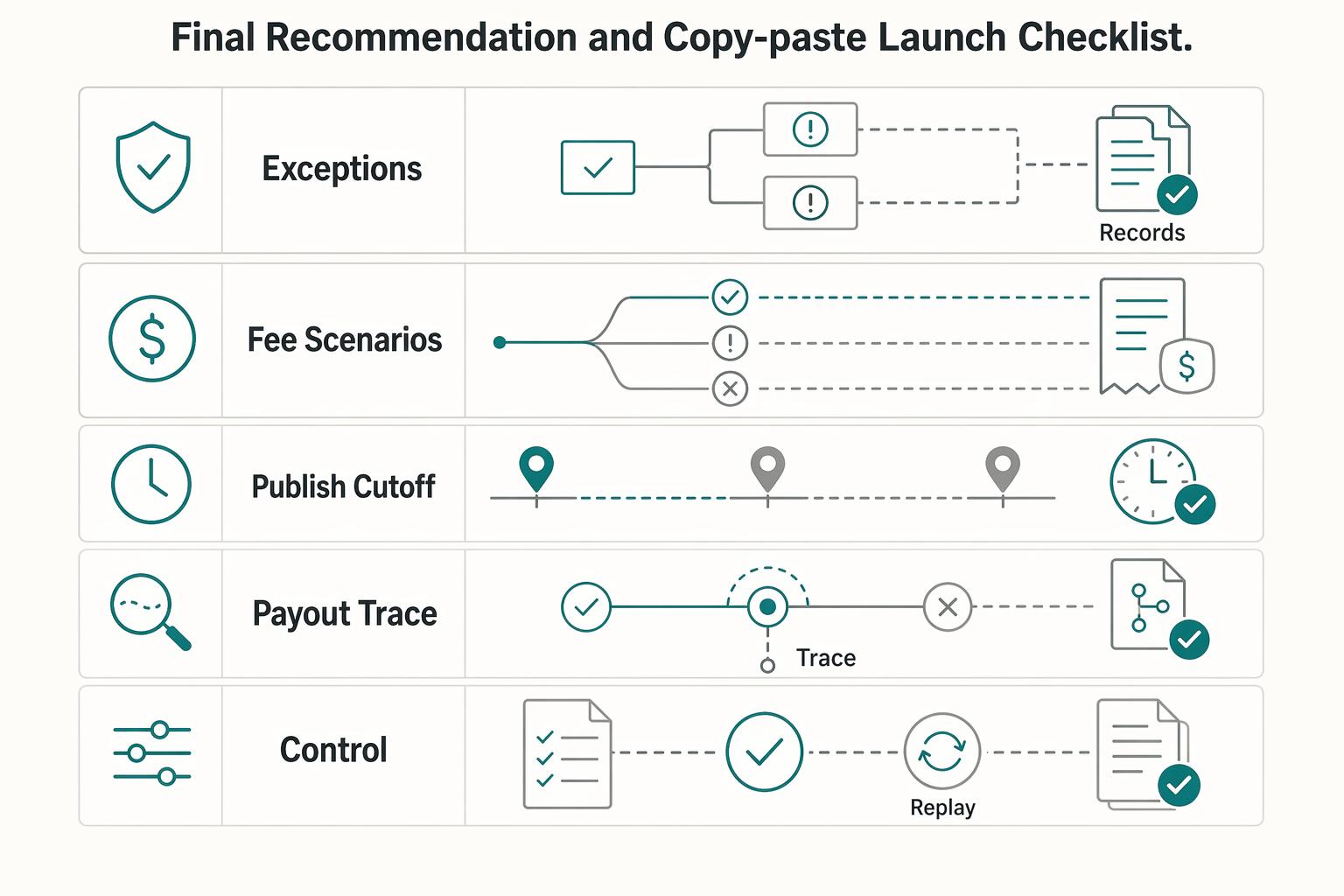
Final recommendation and copy-paste launch checklist#
Use Same-Day ACH as the default speed tier for eligible cohorts only after you can meet provider cutoffs, publish safe fallback rules, and reconcile external outcomes with the ledger. Retain a proven urgent route for cohorts that cannot yet meet those controls.
- Baseline your current rail mix and exception rate.
Map current ACH, Same-Day ACH, and wire transfer volume, then isolate the failure modes that drive cost or SLA misses: cutoff misses, rejects, returns, duplicate attempts, and manual reroutes. Confirm that provider payout counts reconcile to internal ledger counts for completed, failed, and unresolved payouts before changing defaults.
- Build low, base, and high fee scenarios with source-specific inputs.
Use current provider quotes for each route and distinguish actual prices from hypothetical sensitivity bands. Add funding, subscription, failed-attempt, return, and manual costs, then vary cutoff misses and fallback volume. If savings disappear in the defined stress case, narrow the cohort or adjust the routing policy before changing its default.
- Publish cutoff rules and fallback logic by SLA tier.
Same-Day ACH has three same-day forward submission deadlines: 10:30 a.m., 2:45 p.m., and 4:45 p.m. ET. The 2:15 a.m. ET deadline in the broader FedACH schedule is for future-dated items, not a fourth Same-Day ACH window. The current per-entry limit is $1 million; the $10 million rule begins September 17, 2027. Set earlier internal cutoffs and require outcome confirmation before replacement on another rail.
- Enforce idempotent routing and ledger-based completion.
Record business payout and provider-action identities, rail choice, parameters, references, and status history. Deduplicate requests and events within documented provider limits. Confirm external execution before posting paid state, continue ACH return monitoring, and hold unknown outcomes before a replacement or cross-provider send.
- Complete control review, but treat certifications as inputs, not proof.
Collect applicable SOC reports, PCI DSS validation, and claimed ISO/IEC 27001 certification. Review scope, assessment period, exceptions, and remediation. SOC reports are reports rather than certifications; none of these artifacts proves that cutoff handling, replacement safety, or reconciliation works in your production flow.
- Roll out in phases and expand only after checkpoints pass.
Start with cohorts that fit your cutoff windows and do not rely on last-minute urgency. Expand only after SLA, cost, and reconciliation checkpoints are consistently met. If late-day misses repeatedly force wire escalation, pause and fix routing before widening rollout. Copy-paste checklist:
- Baseline current
ACH/Same-Day ACH/Wire Transfermix and exception rates. - Build low/base/stress fee scenarios using dated provider quotes and observed exception costs.
- Publish cutoff rules and fallback matrix (
RTPwhen supported,Wire Transferfor urgent escalation) by SLA tier. - Enforce action-level idempotency, resolve unknown outcomes before replacement, and reconcile external execution to ledger entries.
- Complete applicable compliance and vendor control review, including report scope and exceptions.
- Run phased cohorts and expand only after SLA, cost, and reconciliation checkpoints pass.
When you are ready to operationalize cutoff rules, fallback routing, and audit-ready payout status tracking, review Gruv Payouts.
Frequently Asked Questions
Is `Same-Day ACH` always cheaper than `Wire Transfer` for contractor payouts?
No. It can be cheaper on direct transaction cost, but published pricing varies across providers and plans, and some vendors waive ACH or wire fees on certain tiers. Treat fee claims as source-specific and compare fully loaded cost: transaction fees, exception handling, retries, and manual work from missed cutoffs.
How fast is `Same-Day ACH` in real operations when cutoff windows are involved?
Same-Day ACH is a business-day service. FedACH submission deadlines of 10:30 a.m., 2:45 p.m., and 4:45 p.m. ET correspond to interbank settlement at 1:00 p.m., 5:00 p.m., and 6:00 p.m. ET. Contractor availability is a separate milestone: Nacha specifies 1:30 p.m. receiving-bank local time for first-window credits, 5:00 p.m. local time for the second, and end of processing day for the third, subject to applicable rules and exceptions. Verify the provider’s earlier cutoff and promised delivery conditions.
What does `ACH` actually cost per payout when published ranges disagree?
Start with your contracted fee schedule for each speed tier. Confirm flat versus percentage pricing, caps, minimums, subscriptions, return charges, and funding costs. Divide total cohort cost—including unsuccessful attempts and manual exceptions—by completed payouts. The article’s dollar bands are hypothetical sensitivity inputs, not quoted market rates.
When should a platform still choose `Wire Transfer` instead of `Same-Day ACH`?
Use wire when it is an approved, available route that meets an urgent deadline or requires Fedwire settlement finality. Same-Day ACH currently excludes IAT, ENR, and entries above $1 million; the $10 million increase takes effect September 17, 2027. Verify bank and recipient constraints, funding, and the bank’s wire cutoff. Resolve the earlier attempt before sending a replacement.
How should teams decide between `RTP`, `Push-to-Card`, and `Wire Transfer` as fallback rails?
Use RTP when provider access and the receiving account support the required amount and 24/7 timing. Use push-to-card only for a supported card endpoint with a verified delivery commitment; approval is not a universal guarantee of immediate availability. Use wire where its business-day cutoff and bank service can meet the promise. Confirm the previous attempt did not execute before changing rails.
What is the minimum control set needed before switching default payout routing?
Set explicit rail and recipient-eligibility rules, earlier internal cutoffs, provider-specific idempotency and recovery boundaries, external-outcome confirmation, ledger reconciliation, and a named exception owner. Keep the initiator, approval, provider reference, amount, status history, and replacement decision traceable. Review applicable vendor control reports and certifications for scope and exceptions; they do not replace operational validation.
Where Gruv fits
Researched and edited by the Gruv editorial team. Gruv builds cross-border billing, payouts, and finance-operations software for global businesses.
Sources
- consumerfinance.gov/consumer-tools/money-transfers-revisions-sep...trusted
- consumerfinance.gov/data-research/research-reports/issue-spotlig...trusted
- csrc.nist.gov/glossary/term/audit_trailtrusted
- docs.stripe.com/webhookstrusted
- docs.stripe.com/api/idempotent_requeststrusted
- ecfr.gov/current/title-31/subtitle-B/chapter-X/part-1...trusted
- ecfr.gov/current/title-31/subtitle-B/chapter-X/part-1...trusted
- fdic.gov/risk-management-manual-examination-policies/...trusted
Educational content only. Not legal, tax, or financial advice.
Related Posts

The Freelance Payment Penalty: A Modeled Audit of Platform Fees, FX Spreads, and Payout Delays
The money rarely disappears through a single, easy-to-spot fee. The real loss is stacked. A marketplace takes its commission, a processor adds a charge for international cards, a bank or payment company converts the currency at a spread, a platform holds the funds before release, and a wire sheds a little to intermediaries on the way in. Each layer looks defensible on its own, but the worker feels the combined result as a smaller deposit and a later payday.

How to Respond to a Subpoena for Business Records
Move fast, but do not produce records on instinct. If you need to **respond to a subpoena for business records**, your immediate job is to control deadlines, preserve records, and make any later production defensible.
A US Expat's Guide to Investing in UCITS ETFs to Avoid PFIC Issues
The real problem is a two-system conflict. U.S. tax treatment can punish the wrong fund choice, while local product-access constraints can block the funds you want to buy in the first place. For **us expat ucits etfs**, the practical question is not "Which product is best?" It is "What can I access, report, and keep doing every year without guessing?" Use this four-part filter before any trade: