
Quick Answer
FFC means For Further Credit and supplies onward-credit details. FBO means For Benefit Of: it can describe an account arrangement or name beneficiaries in a wire. FAO is context-dependent, so do not automatically expand it as attention text. Follow the receiving institution’s instructions rather than selecting one acronym for the whole payment.
How FFC, FBO, and FAO Fit Into Platform Wire Instructions#
If your team treats FFC, FBO, and FAO as interchangeable labels, stop there. In production, these terms may be handled differently depending on the bank, provider, rail, and corridor. That is why finance, payments ops, and engineering teams can talk past each other.
| Step | Focus | What to confirm |
|---|---|---|
| 1 | Provider or bank support | Whether your bank or payout provider actually supports the instruction style you want to rely on |
| 2 | Compliance and account structure | Constraints around beneficiary details, account ownership, and onward allocation |
| 3 | Field mapping and validation | Who populates what, from which internal source, and which validation checks run before money moves |
Treat these terms as implementation-dependent instructions. Use them only when your bank or provider confirms support and the exact fields they require.
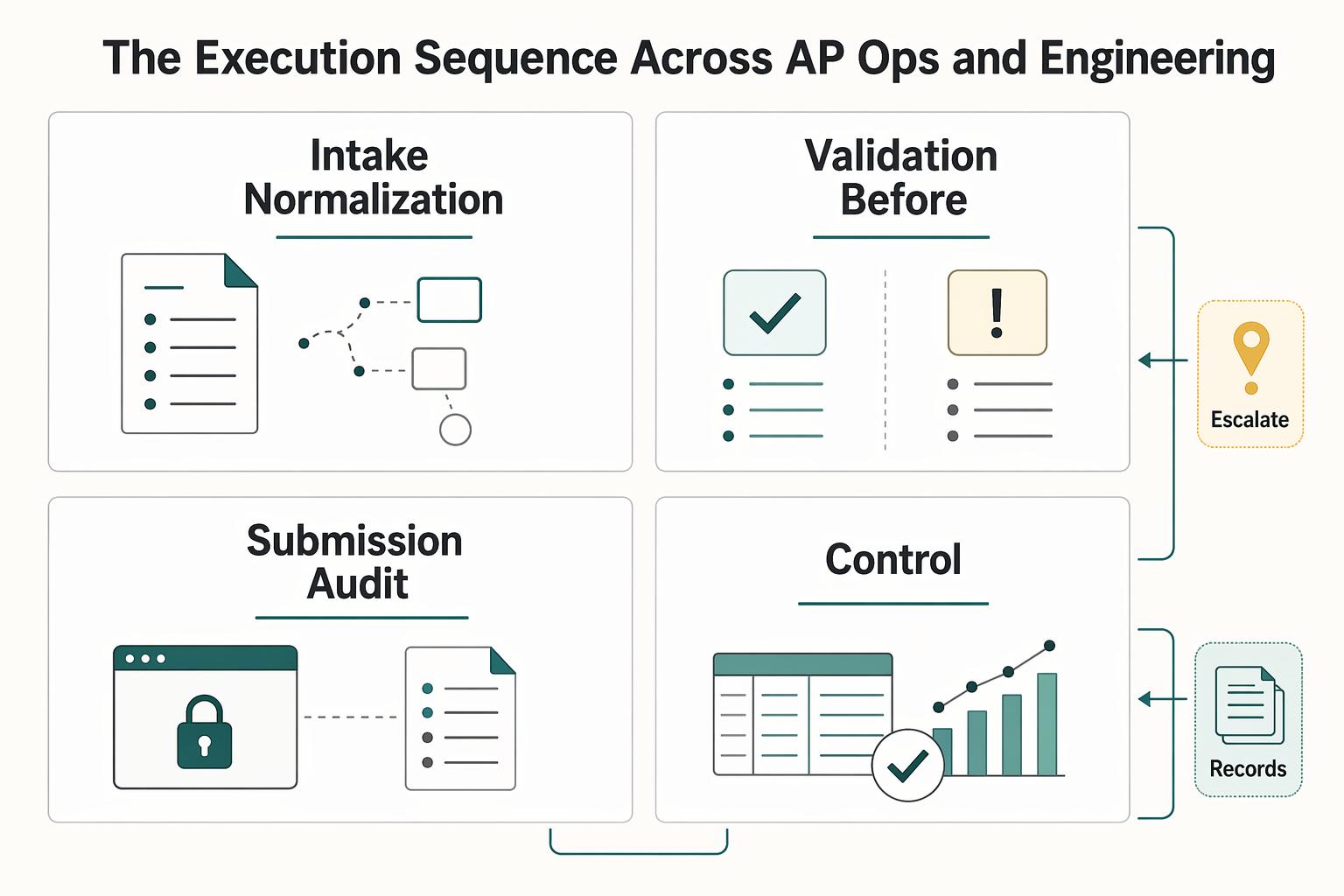
This matters most when you are building or maintaining payout flows, not sending the occasional one-off transfer. The pain usually lands with the teams closest to execution. Finance sets policy. Ops handles bank and provider interactions. Engineering maps internal payout data into transfer instructions across domestic and international corridors. A label that looks harmless in a template can still create an exception path once it reaches a provider, an intermediary, or the receiving institution.
The practical problem is not just terminology. It is decision order. Many teams start by asking what FFC or FBO means in the abstract. A safer first question is whether your bank or payout provider actually supports the instruction style you want to rely on. After that, review compliance constraints, especially where beneficiary details, account ownership, or onward allocation are involved. Only then does field mapping become the main job: who populates what, from which internal source, and with which validation checks before money moves.
This article follows that order. It starts with provider or bank support, moves into compliance and account-structure questions that narrow your options, and then gets into implementation checks that keep the build honest.
A couple of limits are worth stating up front. Practice can vary by bank, rail, provider, and corridor, so expect differences in naming, required text, and where an instruction is accepted. Even when a payment touches SWIFT messaging, confirm the exact bank or provider requirements before launch. Do not assume one institution's template will work everywhere. One useful verification step is to get the receiving institution's current instructions and compare them against the outbound fields your provider actually exposes. If those do not line up cleanly, treat that as a design issue early, not an ops cleanup task later.
The sections that follow are meant to help you make that call with fewer assumptions and clearer ownership. For related background, see Why International Wire Transfers Arrive Short and How to Reduce Fee Leakage.
FFC vs FBO vs FAO at a glance#
FFC identifies onward credit; FBO identifies who funds are for and may also describe an account arrangement. They can coexist in one wire. FAO must be read in the context of the receiving document rather than treated as a universal routing instruction.
| Label | Meaning or role | What it does not establish | Implementation check |
|---|---|---|---|
| FFC | For Further Credit: identifies the account or recipient to credit after initial receipt | The legal ownership or structure of the receiving account | Capture the final account number and required identifying details |
| FBO | For Benefit Of: identifies beneficiaries; an FBO account can hold funds on behalf of others | That an FBO label alone creates a compliant account arrangement | Check both receiving instructions and the account agreement |
| FAO | An institution-specific label; banking documents can use it for For Account Of | A universal attention, ownership, or onward-credit rule | Obtain the full expansion and required value from the receiving institution |
Keep two questions separate: how the account holds funds, and how an individual wire reaches the correct beneficiary. An FBO account may receive a wire that also needs further-credit details. Do not remove one instruction because the other is present.
For example, Fidelity’s USD inbound wire instructions distinguish the receiving bank account, the Fidelity account owners, and the final account number. That is a concrete reason to preserve separate fields in your data model.
What each instruction really does in production#
In production, FFC supplies onward-credit details. FBO can identify a beneficiary on a wire or describe an account used to hold funds for others. FAO needs a definition from the document or institution using it.
FFC (For Further Credit) tells the receiving side where to apply final credit after funds first reach an intermediary or central account. Fidelity’s bank wire standing-instructions form includes a separate further-credit field alongside bank account and beneficiary details. Confirm where your sending provider accepts those details; a memo and a routing field are not interchangeable.
FBO (For Benefit Of) also matters at the account level. Stripe describes an FBO account as an arrangement for managing funds on behalf of beneficiaries, separate from the manager’s own funds. Review the account agreement, control of transactions, and allocation ledger. Adding FBO text to an ordinary wire does not establish that arrangement.
FAO should not automatically be expanded as “for the attention of.” In its discussion of Philippine deposit accounts, Security Bank uses FAO for “For the Account of”. That example does not set wire rules for other banks; it shows why the exact receiving document must determine your mapping.
Which instruction to choose for each payout scenario#
Choose the payment path from the receiving institution’s instructions, then review any account-holding arrangement separately. Central receipt followed by onward credit may need FFC details. Holding user funds may need an FBO arrangement. One flow can involve both.
| Payout scenario | What to evaluate | What to verify |
|---|---|---|
| Marketplace balances held for sellers | Whether the bank/provider arrangement holds funds for beneficiaries | Account agreement, beneficiary allocation, and permitted disbursements |
| Contractor paid through an intermediary account | Whether the receiving instructions require onward-credit details | Supported route and final recipient/account identifiers |
| Treasury top-up | Whether funds stay in the central account or are credited onward | Use FFC only when the receiver requires onward credit |
| Brokerage funding | Bank routing, beneficiary names, and final-credit details together | Follow the brokerage’s current instructions for the currency |
A platform’s internal decision to pool money does not itself make FFC the right sending instruction. FFC matters when the receiving side needs it to allocate the incoming wire. Likewise, FBO account design is a funds-holding decision, not a shortcut for selecting a payout rail.
Brokerage funding is a common case where FFC appears with intermediary routing requirements. In those flows, incomplete or misplaced instruction data can cause delays or returns, so execution quality matters as much as classification.
Use one hard design constraint: if your provider cannot transmit the receiver’s required onward-credit details on the selected route, use a supported payment path. Do not hide missing account identifiers in a memo and assume the receiving bank will reconstruct them.
Centralized receipt can simplify account administration, but missing allocation details create reconciliation work. Assign ownership explicitly: finance approves the funds-holding model, ops confirms receiving instructions, and engineering validates the fields sent.
For a deeper look at FFC specifically, read A Guide to the 'For Further Credit' (FFC) Instruction in Wire Transfers.
How to implement beneficiary instructions without avoidable failures#
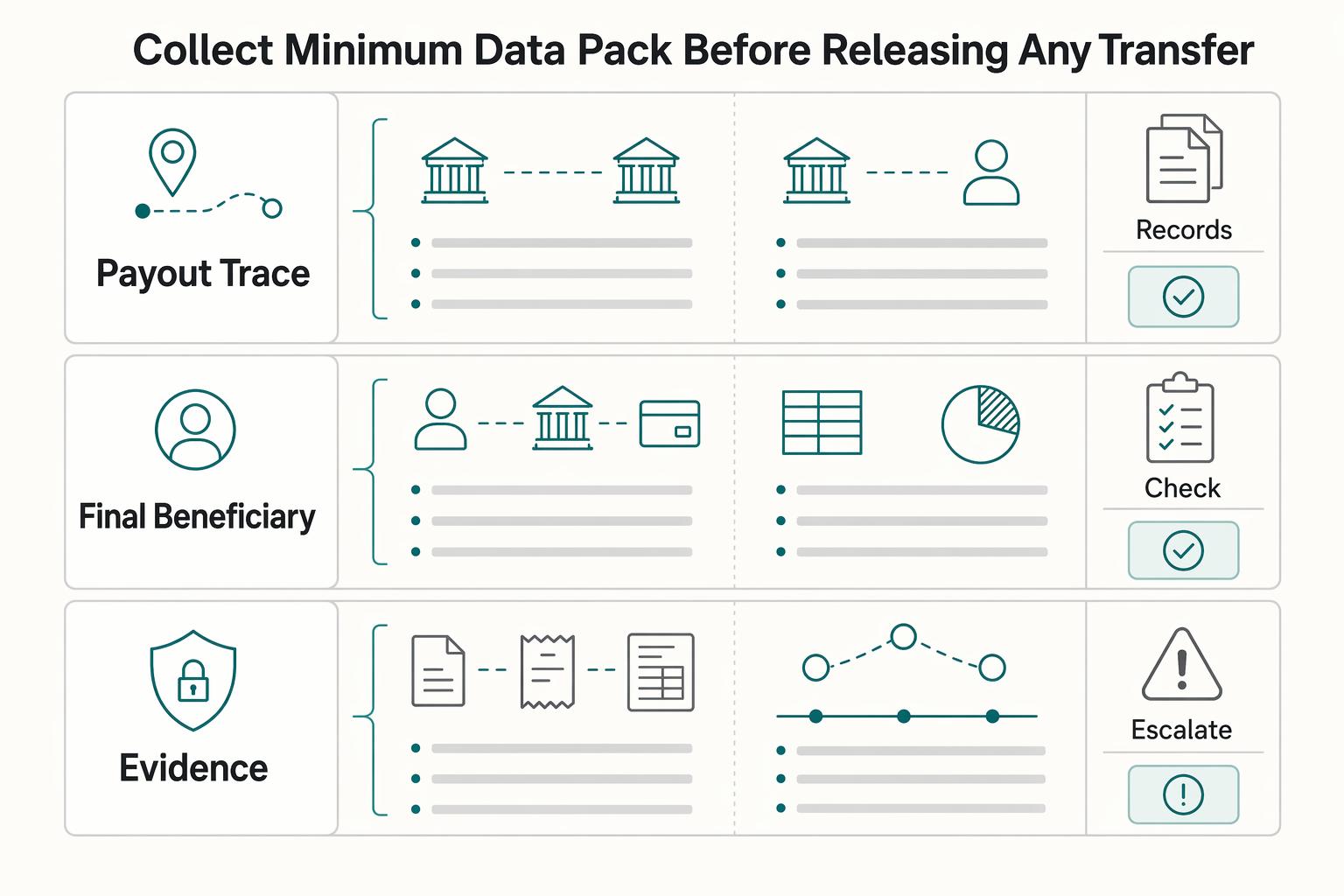
Build the mapping from a current receiving instruction sheet. Keep the receiving bank account, beneficiary names, final-credit account, and any correspondent details as separate values internally. Then map them to the outbound fields your provider accepts for this route.
| Check | What to test |
|---|---|
| Required values | Reject a request missing a final-credit identifier when the receiver requires it |
| Field handling | Inspect the sent payload for omitted or truncated instruction text |
| Final allocation | Confirm credit to the intended end account, not only arrival at the receiving bank |
| Exceptions and retries | Check provider status before resubmitting an uncertain wire; retain the original request reference |
Hypothetical example: a receiver gives you bank account A and final-credit account B. Store both, even if your provider combines onward-credit details into one approved instruction field. Test that the complete value reaches the receiver and is allocated to B. A “sent” status for A alone does not prove that outcome.
Use the bank’s documented fields, including an approved narrative field when its instructions require one. Structured internal data makes validation easier; it does not justify overriding the bank’s required format. Test a small supported transfer and its reconciliation path before increasing volume.
Where teams get burned and how to prevent it#
Prevent avoidable failures by checking the exact rail, route, and field mapping before release. Provider support for ordinary wires does not by itself confirm support for your receiving institution’s further-credit or FAO requirements.
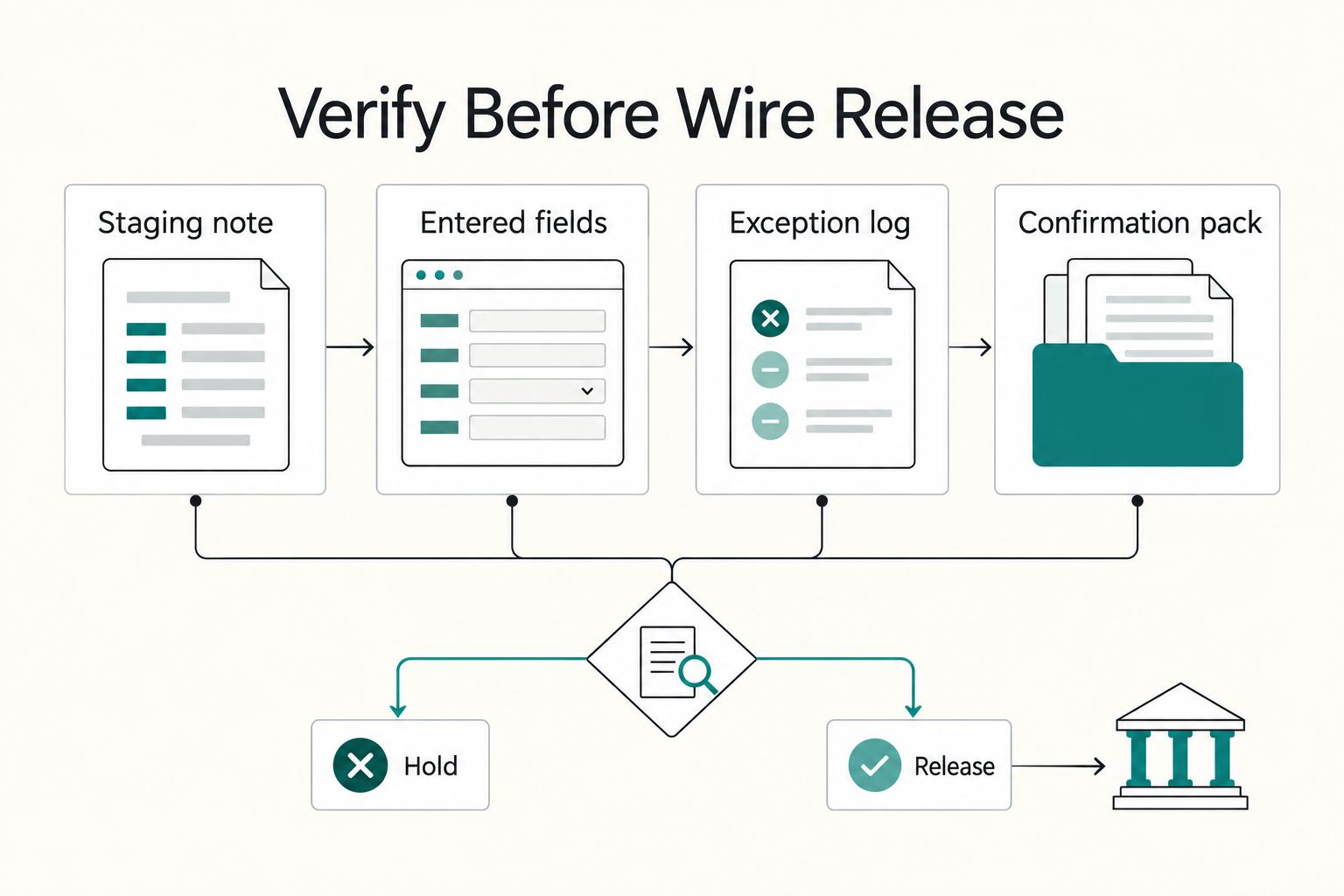
A practical control is end-to-end verification before release: compare the bank's current receiving instructions to the exact normalized outbound instruction your system will send. If that comparison is missing, incomplete, or disputed across teams, pause rollout.
FAO should also be policy-driven, not interpretation-driven. If your provider or bank guidance does not define how to handle it in your outbound fields, do not leave it as open text in a self-serve path.
Structured data over ambiguous text#
Use structured fields for routing-critical details whenever your rail supports them, and treat narrative-only critical instructions as incomplete until reviewed. This keeps reviews auditable and reduces handoff risk between finance, ops, and engineering.
Red flags that should trigger an immediate stop-and-check#
| Red flag | What to check right away | Immediate containment step |
|---|---|---|
| Repeated manual repairs | Whether sent instructions match approved receiving instructions | Require structured-field mapping review before more volume |
| Unexplained returns | Whether route assumptions and required fields were explicitly validated | Reconfirm route and field requirements with provider/bank documentation |
| Frequent clarification loops | Whether your intake captures all required beneficiary details up front | Tighten required fields and remove ambiguous input labels |
| Split ownership answers across teams | Who owns final end-to-end release signoff | Assign one owner for readiness evidence and go/no-go |
The escalation trap is usually organizational: finance assumes ops validated the rail, ops assumes engineering enforced fields, and engineering assumes finance approved instruction handling. If no team can produce the same evidence pack, do not scale the instruction type.
For more detail on how FFC account numbers are used, see FFC Account Number Explained: When and Why Wire Transfers Need Further Credit Instructions.
What to document for audit, reconciliation, and incident response#
Keep a versioned record that connects the approved receiving instructions to the wire you actually sent. This lets ops distinguish a bank-routing issue from a final-account allocation issue without reconstructing the request from chat messages.
| Record | Why it matters |
|---|---|
| Receiving instructions and effective date | Identify the route and requirements approved at submission |
| Beneficiary and final-credit details | Show which account or person should receive final allocation |
| Outbound payload and provider reference | Compare approved details with the values transmitted |
| Approvals, status, and reconciliation result | Connect authorization, submission, final credit, and any exception handling |
For an incident, retain the original sent values and the correction history rather than overwriting the evidence. For FBO account programs, link the payment record to the beneficiary allocation ledger as well.
How Gruv helps teams operationalize these choices#
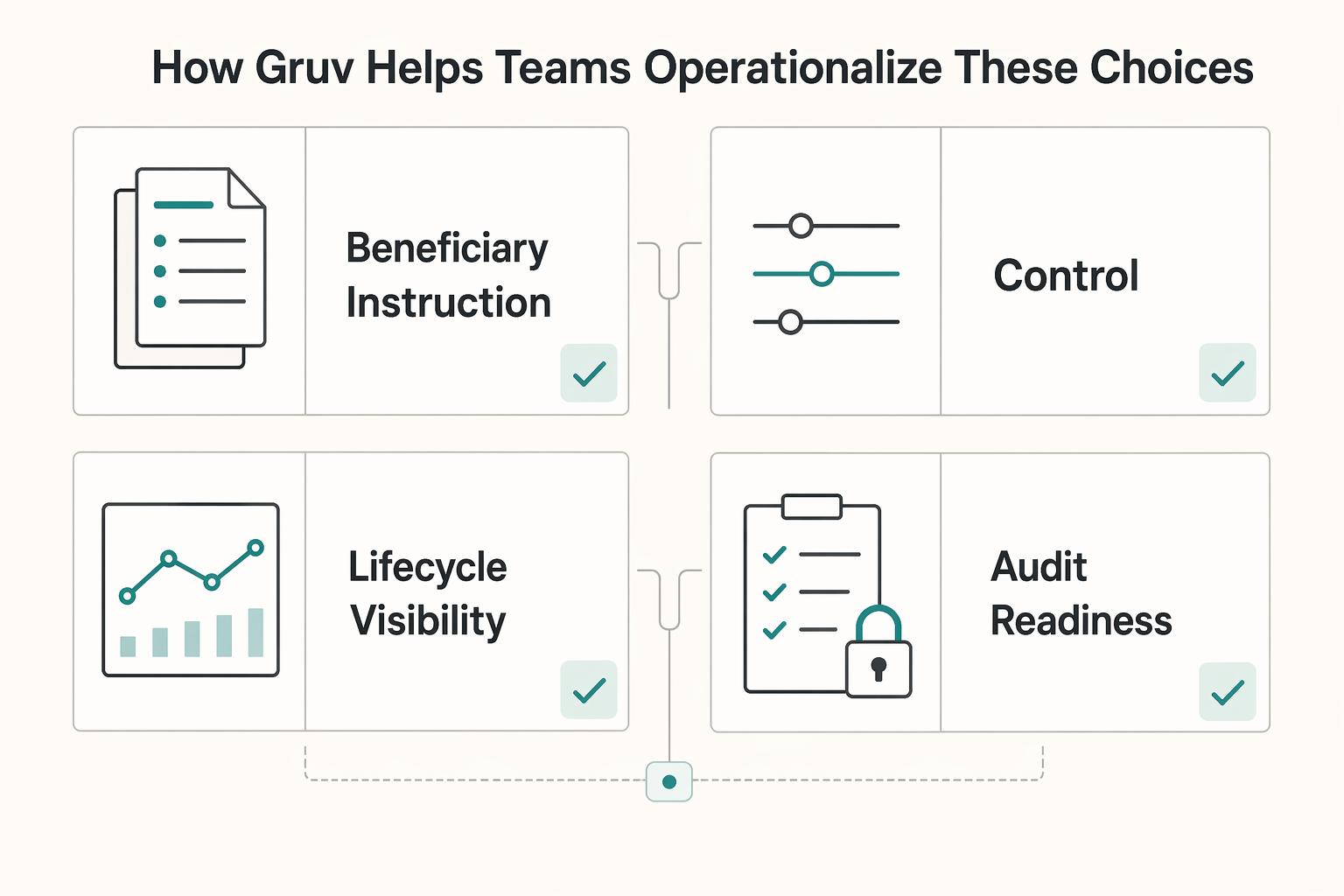
Use Gruv as a control point only after validation, not assumption. Payout support alone does not confirm FFC, FBO, or FAO handling in your flow. The decision should be based on evidence your finance, ops, and engineering teams can review before go-live.
If you are evaluating Gruv Payouts, Virtual Accounts, and API/webhook status surfaces (where supported), verify that beneficiary instructions can be handled in a structured, reviewable, and traceable way rather than through free-text workarounds.
| Area to verify in Gruv | What to confirm before launch | Red flag |
|---|---|---|
| Beneficiary-instruction handling | Instruction choice is captured in a consistent format your team can review | Ops must infer intent from notes or free text |
| Policy controls | Required compliance and identity checks are enforced by your policy path where supported | Payouts can proceed outside required review |
| Lifecycle visibility | API/webhook and operational status data are usable for exception handling and reconciliation | Teams cannot clearly connect request to outcome |
| Retry controls | Replays are handled safely with your idempotency approach | Re-submission can create duplicate attempts |
| Audit readiness | Case records are complete enough for finance review and incident follow-up | Resolution depends on manual reconstruction |
Run one controlled end-to-end test and review the artifacts with all three teams. If the evidence does not support your checklist, treat that as a launch blocker.
Coverage and rail behavior vary by market and provider. Confirm instruction support for your exact route, then align finance, ops, and engineering on one beneficiary-instruction policy and launch checklist.
Conclusion#
Keep account structure and wire instructions distinct. FFC carries onward-credit details, FBO can identify beneficiaries or an account arrangement, and FAO needs the receiving institution’s definition. Preserve all required values even when several labels appear in one payment.
Before scaling, compare the receiver’s current instructions with the payload your provider sends and confirm final allocation. Keep that mapping, the approval record, and the reconciliation result together so the next exception has a clear starting point.
Frequently Asked Questions
What is `FFC (For Further Credit)` in a wire transfer?
FFC means For Further Credit. It identifies the account or recipient to credit after the wire first reaches an intermediary or central receiving account. Use the receiver’s required final-credit identifiers.
What is an `FBO (For Benefit Of)` account, and how is it different from `FFC`?
An FBO account holds or manages funds for beneficiaries. FBO wording can also identify beneficiaries in wire instructions. FFC specifies onward credit, so the same wire may need both FBO and final-credit details.
Is `FAO` the same thing as `FFC` or `FBO`?
No. FAO is context-dependent: some banking documents use it for For Account Of. Obtain the receiving institution’s full definition and required value instead of assuming attention text or substituting it for FFC or FBO.
Can an `international transfer` use `FFC` through a `correspondent bank`?
Yes, when the receiving institution’s instructions and sending provider support that route. Fidelity’s USD instructions, for example, include a SWIFT code for wires from foreign banks alongside final-credit details. Use the exact instructions for the currency and destination.
How do I confirm provider support for FFC?
Compare the receiver’s required further-credit details with the fields available for your selected transfer method and currency. Ask the provider to confirm any unclear mapping, then test that the complete instructions reach the receiver and produce credit to the intended end account.
Where should FFC details go if a bank uses a payment narrative field?
Use the field your institution documents. A required identifier can be lost if it is placed in an unrelated memo or truncated. A narrative field may be valid when the receiving instructions explicitly use it; preserve the complete value and test allocation.
Is there a universal `SWIFT` field standard for `FFC`, `FBO`, and `FAO` across institutions?
Do not infer a universal field mapping from these acronyms. Map the receiving instructions to your bank or provider’s supported fields for the selected message format and route.
Try a related tool
Researched and edited by the Gruv editorial team. Gruv builds cross-border billing, payouts, and finance-operations software for global businesses.
Sources
Includes 3 external sources outside the trusted-domain allowlist.
Educational content only. Not legal, tax, or financial advice.
Related Posts
How to Send an FFC Wire Transfer With Fewer Errors
When a client asks for an **FFC transfer**, treat it as an accuracy-sensitive request, not a speed task. The request itself does not prove payment reliability, so your safest move is to confirm one current instruction source before you enter anything.
For Further Credit Wire Transfers for Platform Payment Teams
A wire can reach the first receiving institution and still need additional instructions to reach the intended final account. In a for further credit wire transfer, funds may first land in an organization's main receiving account, sometimes through an intermediary or correspondent bank, and then rely on final-credit instructions for allocation to the ultimate beneficiary.
FFC Account Number Meaning for Wire Transfers and Further Credit Instructions
FFC means **For Further Credit** in wire instructions. The FFC account number or reference identifies where funds should be credited after they reach the receiving institution’s collection or settlement account. It is usually distinct from the account that receives the wire first; confirm each label against the recipient’s current instructions.