
Quick Answer
An FFC instruction tells the receiving institution which customer account to credit after the wire reaches its receiving account. Use the recipient’s current bank instructions, have the sending bank confirm field placement, and verify changed details through a trusted independent channel before release.
Confirm the FFC request before entering the wire#
When a client asks for an FFC transfer, treat it as an accuracy-sensitive request, not a speed task. The request itself does not prove payment reliability, so your safest move is to confirm one current instruction source before you enter anything.
Step 1 Lock one current instruction source#
Pick one written source as your entry source and treat everything else as context only. If you have forwarded text, screenshots, or pasted fields that do not match, pause and ask for a single updated version in writing.
Your checkpoint is simple: you can point to one message or document and say, "I entered from this version." Keep that source and any clarification together so the record stays clear if questions come up later.
Step 2 Keep roles clear before you touch the form#
If labels blur the receiving bank, intermediary, or final-credit destination, pause and ask for written clarification before entering anything. Use one confirmed version for entry, and treat all other copies as context only.
If you want background context, read this correspondent banking overview.
| Source you have | How to use it | If it conflicts |
|---|---|---|
| One current written instruction source | Use for entry | Pause and request one corrected version |
| Forwarded copy, screenshot, or pasted fields | Context only | Do not enter from it |
| Multiple versions from different people | Hold entry | Escalate in writing until one version is confirmed |
Step 3 Verify the channel before sharing sensitive details#
Verify bank or provider instructions through its official portal or a contact you already trust. HTTPS protects the connection but does not prove that a website or changed bank detail is authentic. Confirm payment-detail changes through an independently obtained phone number before release.
Once you have one confirmed source and a secure-channel check, move to the pre-flight checklist.
Reduce Ambiguity Before You Release the Payment#
Use this as an internal control pattern for payments with layered instructions, not as a legal standard. The goal is to reduce ambiguity before release: keep one current written record, stage updates clearly, and pause when anything is unclear.
Treat changed bank details or conflicting instruction versions as reasons to verify the recipient through an independent channel. Preserve the verified version and the time of the check so the sender can reconstruct what was authorized.
Step 1 Lock one authoritative written record#
Keep one current written instruction record as the working source. Confirm who owns it, which version is current, and where updates are captured.
If ownership or version status is unclear, pause and resolve that first. A simple written change log with timestamps helps keep the sequence clear.
Step 2 Stage updates before release#
Before release, stage instruction details in one working note so changes are visible in a single place.
Focus on traceability to the current written record. If details are unclear or conflict, do not guess; request clarification in writing and update the record first.
Step 3 Re-verify after changes#
Treat re-verification as a release gate. Confirm the staged details still match the latest approved written record and that changes are documented.
If a late update appears, add it to the written record first, then re-confirm the current version before proceeding.
| Common breakdown | Failure signal | Stop action |
|---|---|---|
| Conflicting instructions | Multiple versions differ, or the current one is unclear | Pause and request one current written version from the instruction owner |
| Fragmented updates | Changes arrive in pieces across multiple messages | Consolidate updates into the written record, then re-verify |
| Owner confusion | Multiple people revise details without clear accountability | Stop and confirm one authoritative owner before proceeding |
Treat ambiguity as a stop signal, not something to work around. Once updates are documented and clear, proceed to execution.
Before you finalize payment instructions, sanity-check route and cost tradeoffs with the payment fee comparison tool.
Execution Protocol: A Field-by-Field Guide to Any Wire Form#
After pre-flight, treat execution as strict mapping, not interpretation. In a for further credit (FFC) wire transfer, funds can route to a central account first, sometimes through an intermediary or correspondent bank. The FFC instruction tells the receiving organization where final credit should go. If that mapping is unclear, stop.
Step 1 Map each instruction line exactly#
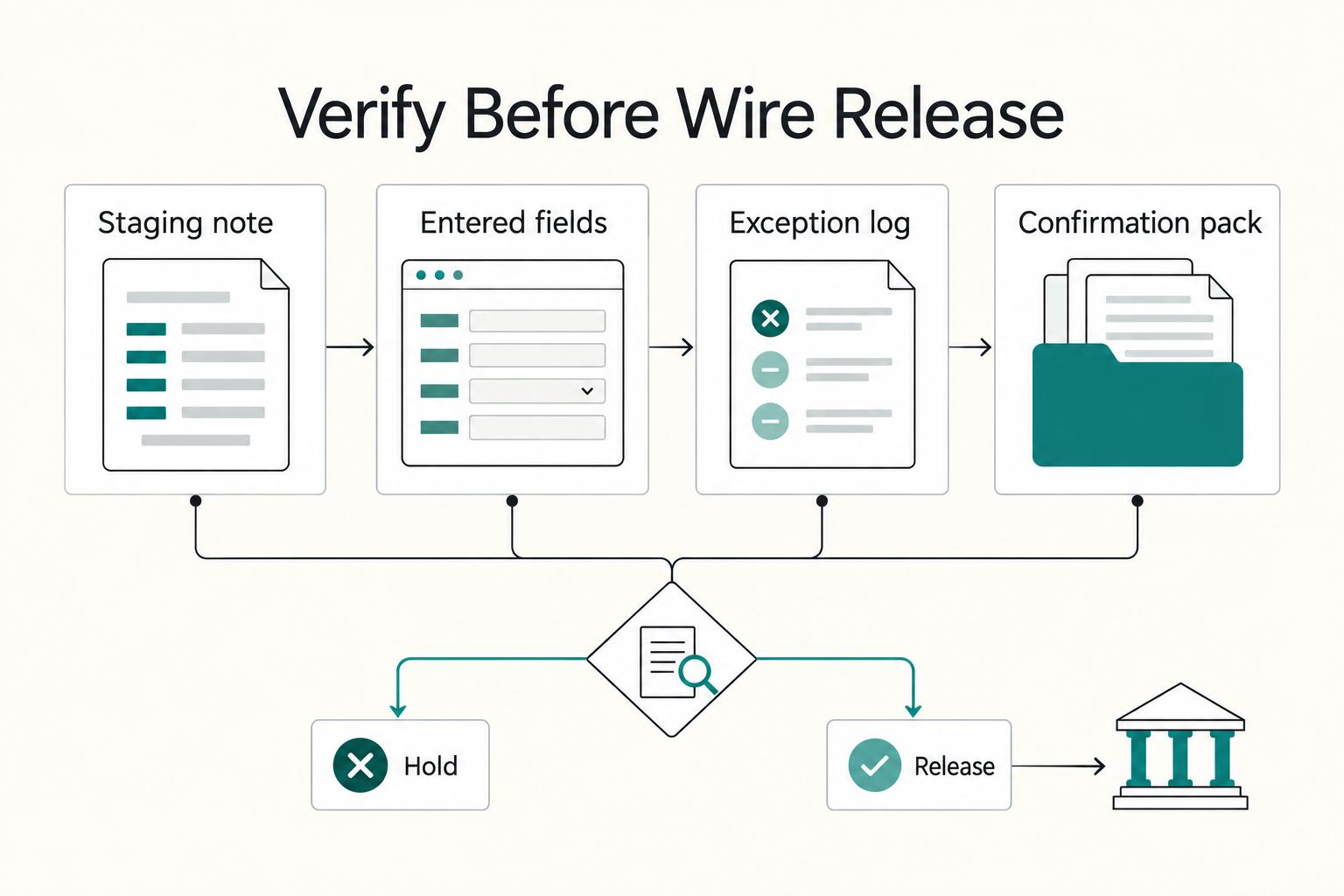
Keep your staging note open next to the live form. For each value, confirm that one written instruction line maps to one field.
Use a bidirectional check before you move on:
- Read the form field, then the matching line in your staging note.
- Read the instruction line, then confirm exactly where it belongs on this form.
- If either direction is unclear, hold entry.
Do not use:
- saved templates
- copied snippets from old payments
- prior form memory
- side-channel instructions from chat, text, or forwarded screenshots
These shortcuts can mix up first-routing details and final-credit details.
| Instruction element (label varies by form) | What it represents in an FFC flow | Enter / hold / escalate rule |
|---|---|---|
| Receiving bank and receiving account | The bank and account receiving the wire before further-credit allocation | Use the current recipient instructions and the sending bank’s confirmed mapping; a beneficiary-account field may require this receiving account. |
| Intermediary or correspondent bank | An additional bank used on the route, when required | Enter only when included in the current instructions; do not substitute it for the receiving bank. |
| Further-credit customer name and account | The customer destination the receiving institution must credit | Place these details in the field confirmed by the sending bank. Do not assume the form’s beneficiary-account field is the customer account. |
| Reference or FFC text field | A bank-specific location for allocation details | Use the confirmed wording and placement. If text limits omit required details, ask the bank before sending. |
If you need context on intermediary routing, see Correspondent Banking Explained: Why Your International Wire is So Slow and Expensive.
Step 2 Pause on ambiguity and get written clarification#
If any field is unclear, missing, or conflicts with your mapping, pause. Resume only after written clarification is logged for that exact form.
Keep the evidence pack tight:
- authoritative instruction set
- staging note
- clarification message
- note of what changed after clarification
If clarification happens by phone or in a meeting, write it into the controlled record before resuming. Do not improvise placement in a generic notes field. The exact details needed for an FFC wire can vary by destination account context, so continue only when placement is confirmed in writing.
Step 3 Verify against the record before release#
Treat final verification as a hard release gate. Compare entered fields to your staging note and confirmation record line by line for an exact match.
Before submission, confirm:
- every entered value matches the staging note
- every late change or exception is logged
- every previously unclear field has written mapping tied to this form
If any item fails, hold the payment. If all pass, release it and preserve the full confirmation packet for the audit step.
The Audit Protocol: Closing the Loop with Professional Follow-Through#
After you send a for further credit (FFC) wire transfer, treat the case as active until you can document full reconciliation. "Sent" starts tracking, because once certain rails are processed, including Fedwire, reversal options may be limited.
| Audit stage | What you capture | Who owns next action | Escalate when | Keep case open until |
|---|---|---|---|---|
| Evidence bundle | Full confirmation artifacts and entered values | You | Any mismatch appears in your own verification | Bundle is complete and verified line by line |
| Live status control | One case record, one owner, one next checkpoint | You | No response or no match by your verified follow-up point | Next action and checkpoint are documented |
| Escalation sequence | Recipient-first for non-fraud, then sending institution; fraud goes to both banks and a recall request | You, then institution contacts | Non-match, mismatch, suspected fraud, or return signal | Written outcome path is documented |
| Closure review | Final reconciliation record | You | Any unresolved mismatch | Money movement and outcome match in one record |
Step 1 Save one reconciliation bundle immediately#
Capture evidence immediately after sending. Save the original receipt or export when available, or a complete PDF or screenshot set that preserves searchable identifiers.
| Bundle item | What to save |
|---|---|
| Confirmation or receipt | Original receipt or export when available, or a complete PDF or screenshot set that preserves searchable identifiers |
| Reference | Confirmation code or reference number |
| Timing | Request date and send date, and time if shown |
| Amount | Amount and currency |
| Destination details | Exactly as entered, including beneficiary bank, any intermediary bank, and any FFC or reference text |
| Invoice / contract / project reference | Invoice, contract, or project reference used for matching |
| Authenticated instructions | Authenticated instruction set and any written clarification used during entry |
| Availability date | Receipt date of availability if this was a covered remittance transfer |
| Follow-up window | Your current follow-up window after verification |
At minimum, keep the items above. Before moving on, verify the saved bundle against your staging note and submitted form line by line.
Step 2 Keep one live status and one named owner#
Run this as one case, not a chain of scattered messages. Assign one owner, set the next checkpoint date, and log the exact trigger for escalation.
If this is a covered consumer remittance transfer from the U.S. to another country, use the disclosed availability date as a control point. Regulation E error timing, including the 180-day reporting window, applies in that remittance context, not to every domestic or business wire.
| Status | Record now | Owner | Escalate when | Keep open until |
|---|---|---|---|---|
| Sent | Reference, amount, currency, destination, send timestamp, next checkpoint | You | Post-send mismatch, suspected fraud, or a covered-remittance cancellation-window issue | Bundle is verified and first checkpoint is set |
| Pending confirmation | Recipient contact path, follow-up timestamp, response or non-response | You | Verified follow-up point passes without match or confirmation | Recipient confirms or case moves to exception |
| Exception | Issue summary, mismatch details, attachments, institution case number | You, then assigned institution party | Immediately for suspected fraud; otherwise on documented non-receipt, mismatch, or return | Written finding, posted return, or confirmed receipt is documented |
| Closure review | Recipient confirmation plus matched business reference | You | Any reconciliation gap remains | Amount, currency, destination, and purpose align in one record |
Step 3 Escalate in order, using artifacts only#
For non-fraud matching issues, start with recipient finance using only the locating artifacts.
Recipient finance message
Payment sent on the transfer date for the payment amount and currency.
Reference: [reference number].
Attached: confirmation and invoice reference.
Please confirm receipt or route to the correct finance contact.
If that does not resolve it, escalate to your sending institution with the same artifacts plus recipient correspondence and the instruction set used.
Sending institution message
We sent the payment amount and currency on the transfer date.
Reference: [reference number].
Recipient cannot confirm receipt / reports mismatch.
Attached: confirmation, entered destination details, authenticated instructions, and recipient correspondence.
Please provide next investigation steps.
If fraud is suspected, contact your bank and the receiving-side bank immediately and request a recall. Act fast, but do not assume recall success. For covered remittance transfers, cancellation rights can depend on a narrow 30-minute window after payment. If your bank requests trace details for a delayed SWIFT payment, use how to use a SWIFT MT103 to trace a delayed wire transfer.
Step 4 Close only on documented reconciliation#
Do not close the case on a verbal assurance or a sent confirmation alone. Close only when one record shows the full match: amount, currency, destination, business reference, and documented outcome, whether received or returned and reconciled. If remittance error rules apply, keep the case open through the provider's written findings, and request supporting documents if needed. In that remittance context, investigations can run up to 90 days after notice.
Use this closure rule: if money movement and documented outcome do not reconcile in the same record, the case stays open.
Use One Rule on Every FFC Wire: Verify, Execute, Audit#
Use one rule on every FFC wire: Verify -> Execute -> Audit. It keeps you out of guesswork in a process where reversals can be limited, because same-day domestic wires may not be cancelable and Fedwire emphasizes payment finality once credited.
| Phase | Controlled action | Common failure pattern | Practical consequence if skipped |
|---|---|---|---|
| Verify | Lock one current written instruction set before opening the form. If details changed, confirm through an independent callback to a trusted number you looked up yourself. | Using mixed screenshots, forwarded snippets, or unverified email updates | You may send from stale or fraudulent instructions, and recovery after error or scam can be unlikely |
| Execute | When separate fields are provided, keep intermediary bank, central receiving account, and final-credit details in their intended fields exactly as instructed. | Guessing field intent, or forcing FFC text into a field that conflicts with bank records | The transfer can be returned, delayed, or fail final allocation |
| Audit | Save confirmation, reference number, send time, and exact entered values. Keep the case open until receipt is confirmed or exception handling starts. | Treating "sent" as complete | Tracing and handoff slow down when cashflow is already delayed |
Verify#
Start by freezing the source to one written version. If portal labels and instruction text do not map cleanly, stop and request written field mapping from the bank or receiving provider before submitting.
Execute#
Enter from the verified record and check every value before submitting. Field placement varies by bank; if there is no dedicated FFC field, get the sending bank’s mapping for the exact form. Never replace the receiving account with the final customer account solely because the field says “beneficiary”.
Audit#
Submission is not the end state. Under UCC Article 4A, completion occurs when the beneficiary's bank accepts the payment order, so if the recipient reports non-receipt, notify your bank immediately and follow up in writing. Keep one clean evidence pack ready for tracing and use the reference number for follow-up. If you need a tracing workflow, use this MT103 guide.
| Approach | What you do | Likely result |
|---|---|---|
| Reactive | Send from mixed instructions, then troubleshoot after failure | More returns, longer exception cycles, and less control over timing |
| Controlled | Run Verify -> Execute -> Audit with one written source and complete records | Cleaner handoffs, faster tracing when needed, and more predictable cashflow follow-through |
If recurring FFC exceptions are creating manual follow-up work, evaluate a more traceable payout workflow with Gruv Payouts.
Frequently Asked Questions
Is an FFC wire transfer safe?
It is safer when you keep first-leg routing details separate from final-credit details and enter each exactly as instructed. Before submission, confirm the instructions clearly show where funds go first and where they should finally be credited. If those layers are blurred or conflict across messages, pause and request one corrected written version.
What is the difference between an intermediary bank and an FFC instruction?
Intermediary details identify a bank on the route; FFC details identify the customer to credit after receipt. A receiving bank and its receiving account can sit between those roles. Your sending bank must confirm which form fields carry each detail.
How do you fill it out if there is no dedicated FFC field?
Do not improvise placement. Bank and provider labels vary, so ask for written mapping for that exact form and keep that reply with your instructions. If support cannot specify exactly where the further-credit text belongs, do not submit.
Why does a brokerage or corporate client ask for this kind of transfer?
A common reason is that they receive incoming wires into one central account and then allocate funds internally to the right customer or business account. Brokerage funding is one example, and the same structure can appear in some international payments. If the instructions do not clearly separate first routing from final credit, ask for that split in writing before sending.
What happens if you make a mistake in the instructions?
If you catch it before submission, stop and get corrected written instructions first. If the wire is already sent, contact your provider immediately with your confirmation, the exact entered values, and the written instructions you relied on. Keep the correction path documented in writing rather than relying on memory or verbal summaries.
Can you use this for a fintech account or crypto platform?
Use this structure only when that provider's written wire instructions explicitly require it. Required details can vary by receiving account, and some providers can support international transfers without supporting FFC wires. If the help center, funding screen, and emailed instructions do not match, pause until the provider confirms the exact method in writing.
What is the single biggest risk control if you remember only one thing?
Use one current written instruction set as your single source of truth. Ignore forwarded snippets, stale screenshots, and copied templates. If form labels or provider guidance do not line up with that source, stop and escalate in writing.
Try a related tool
Researched and edited by the Gruv editorial team. Gruv builds cross-border billing, payouts, and finance-operations software for global businesses.
Sources
Includes 1 external source outside the trusted-domain allowlist.
- consumerfinance.gov/rules-policy/regulations/1005/33trusted
- consumerfinance.gov/rules-policy/regulations/1005/34trusted
- federalreserve.gov/frrs/regulations/uniform-commercial-code-art...trusted
- federalreserve.gov/paymentsystems/fedfunds_about.htmtrusted
- helpwithmybank.gov/help-topics/bank-accounts/electronic-transac...trusted
- fidelity.com/customer-service/bank-wire-instructionsexternal
Educational content only. Not legal, tax, or financial advice.
Related Posts

How LLC Owners Separate Business and Personal Finances
For an LLC, separating business and personal money is best treated as a weekly habit, not a one-time bank setup. It keeps records cleaner, cuts month-end cleanup, and creates clearer boundaries as the company grows.
Why Your International Wire Arrives Late and Costs More
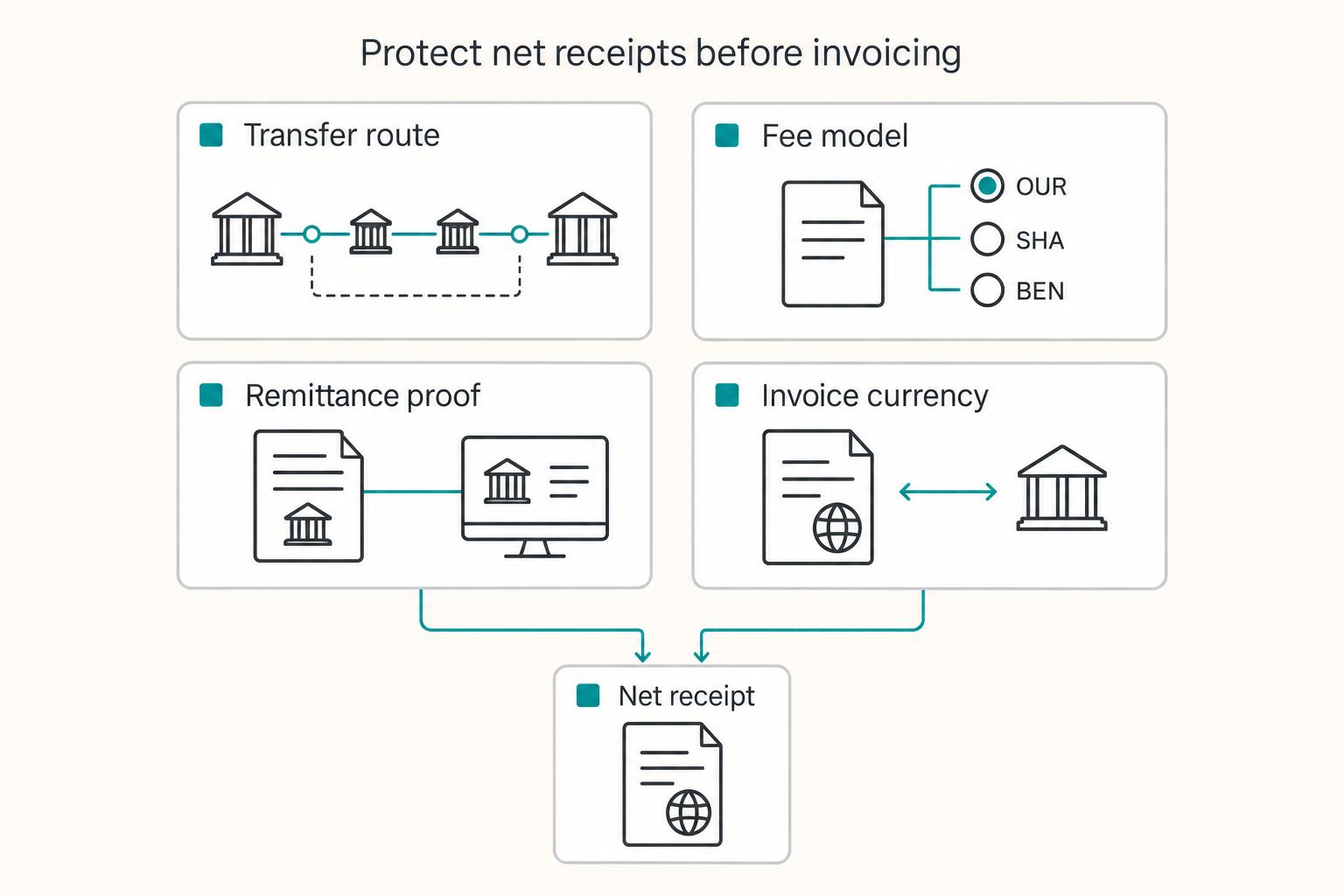
When a client says they paid but your money arrives late, lands short, or is hard to trace, that is a cash-flow risk, not a minor inconvenience. If the amount and timing are uncertain, planning your next moves gets harder.

The Freelance Payment Penalty: A Modeled Audit of Platform Fees, FX Spreads, and Payout Delays
The money rarely disappears through a single, easy-to-spot fee. The real loss is stacked. A marketplace takes its commission, a processor adds a charge for international cards, a bank or payment company converts the currency at a spread, a platform holds the funds before release, and a wire sheds a little to intermediaries on the way in. Each layer looks defensible on its own, but the worker feels the combined result as a smaller deposit and a later payday.