
Quick Answer
For planned U.S. domestic contractor payouts, use ACH when provider timing meets the due date. Check eligible Same Day ACH for urgent cases, and approve wires where delivery, settlement or corridor requirements justify them. Verify bank instructions and any prior attempt before dispatch; never replace a payment that can still complete.
Start with the payout policy your team can enforce#
Use ACH as the default for planned U.S. domestic contractor payouts when the account route, provider timing and due date fit. Treat a wire as an approved exception for delivery or settlement requirements ACH cannot meet. Cross-border payouts need their own corridor and currency checks; contractor nationality alone does not determine the rail.
This guide is for the people who have to make payout routing hold up in practice: finance, payments ops, product, and engineering owners managing scheduled batch payouts and messy off-cycle requests. The goal is not to pick the fastest rail in the abstract. It is to choose the one your team can approve, execute, reconcile, and explain when something goes wrong.
ACH is the practical starting point because it is a batch rail across U.S. institutions, which matches how predictable domestic payout programs run. The Federal Reserve describes ACH as a network through which institutions send batches of electronic credit and debit transfers, and routine payroll-style disbursements are a typical use case. If your contractor payouts are planned, recurring, and domestic, that is the pattern to optimize first.
Verify beneficiary details and approval evidence before dispatch. For domestic Fedwire payments, Federal Reserve account settlement is final and irrevocable; it is not automatic proof that the contractor has received usable funds. A bank may request recovery or return of a wire, but the sender cannot count on unilateral reversal. International delivery also depends on intermediary and recipient-bank processing.
Record the actual bank or provider fee quote, channel cut-off, funding requirement and recipient-delivery estimate. An operator cut-off may be earlier than the network deadline. Include receiving and intermediary charges and any FX conversion in the cost comparison, rather than treating an outgoing wire fee as the entire cost.
A workable policy can be simple:
- Default planned U.S. domestic batch payouts to ACH when provider timing meets the agreed due date.
- Escalate to wire only for documented urgency, exception risk, or cross-border cases where your normal domestic rail does not fit.
- Require approval evidence for every wire exception: business reason, beneficiary verification, and owner sign-off.
One checkpoint matters more than teams expect: confirm cutoff behavior and release channels with your bank or provider before you write product rules. We recommend confirming that channel in the exact release flow your team will use, not only in a policy note. Some providers limit online or app-initiated wires to domestic transactions only, which can break an assumed cross-border path at the last minute. The common failure mode is not choosing the wrong rail on paper. It is discovering after approval that the payment cannot be sent through the channel your team planned to use.
By the end of this guide, you should have three things you can use right away: a default routing policy, a wire escalation path, and a short implementation checklist for approvals, cutoffs, and reconciliation.
For related FX planning, see How to Lock In FX Rates for Contractor Payouts Using Forward Contracts.
ACH vs wire transfer at a glance for platform payout teams#
Use standard ACH as the default for planned domestic payouts, check Same-Day ACH first for urgent domestic exceptions, and use wire when speed, amount, or corridor constraints leave no cleaner option.
| Criteria | ACH transfer | Same-Day ACH | Wire transfer |
|---|---|---|---|
| Speed | Scheduled processing; use the provider delivery estimate. | Eligible entries settle the same business day within applicable windows; confirm recipient availability. | Fedwire provides final interbank settlement; customer delivery and international timing need separate confirmation. |
| Cost | Compare the actual provider quote. | Check any expedited fee against the delivery benefit. | Include outgoing, receiving, intermediary and FX costs. |
| Recovery | Returns and permitted reversals follow specific rules; recovery is not guaranteed. | Same ACH rules; faster settlement is not permission to reverse any payment. | A recall request is not cancellation or guaranteed recovery. |
| Routine U.S. batches | Default when timing fits. | Use when an eligible payment needs faster delivery. | Use an approved exception where its delivery or settlement characteristics are required. |
| Cross-border | Confirm the exact international ACH program and IAT classification with the originating bank. | IAT entries are ineligible. | Confirm corridor, currency, channel and recipient-bank support. |
| Amount | Provider and program limits apply. | Current network cap is $1 million per payment; provider limits may be lower. | Confirm bank limits, liquidity and approval rules; a large amount alone does not mandate wire. |
| Release checks | Bank details, authorizations, funding, cut-offs and due date. | All ACH checks plus eligibility and same-day windows. | Verified beneficiary, delivery estimate, cost quote and exception approval. |
As of October 2026, Same Day ACH has a $1 million per-payment network limit. Nacha has approved an increase to $10 million effective September 17, 2027; it is not yet available under that rule. IAT entries remain ineligible. Confirm lower provider limits, submission cut-offs and recipient availability before choosing same-day delivery.
Before you operationalize this table, verify cutoff behavior in your actual release channel and test failure handling. If an ACH credit is returned or a wire needs investigation, confirm where status appears, who owns follow-up, and what reference IDs your reconciliation team receives. If you make reviewers hunt across tools after release, your exception path is not ready.
A common failure mode is assuming cross-border wire availability just because wires exist in general. Some providers limit online or app initiation to domestic transactions, so approved payouts may still require a branch, banker, or separate portal step.
If you want a deeper dive, read Same-Day ACH for Platforms: How to Speed Up Contractor Payments Without Wire Transfer Fees.
Where ACH transfer should be your default for contractor payouts#
Default to standard ACH for predictable contractor payouts in domestic U.S. payments, especially scheduled batch payouts.
| Override case | Why standard ACH may not fit | Article detail |
|---|---|---|
| Urgent payment | The agreed receipt deadline is earlier than standard ACH delivery. | Check eligible Same Day ACH or an approved alternative before dispatch. |
| First payment | Bank details or provider eligibility need verification. | Complete verification; urgency does not remove the checks. |
| Deadline-sensitive payout | Provider estimates or a missed cut-off no longer meet the due date. | Confirm a viable route and any existing attempt before changing rails. |
ACH is built for grouped processing and recurring runs, which makes it a better default rail for routine volume. When payouts are reviewed and released in planned batches, teams usually face fewer last-minute escalations and less approval churn.
Plan approvals around your provider's submission windows, settlement calendar and recipient-delivery estimate. Do not equate an internal batch approval or scheduled release with bank receipt. A missed window needs a new delivery estimate and an owner who can explain it to the contractor.
Keep one operating checkpoint in place: confirm in your bank or processor channel when the batch was actually submitted and what status appears if it misses a processing window. That catches false "paid today" assumptions before they become support issues.
The failure mode is usually not ACH. It is letting urgency stay implicit until cutoff pressure forces a rail change. Tag same-day-risk payouts early, route them intentionally, and keep ACH as the explicit default for the rest of your domestic payout book.
You might also find this useful: FFC vs FBO vs FAO Wire Transfer Instructions for Platform Teams.
Where wire transfer is the right exception path#
Use wire transfer as a governed exception path when delay risk, settlement sensitivity, or corridor limits outweigh keeping the payout on ACH.
| Exception type | When wire is used | Timing or settlement note |
|---|---|---|
| Urgent off-cycle payout | ACH cannot meet the agreed receipt deadline. | Confirm the wire channel cut-off and recipient-delivery estimate. |
| Cross-border payout | Wire fits the supported corridor and currency better than available local or international ACH routes. | Allow for intermediary processing, reviews and recipient-bank timing. |
| Large settlement | The obligation specifically requires final interbank settlement. | Domestic Fedwire finality applies at Federal Reserve accounts; verify recipient credit separately. |
Use wire when these conditions are true:
- If your payout is time-critical and missing the window would cause a real commercial issue, escalate to wire.
- If your payout is high-value and settlement certainty matters more than routine rail economics, escalate to wire.
- For cross-border payouts, compare supported local, international ACH and wire programs in the required currency. USD denomination alone does not require wire.
Accept the tradeoff deliberately#
Approve the additional cost and controls when the wire meets a real delivery or settlement requirement. Late approval is a planning problem to fix, but a due payment still needs prompt handling through a verified, authorized route. Do not bypass beneficiary verification or other mandatory checks to meet a cut-off.
Evidence every wire exception should carry#
Require a documented approval pack before release:
- Business reason
- Beneficiary account instructions verified through a trusted channel; independently confirm changed bank details
- Urgency proof tied to a deadline, promise, or operational event
- Named owner sign-off
- Second-approver confirmation in the bank or provider channel
Because wires may not be reversible once processed and recovery can be costly, treat missing evidence as a stop condition. If beneficiary details, urgency/corridor justification, or approver records are incomplete, pause the payout. We recommend making that stop automatic so your reviewers are not improvising under cutoff pressure.
Route domestic and cross-border payouts without guesswork#
Start with the account route and actual funds flow, then check urgency, amount and risk. For an ACH entry involving an outside-U.S. financial agency, confirm IAT classification and required data with the originating bank. Do not classify solely by the contractor's residence or nationality, or assume all cross-border payments are ACH entries.
| Route option | Viable when | Likely to fail or be rerouted when | Verify before release |
|---|---|---|---|
| Domestic U.S. ACH | The actual ACH route qualifies and provider timing meets the due date. | Foreign funds-flow involvement was overlooked or the cut-off was missed. | Route classification, verified bank instructions, funding and delivery estimate. |
| International ACH transfer | The corridor is supported by your bank/provider program and country/region requirements are met | Team assumes ACH is universally available cross-border without checking corridor/program requirements | Whether the entry is IAT; corridor support; required destination-country/region data fields |
| Wire transfer | Domestic urgent cases, high-certainty settlements, or cross-border payouts where international ACH is unavailable/unsuitable | Wire becomes default because corridor checks or approvals were skipped | Urgency/risk justification, beneficiary details, and second approval before execution |
| Program availability | Your bank confirms the specific corridor and currency. | A general coverage label is used instead of current program confirmation. | For example, FRFS will stop accepting FedGlobal forward items to Mexico and Panama after November 20, 2026; plan the transition. |
Use a fixed decision sequence#
- Classify the actual account route and funds flow. Ask the originating bank whether an ACH entry requires IAT treatment.
- Check urgency. Decide whether batch timing is acceptable.
- Check amount and risk class. For sensitive settlements, settlement finality may outweigh routine rail cost.
- Choose the rail. Assign ACH, international ACH, or wire only after the first three checks.
Where teams usually get burned#
The common failure is treating cross-border payouts as one category with one answer. They are corridor- and program-dependent, so do not promise coverage until your bank/provider confirms support and route requirements.
Operationally, domestic routing is mostly timing/control. Cross-border routing is coverage first, then timing/control. If corridor support is unclear, pause release instead of letting a generic "bank transfer" label decide.
For corridor-specific detail, use International ACH Transfers and International Wire Transfer for Platforms: When to Use Wires vs. Local Rails for Cross-Border Payouts. This pairs with Southeast Asia Contractor Payouts Across Philippines, Indonesia, Thailand, and Vietnam.
Prevent duplicate payouts when routing changes#
A routing policy needs an exception owner, duplicate prevention and evidence of the payment outcome. The most dangerous change is sending an urgent replacement while the original payment can still complete.
The most common breakdowns are operational:
- Late escalation from ACH to wire. A scheduled payout misses the business need, an urgent wire is requested, and no one confirms whether the original ACH is pending, returned, or posted.
- Duplicated urgent requests. Support, finance, and ops each try to resolve the same complaint from different systems, creating duplicate risk.
- Unclear ownership for exception payouts. If no single owner controls decision, approval, and final status check, a second payment can be sent before the first is resolved.
An ACH return and a reversal are different processes. Nacha permits reversals only for specified erroneous entries and requires timely delivery to the receiving institution, generally within five banking days of the erroneous settlement. Lack of funding is not a permitted reason. Ask the bank to classify the issue and confirm the applicable window; do not treat reversal submission as proof of recovered funds. For a replacement, first establish that the original attempt cannot still complete.
The checkpoint most teams skip#
Before release, simulate a failed batch submission and a retry for the same payout set. The pass/fail question is simple: does the retry create a second disbursement, or return the original result?
Atomically guard each business payout obligation against multiple execution attempts across batches, rails and providers. Use the provider's idempotency key within its supported operation and retention window; an expired key, new key or different rail can create another payment. On partial batch failure, reconcile every item and retry only known unexecuted items. An unknown outcome stays in investigation, including after a timeout, rather than triggering a wire fallback.
Reconcile the request and its attempts with provider or bank outcome evidence and the accounting trail. A matching internal ledger entry is not proof of recipient credit. Keep an unresolved case open with a named owner and trace reference. Only authorize a replacement once the original cannot still complete, and retain the link between the original obligation and the replacement.
Need the full breakdown? Read How to Build a SaaS Marketplace That Manages Subscriptions and Contractor Payouts.
Decision checklist teams can apply this week#
Default planned U.S. domestic contractor payouts to ACH when delivery fits. Document wire exceptions for genuine timing, settlement or corridor requirements, and verify any prior attempt before changing the rail.
Set the default rail by payout class.#
- Use ACH for planned U.S. domestic batches with verified bank details and provider delivery estimates that meet due dates.
- Treat wire as an exception path, not a parallel default.
Define escalation triggers in writing.#
- State the last acceptable delivery time.
- State the business impact if funds land late.
- Confirm corridor constraints for the rail you want to use.
- Separate large settlements from normal contractor disbursements.
Check urgent domestic payouts in order.#
- Check Same-Day ACH availability first.
- Confirm eligible entry type, the current $1 million network cap, any lower provider limit, submission cut-off and recipient availability. IAT entries are ineligible.
Split ownership on purpose.#
- Finance approves exception spend and business reason.
- Ops executes routing and confirms beneficiary instructions.
- Engineering enforces approval logic in payout services so urgent retries cannot bypass controls.
- Keep wire access, initiation, and approval separated.
Review one weekly exception report.#
- Track wire share, reason codes, and preventable escalations from planned batch payouts.
- If the same ACH return codes or late escalations repeat, treat it as a policy gap to fix.
Related reading: How to Use a SWIFT MT103 to Trace a Delayed Wire Transfer.
Implementation checkpoints for finance ops and engineering#
Make the payout path deterministic before you scale exceptions: every payout should follow one ordered flow, and every retry should be duplicate-safe so your team can explain the outcome fast.
| Step | Action | Detail |
|---|---|---|
| Policy gate check | Confirm corridor and urgency | Check whether ACH transfer, Same-Day ACH, or Wire transfer is allowed |
| Rail selection | Write the selected rail to the payout record | Do this before execution |
| Approval | Hold off-cycle payouts or wire exceptions until the required approver signs off | Applies to off-cycle payouts and wire exceptions |
| Execution | Guard the obligation atomically and send with the supported provider key. | Retain each attempt; investigate unknown outcomes before retrying or changing rails. |
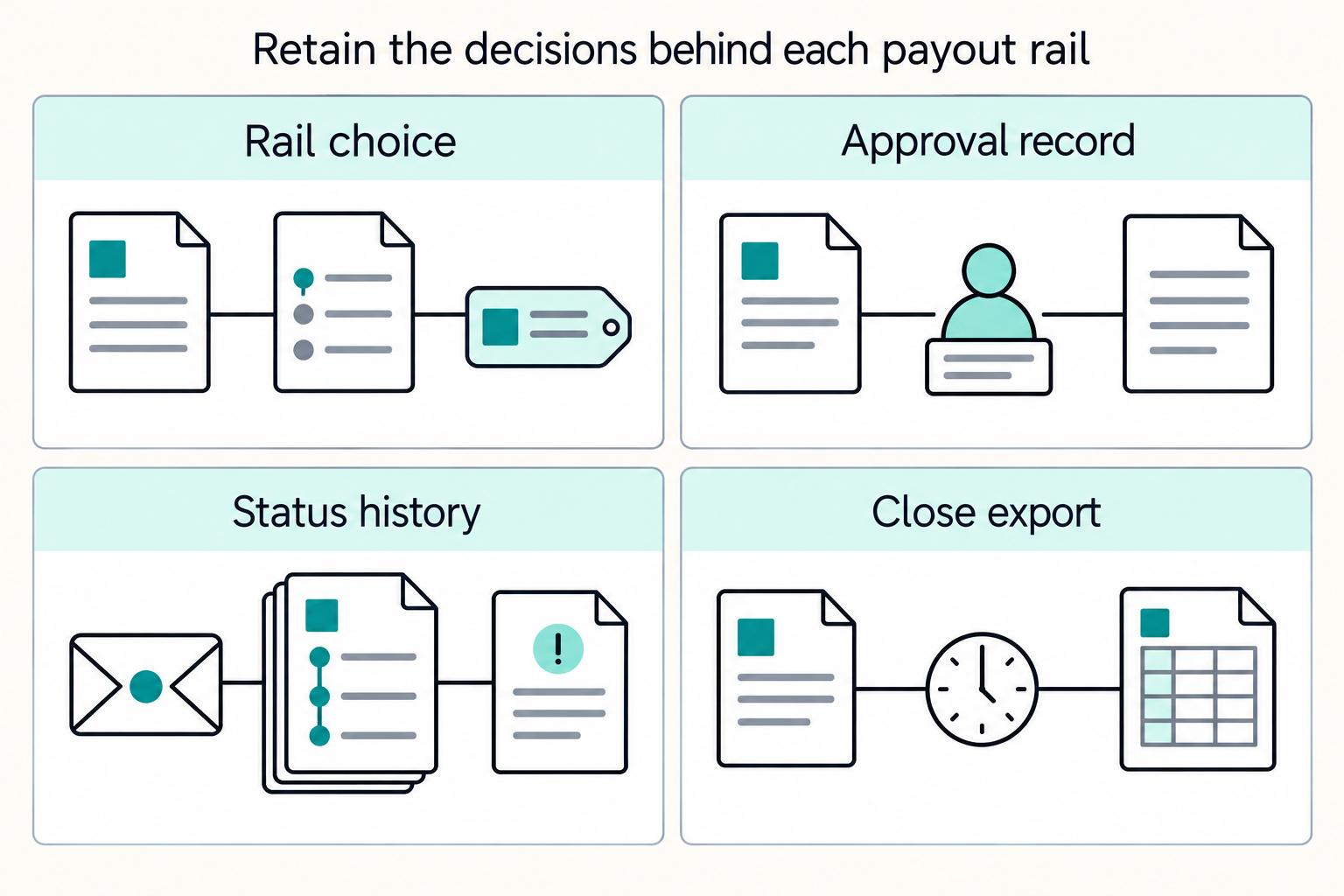
| Status update | Authenticate, durably record and process provider events. | Preserve status history and handle duplicates or out-of-order delivery without regressing the state. |
| Reconciliation artifact export | Export payout ID, rail, approval record, timestamps, idempotency key, and final status | Use this artifact set for close |
Authenticate webhooks and durably store or queue them before acknowledging receipt. Deduplicate event deliveries and apply guarded state transitions; two distinct events may concern the same obligation, so event-ID deduplication alone cannot prevent duplicate payout execution. Test a post-acceptance timeout, a partial batch failure and a repeated off-cycle request against the same obligation.
Give finance and support a consistent permitted view of rail, current state, status history and the next action owner. Preserve restricted diagnostic details for authorized staff. A generic failed label should not conceal whether a payment was rejected before dispatch, returned after sending, or remains unresolved.
For a step-by-step walkthrough, see Wire Transfer Fees for Platforms and How to Minimize Outbound Costs.
Choose one default rail and make exceptions explicit#
Use ACH as the default for planned U.S. domestic payouts whose provider timing meets the agreed due date. Govern wire exceptions through verified requirements and approval.
ACH is built for batch processing, including same-day and next-day settlement options, which fits scheduled and repeat payout cycles. Wire should sit behind a stricter policy bar because it is generally used for large-value, time-critical payments.
Put the routing rule in writing#
- Default planned U.S. domestic batches to ACH when timing fits.
- If timing is tight, check Same-Day ACH before approving a wire.
- Escalate to wire only when urgency, value, or rail fit is documented and approved.
For Same Day ACH, verify entry eligibility, the current network and provider caps, submission cut-off and recipient availability. IAT entries cannot use this service; the approved $10 million network limit starts in September 2027, not in 2026.
Make ownership and evidence non-optional#
Execution matters more than theory. Finance should own exception spend and approvals, ops should execute rail choice and verify payout details, and engineering should make routing logic visible so exceptions are intentional. If your teams cannot see the same rule at release time, your policy will drift.
Before dispatch, retain the payout obligation, verified beneficiary, business reason, delivery requirement, quote and approval records. After execution, add provider or bank references, actual timestamps and accounting evidence. Keep unresolved attempts visible and investigate them before another dispatch. Review repeated urgent exceptions to improve planning and cut-off visibility.
Document your rail policy this week, test it on recent contractor payouts, and tighten rules where decisions were late or weakly documented. We recommend starting with your last urgent payout and your last off-cycle payout so you can see where the rule broke.
Frequently Asked Questions
Is ACH or wire transfer better for paying contractors at scale?
For many scaled contractor programs, ACH is often the default for recurring U.S. payouts because ACH supports batched payment options, including same-day and next-day settlement. Use wire as an exception path when timing, value, or corridor requirements justify it.
When should a platform use wire transfer instead of ACH transfer?
Use a wire when verified delivery or settlement requirements cannot be met by an appropriate ACH option. Domestic Fedwire settlement is final at Federal Reserve accounts; that does not prove immediate beneficiary availability. A recall is a recovery request, not guaranteed cancellation. Confirm the beneficiary, delivery estimate, cost and exception approval before dispatch.
Can International ACH transfer replace wire for cross-border payouts?
Only where the specific bank or provider program supports the corridor, currency, amount and required data. Compare international ACH with local rails and wire using their actual delivery estimates. USD denomination or a large payment alone does not establish that wire is required. Confirm IAT classification for ACH entries with the originating bank.
Is Same-Day ACH fast enough for urgent contractor payouts?
It can be for eligible U.S. ACH entries when the submission window and recipient availability meet the deadline. As of October 2026 the network cap is $1 million per payment; the approved $10 million increase takes effect September 17, 2027. Provider limits can be lower, and IAT entries are ineligible. Confirm cut-offs and delivery rather than promising a fixed number of hours.
Are wire transfers always worth the extra cost for time-sensitive payments?
Compare the cost of delay with actual wire costs and delivery certainty. Check eligible Same Day ACH first. For an urgent make-good, establish that the original payment cannot still complete before approving a replacement on any rail; urgency does not resolve an unknown outcome.
What is the best default for recurring batch payouts vs off-cycle payouts?
For planned U.S. domestic batches, use ACH when timing fits. Put off-cycle requests through the same account verification and obligation guard, then check eligible Same Day ACH or an approved wire exception. Cross-border payments require their own program checks. Preserve the reason, approver and any prior attempt evidence.
Try a related tool
Researched and edited by the Gruv editorial team. Gruv builds cross-border billing, payouts, and finance-operations software for global businesses.
Sources
Includes 3 external sources outside the trusted-domain allowlist.
- docs.stripe.com/api/idempotent_requeststrusted
- docs.stripe.com/webhookstrusted
- federalreserve.gov/paymentsystems/fedfunds_about.htmtrusted
- frbservices.org/news/communications/112525-ach-discontinuati...external
- nacha.org/same-day-achexternal
- nacha.org/rules/increasing-same-day-ach-dollar-limit-1...external
Educational content only. Not legal, tax, or financial advice.
Related Posts
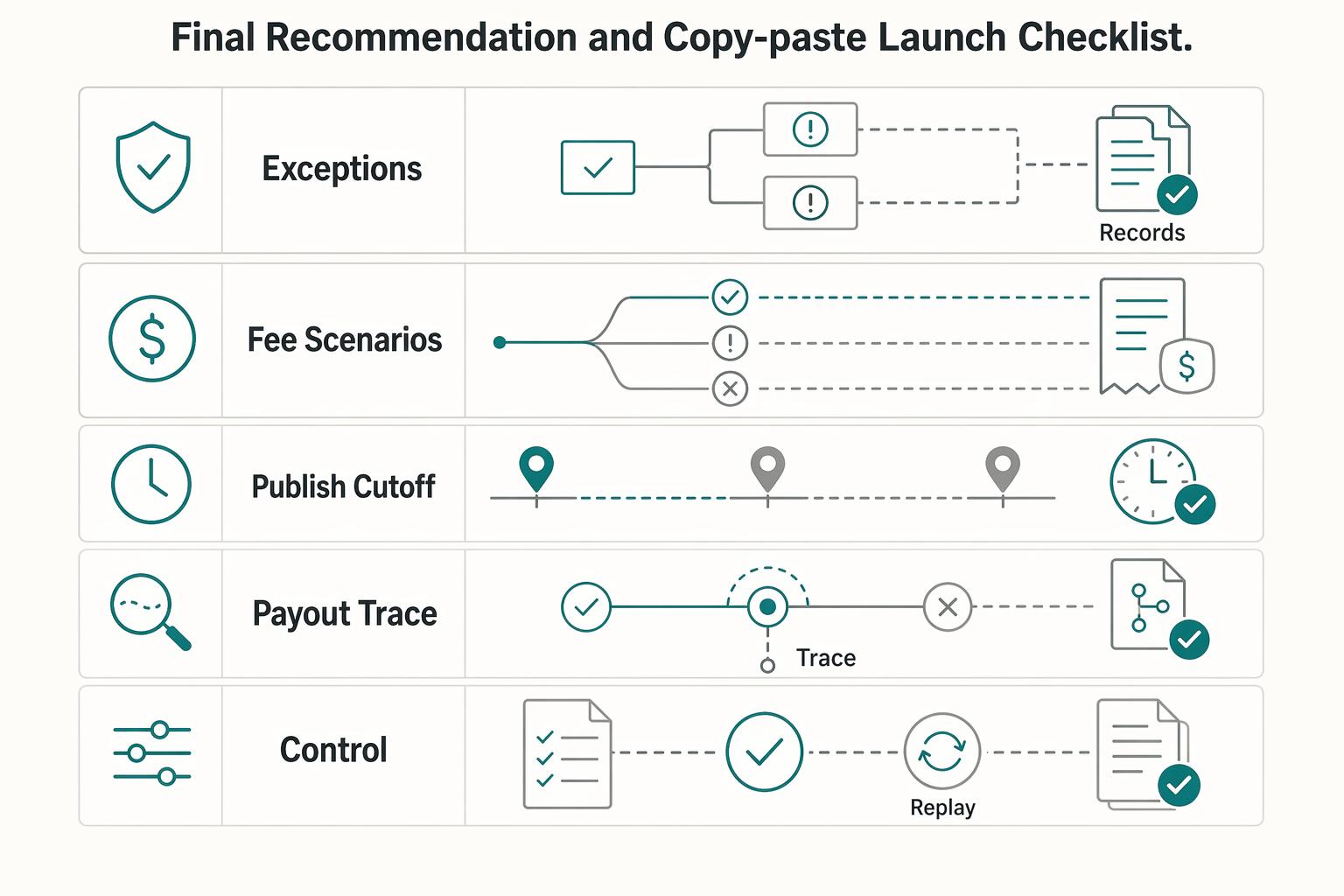
Same-Day ACH for Platforms: How to Speed Up Contractor Payments Without Wire Transfer Fees
The goal is simple: cut avoidable wire use without making contractor payouts less reliable. That is where Same-Day ACH earns its place. Nacha describes it as the faster payment method on the ACH Network. It also notes that it can support same-day pay for many gig and contract workers, with settlement that can occur within a few hours.
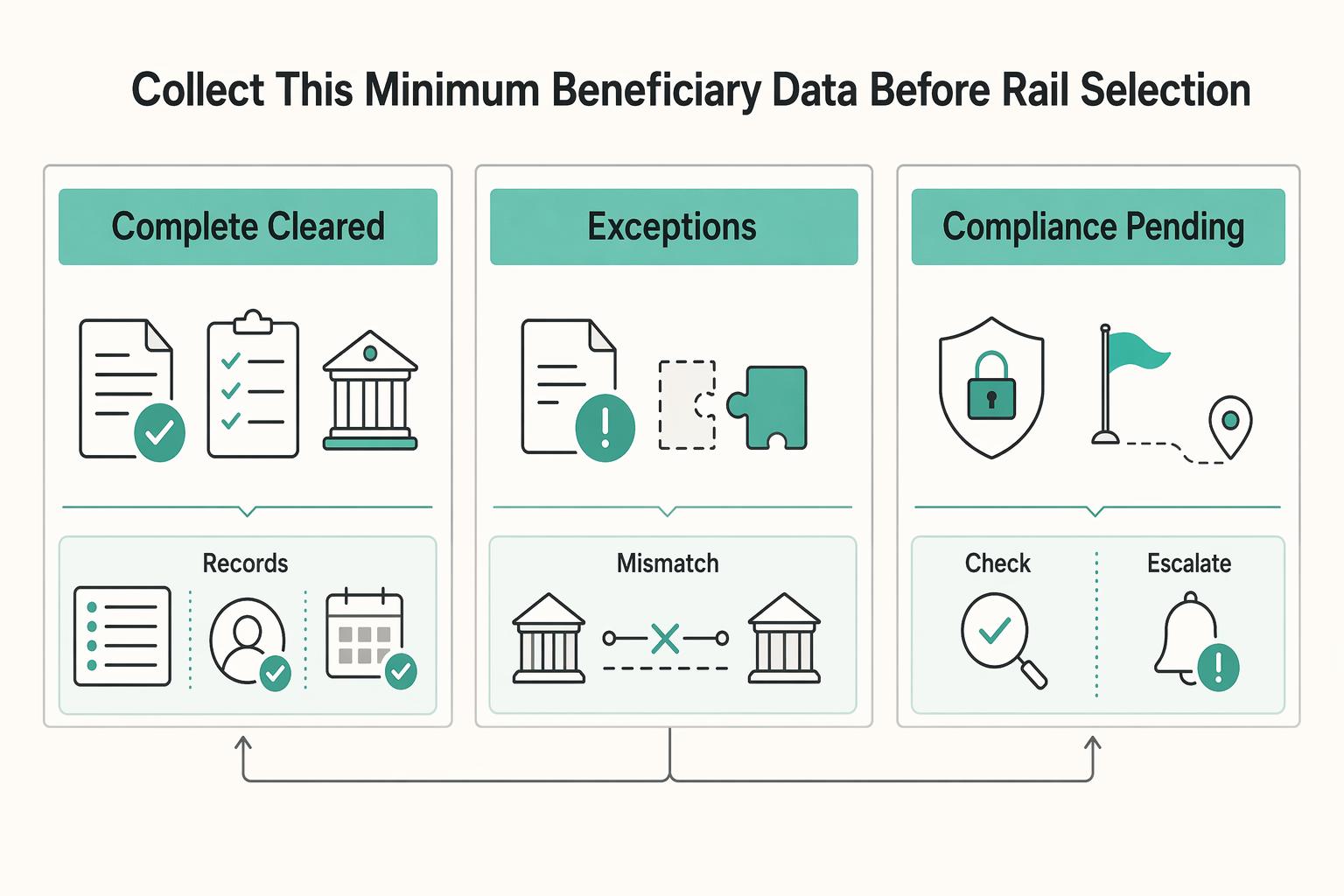
When Platforms Should Use Wires vs Local Rails for Cross-Border Payouts
Treat rail choice as product logic, not team habit. No rail wins everywhere. SWIFT and local payment rails solve different payout risks, so your job is to route each payout by destination, currency, speed, and cost, not by whichever option sounds more global or more modern.
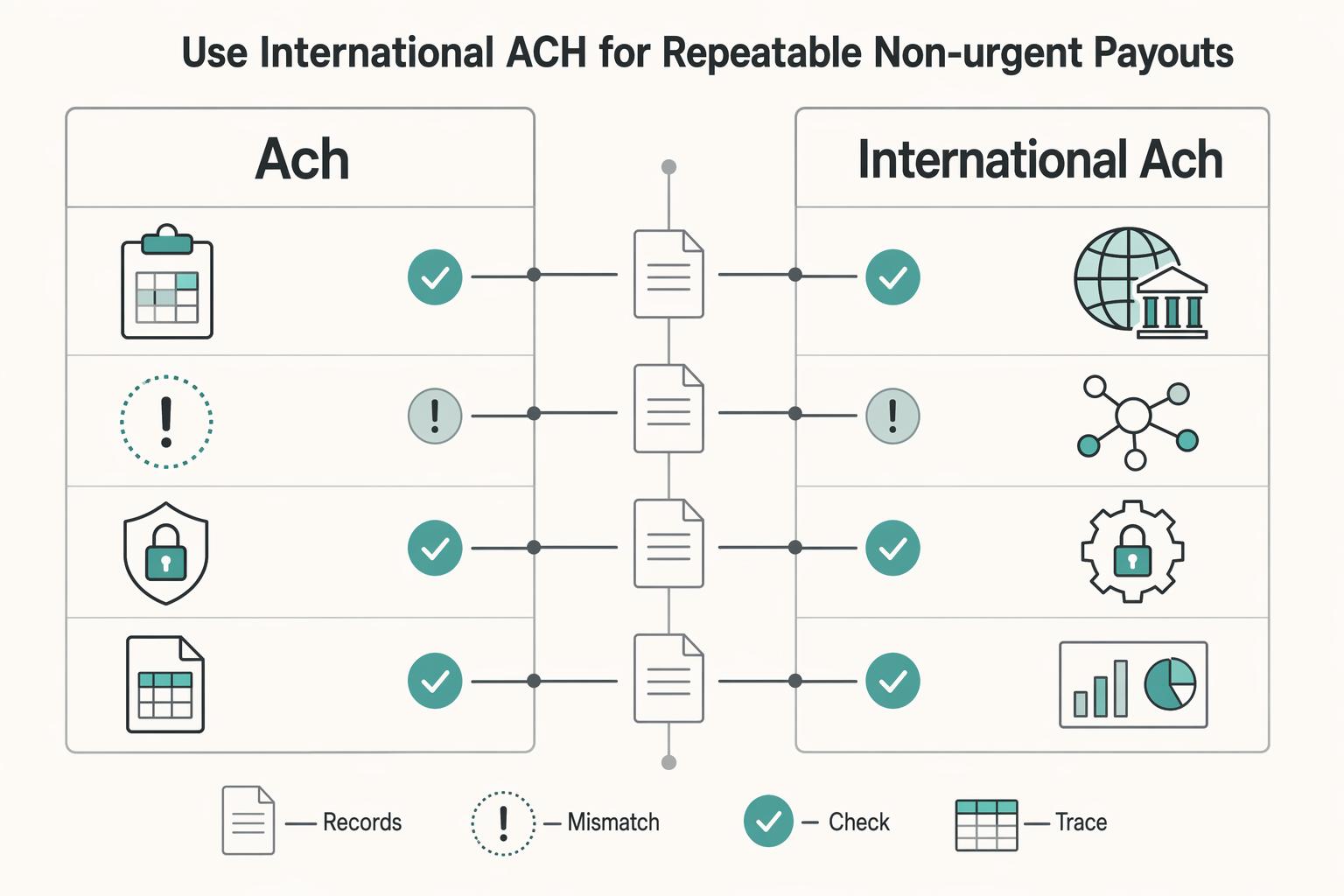
International ACH Transfers for Platform Operators
**International ACH can fit repeatable, non-urgent cross-border payouts when lower payout cost matters and you can still control approval, submission, recipient credit, and reconciliation.** For finance, ops, and product owners, this is less a payment-method debate than an ownership and control problem.