
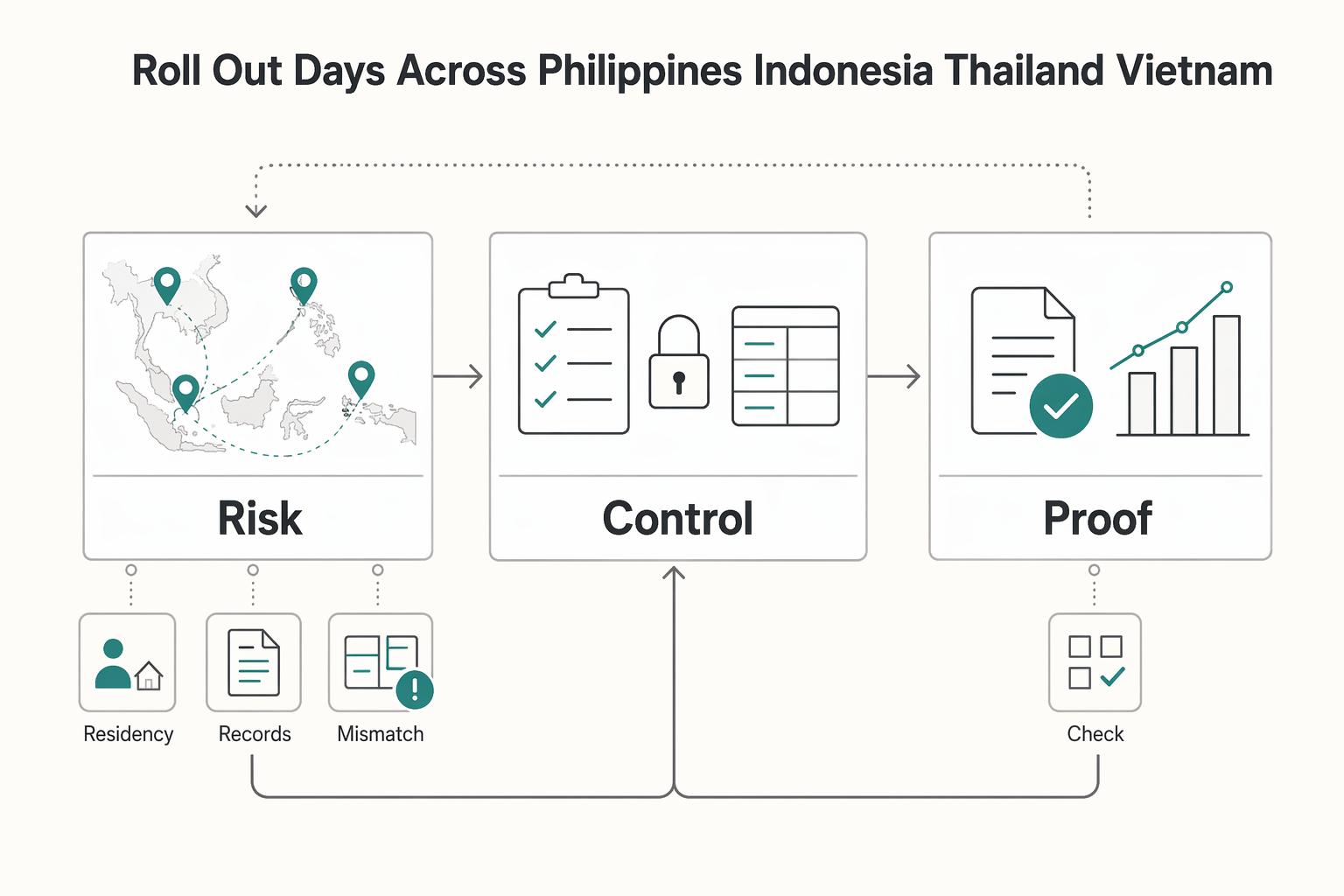
Quick Answer
Start with a country-by-country operating setup for southeast asia contractor payouts, then launch only after compliance gates and payout controls are proven in production-like tests. For Philippines, Indonesia, Thailand, and Vietnam, confirm worker classification ownership, verify rail behavior, require a complete evidence pack, and block release when records are missing. Use pilot cohorts to validate settlement behavior, return handling, and reconciliation before increasing payout volume.
How to run Southeast Asia contractor payouts as country-by-country launches, not one regional rollout#
Treat Southeast Asia as four separate launch decisions, not one regional rollout. If you approach the Philippines, Indonesia, Thailand, and Vietnam with a single APAC payout template, you can create avoidable rework in compliance, rail selection, and reconciliation.
This guide is for teams making operating decisions, not looking for one universal country answer. The region may look similar from a distance, but contractor payouts can differ in practice, and that matters as soon as you start choosing how to onboard, approve, and reconcile payments.
Plan country by country#
Start with a country-by-country plan. That sounds obvious, but it is where teams often get stuck early. A regional plan can help with sequencing and ownership, yet the actual release decision still needs to be made market by market for the Philippines, Indonesia, Thailand, and Vietnam.
Early on, check whether your team can name, for each country, who owns worker classification, who signs off payout compliance, and which payout route is actually under review. If the answer is still "APAC ops" or "the payments provider handles it," you likely are not ready to scale. Thailand is a clear example: contractor payments still require attention to Thai labor laws and tax laws, so assumptions from other markets may not carry over cleanly.
Decide what you can control now#
Decide the four things you can control now: your compliance model, your rail strategy, your payout operations design, and your launch sequence. Those choices shape almost everything that follows, especially where engineering, finance, and legal handoffs can break.
In practice, the tradeoff is speed versus certainty. You can move faster by reusing one onboarding flow and one payout path across countries, but that can raise the risk of hidden exceptions, missing tax artifacts, and support queues finance cannot reconcile later. Or you can slow down enough to define country scope, approval gates, and evidence requirements up front, which usually means fewer surprises once payout volume rises.
Separate facts, assumptions, and proof#
Separate what you know, what you assume, and what still needs proof. Coverage varies by market, program, and provider, so this guide focuses on verification points instead of assuming every rail or payout product is available everywhere.
Use that same discipline internally. Verify provider availability for each target market before you promise launch dates. Verify that contractor onboarding captures the documents finance will need later, not just the data a product flow finds convenient. A frequent mistake is treating neighboring markets such as Singapore or Malaysia as proof that the same setup will work for the four countries in scope here. It may help directionally, but it is not enough evidence for release.
For a step-by-step walkthrough, see How Small Teams Can Outsource IT Work in Southeast Asia Without Losing Control. If you need a practical next step, try the free invoice generator.
What to prepare before you send the first payout#
Before you pick tools, set ownership. For the Philippines, Indonesia, Thailand, and Vietnam, assign who decides worker classification, who approves compliance and payout release, and who signs off reconciliation. If those owners are still implicit or pushed to "the provider," pause launch.
Set owners before tooling#
Document your operating model up front, including whether you pay through your own entity, an EoR, or directly to independent contractors, and who can approve exceptions. This matters because classification and payment obligations depend on where the contractor lives, not on a regional assumption.
Run one end-to-end test file before scaling. You should be able to show who reviewed classification, who approved payout release, and how finance ties the payment to the ledger.
Build one evidence pack per contractor#
Keep one retrievable evidence pack per contractor. As an internal standard, this can include an independent contractor agreement, tax profile, payout destination proof, and consent records stored together.
Avoid fragmented records across tools. That may work at low volume, but it usually breaks once exceptions and audit requests increase.
Freeze phase-one scope#
Lock phase-one scope in writing to the Philippines, Indonesia, Thailand, and Vietnam. Treat Singapore and Malaysia rails or assumptions as out of scope unless separately approved, so adjacent-market coverage is not mistaken for launch proof.
Choose payout rails by market fit and operational burden#
Choose rails country by country, and treat every option as unconfirmed until you can verify it for your exact contractor flow. Use rail names to structure decisions, not to assume readiness.
Build a market matrix from verified evidence#
Build your matrix around what your provider can show in writing and in product behavior for the Philippines, Indonesia, Thailand, and Vietnam.
| Market | Rail or method to review | What to verify now | What remains unproven |
|---|---|---|---|
| Philippines | InstaPay, PESONet, bank transfer via your provider | Whether these options are documented for your account setup, and whether status and reconciliation outputs are available to your team | Settlement behavior, return handling quality, and operational performance for your payout mix |
| Indonesia | Local bank transfer options through your provider | Required beneficiary fields, visibility of payout states, and what reconciliation data is exposed | Real-world success rates, retry behavior, and day-to-day exception workload |
| Thailand | Local bank payout options through your provider | Enablement requirements, failure-state visibility, and export detail for finance | How reliably failures are explained and resolved in live operations |
| Vietnam | Local bank payout options through your provider | Account-format requirements, verification steps, and traceability in your ops workflow | Production reliability and recovery behavior when payouts fail |
| Adjacent markets only | FAST, RTGS, PayNow, DuitNow | Useful labels for provider discussions about rail types and operating models | Proof of behavior for your four launch markets |
InstaPay, PESONet, FAST, RTGS, PayNow, and DuitNow can improve question quality, but they do not confirm capability for your launch scope on their own.
Ask for operator-level detail before deciding#
Prioritize the rail your finance and support teams can actually operate day to day. Ask each provider for the payout status lifecycle, return or rejection reason visibility, reconciliation export examples, and country-specific beneficiary requirements. If a provider example such as HitPay, other global platforms, Alipay, or Furikomi is part of the discussion, label it as directional unless you have program-specific evidence for Philippines, Indonesia, Thailand, or Vietnam.
Separate knowns from pilot-only unknowns#
Keep the boundary clear:
| Category | Validation point |
|---|---|
| Known now | Which payout options the provider lists for each target market |
| Known now | Which beneficiary fields and onboarding inputs are required |
| Known now | Whether status and reconciliation outputs are available to operations and finance |
| Unknown until pilot | Effective fees and FX outcomes on your real payout mix |
| Unknown until pilot | Success and failure patterns by destination |
| Unknown until pilot | Retry and recovery behavior after rejects or timeouts |
| Unknown until pilot | Actual support burden when payouts are delayed or returned |
Shortlist up to two payout paths per market, then run a controlled pilot before scaling. Related: How a Logistics Platform Scaled Driver Payouts Across Southeast Asia.
Set compliance gates before money moves#
Treat compliance as a release gate, not a cleanup step after payout setup. As an operating control, run checks in this order: worker classification review, then KYC/KYB/AML, then payout method enablement, and only then release approvals.
Separate classification, tax, and verification#
Keep these as separate decisions in every market file:
| Decision area | Definition |
|---|---|
| Classification | Whether the person is handled as a contractor or in an employment-like relationship |
| Tax profile | What you collect, report, or withhold for that market |
| Verification | Whether the person or entity passes KYC/KYB/AML controls |
A signed contractor agreement alone should not be treated as full clearance. Before a profile becomes payable, your team should be able to show the classification decision, tax profile, and approver record.
For Thailand, avoid hardcoded automation rules unless your legal team has defined them for your use case. If the onboarding facts look employment-like, route to manual legal review before first payout.
Keep payable status separate from verification#
"Verified" should not automatically mean "approved to pay." Tie payable status to a complete evidence pack, not to ad hoc support notes. At minimum, keep the contractor agreement, tax profile, payout destination proof, and verification result together.
If social security scope changes, capture that separately. Where applicable, Totalization agreements assign coverage to one country and exempt social security taxes in the other, and a Certificate of Coverage is used as proof of that exemption.
Block missing artifacts before release#
Default to fail-closed controls: if required artifacts are missing, block payout release automatically. Use manual exceptions only for true edge cases, not as a weekly operating pattern.
Build payout operations that engineering and finance can both trust#
After compliance gates are in place, design payout ops so one valid payout moves once, posts once, and reconciles once. Use one internal payout record as the source of truth for status, retries, and ledger effects, and attach every provider event back to that record.
Map one payout chain and make it visible#
Map the full chain before you optimize any single step: payout request, provider routing, provider response, webhook updates, internal status transitions, ledger posting, and reconciliation export. Engineering and finance should be looking at the same payout object at every stage.
For each target market - Philippines, Indonesia, Thailand, and Vietnam - trace a real payout by ID and confirm you can answer: who requested it, which route was used, what external reference was returned, which internal status changed on webhook receipt, and when the ledger entry was created. If any answer lives only in inboxes or spreadsheets, fix that before scaling batch volume.
Keep the payout evidence pack attached to the payout record so disputes can be reviewed in one place.
Enforce retry safety and one status owner#
Treat retries and duplicate events as normal operating conditions. Make payout creation idempotent so the same request key resolves to the same payout record, and define one component that is allowed to advance payout status.
Provider webhooks should be inputs to status decisions, not direct ledger writers. That keeps late, replayed, or out-of-order events from creating duplicate disbursements or invalid final states.
In test or staging, replay the same payout request and duplicate webhook deliveries. Confirm you still get one internal record, one outbound disbursement, and one ledger impact.
Control batches and review exceptions by country#
Before release, run preflight validation for payable status, destination details, required compliance artifacts, currency and amount validity, and unresolved holds. Then enforce explicit approval gates and keep a clear record of the released batch version.
After release, route stuck, returned, or rejected payouts into a post-batch exception queue with a named owner and monitored SLA. Avoid silent retries without confirming why the first attempt failed.
Review each cycle by country - Philippines, Indonesia, Thailand, Vietnam - for payout success rate, top return reasons, unresolved exceptions, and aging of open items. Country-level aging is what helps surface hidden operational risk inside aggregate regional metrics.
Related reading: How Australian Agencies Can Pay US Contractors With Lower Risk.
Roll out in 90 days across Philippines Indonesia Thailand Vietnam#
Use 90 days as a controlled launch window, not as proof that all four markets are fully operational. A vendor AP-automation guide cites 10-14 months for full multi-entity rollout, but that is not a validated contractor-payout benchmark; in this plan, the first 90 days are for proving control, reconciliation, and country readiness.
| Phase | Days | Focus | Key rule |
|---|---|---|---|
| Phase 1 | 1-30 | Finalize compliance gates, evidence-pack requirements, and primary and fallback payout rail shortlist by country | Do not treat one regional standard as complete if any market still depends on manual exceptions |
| Phase 2 | 31-60 | Pilot each market separately with low-risk cohorts and prewritten success criteria for payout latency, duplicate and late-event handling, support response, and reconciliation quality | Each test payout should resolve to one internal payout record, one provider reference, and one ledger impact |
| Phase 3 | 61-90 | Increase batch size only in markets where reconciliation is routine and exception handling is predictable | If failures cluster in one market, pause that market and continue the others |
Phase 1 (days 1-30): lock the foundation by country#
For Philippines, Indonesia, Thailand, and Vietnam, finalize:
- compliance gates
- evidence-pack requirements
- primary and fallback payout rail shortlist
Do not treat one regional standard as complete if any market still depends on manual exceptions.
Phase 2 (days 31-60): run low-risk pilots with pass/fail rules#
Pilot each market separately with low-risk cohorts and prewritten success criteria for:
- payout latency
- duplicate and late-event handling
- support response
- reconciliation quality
Each test payout should still resolve to one internal payout record, one provider reference, and one ledger impact, with a clear path for returns or stuck payments.
Phase 3 (days 61-90): scale only where controls stay stable#
Increase batch size only in markets where reconciliation is routine and exception handling is predictable. If failures cluster in one market, pause that market and continue the others so one country does not block the rest of the rollout.
Recover fast when payouts fail or get stuck#
Fast recovery starts with clear triage: every exception gets one class, one owner, one next action, and one evidence trail.
Name the failure before anyone touches it#
Classify the issue first, because labels like "failed" or "pending review" do not tell your team whether to retry, reroute, hold, or reverse.
| Failure class | Primary owner | First recovery action | Manual review trigger |
|---|---|---|---|
| Rejected destination | Ops | Verify destination details against payout destination proof, then correct and resubmit if the contractor confirms the account is still valid | Destination changed, account ownership unclear, or repeated rejection |
Compliance hold AML | Compliance | Freeze release and confirm case status before any resend | Always, until compliance clears or rejects |
| Provider timeout | Engineering or payments ops | Check whether the provider accepted the request using the provider reference or idempotency key before retrying | No definitive provider acceptance state |
| Duplicate retry risk | Engineering | Block resend until you confirm whether the original instruction posted, settled, or failed | Any replay where ledger state and provider state disagree |
| Post-settlement return | Finance or ops | Record the return against the original payout, notify the contractor, and decide whether a new payout is allowed | Return reason is unclear or funds landed back without matching metadata |
Use one checkpoint before automation: every failed item should map from one internal payout ID to one provider reference and one ledger event.
Decide when to retry, reroute, or stop#
Retry only when records show the first attempt was not accepted or was explicitly marked failed. For timeouts, confirm provider acceptance state before any resend.
Reroute only when destination details are current and contractor-approved. If the issue is an AML hold, stop and wait for compliance disposition rather than switching rails.
Require manual review whenever money-movement state is uncertain and documentation is incomplete, including changed bank details, repeated destination rejections, or mismatched ledger and provider states.
Keep external statuses simple and internal records rich#
Keep contractor-facing statuses simple, such as processing, action needed, paid, and returned, while keeping internal records detailed. Tie each internal case to the provider reference, payout attempt number, reviewer, and ledger impact.
A strong recovery record answers three questions without opening chat logs: what happened, who owns it now, and what must be true before money moves again.
Mistakes that create hidden risk in Southeast Asia contractor payouts#
The most expensive mistakes usually look operationally "fine" at first, because money moves while compliance risk accumulates. The common pattern is treating regional guidance as execution-ready for the Philippines, Indonesia, Thailand, and Vietnam.
Reject generic APAC guidance#
APAC is a planning label, not an execution control. If you do not separate decisions by country, you can miss local employment, tax, or entity requirements and still assume you are compliant.
Use a country signoff sheet before launch that names the worker-classification owner, required contractor documents, and tax-handling approver. In Indonesia, keep contractor, EOR, and direct-employment models distinct: the cited EOR material states the EOR is the formal legal employer, and misunderstanding local requirements can cause legal issues, payroll mistakes, unexpected liabilities, and penalties. If an Indonesia partner claims EOR coverage, verify the legal basis and whether setup aligns with KBLI 78300 and the cited labor reference No. 14/2025.
Block batches when core artifacts are incomplete#
Do not release batch payouts until worker classification is confirmed and the independent contractor agreement is complete. The grounding is explicit: worker misclassification is against labor law, and contractors are governed by service agreements rather than employment contracts.
This failure mode is predictable: teams optimize for release speed, then legal or finance must unwind payments made under the wrong relationship. Keep the minimum evidence pack on the contractor record, not scattered in email threads.
Optimize for reversibility, not just speed#
Speed alone is not risk control. If return handling, withholding-tax ownership, and reconciliation are unclear, risk shows up later as unreconciled payouts, tax gaps, or support disputes.
Before scaling rails or providers, require one verification checkpoint: finance can trace each batch to payout approvals, tax records, and return outcomes by country. A cheaper or faster path can still become more expensive once hidden rework appears.
Conclusion#
What usually holds up is not the fastest launch. It is the country-specific one that keeps compliance gates tight, rail decisions explicit, and reconciliation boring before you add volume.
- Confirm legal and document readiness first.
Start with worker classification, because local laws across APAC determine whether someone is treated as a contractor or an employee, and that changes what you are actually allowed to automate. Before a payout is approved, make sure the file has the required engagement documentation, the market-specific tax artifacts you require, and proof of the payout destination. The verification point is simple: if finance or legal cannot pull a complete contractor record on demand, the payout should stay blocked.
- Approve rails country by country, not by regional habit.
Write down why each market gets a specific rail, what tradeoff you are accepting, and what fallback you will use when it fails. The Philippines and Thailand are a good reminder that these are not interchangeable setups. If a provider pitches one setup for all four countries, ask them to prove failure visibility, return handling, and reconciliation exports for each market instead of accepting a single regional promise.
- Enforce retry safety and event-driven status updates.
Use idempotency on payout creation so a timeout or repeated request does not create duplicate disbursement effects. Pair that with a webhook endpoint so your application receives real-time payout events and does not rely on manual status chasing or stale polling. The checkpoint here is one stable internal payout ID tied to one approval, one provider reference, and one final state. If those records do not align, stop the retry and send it to manual review.
- Scale only after reconciliation is consistently clean.
Payment reconciliation is the matching of transaction records against accounting records to confirm accuracy and consistency, so make it ledger-backed from day one. Run pilot cohorts first, review failure reasons and unresolved exceptions on a fixed cadence, then expand market by market based on what the data shows. A real red flag is a country where payouts look successful in the provider dashboard but cannot be matched cleanly in your ledger or accounting export. When that happens, pause that market, fix the evidence trail, and keep the others moving.
If you keep those four steps in order, Southeast Asia stops looking like one rollout and starts behaving like country-by-country launches. That is often the difference between a pilot that moves money and an operation your finance team will still trust six months later.
Frequently Asked Questions
What are the minimum checks before paying contractors in Southeast Asia?
A practical minimum bar is worker classification, a signed independent contractor agreement, clear tax-handling ownership, and proof of the payout destination. In Vietnam, add beneficiary-name verification (including Vietnamese characters where required), the correct branch-specific bank code, and any required purpose code for cross-border transfers. If those records are incomplete or only sitting in email, hold the payout.
Which should we decide first for launch: compliance model, payout rail strategy, or payout operations design?
Decide the compliance model first. Thailand guidance puts worker classification first, which means rail selection comes after you know the legal relationship you are supporting. Once classification is approved, you can choose rails and then design retries, approvals, and reconciliation around that reality.
How should we compare rails like `InstaPay`, `PESONet`, and bank-transfer options when requirements conflict?
Do not rank rails by name or headline speed alone, especially when the underlying behavior is unverified. Compare only what your provider or bank can prove for your use case: beneficiary-data strictness, failure visibility, return handling, reconciliation exports, and whether you get a usable provider reference for support. If speed and control conflict, launch with the option that gives cleaner failure states and easier finance traceability.
What changes in practice between Thailand and the other target markets when classification and tax risk are higher?
In Thailand, the practical change is that classification becomes a hard gate before you enable payment methods or automate onboarding. In Vietnam, account for Labor Code 2019 (effective January 2021) and provincial enforcement by DOLISA. The operator rule is simple: when status is unclear, automate less and require legal signoff earlier.
What are the most common payout failure modes at scale, and which ones should trigger an immediate hold?
Without your own run data, avoid broad claims about the “most common” failure causes across markets. For Vietnam, the evidence here highlights exact-match naming, branch-specific bank code formats, regulated purpose codes for cross-border transactions, and limited SWIFT-only route support. Put an immediate hold on any payout where beneficiary identity cannot be matched exactly, the return reason is missing, or a retry would be sent without idempotency checks.
What can we validate with public information today, and what must be proven in a controlled pilot?
Public information can validate legal anchors and sequencing, not your real payout performance. You can confirm today that Thailand guidance starts with worker classification and that Vietnam has Labor Code 2019 plus provincial enforcement. A controlled pilot still has to prove settlement timing, actual error patterns, retry safety, and whether your provider catches Vietnam-specific data issues before funds move.
How do we keep payout retries safe without creating duplicate disbursements?
Assign one stable internal payout ID to each approved payment intent and keep one source of truth for status. Before any retry, check the provider reference, current payout state, and ledger entry. If those do not line up, stop and send it to manual review. Your audit checkpoint is one invoice, one approval, and one final outcome: settled, returned, or canceled.
Try a related tool
Researched and edited by the Gruv editorial team. Gruv builds cross-border billing, payouts, and finance-operations software for global businesses.
Sources
- acquisition.gov/far/part-52trusted
- cao.lacity.gov/The%20City%20of%20Los%20Angeles_Annual%20Rec...trusted
- congress.gov/committee-report/117th-congress/senate-repor...trusted
- dotd.la.gov/media/ylcnoufp/contract-no-4400032348-stante...trusted
- downloads.regulations.gov/FAA-2025-1908-3028/attachment_1.pdftrusted
- dspace.mit.edu/bitstream/handle/1721.1/8161/51874254-MIT.pdftrusted
- faa.gov/air_traffic/publications/media/AIM_Chg_1_dtd...trusted
- fam.state.gov/fam/04fah01/04fah010520.htmltrusted
Educational content only. Not legal, tax, or financial advice.
Related Posts
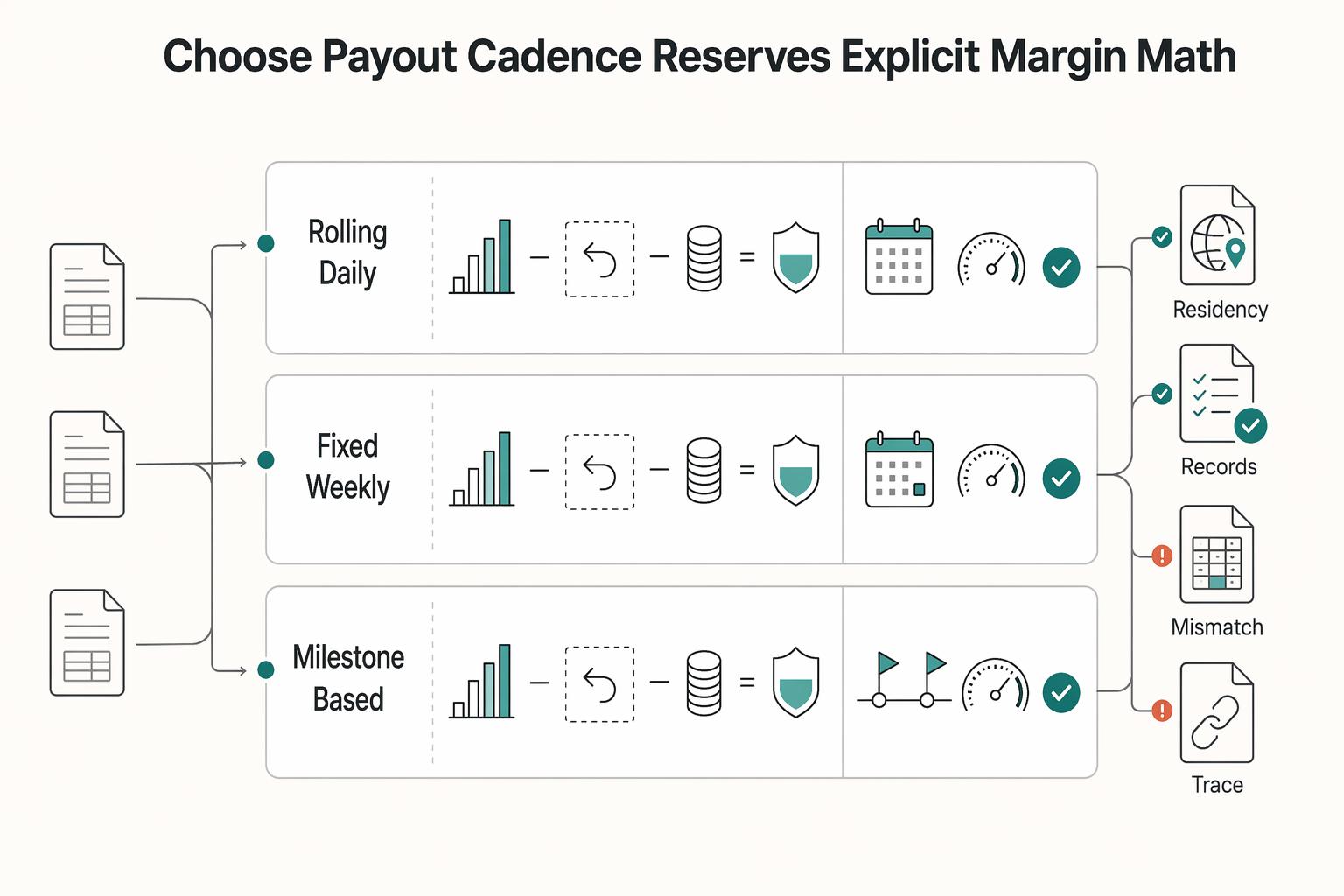
Southeast Asia Ecommerce Marketplace Payouts and Seller Compliance
Southeast Asia ecommerce is now large enough that payout design is no longer a back-office detail. Antom describes the region's ecommerce market as being valued at nearly USD $100 billion and growing at over 10% annually. Citi estimates Southeast Asia cross-border ecommerce reached about $17 billion in 2024, or more than 11% of regional online sales. Those are different metrics, but they point to the same operating reality: money is moving at meaningful scale across more sellers, markets, and payment paths.
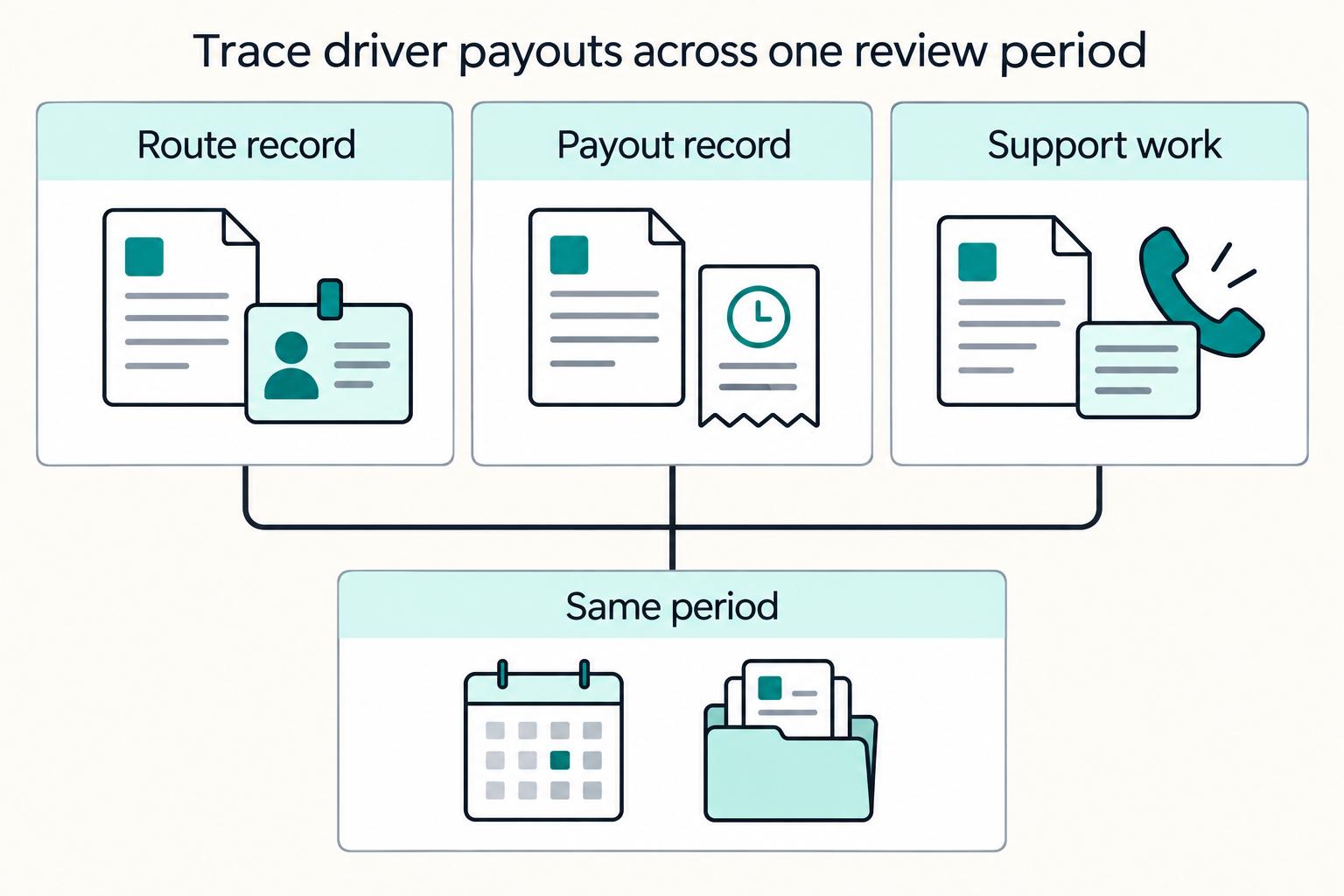
How a Logistics Platform Scaled Driver Payouts Across Southeast Asia
Redesigning driver payouts is rarely just a payments project. For a logistics platform, it is often a margin decision hiding inside an ops problem. Do you fix driver uncertainty first, settlement speed first, or manual finance work first?
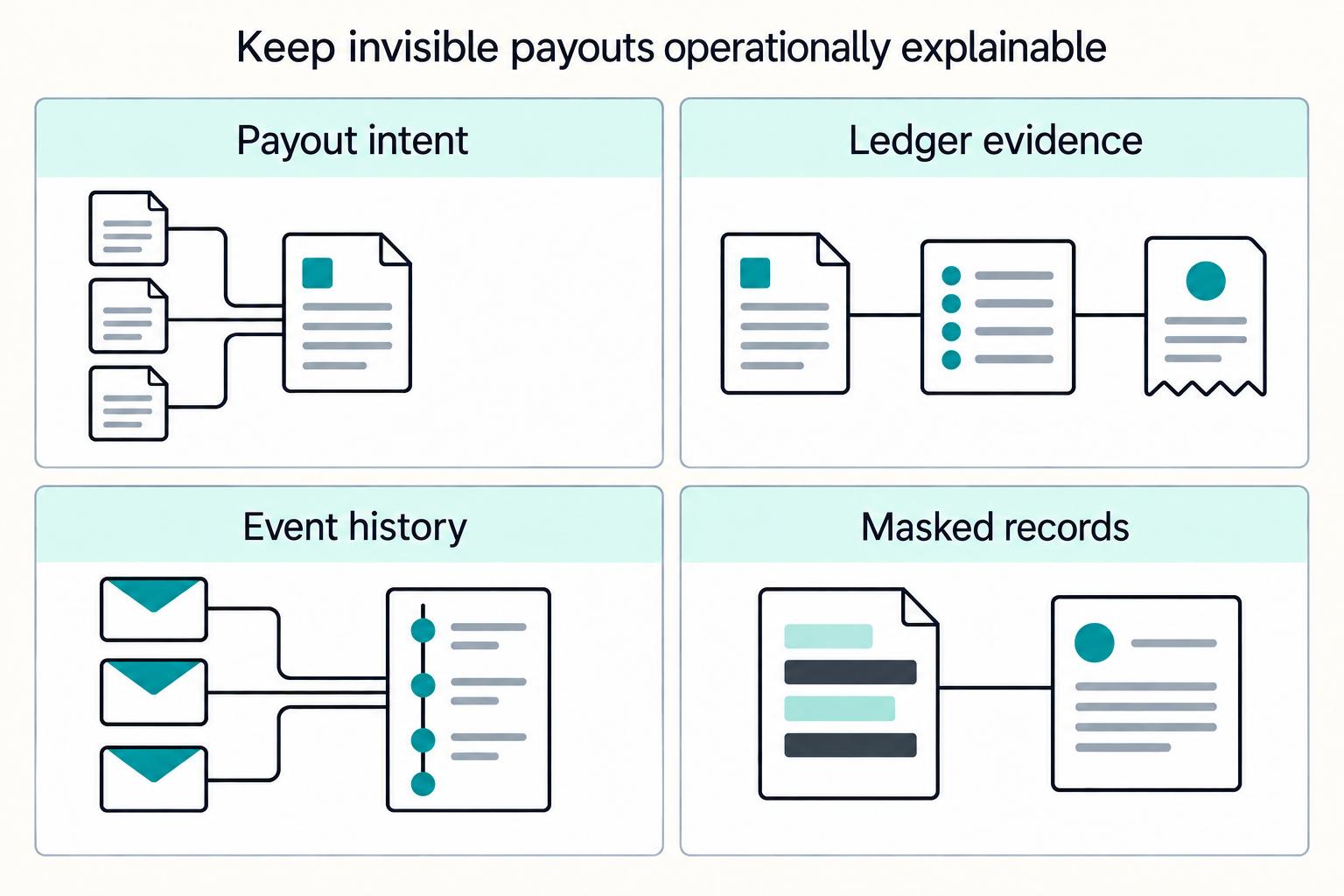
Invisible Payouts: How to Remove Payment Friction for Contractors Without Sacrificing Compliance
Invisible payouts should make life easier for contractors without hiding the controls your team needs. Contractors should get a predictable, low-friction flow, while internal teams can still enforce and document payout decisions when needed. If you run contractor payouts at scale, you need both outcomes at once. We recommend treating every easy payout as a controlled release path your team can replay later.