
Quick Answer
Remove payout friction by automating repeat, low-risk contractor payouts while keeping sanctions, AML, identity, tax, and approval controls explicit and logged. Define eligibility by cohort, map each money-movement handoff, make payout creation idempotent, normalize webhook states, and route policy or delivery exceptions into owned queues. Contractors get a simpler flow, while ops, finance, and audit keep traceable release decisions.
What Invisible Payouts Actually Mean#
Invisible payouts should make life easier for contractors without hiding the controls your team needs. Contractors should get a predictable, low-friction flow, while internal teams can still enforce and document payout decisions when needed. If you run contractor payouts at scale, you need both outcomes at once. We recommend treating every easy payout as a controlled release path your team can replay later.
That balance matters because cross-border contractor payouts get complicated quickly. Paying contractors across borders is not just moving funds; you are dealing with multiple currencies, payout methods, tax documentation, and regional compliance rules. Those issues compound as your contractor network grows.
Separate contractor experience from internal control#
For contractors, invisible means fewer repeated actions and less friction. For your team, it means clear internal controls with traceability for payout decisions. If you are redesigning this flow, decide which steps disappear for the contractor and which approvals your team must still see.
Design for outbound payouts, not invisible checkout#
Outbound contractor payouts are a disbursement process with their own reliability and compliance considerations.
A common failure mode is starting with wires or wallets and assuming they will scale cleanly. They often do not once the contractor network grows.
Set speed and proof priorities before automation#
You are balancing payout flexibility and a contractor experience that does not create drop-off or churn, without adding internal operational lift. Every click you remove for contractors should still map to a clear internal control.
Use this guide as an execution sequence#
The next sections follow a practical order. Define what "invisible" means for your payout flow, prepare the evidence before automation, map the payout path, remove the right friction, keep required controls visible, and plan failure recovery before launch.
The goal is simple: give product, ops, finance, and engineering a rollout sequence with clear decision checkpoints.
Define invisible payouts the right way#
Treat "invisible payouts" as a product framing, not as hidden money movement. The contractor experience can feel simple, while internal ownership and controls stay explicit.
Define invisible payouts as background execution, not background governance#
If you want an embedded experience, keep routine payout actions inside your platform and avoid extra redirects, external pages, or repeated logins where possible. That UX choice does not, by itself, define how payout governance should work internally.
Keep invisible payments and contractor payouts separate#
Here, "invisible payments" refers to checkout automation, where friction is reduced through smooth authorization. That user experience can be a useful reference point, but outbound contractor disbursements are a different process and should not inherit buyer-checkout assumptions by default.
Keep internal ownership explicit when payout context is unclear#
Background execution can stay simple, but the guidance here does not define contractor payout release rules. If payout context or ownership is unclear, treat the release path as an explicit internal policy decision. If you cannot name the owner, you should pause release until your policy does.
Design for traceability from the start#
This matters even more when payouts run through API-based, white-label provider functionality. Build enough internal visibility to understand what triggered a payout request and how its status changed.
Prepare the evidence pack before you automate#
Automate preparation first, but keep release approval-gated. If your records do not match operational reality, automation usually turns into delays, reconciliation issues, and compliance debt later.
Document the control path for payout eligibility#
Before you remove clicks, document your eligibility checks, where evidence lives, and who approves exceptions.
Require human approval for material changes and exceptions. Repeat, policy-clean payouts can use an approved auto-release rule, provided the record shows which rule authorized execution. Automate collection, validation, and exception packaging first, then test whether one payee can be traced from evidence to an eligibility decision and a reconciled payout.
Set document prerequisites by payout cohort#
Do not rely on one undocumented rule for every cohort. Define which records must be complete before eligibility is marked complete.
Do not let payout creation depend on records still marked "to be collected." Missing line items and unreconciled numbers are known failure patterns. The checkpoint is simple: the document status used by payouts should match the real underlying records.
Confirm execution controls before release#
Define approval steps for execution and exceptions as explicit, testable rules, and make sure each cycle leaves evidence your team can reconcile later.
Pressure-test at least one exception path before launch. If the team cannot explain the approval path when execution is blocked, the workflow is not ready.
Ship with a launch packet that non-build teams can review#
Keep it compact, but complete enough for ops, finance, and audit to reconstruct a payout cycle.
Include:
- A controls map by payout cohort covering required checks and approvals
- Defined exception classes, such as missing line items, data mismatches, and execution exceptions
- Evidence expectations for what is retained each cycle and how it is reconciled
- Mandatory approval checkpoints before release
Final gate: the documentation must match how work is actually done. If the docs say auto-release but operators still rely on ad hoc approvals, pause launch and align the process first.
For a step-by-step walkthrough, see Crypto Payouts for Contractors: USDC vs. USDT - What Platforms Must Know.
Map the payout path and assign ownership#
The table illustrates a stablecoin-backed route; a direct bank payout has different handoffs. Document the path your provider actually uses, including funding, any conversion, transfer references, and local delivery evidence.
| Handoff | Movement | Evidence |
|---|---|---|
| On-ramp | Fiat to stablecoin | Funded currency and disclosed conversion rate |
| Transfer | Stablecoin to stablecoin | Provider transaction ID and timestamp |
| Off-ramp and destination payout | Stablecoin to local currency through local rails | Delivery-stage evidence to the verified counterparty |
Trace the path in movement order#
Status stays explainable when you break the path into real handoffs. Write each stage separately:
- on-ramp (fiat to stablecoin), including funded currency and disclosed conversion rate
- transfer (stablecoin to stablecoin), including provider transaction ID and timestamp
- off-ramp (stablecoin to local currency) and destination payout through local rails to the verified counterparty
Assign one accountable owner per handoff#
For each handoff, assign one accountable owner and avoid vague ownership like "the team checks it." Unclear handoffs can slow payout investigations.
Separate speed from completion#
A stablecoin transfer can run outside bank opening hours, but that does not make the destination payout complete. Conversion, compliance checks, and local banking availability can still affect delivery; use the route's actual arrival estimate and credit confirmation.
Add one explainability checkpoint#
Before you automate further, test one payout end to end. Capture its funding details, transfer references, any conversion, and delivery evidence. If those records are missing or inconsistent, tighten the path before presenting it as frictionless.
For a broader compliance operating model, see How to Manage and Pay a Global Team of Contractors Compliantly.
Choose where friction should disappear and where it must stay#
The right tradeoff is not zero friction everywhere. Remove repeat steps only where control evidence is stable, and keep explicit review gates where evidence is new, changed, or unclear. If you want faster repeat payouts, keep your evidence rules stable enough that your reviewers can approve without rebuilding the case.
Assign a default release mode to each payout segment#
Make the default explicit so ops, product, and engineering apply the same rule every time. Use these modes as operational defaults, then tune them to your risk posture.
| Contractor payout segment | Default release mode | Control boundary |
|---|---|---|
| Repeat contractor, same verified destination, no open policy issues | Auto-release candidate | Remove repeat steps when existing records already support release. |
| Repeat contractor with a beneficiary change, stale record, or unresolved dependency | Delayed release | Queue the payout until the changed condition is confirmed. |
| First-time contractor or any higher-risk case | Manual review | Keep a human decision point before funds move. |
Keep "higher-risk" operational: the evidence is incomplete, conflicting, or newly changed. That boundary matters more than making every payout feel instant.
Automate from stable facts, not from volume#
When a case is repeat, details are unchanged, and the case is policy-clean, it may be suitable for auto-release. When it is first-time or a material detail has changed, require review before release.
This keeps verification in the flow while preserving human review when risk rises. Invisible processes can remove clicks, but approvals, handoffs, and access prerequisites still exist. If you do not design those checkpoints on purpose, they tend to return as avoidable exceptions.
Choose rails by control and explainability#
Do not choose rails only by how fast they look in the product flow. Different payout rails create different operating conditions.
Treat rail choice as a risk decision. Fragmented rails can become a strategic problem, not just an engineering one. Before you make any rail path invisible, document the last point where you can still stop release and the point where outcomes depend on external processing.
Keep "invisible" at the user experience layer only#
Approval logic should stay explicit and enforceable through policy rules, with a clear record of who or what authorized release.
Contractors can see a simple status such as processing, but your internal states should stay specific: auto-released under a repeat-payee rule, delayed pending a change check, or held for manual review. If a payout pauses, ops should be able to tell immediately whether it is waiting on a rail event, a policy check, or a human decision.
If you are building payout controls, map release decisions to payout statuses and retry behavior in Gruv Payouts.
Keep mandatory compliance controls visible#
Once you decide which payout paths can move with less friction, the controls that determine trust still need to stay explicit, logged, and able to stop release. This is where low-friction design either holds up or falls apart.
Build one non-negotiables table before automation#
Define each required check, the evidence it must produce, and the fail state if it is missing or fails. Weak onboarding controls often resurface later as payment errors, duplicate records, audit findings, and fraud risk.
| Control area | What you are checking | Minimum evidence to keep | If incomplete or failed |
|---|---|---|---|
| Identity/profile verification | Whether the payee record meets your program's required profile and validation checks | Record ID, required-field status, validation result, decision timestamp | Keep payout blocked until corrected |
| Compliance screening | Whether required compliance screening has been completed before payment flow | Screening status, decision timestamp, rule or reviewer source | Block release and route to compliance handling |
| Risk/compliance review status | Whether an open risk or compliance review is preventing payout | Review status, reason code, decision timestamp | Keep payout blocked until the review is resolved |
| Tax treatment and documentation | Which documents, withholding, and reporting rules apply to this cohort | Document status, tax classification, withholding decision, reviewer or rule, timestamp | Apply the approved hold or withholding path; do not treat missing forms as a universal legal ban on payment |
Use this table as an operating control, not as a policy document that sits unused.
Enforce structured capture and validation before records enter payment systems#
Required fields and validation at this checkpoint reduce errors and rework. Email, PDF, and manual rekey workflows usually carry weak controls and inconsistent data into payout decisions.
For payouts, do not treat "record created" as "payout eligible." Confirm that required data is complete, required checks have run, and decision evidence is attached to the payee record.
A practical test is whether your team can answer, without manual digging:
- Which controls were required for this cohort?
- Which controls passed, failed, or are still open?
- Where is the evidence for each decision?
Gate tax artifacts only where your program requires them#
This guide does not assume universal W-8, W-9, or 1099 rules for every case.
Separate payee creation from tax readiness. Missing or invalid documentation should enter a defined hold or withholding path for the applicable payer, payee, and income type. For example, U.S. reportable contractor payments may require backup withholding when a correct TIN is missing. Record the treatment before release instead of assuming every missing form legally prohibits payment.
Make risk-control priority explicit#
Unresolved compliance or risk issues should override speed goals. You do not need complex logic, but you do need clear fail states and documented exception handling so teams do not treat policy blocks like transient payment retries.
Bind each control to an evidence output#
That way, decisions are reconstructable later. At minimum, retain the control name, status, decision time, source record or document reference, and the actor or rule that made the decision.
If sanctions screening is a core part of your flow, see OFAC Compliance for Payment Platforms. The point here is narrower. Friction can be invisible in the user experience, but stop rules must stay visible to operators and auditors.
Build execution for idempotency and auditability#
After controls can block payouts, execution quality determines whether payouts stay fast and trustworthy. As payments shift from batch-based processing toward always-on, real-time value exchange, latency and downtime become business risks. Retries should not create duplicate money movement, and your records should let finance explain status without manual reconstruction.
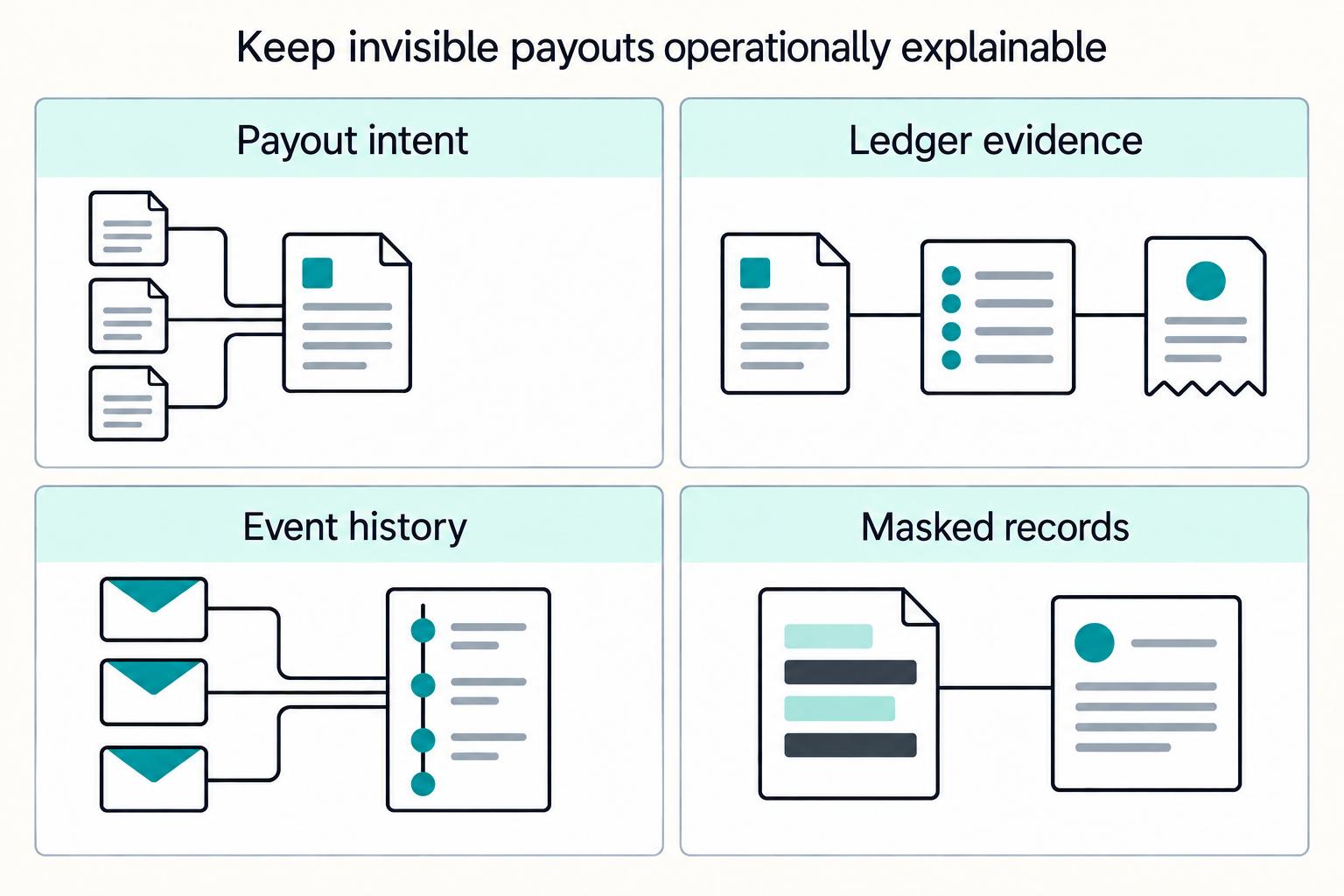
| Area | Core practice | Control outcome |
|---|---|---|
| Payout batches | Create one payout intent per approved disbursement and reuse it on retries | Replay returns the existing payout record instead of a second payable item |
| Ledger journals | Treat UI balances as derived views and reconcile to authoritative records | Teams can confirm what was requested, what posting exists, and which external reference is attached |
| Webhooks | Normalize provider events into your own state model | Transition history shows which event changed state, when, and why later events were accepted or ignored |
| Display masking | Use consistent masking across logs, support tooling, and traces | Most day-to-day workflows avoid exposing raw values; authorized investigations use a controlled retrieval path |
Make payout creation replay-safe in Payout batches#
Create one payout intent per approved disbursement, and make retries reuse that same intent instead of creating a new instruction.
When the same request is replayed, return the existing payout record rather than adding a second payable item. That keeps timeout recovery, queue replay, and operator resubmits from turning one decision into duplicate execution work. If you expose the idempotency key to ops, your team can explain exactly why a retry did or did not create money movement. Keep the internal intent durable; provider keys may expire. Recover an uncertain provider result before issuing a fresh instruction beyond its idempotency window.
Keep an auditable financial source of truth (often Ledger journals)#
Treat UI balances as derived views that may lag.
Before you resolve any payout dispute, reconcile status to authoritative records. Confirm what was requested, what posting exists, and which external reference is attached. If your team still relies on manual reconciliation, spreadsheet tracking, and status follow-ups to answer that, auditability is weak and exception handling will consume more capacity.
Normalize provider Webhooks into your own state model#
Do this before they drive reporting, notifications, or retries. The goal is deterministic internal transitions, even when inbound events are noisy.
Keep transition history explicit so operators can show which event changed state and why later events were accepted or ignored. Provider webhooks may arrive more than once or out of order, so deduplicate by event identity and use authoritative provider records to resolve uncertain status.
Limit sensitive-data exposure with Display masking#
Use consistent display masking across logs, support tooling, and traces where operationally required. Masking limits what users see; tokenization separately replaces sensitive values with surrogate tokens and requires its own storage and retrieval design. Execution may require bank or beneficiary data, but most day-to-day workflows should avoid exposing raw values.
Keep a controlled retrieval path for authorized investigations so privacy risk does not become the hidden cost of auditability.
Related: Push Notification Strategy for Payment Platforms: How to Alert Contractors About Payouts.
Design exception handling before launch day#
Do not wait for live traffic to discover your exception model. Policy failures should stop automation, while delivery failures should move into an owned ops queue with a clear next action.
Classify blocking exceptions before the first live payout#
Do not collapse sanctions, KYC mismatches, AML review flags, stale beneficiary data, and provider returns into one generic failed state.
| Failure mode | Default action | Evidence needed before release or retry |
|---|---|---|
| Sanctions hit | Block payout and send to manual review | Screening result, reviewer decision, and required reporting path |
| KYC mismatch | Hold payout capability until verification is corrected | Updated identity or business data, verification pass, verification-code resolution |
| AML review flag | Pause release and escalate to compliance review | Case notes, compliance disposition, and reporting path where applicable |
| Stale beneficiary data | Stop retries to that destination | Updated external account or beneficiary details |
| Provider return | Mark payout failed or returned and invalidate destination if needed | Return code, provider reference, corrected payout destination |
Map provider outcomes like Payout failed, Payout returned, and payout.failed into your internal exception classes instead of flattening everything into one error bucket.
Freeze retries until the evidence changes#
Sanctions flags, KYC mismatches, and AML review flags are policy exceptions, not transient outages.
Gate retries on new evidence: a changed verification record, corrected beneficiary details, or a closed review decision. If a blocked payout is resubmitted with no new KYC result, sanctions decision, or beneficiary update, return the same blocked state and create no new payout instruction. This keeps payout capability tied to verified readiness and avoids blind retries. A confirmed sanctions block is different from a possible screening match: blocked property must remain blocked until release is legally authorized, not merely until an internal case is closed.
Treat beneficiary errors as high-risk cleanup. Some providers block further payouts to an external account until details are updated, and incorrect-recipient errors may not be reversible immediately.
Route unresolved exceptions into owned queues from Webhooks#
Each case needs an owner, a required next action, and an oldest outstanding timestamp.
Preserve chronology by storing provider event ID, provider timestamp, normalized internal state, case owner, and manual actions. Check webhook timestamps, keep webhook delivery failed separate from payout failed, and design for provider retry behavior rather than assuming one failed acknowledgment ends the story.
Trigger contractor communications from payout states#
Send state-aligned messages when review starts, user action is required, a payout fails or returns, and credit is confirmed. Keep sensitive compliance case details in restricted tooling and use approved contractor wording; an internal AML investigation should not automatically trigger a disclosure to the payee.
Ask for corrected verification or payout details when action is needed, and avoid promising a delivery date during unresolved review. Link communications to a payout state, case ID, and timestamped history. Compliance should approve what can be disclosed for sanctions or AML cases.
Roll out in phases with hard go or no-go checks#
Expand only when each phase clears predefined go or no-go checks. Rollout should be earned, not assumed.
Start with a narrow pilot path#
Choose a path you can observe end to end. In practice, a limited cohort and payout path make it easier to prove your baseline without mixing too many variables.
If scheduled ACH already works well, retain it as a pilot lane while evaluating faster options separately. Confirm destination eligibility and provider limits before opening an instant-payout path to a wider cohort.
Set phase checks before launch#
Define what would stop expansion. If that stop condition is unclear, the phase is not ready.
Review checkpoint evidence by cohort and payout path, including eligibility trends, exceptions, and reconciliation status. If the team has to manually hunt logs to assemble that view each time, treat that as a no-go signal.
Expand one variable at a time#
Add a jurisdiction or a payout type, but avoid adding both in the same phase.
For cross-border expansions, expect timeline pressure from compliance checks, incomplete or incorrect information, and manual or legacy processes. If exceptions rise after expansion, tighten that path before widening scope again.
Use operational stability as the final release gate#
Expand only when payout batches are predictable, exception handling stays controlled, and reconciliation remains complete.
Keep monitoring after each phase. Risk controls are continuous, especially when third parties are involved in payout operations. Pause and correct when manual interventions or unresolved cases start to build.
Avoid the common failure patterns#
As rollout widens, control can break when convenience rules replace payout rules. Fix each failure pattern directly instead of treating this as one generic cleanup task.
Keep inbound Invisible payments and outbound payout controls separate#
A near-invisible checkout flow does not remove the need for explicit payout eligibility, release, and audit logic.
Use one readiness test for every payout marked ready: can you trace contractor status, sanctions result, tax status, provider reference, and ledger posting? If not, your payout flow is still borrowing checkout assumptions.
Apply required identity and sanctions checks before auto-release#
Due diligence gaps create legal and operational risk, and sanctions matches can create blocking consequences.
Sample eligible contractors and verify completed review status, decision timestamp, and supporting evidence before the first payout. If a payout is blocked for sanctions or diligence reasons, keep it blocked until the underlying evidence changes. For deeper sanctions handling, see OFAC Compliance for Payment Platforms: How to Screen Every Payout Against the Sanctions List.
Do not rely on provider dashboards as your system of record#
Payout outcomes are asynchronous, so normalized Webhooks plus internal Ledger journals should drive state and reconciliation.
Verify webhook signatures before trusting events, durably record accepted deliveries, and acknowledge with the provider's required success response. Deduplicate events and update payout state; post journals only when the event represents an accounting effect. A repeated status notification should not generate another journal entry.
Gate payout eligibility on the applicable tax documentation when required#
Form W-9 supports TIN collection for U.S. information-return reporting. Form W-8BEN documents foreign individual beneficial owners; foreign entities generally use Form W-8BEN-E or another applicable form. Select documentation for the payer, payee status, and income type rather than routing every foreign contractor to W-8BEN.
Record the tax treatment before release. If your policy requires a completed form, hold the payout while collecting it; where applicable rules require withholding instead, calculate and retain that decision. Keep information-return readiness separate from a universal prohibition on payment.
Choose the right Gruv module mix for your payout model#
Start with the smallest module mix that solves the payout job. For many operations, that means Payout batches first. Add Virtual Bank Accounts (VBAs) when incoming-payment attribution is needed. Evaluate Merchant of Record (MoR) arrangements when the customer-sales model needs them; adding a payout route does not itself transfer contractor, tax, or compliance responsibility.
| Module | Use when | Checkpoint |
|---|---|---|
| Payout batches | Your core need is disbursing to many contractors with explicit control and visibility | Each payout item maps to a request ID, provider reference, eligibility decision, and ledger journal link |
| VBAs | Virtual accounts materially improve intake and incoming-payment visibility | Each incoming credit lands on the right identifier and posts to the correct internal funding record before a payout is marked ready |
| MoR | Your customer-sales model requires a defined seller and merchant role | Confirm seller identity and contracted payment, refund, tax, and compliance responsibilities separately from contractor disbursement obligations |
Start with Payout batches#
Use payout batches when you need to disburse to many contractors with item-level visibility. Check the selected provider's batch-size and payload limits, and split requests without losing each item's approval, reference, and retry history.
Your operating checkpoint is simple: each payout item should map to a request ID, provider reference, eligibility decision, and ledger journal link. If you can confirm only batch submission, but cannot explain why a specific item is pending, failed, or returned, control is not strong enough for broad automation.
This is the right first module when eligibility and release controls are already clear. If those controls are still inconsistent, adding more rails usually spreads ambiguity instead of removing friction.
Add VBAs only where they materially improve intake#
A virtual account provides an identifier for attributing incoming payments. Its legal account structure and supported currencies depend on the provider. Use it to connect incoming credits to the right funding record before a payout is marked ready.
The practical test is attribution quality. Each incoming credit should land on the right identifier and post to the correct internal funding record before a payout is marked ready. If credits still require manual guesswork to assign to the right program or payout pool, the VBA layer is not reducing operational load.
Evaluate MoR for the customer-sales model#
A merchant of record is responsible for the customer transaction, including the purchased goods or services and associated disputes or refunds. The arrangement should identify the seller and divide payment, tax, and compliance tasks in writing. Those customer-sale responsibilities are separate from obligations arising when you pay contractors.
Confirm the merchant role from the commercial agreement, customer terms, and provider configuration. A processor, virtual account, or payout API alone does not establish who sells the service or which party must satisfy a particular tax or compliance obligation.
Before go-live, document the seller, payment processor, contractor payer, and each party's obligations. Confirm supported Gruv module coverage for the target market, then expand only while the evidence chain stays intact.
If operational traceability is weak, simplify module scope before adding more rails or regions. One narrow path with clean evidence is safer than a broader mix your team cannot fully audit.
Conclusion and launch checklist#
Invisible payouts work when speed and control are designed together. Automate low-risk paths under an approved rule, keep applicable sanctions, AML, identity, and tax-treatment decisions explicit, and make every release reconstructable from your own records.
Use this launch checklist before you expand coverage:
- Define payout cohorts and risk tiers
Start with one low-risk cohort and one rail. Keep cohorting risk-based and proportional, with simplified measures only where risk is lower. Verify: each cohort has written entry criteria, such as first-time versus repeat payee, jurisdiction, entity type, and rail. Red flag: if you cannot explain why a contractor is in auto-release, that cohort is not ready.
- Map required controls before automation
Put controls in writing before you automate. For applicable money-services activity, AML controls must be written and commensurate with risk, and should cover identification, reporting, recordkeeping, and law-enforcement response. Include prerequisites by cohort, as required by jurisdiction and program: KYC or CIP, KYB or beneficial ownership for legal entities, AML review, OFAC screening, and tax docs such as W-9 or W-8BEN. Verify: policy docs name the exact check or document required per cohort. Red flag: do not copy one control matrix across jurisdictions or license models without legal review.
- Implement idempotent payout creation and duplicate-safe webhooks
Require idempotency keys on payout creation so retries return the first result instead of creating duplicate payouts. Build webhook handling for duplicate and replay events. Verify: replaying the same request returns the same internal payout record. Failure mode: duplicate webhook processing that mutates state can create false exceptions or double-post ledger entries. Check provider retention limits and recover the original result before retrying an older uncertain request.
- Bind payout states to ledger-journal evidence
Treat ledger-style transaction records as your accounting source of truth. Dashboard status alone is not enough for reconciliation or audit. Verify: for any paid payout, you should be able to retrieve one chain: request ID, idempotency key, provider reference, webhook history, and linked ledger journal. Red flag: if finance must reconstruct outcomes from screenshots or exports, pause expansion.
- Create exception queues with named owners
Separate policy exceptions from delivery exceptions. Sanctions, AML, and identity holds should not be retried blindly. Transport failures may warrant controlled retries. Verify: each exception class has a queue, owner, and timestamped actions. Failure mode: blind retries on blocked or mismatched records add noise and delay resolution.
- Run phased rollout with hard go/no-go checks
Expand only after the first cohort reconciles cleanly and exception handling is stable. Verify: controls trigger correctly, webhook processing remains replay-safe, and ledger evidence matches provider outcomes.
- Expand only after reconciliation and control stability are proven
Move to harder cohorts, more rails, or new jurisdictions only after the base path stays clean over time. If U.S. tax rules apply, align documentation, withholding, and reporting with current IRS instructions. Verify: the required tax treatment is resolved before release. Red flag: expansion outpaces the quality of eligibility and reconciliation evidence.
Before rollout, validate rail coverage, compliance gates, and ownership model for your target markets with Gruv team.
Frequently Asked Questions
What is the difference between invisible payouts and invisible checkout?
Checkout is the inbound flow for collecting a payer's payment details and taking payment, while payouts are outbound transfers to a bank account. Because they are different flows, the control points are different too. If you treat them as the same, you can end up applying conversion-style logic to a payout release decision that may carry AML, sanctions, tax, and audit consequences.
How do we remove payout friction without weakening compliance controls?
Automate repeat, low-risk releases, but keep eligibility checks explicit in your logic and your records. In practice, automate only after applicable identity, sanctions, AML, and required tax documentation checks are in order for that cohort. For any released payout, you should be able to show the request ID, idempotency key, decision timestamp, and ledger link from your own audit trail.
Which payout controls should never be fully invisible?
Keep sanctions, AML, identity, and tax decisions visible to authorized operators. A screening alert or identity failure is not automatically a reportable event. Determine the applicable review and reporting rules for the actual case; for example, OFAC blocked-property reporting applies to covered persons holding or controlling blocked property. Keep restricted case details out of routine contractor messages.
When do invisible payouts backfire for marketplace or creator platforms?
They backfire when you auto-release with weak onboarding data or unverified first-time payees. Risk increases on instant rails where settlement can be final and irrevocable. If your exception queue is already heavy with compliance reviews, more automation can hide defects instead of fixing them.
What should we implement first if we are starting from manual payout ops?
Start with one low-risk cohort and make duplicate prevention non-negotiable. Idempotency is the first control to add because safe retries reduce accidental double sends when requests are replayed. Then normalize webhook events into one internal payout-state model so payout statuses stay consistent.
How do we keep contractor experience fast when sanctions or AML checks delay release?
Tell contractors the payout is pending review using approved wording, rather than presenting it as complete. Collect bank details and applicable tax documentation early. Avoid blind retries on policy holds, and let compliance decide which case details can be disclosed.
Which records do finance and audit teams need to verify payout decisions later?
Keep a full decision chain: payout request, idempotency key, webhook history, ledger journal, status changes, and any manual override with timestamp and owner. Store the eligibility evidence too, including identity checks where applicable, AML or sanctions screening outcomes, and tax documentation. Keep those records for the required retention period and make sure they remain accessible when finance or audit needs them.
Researched and edited by the Gruv editorial team. Gruv builds cross-border billing, payouts, and finance-operations software for global businesses.
Sources
Educational content only. Not legal, tax, or financial advice.
Related Posts

The Freelance Payment Penalty: A Modeled Audit of Platform Fees, FX Spreads, and Payout Delays
The money rarely disappears through a single, easy-to-spot fee. The real loss is stacked. A marketplace takes its commission, a processor adds a charge for international cards, a bank or payment company converts the currency at a spread, a platform holds the funds before release, and a wire sheds a little to intermediaries on the way in. Each layer looks defensible on its own, but the worker feels the combined result as a smaller deposit and a later payday.

How to Respond to a Subpoena for Business Records
Move fast, but do not produce records on instinct. If you need to **respond to a subpoena for business records**, your immediate job is to control deadlines, preserve records, and make any later production defensible.
A US Expat's Guide to Investing in UCITS ETFs to Avoid PFIC Issues
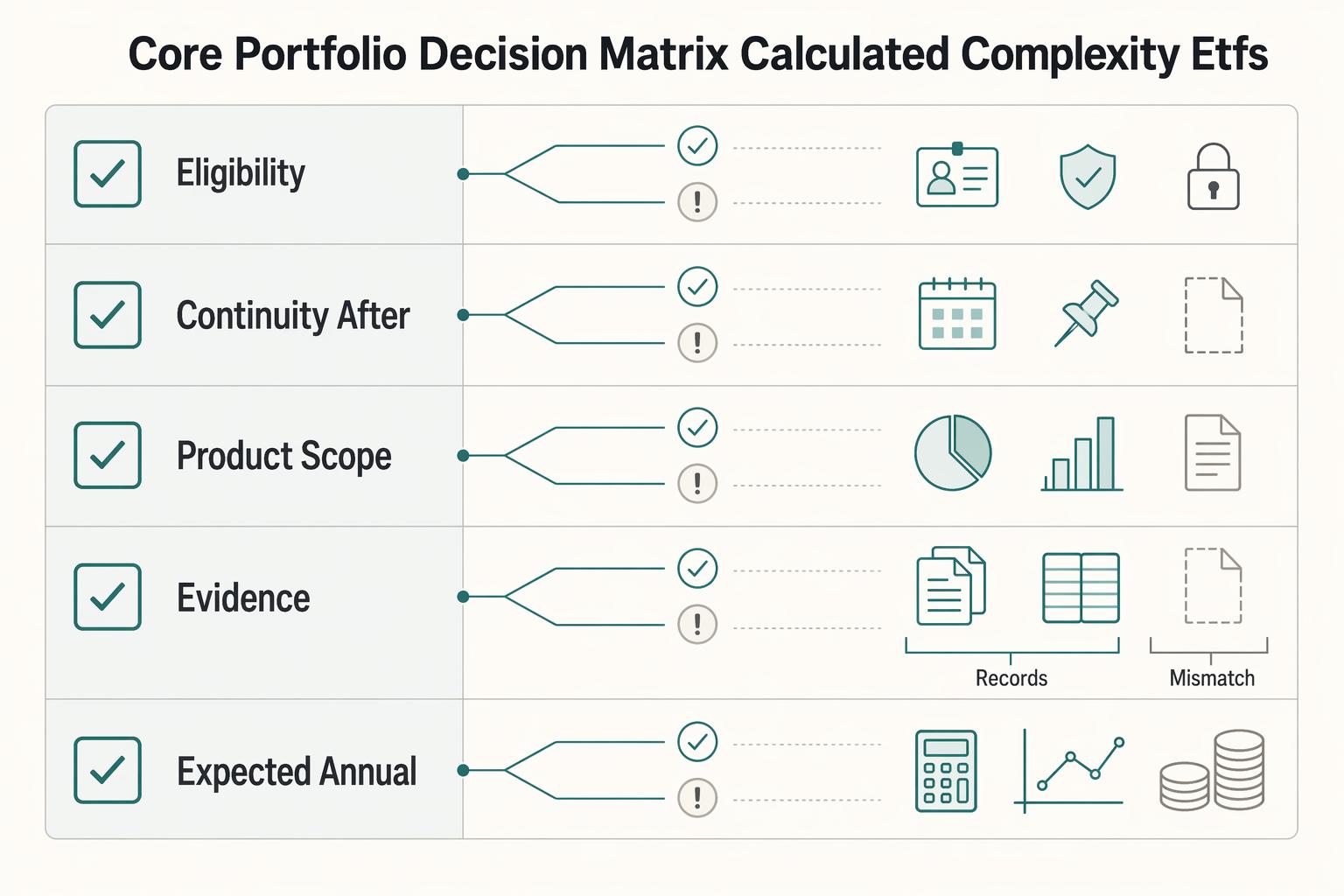
The real problem is a two-system conflict. U.S. tax treatment can punish the wrong fund choice, while local product-access constraints can block the funds you want to buy in the first place. For **us expat ucits etfs**, the practical question is not "Which product is best?" It is "What can I access, report, and keep doing every year without guessing?" Use this four-part filter before any trade: