
Quick Answer
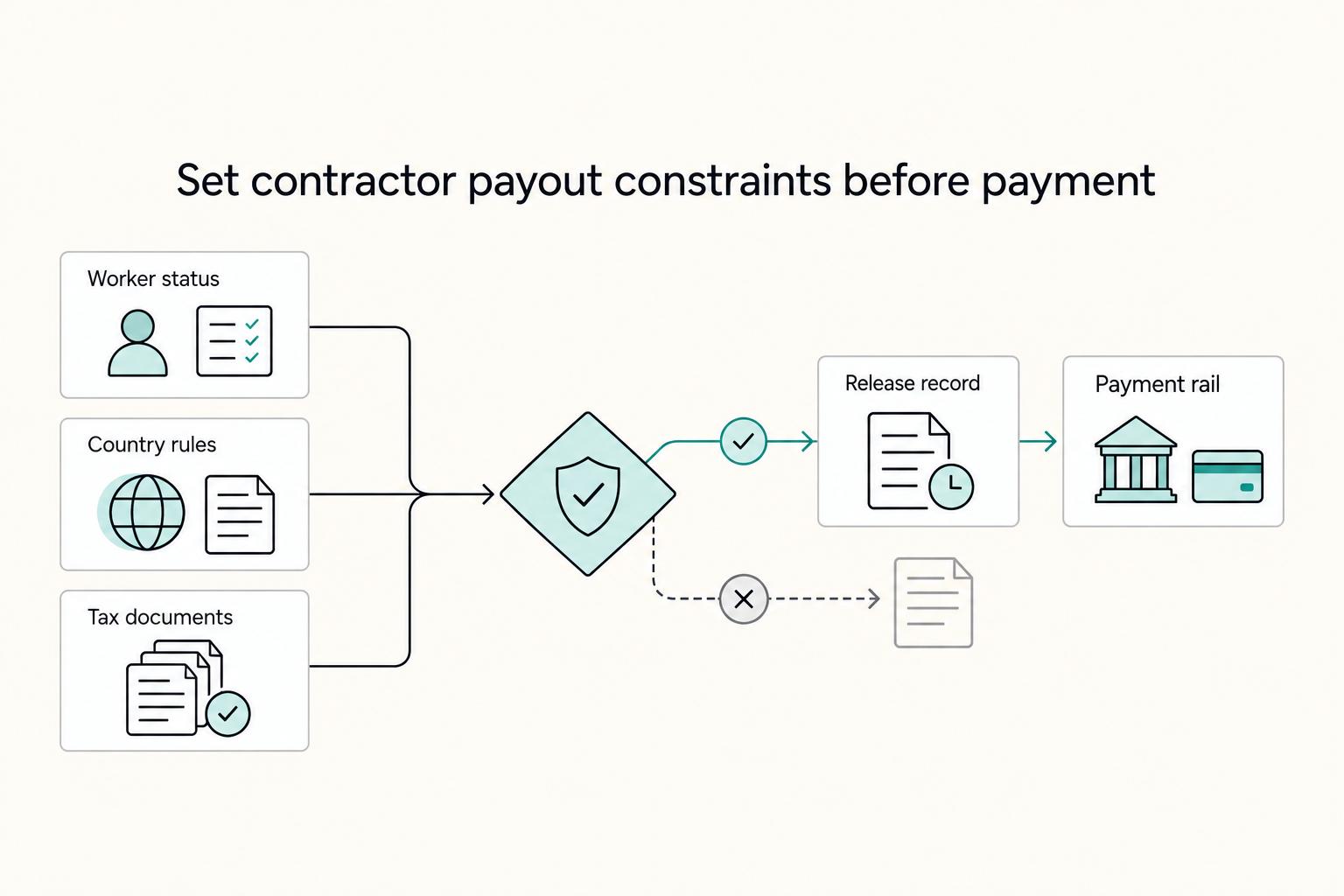
Verify the contractor relationship, payment details and signed terms, then complete the release or withholding checks required for the actual payment. Approve invoices, execute with duplicate protection, reconcile provider evidence and assign failed or returned cases. Keep the contractor’s own filing duties separate and preserve deadlines for pay already earned.
Start with clear payment terms#
Reliable contractor payments begin with verified payee details, clear terms and the checks required for the actual engagement. Separate the payer’s release and withholding obligations from the contractor’s own tax-registration and filing tasks.
The goal is practical: fewer delays and lower penalty risk when you pay international contractors compliantly. Treat each jurisdiction as its own filing path with its own deadlines, and make sure your team can explain your path in one sentence. We use the same rule in What to Do If You've Been Misclassified as an Independent Contractor.
For a UK sole trader who needs Self Assessment for 2025–26, notification where required is due 5 October 2026, usual paper filing 31 October 2026 and usual online filing and balancing payment 31 January 2027. These are the taxpayer’s filing duties, not universal prerequisites for an international client to pay an earned invoice. Determine who owns each obligation rather than turning every UK-linked payment into a Self Assessment gate.
Use the sections below to document setup, terms, payment route, FX and recovery. Hold a payment only when the applicable legal, provider or agreed control rule requires it; distinguish a missing document that changes withholding from a missing field that prevents execution. Keep earned-payment deadlines visible during any review.
Define your operating constraints before you pay anyone#
Write down your operating constraints before the first payout so decisions stay stable when timing pressure rises. Keep the register short enough that another teammate can run it without guesswork.
Use explicit UK checks. For non-UK countries, document assumptions and an owner for local validation instead of reusing UK rules.
Near the cutoff, identify the actual missing release condition and route it to the owner. Resolve payment, withholding or a required hold under the applicable rule and keep the invoice due date visible; do not delay solely because optional or future-filing records are incomplete.
Set risk limits your team will use.#
Set acceptable delay, FX variance and manual workload, and name the exception owner. Record the payer entity, contractor location, work location and provider requirements so the team can identify which rules govern the engagement.
Separate recipient tax registration from payer release checks#
For UK Self Assessment, review the taxpayer’s actual notification and filing conditions. The usual current 2025–26 dates are 5 October 2026 for notification where required and 31 January 2027 for online filing/payment. Do not require proof of the contractor’s future return before paying solely because the engagement is UK-linked.
Confirm filing route before deadlines.#
Assign recipient tax filing to the taxpayer and payer reporting to your own tax owner. Any reactivation or special filing-software requirement belongs to that filing process. It does not automatically prevent payment of a valid contractor invoice.
Decide control depth before scaling payouts.#
Choose your payout operating model, then document required records and checks before rollout.
Set release gates before money moves.#
Before release, verify the actual required payee, payment, screening and tax-treatment fields. State whether a missing field requires correction, withholding or a provider hold, and give the case an owner and deadline. Do not invent a universal registration gate.
Keep the constraints register specific to the payer, payee, work location and payment route. Validate new-country requirements before activating that route, while resolving amounts already earned under the applicable payment and withholding rules.
Gather onboarding and compliance evidence before work starts#
Keep one evidence pack per contractor. Distinguish required release fields from records collected for later reporting. Missing optional or future-filing evidence should not silently block an otherwise payable invoice.
| Step | What to keep | Checkpoint |
|---|---|---|
| Independent contractor profile | Legal name, jurisdiction, payment details, and tax profile | Capture before any invoice is approved |
| Nonemployee status | Short classification note for why the person is treated as an independent contractor | Resolve classification before new engagement activation; separately determine treatment and timely payment of amounts already earned |
| Evidence pack | Contractor agreement, payment details, tax documents, and approval history | Keep one evidence pack per contractor so readiness review is fast and consistent |
| U.S. reporting notes | Record when Form 1099-NEC may apply and keep explicit not-applicable decisions | If filing paper Forms 1099-NEC, confirm Form 1096 is included |
| Pre-release evidence check | Mandatory fields and records with a pass or fail decision, timestamp, and owner | Schedule after required release checks; resolve documented withholding or hold treatment and keep earned-payment due dates visible |
Assign owners for onboarding sign-off and tax reporting notes before first invoice review. The owner list should be visible to finance and legal so no one assumes another team has already cleared a required field.
Step 1: Build the independent contractor profile first.#
Capture legal name, jurisdiction, payment details, and tax profile before any invoice is approved. Expected outcome: each profile shows who is being paid, where they are based, and how reporting will be handled.
Step 2: Verify nonemployee status and record the basis.#
Keep the facts and review supporting contractor treatment with the profile. Nonemployee reporting is conditional on the payment and recipient. Escalate uncertain status before new work; separately determine the correct treatment for pay already earned.
Step 3: Keep one evidence pack per contractor.#
Store the contractor agreement, payment details, tax documents, and approval history together so readiness review is fast and consistent. Expected outcome: commercial terms, payment execution, and compliance controls stay aligned in one review path.
Step 4: Document U.S. reporting applicability notes.#
For services performed for your trade or business, record when Form 1099-NEC may apply. Keep clear applicability notes for Form 1099-NEC, including explicit not-applicable decisions where relevant, and check current form details on the IRS Form 1099-NEC page. Verification checkpoint: if you file paper Forms 1099-NEC, confirm Form 1096 is included and review the IRS Form 1096 page.
Step 5: Enforce a pre-release evidence checkpoint.#
Review required release fields and record the decision, timestamp and owner. If a tax document is missing, determine the actual withholding or hold rule. Keep future reporting tasks separate from execution readiness and route exceptions before the due date.
Complete required execution fields before release, and resolve any payment-specific withholding or provider hold. Optional evidence and future reporting tasks stay on their own checklist with named owners.
Write contract terms that prevent delayed payment fights#
Clear terms are a primary payment control. When terms are vague, disputes grow and payment timing becomes unpredictable.
Common cross-border contract problems include unclear terms, poorly defined payment structures, and weak dispute clauses. Treat the Contractor agreement as an execution document where each payment clause names who decides, by when, and based on what evidence.
Before you sign, run one plain-language review of payment, dispute, and currency clauses with the approver who will execute payouts. If the executor cannot explain how a disputed invoice gets resolved, the contract is not ready.
Step 1: Set payment timing, acceptance criteria, and invoice rules in the Contractor agreement.#
Use explicit due dates or event triggers. For milestone work, define acceptance, approver responsibility, and rejection feedback. For ongoing work, set fixed pay dates and invoice cutoffs. Define required invoice fields so approvals stay consistent. Expected outcome: invoice decisions are objective and repeatable. Verification checkpoint: check required fields and the applicable time or service evidence. Require acceptance evidence when the agreement makes acceptance a payment condition, and keep the agreed due date visible.
Step 2: Add scope-protection clauses before services begin.#
Include scope-protection terms that are relevant to the work, with plain definitions so both parties understand what is restricted and when it applies. Failure mode to avoid: broad, undefined clause text that can trigger interpretation fights near release.
Step 3: Write a Dispute resolution clause that is operational, not generic.#
State how disputes are raised, reviewed, and resolved. If you use pay-if-paid or pay-when-paid language, state it directly and assign risk explicitly. In practice, enforceability can vary by jurisdiction, so do not rely on implied conditional payment language.
Step 4: Define currency and fee responsibility in writing.#
State invoice currency, payout currency, fee responsibility, and how conversion deductions are handled. Keep net versus gross expectations explicit before settlement. Verification checkpoint: hold release if signed currency and fee fields are incomplete.
Step 5: Add a classification trigger to protect the payment path.#
The contractor versus employee distinction affects contract terms, IP ownership, invoice handling, and tax reporting. Add an if-then rule: if engagement facts shift toward employee-like control, pause new work under current terms and escalate misclassification review.
Red flag: if either side says key terms can be finalized later, pause signature until acceptance, dispute handling, and currency and fee terms are fully defined.
Check classification and local tax rules before first payout#
Review classification before activating an engagement, using actual working facts and applicable law. If status becomes uncertain, pause new contractor work and escalate the engagement model; determine separately how already-earned pay must be handled. A classification concern is not permission to leave earned invoices unpaid indefinitely.
Keep one short decision record per contractor. It should capture the classification call, the reviewer, the date, and the trigger that would force reassessment.
Step 1: Classify before activation.#
Compare the contract with real working patterns and document the reviewer, date and facts supporting classification. If the engagement appears employee-like, stop new work under that model and seek the correct employment or contractor treatment. Resolve earned pay and any withholding obligations during the review.
Step 2: Flag jurisdiction risk points early.#
Route country-specific engagement questions to a named reviewer before activation. Track payer location, work location and contractor status; one country’s test does not automatically apply elsewhere. If an issue arises after work was performed, keep its payment resolution separate from approval of future work.
Step 3: Document the U.S. reporting path before first invoice.#
If payments relate to a U.S. trade or business, record whether nonemployee compensation reporting applies. Reporting may require Form 1099-NEC when listed conditions are met; if filing on paper, include Form 1096. Record your selected path, whether Form 1099-NEC or another treatment applies, and the approver before payout starts. Expected outcome: tax reporting treatment is decided before the first invoice cycle. Consequently, you avoid deciding form treatment after payout and doing retroactive cleanup.
Step 4: Enforce one escalation rule.#
When actual working facts no longer support contractor treatment, pause new contractor work and review a lawful alternative. A revised label or contract alone does not cure employee-like facts. Document the model decision and separately resolve pay already earned.
Pick a payment method with explicit tradeoffs#
Choose the lane that best fits your payout pattern and controls, not the lowest headline fee. Use one decision matrix so finance, operations, and legal are reviewing the same criteria and evidence.
| Lane | Cost signal | Speed signal | Compliance signal | Admin signal | Recovery signal |
|---|---|---|---|---|---|
| Bank wires | Fee schedule, intermediary fee policy, FX method | Recent payout timing by country | Required checks and hold reasons | Manual steps per cycle | Returned or failed events and owner handoff |
| Money transfer app | Usage-based pricing, currency-specific fees, FX method, volume-discount threshold, and receiving-fee exceptions | Recent payout timing by country | Checks required before release | Steps to prepare and approve payouts | Visibility into pending and failed payouts |
| Recruiting platform | Contracted pricing and FX terms | Historical payout timing | Onboarding and tax checks in service terms | Profile and approval maintenance effort | Incident path and reissue traceability |
| Payroll or global contractor platform | Contracted fees, country add-ons, FX terms | Country-level payout timing history | Compliance checks, document requirements, audit exports | Monthly cycle and exception effort | Returned-payment path and root-cause reporting |
Treat the table as a live decision record, not a one-time exercise. Re-score when your country mix changes, when payout volume increases, or when failure handling quality drops.
Step 1: Score each lane before setup.#
Use the same criteria for each lane: total cost, speed consistency, compliance support, admin burden, and failure recovery visibility. Keep scoring simple and attach one evidence item per score. Expected outcome: one comparable scorecard instead of separate opinions.
Step 2: Normalize true cost before deciding.#
Compare total cost for the actual route: sending fee, FX method, receiving and intermediary charges, and expected rework. For Wise, use the country-specific business price page and executable quote; fees vary by currency, route and account eligibility. A mid-market exchange rate does not mean the whole transfer or every incoming payment is free.
Step 3: Match lane choice to payout pattern.#
For low volume and low complexity, a lower-admin lane may be enough if it still meets your control checks. For repeat multi-country payouts, prioritize stronger compliance evidence and audit support in your testing.
Step 4: Enforce one red-flag rule before go-live.#
Reject any method chosen only on headline fees if onboarding controls or failure handling are weak. If your team cannot quickly confirm who can place a hold, current payout status, and reissue ownership, the lane is not ready for production.
Set currency and FX rules before invoices are issued#
Set currency and FX rules before invoices go out. That decision can reduce avoidable disputes and make payout outcomes more predictable for both sides.
| Rule area | What to document | Review or hold point |
|---|---|---|
| Default invoice currency | One billing currency in the contractor profile, plus exception rules and approver | Resolve a missing default currency; require an exception reason and authorized approver when a currency exception is requested |
| Quotes and rates | Planning quotes and executable rates, with timestamps for both | If a quote is no longer current at execution time, refresh and reapprove |
| FX variance and fees | Who approves variance exceptions and who absorbs spread and transfer fees | Hold payout release when variance approval or fee ownership is unclear |
| Policy wording | Final language for currency, fee allocation, and exception handling | Have legal and finance review final language and version each update |
Treat currency and FX rules as internal commercial controls subject to the signed agreement and applicable law. Record the executable quote, expiry, fee allocation and relevant approval with the payout.
Currency policy should be visible in both onboarding records and payment approvals. If those two records disagree, stop and resolve the mismatch before settlement.
Step 1: Set a default invoice currency for each contractor and document exceptions.#
Assign one billing currency in the contractor profile, then define when exceptions are allowed and who approves them. Keep the same rule in your agreement language so teams execute one standard. Expected outcome: each active contractor has one default invoice currency and a clear exception path. Verification checkpoint: resolve a missing default currency, and require an exception reason and authorized approver when a currency exception is requested.
Step 2: Separate indicative quotes from executable rates and enforce stale-quote handling.#
Use planning quotes for estimates and executable rates for settlement, with timestamps for both. If a quote is no longer current at execution time, refresh and reapprove. Expected outcome: each conversion decision is traceable from estimate to settled rate. Failure mode to avoid: settling on an outdated quote without reapproval.
Step 3: Add FX variance approvals and fee ownership rules.#
Define who approves variance exceptions when invoice and payout currencies differ. State who absorbs spread and transfer fees so outcomes remain consistent across cycles. Expected outcome: fee and variance decisions are applied consistently. Verification checkpoint: hold payout release when variance approval or fee ownership is unclear.
Step 4: Review policy wording before publication.#
Have legal and finance review final language for currency, fee allocation, and exception handling. Version each update so teams can see what changed and when. Expected outcome: policy language is clear, reviewable, and consistent across teams.
Keep contractor-facing language plain in templates and onboarding: invoice currency, payout currency, applicable fees, and what can change if rates move before execution.
Execute payment day in a fixed order with checkpoints#
Payment day runs more cleanly when you use one fixed sequence. Keep the order consistent so approvals and exceptions are easier to manage.
Set a clear pre-release cutoff for changes to invoices, payee details, and currency fields. After cutoff, route changes back through review before release.
Step 1: Validate contractor status before release prep.#
Before batch preparation, check whether the engagement facts changed and whether required payment or withholding decisions remain current. Escalate uncertain classification for future work and resolve already-earned amounts under the correct treatment. Keep reviewer, date and next action with the payout record.
Step 2: Verify invoice approval against contract terms.#
Confirm each invoice matches the active contract, including timelines, deliverables, and payment terms. Keep the approved payment structure explicit, such as hourly, milestone-based, or fixed. Expected outcome: invoices are approved against agreed contract terms each cycle. Failure mode to avoid: releasing payments that do not match agreed terms.
Step 3: Complete approvals, then release payouts.#
Release payouts only after approvals are complete. If contract terms or invoice details change, reopen review and reapprove before releasing. Expected outcome: payouts are released from fully reviewed records. Verification checkpoint: each released payout is tied to approved contract terms and an approved invoice.
Step 4: Confirm outcomes and assign follow-up ownership.#
Confirm whether each payout completed as expected and assign a clear owner whenever follow-up is needed. Keep handoffs explicit so every issue has a next action. Expected outcome: every payout has a current outcome and a named owner for follow-up when required. Verification checkpoint: end-of-day review has no unowned follow-ups.
Reconcile every payout to records you can defend#
Your reconciliation is defensible only when each payout can be traced from request to settlement without guesswork. If a payout cannot be traced end to end, treat it as an open risk. Use one payout ID across provider records and your internal ledger, and reconcile by cycle instead of ad hoc checks.
At cycle close, create one reconciliation packet that includes exports, exception notes, and ownership updates. This makes month-end review faster and helps keep open issues from slipping into the next payment round unnoticed.
Step 1: Link each payout to one evidence packet.#
For each payout ID, keep the contractor agreement, approved invoice, provider reference, and internal ledger entry together. Expected outcome: a reviewer can follow approval to settlement without searching across chats and inboxes.
Step 2: Export reconciliation data at each cycle close.#
Use a consistent export structure every cycle so comparisons stay reliable over time. Expected outcome: finance can trace totals and exceptions quickly. Failure mode to avoid: changing export structure every cycle and forcing manual rework.
Step 3: Mask sensitive fields while preserving traceability.#
Mask tax and identity values in broad reconciliation views, and keep full values in restricted records with controlled access. Use a consistent token so authorized reviewers can resolve exceptions without breaking the audit trail.
Step 4: Close exceptions before the next cycle opens.#
Run a monthly exception review, assign an owner and due date, and close or formally accept risk before the next cycle starts. If exceptions continue without ownership, consider pausing new releases until accountability is restored.
Recover quickly from failed or returned payments#
Treat every failed or returned payout as a managed incident with one owner. Keep it tied to the same payout ID and evidence packet used in reconciliation so recovery stays traceable.
Incomplete incident records slow recovery. Capture current status, reason (when available), owner, and next action so the case can be followed without rework.
Step 1: Document the failure before any resend.#
Record provider reason (if available), latest status timestamp, owner, and next action in one incident record before retrying. Expected outcome: each failed payout has a clear, documented path.
Step 2: Choose fallback only after risk checks.#
Before changing method or retry path, confirm compliance review, likely cost impact, and duplicate-settlement risk. If the issue moves into formal dispute recovery, follow agreement terms and the applicable local process (for example, a European order for payment where relevant).
Step 3: Send clear status updates in one format.#
Use the same structure each time: current status, blocking issue, owner, and next expected update window (if known). Expected outcome: contractors receive consistent updates on what is happening and what comes next.
Step 4: Close with root cause and prevention action.#
Record what failed, what fixed it, and what changes before the next cycle to help prevent recurrence. Verification checkpoint: no incident closes without a documented preventive action.
Know when to move from contractor payouts to an EOR model#
Review employment or EOR options when the actual working relationship requires employment, or when the business deliberately wants an employment model. Administrative friction can justify changing your payment provider or process; it does not itself change worker classification.
Use incident records to identify whether the recurring problem is payee data, provider execution, contract ambiguity or engagement classification. Assign the remedy to that cause. An EOR employment service and a contractor payment platform solve different problems.
Repeated filing delays alone do not establish an employment relationship. Review control, obligations and other applicable status factors, then select a lawful engagement model for the actual work.
Distinguish worker status from filing administration#
UK Self Assessment notification or reactivation issues belong to the taxpayer’s filing process. Escalate employment-status uncertainty through the applicable status review instead of treating a missed tax deadline as an EOR eligibility test.
Step 2: Count admin burden, not just payout fees.#
Compare the cost of the lawful engagement alternatives, including service fees, employer obligations where applicable, record collection and payment administration. Do not presume an EOR takes over a contractor’s historical personal tax filings.
Step 3: Keep the decision bounded and evidence-based.#
Document what the chosen service actually covers: employment responsibility, payroll, contractor administration or payment execution. Review country and program eligibility before changing the engagement.
Step 4: Reassess structure when friction does not improve.#
If contractor status is supported and controls work, retain the direct model. If the role requires employment, review direct local employment or an eligible EOR arrangement. Track the transition date and pay already earned so the change does not interrupt obligations.
Conclusion#
The closeout rule is simple: run the same sequence every cycle. Confirm classification, lock terms, execute with controls, and reconcile to records.
If you are tightening the process in phases, start with the first three checks and enforce them consistently. Then add stricter payment-method comparisons and exception handling once your contract controls are stable.
Confirm classification before approval.#
Retain the facts supporting the engagement model. If they shift toward employment, pause new contractor work and review the correct treatment; separately resolve pay already earned and relevant tax obligations.
Complete onboarding and due diligence.#
Collect full name, address, contact details, and applicable tax information such as tax ID or VAT number. Capture required forms, including W-8BEN where relevant, and complete sanctions screening before release.
Verify agreement and payment terms.#
Make payment timing and payout currency explicit before payment execution. Keep contract terms aligned with local law so finance executes what was agreed.
Choose the payment method by tradeoff, not headline price.#
Use the same criteria each time: convenience, cost-effectiveness, and security for both parties. Include platform fees when comparing options, and confirm where hiring or contract responsibilities remain with your company.
Lock currency and fee handling before sending funds.#
Agree currency in advance and factor transaction and foreign-exchange fees into payment calculations. After payment, share a transaction reference or confirmation so each payout is traceable.
Reconcile and store evidence immediately.#
Record amount, date, and method for every payment, then keep invoices, receipts, and compliance documents together for accounting and tax records. If your misclassification risk resurfaces, escalate early. However, if your controls are stable, keep using the same documented sequence so you can pay international contractors compliantly each cycle. We recommend keeping your payout checklist in the same folder as your reconciliation export.
Frequently Asked Questions
What is the safest way to pay international contractors if I am a small team?
There is no universally safest method for every small team. A practical baseline is to pay by invoice on an agreed method and schedule, then run the same process each cycle. Keep payout options limited and documented to reduce avoidable exceptions.
Which payment method is usually cheapest versus most compliant?
There is no universal winner on cost or compliance. Banks and money transfer apps often charge per transaction, while payroll platforms often charge a monthly per-contractor fee and may help with onboarding and compliance. Choose based on local labor laws, total fees, and contractor preference, not headline price alone.
Should I pay contractors in USD or in their local currency?
No single currency is universally better in all cases. Set payment currency and schedule clearly in your invoice process, then apply that standard consistently. If conversion is involved, define who handles those costs before payouts begin.
What documents should I have before the first international payout?
There is no single checklist in this guidance that fits every country. At minimum, agree the invoicing process, payment method, and payout schedule before the first payment. Align your records with local legal requirements tied to the payment method you use.
How can I reduce failed payments and FX surprises each month?
Use one repeatable monthly sequence instead of ad hoc payment decisions. Confirm invoice and payout details before release, then reconcile outcomes after each cycle to catch issues earlier. For FX, keep currency terms explicit and review conversion outcomes regularly.
When should I use an Employer of Record (EOR) instead of paying an independent contractor directly?
Choose employment or EOR service when the actual work requires employment or you deliberately choose an eligible employment model. A contractor administration service does not itself make employee-like work independent contracting. Review local status and service scope, and keep the transition and earned-pay treatment documented.
Try a related tool
Researched and edited by the Gruv editorial team. Gruv builds cross-border billing, payouts, and finance-operations software for global businesses.
Sources
Includes 2 external sources outside the trusted-domain allowlist.
Educational content only. Not legal, tax, or financial advice.
Related Posts

What to Do If You've Been Misclassified as an Independent Contractor
If a business calls you an independent contractor but directs your work like an employee, check the rules for the rights you need to recover. A contract label, LLC or Form 1099 does not decide every legal status. Federal wage law, federal employment taxes and state employment laws can use different tests and provide different remedies.

A Freelancer's Guide to Content Licensing and Syndication
A finished article can have value beyond its first publication. Before offering it again, establish which rights you own and what permission the first client already has.
Tax on Foreign Inheritance for U.S. Persons
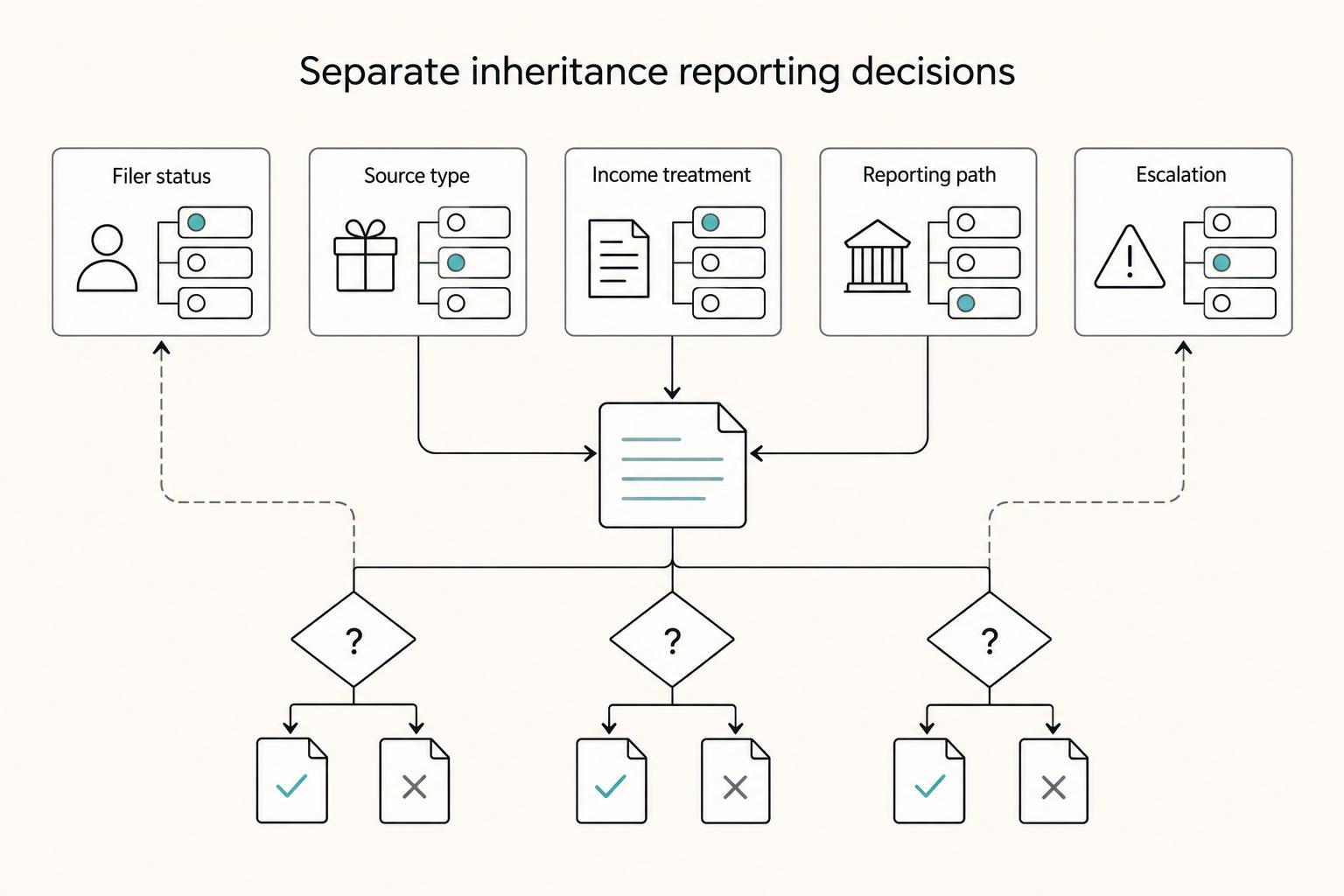
Start by separating three decisions before you touch any forms: whether a foreign transfer is treated as a gift or bequest that is excluded from gross income, whether `Form 3520` reporting may apply, and when the facts are uncertain enough to require a qualified tax professional. The goal is documented judgment, not guesswork.