
Quick Answer
A client does not complete I-9 or an employee E-Verify case for a genuine independent contractor. Confirm the actual relationship first. Vendor tax documentation depends on payee status: W-9 is for U.S. persons, while foreign payees need the appropriate alternative. Once you employ covered staff in the United States, complete I-9 on schedule and follow any E-Verify mandate or enrollment obligations.
Which Form Fits the Relationship: I-9 or W-9#
For a genuine independent-contractor engagement, the client does not complete Form I-9 for you. I-9 verifies identity and employment authorization for covered employees working in the United States. Contractor tax documentation is a separate question: Form W-9 documents a U.S. person, not every contractor worldwide. Foreign payees need the appropriate foreign-status or other tax form for their circumstances.
Use these definitions to orient quickly:
- Employee classification: examine the actual relationship under the applicable legal test; federal tax and employment-law tests are not identical.
- Independent contractor: you operate your own trade, business, or profession and offer services to the public.
- Form I-9: verifies identity and employment authorization for each new employee.
- Form W-9: a U.S. person provides a correct TIN and certifications to a payer for tax reporting.
The actual relationship matters. A contractor label, vendor payment route or W-9 does not establish classification. The client does not complete I-9 for a genuine contractor or the contractor’s employees; the contractor may have its own employer duties. Employees working entirely outside the United States are outside the I-9 requirement, though local hiring rules still apply.
| Factor | Form I-9 | Form W-9 |
|---|---|---|
| Primary purpose | Verify identity and employment authorization for a new employee | Provide a correct TIN to a payer for IRS information reporting |
| Relationship type it fits | Employer to employee | Payer to U.S.-person payee for tax reporting, including genuine contractors |
| Who is legally responsible | Employer completes and retains it for each person hired for employment | Payee provides it to the client or payer |
| What you are confirming | Employment eligibility and identity documentation | Taxpayer identity and U.S.-person status for payment reporting |
| Practical checkpoint | Are you being hired onto payroll as an employee? | Are you being paid as a vendor or contractor? |
| Risk if used in the wrong context | Can signal a classification mismatch and potential employment-tax exposure | Does not establish worker classification; foreign payees require the appropriate alternative |
E-Verify is an employer system that checks employee I-9 data against DHS and SSA records; it does not replace I-9 or verify independent vendors. Participation is voluntary for many employers, but particular laws and covered federal-contract clauses can require it. Voluntary enrollment also creates program obligations at participating hiring sites.
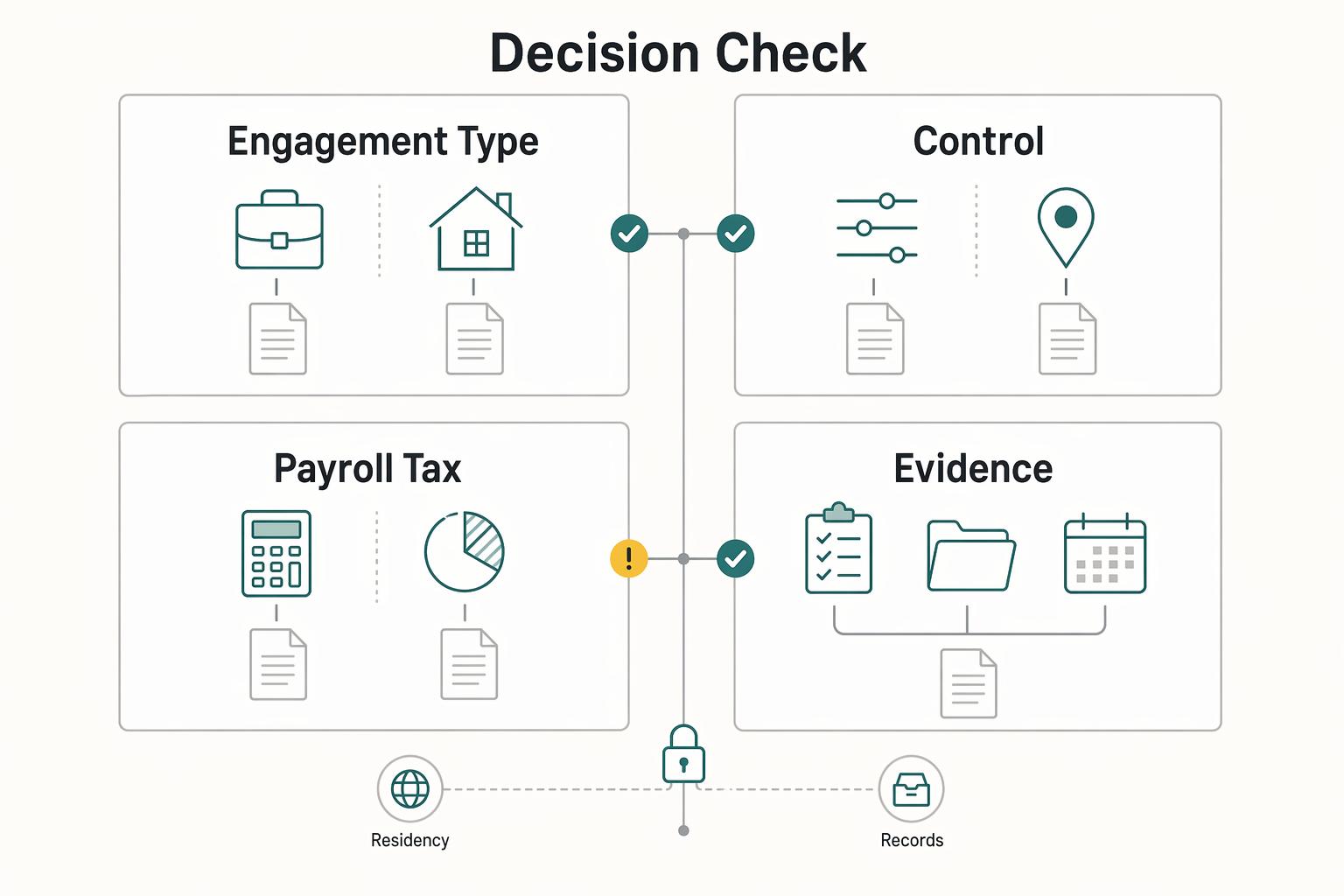
Decision check#
Before you respond, run a quick self-audit against the actual working setup:
| Check | Employee setup | Contractor setup |
|---|---|---|
| Engagement type | Hired into a job | Retained as an independent business |
| Control level | Client controls how you do the work | Client mainly controls the deliverable and timeline |
| Payroll/tax treatment | On payroll as an employee | Paid as a vendor or contractor |
| Correct document | Employee onboarding points to Form I-9 | Vendor tax documentation depends on payee status; W-9 for U.S. persons |
An I-9 request for a vendor engagement warrants clarification, but an identity-document request alone is not proof of employee treatment: vendors may face separate identity checks. Ask which form, legal requirement and relationship the client means, and confirm the underlying work facts.
The Strategic Response: A Guide to Correcting a Client's I-9 Request#
Ask whether the packet was sent in error or the client believes it is hiring an employee. Resolve that factual difference before selecting the forms. If the engagement is genuinely independent services, request vendor onboarding and provide the tax certificate appropriate to the payee.
W-9 is for U.S. persons, including eligible resident aliens. Foreign payees may need a W-8-series form or another certificate; the choice depends on the payee and payment. Do not certify U.S.-person status merely because the client is American.
Use the Acknowledge, Educate, Provide sequence#
Acknowledge. Start from good intent. "You're trying to keep onboarding compliant, and I want the file to be accurate too."
Educate. Keep it narrow and factual. "If this engagement is contractor-based, employee hiring documents do not fit. I-9/E-Verify is generally tied to employee onboarding, and E-Verify runs from completed I-9 data."
Provide. Send the correct tax form through the client’s secure collection channel. For a U.S.-person contractor: "I can provide my completed W-9 through your vendor portal. Please confirm that this is the correct packet for independent services."
- If the packet was sent in error, send clarification and provide the appropriate vendor tax certificate securely.
- If the client is insistent, request classification review by HR, procurement, or legal.
- If legal or procurement escalates, move to a documented reconciliation of contract terms, onboarding requirements, and policy.
Response choices and what each one signals#
| Response choice | Relationship signal | Risk exposure | Recommended action |
|---|---|---|---|
| Sign I-9 | Employee-style onboarding signal | Tax, wage-and-hour, and contract-file mismatch risk | Do not sign when the engagement is truly contractor-based |
| Provide the correct tax certificate | Payee tax documentation | Does not determine worker classification | Use W-9 for a U.S. person; confirm the appropriate certificate for a foreign payee |
| Pause and request review | Classification uncertainty signal | Short delay now to avoid larger downstream disputes | Use when contract terms and onboarding forms conflict, or the client insists on employee-only forms |
First reply for a U.S.-person payee, followed by escalation scripts#
Hi [the client's name],
Thanks for sending the onboarding packet. I want to make sure your records match the engagement correctly.
This engagement is for independent services through [Your Business Name]. Please confirm whether the I-9 request was sent in error or whether your team believes this is an employee hire. I am a U.S. person for tax purposes and can provide a completed W-9 through your secure vendor portal.
If you need any additional vendor onboarding documents, send them over and I'll complete them promptly.
Follow-up when they are confused
Happy to clarify. I-9/E-Verify is generally part of employee hiring, while this engagement is contractor-based. If your team has a vendor onboarding packet, I can complete it right away.
Escalation when they are insistent
I want to support your compliance process, and I also need the onboarding documents to match the contract and payment setup. Please have [HR/Procurement Contact] or [Legal Contact] review whether the I-9 request was sent in error for this contractor engagement.
Legal/procurement escalation
For review, this file currently reflects contractor treatment: [MSA/SOW dated ___] and [payment setup]. Please review those documents alongside the actual work arrangement. If you require a different vendor document, identify it and the secure collection route. If worker status is unresolved, let’s agree the next step before completing employee forms.
Verify your file before sending#
Before replying, compare the agreement with the actual work: supervision, control, deliverables and other relevant facts. Confirm the legal payee and its tax status before completing a certificate. Use a secure portal or another agreed protected channel for forms containing a TIN; retain the clarification without unnecessarily spreading identity documents.
If those points do not line up, pause and request classification review. Status turns on the full facts, not a label alone.
If a covered federal contract includes FAR 52.222-54, identify the employer responsible for each worker and any subcontract flow-down. That requirement does not turn a genuine self-employed vendor into the client’s employee. A subcontractor with employees may have its own covered duties.
A misclassified employee can create employment-tax, wage-and-hour and other obligations despite the contractor label. These tests and remedies differ by law. Separately, businesses cannot knowingly use a contract to obtain unauthorized labor in the United States; the absence of a contractor I-9 does not authorize unlawful work.
Handoff checklist
- Provide the appropriate tax form through the agreed secure collection channel.
- Document the exchange, including the request, your response, and any escalation path.
- Confirm onboarding will proceed under contractor terms, or pause pending classification review.
Once You Hire, Run the I-9 and Decide on E-Verify#
When you hire a covered employee to work in the United States, you become responsible for the employer’s I-9 process. Hiring a genuine contractor and employing staff are separate decisions.
In this context, an employee is a person who performs labor or services in the United States for wages or other remuneration. Form I-9 is the federal form used to verify identity and employment authorization for covered employees. E-Verify separately compares I-9 data against DHS and SSA records. You must run I-9 for covered hires. E-Verify case duties can follow a legal or contract mandate, or voluntary enrollment under the program rules.
Run I-9 as an onboarding sequence, not a loose checklist#
Download the current USCIS Form I-9 and instructions rather than reusing an old saved packet. Track Section 1, document examination, Section 2 and retention as separate steps.
| Step | Action | Timing |
|---|---|---|
| Offer accepted | Send Form I-9 instructions as part of onboarding; Section 1 may be completed | After offer acceptance |
| First day of employment | Ensure Section 1 is completed and signed | No later than the first day of employment |
| Document review (Section 2) | Complete Section 2 | Within three business days after the first day; on day one if employment lasts less than three business days |
| Record storage | Store completed I-9 records in paper or electronic format | After completion |
| Retention tracking | Keep throughout employment, then until the later of three years after hire or one year after termination | Retention period |
Section 2 is due within three business days after the employee’s first day of employment. If the employment will last less than three business days, it is due on the first day. Example: with a Monday-to-Friday business schedule and no holiday, a Monday October 5, 2026 start requires Section 1 by Monday and Section 2 by Thursday October 8.
Keep the form throughout employment. After employment ends, retain it until the later of three years after hire or one year after termination. For a hire on October 5, 2026 who leaves April 30, 2027, the later date is October 5, 2029.
Review documents correctly without overreaching#
Let the employee choose one acceptable List A document or an acceptable List B plus List C combination, subject to the official rules for receipts and extensions. Review whether the evidence reasonably appears genuine and relates to the employee. E-Verify requires a photo on a selected List B document; it still does not let you choose the document for the worker.
-
Let the employee choose which acceptable documents to present.
-
Review only what Form I-9 requires.
-
If a document does not reasonably appear genuine or related to the person, reject that document and request other acceptable documents.
-
Do not tell the employee which documents to present.
-
Do not ask for extra documentation to support Section 1 entries.
-
Do not demand a particular citizenship or immigration-status document; accept the employee’s permitted document choice under the I-9 rules.
Arrange physical document examination by you or an authorized representative unless you qualify for and follow a DHS-authorized alternative. The remote alternative is for qualified E-Verify employers in good standing at participating sites: it requires document-copy review, a live video interaction, retained copies and the required form notation. A video call alone is insufficient. Escalate unusual receipts or extensions promptly without treating the need for advice as an extension of the deadline.
Decide whether E-Verify is required, optional, or not applicable#
Decide whether enrollment is legally required or voluntary, then follow the obligations of participation. Lack of a mandatory trigger does not mean an enrolled employer may skip cases selectively.
| E-Verify status | When it applies | What you do |
|---|---|---|
| Legally required | A law or covered federal-contract clause applies | Confirm coverage and applicable enrollment and case deadlines; FAR contractors have special new-hire and existing-employee rules |
| Voluntary enrollment | No mandate applies, but the employer chooses to participate | Follow the MOU and verify eligible new hires at participating sites; the usual case deadline is the third business day after work for pay begins |
| Not enrolled; no mandate | No applicable requirement and no voluntary participation | Complete I-9 for covered employees; do not create E-Verify cases |
| Genuine independent vendor | The individual is not your employee for I-9 purposes | Do not create an employee E-Verify case for that vendor |
If you receive an E-Verify Tentative Nonconfirmation (Mismatch), treat it as a process step, not proof of unauthorized work. The employee must have an opportunity to resolve it, and you may not terminate or take adverse action based only on that mismatch before final resolution.
Keep the first-hire record complete#
- I-9 workflow completed with Section 1 and Section 2 on time
- Document review handled within I-9 boundaries, with no over-documenting
- Storage method selected (paper or electronic)
- Retention date tracked under the 3-years/1-year-later rule
- E-Verify decision documented as required, optional, or not applicable
- Track reverification when required on I-9 Supplement B; E-Verify is not a reverification tool.
Resolve the relationship and document the right process#
For vendor intake, confirm the work relationship and payee tax status, correct the packet and retain the clarification. For employee hiring, track I-9 deadlines and any E-Verify obligation separately. Neither a tax form nor a contract label replaces the underlying assessment.
Frequently Asked Questions
Do independent contractors or 1099 workers ever fill out a Form I-9?
A client does not complete I-9 for a genuine independent contractor. A 1099 label alone does not settle the relationship; if the person is actually a covered employee, the employer’s I-9 duty applies. A contractor employing its own covered staff has separate employer obligations.
What should I do if a client insists I fill out an I-9 as a freelancer?
Ask whether the packet was sent in error and request review of the actual engagement if the client believes you are an employee. For genuine vendor services, request the vendor packet and provide the appropriate payee tax certificate. U.S. persons use W-9; foreign payees should not sign it merely to satisfy the portal.
Is refusing to sign an I-9 bad for the client relationship?
Keep the exchange cooperative: identify the apparent mismatch, ask for confirmation and offer the correct vendor documentation. If the client disputes the relationship, route the facts to the responsible HR or legal team rather than arguing from the contract label alone.
What are the biggest risks for a business that misclassifies a contractor?
Potential exposure includes employment taxes, wage-and-hour claims and other duties under the applicable law. A W-9 or contractor agreement does not cure employee treatment. Misclassification background can help frame the issue, but tax and employment-law tests must be evaluated separately.
Is E-Verify mandatory for all U.S. businesses?
No. Many employers participate voluntarily; some are required by law or a covered federal-contract clause. Once enrolled, create cases for eligible new hires at participating sites under the program rules and MOU effective date. Federal contractors have special coverage and timing rules, including some existing employees. Do not use E-Verify to prescreen applicants or to reverify expiring work authorization.
What are the deadlines for completing Form I-9 for a new employee?
Section 1 must be completed and signed no later than the first day of employment, after an offer has been accepted. Section 2 is due within three business days after that first day; for employment lasting less than three business days, it is due on day one. E-Verify has a separate usual third-business-day case deadline, subject to program exceptions and federal-contractor rules.
Try a related tool
Researched and edited by the Gruv editorial team. Gruv builds cross-border billing, payouts, and finance-operations software for global businesses.
Sources
- acquisition.gov/node/32068/printable/printtrusted
- e-verify.gov/book/export/html/2113trusted
- e-verify.gov/e-verify-user-manual-for-corporate-administr...trusted
- govinfo.gov/content/pkg/FR-2023-07-25/pdf/2023-15532.pdftrusted
- irs.gov/instructions/iw9trusted
- irs.gov/instructions/iw8bentrusted
- uscis.gov/sites/default/files/document/forms/i-9.pdftrusted
- uscis.gov/sites/default/files/document/forms/i-9instr.pdftrusted
Educational content only. Not legal, tax, or financial advice.
Related Posts

What to Do If You've Been Misclassified as an Independent Contractor
If a business calls you an independent contractor but directs your work like an employee, check the rules for the rights you need to recover. A contract label, LLC or Form 1099 does not decide every legal status. Federal wage law, federal employment taxes and state employment laws can use different tests and provide different remedies.

The Freelance Payment Penalty: A Modeled Audit of Platform Fees, FX Spreads, and Payout Delays
The money rarely disappears through a single, easy-to-spot fee. The real loss is stacked. A marketplace takes its commission, a processor adds a charge for international cards, a bank or payment company converts the currency at a spread, a platform holds the funds before release, and a wire sheds a little to intermediaries on the way in. Each layer looks defensible on its own, but the worker feels the combined result as a smaller deposit and a later payday.
How to Respond to a Subpoena for Business Records
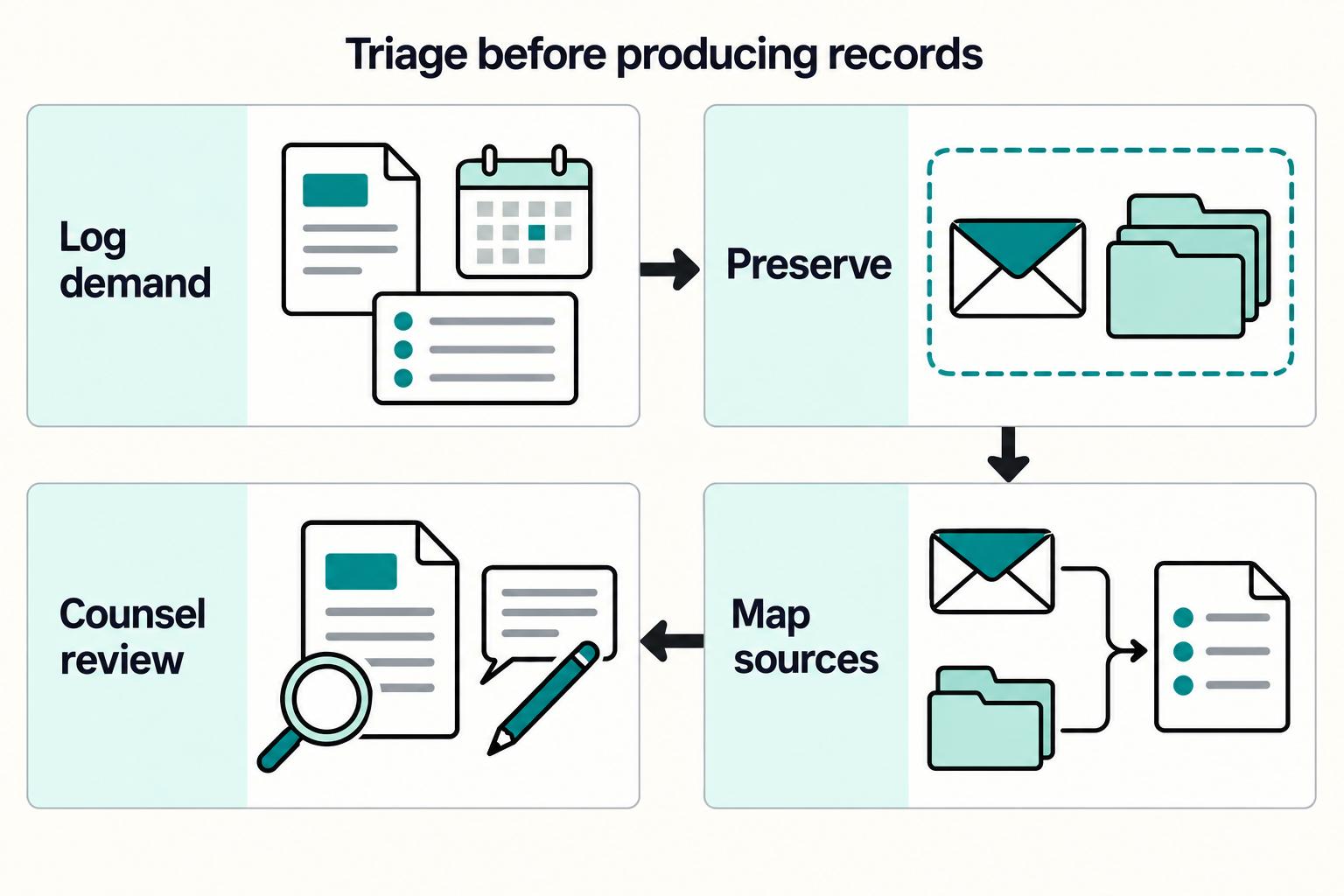
Move fast, but do not produce records on instinct. If you need to **respond to a subpoena for business records**, your immediate job is to control deadlines, preserve records, and make any later production defensible.