
Quick Answer
Start with a single stablecoin rail, usually USDC, and add USDT only when corridor demand and provider coverage are confirmed in writing. For crypto payouts usdc usdt contractors decisions, the deciding factor is operational control: can your team map payroll registers to payout execution, track provider IDs and statuses, and resolve failures with named ownership. Before rollout, lock KYC/KYB/AML gates, verify funding mechanics, and test failed or returned payout handling on a limited cohort.
Crypto payouts for contractors are a platform decision, not a wallet preference#
Treat this as an operating decision first. If you are a platform team building contractor payroll, the early mistake is to frame USDC versus USDT as a recipient wallet preference. The real choice sits with Finance, Ops, Product, and Engineering.
| Provider check | What to confirm |
|---|---|
| Country and corridor support | Confirm in writing for your exact contractor program, not just broad crypto-payroll marketing. |
| Funding mechanics | Confirm whether the provider expects you to prefund or hold stablecoins directly. |
| Payout limits | Confirm payout limits for the program. |
| Supported networks | Confirm which networks are supported for the program. |
| Status and exceptions | Confirm status reporting and how failed or returned payouts are surfaced back to your team. |
Sending a stablecoin is the easy part. The harder work is the control surface around it. You need to decide who is eligible, how payouts are approved, how payroll records reconcile to actual execution, and what you can prove later if something goes wrong. Keep one grounded rule in front of the team from day one: if you cannot reconcile payroll registers to payout execution, you do not have crypto payroll in any meaningful operational sense.
This guide is not for individual freelancers choosing a coin. It is for platform owners deciding whether a stablecoin rail belongs inside contractor payroll, what the first launch scope should be, and how to avoid creating a support and compliance problem in exchange for a new payout option. USDC and USDT may look similar on the surface, but the decision changes your control model, reconciliation burden, and the amount of evidence you need to retain.
You should also expect the answer to vary by program. Different payout programs can land on different token and routing choices even if they use the same vendor. The next sections focus on practical decision rules: when to start with one rail, what to verify before go-live, and how to handle the failures that show up after launch, not in the sales demo.
Before you commit to any provider, keep the unknowns explicit. Public material is often not enough to answer the rollout questions that actually affect your program.
- Confirm country and corridor support in writing for your exact contractor program, not just broad crypto-payroll marketing.
- Confirm funding mechanics, including whether the provider expects you to prefund or hold stablecoins directly.
- Confirm payout limits, supported networks, status reporting, and how failed or returned payouts are surfaced back to your team.
Even when a provider publicly describes crypto payroll support, availability can differ by worker type, market, and launch stage. Deel, for example, publicly states support for compliant crypto payroll options for US employees and says international availability is coming soon. That is useful context, but it is not a substitute for contractor-specific diligence.
As a starting rule, do not approve a token policy until you have a minimum evidence pack defined. At minimum, you want a clean link from payroll registers to payout execution, with audit-ready records for what was instructed, what executed, and what exceptions occurred. Without that, the coin choice is secondary to the operational gap.
USDC vs USDT at a glance for platform payout teams#
A practical launch default is one stablecoin rail first, then expand only after your controls hold up in production. USDC and USDT are both fiat-backed stablecoins pegged to the US dollar, and neither has a blanket factual edge for every platform program.
| Criteria | USDC | USDT | Operator read |
|---|---|---|---|
| Treasury and risk posture | Fiat-backed, USD-pegged stablecoin. | Fiat-backed, USD-pegged stablecoin. | No universal treasury winner is proven here; set a written token policy before launch. |
| Contractor preference coverage | Reported as broadly available across major exchanges, wallets, and dapps. | Reported as broadly available across major exchanges, wallets, and dapps. | Broad availability is not corridor-level demand; validate your own contractor mix before adding rails. |
| Network availability | Broad network presence is supported, but provider-specific network support is not confirmed. | Same limitation. | Treat network support as a provider confirmation item, not a token assumption. |
| Reconciliation complexity | Simpler when used as a single launch rail. | Adds more mapping and status paths when introduced as a second rail. | Keep the core rule: if you cannot reconcile payroll registers to payout execution, the program is not operationally sound. |
| Compliance review load | Lower with one enabled token at launch. | Higher when added alongside another token. | One token is easier to document, monitor, and defend in review. |
| Exception handling | Fewer branches when paired with limited networks and narrow eligibility. | More branches once token choice and routing paths expand. | Failures usually show up in handling delays, returns, and unsupported destinations, not in sending itself. |
| Default recommendation | Strong first rail when you want a smaller control surface for initial rollout. | Add only when confirmed program demand and provider coverage justify extra ops burden. | Delay rollout if provider confirmations are incomplete. |
| What must be verified with provider | For Rise, BVNK, and Deel: supported contractor corridors, payout limits, supported networks, and funding mechanics (including whether stablecoin holding/prefund is required). | Verify the same points separately for this token. | Do not assume parity from generic crypto-payroll marketing. Rise's USDC-focused post dated November 24, 2025 is context, not program-level proof. |
Market-readiness signal (keep in proportion): Toku cites that nearly 1 in 4 North American CFOs expect digital-currency use within two years. That supports category momentum, not provider-level fit for your corridors, limits, or funding model.
Before go-live, require a single evidence pack that links payout instruction to provider payout ID, wallet, network, execution status, and ledger mapping, then test failed or returned payout flows in a small batch before you expand rails.
Choose your first rail by operating model and risk tolerance#
If you need the tightest operational control at launch, start with one rail, usually USDC, and treat USDT as a second rail only when recipient demand or corridor constraints clearly justify it.
The main risk is not sending the payment. It is whether you can prove who was paid, on which token and network, under which approval path, and reconcile payroll registers to payout execution for close.
For high-volume cross-border payouts, choose token and network together. Treat "minutes" settlement claims as directional, then verify failure and recovery behavior in your own program: retry logic, duplicate prevention, payout-status detail, and what evidence you receive when a payout is delayed, fails, or enters manual review.
For early-stage rollout, do not offer every token in every corridor. Launch 1 to 2 corridors with one approved token and explicit eligibility gates, then expand only after exception rates are manageable and support can resolve failures without manual chain hunting.
Scenario grid#
| Payout model | First rail recommendation | Why this fits the operating model | Escalate only when |
|---|---|---|---|
| Marketplace payouts | USDC on a narrow approved network set | Fewer payout branches and cleaner support handling across many smaller payouts | A corridor or recipient segment repeatedly cannot receive the default route, and your provider can show token-specific status and retry handling |
| Creator payouts | USDC first, with USDT as a later exception path | Wallet preference can matter, but early recipient choice increases support and reconciliation load | You see clear opt-in demand from a defined cohort and can support token-specific eligibility and exception messaging |
| B2B contractor payouts | USDC as the default contractor rail | Highest expectation for auditability, register-to-execution matching, and policy clarity | Treasury, Compliance, and Ops approve a second-rail policy and your provider confirms separate coverage, limits, and reporting for that token |
Use this decision rule: pick the rail your team can explain, reconcile, and support under pressure. If you cannot show token, network, wallet, payout ID, and final status in one evidence trail, keep a single-rail launch and delay the second rail.
For a step-by-step walkthrough, see A Deep Dive into Deel's Pricing and Fees for Contractors.
Compliance gates you need before enabling contractor stablecoin payouts#
Before you enable contractor stablecoin payouts, keep two separate control tracks: payout eligibility and tax/document review. If you combine them, teams can treat operational onboarding as proof that tax reporting analysis is complete when it is not.
Your payout-eligibility track can include internal gates such as KYC, KYB, and AML checks for contractor payroll. Keep that separate from the tax track, which should record whether Form 8938, FATCA, and possible FBAR review were considered.
| Control track | What it answers | Checkpoints to record | If mixed with the other track |
|---|---|---|---|
| Payout eligibility | Can this contractor receive this token on this approved network? | Approval date, reviewer, wallet/network, provider reference, policy version | Payouts get blocked or approved on tax assumptions instead of payment risk |
| Tax and document review | Does this party or entity need additional reporting analysis? | Whether Form 8938 was considered, whether FBAR review was considered, entity type, threshold review note | Onboarding gets treated as proof tax review is done |
| Audit evidence | Can Finance, Ops, and Compliance reconstruct the decision later? | Ledger mapping, exception disposition, payout ID, retained approval logs | Funds can settle while audit/support evidence is incomplete |
Be precise about Form 8938: IRS says it is used to report specified foreign financial assets when total value exceeds the applicable threshold, and when required it is attached to the annual tax return. IRS also says if a taxpayer does not need to file an income tax return for that year, they do not file Form 8938 for that year.
For certain specified domestic entities, the instructions cite thresholds of over $50,000 on the last day of the tax year or over $75,000 at any time during the tax year. IRS also notes that Form 8938 and FBAR may both be relevant, and cites penalties of $10,000 and up to $50,000 for continued failure after notice, plus a 40 percent understatement penalty in some cases.
For US vendor diligence, document in writing which regulated entity is in your flow and how FinCEN, Money Services Business, money transmitter, and NMLS status are being handled where applicable. If the provider cannot clearly identify the operating entity, the in-scope service, and the records you will receive back, pause rollout.
Your audit pack should include:
- approval logs with timestamps and named approvers
- policy versions in force when approval happened
- provider references such as payout IDs and program/account identifiers
- ledger mappings from payout event to finance entry
- exception dispositions for failed, returned, or manually reviewed payouts
If you cannot show both the rail-approval trail and the separate tax-review trail for one contractor, stay in a narrow pilot. Related: Stablecoin Payouts for Platforms: How to Disburse USDC to Contractors Globally.
Build the payout flow in the right order from funding to contractor receipt#
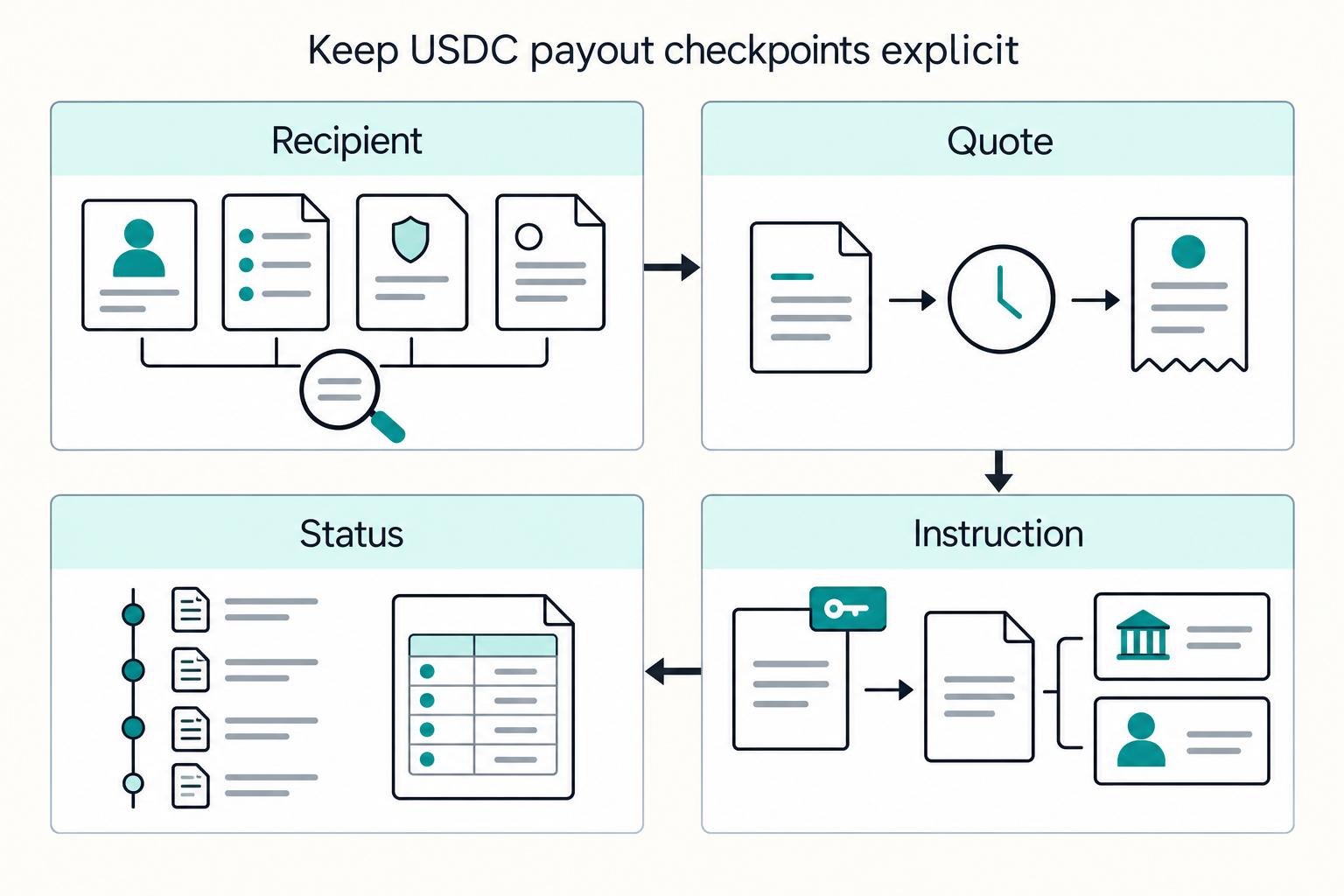
Build this flow in a fixed sequence: funding source setup -> eligibility checks -> payout instruction creation -> provider routing -> status webhooks -> ledger reconciliation. If you start at the send step, you usually create avoidable duplicate, status, and close-process issues.
| Stage | What to do | Checkpoint before next stage |
|---|---|---|
| Funding source setup | Define how funds enter the flow and record that funding event first. | Funding lands in the ledger with a unique reference and expected amount. |
| Eligibility checks | Apply KYC/AML and program rules for who can receive which payout option. | Contractor is approved for the specific token/network option, not just generally onboarded. |
| Payout instruction creation | Create one internal payout record per business event. | Retries replay the same record safely instead of creating a second send. |
| Provider routing | Submit to the payout provider and store the provider reference. | Internal payout ID maps cleanly to provider payout ID. |
| Status webhooks | Ingest provider status events and update internal history. | Each event is authenticated and linked to one payout record. |
| Ledger reconciliation | Reconcile provider outcomes back to finance entries. | Totals, counts, and exceptions match across records. |
Model the funding pattern as fiat-first, then conversion where applicable. A documented contractor flow starts with invoice approval and company payment in USD, and one published setup for contractor stablecoin payouts uses Stripe Connect for receiving payments and payout to a crypto wallet.
Keep eligibility constraints explicit in code and Ops checks. In that same published setup, contractors can receive USDC; eligibility includes working for a company billed in USD; and Stripe disbursement is currently limited to USDC.
For idempotency, keep one business event tied to one internal payout ID and one idempotency key. Every retry should point to that same record so replay is safe.
Set source-of-truth boundaries early: the ledger is the source of truth. Wallet or projected balances are derived views that may lag. Use an internal status model Ops can run: pending, submitted, on-chain/processing, paid, failed, returned, manual-review.
Before you expand beyond pilot scope, require all three to pass across consecutive batches: successful batch completion, exception rate below your pre-set threshold, and reconciliation parity between ledger records and provider reports.
Where teams get burned in production and how to prevent it#
Teams usually get burned by operations, not chain speed. Stablecoins can settle fast while payouts still fail in slow, boring ways when delay states are unclear, retries are unsafe, and no one owns exceptions.
| Failure mode | What happens | Preventive control |
|---|---|---|
| Unclear delay states | Holds, review queues, or bad destination details can block receipt even after submission. | Treat delayed payouts as an operations queue with a clear escalation path. |
| Token or network mismatch | A cited CFPB complaint describes a BEP-20 token sent to an ERC-20 address. | Use pre-send validation for token, network, destination, and recipient ownership alignment. |
| Unsafe retries | Retrying after a payout API timeout without a deterministic idempotency key can create two submissions. | Use deterministic idempotency keys with documented retry and backoff behavior for API errors. |
| No exception owner | If no one owns failed, returned, and manual-review, contractor tickets grow and Finance close slows. | Run daily failed-state triage with a named owner and recorded disposition for each exception. |
| Post-submission freeze risk | "Paid" is not always final and usable; CCN reported frozen USDC business hot wallets. | Keep post-submission exception handling in scope. |
"Settlement in minutes" can still end in a contractor delay. Holds, review queues, or bad destination details can block receipt even after submission. Identity and ownership mismatch is one cited failure mode, and destination mismatch is another: one CFPB complaint describes a BEP-20 token sent to an ERC-20 address, followed by "The funds never showed up in my Kraken account." Treat token, network, and wallet ownership as one validation object.
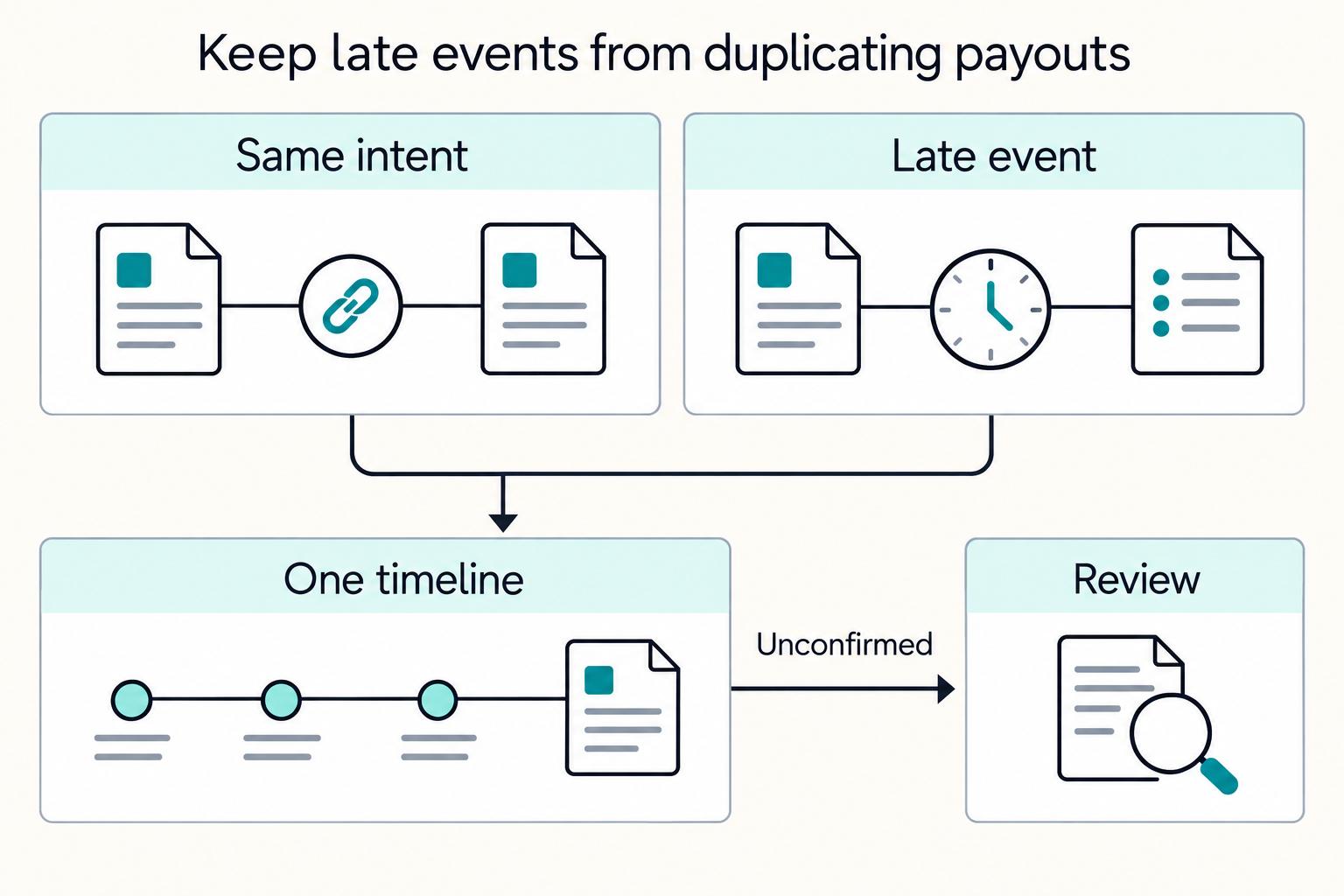
Duplicate sends usually start in retry logic. If a payout API call times out and you retry without documented backoff tied to the same deterministic idempotency key, you can create two submissions that both look valid. Every retry should point to the same internal payout ID, with the original request timestamp, provider response or timeout, selected network, and current status visible to Ops.
A separate failure is unclear ownership inside your org. If no one is assigned daily ownership of failed, returned, and manual-review, contractor tickets grow and Finance close slows.
Use these controls before you scale:
- pre-send validation for token, network, destination, and recipient ownership alignment
- deterministic idempotency keys with documented retry and backoff behavior for API errors
- daily failed-state triage with a named owner, escalation SLA, and recorded disposition for each exception
One more production warning: "paid" is not always "final and usable." A stablecoin centralization risk question is still "Can assets be frozen?", and CCN reported that 16 USDC business hot wallets were frozen on March 23, 2026. Fast on-chain movement does not remove the need for post-submission exception handling.
Price the full payout cost before committing to a provider#
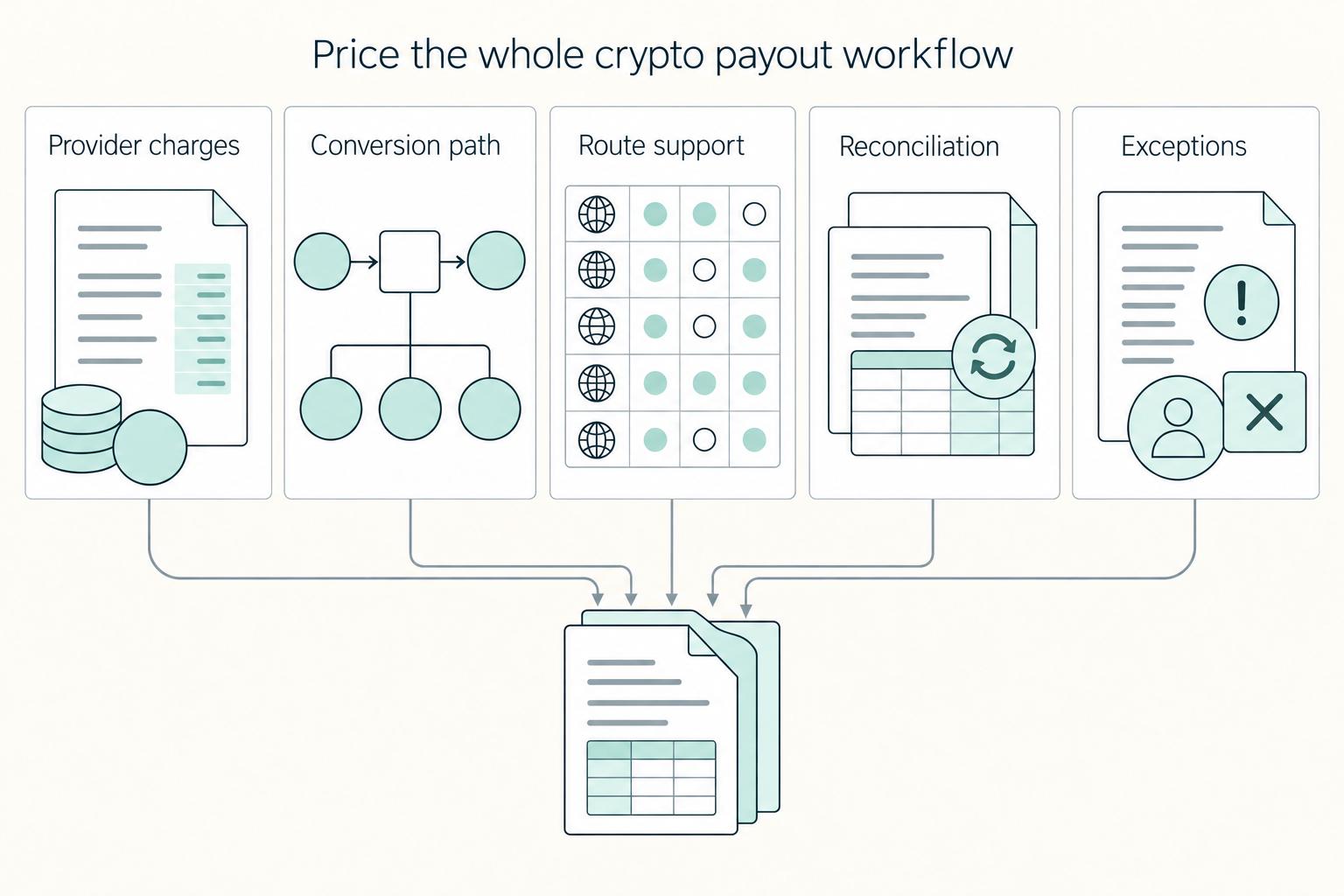
Price total operating cost, not the headline payout fee. Compare Rise, BVNK, and Deel on the full payout workflow, including what happens when payouts fail or need manual handling.
Use a simple procurement rule: require a written breakout of fee components, conversion handling, and corridor or token constraints. If two options are commercially close, choose the one with clearer reconciliation outputs and lower exception workload for Ops and Finance.
| Cost line item | What to require from Rise, BVNK, and Deel | Why it affects real cost |
|---|---|---|
| Provider fee | Charges per payout, batch, funding event, account, or program | Prevents low visible transfer pricing from masking other charges |
| Conversion and FX handling | Where conversion happens, which asset is funded vs paid out, and who sets spread | Conversion and FX handling can materially change total payout cost |
| Corridor and token constraints | Supported countries, entities, tokens, and networks for your exact program | A low quote is not useful if your required route is not supported |
| Reconciliation surfaces | Payout exports, webhook fields, status states, IDs, and month-end format | Weak reporting increases manual close and matching work |
| Support burden | Who handles recipient issues, response expectations, and support-visible data | Support gaps increase ticket volume and internal time |
| Exception remediation | Process and commercial treatment for failed, returned, and manual-review payouts | Exception handling is a common source of unpriced operational cost |
| Cannot verify publicly | Explicit list of terms not confirmed from public materials | Forces unknowns into approval before signing |
Request an evidence pack, not just a pricing sheet: sample invoice, reconciliation export, status taxonomy, webhook payload examples, corridor matrix, and USDC/USDT token-plus-network support matrix. If a response says "global support" or "low fees," ask for the exact country list, entity restrictions, and whether pricing changes by token, network, or corridor.
Public materials may not fully verify commercial terms. Exact public fee claims for Rise, BVNK, or Deel are not established, and one referenced source in this space was inaccessible. Treat that as a decision input: add a cannot verify publicly row and require written confirmation before approval.
Launch checklist by function for a low-surprise rollout#
Treat go-live as a controlled operating decision: assign named owners across Finance, Payments Ops, Engineering, and Compliance, and expand only after a checkpoint review on an initial cohort.
| Function | What to lock before go-live | Evidence to require at checkpoint | If skipped |
|---|---|---|---|
| Finance and AP | Written token policy for USDC and USDT, reconciliation pack format, close owners | A sample payout export mapped to internal payout IDs and month-end close workflow | Close slows down, exceptions accumulate, and token decisions drift case by case |
| Payments Ops | Monitoring ownership, failed-payout queue ownership, contractor communication templates | A documented handoff for payout exceptions and recipient updates | Delays turn into unresolved support tickets |
| Engineering and Product | Reliable payout execution controls and auditable payout status history | Test evidence for retry handling, duplicate-prevention behavior, and status traceability | Higher risk of avoidable payout errors and weak audit trails |
| Compliance | Documented KYC/KYB/AML policy gates, market eligibility decisions, evidence retention owners | A single approval packet with current policy references and decision records | Payouts can move ahead without clear control evidence |
Use a limited launch cohort first, then expand only when reconciliation quality, exception handling, and support load are acceptable. If any function cannot produce its evidence pack on demand, treat that as a stop signal.
That caution is practical: stablecoins have moved from niche crypto usage toward mainstream fintech attention, while the regulatory environment is still evolving over the next eighteen months. Keep rollout approval documented as an operating record, not just a product milestone.
The practical next step for platform teams#
Take a narrow launch path first: choose one scenario, one default token, and one corridor set, then pause expansion until compliance and operations checks pass. USDC vs USDT is not a marketing-speed choice; it is an operating choice you can verify, reconcile, and defend with written evidence.
| Launch choice | When it is reasonable | What must be true before expansion |
|---|---|---|
| Single token, single corridor pilot | You want the lowest coordination load across Product, Ops, Finance, and Compliance | You can show end-to-end payout status, failed-state handling, and ledger reconciliation for a sample batch without spreadsheet repair |
| Dual token pilot | You already have written evidence that a specific contractor segment or corridor needs a second rail | The provider confirms the exact token path, destination support, exception handling, and reporting fields in writing |
| Defer launch | Key facts are still unclear, especially around funding, wallet verification, or support ownership | Unknowns are resolved in contract documents, not left to sales calls or public pages |
Lock down funding mechanics first. TransFi's March 27, 2026 article describes a flow where employer fiat is converted to crypto (usually stablecoins) and sent to contractor wallets, so ask directly: where does conversion happen, and does settlement ever touch your balance sheet? If that answer is unclear, your launch is not ready.
Apply the same standard to wallet destinations. A New York Attorney General summons and complaint dated January 9, 2025 describes defendants as unknown parties in ownership and/or control of digital wallet addresses, so a wallet address alone is not identity evidence. Require a documented match between the approved contractor record and destination wallet, and keep the approval log with the policy version used at the time.
What to verify in writing#
Keep a short verification list and mark each item verified or unverified until contract-stage confirmation:
| Verification item | What to confirm | Status |
|---|---|---|
| Supported token and program path | Confirm the exact supported token and program path. | Verified or unverified |
| Corridor and recipient eligibility | Confirm corridor and recipient eligibility for your use case. | Verified or unverified |
| Funding mechanics | Confirm the fiat-to-stablecoin conversion point. | Verified or unverified |
| Payout status behavior | Confirm payout status fields, webhook behavior, and failure states. | Verified or unverified |
| Reconciliation data | Confirm what reconciliation data is returned for each payout. | Verified or unverified |
| Holds and support path | Confirm review holds, returns, and the support escalation path. | Verified or unverified |
Use market reports as context, not commitments. Rise's "State of Crypto Payroll Report 2026" page (published March 14, 2026) may help with background, but it is not evidence of your coverage, controls, or SLA.
Bring this checklist to the sales conversation and confirm coverage, controls, and corridor support for your exact program before adding a second rail. Related reading: Remote.com Pricing for Contractors and the Fees That Change Your Total.
Frequently Asked Questions
Should platforms start with USDC or launch USDC and USDT together for contractor payouts?
Start with USDC unless you already have written evidence that a specific corridor or contractor segment truly needs USDT. That keeps policy, reconciliation, and support narrower at launch. One grounded reason: in Remote’s Stripe Connect flow, Stripe currently supports only USDC for disbursement currency, which is a useful reminder not to assume dual-rail support exists just because a vendor markets “stablecoin payouts.”
Can we offer crypto payouts without holding stablecoins on our own balance sheet?
Possibly, yes. Remote says its contractor stablecoin option is delivered with Stripe Connect, which shows a provider-mediated model can exist. The checkpoint is contractual, not marketing copy: confirm the funding path, whether settlement ever touches your balance sheet, and what ledger fields you receive back for reconciliation.
What compliance controls are required before enabling contractor crypto payroll options?
Do not enable the option until your approval gates are documented and owned. At minimum, that means your eligibility rules and approval records are in one evidence pack, so you can show why a contractor was allowed onto the rail. If your team cannot produce the current policy version and provider terms on demand, you are not ready.
How should we handle failed or delayed stablecoin payouts operationally?
Treat delayed payouts as an operations queue, not a vague wallet problem. You need named owners for pending, failed, returned, and manual-review states, plus contractor communication templates and a daily triage check. A common failure mode is assuming “stablecoin” means instant, then discovering delays with no clear escalation path.
What should Finance track to reconcile contractor payouts and pass audit review?
Finance should track the payout instruction ID, provider payout ID, token, amount, wallet destination, status history, and final disposition for every payment. The hard rule is worth keeping in front of the team: if you cannot reconcile payroll registers to payout execution, you do not have crypto payroll. Test this before expansion by matching a sample batch end to end without spreadsheet repair.
How should US contractor requirements differ from non-US contractor payout policies?
Keep them separate in policy and approval. For non-US contractors, availability may depend on whether the contractor lives in a supported country. Remote also notes eligibility can depend on working for a company billed in USD and using Stripe Connect. For US contractors, do not inherit the global rule set by default. Require a distinct legal, tax, and compliance review before enabling the option.
Which provider claims should we treat as unverified until contract-stage diligence?
Treat country coverage, payout limits, exact fees, FX handling, guaranteed timing, and funding mechanics as unverified until they are confirmed in writing. Also treat any “supports stablecoins” claim carefully unless the contract names the exact token and program path. If a vendor implies USDT support, ask for the specific disbursement flow and corridor approval rather than assuming it matches their broader marketing.
Try a related tool
Researched and edited by the Gruv editorial team. Gruv builds cross-border billing, payouts, and finance-operations software for global businesses.
Sources
- ag.ny.gov/sites/default/files/court-filings/oag-pleadi...trusted
- brookings.edu/articles/next-steps-for-genius-payment-stabl...trusted
- consumerfinance.gov/data-research/consumer-complaints/search/api/v1trusted
- esrb.europa.eu/pub/pdf/reports/esrb.report202510_cryptoasse...trusted
- fincen.gov/report-foreign-bank-and-financial-accountstrusted
- irs.gov/businesses/corporations/fatca-information-fo...trusted
- irs.gov/forms-pubs/about-form-8938trusted
- scholarship.law.gwu.edu/cgi/viewcontent.cgitrusted
Educational content only. Not legal, tax, or financial advice.
Related Posts

USDC Contractor Payouts for Platforms and Stablecoin Rollout Decisions
If you are deciding whether to offer USDC contractor payouts, treat it first as an operating model decision: can you launch with clear eligibility, fallback payout paths, and audit-ready controls?
Stablecoin Payouts for Platforms Disbursing USDC to Global Contractors
**Step 1. Set the operating model before you talk about speed.** This guide is for platform operators shipping stablecoin contractor payouts in production, not for freelancers choosing a wallet. The core stance is simple: approve compensation in USD, use a stablecoin as the settlement rail, and treat controls as product requirements from day one. Stablecoins are built to behave like money, and businesses already use them for supplier payments, cross-border invoicing, and treasury movement. That makes stablecoin payouts worth a look, but only if your payout process is as disciplined as your fiat process.
USDC Payouts for Platforms and Stablecoin Settlement for Contractors
For teams evaluating USDC payout options, the real decision is operational, not ideological. You are deciding whether to add USDC as a contractor or creator payout rail without disrupting finance controls, month-end reconciliation, support handling, or compliance review.