Prioritize operational control over headline speed: launch USDC payouts only for cohorts with explicit eligibility and a tested fiat fallback. In the Connect-style flow described, contractors may receive USDC in 69 countries, but access depends on country and setup path, and users can hold either a Crypto account or a Stripe account at one time. Treat go-live as a controls decision by proving payout-status traceability, reconciliation exports, and exception handling before broader rollout.
If you are deciding whether to offer USDC contractor payouts, treat it first as an operating model decision: can you launch with clear eligibility, fallback payout paths, and audit-ready controls?
USDC is a digital stablecoin pegged to the US dollar. For platforms with USD-denominated contractor payouts, it can align with existing payout demand. The practical question is whether to add a USDC option, which provider route to use, and what controls you need in place.
This guide compares routes discussed in the market: Stripe Connect, Remote, Toku, Rise, and TransFi. The published evidence is uneven. In materials from Remote and Stripe Connect, Remote says contractors can opt into USDC through its existing setup and link a crypto wallet to a Connect account. It also says it launched this option in two weeks, reports stablecoin payouts in more than 60 countries, and says its broader contractor payout footprint spans more than 150 countries.
Eligibility is not universal, and your product should surface that early. Remote's published criteria include working for a company billed in USD and residing in a supported country. If the Crypto option is not visible, the contractor is not eligible in that context.
Account setup choices create real tradeoffs too. In the described Remote flow, a user can have either a Crypto account or a Stripe account, but not both at the same time. That affects fallback to fiat and how you handle payout method changes for contractors who want flexibility.
Compliance and reconciliation are the other half of the decision. Toku frames controls, evidence, and compliance as core requirements. It says that if you cannot reconcile payroll registers to payout execution, you do not have a controlled crypto payroll process. For contractor payouts, that is a useful control baseline. Maintain an explainable trail from payout initiation to settlement and ledger impact.
The goal here is simple: choose a route, set guardrails, run a narrow pilot, and scale only when the operating evidence is strong. Where the published facts are strong, this guide uses them directly. Where vendor detail is thin, it treats those gaps as validation work for your team.
Choose the route by operating fit first, then vendor fit. If you run a marketplace, contractor platform, or embedded-payments program with mostly USD payouts and clear contractor demand to hold value outside local fiat, stablecoin payout options should be on your active shortlist. If you are choosing a personal wallet, this is the wrong decision frame.
This is a platform payout decision, not an individual holdings decision. Your route needs onboarding, eligibility logic, payout tracking, and exception handling. If a provider only supports on-chain transfers, it is solving only part of the problem if your program also needs on-ramp and off-ramp flows.
If your payout base is mostly USD and contractor demand shows up in payout behavior or support volume, evaluate stablecoin payouts now. Compare the current pain to the upside you expect. Traditional cross-border payouts are often described as taking three to five business days, with $15 to $50 wire fees and 2-4% FX markups. Stablecoins are often described as settling in minutes, and some materials cite 80%-90% fee reduction. Treat those outcomes as directional until you prove them in your own corridors.
Write your non-negotiables first: supported countries, contractor eligibility rules, fiat fallback when a stablecoin payout option is unavailable, and whether stablecoin payout is optional or default in your product. This quickly exposes weak routes. Claims like settlement coverage across 65 countries matter only if they match your countries and your worker model.
Ask vendors to prove settlement behavior, failure handling, status visibility, and reconciliation outputs. Ask for a concrete transaction-tracking example and an export your finance team can match to internal payout records and support cases. Traceability claims matter only if they reconcile cleanly to your ledger.
Regulatory context is useful, but it is not enough for diligence. A FederalRegister.gov page dated 03/02/2026 can still be informational rather than the official legal edition. Verify legal posture separately from country, program, and control validation.
If you want a deeper dive, read Stablecoin Payouts for Platforms: How to Disburse USDC to Contractors Globally.
Treat this as a shortlist filter, not a capability verdict. Evidence is uneven in this pack. Some options show useful signals, but operating detail is still incomplete across most of the field.
If a vendor cannot answer the four core fields in writing, including supported assets and chains with USDC, pause before engineering scoping. Also keep stack roles separate: gateway versus processor. Accepting crypto alone does not prove payout operations, compliance boundaries, or reconciliation readiness.
| Option | Best for | Eligibility controls | Compliance ownership | Wallet setup burden | Payout status visibility | Top pros | Top cons | Concrete use case | Explicit unknowns |
|---|---|---|---|---|---|---|---|---|---|
| Stripe Connect | Teams already on Stripe deciding whether to run deeper stablecoin diligence | Not evidenced in this pack | Not evidenced in this pack | Not evidenced in this pack | Not evidenced in this pack | Included in a January 09, 2026 stablecoin provider shortlist, so it is reasonable to follow up if it is already in your stack | Inclusion is framed as market signals and public benchmarks, not program-level proof; no Connect-specific contractor payout detail here | Ask the vendor to confirm, in your worker model, USDC support by country, fallback rails, and reconciliation outputs before scoping | Country carve-outs, compliance boundary, wallet UX, status artifacts, and legal edge cases are unresolved here |
| Remote | Teams with an active vendor conversation who can get direct written answers fast | No direct evidence in this pack | No direct evidence in this pack | No direct evidence in this pack | No direct evidence in this pack | Keep it as a candidate only pending direct written product evidence | Key assumptions on controls, compliance, and contractor UX would still be risky from this evidence set alone | Keep on the shortlist only if Remote provides written country and worker eligibility, supported assets and chains, and payout-tracking evidence up front | Most decision-critical items are still unresolved, including compliance ownership and the exact operating boundary |
| Toku | Teams that want a web3-specialized candidate in the comparison | Not evidenced in this pack | Not evidenced in this pack | Not evidenced in this pack | Not evidenced in this pack | The August 30, 2025 Rise comparison includes "4. Toku: Web3 Specialized Platform," which is a clear specialist signal | Specialist positioning does not answer finance or compliance details; worker type, country coverage, and reporting are unresolved | Use as a specialist comparator against broader payment vendors | Compliance ownership, tax handling, jurisdiction support, asset coverage depth, and operational visibility remain unclear |
| Rise | Teams doing first-pass market mapping to structure vendor conversations | Not evidenced in this pack | Not evidenced in this pack | Not evidenced in this pack | Not evidenced in this pack | Its comparison format is useful as an initial shortlist artifact and surfaces candidates like Toku | Vendor-authored comparisons are not independently validated operating evidence | Use Rise to build your diligence question set, then require direct operational proof from each vendor | Product-level controls, legal treatment, and corridor-level performance evidence are not established here |
| TransFi | Teams open to another candidate, but only on hard evidence | No direct evidence in this pack | No direct evidence in this pack | No direct evidence in this pack | No direct evidence in this pack | Keep it in scope only as a diligence candidate until direct documentation is provided | There is no grounded basis here to treat speed, fees, countries, or contractor operations as proven for your program | Keep it in a "prove it first" lane and request country coverage, status tracking, failure handling, and asset and chain support before review | Major decision points are still open, including savings methodology and country restrictions |
The decision checkpoint is not brand recognition. It is proof of supported assets and chains, gateway versus processor responsibility, and payout-status artifacts that Finance and Support can actually use.
Also avoid over-reading settlement headlines. A 2026 guide mentions ~6 seconds on Solana for USDC in some cases, while also framing comparisons as market signals and public benchmarks. Treat that as context, then validate your own corridors, worker mix, and support burden.
If you already run on Connect, this can be a practical way to add USDC payouts alongside existing rails. Keep employer funding in USD, keep bank payouts live where supported, and offer USDC as an optional contractor method.
A cited Remote setup using Connect shows the pattern clearly: employers fund in US dollar fiat, while contractors in 69 countries can receive USDC. That lets you keep existing billing and treasury flows while changing the worker payout choice.
The contractor experience is also straightforward. Stripe's example shows a worker choosing local bank transfer, which could take a few days, or USDC to a wallet, which can take a few minutes in some cases. Operationally, that makes crypto an elective option rather than a forced change.
The value here is not the label. It is the operating model: existing payout orchestration and explicit worker choice between fiat and crypto.
In the cited flow, contractors receive USDC on a Base wallet address. For diligence, ask not just whether USDC is supported, but which networks and wallet destinations are supported for your exact program.
Eligibility is the main constraint. In the cited setup, Connect payouts were previously local-currency only, so USDC availability depends on supported-country rules and setup paths rather than universal access.
Compliance is another constraint. The model includes a dual KYC checkpoint: Remote performs KYC during onboarding, and the provider performs a separate KYC process. Define ownership and failure handling up front so Support and Ops can manage edge cases cleanly.
Before engineering starts, get these points in writing so your pilot does not drift:
Also separate on-chain receipt from local cash-out reality: stablecoin flows can still depend on redemption infrastructure, often through a centralized exchange that supports local fiat conversion. Use this route when you want optional USDC while keeping current USD invoicing and fiat fallback paths.
Related reading: Virtual Credit Cards for Platforms: How to Issue Single-Use Cards for Contractor and Vendor Payments.
Keep Toku on the shortlist when compliance is the hard part, not just payout rails. The clearest grounded signal is that Toku's own material treats legal, tax, and reporting work as core implementation considerations.
Toku's Token Compensation Primer is a concrete diligence artifact, framed as "The complete guide to token compensation." Its page also explicitly tells teams to "Navigate legal, tax, and compliance requirements with confidence" and to "Understand benefits, risks, and legal considerations for each method."
If your program may include different worker types, that framing matters. You are choosing a compensation method and reporting approach, not just testing whether stablecoin payouts are possible. Toku's material also pushes teams to compare token grant models and choose what fits their business.
This route is most relevant for teams that want a crypto-native payroll motion with compliance-oriented guidance before rollout. A third-party stablecoin payroll roundup dated January 20, 2026 includes Toku, which supports keeping it in a serious vendor set.
A practical use case is a company exploring structured stablecoin payroll for part of its workforce and needing legal, tax, and reporting review artifacts early in the process.
You should treat public stablecoin rail details as unconfirmed until Toku validates your exact setup. Third-party headlines conflict on network framing, with one referencing Sei and another Polygon. Confirm scope in writing before scoping build work.
Toku's page says its team will connect within one business day after contact submission. Use that checkpoint to request product-level proof, not marketing summaries.
Toku looks strongest when you need compliance depth around crypto compensation. The current excerpts do not resolve country-by-country treatment, KYC and tax ownership, or definitive stablecoin rail details. Approval should depend on written confirmation of asset, network, worker-type scope, and reporting artifacts.
Rise is a reasonable shortlist candidate when you want a stablecoin-forward payroll option alongside other routes. Treat it as a comparison candidate, not a USDC approval, until Rise confirms your asset, chain, and eligibility scope in writing.
The clearest grounded signal is the March 2, 2026 Mercury case study. It describes Rise as serving distributed teams that needed payouts "in both fiat and crypto, compliantly." The same piece calls Rise "a hybrid payroll platform" and says it built "the compliance layer and the payment rails as a single integrated stack." If you want one vendor conversation across local-currency and stablecoin payout paths, that matters.
The same source also provides scale context: over $30 million in payroll volume by end of 2023, and $1 billion total payroll volume by November 2025. It also says 53%+ choose stablecoin payouts. That supports category fit for stablecoin payouts, not a USDC-specific conclusion.
Rise provides concrete infrastructure detail. Core infrastructure is described as running on Arbitrum, with support across Ethereum, Optimism, Polygon, and Avalanche. The described flow also supports cross-chain deposit and withdrawal, where an employer can deposit on one chain and a contractor can withdraw on another.
For shortlist work, that suggests meaningful chain coverage worth evaluating. You still need to verify whether those options apply to your exact program, worker type, and stablecoin mix.
Do not let third-party "best overall" rankings drive the decision. If Rise stays on your shortlist, confirm these points:
Large crypto mass payouts get more complex as volume grows, and delays or failed payments can hurt trust and retention. If your pilot could scale quickly, request clear exception-handling evidence before comparing vendor marketing claims.
Related: USDC Payouts for Platforms: How to Offer Stablecoin Settlement to Contractors.
Keep TransFi as a secondary benchmark when you want to compare potentially faster stablecoin disbursements against your current fiat rails. It is most useful for teams evaluating broader partner or contractor payout models, while treating corridor-level certainty as a validation step before selection.
TransFi's March 31, 2026 materials frame stablecoin payouts as an alternative to traditional global payment methods that run through correspondent networks with multiple intermediaries. That framing is useful if your baseline is cross-border wire routing.
It also provides one concrete workflow signal for mass payouts: you upload a recipient list, set payout parameters, and the platform handles the batch flow. If your team still runs high-volume payouts manually, that matters because the same source describes manual handling as slow and error-prone.
The vendor-stated economics are straightforward, but you should treat them as directional until you test your own corridors:
1 to 5 business days, and $35 to $45 per transaction plus FX margins.$1 to $3.less than 5 minutes.Do not choose on headline speed alone. Ask TransFi to run tests against your current wire or local-payout baseline by corridor, payout size, and exception rate.
Focus on these checks first before you compare headline speed to your current process:
One explicit tradeoff in the source is worth keeping in mind: not every business needs mass payouts on day one. If your rollout is narrow, keep TransFi in the benchmark set rather than treating it as an automatic replacement.
Choose buy when launch speed is the priority, move to hybrid when control and reconciliation become the constraint, and choose build only when payout control is a core product capability.
| Route | Best when | What to validate | Key caveat |
|---|---|---|---|
| Buy | Launch speed is the priority, and your unknowns are adoption, eligibility, and corridor fit | Require one full payout trail from initiation to final status and a reconciliation export Finance can use | If the trace is weak in testing, treat it as a warning sign for month-end operations |
| Hybrid | You need stronger approvals, state visibility, and reconciliation without rebuilding every rail | Use vendor rails for disbursement while your platform tracks payout records, approval history, and reconciliation state | The excerpts do not verify an exact off-the-shelf vendor pattern, so validate it directly |
| Build | Custom payout control is strategic, and your team must own payout state, approvals, routing, and reconciliation end to end | Be ready to own the operational burden long term | This is a long-term operating commitment, not just an engineering project |
Stablecoins can move money with fewer intermediaries, but that does not remove the need for clear payout state, exception handling, and auditability. In practice, once you offer stablecoin payouts alongside fiat, operational control can matter more than headline settlement speed.
Use a provider stack as your main operating layer when you are still validating demand, corridor fit, and eligibility. This can be a fast path to program evidence without building your own payout ledger and approval model first.
Before you commit, require one full payout trail from initiation to final status, plus a reconciliation export your Finance team can use. If that trace is weak in testing, treat it as a warning sign for month-end operations.
Treat bolt-on crypto carefully. The Rise case-study language draws a clear distinction between deeper architecture and platforms that have "just bolted a wallet onto a legacy system."
Build only when your team must own payout state, approvals, routing, and reconciliation end to end as a strategic capability. This is a long-term operating commitment, not just an engineering project.
Rise's published architecture is a useful marker for complexity depth: Arbitrum as core infrastructure, support across Ethereum, Optimism, Polygon, and Avalanche, and cross-chain flow where employers can deposit on one chain while contractors withdraw on another. If your product needs that level of control, building becomes easier to defend.
The failure mode to avoid is operational, not just technical. One excerpt warns that poor platform choice can create "reconciliation headaches, compliance gaps, and operational chaos."
Hybrid can be a practical middle path: keep vendor rails for execution while your platform tracks payout records, approval history, and reconciliation state.
That can mean using a provider for disbursement while your internal system tracks business-state transitions like created, approved, submitted, processing, settled, failed, or held. The key caveat is that the provided excerpts do not verify an exact off-the-shelf vendor pattern for this, so validate it directly.
One signal from the Rise case study is worth noting. It describes a "hybrid payroll platform" where compliance and payment rails were built as an integrated stack. In that same snapshot, 53%+ chose stablecoin payouts, and total payroll volume crossed $1 billion by November 2025. As adoption grows, control design becomes an operating requirement, not a preference.
Roll out in four gates: lock eligibility first, publish wallet and network policy second, pilot narrowly third, and scale only after Support and Finance can explain every payout outcome.
| Gate | Focus | Grounded details |
|---|---|---|
| Lock the corridor and eligibility matrix first | Combine country, payout method, and worker segment before expanding any rail | Include worker segment, company billing currency including whether billed in USD, contractor residence country, allowed payout methods, and the fallback path when USDC is unavailable |
| Publish a wallet and network policy before onboarding starts | Set the support policy before users begin setup | The wallet must support Base, Aptos, or Polygon; disbursement is USDC only; users select Crypto, when available, rather than Stripe; a user can have either a Crypto account or a Stripe account, not both at the same time |
| Pilot with narrow cohorts and verify evidence, not intent | Use the smallest cohort that still gives real payout evidence | A practical shape is one worker segment, one USD-billed company pattern, and a limited country set; if the Crypto option is missing, treat it as an eligibility outcome, not a wallet failure |
| Scale only after ops can handle volume without manual chasing | Expand only after status tracking and exception handling are repeatable | Use the provider's transfers, balances, and workflows lens; if failure rate or support load jumps when you add a country or segment, pause expansion and fix onboarding friction first |
Start with a single matrix that combines country, payout method, and worker segment before you expand any rail. In the cited Remote and Connect flow, stablecoin payouts are for contractors working for companies billed in USD, and eligibility also depends on residing in a supported country, so treat those as separate gates.
Include at least these fields in the matrix so Product, Support, and Finance are using the same logic:
Design that fallback in your own product logic, and do not assume provider-side automatic fallback. Also treat visibility rules as routing rules: if the Crypto option is not visible, the contractor is not eligible in this flow, and even when Crypto appears, residential address can still affect eligibility.
Set the support policy before onboarding starts. In this flow, the wallet must support Base, Aptos, or Polygon, and setup includes going to Withdrawal Methods and selecting Add withdrawal method.
Be explicit about token and UI path: in this Connect context, disbursement is USDC only, and contractors should select Crypto, when available, rather than Stripe. That clarity prevents teams from troubleshooting the wrong account path.
If you include wallet-brand guidance, treat it as separate validation work. The evidence here confirms Base, Aptos, and Polygon compatibility requirements, but it does not confirm support for specific wallet brands in this contractor flow.
Also call out the account-type constraint early: users can have either a Crypto account or a Stripe account, not both at the same time.
Pilot with the smallest cohort that still gives real payout evidence. A practical shape is one worker segment, one USD-billed company pattern, and a limited country set you have already reviewed internally.
Your pass criteria should be operational, not aspirational: Support can explain why a user is blocked, and Finance can trace initiation to final outcome using available provider records plus internal records. Confirm the team can separate ineligibility from setup mistakes before expansion.
In this flow, if a user wants USDC but the Crypto option is missing, treat it as an eligibility outcome, not a wallet failure.
Scale only after the pilot is stable and your operating controls are repeatable. Where your stack supports it, move to repeatable status tracking and exception handling for failed or held disbursements so teams are not manually chasing dashboard state.
Use the provider's transfers, balances, and workflows lens to pressure-test readiness: sending funds is only one part of the system. You also need reliable state intake and clear separation between routine completions and exceptions.
If failure rate or support load jumps when you add a country or segment, pause expansion and fix onboarding friction first. Pay special attention to eligibility messaging, wallet-network instructions, and the Crypto-versus-Stripe account choice.
Do not treat a successful pilot as launch readiness. Rollout is ready only when Finance, Compliance, Engineering, and Product each sign off with evidence you can reopen later and still audit quickly.
| Stakeholder | Sign-off depends on | Key evidence |
|---|---|---|
| Finance | The payout path is traceable end to end, and reconciliation evidence is easy to retrieve | Keep evidence for successful, blocked, and fallback outcomes |
| Compliance | There is a documented, jurisdiction-specific decision on eligibility, AML controls, and tax-handling boundaries | Show how legal and prudential safeguards are addressed, and validate key assumptions with current primary sources before launch |
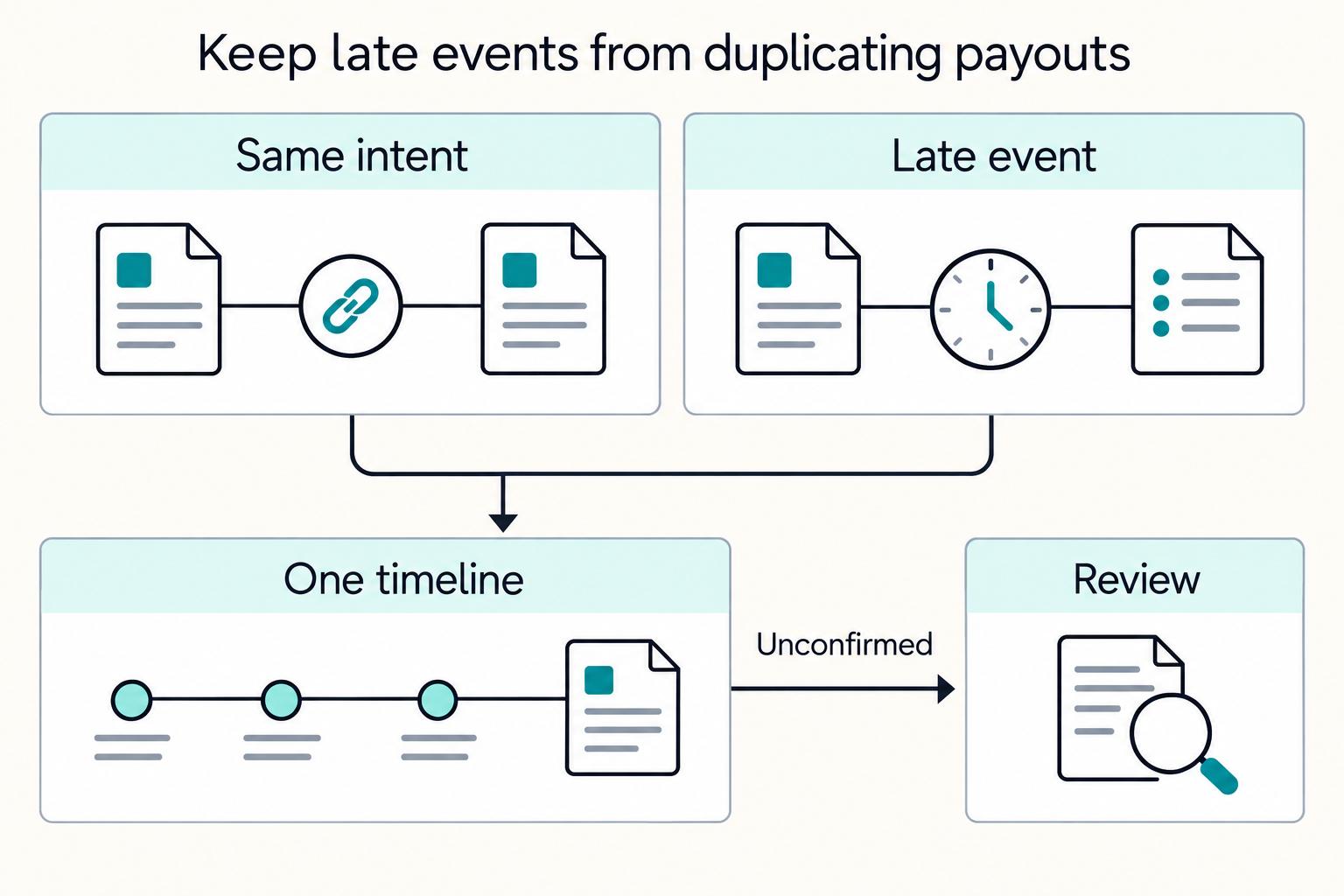
| Engineering | Payout execution is operationally safe under failure conditions | Define and test retry behavior, duplicate-event handling, and delayed-processing paths, and keep monitoring evidence |
| Product | Contractor UX makes payout choices, eligibility limits, and fallback paths unambiguous | Clearly distinguish eligibility outcomes from setup issues, and align disclosures and decision copy with compliance and operations rules |
Finance should sign off only when a payout path is traceable end to end and reconciliation evidence is easy to retrieve. If that trail fails for either successful or exception outcomes, launch is premature. Keep evidence for successful, blocked, and fallback outcomes so reconciliation is testable, not assumed.
Compliance should approve only with a documented, jurisdiction-specific decision on eligibility, AML controls, and tax-handling boundaries. "Supported in country" is not the same as approved for your program. Regulatory treatment is not uniform, including a harmonized MiCA approach in the EU and a fragmented model in the U.S. Your pack should also show how legal and prudential safeguards are addressed and how stablecoin standards on issuance, reserves, and redemption are handled for relevant counterparties. Because some policy reviews rely on secondary data, validate key assumptions with current primary sources before launch.
Engineering should sign off only when payout execution is operationally safe under failure conditions. Define and test retry behavior, duplicate-event handling, and delayed-processing paths explicitly so policy or rule changes do not force manual repair later. Keep monitoring evidence so controls can be rechecked as jurisdictions evolve.
Product should sign off only when contractor UX makes payout choices, eligibility limits, and fallback paths unambiguous. If a crypto method is unavailable, the experience should clearly distinguish eligibility outcomes from setup issues. Keep disclosures and decision copy aligned with compliance and operations rules so Support, Finance, and contractors all see the same truth.
Use this sign-off checklist to map your approval gates, retry policy, and reconciliation workflow against Gruv Payouts.
If you cannot answer these clearly, do not move from pilot to rollout.
Block launch if some contractors see USDC while others only see fiat and your teams cannot explain the rule in one consistent way. You need a documented eligibility matrix for the factors you actually use (for example country, contractor segment, and payout method), along with clear user-facing block messages and a named approval owner. Your Business-Wide Risk Assessment (BWRA) also needs to be updated for this specific stablecoin product, since a generic virtual-asset appendix is not enough.
Block launch if your case depends on "faster and cheaper" but you have not validated it against your own cross-border wires baseline by corridor. The pack includes directional benchmarks, with traditional payouts at 1 to 5 business days and $35 to $45 per transaction, and stablecoin transfers usually $1 to $3, but those are not proof for your program. Require your own before-and-after table across real routes: settlement time, provider fees, FX impact, support effort, and exception handling.
Block launch if wrong-network wallet details, delayed confirmations, or provider rejects do not produce clear statuses and next actions. You should be able to show what the contractor sees, what the ledger records, whether retry is allowed, and when fallback to fiat happens. Because fiat and stablecoin conversion points are identified as the highest-risk laundering moments, exception flows also need an auditable review path, including CDD escalation where your compliance policy requires it.
Block launch if your product says "crypto payouts" but your policy does not clearly define asset and network scope. Decide and document what is in scope, what is out of scope, and exactly how Support responds to requests for USDT, BTC, or ETH when you only support USDC. This ambiguity matters at scale: FATF describes rapid stablecoin growth, with more than 250 stablecoins and market capitalization above USD 300 billion by mid-2025. If you are USDC-only, state it plainly and keep responses consistent. If you are evaluating expansion, review USDC vs. USDT for platforms before changing scope.
For a step-by-step walkthrough, see How Platforms Should Design Loyalty Reward Payouts for Margin and Control.
Launch USDC payouts only where you can operate and evidence them end to end. Keep eligibility explicit, keep fiat active where coverage or legal treatment is unclear, and scale only after the controls hold up in practice.
Cross-border wires can still take 3-5 days, so stablecoin payouts may be worth evaluating. But keep rollout limited to cohorts you can support with a clear matrix by country, worker type, and payout method. Where both are supported, show a visible choice between USD (fiat) and USDC (stablecoin). If crypto is unavailable, route contractors to a normal fiat path with clear messaging.
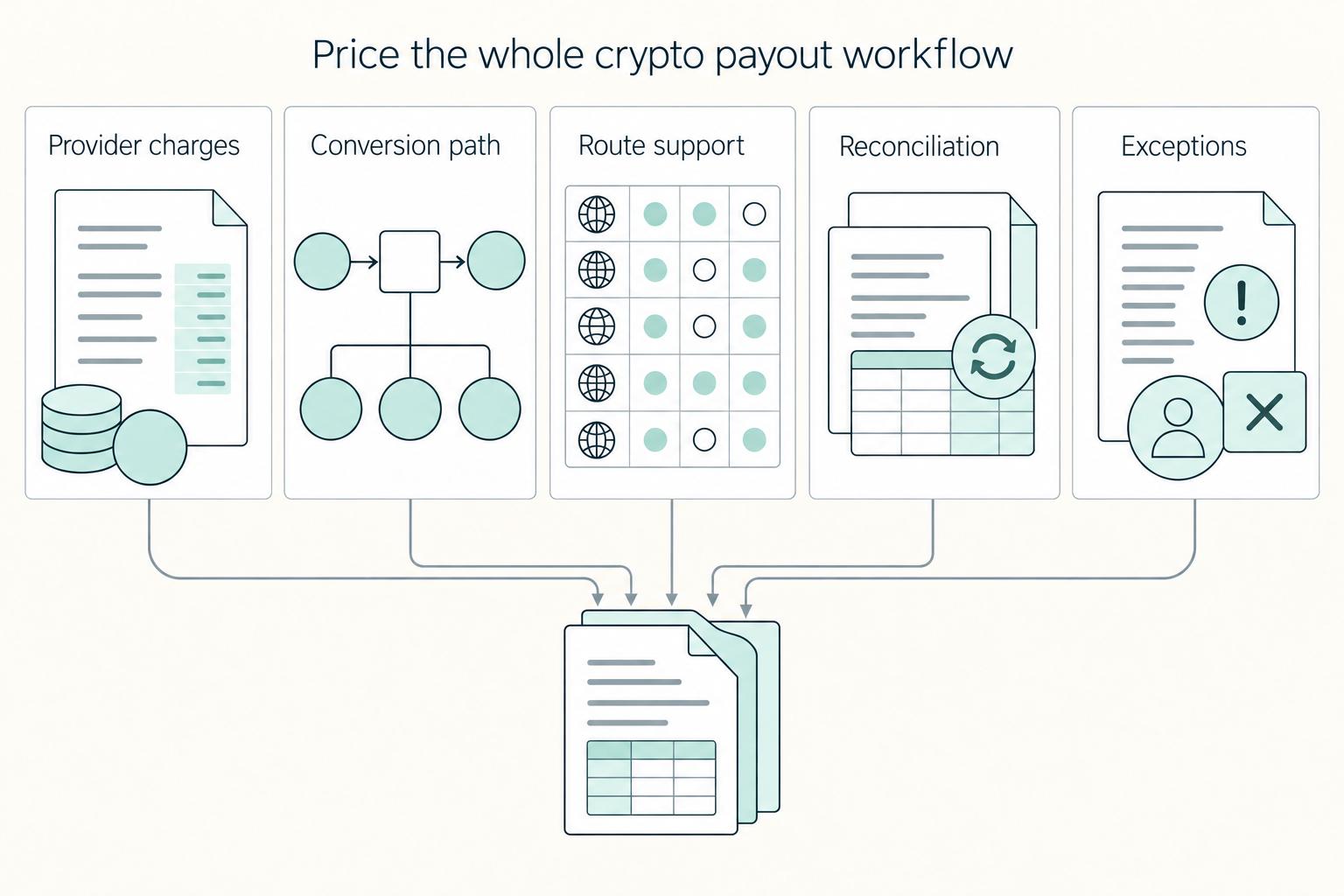
The hard part is not sending tokens. It is running compliance, conversion, reporting, and reconciliation as one auditable process. Treat launch readiness as the ability to reconcile payroll registers to payout execution, explain exceptions, and show each contractor's payout-method selection. Keep a complete record set for execution results and exceptions, or you do not have a production-ready process.
Run a limited pilot, verify outcomes, then expand only where operations stay controlled and legal treatment is clear enough for your program. Regulatory momentum exists, but detailed rules on eligible assets, operational standards, insolvency treatment, and securities-regulator coordination can still be unresolved in at least some jurisdictions. When that uncertainty appears, keep USDC optional and keep fiat rails live through a hybrid model.
Before expanding beyond your pilot, validate corridor and compliance assumptions for your program scope with Gruv so your rollout stays inside what you can actually support.
A USDC contractor payout is a form of crypto payroll: the contractor is paid in stablecoin to a wallet instead of by bank transfer. In Connect terms, a payout is when funds are sent to a bank account or debit card, so wallet-based payouts use a different destination and operating flow. This can change how you track events, reconcile outcomes, and handle support.
USDC can be offered as an additional payout rail rather than a blanket replacement for fiat. The provider’s stablecoin pricing describes a broader package than token transfer alone, including conversion to fiat, wallet and AML screening, fraud prevention, and gas sponsorship. That is why rollout decisions are often about operating model and coverage, not just transfer mechanics.
Eligibility is program-specific, not universal. Managed Payments states that select local payment methods are available to eligible sellers, which reflects provider-side filtering rather than automatic access for everyone. Define eligibility clearly by your own country, contractor segment, and payout-method rules before expanding availability.
No. You should not claim stablecoin payouts always settle in minutes or always cost less across every corridor. The provider also notes that costs are subject to change, so fee assumptions must be treated as variable over time.
You need clear ownership, eligibility controls, and auditable operations, not just API completion. Connect explicitly frames a control tradeoff: offload maintenance to the provider or take fuller ownership of payments. Your rollout should document who is eligible, how exceptions are handled, and how payout outcomes are reconciled.
Start with USDC-only when that is the only asset policy you can support consistently in operations and user messaging. Do not assume USDT support is equivalent just because both are stablecoins. If you later expand scope, treat it as a new policy and rollout decision. For comparison context, review USDC vs. USDT for platforms.
There is no universal fallback flow defined in this material for every unsupported case. Use supported payout methods where available, show clear block messaging when a crypto route is unavailable, and log the reason. Route exceptions through a defined review path instead of handling them ad hoc.
A former product manager at a major fintech company, Samuel has deep expertise in the global payments landscape. He analyzes financial tools and strategies to help freelancers maximize their earnings and minimize fees.
With a Ph.D. in Economics and over 15 years of experience in cross-border tax advisory, Alistair specializes in demystifying cross-border tax law for independent professionals. He focuses on risk mitigation and long-term financial planning.
Includes 1 external source outside the trusted-domain allowlist.
Educational content only. Not legal, tax, or financial advice.

**Step 1. Set the operating model before you talk about speed.** This guide is for platform operators shipping stablecoin contractor payouts in production, not for freelancers choosing a wallet. The core stance is simple: approve compensation in USD, use a stablecoin as the settlement rail, and treat controls as product requirements from day one. Stablecoins are built to behave like money, and businesses already use them for supplier payments, cross-border invoicing, and treasury movement. That makes stablecoin payouts worth a look, but only if your payout process is as disciplined as your fiat process.

Treat this as an operating decision first. If you are a platform team building contractor payroll, the early mistake is to frame USDC versus USDT as a recipient wallet preference. The real choice sits with Finance, Ops, Product, and Engineering.

For teams evaluating USDC payout options, the real decision is operational, not ideological. You are deciding whether to add USDC as a contractor or creator payout rail without disrupting finance controls, month-end reconciliation, support handling, or compliance review.