
Quick Answer
Choose the reward model your team can operate: cashback for a clear currency value, points when you can explain valuation and redemption, or hybrid for uneven category margins. Ledger-first infrastructure can support any of these. Before launch, document earn rules, funding, settlement timing, and exception ownership, then validate payment-state mapping, sample exports, and reversal handling.
Start With Margin, Control, and Reconciliation#
A customer loyalty program should not be approved on headline appeal alone. If you are choosing between cashback, points, account credit, discounts, or a hybrid model, the real question is simpler: does the payout design improve repeat behavior without quietly damaging unit economics or creating a reward liability your team cannot explain?
That matters because loyalty incentives are meant to bring customers back, but they also create real finance and operating consequences. In retail and consumer settings, promotional and loyalty programs need explicit accounting evaluation, and points-based structures can push part of revenue into deferred treatment based on the standalone selling price of those points. For teams reporting under IFRS 15, which has applied to annual reporting periods beginning on or after 1 January 2018, reward design is not just a growth decision. It can also affect how timing, value, and uncertainty are handled internally.
This guide is for the people who actually carry that risk: founders, revenue leaders, product teams, and finance operators. If you own AOV, CAC payback, retention, payout accuracy, or close quality, you need more than loyalty ideas. You need a way to choose a model that matches your margin tolerance, expected redemption behavior, and your ability to handle exceptions when payouts fail, reverse, or remain unresolved.
The practical recommendation up front is simple: treat reward payouts like a finance decision with product consequences, not a marketing add-on with a catchy earn rate. If your team cannot describe, on one page, how value is earned, when it can be redeemed, when it settles, and who owns exceptions, the design is not ready for launch.
Assume public vendor detail will be incomplete. Many vendor pages describe a rewards platform as an end-to-end tool for designing and managing loyalty across channels, but public materials do not always make fees, configurability, reporting depth, or reconciliation detail easy to compare. That is a procurement red flag, not a minor inconvenience. Before you get attached to a model, ask for concrete evidence such as payout status states, export samples, reversal handling, and how finance can trace accruals through settlement.
What follows is meant to help you make that choice with fewer blind spots. You will get clear selection criteria, side-by-side tradeoffs across the main payout models, and specific "best for" guidance tied to operating reality, including where platform detail is still unclear from current public coverage.
If rewards cross borders, How Payment Platforms Really Price FX Markup and Exchange Rate Spread breaks down where payout margin actually goes.
Who this list is for and the criteria that actually matter#
This list is for teams accountable for AOV, CAC payback, and payout reliability, not teams looking for generic engagement ideas without operational ownership.
Use this filter first: AOV is revenue divided by orders, and CAC payback is the time needed to recover customer acquisition spend. If your loyalty design cannot show a credible path to stronger order value, repeat behavior, or acquisition-cost recovery, it is adding complexity before value.
Best fit and poor fit#
Best fit: cross-functional teams where product, growth, and finance each own part of the outcome. Poor fit: teams treating rewards as a campaign concept instead of a commercial control point.
The five criteria worth using first#
| Criterion | What to confirm |
|---|---|
| Value clarity to users | Users can understand what they earned and what it is worth quickly |
| Redemption behavior control | You can control thresholds, expiry, restrictions, and whether those rules appear in operational exports |
| Reconciliation flows quality | Traceability from earn event to redemption to settlement, including failed and reversed payouts with timestamps |
| API maturity | Safe retry behavior (idempotency) and clear status handling before launch |
| Finance visibility into reward liability | Clear visibility into outstanding obligations, expected redemption patterns, and settlement timing |
- Value clarity to users
Users should be able to understand what they earned and what it is worth quickly. If test users or support tickets show confusion on earn or redeem rules, simplify before adding more reward types.
- Redemption behavior control
Reward economics depend on when and how users redeem, not just earn rate. Check whether you can control thresholds, expiry, restrictions, and whether those rules appear in operational exports.
- Reconciliation flows quality
Reconciliation is matching transaction records against accounting records and statements for accuracy. You need traceability from earn event to redemption to settlement, including failed and reversed payouts with timestamps.
- API maturity
API maturity is about how reliably integrations hold up in production conditions. Confirm safe retry behavior (idempotency) and clear status handling before launch to reduce duplicate financial actions.
- Finance visibility into reward liability
When loyalty options create a material right, they can be treated as separate performance obligations. Under IFRS 15 (effective for annual periods beginning on or after 1 January 2018) and similar US GAAP material-right analysis, finance needs clear visibility into outstanding obligations, expected redemption patterns, and settlement timing.
Require a short pre-launch decision memo that covers funding strategy, downside scenarios, and exception ownership. If you cannot explain earn timing, redemption rules, and settlement timing on one page to product and finance, the design is not ready.
Related: The Best Tools for Tracking Your Credit Card Points and Miles.
Compare three reward models and their payout infrastructure#
Compare cashback, points, and hybrid rewards on customer value and unit economics. Ledger-first infrastructure is a separate operating choice that can support any of them; assess it alongside the model rather than treating it as a fourth reward type.
A reward program needs records that connect each earned amount to its redemption and payout. Compare settlement timing, status clarity, reversals, and export depth before launch; a strong engagement report cannot resolve a missing payment.
| Reward model or operating approach | Best for | Key pros | Key cons | Failure mode | Known unknowns |
|---|---|---|---|---|---|
| Cashback | Fast launch and low user confusion | Clear, tangible value; usually simpler support handling; often faster rollout | Direct margin impact is visible; less flexibility for non-cash behavior shaping | Payout exceptions (failed/reversed) create manual cleanup and ticket volume | Fees by payout rail, minimum redemption controls, reversal/settlement reporting depth |
| Points-based rewards | Broader engagement across purchases and other actions | Flexible earn logic; strong engagement upside; tier/perk design room | Value can feel opaque; higher rule and support complexity | Users earn but cannot interpret value or eligibility, reducing trust | Point valuation controls, expiry configurability, liability reporting detail, API status coverage |
| Hybrid rewards model | Mixed-margin catalogs needing different reward mechanics | Lets you mix cashback, points, and credits by economics; can protect margin while keeping perceived value high | More policy complexity and edge cases | Rule drift across reward types creates inconsistent treatment and finance disputes | Cross-wallet reporting, rule precedence, category-level configurability, exception routing, pricing clarity |
| Ledger-first infrastructure for any reward model | Teams prioritizing auditability and API-driven payout operations | Strong traceability, better reconciliation posture, cleaner operational controls | Longer implementation runway; heavier finance/engineering coordination | Weak state handling across payout lifecycle leads to unresolved exceptions and manual intervention | Public pricing detail, implementation scope, reporting granularity, status taxonomy, cross-border settlement behavior |
How to read the tradeoffs#
Cashback has a visible currency value but directly consumes contribution margin. Points offer more earning and redemption options at the cost of additional rules. Hybrid combines those mechanics across categories. All three need reliable records and payouts; ledger-first infrastructure supplies those controls rather than replacing the reward choice.
What to verify before you shortlist#
Treat the "known unknowns" column as a procurement checklist. Ask for a quote based on your expected members, transactions, payout countries, and support needs, including implementation and usage charges.
Before scoring any option, require a sample export, a payout status map, and a written exception-handling flow. If fees, configurability, or reporting depth stay unclear, mark them as unresolved procurement risk.
Best for fast adoption and low confusion is a cashback-first design#
If speed, clarity, and low user education are the priority, start with cashback or account credit. It is usually the easiest model to explain because rewards come from one core action, buying, and the value feels immediate.
- Best for: quick uptake, simple messaging, and lower explanation burden.
- Main tradeoff: weaker long-horizon emotional pull and less differentiation when competitors already run similar discounts or rebates.
Why cashback gets understood quickly#
A cashback program is straightforward: each purchase returns money, or credit, to the customer. That tangible, immediate value is often easier to trust and act on than points models that require users to interpret broader earning rules.
Operationally, this also reduces confusion in support conversations because the reward unit is clearer. If you use account credit instead of standalone cash, say plainly that it reduces the balance owed.
Set the earn rate from your contribution margin and expected redemption cost. For an illustrative $100 order with $20 contribution before rewards, a fully paid $3 cashback reward leaves $17 before payout fees and program operating costs. Test whether additional repeat purchases cover those costs rather than treating redemption volume as incremental profit.
Where cashback is weaker#
Cashback is strong for instant gratification, but that can be weaker for long-horizon emotional loyalty, status, or premium positioning. In some segments, a plain cashback offer can cheapen the experience.
It is also easy to copy. Treat cashback as a practical first design, not an automatic long-term moat.
A practical launch pattern#
Launch cashback first on high-frequency transactions so users feel the reward loop quickly, then check cohort-level AOV and repeat purchase frequency before you expand earn categories.
Focus on two checks:
- Customer path clarity from purchase to posted reward to redemption, including whether payout is cash or account credit.
- Early cohort movement in repeat rate and AOV, not just sign-ups or redemption volume.
If redemption is healthy but repeat purchase frequency or AOV is flat, keep scope narrow and reassess reward type by category.
For a step-by-step walkthrough, see Involuntary vs Voluntary Churn on Platforms and How to Attack Each.
Best for retention depth and brand stickiness is a points-based design#
Use a points-based model when your goal is deeper repeat behavior and brand affinity, not just immediate uptake. It works best if your team can actively run gamification, status tiers, and aspirational rewards while keeping value easy to understand.
Why points can deepen loyalty#
Points give you room for progress mechanics, exclusive access, and non-cash benefits. Those options can support repeat behavior, but the points unit itself does not guarantee stronger loyalty than cashback. Compare cohorts on repeat purchases and contribution after reward costs.
Where trust breaks#
If value is hard to read, an attractive earn rate can turn into support work. Show the conversion value, eligibility, expiry rules, and redemption restrictions before customers commit. Test a purchase, a refund, and a redemption with users to find where the promise becomes unclear.
If support signals already show value confusion, pause new promotions and simplify the base rules before adding tiers. Keep conversion and redemption logic consistent across product copy, CRM, and support workflows, and treat simplification as a corrective move when loyalty is being misrecognized, not as a cosmetic rewrite.
If manual review, reconciliation, or exception handling is driving cost, Business Process Automation for Platforms: How to Identify and Eliminate the 5 Most Expensive Manual Tasks goes deeper on where to automate first.
Best for mixed catalog economics is a hybrid rewards model#
A hybrid model is usually the strongest fit when your catalog has uneven margins, because it lets you protect unit economics in some categories while keeping perceived value high in others. Use cashback or account credit where buyers are highly price-sensitive, and use points or status-style perks where you want to shape repeat behavior beyond a single transaction.
This pattern is already operationally credible in live programs: category-aware earn logic and multiple redemption paths, including cash back and non-cash options, are used at scale. Treat this as a design rule, not a universal law. If one rule is forced across every category, you usually end up with either overpaid rewards in thin-margin areas or weak perceived value in strategic ones.
Hybrid only works if rule logic is explicit and auditable. Keep one category eligibility matrix tied to customer, order, and metadata rules, and make sure your customer-facing policy matches live enforcement to avoid disputes.
The accounting and audit burden is real#
Document the accounting treatment of each reward before launch. A customer option that provides a material right can be a separate performance obligation under IFRS 15 or ASC 606; not every promotional reward qualifies. Evaluate cash payments to customers separately, including whether they reduce the transaction price or pay for a distinct good or service. Do not infer treatment from the reward name alone.
The common failure mode is policy drift across product, marketing, support, and finance. Exportable transaction trails, for example CSV-level loyalty or point-movement exports, are critical for reconciliation and for explaining margin impact and reward liability over time.
Governance that keeps hybrid usable#
Hybrid stays manageable only when ownership and approvals are explicit, with segregation of duties across rule setup, approvals, and review.
| Control area | Rule owner | Finance approver | Monthly review cadence and focus |
|---|---|---|---|
| Earn rules by category | Product or loyalty owner | Finance lead | Monthly: category margin impact, exception count, reversal volume |
| Redemption rules and catalog | Product or CRM owner | Finance lead | Monthly: reward liability, redemption mix, breakage assumptions |
| Policy changes and promotions | Cross-functional owner with support visibility | Finance lead or controller | Monthly: audit trail completeness, customer-facing rule accuracy, effective-date control |
Before launch, require an evidence pack: category eligibility matrix, earn and reversal logic, redemption rules, accounting treatment memo, and a transaction-export test. Without that baseline, hybrid can still drive engagement but becomes hard to explain and control as exceptions accumulate.
Best for global scale and auditability is ledger-first payout infrastructure#
Ledger-first payout infrastructure is usually the clearest fit when you need cross-border reward payouts, strong auditability, and reconciliation you can run at close without rebuilding history. The core design choice is simple: your ledger is the system of record, and provider events update that record rather than replacing it.
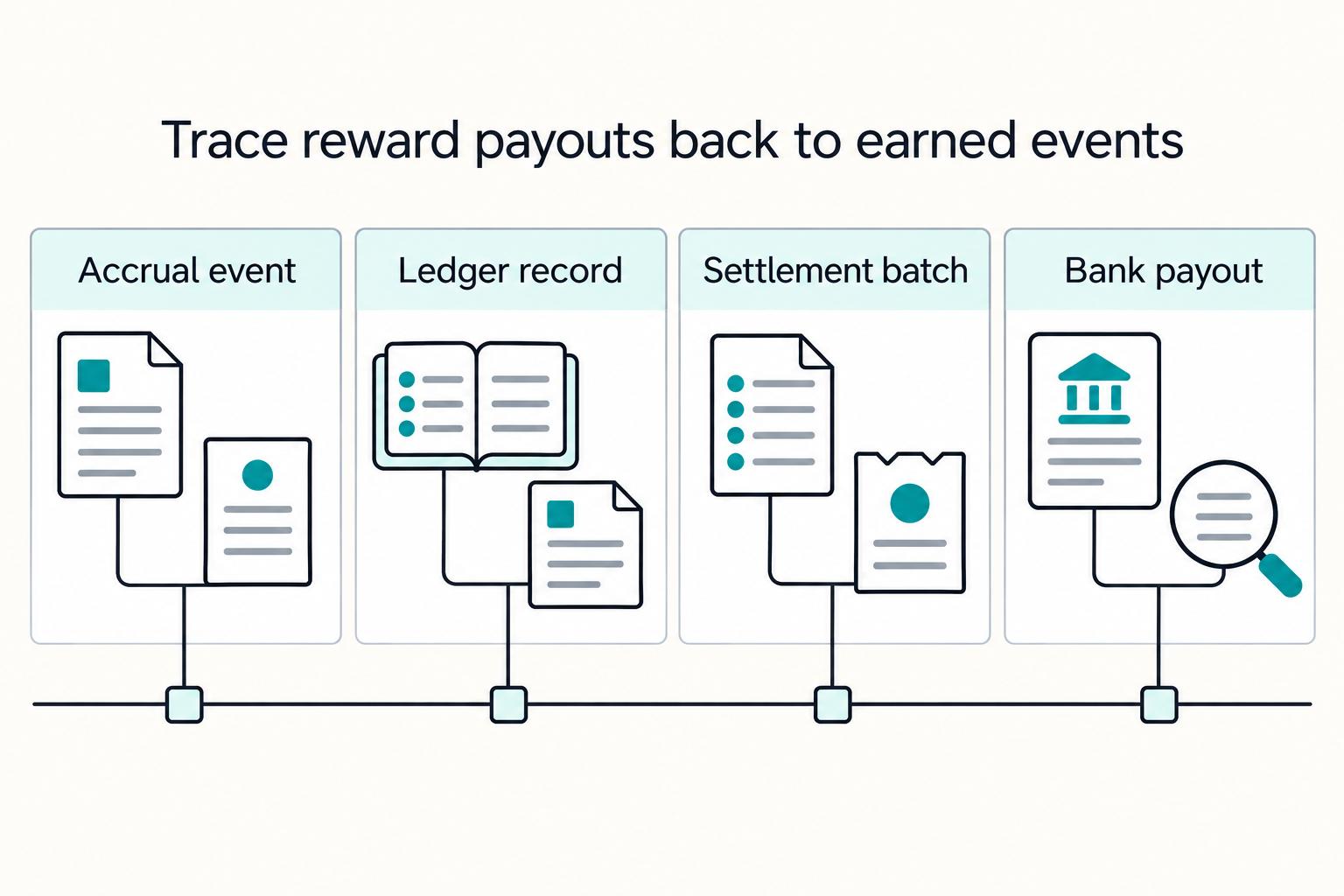
This infrastructure supports whichever reward model you choose. Maintain a traceable ledger of earning, redemption, payout attempts, and reversals, then reconcile provider records with bank evidence. Stripe’s payout reconciliation report is one provider example for matching automatic payout batches with their underlying transactions; it is not a universal report for every reward-recipient payment.
The tradeoff is coordination: product, finance, ops, and engineering need aligned ownership for event timing, state mapping, and exception handling before you scale.
Order of operations to document before launch#
| Step | What to document |
|---|---|
| Accrual event | Define the exact trigger and required transaction fields |
| Ledger posting | Create one traceable ledger entry per earned event, with linked reversals |
| Eligibility checks | Apply program and policy rules before release |
| Payout trigger | Define what moves balance into a payout attempt |
| Provider status updates | Map lifecycle states such as paid, failed, canceled into internal states |
| Exception queue | Route failed or mismatched payouts to a named owner |
| Reconciliation close | Match bank payouts back to settlement batches and ledger records |
What to verify before expanding volume#
Test duplicate events, retries, and a timeout after a provider accepts a payment. Use one durable operation identity, commit local deduplication with the balance change, and follow the remote endpoint’s idempotency scope and retention rules. Resolve an unknown remote outcome before creating a new attempt. Then trace bank evidence back through the provider payment, ledger postings, and source accrual events.
A practical launch evidence pack is: event-to-ledger mapping, retry policy, status mapping, sample payout export, exception ownership, and finance's reconciliation sign-off rule.
Implementation checklist before procurement and launch#
Before procurement, make the evidence harder than the demo: if finance, ops, and product cannot review one written model for how rewards are earned, funded, accounted for, and reconciled, you are not ready to choose a vendor.
| Step | Requirement | Key details |
|---|---|---|
| Build the minimum evidence pack | Put five items in one memo | Reward rules; payout funding strategy; liability treatment; failure-mode handling; reconciliation sign-off criteria |
| Use a weighted scorecard, then check cost | Validate technical viability before cost | Ask for sample data outputs, payout lifecycle fields, and one failure-case walkthrough |
| Set go/no-go gates before the pilot starts | Define the pilot start date, end date, and measurable success targets in advance | Use a minimum 30-day window, one behavior metric such as AOV or retention, and one operations gate with no unresolved payout reconciliation breaks |
| Log unknowns in writing | Keep a red-column list for unresolved items | Especially pricing model transparency and comparative feature matrix depth |
- Build the minimum evidence pack
Put five items in one memo: reward rules, payout funding strategy, liability treatment, failure-mode handling, and reconciliation sign-off criteria. Include finance's judgment on whether the reward option could create a material right under ASC 606, since that can create a separate performance obligation. Your traceability check is simple: can an earn event be followed through to a bank reconciliation report, or equivalent close export, without ad hoc vendor screenshots?
- Use a weighted scorecard, then check cost
Score controls, reporting, integration depth, support for hybrid logic, and finance-grade export quality with explicit weights. In line with formal RFP practice, validate technical viability before cost so low pricing does not override weak payout-state visibility or missing exports. Ask for sample data outputs, payout lifecycle fields, and one failure-case walkthrough, not just a feature demo.
- Set go/no-go gates before the pilot starts
Define the pilot start date, end date, and measurable success targets in advance. A minimum 30-day window is a practical baseline, with one behavior metric, such as AOV or retention, and one operations gate, no unresolved payout reconciliation breaks during the pilot. If failed or canceled payouts cannot be traced and closed cleanly, pause expansion.
- Log unknowns in writing
Keep a red-column list for unresolved items, especially pricing model transparency and comparative feature matrix depth. Marketplace rankings can be influenced by sponsorship, so treat them as inputs, not final truth. If pricing is opaque or export detail is thin, lower confidence explicitly instead of filling gaps with assumptions.
Related reading: Mass Payouts for Gig Platforms That Teams Can Actually Operate.
Conclusion and next step#
Choose a model your team can explain to customers and reconcile at close. A higher repeat-purchase rate is useful only when incremental contribution covers rewards and operating costs, outstanding obligations are understood, and payout exceptions have owners.
- Pick cashback first when speed and clarity matter most
If your priority is fast adoption, low education burden, and a cleaner first launch, start with cashback or account credit. The practical differentiator is immediacy: customers can see the value without learning a conversion rule, which can reduce the chance that support, product, and finance all explain the reward differently. Your checkpoint before wider rollout is straightforward: test a few common transactions and confirm everyone describes the same earn outcome, timing, and redemption result. A known failure mode is mistaking early uptake for program quality while exception handling and liability tracking are still loose underneath.
- Use points or hybrid when you need behavior shaping and can govern it tightly
Choose points-based rewards or a hybrid rewards model when you need more than a simple giveback on spend. The differentiator is flexibility: you can push customers toward higher-value actions, strategic categories, or non-cash perks, but only if your rules remain consistent enough that the reward still feels real. This is where teams often overreach. BCG's warning that "offering points and cash back isn't enough" is useful because it cuts both ways: richer value design can help retention, but more moving parts also create more room for policy drift, unclear redemption value, and finance questions you cannot answer cleanly. If you cannot explain the logic in plain English to internal stakeholders, keep the design simpler.
- Prove the model in a pilot before full rollout
The next step is not a full launch. Run a controlled pilot with a smaller user group. Pilot-led rollout and soft launch approaches are documented ways to reduce risk before scaling, and you should define success up front instead of reverse-engineering it later. For this decision, track a small set of metrics across business impact, finance control, and operational reliability. Good choices include repeat purchase rate or AOV for impact, reward liability trend for finance, and payout exception rate for reliability. The red flag is clear: if engagement improves but payout issues remain unresolved or finance cannot explain the liability movement, pause expansion and fix that operating gap first.
Frequently Asked Questions
Cashback vs points, which should we launch first?
Start with cashback when clarity and speed matter most. It is often easier for users to understand because the value is immediate and tangible, which can reduce education burden. Choose points first only if you can keep value communication consistent over time and you have the product and ops capacity to manage tiers, exceptions, and ongoing messaging.
When should we combine cashback and points?
Consider combining them when your margin profile is uneven across categories and one reward type could overpay low-margin activity or undersell high-value behavior. A hybrid model is most workable when category rules are clear up front and remain auditable. If finance cannot explain why one category earns account credit while another earns points in a single memo, the mix is likely too complex for launch.
How do reward payouts affect margins?
Margin impact comes from the earn rate, redemption mix, and payout and operating costs. A points option that provides a material right can be a separate performance obligation under ASC 606: allocate the transaction price using relative standalone selling prices and recognize the allocated revenue as the obligation is satisfied. Finance must assess expected redemption and applicable breakage rules; expiry alone is not a universal recognition trigger. Revisit program economics when actual behavior differs from the assumptions.
How do we stop points from feeling like fake money?
Publish a simple conversion logic and stick to it. Trust drops when rewards are revoked, canceled, or blocked by buried or vague conditions, and a known failure mode is points being deducted without the user receiving the benefit. Pick three common redemption scenarios and verify that support, product, and legal describe the value and rules the same way.
What should we require from a rewards platform before signing?
Require API access, auditable payout states, and exports that link each earned or redeemed reward to its payout attempt and outcome. For batched payments, require batch-to-line mapping; for individual transfers, require the provider reference and bank evidence. Ask for a sample export and a real failed or reversed payment walkthrough before signing.
Which metrics should trigger a model change?
Look for a pattern, not a single bad week: worsening CAC payback period, negative margin impact, more support tickets about redemption confusion, and liability growth. CAC payback is the time it takes to recover what you spent to acquire a customer, so sustained deterioration is a real economic warning sign. Do not switch models on ticket volume alone. Confirm the problem in redemption data, liability trend, and reconciliation exceptions first.
Try a related tool
Researched and edited by the Gruv editorial team. Gruv builds cross-border billing, payouts, and finance-operations software for global businesses.
Sources
Includes 1 external source outside the trusted-domain allowlist.
- consumerfinance.gov/compliance/circulars/consumer-financial-prot...trusted
- consumerfinance.gov/about-us/newsroom/cfpb-takes-action-on-bait-...trusted
- docs.stripe.com/api/idempotent_requeststrusted
- docs.stripe.com/reports/payout-reconciliationtrusted
- occ.gov/publications-and-resources/publications/comp...trusted
- pa.gov/agencies/dgs/procurement-resources/rfp-scori...trusted
- stripe.com/resources/more/payment-reconciliation-101trusted
- antavo.com/blog/cashback-reward-programexternal
Educational content only. Not legal, tax, or financial advice.
Related Posts
How to Maximize Credit Card Rewards for Free Travel
**Build a simple rewards system that protects your ability to get paid first, then use it to maximize credit card rewards without adding risk or busywork.** You've moved past the hype cycle of "travel hacking." Run this like an operator: fewer cards, clearer rules, and decisions you can defend in your books. If you run a business-of-one, you're the CEO, and your rewards setup should protect cashflow before it chases points.
The Best Tools for Tracking Your Credit Card Points and Miles
**Pick a stack based on your failure mode (choosing the wrong card vs losing visibility), then run a simple recurring check so you can keep rewards visible without turning them into admin work.** If you're a business of one, rewards only matter if the system runs without stealing focus from client work.
The Best Community Platforms for SaaS Businesses
Start by classifying the job. If you want access to other people's audience, ideas, or conversations, you are choosing a community to join. If you want a place your customers or members use under your brand, with your rules and structure, you are choosing software you will need to operate every week.