
Quick Answer
Use a controlled invoice-led payout flow: agree on compensation and USDC settlement terms, verify recipient and chain/asset destination, clear required controls, execute safely and retain close evidence. Confirm actual provider eligibility and resolve unknown original outcomes before any replacement.
Stablecoin payouts can reduce friction but only with tighter controls#
Step 1. Set the operating model before speed. This guide uses a USD-approved invoice settled in USDC as its example. Agree on compensation currency and settlement terms with the contractor; USD is an example choice and can be a requirement of a selected provider program, not a universal accounting rule. Define approvals, recipient eligibility, destination control and close evidence before execution.
Step 2. Preserve the agreed commercial amount. Keep the invoice’s currency and approved amount authoritative in AP. For the USD/USDC example, record the accepted settlement terms, resulting USDC amount, fees and any conversion difference separately. Do not assume USDC settlement eliminates depeg, provider or off-ramp risks.
Your first checkpoint is whether you can show those three records together without stitching them back together in spreadsheets. If you cannot, you do not have a stablecoin program yet. You have a settlement experiment.
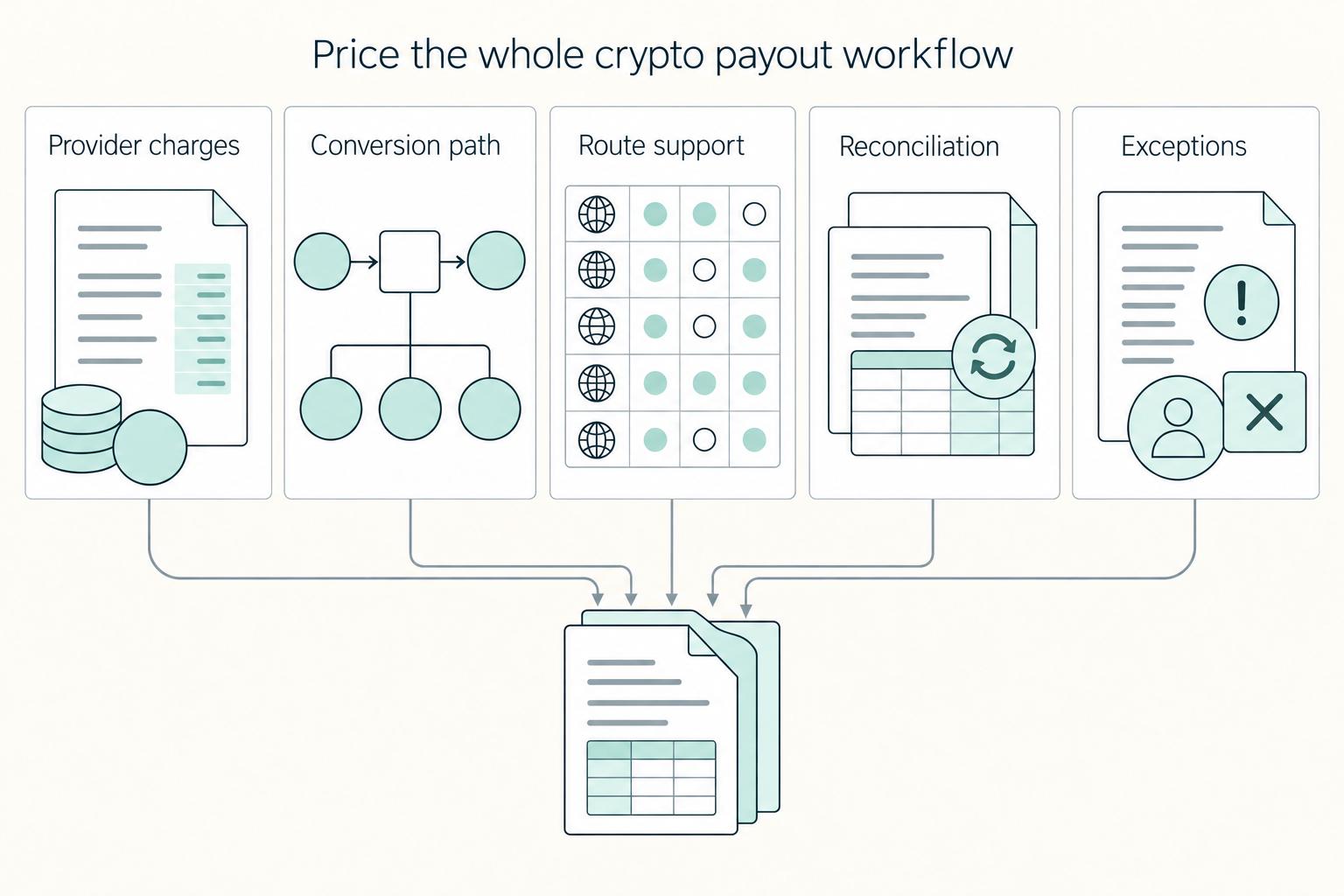
Compare end-to-end time and cost in the actual corridor. Blockchain confirmation can be fast, while eligibility checks, provider release, network congestion and conversion or off-ramp steps add delays and fees. Preserve approvals and close evidence throughout rather than treating onchain submission as completed contractor receipt.
Step 3. Define scope around eligibility, compliance gates, operations, and evidence. Many discussions spend more time on wallet setup and less on who is eligible, what blocks a payout, who reviews exceptions, and what finance keeps on file. For production use, scope should cover four boundaries. First, eligibility: which contractor segments, countries, and payout scenarios you will support. Second, compliance gates: the checks that must clear before a payout can be released. Third, payout operations: who owns release, retries, and contractor communication when something fails. Fourth, reconciliation evidence: the approval record, destination verification proof, transfer reference, and close package finance can retrieve later.
A practical recommendation: if you cannot verify a destination change, capture the transfer confirmation, and tie both back to the approved USD invoice, delay launch. Stablecoins have moved past early experimentation, but a payment rail only stays predictable when your internal controls are tighter than the rail is fast. For a broader overview, see Crypto Payouts for Contractors: How Platforms Can Offer USDC and Stablecoin Payments.
Decide if USDC payouts fit your platform right now#
Use a go/no-go screen based on your own payout history, not momentum. USDC is most useful when it fixes a repeat problem you already see in operations.
Step 1. Confirm a real payout pain point. Review measured bank delays, rejections and contractor preferences by corridor. Keep fiat as the default where it works, and offer USDC where verified eligibility, settlement terms and contractor acceptance justify it.
Step 2. Require control readiness before rollout. Delay launch if you cannot enforce wallet address verification and maintain audit logs in both product and AP workflows. At minimum, keep a traceable record of the approved USD amount, verified destination wallet, approval/change history, and final transfer reference tied to that payment.
Step 3. Set asset policy early. Treat supported stablecoins as an explicit business decision and define scope before engineering work starts. Start with USDC for contractor disbursements, and evaluate any additional stablecoin support as a separate rollout with its own support and exception plan.
For the USDC-specific settlement model, see USDC Payouts for Platforms: How to Offer Stablecoin Settlement to Contractors.
What to prepare before you touch an API#
Before you build, lock ownership, policy, and recordkeeping so payouts can be approved, released, and reconciled without guesswork.
| Area | What to define | Evidence to keep |
|---|---|---|
| Document prerequisites | One pre-build checklist for each corridor and payout path; written confirmation for any open dependency before launch | Keep the confirmation attached to the launch ticket so Finance, Ops, and Engineering use the same source of truth |
| Assign owners | Define who owns invoice approval, destination verification, payout release, exception approval, and failure handling | For any payout, show who approved it, who changed or confirmed destination details, and where the evidence is stored |
| Lock policy and evidence standards | Put sanctions and AML escalation handling in policy form and define retention expectations for supporting records | Retain screening decisions, destination approval and release evidence under the applicable program and legal retention policy. |
| Standardize accounting evidence | Define a reconciliation pack format in advance | Keep the approved invoice, destination verification evidence, payout instruction, transfer reference, and audit-log extract tied to invoice ID |
- Document prerequisites as verified inputs, not assumptions.
Build one pre-build checklist for each corridor and payout path, and require written confirmation for any open dependency before launch. Keep that confirmation attached to the launch ticket so Finance, Ops, and Engineering are using the same source of truth.
- Assign owners across the full invoice-to-payout flow.
Define who owns invoice approval, destination verification, payout release, exception approval, and failure handling. Your control test is simple: for any payout, you can show who approved it, who changed or confirmed destination details, and where the evidence is stored.
- Lock policy and evidence standards before rollout.
Put sanctions and applicable AML escalation handling into policy, with owners and retention periods determined for the entity and jurisdiction. Preserve the decision used at release. Stablecoin settlement does not establish which reporting or licensing duties apply to your structure.
- Standardize accounting evidence so month-end closes cleanly.
Keep the approved invoice, agreed settlement amount, destination verification, payout instruction, network/asset details, transfer reference and status history tied to one invoice and payout intent. Reconcile provider fees and any conversion difference separately from contractor compensation.
Choose provider and rail design with clear tradeoffs#
Pick your provider only after you separate fee ownership from capability proof. If a provider cannot prove the evidence trail, routing behavior, and failure handling you need, keep it out of your launch path.
Build a provider matrix with evidence#
Evaluate the provider’s current program, not just its brand. Stripe’s stablecoin Connect payout documentation describes a private preview for U.S.-based platforms, with USDC and eligible individual or sole-proprietor recipients in supported countries. Access and recipient constraints must be confirmed before including it in a launch route. Other providers require their own evidence review.
Track these fields per provider:
- Pricing model and who pays fees
- Country and program coverage
- Actual provider/program dependency
- Payout status visibility
- Webhook depth
- Reconciliation exports
- Invoice-to-transfer traceability
- Wallet and chain support
- Unsupported-destination handling
For every non-price field, require one of: provider docs, a dated provider confirmation, or a sandbox result. If none exists, mark it unverified.
Model the current quote for the actual payout program, not an unrelated card-processing fee schedule.
| Cost component | Evidence to request | Reconciliation treatment |
|---|---|---|
| Provider payout fee | Dated fee schedule for the selected program and corridor | Record who pays and whether deducted from the transfer |
| Asset conversion and spread | Rate, quote status, expiry and accepted conversion terms | Reconcile approved fiat amount to USDC amount and differences |
| Network fees | Chain-specific fee responsibility and funding requirements | Record the fee asset, payer and transfer reference |
| Recipient off-ramp | Supported withdrawal route, charges and eligibility | Compare final net receipt and time with the fiat alternative |
Require proof of auditability before you decide#
Use one hard decision rule: if you need strict AP evidence and controllable payout approvals, prioritize providers that can prove invoice IDs map to transfer confirmations and audit logs in real workflows.
Ask each provider to walk one successful payout and one failed payout end to end. Your packet should include invoice reference, approval record, payout instruction, transfer reference, status history, and the export or log finance will use at close.
Test wallet and network behavior as controls#
Treat wallet and network handling as a control test, not a feature claim. Validate what happens when a contractor submits:
- A wallet on the wrong network
- A destination change after approval
- An unsupported destination
Verify the selected chain, token contract and destination acceptance through the actual provider flow. Address syntax alone cannot establish the intended EVM chain or that a recipient controls the address. Require explicit network selection and contractor confirmation, and block unsupported combinations before submission.
Revalidate supported countries, recipient types, networks and the actual fee quote before launch and expansion. Keep a dated provider confirmation and test evidence with the program scope.
Design the invoice to payout sequence end to end#
Once you choose a provider with a usable evidence trail, fix the sequence and keep it consistent: AP invoice approval, recipient verification, payout instruction, blockchain confirmation capture, then reconciliation close.
| Checkpoint | Required evidence | Rule |
|---|---|---|
| Approve agreed compensation first | Invoice currency and approved amount, agreed USDC settlement terms, approver and payee ID | Approve before execution; this guide’s example uses USD, while actual provider requirements can differ |
| Verify the recipient before release | Confirmed destination tied to the correct contractor and visible in logs before release | Block release when the invoice is not fully approved in AP, sanctions screening is pending failed or stale, or destination verification is missing mismatched or recently changed |
| Capture transfer proof and close the package | Approval record; destination verification proof; sanctions state at release; payout instruction ID; transfer reference; confirmation status history; final ledger or audit-log export | Close only when the evidence package is complete and traceable end to end |
Approve the invoice in USD first#
In this example, approve the invoice in USD before execution. Preserve the approved amount and agreed USDC settlement terms, including fee ownership and any conversion adjustment, before releasing funds.
AP remains the record of approved compensation, invoice and payee. Provider release, blockchain confirmation and recipient off-ramp are separate stages with different timing. Define the completion evidence and contractor-facing status for the selected route.
Minimum evidence at this checkpoint:
- invoice ID and approved USD amount
- approval record with approver and timestamp
- payee identifier reused in payout and ledger exports
Verify the recipient before release#
Verify the destination and enforce a hard release gate before payout creation. The destination should be confirmed, tied to the correct contractor, and visible in your logs before release.
Block release when any required state is incomplete:
- invoice is not fully approved in AP
- sanctions screening state is pending, failed, or stale
- destination verification is missing, mismatched, or recently changed
If any state is red, route to manual review instead of bypassing controls.
Capture transfer proof and close the package#
At payout, convert from the approved USD amount at your controlled payout point, then record the resulting USDC amount and transfer reference. Close only when the evidence package is complete and traceable end to end.
Include:
- approval record
- destination verification proof
- sanctions state at release
- payout instruction ID
- transfer reference
- confirmation status history
- final ledger or audit-log export
The close criterion is not only that funds moved, but that you can reconstruct the workflow later and show it was auditable, resumable, and correct under failure.
Build compliance and destination controls that actually hold#
After you lock the invoice-led flow, destination control is the failure point to protect first. Treat wallet destinations like bank details, and make compliance checks a hard release gate, not a background task. If either control is bypassed because USDC settles fast, you increase the chance of paying an unverified, changed, or blocked destination.
| Control area | What to enforce | What to store or do |
|---|---|---|
| Put wallet changes behind change control | Require formal change control before a wallet destination can be used for payout | Verify the destination and track the contractor, wallet address, selected network, approval event, who approved it, and timestamp in audit logs |
| Screen identity and sanctions before payout creation | Apply required identity, sanctions and AML controls for the entity, jurisdiction and selected program before release | Retry a failed screening call only under safe service semantics; escalate matches. Release only after documented authorized clearance. Confirmed sanctions holds remain blocked unless applicable legal authorization permits the action. |
| Freeze stale or unresolved cases | If identity or sanctions status is stale, freeze payout creation and route to manual review | Store the screening result used at release, timestamp, reviewer if escalated, and final disposition |
Put wallet changes behind change control#
Require formal change control before a wallet destination can be used for payout. At minimum, verify the destination, track who approved it and when, and keep that record in your audit logs. If a destination changes after invoice approval, force a fresh review before payout creation.
Your control check is not just whether an address exists. You need a traceable record tying the contractor, wallet address, selected network, approval event, and timestamp so reconciliation can reconstruct the decision path later.
Screen identity and sanctions before payout creation#
Apply the required identity, sanctions and AML controls for the entity, jurisdiction and provider program. OFAC obligations attach according to their legal scope; BSA/FinCEN duties depend on the activity and entity. FATF guidance informs national regimes and is not itself a universal direct obligation on every platform. Keep unresolved required checks held for authorized review.
Make exception handling explicit in product and ops policy:
- retry only when the screening call failed or timed out
- escalate when a match or possible match is returned
- block release until documented authorized clearance; closing a review does not clear a confirmed sanctions hold
No payout instruction should be created while identity or sanctions status is pending, stale, or unresolved.
Freeze stale or unresolved cases#
If identity or sanctions status is stale, freeze payout creation and route to manual review. Enforce this in code and policy so it cannot be bypassed under queue pressure.
Record the actual required screening result, timestamp, policy version, reviewer and disposition used at release. Determine applicable sanctions and AML obligations for your structure rather than treating a generic provider feature as compliance clearance.
For contractor-facing payout design, see Invisible Payouts: How to Remove Payment Friction for Contractors Without Sacrificing Compliance.
Implement payout states webhooks and idempotent retries#
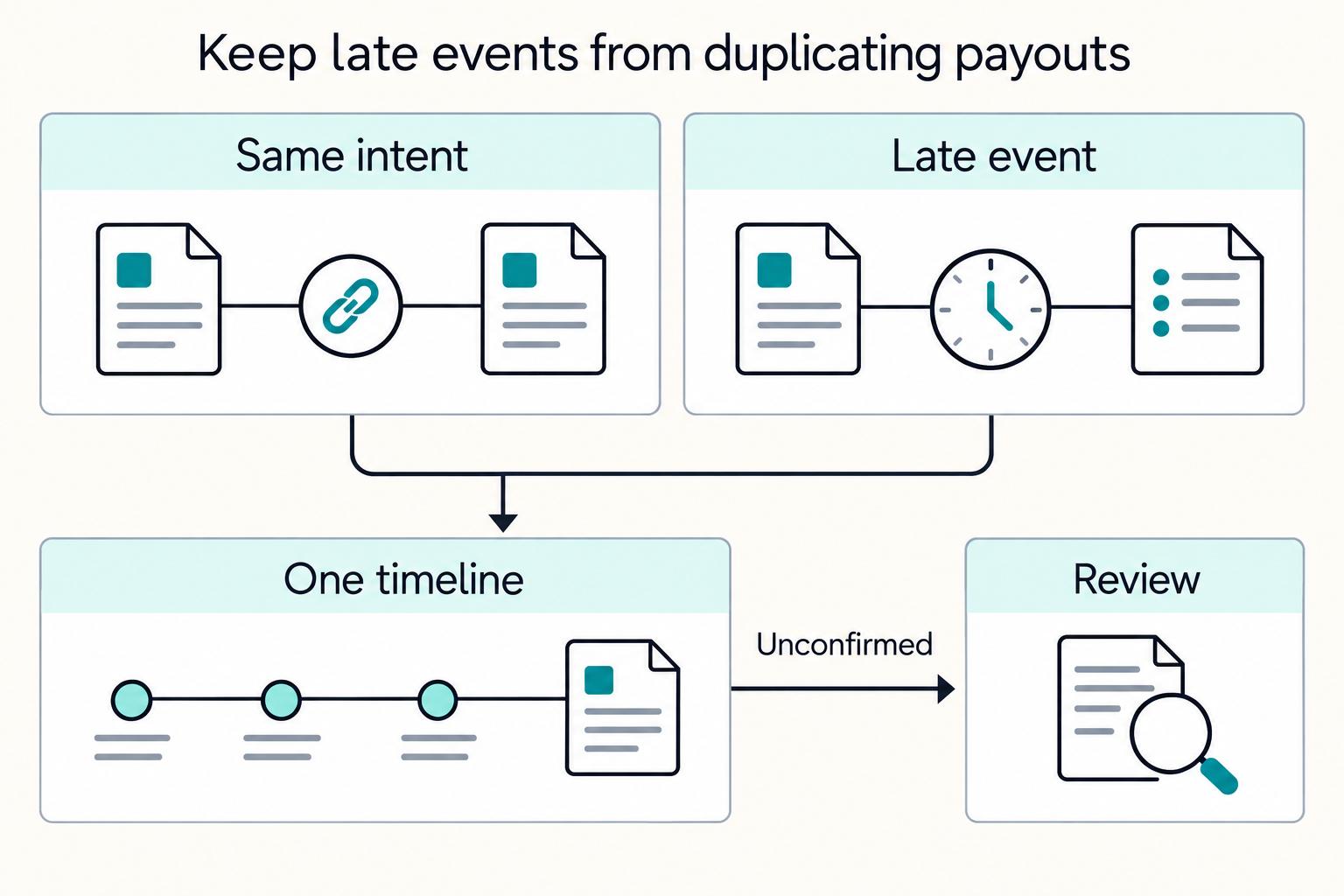
After compliance gates, reliability comes down to state control. Use one payout state model, enforce idempotent retries, and keep one traceable timeline so late webhooks or replayed jobs do not create duplicate sends or reconciliation gaps.
Define one canonical payout state model#
Define one internal state model and map every provider event into it. The labels can vary, but the model must be consistent across product, ops, finance, and engineering.
| Internal state | User-visible status | Operator meaning |
|---|---|---|
| requested | Processing | Payout request exists but is not ready to execute |
| queued | Scheduled | Approved and waiting for release or submission |
| sent | Sent | Instruction released; final settlement not yet confirmed |
| confirmed | Paid | Settlement confirmed and ready to close |
| failed | Action needed | Confirmed unsuccessful execution; unknown outcomes remain held for investigation |
| returned | Returned | A separately evidenced return or offset linked to the original transfer; not an assumption that an onchain transfer can be canceled |
Retain late events and apply valid provider transitions using their financial meaning. Ignore a stale processing event after confirmed settlement, but do not discard a genuine later return or correction merely to keep status monotonic. Preserve current state, original responses, timestamps and linked return records.
Use idempotency keys for business intent#
Keep one durable internal payout intent and record each provider attempt. Use the selected endpoint’s documented idempotency key for supported retries within its scope and retention; deduplicate webhook event IDs separately. A provider request key does not establish duplicate protection across chains or providers.
Resolve the original attempt before changing amount, destination, chain or provider. An approved correction may need a new request key, but that key does not prevent the original from completing. Hold uncertain outcomes for status lookup or reconciliation and link any authorized replacement to the original intent.
Reconcile async events into one timeline#
Do not keep disconnected logs. Reconcile provider webhook references, internal transaction IDs, and AP invoice IDs into one timeline so finance can trace approval through settlement.
Before launch, verify three checkpoints:
- stale-event detection that records late events without state rollback
- replay handling tests for duplicate webhooks and repeated client retries
- fail-safe handling for missing confirmations so
sentpayouts go to review instead of blind auto-retry
For the fiat comparison, see Local Currency Payouts vs USD Payouts for Contractor Platforms.
Handle failures and exceptions without finance fire drills#
Handle exceptions as routed operational work, not generic payout failures. Most breakdowns here are operational, not technical, so your job is to classify fast, assign a clear owner, and keep finance and contractor comms tied to one audit trail while the payout stays blocked.
Classify the failure before retrying#
Classify first, then decide recovery. Keep these exception types separate: unsupported country at disbursement time, invalid wallet format, network mismatch (Base, Aptos, Polygon), and sanctions hold.
For each failed or held payout, keep one record with AP invoice ID, contractor ID, selected network, wallet version, provider reference, screening state, failure code, and current owner. Do not mask root cause with ad hoc retries after destination edits.
Assign recovery by owner#
Use fixed ownership boundaries so issues do not bounce between teams.
| Exception type | Primary owner | Recovery path |
|---|---|---|
| Webhook/state conflicts, missing or duplicate confirmations | Engineering | Resolve state and event consistency, then return to normal payout flow |
| Destination errors (invalid wallet, network mismatch, ownership mismatch) | Payments Ops | Resolve the original outcome first, then correct and reapprove destination data; release only after safe replacement is established |
| Unsupported country at send time | Payments Ops, then Finance/AP if needed | Confirm corridor eligibility; if method must change, route to Finance/AP approval |
| Invoice or approval gap | Finance/AP | Resolve business approval before payout execution resumes |
| Sanctions hold | Compliance path (with Ops coordination) | Freeze payout and escalate; do not "test" by editing destination |
Standardize contractor messaging and pause bad routes#
Use exception-specific, time-bounded contractor updates mapped to the same audit record. Ask for one clear correction on destination errors, describe invoice/approval gaps as internal approval status (not chain delay), and keep sanctions-hold messages factual and non-speculative.
Add a hard stop: if failures cluster in one corridor or provider route, pause that route and require manual approval before resuming release.
Final launch checklist for product finance and engineering#
Launch only when scope, controls, and evidence pass together. Working payout code alone is not a launch signal.
Approve launch scope in writing#
Ship only after finance, product, and legal approve a written scope memo that covers:
- Target corridors
- Pilot contractor cohorts
- Whether compensation stays approved in USD
- Approved fallback terms and route, used only after the original transfer outcome is resolved
If that memo is missing, pilots tend to expand beyond intended country or cohort limits.
Validate legal basis and live controls#
Confirm the legal basis you rely on today, then verify controls are active in production-like tests:
- Wallet address verification
- Sanctions screening
- AML gating
- Audit-log retention
Verify the currently applicable licensing, sanctions and AML requirements for your entity, activity and jurisdictions with the responsible legal/compliance owner. A proposal, issuer authorization or provider feature does not by itself establish your platform’s eligibility or permission to operate.
Test failure handling with finance evidence#
Prove the system under failure, not only on the happy path. Pre-launch checks should pass for:
- Idempotent retries
- Webhook reconciliation
- Payout state mapping
- AP evidence exports
Review one shared evidence packet across engineering and finance that links approval reference, destination verification, transfer reference, status progression, and full audit trail.
Run a narrow pilot with named exception owners#
Start with a small pilot cohort you can inspect manually. Set explicit go/no-go criteria before launch, including no unresolved state-mapping defects, no missing AP export fields, and named exception owners across engineering, payments ops, and finance.
Reconfirm provider coverage before broad release#
Before expansion, obtain dated evidence of supported countries, recipient types, asset/chain combinations and program access. Re-run destination, unknown-outcome and evidence-export checks on the actual route and preserve the results.
If approved amounts, destination verification, and transfer confirmations cannot be connected in one traceable record, hold rollout and close that gap first.
For the USDC-versus-USDT choice, see Crypto Payouts for Contractors: USDC vs. USDT: What Platforms Must Know.
Frequently Asked Questions
How do platforms pay contractors in USDC safely without losing AP control?
Use an agreed compensation currency and explicit USDC settlement terms; this guide illustrates a USD-approved invoice. Approve the invoice, confirm recipient and chain/asset destination, clear required controls, execute safely and retain confirmation evidence. Reconcile approved compensation, transfer amount, fees and differences rather than assuming a one-to-one cash outcome.
Who is typically eligible for USDC contractor payouts and what blocks eligibility?
Eligibility is provider-specific. Stripe’s documented private-preview Connect program is for U.S.-based platforms and eligible individuals or sole proprietors in supported countries, with access requirements. Remote separately requires the company to be billed in USD, contractor Stripe Connect setup and supported residence. Confirm the available Crypto option, current chain choices and recipient eligibility in the actual program before offering it.
Which controls are non-negotiable before enabling stablecoin payouts?
Treat wallet addresses like bank details: verification, change control, and audit logs are not optional. You also need a documented invoice-to-payout sequence so invoice approval, destination verification, transfer execution, and proof capture happen in the same order every time. A practical red flag is any process that allows wallet changes or payout handling without a clear approval and transfer trail.
What are the most common operational risks in USDC contractor disbursements?
A key risk is losing the link between approved pay, destination used, and proof of execution. Another risk is destination handling: the wrong wallet, a changed wallet without proper review, or a contractor failing eligibility checks at disbursement time because country or flow requirements are not met.
How should we evaluate providers when claims on speed and cost look similar?
Ask for evidence, not positioning. You want to see how the provider handles eligibility rules, whether compensation stays denominated in fiat, what proof is exported after transfer, and whether invoice IDs can be mapped to payout references in reconciliation. If a provider cannot show a sample export or audit log that links approval, destination, and transfer confirmation, that matters more than a marketing claim about instant settlement.
Is USDC always faster or cheaper than fiat payout rails for global contractors?
No. Compare the full corridor: release and confirmation time, provider and network fees, conversion spread, recipient off-ramp, eligibility constraints and final net receipt. USDC’s transfer stage alone does not establish a faster or cheaper end-to-end payout.
Try a related tool
Researched and edited by the Gruv editorial team. Gruv builds cross-border billing, payouts, and finance-operations software for global businesses.
Sources
Includes 2 external sources outside the trusted-domain allowlist.
Educational content only. Not legal, tax, or financial advice.
Related Posts

USDC Contractor Payouts: Design Delivery and Safe Recovery
A USDC payout program changes the delivery of an existing payment obligation. Start with the contractor’s agreement: whether they choose this method, what currency the obligation uses, how many tokens settle it, which network and token are accepted, who pays fees and when delivery discharges the obligation. Do not replace a promised bank payment with crypto merely because the platform can send it.

USDC Contractor Payouts for Platforms and Stablecoin Rollout Decisions
If you are deciding whether to offer USDC contractor payouts, treat it first as an operating model decision: can you launch with clear eligibility, fallback payout paths, and audit-ready controls?
Crypto Payouts for Contractors: USDC vs. USDT - What Platforms Must Know
Treat this as an operating decision first. If you are a platform team building contractor payroll, the early mistake is to frame USDC versus USDT as a recipient wallet preference. The real choice sits with Finance, Ops, Product, and Engineering.