
Quick Answer
Yes. Cash pickup payouts for unbanked contractors can be the right rail when digital receipt is unreliable in a specific corridor, but only after you define scope, ownership, and failure handling. The article recommends setting corridor-level rules first, then validating provider specifics such as reference lifecycle, uncollected-transfer returns, and support escalation paths. It also flags practical anchors like MoneyGram pickup requirements and the need to verify status transitions before scale.
When Cash Pickup Is the Right Rail for Unbanked Contractors#
Cash pickup can be an access rail, but it is not automatically the right fit for every unbanked contractor. If you treat every unbanked contractor as cash-dependent, you can create compliance, reconciliation, and support work that your program may not need.
That distinction matters more than it first appears. In a July 2024 FDIC Consumer Research Perspectives brief, the agency separates unbanked cash-only households from unbanked households that use prepaid cards or nonbank payment apps. For platform teams, the takeaway is straightforward: unbanked is not one operating profile. Some people may need physical cash access, while others may still receive funds digitally through prepaid cards or nonbank payment apps.
Before you start#
Use this guide if you are making a product and operations decision, not just enabling one more payout method. The real question is whether cash pickup should be a core rail, a fallback rail, or not offered at all in a specific program or corridor.
- Separate cash need from bank absence.
Start with the actual problem: lack of bank participation, lack of digital acceptance, or a need for same-day usable funds. A contractor without a bank account is not automatically a cash pickup user. Checkpoint: verify this with real onboarding and payout data by country or contractor segment, not a global assumption. A red flag is treating low bank-account capture as proof that physical pickup is required.
- Decide the role of cash pickup before vendor talks.
Depending on your segment, this rail may help you reach contractors who would otherwise drop off at the payout step. In other programs, it may work better as a conditional fallback after bank payout, wallet payout, or other digital options are assessed first. Decision rule: if your target segment can reliably receive funds through prepaid or nonbank app behavior, test those routes first and keep cash pickup tightly scoped.
- Treat this as an operations design choice.
The risk does not stop at payout initiation. It can show up later in identity checks, pickup confirmation, uncollected transfers, returned funds, and finance reconciliation. That is why this guide stays focused on day-to-day operating details rather than abstract financial-inclusion language. Checkpoint: if you cannot explain how a payout moves from requested to available to collected or returned, you are not ready to launch this rail.
An adjacent policy frame is useful here too. A separate publication titled Banking the Unbanked is framed as a market study and feasibility assessment, which is a useful way to evaluate cash pickup for contractors. That is a market-access decision with operating tradeoffs, not a simple feature choice.
By the end, you should have a clear rule for when this rail earns a place in your stack, what to verify before launch, and how to recover when pickup flows do not complete cleanly.
Related: Paying the Unbanked: How Platforms Reach Contractors Without Bank Accounts in Developing Markets. If you want a quick next step, try the free invoice generator.
What to Prepare Before You Enable Cash Pickup#
Do the prep before you touch an API: define the corridor, policy gate, and reconciliation owner for each transfer, or this rail will create exceptions instead of access.
| Prep area | What to define | Article detail |
|---|---|---|
| Corridor and program scope | Country, payout currency, contractor segment, and whether the flow runs through MoR or a separate contractor payout flow | Name the exact lane and confirm who initiates the payout, which entity funds it, what reference the contractor gets, and where identity is checked at pickup |
| Evidence pack | Expected monthly volume, average and maximum ticket size, how many payouts need fast pickup, and whether ops can use payout batches or need real-time initiation | Build this before vendor calls |
| Provider screening inputs | For Hyperwallet cash pickup through MoneyGram: pickup in 30 minutes to 1 hour after processing, $10 USD to $9,100 USD per transaction, and return of uncollected funds after 30 days | Ask for country-level fees early because fees vary by country |
| Compliance and tax prerequisites | KYC, KYB where applicable, AML triggers, and tax-document dependencies like W-8, W-9, and Form 1099 handling where applicable | Keep this program-specific because MoR and direct contractor payout flows may not share the same document path |
| Engineering readiness | Idempotent payout requests, durable storage of provider reference IDs, retry-safe webhook/event handling, and reconciliation across requested, available, collected, expired, or returned states | Traceability is non-negotiable because collection depends on the transfer reference plus government-issued ID |
Start with scope by corridor and program. Specify country, payout currency, contractor segment, and whether payouts run through your Merchant of Record (MoR) flow or a separate contractor payout flow. Name the exact lane, for example Philippines and PHP, instead of broad labels. If a provider cites network size, such as MoneyGram's 350,000 agent locations worldwide, treat it as a starting point, not proof for your corridor. Checkpoint: confirm who initiates the payout, which entity funds it, what reference the contractor gets, and where identity is checked at pickup.
Build an evidence pack before vendor calls. Bring expected monthly volume, average and maximum ticket size, how many payouts truly need fast pickup, and whether operations can run with Payout batches or require real-time initiation.
Use provider limits and timelines as screening inputs, not guarantees. For Hyperwallet cash pickup through MoneyGram, stated parameters include pickup in 30 minutes to 1 hour after processing, $10 USD to $9,100 USD per transaction, and return of uncollected funds after 30 days. Ask for country-level fees early, because fees vary by country.
Lock compliance and tax prerequisites by program before launch. Define what must be complete before first payout (KYC, KYB where applicable, AML triggers, and tax-document dependencies like W-8, W-9, and downstream Form 1099 handling where applicable). Keep this program-specific, since MoR and direct contractor payout flows may not share the same document path.
Set engineering readiness criteria as a launch gate. Require idempotent payout requests, durable storage of provider reference IDs, retry-safe webhook/event handling, and reconciliation that traces each state: requested, available, collected, expired, or returned. Because collection depends on presenting the transfer reference plus government-issued ID at the agent location, traceability is non-negotiable.
Decide If Cash Pickup Is the Right Rail for the Job#
Treat cash pickup as a conditional rail: use it when digital disbursement is not reliable for the target contractor segment in a specific corridor, and keep digital payout as the default where it works.
Start by documenting access need, not preference. For each corridor and segment, define who cannot reliably receive digital funds, what ticket profile you are serving, and what pickup instructions the contractor receives. If most of the cohort can take bank payout, wallets, or Virtual Accounts, test those first and reserve pickup for the subset that cannot.
Keep payout and collection decisions separate in your operating model. Contractor payout flows and customer pay-in flows should have different owners, metrics, and support paths, even if the same provider appears in both discussions.
Delay launch until exceptions are explicitly owned end to end. If your documents do not clearly assign responsibility for failed pickups, identity mismatches, uncollected transfers, returns, and escalations, you are not ready.
Verification point: if your flow could involve a U.S. consumer's international electronic transfer, check whether the CFPB Remittance Rule (initial rule effective in October 2013, with related rulemaking effective through November 2014) applies before launch.
For a step-by-step walkthrough, see Discounted Cash Flow DCF Valuation for Solo Professionals.
Compare Providers With an Operator Scorecard#
If pickup is justified, run an operator scorecard rather than a sales comparison. Any unresolved item on fees, FX, reversals, or country rules is a launch blocker until it is confirmed in writing.
Step 1 Build one scorecard per corridor and program#
Score Hyperwallet, MoneyGram, i-payout, and Rapyd only against a specific use case: your entity, contractor type, payout country, payout currency, and expected ticket size. Do not score providers in the abstract.
Older financial-exclusion research is still directionally useful here: misalignment is often about product design and distribution network choices, not only bank-account status. That is why you should score contractor payout fit and pickup-network depth together.
| Provider | First fit question | Proof to request | Immediate red flag |
|---|---|---|---|
| Hyperwallet | Is pickup a live contractor payout method in your exact program and corridor? | Country/currency matrix, contractor flow, sample payout statuses | Broad coverage language, but vague expired/returned-funds handling |
| MoneyGram | Are you integrating directly or through another payout platform? | Pickup location constraints, country ID rules, reference-code rules | No clear owner for uncollected transfers or reissue approval |
| i-payout | Which pickup partners and corridors are live for your entity type? | Live corridor list, status/event spec, finance export sample | Fees or FX described only as estimates |
| Rapyd | Is this contractor disbursement, not Over-The-Counter (OTC) cash collections or another pay-in flow? | Payout docs, country eligibility, reversal path | Materials focus on collections, not contractor pickup |
Step 2 Add the fields that usually break launches#
Add the technical and operational fields that usually break launches before go-live: reference-code lifecycle, payout state model, webhook reliability, and support escalation ownership.
Request the exact lifecycle of the pickup reference: expiry behavior, reissue behavior, whether reissue creates a new reference, and which event means funds are actually ready for pickup. If a provider cannot supply a state model and sample events, treat that as risk, not polish work.
Your minimum reconciliation sample set should cover: accepted, ready for pickup, picked up, expired/uncollected, and funds returned.
Step 3 Force answers on known blind spots#
Do not defer the four common failure points: fee schedule, FX mechanics, reversal handling, and country-level constraints. Capture where each answer lives, whether in the contract, product doc, implementation guide, or support policy. If it exists only in email, mark it as uncontracted in the scorecard.
Add one more comparator column: viable digital fallback. Push-to-card payments send funds to debit/prepaid cards, typically through Original Credit Transactions (OCTs). Inyo states Visa Direct and Mastercard Send together reach more than 4 billion cards across 200+ countries and territories, with eligible Visa Direct Fast Funds delivery within 30 minutes and 24/7/365 availability. Treat those as comparator claims, not provider contract terms.
Implement the End-to-End Payout Flow in the Right Order#
Stabilize the contractor path and payout state model first, then automate finance and support around those states.
| Payout state | What to test or capture | Operational note |
|---|---|---|
| Request accepted | Collect one event payload and one finance-export row in testing | Do not notify contractors at this state before funds are actually available |
| Provider acknowledged | Collect one event payload and one finance-export row in testing | Map trigger event, user message, ledger posting, and exception owner |
| Ready for pickup | Collect one event payload and one finance-export row in testing | Use the state that means funds are actually ready for pickup |
| Picked up | Collect one event payload and one finance-export row in testing | Map trigger event, user message, ledger posting, and exception owner |
| Expired or uncollected | Collect one event payload and one finance-export row in testing | Follow the provider-defined return path |
| Returned funds posted | Collect one event payload and one finance-export row in testing | Block automatic reissue until returned funds are posted |
Step 1 Enable the contractor path before back-office automation. Make the method-selection flow work end to end first: method selected, amount and currency confirmed, and pickup reference or instructions delivered. From the first successful request, capture the method, corridor, amount, currency, contractor identifier, and provider reference ID when available.
Treat disclosures as part of implementation, not legal cleanup. If the experience looks wallet-like or balance-like, do not imply the contractor is transacting with an insured depository institution or that funds are FDIC-insured unless that is true. The FDIC has warned consumers can be misled on this point; its amendments were effective April 1, 2024, with an extended compliance date of January 1, 2025.
Step 2 Define and test control points for each payout state. Before go-live, define the full chain you will operate: request accepted, provider acknowledged, ready for pickup, picked up, expired or uncollected, and returned funds posted. For each state, map four items: trigger event, user message, ledger posting, and exception owner.
In testing, collect one event payload and one finance-export row per state. This prevents common failures like notifying contractors at "accepted" before funds are actually available, or missing returned-funds postings and creating duplicate retries.
Step 3 Operationalize pickup checks and timeout handling. Configure identity and reference checks as explicit corridor rules in product, notifications, and support tooling. If provider or country rules require specific pickup checks, show them before confirmation and repeat them in support-facing messages.
Apply the same discipline to uncollected payouts: follow the provider-defined return path and block automatic reissue until returned funds are posted. If you optimize for near-immediate movement, make sure you have also designed for irrevocability and liquidity risk.
Step 4 Wire auditability from day one. Every payout should be explainable from records, not screenshots. At minimum, keep internal payout ID, provider reference ID, contractor ID, amount, currency, status timestamps, and linked ledger entries. If you use Payout batches, reconcile both the individual payout and batch total in finance exports.
Use strict go/no-go checks and launch one corridor at a time. Expand only when planned states are observed, returned funds reconcile cleanly, notifications reflect actual provider state, and support can resolve payout status with provider reference ID plus batch context.
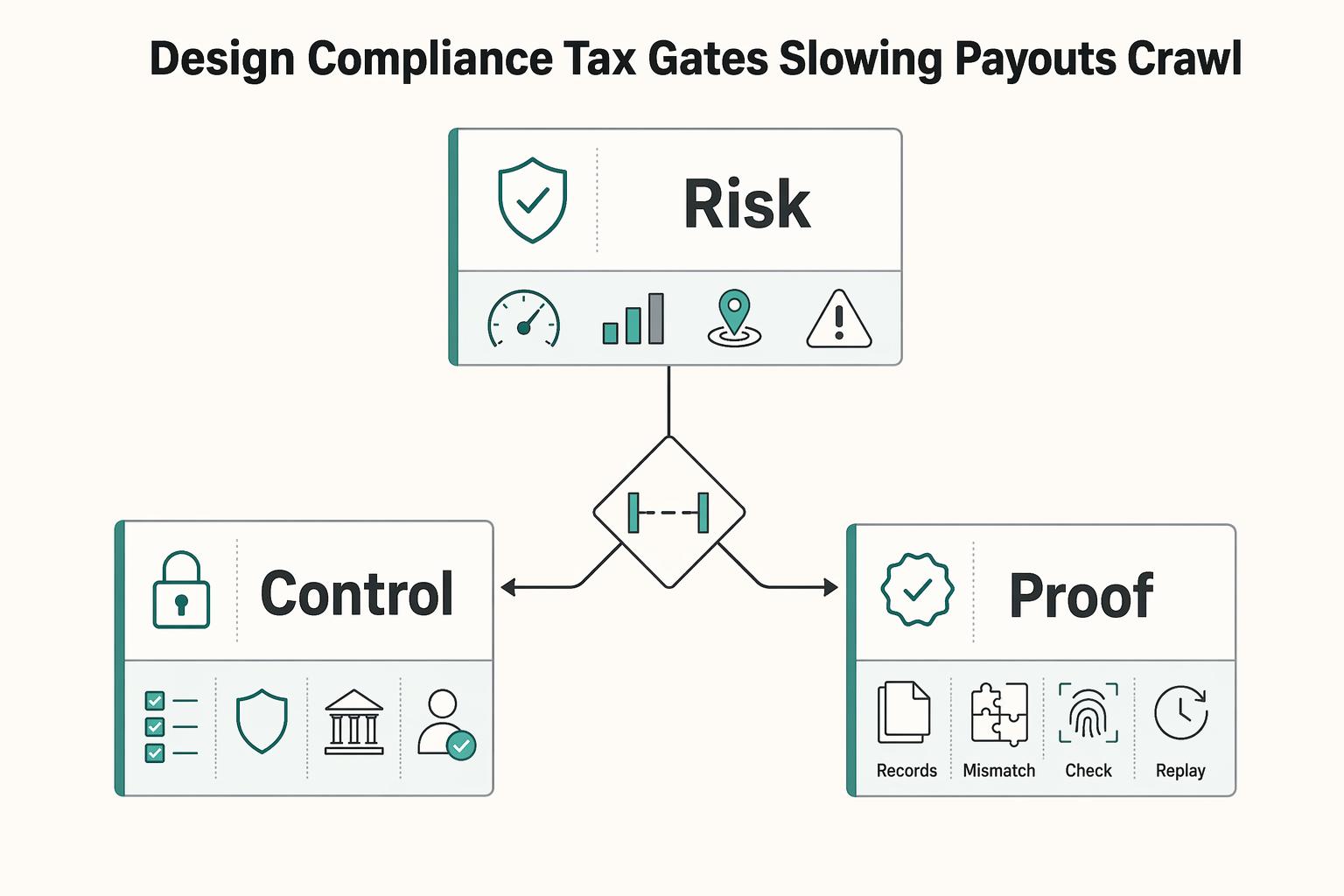
Design Compliance and Tax Gates Without Slowing Payouts to a Crawl#
Move faster by gating checks based on actual payout risk and keeping tax and privacy controls separate from payout execution.
Step 1 Apply verification gates only where they change risk. If your program uses KYC, AML, or KYB controls, define exactly when each one is triggered in your operating model instead of applying every check to every contractor up front. Keep hold reasons explicit in your payout states so ops can distinguish "not yet verified," "under review," and "blocked." That keeps support and compliance from working the same case in parallel with different assumptions.
Step 2 Keep tax artifacts separate, but linked to payout records. Treat tax documents and mappings as controlled artifacts, not fields spread across logs and webhook payloads. In payout records, store only the operational metadata needed for routing and review, and keep personal information in the appropriate controlled system. Your baseline should match your own privacy commitments: submitted information is handled under your privacy policy and user consent.
Step 3 Align invoicing and payout eligibility on one lifecycle state. If you support invoicing or pay-ins, define one source of truth for readiness so tax and payout statuses cannot conflict. A common operational failure is letting one workflow proceed while another still marks the contractor as not ready. Decide which status governs release, document that rule, and test the handoff before scaling cash pickup.
Handle Common Failure Modes Before They Hit Support Queues#
Most support spikes come from four predictable exceptions, so define the recovery path before volume rises.
| Failure mode | Required response | Checkpoint or evidence |
|---|---|---|
| Expired pickup or uncollected transfer | Route it into a return state, not a manual inbox | For MoneyGram, expiry window is 90 days; in some foreign-currency corridors, converted payout amounts may be recalculated after 45 days if funds are still uncollected |
| ID-name mismatch | Collect exact ID name, sent transfer name, and pickup details, then run a document re-check before any controlled re-send | Required pickup details include the reference number plus valid photo ID |
| Provider event and ledger divergence | Use webhooks as status triggers, not final proof, then reconcile before escalation | Escalate with provider reference ID, internal payout ID, amount, currency, and event timestamps attached |
| Fee or FX differs from disclosure | Pause corridor rollout, rerun margin and user-impact checks, and update disclosures | Relaunch only when product, finance, and support are aligned on current economics |
Step 1 Route expired pickups into a return state, not a manual inbox. Treat an uncollected transfer as no longer executable once it reaches the provider's expiry window, for MoneyGram, 90 days. In some foreign-currency corridors, converted payout amounts may also be recalculated after 45 days if funds are still uncollected. Your ops check: support can see provider reference, expiry reason, and whether returned funds have posted before any re-send is allowed.
Step 2 Fix ID-name mismatches before reissuing. Many pickup agents will not release cash if the receiver name does not match the government ID exactly. Collect the exact ID name, the sent transfer name, and the required pickup details, reference number plus valid photo ID, at intake, then run a document re-check, correct profile data where permitted, and only then issue a controlled re-send. Your checkpoint is a one-screen comparison of transfer name, profile name, and verified ID name without exposing raw documents in app logs.
Step 3 Reconcile provider events against your ledger, then escalate with evidence. Use provider webhooks as status triggers, not final proof. If provider events and internal payout state diverge, run reconciliation using payout reconciliation or transaction-level settlement reporting, then escalate with provider reference ID, internal payout ID, amount, currency, and event timestamps attached.
Step 4 Pause corridor rollout when fees or FX differ from disclosure. If actual fee or FX outcomes differ from what users were shown, stop rollout for that corridor. Since fees and exchange rates can change without notice, rerun margin and user-impact checks, update disclosures, and relaunch only when product, finance, and support are aligned on current economics.
Launch in Phases and Verify With Hard Checkpoints#
Launch one corridor and one user segment first, then expand only after pickup execution is consistently clean.
Step 1 Start with one corridor and a lower-friction segment. Begin where you can control variables and read signal quickly. Prioritize users who already completed identity checks, then confirm each payout can be collected with the required details: valid ID or passport, transaction reference, and a transaction name that matches the ID name.
Step 2 Define pre-launch and post-launch gates before going live. Pre-launch, confirm KYC readiness and clear visibility into payout status for support and operations. Post-launch, keep the checkpoint set tight: pickup completion, ID-name mismatch frequency, transfer status clarity, and whether support can resolve issues quickly.
Step 3 Alert on patterns, not isolated tickets. Single failures happen; repeated failures usually point to a workflow issue. Trigger operational alerts when you see clusters of ID-name mismatches, unclear transfer states, or unresolved cases accumulating in one corridor.
Step 4 Run a standing corridor decision review. On a regular cadence, make one decision per corridor: expand, hold, or rollback. Expand only when pickup completion and issue handling are stable; hold or rollback when identity mismatches or unresolved cases keep repeating.
Related reading: How to Use Make.com to Automate Onboarding, Compliance, and Cash Flow for Your Freelance Agency.
Conclusion#
For cash-adjacent remittance flows, treat scope and legal interpretation as explicit decisions, not assumptions. As a narrow baseline, remittance transfers generally include almost all international electronic money transfers by consumers, and unbanked households may rely on alternatives such as check-cashing and bill-payment services.
- Define scope before rollout.
Confirm the countries, users, and flow direction you are actually serving, and keep contract language, product copy, and support guidance aligned.
- Separate confirmed requirements from assumptions.
Compliance, tax, and operational dependencies can vary by market and program. Confirm the applicable requirements with the relevant authority before launch.
- Make status handling explicit.
Document the full request-to-final-status path and retry behavior so teams can trace outcomes without ambiguity.
- Document exception ownership.
Define who handles exceptions, what evidence is required, and when escalation is required, instead of relying on ad hoc manual handling.
- Use the remittance-rule baseline for legal review.
CFPB materials state that remittance transfers generally include almost all international electronic money transfers by consumers. Dodd-Frank directed the Bureau to issue remittance rules, and the referenced Bureau report covers rules effective through November 2014. If your flow might fall under those rules, route it through legal review before expansion.
Frequently Asked Questions
What is cash pickup payout for contractors, and when should a platform use it?
Cash pickup payout eligibility and product definitions are provider- and program-specific. Require written definitions from your provider before launch.
How is cash pickup different from `Over-The-Counter (OTC) cash collections`?
Confirm in writing how each provider defines the flow, who initiates it, and what in-person identity checks apply.
What implementation details matter most in `Hyperwallet` and `MoneyGram` style flows?
Before launch, get written documentation of status states, reference handling, and exception ownership from the provider.
What should we verify before launch if coverage varies by market and program?
Treat program setup details as items to verify directly with the provider in writing. On compliance framing, if U.S.-regulated financial institutions are involved, the Bank Secrecy Act and the Anti-Money Laundering Act of 2020 require reasonably designed risk-based AML/CFT programs to help prevent money laundering and terrorist financing.
Which unknowns should block provider selection until clarified in writing?
A hard stop is unclear AML/CFT responsibility, because money laundering is framed as the process of legitimizing illicit funds. For regulated financial institutions, risk-based AML/CFT programs are required controls, not optional later-phase work.
How should we handle expired pickups, ID mismatches, and payout reversals operationally?
There are no ready-made operational rules for those scenarios. Define written exception procedures with the provider and your compliance/legal owners before go-live.
Try a related tool
Researched and edited by the Gruv editorial team. Gruv builds cross-border billing, payouts, and finance-operations software for global businesses.
Sources
- appropriations.senate.gov/congressionally-directed-spending-requests-f...trusted
- congress.gov/event/119th-congress/house-event/117858/texttrusted
- docs.house.gov/meetings/IF/IF17/20250521/118288/HHRG-119-IF...trusted
- downloads.regulations.gov/TREAS-DO-2025-0004-0216/attachment_1.pdftrusted
- euda.europa.eu/system/files/documents/2023-05/2022edmr_cash...trusted
- fdic.gov/consumer-research/closer-look-unbanked-cash-...trusted
- fdic.gov/consumer-compliance-examination-manual/ii-14...trusted
- files.consumerfinance.gov/f/documents/bcfp_remittance-rule-assessment_...trusted
Educational content only. Not legal, tax, or financial advice.
Related Posts
Invisible Payouts: How to Remove Payment Friction for Contractors Without Sacrificing Compliance
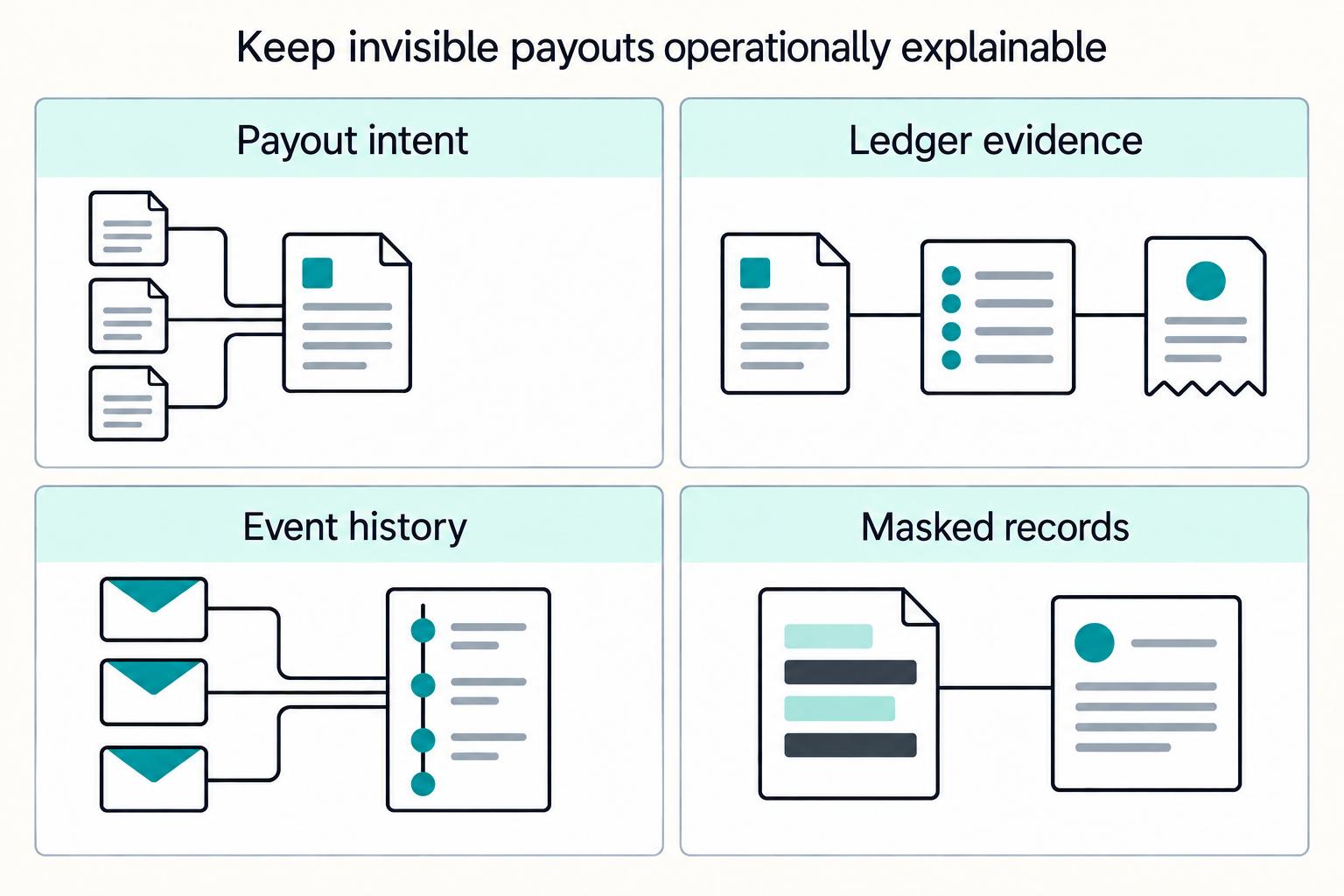
Invisible payouts should make life easier for contractors without hiding the controls your team needs. Contractors should get a predictable, low-friction flow, while internal teams can still enforce and document payout decisions when needed. If you run contractor payouts at scale, you need both outcomes at once. We recommend treating every easy payout as a controlled release path your team can replay later.

Paying Unbanked Contractors in Developing Markets: Best Payout Routes for Platforms
If your team needs to send money to contractors, creators, freelancers, marketplace sellers, or other non-payroll recipients across borders, the payout decision can look deceptively simple at first. On paper, you are choosing a payment rail. In practice, you are choosing an operating model that affects onboarding, compliance, support load, engineering effort, treasury visibility, failure recovery, and the degree of legal risk your company is willing to carry.

Invoice Factoring for Contractors: How Platforms Offer Early Payment and Manage Risk
If you run a platform for contractors, early payment is a product and risk decision before it is a goodwill feature. Ask four things up front: Who funds the advance? Who collects from the payer? Who absorbs nonpayment risk? Do the unit economics still work once disputes and exceptions show up?