
Quick Answer
Start with a reconciled baseline, then sequence changes: visibility in the Driver Mobile App and Customer Portal first, automation next, settlement timing last. Split owner-operators from company drivers, and trace each payout status to a Gruv event and ledger result before expanding across Southeast Asia clusters. Use stop/go gates for status accuracy, exception backlog, and invoice-to-payout reconciliation. If those checks fail, pause rollout instead of adding faster payout rules finance cannot verify.
What It Took to Scale Driver Payouts Across Southeast Asia#
Redesigning driver payouts is rarely just a payments project. For a logistics platform, it is often a margin decision hiding inside an ops problem. Do you fix driver uncertainty first, settlement speed first, or manual finance work first?
This guide is built around that choice. It focuses on last-mile delivery and B2B freight, where payout design shapes driver trust, support volume, invoice timing, and how much cash stays trapped between customer billing and driver settlement. The goal is not to push one answer for every operator. It is to help you choose the first lever that fits your economics, then validate whether it improved the business before you scale it.
Public case pages can show patterns, but they rarely provide clean proof. One transportation case describes replacing manual coordination, phone-based load matching, and dispute-prone payments with a unified mobile-first platform that connects customers, transporters, and drivers in one structured system. It also mentions milestone-based wallet payments with a 50%-50% split. That detail matters because payout redesign is not only about paying faster. It is also about deciding which event unlocks payment, what evidence supports it, and where disputes should stop.
A different logistics example points to another constraint: cross-border payment costs driven by transaction fees and poor exchange rates. Its response was automated smart payment routing to choose the fastest, most cost-effective payment paths, plus reloadable virtual cards for driver expenses with customized spend limits and real-time monitoring. That is a practical warning. A payout option can look better to drivers on speed while quietly hurting margin through fees, FX, or exception handling.
Transparency is the other recurring theme. One operations case frames modernization around transparency and flexibility in client and driver interactions, a useful reminder that visibility can matter before settlement timing changes. If drivers can clearly see status, you can often reduce pay-related contacts without changing the underlying payout rail. Separate research on platform work also highlights minimum compensation guarantees as a driver-welfare lever. Even if you do not adopt that policy, it shows that earnings design and payout design are linked. Clean disbursement mechanics will not fully hide a weak compensation model.
So the stance throughout this guide is intentionally strict. Use public examples as prompts, not quantified proof. Start by building a baseline evidence pack, checking that payout status in product matches ledger truth, and writing down the tradeoff you are accepting on visibility, speed, and automation. The main failure mode is easy to miss: teams launch faster payouts or new rules, driver complaints briefly drop, and finance later discovers higher exception volume, worse cash control, or margin leakage by corridor.
Related: Delivery and Logistics Platform Payouts: Paying Drivers Across 20+ Countries.
Define the baseline before changing payout design#
Do not change payout rules until you can show where the current process breaks. If the baseline is fuzzy, later gains are hard to trust, and finance cannot tell whether improvement came from visibility, automation, or settlement timing.
| Baseline step | What to collect/check | Why it matters |
|---|---|---|
| One evidence pack | Use a fixed recent period at route level for last-mile delivery; include invoice processing timestamps, payout cycle timestamps, support contacts tied to pay questions, and exception counts with short reason codes | If those inputs are scattered across systems, the proof chain is already broken |
| Reconcile across systems | Pull the same date range from the ledger or payout export, support queue, and operations tracker; at minimum track route or load ID, driver ID, driver type, promised payout event, actual payout event, invoice status, and whether support or ops touched the case | A payout record should trace to a route or load without manual guesswork |
| Split by driver model | Separate owner-operators and company drivers and use a stable classification rule from day one | Blended views hide friction |
| Map human intervention | Mark intervention points across the Driver Mobile App and Customer Portal from job completion to payout receipt; include off-platform calls, chat threads, and spreadsheet fixes | Otherwise the real labor cost is missed |
| Label unknowns | Write unknowns down early and treat Nuvizz, Driver Pay & Billing Automation, and 50%-50% wallet splits as directional unless hard before/after data exists | This avoids false precision |
Start with one evidence pack#
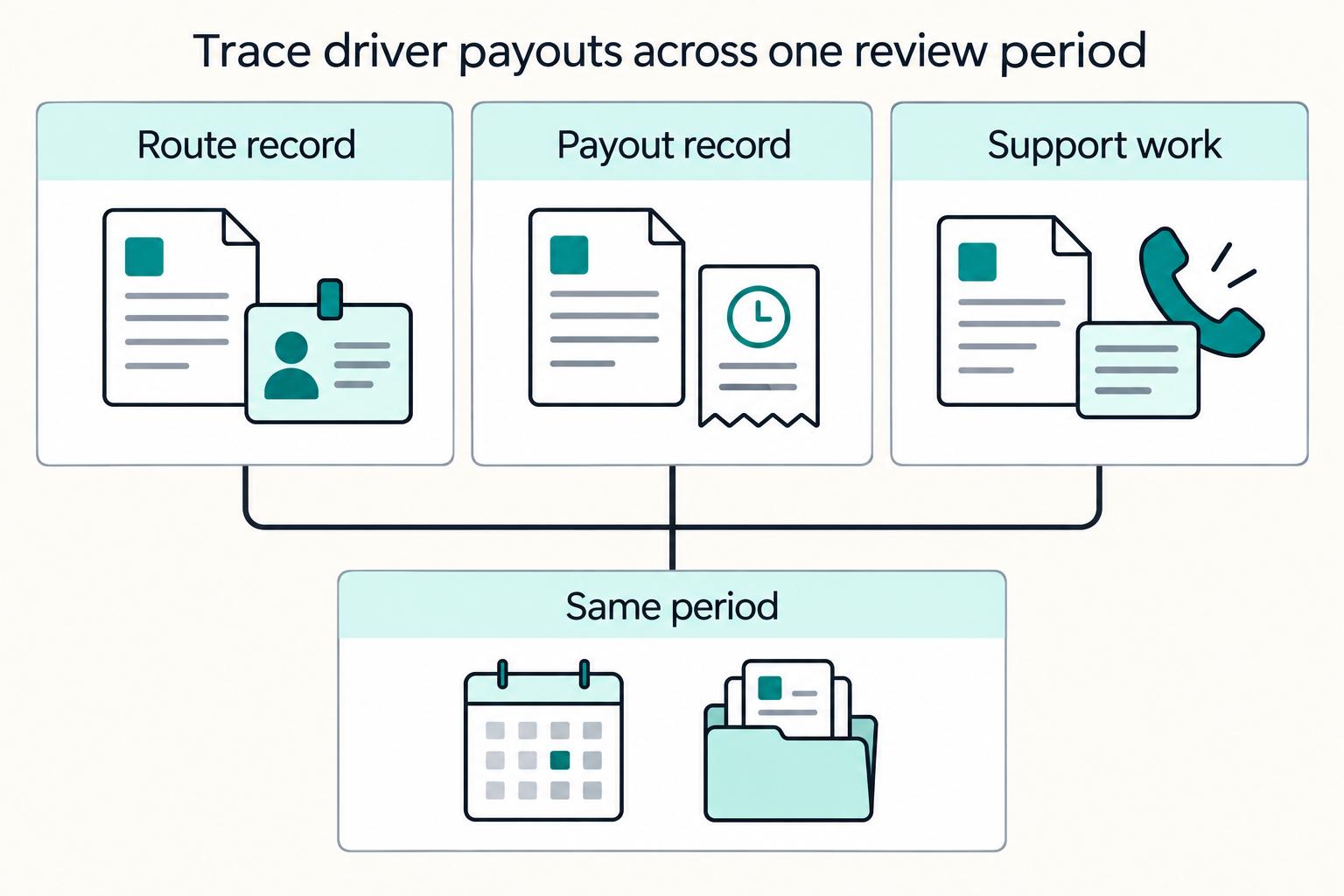
Build one evidence pack for a fixed recent period, at route level for last-mile delivery. Include invoice processing timestamps, payout cycle timestamps, support contacts tied to pay questions, and exception counts with short reason codes. If those four inputs are scattered across systems, treat that as a baseline finding because your proof chain is already broken.
Collect a baseline you can reconcile#
Collect the baseline in a format you can reconcile across systems. Pull records for the same date range from your ledger or payout export, support queue, and operations tracker. At minimum, track route or load ID, driver ID, driver type, promised payout event, actual payout event, invoice status, and whether support or ops touched the case.
First check: can you trace a payout record to a route or load without manual guesswork? If not, pause there. Teams often diagnose a payout issue when the root issue is reference IDs.
Split the data by driver model first#
Split owner-operators and company drivers before reviewing averages. Blended views hide friction, because the same delay can mean cash-flow pressure for one segment and a lower-salience payroll issue for another.
Use a stable classification rule from day one so drivers do not shift segments across reports. It does not need to be perfect initially, but it does need to be consistent.
Map where humans still intervene#
Map intervention points across the Driver Mobile App and Customer Portal from job completion to payout receipt. Mark each stop where ops steps in to answer pay-per-load or pending-status questions.
Public examples of replacing manual coordination, phone-based matching, and dispute-prone payments are useful prompts, but they are not your baseline. Include off-platform calls, chat threads, and spreadsheet fixes, or you will miss the real labor cost.
Label unknowns early and keep vendor evidence directional#
Write unknowns down early, and label vendor evidence as directional unless it has hard before/after data. If Nuvizz or Driver Pay & Billing Automation pages imply better payout outcomes without publishable baseline-to-outcome metrics, mark them unverified. The same applies to milestone-based wallet structures like 50%-50% splits: they show payout design options, not guaranteed cycle-time, support-volume, or exception outcomes in your operation.
A strong output here is not certainty. It is a baseline pack with clear evidence, explicit gaps, and no false precision.
For a step-by-step walkthrough, see How a Creator Platform Streamlined 1099 Filing with Gruv.
Choose the first lever with a margin-first rule#
Choose one lever first and break ties with margin impact you can actually measure. Do not run visibility, automation, and settlement-speed changes at once unless you can reconcile outcomes to a single decision.
Use vendor examples as pattern references, not outcome proof: Locus Companion App (visibility-first), PortPro/OCTS (automation-first), and Nuvizz (settlement-speed/billing positioning).
| First lever | Start here when | First effect | Implementation effort | Driver trust impact | Gross-margin question (B2B freight) |
|---|---|---|---|---|---|
| Visibility first (Locus Companion App pattern) | Support burden and churn signals are the loudest | Reduces payout-status confusion and repeat contacts | Lower to medium if status logic is clean | Often improves quickly if app status matches finance status | Do fewer disputes and support touches offset delivery and support costs? |
| Automation first (PortPro/OCTS pattern) | Manual interventions and exception handling are the main drag | Removes handoffs and repetitive ops work | Medium to high due to rules and reconciliation reliability | Improves only if exception handling is consistent | Does lower ops effort improve margin without increasing payment errors? |
| Settlement-speed first (Nuvizz positioning) | Cash-conversion pressure and invoice-processing delays are the bottleneck | Pulls payout timing forward or reduces lag | Medium to high across finance, billing, and reconciliation | Can improve if timing improves without accuracy loss | Can faster payout timing avoid unreconciled items, financing pressure, or margin leakage? |
Use this rule: if support burden and churn pressure are highest, start with visibility. If cash conversion is constrained by invoice processing, start with settlement and billing discipline. Start with automation when manual interventions are already mapped and material.
Before kickoff, write the tradeoff under three headings: implementation effort, driver trust impact, and gross-margin effect in B2B freight. In multi-tier outsourced logistics, also state who owns the payout promise and who can approve exceptions, because governance gaps can create new information asymmetries even when UI clarity improves.
Set a stop/go checkpoint before rollout: if you cannot measure expected impact and reconcile it with current data, narrow the scope before launch.
Prepare prerequisites across product, finance, and compliance#
Once you choose the first lever, lock the operating prerequisites before you ship customer-facing changes. That is what keeps payout decisions traceable across product, ops, and finance.
| Area | What to set | Pre-launch check |
|---|---|---|
| Country scope | For each launch market, note payout trigger, approval owner, exception path, and what the driver sees in the Driver Mobile App versus the Customer Portal | Test one real payout path and confirm policy, product wording, ops handling, and finance treatment match |
| Gruv control points | Set up idempotent retries, clear payout status surfaces, reconciliation exports for finance review, and an audit trail from request to ledger result | Run a small sample to catch stale or conflicting states early |
| Policy and sign-off | Name who can approve payout exceptions, who can change status logic, and who signs off across product, payments ops, and finance | For any disputed payout, show the policy rule, status history, reconciliation record, and final ledger outcome without manual reconstruction |
Define country scope before you copy policies forward#
Define country scope first, then document assumptions. For each launch market, note payout trigger, approval owner, exception path, and what the driver sees in the Driver Mobile App versus the Customer Portal.
Use the Sarthitrans lesson as a structure check, not a geography template: a unified mobile-first platform with centralized operational control and milestone-based wallet payments (50%-50%). Before launch, test one real payout path and confirm that policy, product wording, ops handling, and finance treatment match.
Configure the control points in Gruv before launch#
Configure Gruv control points before launch. Set up idempotent retries, clear payout status surfaces, reconciliation exports for finance review, and an audit trail from request to ledger result.
Then run a small sample to catch stale or conflicting states early, especially where one surface can imply a status that finance would not confirm.
Lock policy gates, exception ownership, and sign-off#
Lock policy gates, exception ownership, and sign-off in one release checklist. Name who can approve payout exceptions, who can change status logic, and who signs off across product, payments ops, and finance.
Tie that checklist to every Driver Mobile App and Customer Portal update. The goal is simple: for any disputed payout, you can show the policy rule, status history, reconciliation record, and final ledger outcome without reconstructing events manually.
Roll out in phases and lock operating ownership#
Run this in three phases, and do not let faster payments outrun cleaner data. If you change visibility, automation, and settlement timing at the same time, you cannot isolate what worked or roll back cleanly when a Southeast Asia country cluster behaves differently.
| Phase | What changes | Gate or rollback |
|---|---|---|
| Visibility first | Update Driver Mobile App and Customer Portal status visibility while keeping pricing and payout economics unchanged | Stop if Gruv, the Driver Mobile App, and the Customer Portal do not show the same status history; roll back new status surfaces for status mismatches, duplicate request creation, or unreconciled payout states |
| Automation in cohorts | Add automation and routing only after status accuracy is stable; test routing behavior, exception handling, approval handoffs, and silent failures when input data is incomplete | Use controlled cohorts and lock named owners before each cohort expands |
| Settlement timing last | Optimize settlement timing only after finance validates invoice readiness, payout release logic, and final reconciliation outcome | Do not accelerate settlement if finance cannot trace the invoice-to-payout path without manual reconstruction; roll back any cluster where faster settlement increases unresolved exceptions, breaks ledger matching, or pushes payout disputes outside Gruv |
Release visibility first and prove Gruv is the event truth#
Start with the Driver Mobile App and Customer Portal, while keeping pricing and payout economics unchanged in this phase. The goal is to make payout, approval, and exception states visible without changing settlement policy, so you can see whether disputes come from missing information or from payout design.
Your first checkpoint is status accuracy in Gruv. Sample live payouts across owner-operators and company drivers, then confirm the same status history appears in Gruv, the Driver Mobile App, and the Customer Portal. If those surfaces disagree, stop and fix the mapping before moving forward.
This is where single-source-of-truth problems surface quickly: siloed data makes cost allocation, exception tracking, and visibility harder. Write a Phase 1 rollback rule for each country cluster before launch. If you see status mismatches, duplicate request creation, or unreconciled payout states in the sample, roll back the new status surfaces until consistency is restored.
Add automation in cohorts and keep ownership explicit#
Add automation and routing only after status accuracy is stable. Roll out in controlled cohorts, not market-wide, so you can isolate whether issues come from policy, product logic, or reconciliation.
Use PortPro and OCTS as references for what to test first, not proof that the same design will work for you. Focus testing on routing behavior, exception handling, approval handoffs, and silent failures when input data is incomplete. Weak input state will make automation fail faster, not better.
Lock named owners before each cohort expands.
| Operating area | Named owner | What they must approve |
|---|---|---|
| Policy | Product or payments policy lead | Payout rules, visible status language, exception criteria |
| Execution | Payments ops lead | Queue handling, retry handling, manual intervention steps |
| Reconciliation | Finance lead | Export review, ledger match, invoice-to-payout trace |
Keep one consistent payout path for owner-operators and company drivers unless you have a documented contractual reason to split them. Special-case handling that finance cannot reconcile is usually where disputes cluster first.
Tune settlement timing only after finance signs off#
Optimize settlement timing last, because it affects cash flow, invoice processing, and exception cost together. Reducing transaction friction can free up working capital and support faster payment cycles, but only if finance can still trace each payout from invoice processing to final posting.
Before expanding Phase 3, have finance validate invoice readiness, payout release logic, and final reconciliation outcome on a fresh sample in each Southeast Asia cluster. If finance cannot trace the invoice-to-payout path without manual reconstruction, do not accelerate settlement.
Treat market claims like "less than one percent" manual invoice touch as company-specific, not a target to assume. Your go rule is finance validation. Your rollback rule is any cluster where faster settlement increases unresolved exceptions, breaks ledger matching, or pushes payout disputes outside Gruv.
Track the scorecard that proves unit-economics impact#
Prove impact with one scorecard that keeps attribution clean. Track visibility, automation, settlement timing, segment mix, and country mix separately so you do not claim gains you cannot defend.
Build one scorecard with fixed KPI definitions#
Use one table with baseline, current, and target so every review starts from the same frame. Keep each KPI definition fixed across the rollout window. If definitions change, trend comparisons get weaker.
| KPI | Definition to lock | Baseline | Current | Target | Required cuts | Primary attribution | Confidence |
|---|---|---|---|---|---|---|---|
| Payout cycle time | Time from invoice-ready state to final posted payout | Fill from pre-launch period | Fill from latest closed period | Set by finance and ops | owner-operators, company drivers, Southeast Asia cluster, country | Visibility / automation / settlement | High / Medium / Low |
| Support contacts per payout | Support contacts tied to payout questions divided by completed payouts | Fill | Fill | Set | same cuts | Visibility / automation / settlement | High / Medium / Low |
| Exception rate | Payouts requiring manual intervention divided by payout attempts or completed payouts, whichever you choose and keep constant | Fill | Fill | Set | same cuts | Visibility / automation / settlement | High / Medium / Low |
| Margin by segment | Segment-level margin measure approved by finance | Fill | Fill | Set | owner-operators, company drivers, geography | Visibility / automation / settlement | High / Medium / Low |
As a control, finance, ops, and product should be able to reproduce current-period values from the same exports and records.
Separate attribution before you discuss impact#
Assign each KPI movement to the intervention most likely to have changed it: Locus Companion App-style visibility, PortPro/OCTS-style automation, or Nuvizz-style settlement positioning. Keep those tags separate even when stakeholders want one headline result.
If multiple changes shipped together, lower causal confidence unless you have a clean cohort split or timing break. For example, if settlement timing and margin moved at once, avoid crediting the visibility layer for the finance outcome without clear isolation.
A compact evidence pack for each KPI helps:
- numerator and denominator used
- source report or export name
- date range and excluded records
- named owner who approved the calculation
Cut the data by segment and geography before drawing conclusions#
Check segment and geography cuts before presenting blended results. Owner-operators, company drivers, and country clusters can follow different operating patterns, so blended averages can hide weak pockets.
Use a simple rule: if the improvement does not hold after segment or country cuts, do not present the blended number as proof of design success. Also confirm that cut-level totals roll back to the finance-approved total.
Grade confidence and sanity-check external benchmarks#
Show a confidence grade on every KPI: High, Medium, or Low, based on definition stability, timing clarity, and confounders.
Treat outside material as context, not direct payout proof. A September 2024 study links country-level logistics performance with IPO outcomes and notes an uncertainty and information-asymmetry channel, with stronger effects in logistics-dependent industries and during the GFC. That can inform framing, but it is not a payout-cycle benchmark for your operation. Likewise, qualitative platform labor evidence from interviews (N = 12) can surface risks to monitor, but it should not be your baseline for target-setting.
If you use Modern Shipper, American Trucking Associations, or any external source, log geography, publication date, sample, and metric definition beside the reference. If the context does not match your Southeast Asia payout operation, treat it as directional only. Related reading: How to Hedge FX Risk on a Global Payout Platform.
Prevent common payout failures and recover fast#
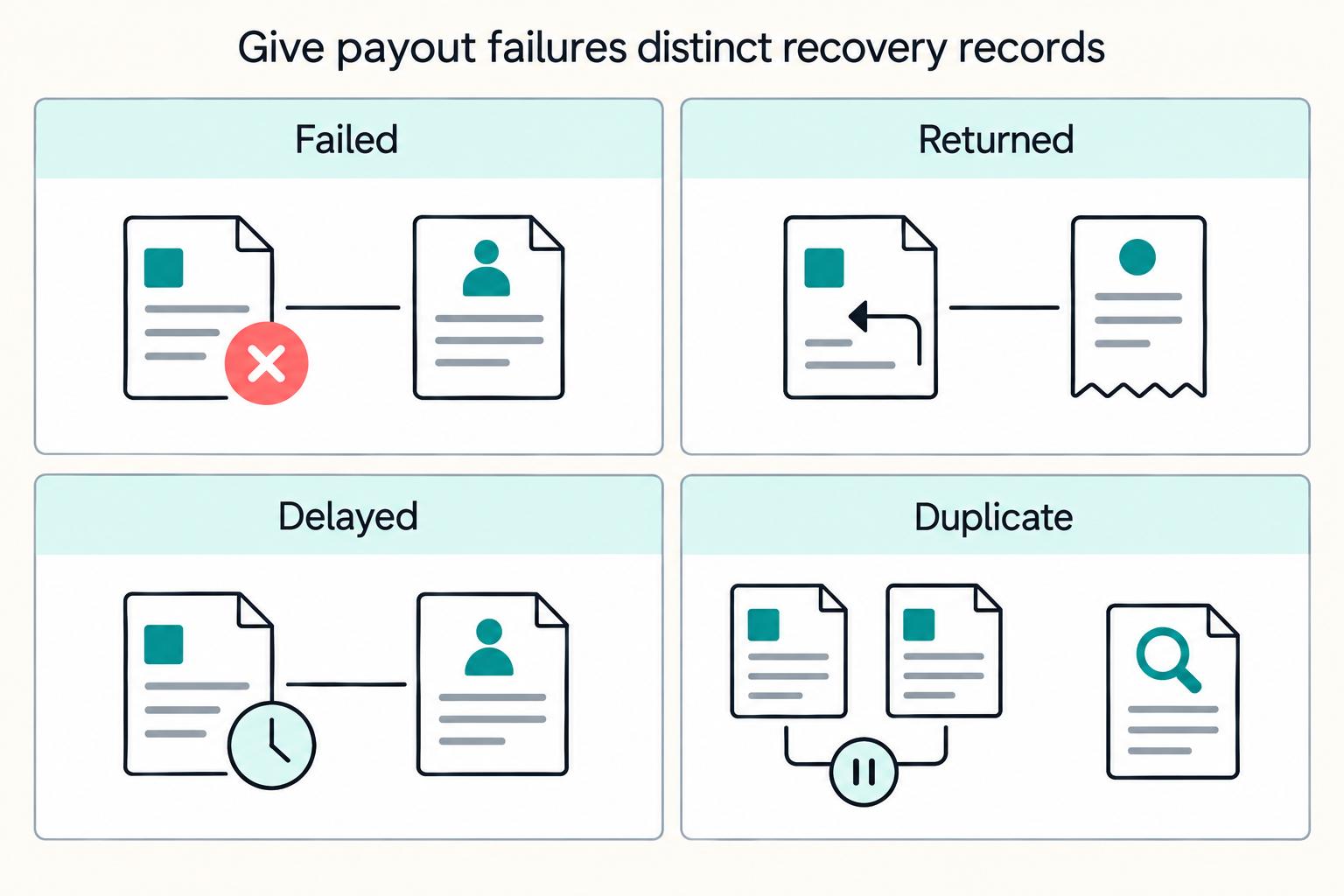
Set recovery rules before you scale: keep one payout truth, triage exceptions quickly, and resolve failures with clear ownership. In the available logistics-sharing evidence, failure patterns cluster around platform operation, matching, and communication, so your controls should start there.
Enforce Gruv as the authoritative payout record#
Use Gruv as the single payout event trail, and make the Customer Portal and Driver Mobile App display only states derived from that trail. If a customer-facing status is stale or delayed, suppress it and show the last confirmed state with a review flag.
Your trust check is simple: each visible payout status should map to one Gruv event record and timestamp. If support cannot trace a disputed status back to that record quickly, the status layer is not reliable enough yet.
Tighten validation before you speed up payouts#
Do not expand payout speed or corridor scope until validation and triage are tight. If you move faster without stronger checks, exception handling can become the bottleneck.
Keep the gate practical: required fields, duplicate prevention, and clear exception ownership before expanding Southeast Asia corridors. For each held or failed payout, keep a triage pack with corridor, segment, exception reason, current Gruv status, and next owner.
Investigate margin when support gets quieter#
Lower payout-related support volume is not a success signal on its own, especially in B2B freight. If support contacts drop while margin weakens, treat it as an operating risk and review routing and fee logic by lane.
Use a hard rule: if support contacts per payout improve but segment margin declines, pause the win narrative and inspect lane economics first. Split checks across owner-operators and company drivers so segment differences do not hide leakage.
Run a weekly red-flag review and close the loop#
Run one weekly review of unresolved exceptions and Driver Mobile App issues in the same meeting. Break results out by owner-operators and company drivers to isolate whether the root issue is platform operation, matching, or communication.
When a platform-side failure causes loss or delay, act. The available service-recovery evidence shows that doing nothing is the weakest response, while compensation is the strongest recovery response.
Write case-study proof leaders can trust#
Leaders trust payout case studies when the proof is explicit about what changed, where it changed, what improved, and what is still unproven.
Structure the proof in five parts#
Keep each part evidence-bound and easy to verify.
- Baseline pain
Define the pre-change problem in operating terms and by segment.
- Intervention
State the exact change and the product surface or control point that changed.
- Rollout scope
Say who was included, who was excluded, and where the rollout ran.
- Results
Report only measured deltas in a defined time window, tied to a single source of record.
- Remaining unknowns
State what you cannot isolate when multiple changes happened at once.
Use external case material as operating context, not causal proof#
Use outside examples to show operational patterns, not to prove your outcome. Broader logistics case material is often presented as practical inspiration for long-term cost management, and it can show that cost gains are hard to sustain over time. Treat those examples as context for decisions, then prove impact with your own before-and-after data.
Write one hard decision rule in plain language#
Use a clear rule leaders can apply immediately: if payout support demand is mostly status confusion, prioritize status visibility before faster settlement. Faster settlement helps less when users still cannot see what is happening.
Then label transfer limits plainly. If an example comes from a different market or operating context, treat it as context, not proof that the same outcome will hold in Southeast Asia.
Conclusion#
Confirm the baseline pack before you change payout design#
Lock the starting record first: payout timing, support burden, exception profile, and invoice processing performance. In practice, that means one scorecard split by driver segment and your country cluster, plus the evidence behind it. Your verification check is simple: finance should be able to trace a payout request to invoice status, status events, and the ledger record in Gruv. If the story depends on screenshots, chat history, or operator memory, the baseline is not ready.
Choose one first lever and write down the tradeoff#
Do not launch visibility, speed, and automation together unless you are willing to give up clean attribution. If the main pain is trust and repeated "where is my payout?" contacts, start with visibility. If delays and fee friction are the bigger issue, speed may deserve priority. One cited case, Frayt, describes a prior setup that charged transaction fees and took up to a week to process payouts, but that is not proof that the same change will improve margin in Southeast Asia. If your real problem is manual coordination and dispute-prone payments, automation is the more defensible first move, especially when invoice processing is weak.
A useful red flag here is trying to speed settlement before invoice readiness is under control. That can make drivers happier for a moment while pushing more exceptions and reconciliation work into finance. Another pattern worth noting is structured payout logic such as milestone-based wallet payments at 50%-50%, which can clarify payout expectations only when milestones are easy to verify and survive exceptions.
Roll out in phases with ownership and gates inside Gruv#
Give each phase a named owner for policy, execution, and reconciliation. Start with status visibility, then add automation, then test settlement timing changes once invoice processing is stable enough to support them. Before you expand, require three checks in Gruv (where enabled): status accuracy across surfaces, a reconciliation export that ties request to ledger, and a manageable exception queue with reason codes that finance accepts. If any one of those fails, hold the rollout.
Keep the proof narrower than the ambition#
A credible driver payout case study is not the biggest claim you can make. It is the strongest claim your records support. If you cite external case studies, use them as directional examples of operating patterns, not as proof that your margin outcome will transfer unchanged to Southeast Asia. Label unknowns where causality is incomplete, especially if multiple product and finance changes shipped together.
Scale only when the scorecard stays strong over time and across cohorts. That discipline is what turns a promising payout redesign into evidence leaders can actually trust.
Frequently Asked Questions
What should a logistics platform driver payout case study include to be decision useful?
Keep it tight: baseline pain, exact intervention, rollout scope, measured results, and remaining unknowns. Every result should trace to one source of record such as a finance export, a scorecard, or an event trail, not a blend of screenshots, anecdotes, and Slack messages. If owner-operators and company drivers behaved differently, split them instead of reporting one blended average.
How does payout visibility change operations beyond driver experience?
Visibility is often used to reduce status confusion, repeat support contacts, and dispatcher interruption, not just driver frustration. If operations surfaces show the same payout state, your team can spend less time explaining what is pending and why. A red flag is conflicting statuses across surfaces, because that can create more disputes even when the underlying payout is correct.
What is the operational difference between payout visibility and payout speed?
Visibility tells people what is happening. Speed changes when money lands. If your queue is full of “where is my payout?” contacts, better status events may solve more pain than faster settlement. If the real bottleneck is invoice readiness or legacy logistics payment rails like paper checks, ACH, or wires with delays and reconciliation headaches, speed and payment method become the harder issue.
Which payout changes usually improve retention first, and which improve margin first?
Start with visibility when the main problem appears to be trust, confusion, or avoidable support churn. Start with automation and invoice-processing discipline when finance is absorbing manual exception work and margin is getting squeezed by rework. Be careful about claiming causality here: you can recommend a likely first move, but you should not state that visibility alone improves retention or speed alone improves margin without your own before-and-after evidence.
How can logistics teams reduce payout disputes without adding manual finance work?
Tighten the evidence pack before the payout leaves finance: status events, invoice readiness, exception reason codes, and a reconciliation export that ties request to ledger. You want disputes resolved from records already produced by the product and finance stack, not by asking operators to rebuild the story by hand. If frequent errors exist between drivers and dispatchers, fix the status and data-entry surfaces first, because bad inputs can create downstream disputes.
What metrics should founders and finance operators track before scaling to another market?
Track a small set of core business metrics that show whether the change is actually helping, for example: payout cycle time, support contacts per payout, exception rate, reconciliation effort, and margin by segment. Pick one North Star Metric only if it genuinely aligns teams around the main goal. Otherwise, a compact scorecard is better than one vanity number. These are the kinds of metrics investors and boards will ask for, so keep the definitions stable before you expand.
How do you prove payout redesign impact when multiple systems changed at the same time?
State the overlap plainly and grade confidence instead of over-claiming. If you changed visibility, finance automation, and settlement timing in one release, report the combined outcome but say you cannot isolate each effect. The cleanest checkpoint is a narrow cohort rollout with one change family at a time, then a comparison against the pre-change scorecard.
Try a related tool
Researched and edited by the Gruv editorial team. Gruv builds cross-border billing, payouts, and finance-operations software for global businesses.
Sources
- congress.gov/bill/119th-congress/senate-bill/1071/text/enrtrusted
- dot.ca.gov/-/media/dot-media/programs/transportation-pl...trusted
- dr.lib.iastate.edu/bitstreams/e84ff013-0f68-4fc9-85a6-1c440197f...trusted
- dspace.mit.edu/bitstream/handle/1721.1/156444/guo_multihomi...trusted
- ftp.txdot.gov/pub/txdot/move-texas-freight/resources/texas...trusted
- nvlpubs.nist.gov/nistpubs/Legacy/SP/nbsspecialpublication652.pdftrusted
- oecd.org/content/dam/oecd/en/publications/reports/201...trusted
- pmc.ncbi.nlm.nih.gov/articles/PMC9014211trusted
Educational content only. Not legal, tax, or financial advice.
Related Posts
How a Healthcare Staffing Platform Improved Payout Reliability with Gruv
Treat this as a monetization and operations question first. The question is whether a staffing platform could make payouts more dependable with Gruv while keeping margin intact after support load, exception handling, and reconciliation work are counted.
Delivery and Logistics Platform Payouts Across 20+ Countries
A **delivery driver payouts platform** is not the same as an instant cashout feature in a driver app. It can be the operating layer behind driver onboarding, compliance checks, payout execution, and reconciliation across countries. If you treat payouts as only a UX choice instead of a market-entry function, expansion usually breaks at the point where drivers expect money to arrive.
Case Study Framework: How to Document Platform Payment Wins for Marketing
Payment case studies are most credible when they read like an operating record, not marketing copy. In payments, a "win" often reflects design tradeoffs across routing, controls, and settlement behavior, not just a faster user flow.