
Quick Answer
Start with weekly payouts, then add instant access only after eligibility gates and failure handling are proven in each market. For a delivery driver payouts platform, the launch decision should depend on evidence, not marketing claims: confirm payout route availability, required onboarding inputs, and a Finance export that matches internal records to provider events. If any of those three checks is still inferred, keep that country unconfirmed.
Why delivery driver payouts break during global expansion#
A delivery driver payouts platform is not the same as an instant cashout feature in a driver app. It can be the operating layer behind driver onboarding, compliance checks, payout execution, and reconciliation across countries. If you treat payouts as only a UX choice instead of a market-entry function, expansion usually breaks at the point where drivers expect money to arrive.
That matters more in delivery than in many platform categories because payouts sit inside a broader fulfillment operation. Uber describes fulfillment as delivering a product or service to a customer, and its own Fulfillment Platform as a foundational capability and source of truth used by many internal services. That is the useful mental model here: once you operate across borders, payouts also need a source of truth. Without one, you can end up with mismatched driver states, unclear holds, and Finance reconciling fragments after the fact.
The scale and labor model make this harder, not easier. Human Rights Watch cites more than 777 active digital labor platforms in 2021, with 489 of 777 dedicated to ride hailing and delivery services. It also warns that workers are increasingly hired, compensated, disciplined, and fired by algorithms that can be opaque and error prone. In practice, payout decisions can be tied to automated eligibility logic while the underlying evidence is not always obvious when something fails. A driver may only see "not paid." Your team sees identity status, order data, country rules, and provider responses.
What most search results miss#
Most search results split the problem in the wrong place. Driver-facing pages tend to focus on how earnings work from the courier's point of view. Infrastructure pages from vendors explain what their product can do. Neither view is enough if you are the founder or operator deciding how to launch across many countries with reliable payout operations.
You need a market-entry lens. That means asking whether a country is actually launchable with your controls, not just whether a provider advertises global reach. A simple checkpoint helps: before you open a market, verify country-specific onboarding requirements, payout route availability, and the finance export you will use to match internal records to provider events. If one of those is still inferred rather than proven, treat that country as unconfirmed.
What this guide will help you decide#
This guide is built for operators making rollout decisions, not just comparing payout features. The promise is narrower and more useful: you should be able to decide where to launch next using explicit checkpoints on coverage, controls, and finance operations.
That also means facing an uncomfortable tradeoff early. A fast launch promise can hide weak operational visibility. The Harvard-linked report on Amazon's delivery model notes that there is often little data to look inside the black box of workers' experiences. If your payout path has that same black-box quality, each added country can amplify support issues and reconciliation pain long before it creates growth.
If you want a deeper dive, read How a Logistics Platform Scaled Driver Payouts Across Southeast Asia.
The operating model founders should align on before market selection#
Set your operating-model boundaries before you rank countries. If you do this late, market selection turns into one mixed debate about driver UX, payout execution, and legal scope, and teams start moving in different directions.
That risk is higher in multi-sided platforms, where outcomes are tied to business-model complexity, not one visible feature. It is also harder under regulatory and compliance pressure. Planview's cited figures are a practical warning: only 8% of planned Agile work gets delivered, and 33% of respondents cite strategy-execution misalignment as a major barrier. In payout programs, that usually shows up as launch promises being made before ownership and constraints are settled.
Separate the decisions early#
Use one internal glossary for terms like Payouts API, Merchant of Record (MoR), and Virtual Accounts, and tie each term to a distinct decision. Keep these decisions separate:
| Decision | Scope |
|---|---|
| Driver payout experience | what drivers see, when they expect funds, what statuses appear, and what support promises you make (the Roadie/Grubhub layer) |
| Back-end orchestration | how payout instructions are created, retried, confirmed, and reconciled across providers (the Dots/Stripe-style layer) |
| Legal and compliance scope | who carries which responsibilities under your operating model, and what that changes for Finance and risk |
A common failure mode is promising "instant" in the app before route availability, reconciliation exports, or legal responsibility are confirmed.
Set ownership where failures actually happen#
Keep ownership explicit for three outcomes: payout reliability, reconciliation, and integration correctness.
| Owner | Owns |
|---|---|
| Payments Ops | payout success rates, failure triage, and provider escalation |
| Finance | reconciliation rules, export review, and audit artifacts |
| Product/Engineering | idempotent retries, webhook handling, and the internal status model that keeps driver-facing states aligned with provider events |
Before you score countries, require a short evidence pack:
- glossary with approved meanings for core payment terms
- ownership matrix for execution, reconciliation, and incident response
- one sample payout lifecycle (initiation, failure, retry, final status)
- finance export or ledger view used to match internal records to provider events
If your first three countries differ materially in regulation or rails, decide these architecture boundaries before you build payout promises into the app. If you need a deeper comparison, see Integrated Payouts vs. Standalone Payouts: Which Architecture Is Right for Your Platform?.
For a step-by-step walkthrough, see Last-Mile Delivery Platform Payments: How to Pay Couriers Per-Drop with Surge Adjustments.
Instant payout vs weekly payout choices that hold up in operations#
Use weekly payouts as the default. Add instant access only where cash timing clearly affects retention and the payout route is supported. The risk is not choosing weekly; it is promising instant before you can control eligibility, failures, and finance visibility.
What changes when you choose one mode over the other#
Weekly payouts usually make treasury planning and reconciliation more predictable. The tradeoff is driver liquidity: in markets where cash access matters, slower payout timing can weaken the driver experience.
Instant payouts improve cash access for eligible drivers, but they also raise operational pressure. Failure handling becomes more urgent, support escalations move faster, and teams need tighter event-level tracking.
| Approach | Driver impact | Ops and support impact | Finance impact |
|---|---|---|---|
| Weekly only | Lowest cash flexibility | Fewer urgent payout cases and simpler exception handling | More predictable forecasting and regular reconciliation |
| Weekly baseline plus controlled instant access | Better balance across mixed needs | More policy checks and faster triage for instant exceptions | Forecasting remains manageable if instant usage is bounded |
| Instant first | Strongest cash-access signal | Highest urgency on failures, retries, and eligibility disputes | Harder treasury planning and more granular reconciliation |
A practical rule is straightforward: if cash access really drives retention, prioritize instant rails where they are supported. If margin discipline and forecasting matter more, keep weekly as the core and make instant conditional.
Put policy gates in front of every payout#
Payout speed should never bypass controls. Require explicit release gates for both weekly and instant payouts before funds leave your system:
- KYC/AML status is releasable, not just created. Fast-payments contexts still operate under KYC/AML rules.
- Velocity rules pass for count, amount, or frequency limits based on your risk policy.
- Exception states block release automatically until resolved.
Operationally, the control point is the release record, not the "cash out now" button. You should be able to trace payout instruction ID, driver ID, eligibility outcome, destination instrument, and status progression quickly when Support or Finance asks.
Before launch, use provider coverage and live status signals as checks, not guarantees. A provider can market broad coverage and real-time status, but you still need internal gating and clear failure-state handling.
Use competitor pages as signals, not proof#
Treat competitor pages as directional input, not evidence. Roadie messaging is commonly framed around both weekly and instant options, which signals that payout choice matters. The Grubhub excerpt in scope confirms transparent per-order pay and tips, but payout timing should remain unknown from the provided text.
Apply the same standard to your own product language: if timing or eligibility is conditional, say that clearly in product copy and support macros. For scope alignment on payout spend, see the addressable-spend guide for platform payouts.
Country entry sequencing for 20+ markets without guesswork#
Use one operating rule: launch countries you can verify, not countries you can pitch. If Ops capacity is limited, sequence by certainty first and market size second.
Run country rollout on explicit checks, completed country by country. Treat each market as launch-ready only when your team has verified the required payout, compliance, and reconciliation evidence for that specific country.
Build a scorecard that forces verification#
Use a scorecard with fields that require evidence and named approval. For each country, mark every field as confirmed or unconfirmed, then gate launch on confirmed status.
| Field | Country check |
|---|---|
| Coverage Map status | for the country in scope |
| Payout route availability | for the routes you need |
| Settlement behavior | from testing and provider materials |
| Local entity and tax requirements | confirmed by Legal/Finance |
| Operational support burden | for payout exceptions |
If a vendor says it supports global payouts but does not clearly confirm your target corridor at country level, keep that country as unconfirmed until verified.
Gate each market with evidence, not optimism#
Before launch, require a small evidence pack for that country:
- payout route viability
- compliance checks that move a driver to a releasable state
- clear handling for failed, returned, or held payouts
- reconciliation export Finance can map to internal records
If that pack is incomplete, do not open the market yet.
Use source discipline when deciding readiness#
The material in scope here is mostly earnings-focused, not country-rail documentation. For example, one Gridwise title is about making "$1,000 a week" with Uber Eats in 2026, and another is Spark earnings content with "2025 Data from 500k+ Drivers" and "Payment Schedule." Useful context for earnings behavior, but not proof of country launch readiness.
Treat regions as planning groups, not proof groups. Even when expansion is organized regionally, verify launch evidence country by country.
You might also find this useful: Gaming Platform Payments for Market Entry and Developer Payouts.
Compliance and tax controls that must exist before first payout#
Before first payout, your control standard should be simple: no payout is released unless the recipient's compliance and tax state is both releasable and explainable. If your team cannot show why a driver was approved, held, or released on a specific day, the market is not operationally ready.
Set a minimum eligibility stack per country and program: KYC, KYB where payouts go to businesses, and AML checks. Define release logic in advance, not during exceptions: which checks must pass, which states create a hold, who can override, and what evidence is stored.
| Control area | What must be defined before launch | Audit artifact to retain |
|---|---|---|
| KYC | Which payee profiles require identity verification and which state is required before release | Verification state, timestamp, provider result, manual review notes |
| KYB | Whether the program pays sole traders, companies, or both, and when business verification applies | Business verification outcome, linked entity record, reviewer actions |
| AML | Which screening/monitoring steps must clear before payout release | Hold reason, match disposition, escalation record, release decision |
| Tax and invoicing | Which document/tax fields are required by payer/payee profile and jurisdiction | Form status, VAT field status where relevant, document history |
Apply the same structure to tax handling. For U.S.-linked payer or payee scenarios, define how W-8, W-9, and 1099-related status is collected or tracked by profile, and make that visible to both Finance and Compliance.
Handle FEIE and FBAR as conditional topics, not universal payout gates. FEIE applies only to qualifying individuals with foreign earned income, and the physical presence test references 330 full days during a 12 consecutive months period. FBAR refers to reporting foreign bank and financial accounts. Operationally, that means flagging when these may matter for support or communications, not making them blanket onboarding requirements.
Include VAT validation where invoicing or finance records require it, and document where requirements vary by jurisdiction. Keep a full audit trail for each decision point: verification status, hold reasons, reviewer identity/actions, and payout release events.
This pairs well with our guide on What Is a Demand-Side Platform (DSP)? How Programmatic Ad Platforms Manage Publisher Payouts.
Integrated stack or standalone payout vendor choices that change your roadmap#
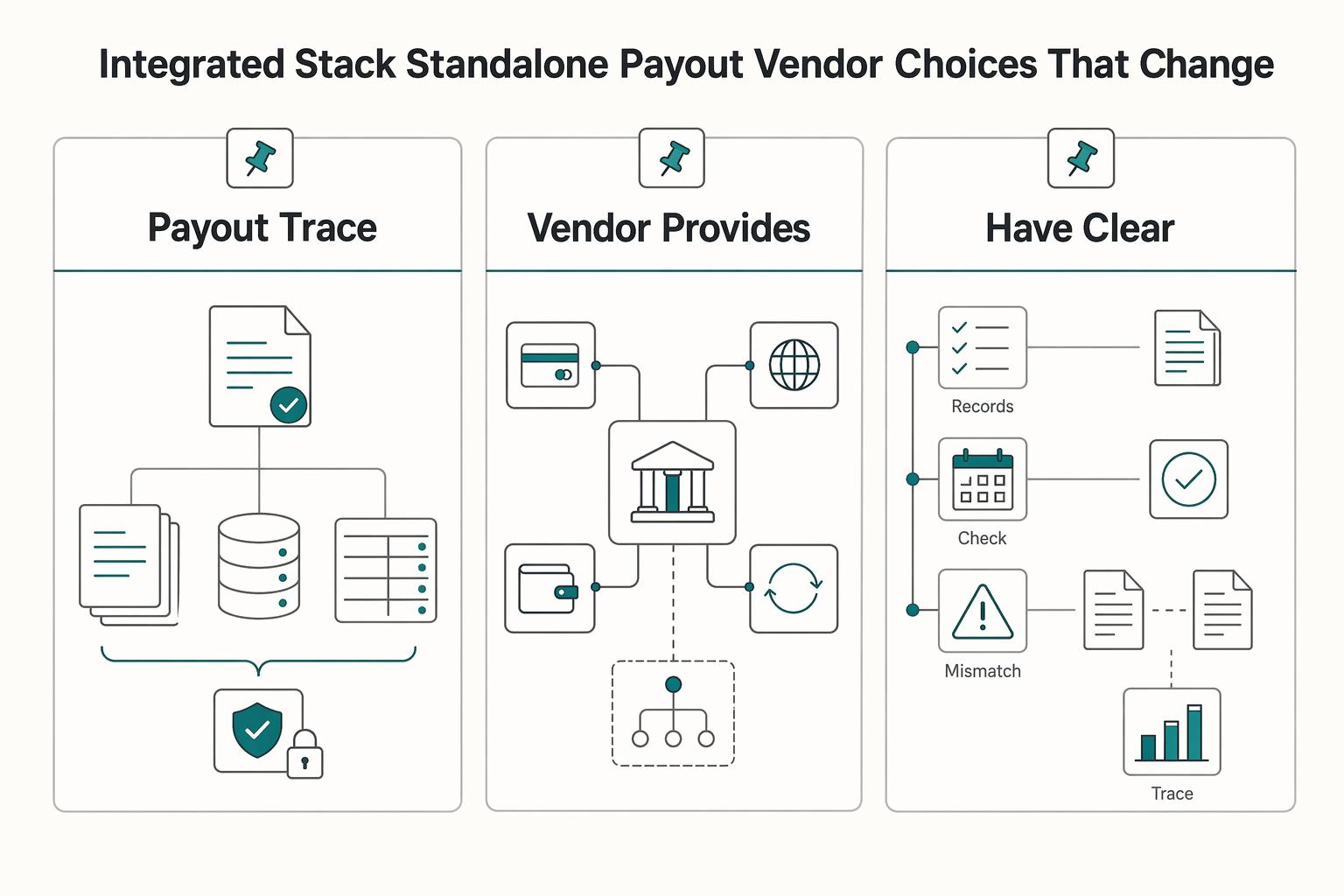
If Finance needs a unified audit trail and fewer control boundaries, integrated architecture is usually the better default. If your priority is a fast pilot in one market, a standalone payout vendor can be acceptable, but only with explicit exit criteria from day one.
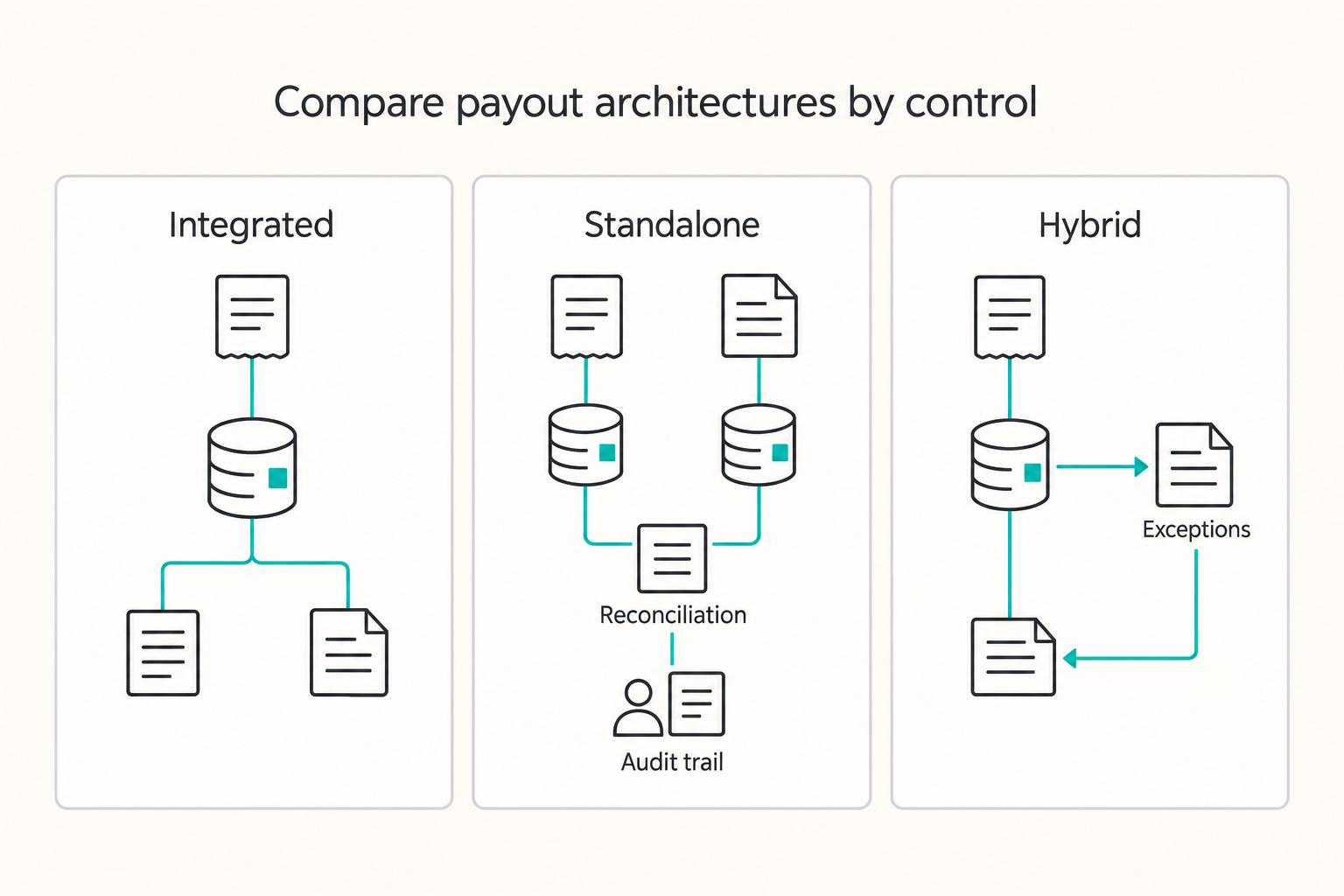
The core tradeoff is where payment evidence lives. An integrated path keeps more of the money lifecycle together, while a standalone path adds a payout layer to systems you already run for onboarding, treasury, or ledgering. Both can work, but they create different control and reconciliation burdens as you scale.
In practice, the decision should be driven by traceability, not just send-funds speed. You should be able to prove one payout end to end: release decision, payout instruction, provider status, and ledger result, including returns or settlement outcomes.
If your design uses elements like Virtual Accounts and a Payouts API, treat them as architecture components that still must pass the same traceability and control tests. A standalone rail can speed a narrow launch, but it typically adds more joins and third-party oversight work as markets or rails increase.
This risk is operational, not theoretical. Payment-systems oversight explicitly calls out internal controls and third-party risk management, alongside operational, fraud, strategic, credit, liquidity, and compliance risk. More providers usually means more control boundaries to monitor, explain, and audit.
Before you approve a standalone design, confirm these in writing:
- You can trace one payout from release decision to provider status to ledger posting to return or settlement outcome.
- The vendor provides stable event IDs, failure/return codes, and exports Finance can reconcile daily.
- You have a clear migration trigger (for example, a second market, rail, or treasury flow).
Also watch for legal and bank-ops scope drift. If your model moves closer to payment-system participation or notice questions under 12 CFR 7.1026, this is no longer only an engineering choice. For deeper architecture guidance, see Integrated Payouts vs. Standalone Payouts: Which Architecture Is Right for Your Platform?. Need a broader implementation view? Read the crypto payouts integration guide.
Failure modes that create payout outages and how to prevent them#
Once you know where money movement lives, the first priority is root-cause discipline. Payout incidents are easier to contain when you separate customer-side payment failures, technical failures, and policy violations early, then assign owners to each path.
Customer-side payment failures that look like payout incidents#
Some failures are not rail outages. They come from expired cards, insufficient funds, or outdated payment details, and they can still create real cash-delay pressure for drivers and support teams. Treat these as a distinct incident class so your team does not waste time debugging the wrong layer.
Technical errors that block successful payment flows#
Technical system errors are a separate failure mode and should be triaged as such. Keep incident intake structured so technical faults are visible immediately, then route them to execution owners instead of mixing them into compliance or customer-detail queues.
Policy and reliability violations that interrupt delivery earnings#
Policy breaches can also create payout-impacting disruption, even when the payment rail is functioning. DoorDash's public examples include inaccurately reporting a store as closed, Red Card misuse, and failing to deliver an accepted order; this is framed under expected honest, good-faith delivery conduct in an Independent Contractor Agreement.
Classify impact, find root cause, and communicate clearly#
Use two impact labels first: cash delayed and cash failed. Then assign one owner per class and require a clear internal root-cause record for each incident, consistent with Stripe's guidance to identify causes of failed payments inside your business. Keep Finance and Ops on a single reconciliation and escalation workflow, and align customer communication SLAs before launch so status updates stay consistent during incidents. For a finance-side operating model, see our guide to payment platform expansion as a strategic driver.
The prelaunch checklist every market must pass#
Do not approve a market because staging works. Approve it only when Product, Payments Ops, and Finance can review the same evidence pack and confirm the payout flow end to end.
Your readiness packet should answer the operating questions that usually get hand-waved:
- Which payout route you plan to use, and whether any part is still a vendor dependency.
- What event makes a trip settlement-ready.
- Whether pricing is fixed by admin rules or changes in real time with supply and demand.
Then run the simulation set, not just the happy path:
- One normal payout
- One hold and release
- One return or failure
- One retry and replay case
- One reconciliation export check
Use a single sign-off standard: traceability without guesswork. If replay behavior, payout status, and reconciliation output do not line up cleanly across teams, stop there.
Apply the same discipline to product copy. If payout timing depends on conditions, do not present it as unconditional or instant.
If these artifacts are not shared and accepted across all three teams, pause launch. That gap turns a feature launch into a finance problem.
Build for payout reliability first, then scale market count#
Your payout setup should prioritize reliability before expansion: prove payouts can move from eligible to settled, and that Finance can reconcile the result without manual investigation. Fast cashout can matter, but it is not a substitute for verified operations market by market.
The expansion pressure is real. Human Rights Watch, citing the ILO, reports over 777 active digital labor platforms in 2021 (up from 142 in 2010), with 489 of 777 focused on ride-hailing and delivery, and 79% of platform companies situated in G20 countries. That scale makes speed tempting, but scaling unverified payout operations usually scales support risk too.
Teams that scale cleanly separate promise from proof. Do not launch a country until payout rails, policy gates, and finance-ready records are all verified for that market.
Use a simple country-by-country checkpoint before you commit GTM spend:
- mark rail availability as
verified,unconfirmed, orunavailable - confirm the exact eligibility checks and data required before payout release
- verify reconciliation artifacts include the calculation inputs tied to each settled payout
- test non-happy paths, including holds/releases and failed or returned payouts
If one country has lower TAM but cleaner operational proof, launch that one first. Reliable expansion usually beats ambitious expansion.
We covered this in detail in Gruv Platform Payments for Global B2B Payouts and Compliance.
Frequently Asked Questions
What is a delivery driver payouts platform, and how is it different from a driver app?
In practice, teams often use delivery driver payouts platform to mean the back-end layer for payout eligibility, pay calculation, payment execution, and records Finance can reconcile, while a driver app is the front-end experience drivers see. The public FAQs from Grubhub, Spark, and Amazon Flex mainly describe earnings components, estimates, application steps, and required details, not deeper operational controls behind payout execution.
When should a platform offer instant payouts instead of weekly payouts?
As a policy choice, offer faster access only when the amount is truly final and your eligibility gates are already cleared. That matters because Grubhub says delivery pay can change with market, mileage, time, delivery type, and bonuses. Spark says shown rates are "only estimates." If your first visible amount is still provisional, weekly payout is the safer promise until your finalization step is reliable.
What data do we need before launching driver payouts in a new country?
At minimum, you need the inputs that decide eligibility and final pay, not just signup copy. The grounded examples here are useful: Amazon Flex collects tax and payment details and requires a background check that includes motor vehicle record review, while Grubhub highlights pay variables such as market, mileage, time, delivery type, and bonuses. If you cannot name those fields for the target market, you are still in discovery, not launch prep.
What are the minimum controls for audit-ready driver payouts?
Keep a record of the exact inputs used to calculate the final amount, and clearly separate estimates from settled payouts. That checkpoint matters because Spark explicitly warns that displayed rates may not be final. Also retain evidence of driver eligibility steps, such as tax and payment details collected and whether background review passed, so Support and Finance can explain payout status without reconstructing the story by hand.
How do we evaluate whether a provider’s global coverage claims are actually usable?
Do not treat a global coverage page as launch proof by itself. Ask for evidence on your actual target market: what driver data is collected, what checks must pass before payout, and what happens when capacity or availability is not there. Amazon Flex's "interest list" is a good reminder that a market can look addressable in theory while still having no practical local availability.
Should we choose integrated payouts architecture or a standalone payouts vendor first?
The driver-facing FAQs in this research do not answer architecture choice, so do not use them as decision evidence. If you need a fast pilot in one market, a standalone vendor can be a reasonable starting point, but set an exit condition before data silos pile up. If Finance needs cleaner reconciliation across onboarding, pay calculation, and payout records, read the deeper comparison in Integrated Payouts vs. Standalone Payouts: Which Architecture Is Right for Your Platform?.
Try a related tool
Researched and edited by the Gruv editorial team. Gruv builds cross-border billing, payouts, and finance-operations software for global businesses.
Sources
- clje.law.harvard.edu/app/uploads/2025/10/Amazon-Drives-Low-Wages-...trusted
- fastpayments.worldbank.org/sites/default/files/2026-02/ID%20Meets%20Ins...trusted
- ferc.gov/sites/default/files/2020-06/orderno.890.pdftrusted
- fincen.gov/report-foreign-bank-and-financial-accountstrusted
- irs.gov/individuals/international-taxpayers/figuring...trusted
- irs.gov/individuals/international-taxpayers/foreign-...trusted
- occ.gov/publications-and-resources/publications/comp...trusted
- ucsc-extension.edu/sites/default/files/documents/106/Summer-202...trusted
Educational content only. Not legal, tax, or financial advice.
Related Posts
How a Logistics Platform Scaled Driver Payouts Across Southeast Asia
Redesigning driver payouts is rarely just a payments project. For a logistics platform, it is often a margin decision hiding inside an ops problem. Do you fix driver uncertainty first, settlement speed first, or manual finance work first?
How Modern CFOs Make Payment Platform Expansion a Strategic Driver
A payment platform should choose its next market based on operational readiness, not volume forecasts alone. The real question is whether you can run that market safely and clearly without creating finance debt that later shows up as payment, reconciliation, or compliance failures. If you cannot explain that operating path cleanly, your forecast should not carry the decision.
Integrated Payouts vs Standalone Payouts for Platform Architecture Decisions
**Treat integrated and standalone payouts as an architecture decision, not a product toggle.** The real split is the same one you see in payment processing more broadly: either payments are connected to the core platform experience, or they are not. [Lightspeed](https://www.lightspeedhq.com/blog/payment-processing-integrated-vs-non-integrated) puts that plainly in POS terms: your payment terminal either speaks to your point of sale, or it does not. For platform teams, the equivalent question is whether payment flows run through one connected system or sit in separate lanes you manage independently.