
Quick Answer
Choose from the actual funds flow and responsibilities. A provider supporting both collection and payout can reduce integration surfaces; a separate payout provider can serve coverage or funding needs outside that flow. Either can reconcile well if the platform maintains stable intent IDs, clear state mappings, and one authoritative ledger. Prove normal, failed, and unknown payment cases before deciding whether another route is needed.
How to Compare Integrated and Standalone Payouts#
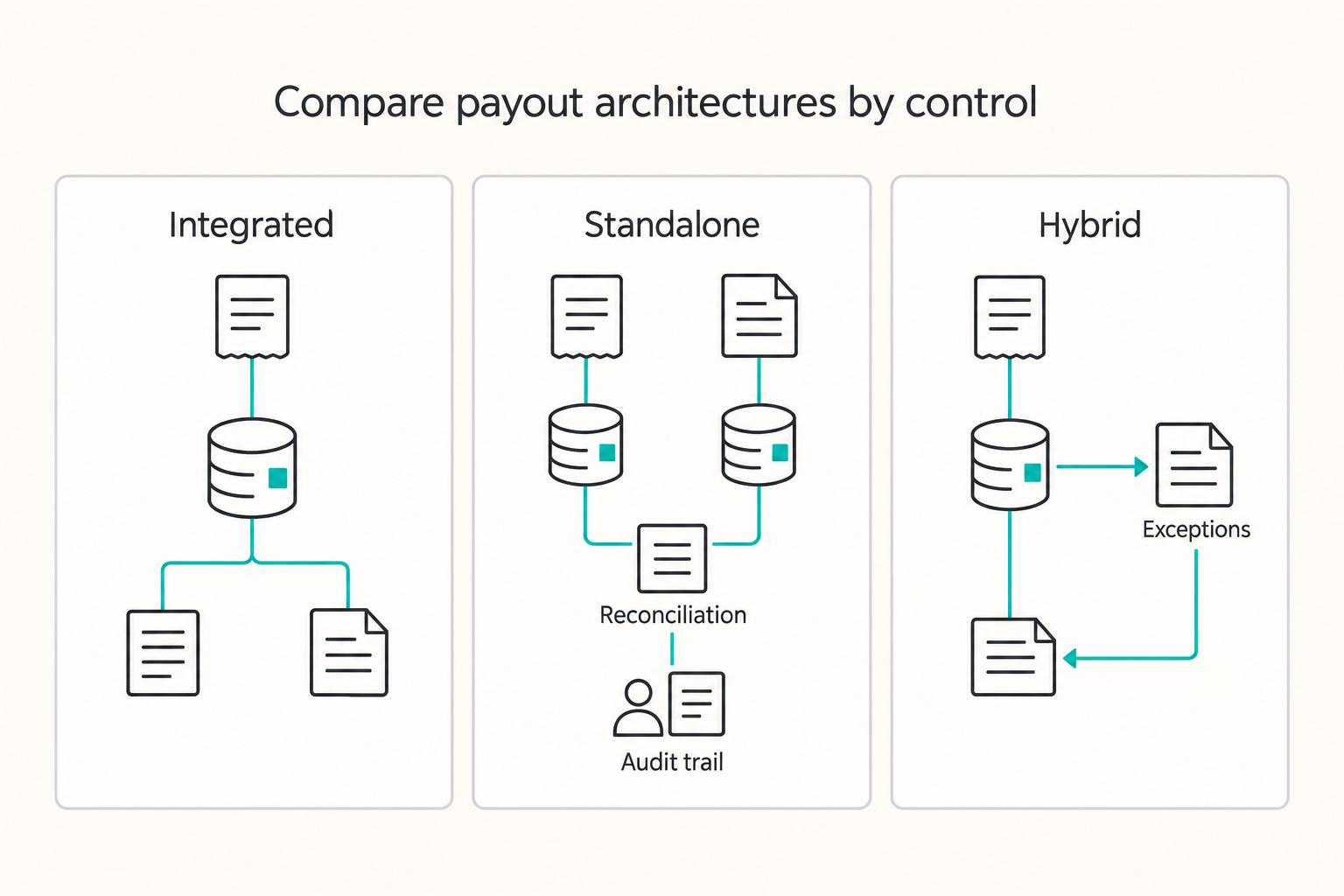
Here, integrated means a provider supports both collection and payout in the platform’s funds flow. Standalone means a separate provider executes disbursements, funded from your platform or another payment system. Hybrid means multiple governed routes. These are working architecture definitions, not universal vendor product categories.
Separate provider choice from record integration. A standalone service can be deeply integrated into your platform ledger, while a single-provider design can still require manual reconciliation. The decision depends on the funds flow, responsibilities, and evidence you can obtain.
This guide is for the people who usually inherit the downstream mess when that call is made too casually: founders, product owners, finance leads, ops managers, and engineering teams running contractor, creator, or two-sided marketplace flows. The goal is practical. You should come away knowing where an integrated pay-in and payout approach usually earns its keep, where a standalone payout approach can still be the safer choice, and when a hybrid architecture is the more honest end state.
Start with one simple check: verify what is actually connected and where the handoff happens. Do not rely on marketing labels like "integrated" alone. Ask whether transaction records and operational reporting are connected in one place, or whether your team will still need to reconcile across separate tools and exports. That check can surface hidden work early.
One planning risk is choosing on surface convenience. Teams may choose an integrated path because it promises simpler operations, or a standalone path because it appears easier to slot in quickly. The harder work is often ownership: who handles exceptions, who verifies status across systems, and who explains mismatches when money movement and reporting do not line up cleanly.
One scope note before you commit roadmap or contracts: verify what your provider and stack actually support for your specific flows and reporting needs before you lock implementation. Related: Invisible Payouts: How to Remove Payment Friction for Contractors Without Sacrificing Compliance.
At-a-glance comparison for platform teams#
Use the table to identify what each design must prove. Clean reconciliation and resilience depend on the implementation, not the integrated or standalone label.
| Criteria | Integrated pay-in/payout solution | Standalone payout solution | Hybrid payout architecture |
|---|---|---|---|
| Funding | Document collection availability, reserves, and payout funding rules | Document how funds reach the payout provider and reconcile that leg | Set separate funding and balance controls per route |
| Reconciliation | Join incoming payment, internal transfer, and external payout where applicable | Automate funding and payout references back to the obligation | Preserve one authoritative obligation and ledger across routes |
| Disputes and returns | Establish liability and any balance recovery | Separate collection disputes from payout returns | Prevent adjustments being applied twice across providers |
| Incentives | Test whether the flow supports approved adjustments | Map incentive approval to payout intent | Define route selection from documented requirements |
| Identity and tax | Confirm provider checks and platform obligations | Confirm handoffs and retained duties | Keep evidence access and policy versions consistent |
| Failure recovery | Resolve unknown submissions before replacement | Resolve funding and payout outcomes separately | Use one executing route per obligation; do not fail over unknown execution |
| Cost | Measure fees, FX, reserves, and support work | Include funding, integration, and reconciliation cost | Include both routes and governance overhead |
Two checks should drive the decision:
- Reconciliation reality: once you run multiple providers with different payout cycles, dashboards, and reporting methods, reconciliation complexity rises quickly.
- Model evaluation discipline: choose the model that holds up across benefits, total cost of ownership, and risk together, not demo simplicity.
Before shortlisting vendors or designs, trace one payout end to end (API request -> provider reference -> posting record -> finance export). For hybrid, trace one exception case too. If those traces require cross-dashboard stitching or spreadsheet joins, treat that as architecture risk, not implementation noise.
What changes in your operating model when you choose each architecture#
The main difference is the provider boundary. An integrated collection-and-payout flow can share provider records; a separate payout flow needs an explicit funding and reference handoff. Both need platform approval rules and ledger controls.
| Architecture | Core split | Source-of-truth pressure | Who feels the work first |
|---|---|---|---|
| Integrated | Transaction and payout logic stay connected in the same software path | Higher pressure to keep records and audit trail aligned across the full money flow | Product, Engineering, and Finance together |
| Standalone | Disbursement runs through its own API and payout batch lane | Higher pressure to reconcile across separate transaction and payout histories | Finance and Ops first, then Engineering on exceptions |
| Hybrid | Core flows stay connected, with a separate lane for exceptions | Requires explicit rules for which record is authoritative in each lane | Shared ownership, with clear boundaries required |
Where the record really lives#
As volume grows, the key question becomes: which record is authoritative when systems disagree? If transaction history and disbursement history live in different places, your team has to reconcile that split in reporting and audit trails.
Trace one normal payout and one exception from approved obligation to funding, provider submission, status evidence, and journal entries. Automating joins across providers can be a sound design; undocumented manual reconstruction is the gap to fix.
Ownership shifts with the architecture#
Integrated designs usually pull Product, Engineering, and Finance into one operating loop. Product defines earning and release rules, Engineering owns API and webhook behavior, and Finance signs off on the record used for reporting and audit.
With a separate provider, name who owns funding, reference joins, returns, and recipient support. Measure those tasks before estimating operating cost; a documented automated handoff can reduce manual work.
One concrete distinction is transfer versus payout. In Stripe Connect, a transfer between platform and connected-account balances is separate from a payout to an external bank account. A connected provider flow still needs both records where both legs exist; do not treat a transfer success as bank receipt.
Revisit the design when coverage, funding, volume, or provider terms change. Use operating evidence and actual migration cost rather than a fixed refresh interval.
If payout reliability and contractor experience are part of the decision, see Bad Payouts Are Costing You Supply: How Payout Quality Drives Contractor Retention.
Costs and failure modes to include in the decision#
The hidden cost most teams miss is concentration risk, not just the quoted payout fee. If one provider sits in the middle of your payout lane and you have no real fallback, one outage, deprecation, or vendor pivot can disrupt core workflows. The blunt rule is still useful: if your team cannot explain API request -> provider reference -> posting record for a payout, you are not ready to scale either model safely.
This is not only a standalone problem or an integrated problem. Either architecture can become a single point of failure when ownership, replay handling, and fallback routing are vague. And when that failure hits, the impact is usually wider than downtime: lost revenue, damaged relationships, and a long cleanup cycle for Ops and Finance.
A provider outage does not always permit failover. If submission may have executed, preserve the original intent and investigate its state before using another route. Otherwise a second provider can pay the same obligation twice.
Red flags that should stop rollout#
| Red flag | Control area |
|---|---|
| no explicit audit trail | audit trail |
| no owner for failed webhook replay | ownership and replay handling |
| no documented fallback when provider routing degrades | fallback routing |
If any of these is unresolved, pause rollout until it has a named owner and a documented fix.
Use the same identifiers in the cross-team walkthrough. Confirm that automated joins and provider reports can reconstruct a payout without undocumented manual edits.
Which architecture fits your platform scenario#
Select the narrowest architecture that meets current requirements. Add another route when the first cannot meet a documented coverage, funding, cost, or continuity need and you can operate the extra controls.
| Platform scenario | Default pattern | If/then trigger | Decision criteria to check first |
|---|---|---|---|
| Early low-volume platform | Start with one eligible route | Add another only for a documented gap | Funding and manual work |
| High-growth marketplace | Compare joined collection/payout and separate disbursement | Choose from evidence, not a default hybrid label | Coverage, liability, record joins, returns |
| Cross-border contractor network | Route by corridor and recipient eligibility | Multiple providers only where required or beneficial | Documentation, funding, delivered cost, restrictions |
| Incentive-heavy creator platform | Keep earning rules separate from execution | Frequent adjustments need controlled intents, not necessarily another provider | Adjustment approval and duplicate prevention |
Worker tax status can affect documentation, withholding, and reporting. An individual’s foreign-earned-income exclusion or FBAR filing does not by itself determine which payout provider or route the platform should use.
Set explicit lane rules early: what stays in integrated core, what moves to standalone, and which record is authoritative when a payee appears in both lanes.
Do not migrate all flows at once without proving parity on reconciliation outputs and audit-trail outputs first.
Compliance and tax control points that should change your decision#
Keep the evidence needed for your applicable identity, withholding, reporting, and provider capability rules connected to the payout decision. Confirm which duties the platform retains when a provider performs verification.
| Control point | What must be true | Why it should affect architecture |
|---|---|---|
| Identity and capability | Applicable provider requirements and enabled payout states | Record who verifies and who may restrict release |
| Tax documentation | Payee status, entity type, payment category and service location where relevant | Choose appropriate documentation and withholding/reporting paths |
| Reporting continuity | Payment amounts, dates, corrections, and supporting tax records | Preserve evidence across provider changes |
| Privacy | Restricted evidence storage with references in finance exports | Do not copy full identity or tax documents into general logs |
What to verify before go live#
Treat this as an internal-control design check, not a single-field profile setup. Finance should be able to export, in one pass, the payout record, tax-status evidence used at decision time, and the posting record tied to the books. If that export is fragmented, your operating model is likely under-specified.
| Item | Type | Expectation |
|---|---|---|
| payout record | Export | Finance should be able to export it in one pass |
| evidence references and applied tax treatment | Restricted reference | Keep the decision reviewable without exposing full documents in a general export |
| posting record tied to the books | Export | Finance should be able to export it in one pass |
| policy matrix | Artifact | Practical minimum |
| exception log | Artifact | Practical minimum |
| masked PII handling plan | Artifact | Practical minimum |
| exportable audit pack for Finance | Artifact | Practical minimum |
A practical minimum is a policy matrix, an exception log, a masked PII handling plan, and an exportable audit pack for Finance. These do not create compliance on their own, but they make ownership and retrieval gaps visible before scale.
The failure mode to avoid#
Preserve the link between the payout decision, required evidence, and accounting effect across every route. If one path cannot produce that evidence, improve its integration or select another provider rather than treating a hybrid design as inherently safer.
Implementation sequence with verification checkpoints#
Treat rollout as a stage-gated promotion, not a one-time cutover. Set explicit validation thresholds at each step, and do not ramp volume until the evidence chain is complete enough for non-Engineering teams to verify.
| Step | What you do | What you verify before moving on | Red flag if it fails |
|---|---|---|---|
| 1 | Baseline current state | Failed payout reasons, reconciliation cycle time, manual touch count, chargeback handling latency | You cannot tell whether the new path improved outcomes |
| 2 | Implement core API and webhook path | Idempotent retries avoid duplicate attempts, ledger posting matches payout state, audit trail is complete | Payouts look successful, but records are not traceable end to end |
| 3 | Run a limited cohort and shadow comparisons | Only one route executes each payment; compare records and exceptions | Old and new routes both disburse the same obligation |
| 4 | Add another route where justified | Resolve original execution before replacement; document funding and operator ownership | Unknown submissions get paid again through a different provider |
| 5 | Gate production rollout | Explicit owner sign-off on reconciliation and compliance evidence before ramp | Launch proceeds with unresolved ownership or missing export evidence |
Start with measurement so your decisions are based on evidence, not memory. Then validate the narrowest working flow first, keep parallel validation intentionally small, and add fallback handling only after core traceability is stable. Skipping that sequence is how preventable failures become higher operating cost and liability later.
Decision checklist you can use this week#
Do not lock the architecture until you can answer these with named owners, one sample payout trail, and documented operating inputs.
| Check | What to confirm |
|---|---|
| Dominant payout patterns | Whether most volume is straight-through disbursements or frequent adjustments are part of normal operations |
| End-to-end trace | Verify a real chain from API request to provider reference to posting record to finance export |
| Exception ownership | Assign clear primary and backup owners across teams |
| Onboarding, compliance, and tax inputs | Document them before build decisions |
| Hybrid split | Document which flows stay integrated vs standalone, why, and who owns each lane |
Conclusion#
Choose the option that meets your funds-flow and coverage needs with records Finance can reconcile and exceptions Ops can resolve. Add a second route only when its benefit is explicit and its funding, liability, and execution rules are owned.
For example, a marketplace may record a $100 customer collection and a $70 seller obligation. In a connected-provider design, the $70 may move first to the seller’s provider balance and later to the bank. With a separate payout provider, funding and disbursement create another handoff. Both designs must preserve the $70 obligation, each money-movement reference, and any return. The amounts are illustrative; fees and reserves would add their own entries.
Use the same acceptance criteria for both designs: trace approved obligation, funding, provider execution, final outcome, and accounting entries. An automated cross-provider join can meet that standard. An unexplained spreadsheet adjustment cannot.
The most useful next step is not another round of abstract debate. Build your comparison table with your actual constraints and force each option to answer the same operator questions:
- How will this handle your primary transaction-linked payouts?
- Which flows need a separate lane, such as bonuses, tier changes, or manual corrections?
- What exact evidence will Finance receive for reconciliation and audit review?
- Who owns failed webhook replays, payout exceptions, and refund or reversal mapping?
- Where are the market and program coverage gaps that could block launch later?
Run an end-to-end example and a return or unknown-submission case. Save funding and payout references, check the accounting entries, and inspect the export Finance will use. Document any manual step and its owner before estimating implementation or close savings.
Confirm coverage and responsibilities, prove reconciliation and unknown-outcome handling, and estimate operating cost from your own cohort. Keep the chosen design as simple as those requirements allow.
For more, see Mass Payouts for Gig Platforms That Teams Can Actually Operate.
Frequently Asked Questions
What is the practical difference between an integrated pay-in/payout solution and a standalone payout solution for a platform?
An integrated collection-and-payout provider can share records across the incoming and outgoing legs. A separate payout provider needs an explicit funding handoff and reference mapping. Either can be integrated into your platform ledger; test the actual trace rather than the product label.
Is integrated payouts always the better choice for scaling platforms?
No. Compare actual eligibility, funding, liability, cost, and reconciliation evidence. A one-provider design can reduce interfaces but also concentrates dependencies. A separate provider can work well when funding and record joins are explicit and automated.
Can a standalone payout solution still scale if we have strong ops and engineering?
Yes. Maintain an authoritative payout intent and ledger, automated funding reconciliation, provider state mapping, and owned exception queues. Verify returns and unknown submissions as carefully as successful payouts.
Why do mature platforms often end up with a hybrid payout architecture?
Coverage or funding needs may justify more than one route. Hybrid adds its own state and funding controls, so use it when a documented need outweighs that cost. A mature platform can also remain with one provider if that flow meets its requirements.
How should bonuses, tiered commissions, and one-off incentives change our architecture choice?
Treat them as an exception test, not proof that one architecture is always right. Validate one real case end to end before committing, including how it appears in finance exports, how reversals or refunds are handled, and whether the audit trail is clear.
What should we validate first when public comparisons do not show clear TCO or implementation timelines?
Measure your current manual touches, reconciliation time, failure rates, funding cost, and maintenance effort. Ask candidates for a scoped implementation plan and sample reports. Validate a normal payout, a return, and an unknown submission before estimating savings.
Try a related tool
Researched and edited by the Gruv editorial team. Gruv builds cross-border billing, payouts, and finance-operations software for global businesses.
Sources
Educational content only. Not legal, tax, or financial advice.
Related Posts
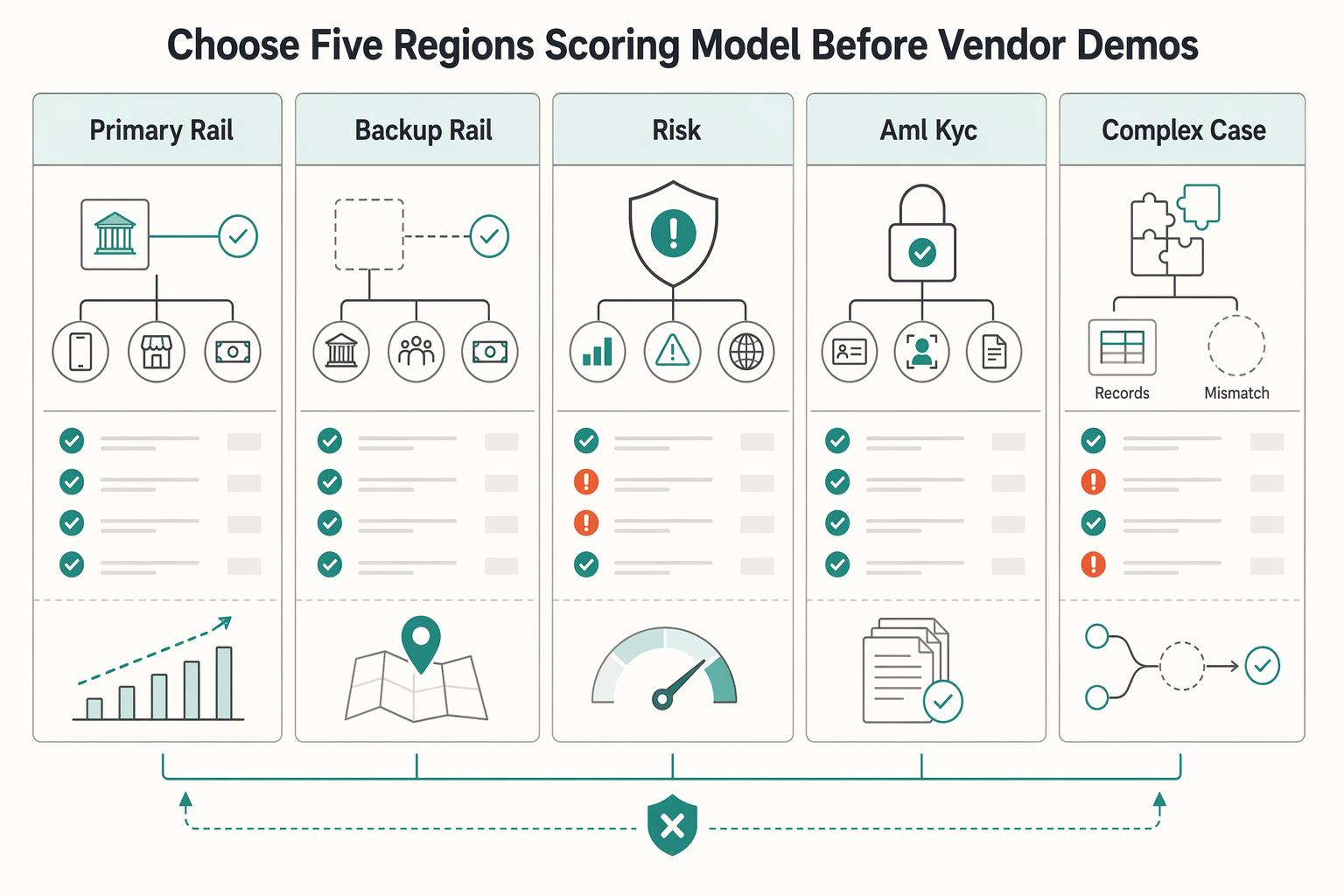
How Platforms Should Prioritize 5 Emerging-Market Payout Regions
If you are choosing where to launch cross-border payouts in 2026, start with what your team can actually run. Too many "top" lists lean on hype or market-cap tables. That may work for headlines, but it does not help with execution.
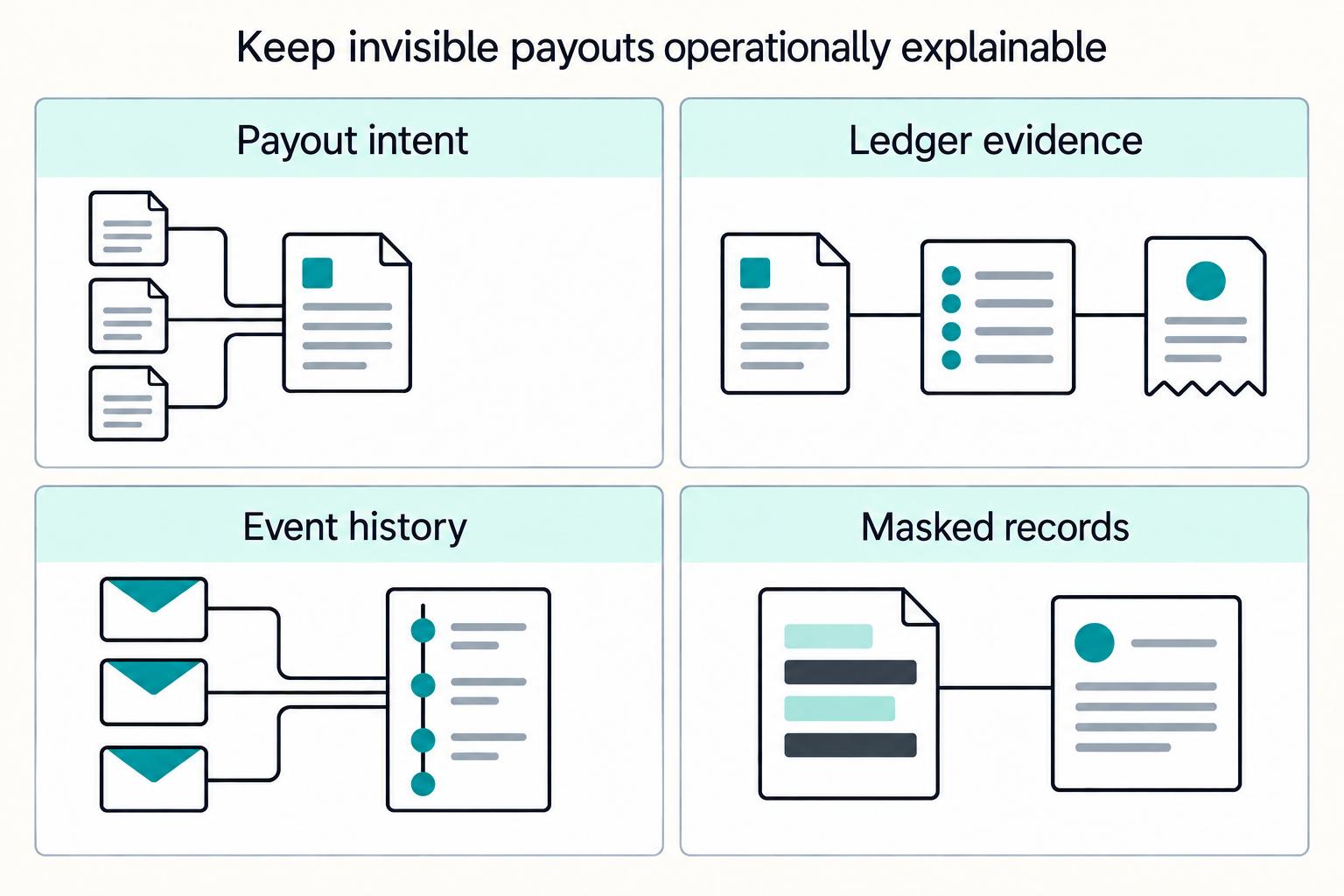
Invisible Payouts: How to Remove Payment Friction for Contractors Without Sacrificing Compliance
Invisible payouts should make life easier for contractors without hiding the controls your team needs. Contractors should get a predictable, low-friction flow, while internal teams can still enforce and document payout decisions when needed. If you run contractor payouts at scale, you need both outcomes at once. We recommend treating every easy payout as a controlled release path your team can replay later.
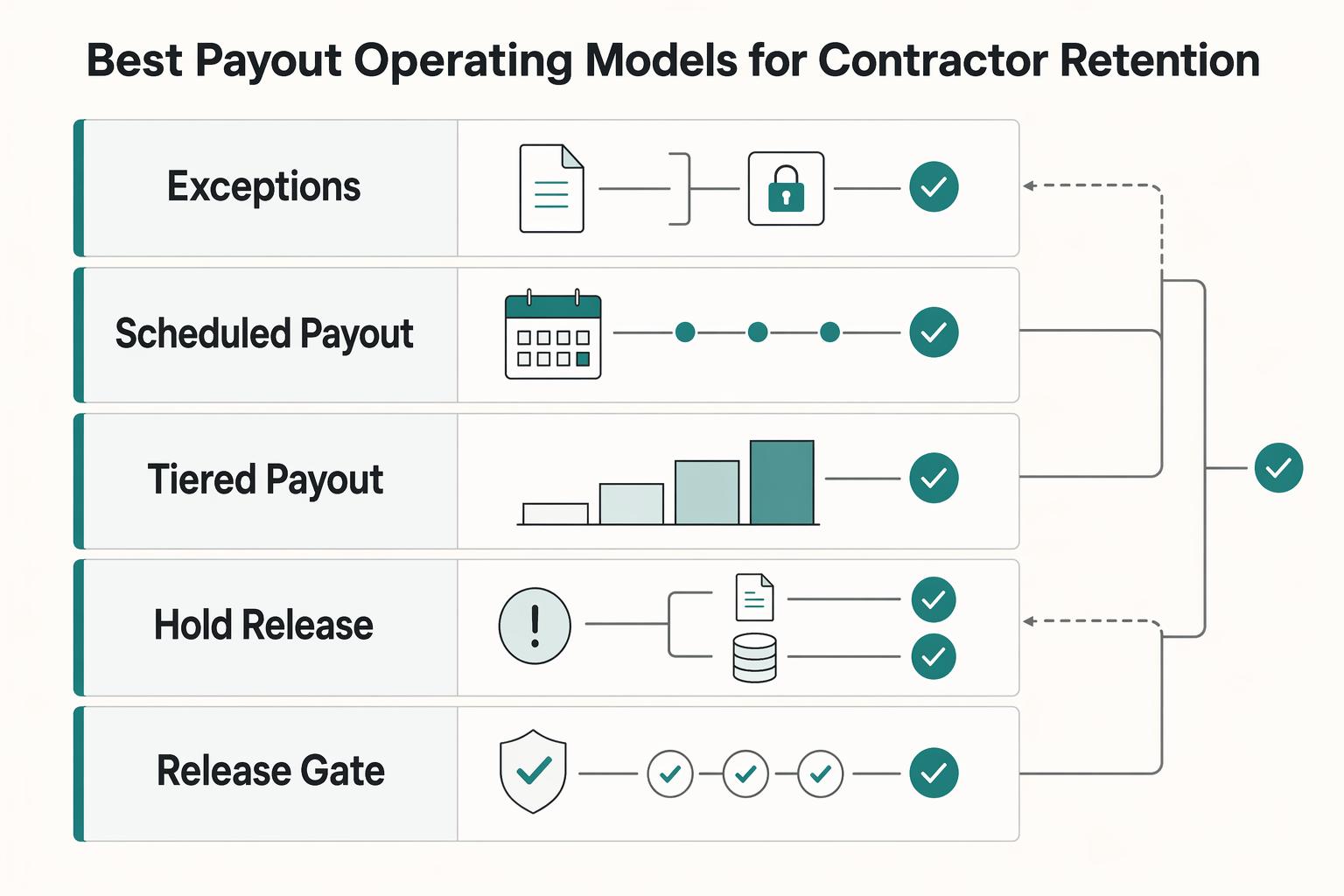
Bad Payouts Are Costing Your Supply in Two-Sided Platforms
Payout issues are not just an accounts payable cleanup task if you run a two-sided marketplace. They shape supply-side trust, repeat participation, and fill reliability. They can also blur the revenue and margin signals teams rely on.