
Quick Answer
Choose the card-payout route that proves recipient eligibility, acceptable credit timing, low exception cost and reconcilable status in your actual corridors. Visa documents AFT funding and OCT push primitives; ecommpay documents a specific Mastercard MoneySend FT/PT mapping. Neither proves a universal price or recipient-visible SLA for your program.
What This Comparison Covers#
If you need an evidence-first decision on visa direct vs mastercard send payouts, this guide keeps the focus on operating reality rather than marketing language. It covers payout mechanics, recipient eligibility, timing, cancellation limits, reconciliation impact, and the unknowns you still need a provider to confirm.
The scope is intentionally narrow: card-based Push to Card payouts, disbursements, and marketplace money movement across Visa Direct and Mastercard Send. These are payment rails, meaning digital networks that move funds between payers and payees. This is not a bank-transfer comparison, a stablecoin rail comparison, or a full treasury architecture debate.
Category confusion leads to bad rail decisions. Visa Direct for Card documents an OCT push to an eligible card-linked account and an optional AFT pull when the program funds from a card. Mastercard Send disbursement and MoneySend details depend on the contracted API and provider. Neither network headline proves a specific recipient’s eligibility or final credit time.
This comparison separates confirmed operator facts from soft claims and open gaps. Where evidence is clear, we treat it as confirmed. Where evidence is partial, blocked, or corridor-specific, we flag it for direct provider confirmation. One recurring checkpoint is required-field validation in provider docs before pilot signoff, so schema gaps do not first appear in production.
This guide also covers failure modes, not just the happy path. One documented constraint is that credit transactions may not be cancellable once processed, which directly affects retry design, support handling, and approval controls. If non-reversible payout mistakes are unacceptable for your model, build idempotency, operator review states, and payout evidence into day-one operations. By the end, you should have four usable outputs this quarter:
- an at-a-glance comparison matrix
- scenario-based recommendations by platform type
- failure-mode checks for finance and ops
- a launch checklist for pilot, rollout, and control validation
The goal is practical: understand where one rail may be stronger, where the public record is still thin, and what to validate before you promise speed or coverage to users. If your decision depends on corridor-level certainty, provider confirmation and pilot data matter more than headline claims.
Visa Direct vs Mastercard Send at a glance#
The public documents establish different primitives and integration surfaces, but they do not provide a common, contract-ready recipient-visible SLA or price for every corridor. Decide from written program eligibility and the same pilot measurement on both routes; keep issuer and provider behavior separate from network capability.
| Comparison point | Visa Direct | Mastercard Send / Mastercard MoneySend | Confidence | What to do now |
|---|---|---|---|---|
| Published card-payout primitives | Visa Direct for Card documents AFT pull/funding and OCT push; use either independently or together as the approved program permits | Mastercard Send has disbursement, funding and P2P APIs; ecommpay’s MoneySend implementation labels debit FT and credit PT | Confirmed mechanics, program-specific mapping | Request your processor’s exact endpoint and transaction-state map |
| Recipient endpoint | Visa says the OCT credits an account linked to an eligible Visa card | Mastercard endpoint and recipient identifier requirements depend on its contracted program and provider | Conditional | Validate actual issuer, card type, corridor and required fields |
| Timing and price | Visa describes real-time request processing, while actual availability varies by receiving institution/account and region | Mastercard/provider pricing and recipient-visible timing are not uniform public promises here | Unknown for this contract | Measure p50/p95 recipient credit and quote fees for each corridor |
| Cancellation and failures | Visa documents canceling a deferred OCT before processing, transaction query, and reversal of a failed funded push under its rules | Ecommpay marks a processed credit as non-cancellable in its implementation; confirm Mastercard/provider exception rules | Source-specific | Record the last cancellable state and failure/reversal owner |
| Reconciliation | Visa transaction identifiers link funded pull and subsequent push; query supports timeouts | Mastercard Send release notes document local transaction time in reconciliation reports; provider IDs and callbacks vary | Documented surfaces | Tie API reference, callback, ledger journal and final recipient result |
Use the confidence labels literally. Confirmed means directly supported by published documentation. Partially confirmed means category-level signal without rail-level launch detail. Unknown means not safe to assume for production decisions.
Copyable dual-rail pilot scorecard#
Use the same period, corridor, recipient mix, funding source and payout sizes for each contracted route. Do not fill an unknown cell with a network headline. Set pass thresholds before traffic and review failed/ambiguous cases with finance and support.
| Measure | Visa route result | Mastercard route result | Evidence to retain |
|---|---|---|---|
| Eligible recipients / attempted | Record count and issuer/card exclusions | Record count and issuer/card exclusions | Provider eligibility response and program rule |
| Recipient-visible credit p50 / p95 | Measure request-to-credit timestamps | Measure request-to-credit timestamps | Request, provider and recipient confirmations |
| Unresolved or returned / attempted | Count and age by reason | Count and age by reason | Query/callback, return and final disposition |
| Effective cost per completed payout | Fee + FX + retry + manual review | Fee + FX + retry + manual review | Contract quote and operations time log |
| Ledger match rate | Match provider IDs, amount and final state | Match provider IDs, amount and final state | Journal, callback and reconciliation export |
How each payout actually moves money in production#
In production, it is useful to model these payouts with two checkpoints: when funds are initiated and when recipient credit is confirmed. If you only model final credit, product, ops, and finance can read the same payout differently, and reconciliation can break down.
| Production view | Visa Direct | Mastercard Send | What to verify |
|---|---|---|---|
| Rail positioning | Described as a credit push that runs on debit card rails | Positioned as a card-network payout option for cross-border movement | What the provider documents for your corridor and issuer set |
| Processing reality | Speed-focused positioning does not guarantee a fixed delivery window | Same | Where delays can occur and how exceptions are surfaced |
| Recipient input | Treat as card-based routing | Treat as card-based routing | Corridor- and provider-specific identifier rules in writing |
| Ops checkpoint | API acceptance is not final payout success | Same | Evidence of acknowledgment, exceptions, and final outcome |
Treat rail labels as control points, not jargon#
Use internal labels for funding and recipient-credit checkpoints as an operating model, not as a claim about exact message choreography or field requirements. The practical value is that your teams can separate where value is initiated from where value is pushed out.
That distinction matters when outcomes diverge. A payout can be accepted in an API call while the recipient side is still unresolved. Where available, funds receipt acknowledgment is stronger evidence than submission success alone.
Align operator and API-triggered operations before launch#
Your API should create payout intent and return traceability data, but it should not be your only source of truth. Operator and API-triggered views should reflect the same working checkpoints: request accepted, acknowledgment or exception, and final posted outcome.
Set one rule across product and engineering: completion means a provider-confirmed end state, not just request receipt. That guardrail matters in cross-border flows, where recipient-visible credit can lag an accepted payout request.
Recipient identifiers affect UX and support load#
Card-based entry can be explicit and easier to troubleshoot against a specific recipient instrument, but it can add user friction and input-error risk.
If your Mastercard Send path includes proxy identifiers like mobile or email, treat that as conditional. Confirm exactly where proxy resolution is supported and what fallback path is used when resolution fails.
Reconciliation must survive delays, exceptions, and audits#
Each payout record should retain internal IDs plus external references for submission, acknowledgment, and outcome events. That is what lets finance map one user withdrawal to one internal ledger movement and one external payout trail.
If a provider cannot clearly map these events to API activity, operator visibility, and reconciliation references, pause launch. Fast rails without traceable state transitions create fast-moving support and finance failures.
Related: Payee Verification at Scale: How Platforms Validate Bank Accounts Before Sending Mass Payouts.
Speed claims and what they mean in real operations#
Once you break payout flows into steps, speed language is easier to read. Treat it as marketing until your own data proves otherwise. For Visa Direct and Mastercard Send, "near real-time," "within 30 minutes," and "seconds" are different statements, not interchangeable SLA commitments.
| Phrase you will see | What it tells you | What you still need to verify |
|---|---|---|
| Near real-time push payments | Fast card payouts are possible, but this is a descriptor, not a universal commitment | Corridor, issuer participation, and endpoint eligibility |
| Within 30 minutes | One published Visa Direct framing says transactions typically complete in this window | Whether your flow is in Fast Funds and whether the recipient has an eligible Visa card |
| Seconds | Some payouts may arrive this quickly | How often that happens in your real recipient mix, not just best-case paths |
The main gap is eligibility. One source describes Visa Direct as typically within 30 minutes, while another narrows that timing to eligible Fast Funds transactions and says many arrive in seconds. Mastercard Send is also described as a real-time push payment platform, but that still does not mean every issuer, card, or corridor behaves the same way.
Operationally, timing has checkpoints. An Original Credit Transaction (OCT) is the card-network transaction type used to push funds to cardholders, so API acceptance alone is not a safe basis for an "instant" product promise.
If timing is user-critical, benchmark against your own recipient mix before you publish promises. Use a pilot cohort across your top corridors and issuers. Track request accepted, payout-leg acknowledgment, and final posted outcome. If results do not consistently support "seconds," publish a wider window. Also be careful with retries: some credit transactions cannot be canceled once processed.
You might also find this useful: What Is an IBAN Number? How Platforms Use IBANs to Send Error-Free European Payouts.
Coverage and endpoint eligibility by corridor#
Coverage is a launch gate, not a marketing line. Do not publish corridor-level claims until both rails pass live recipient eligibility tests in that corridor.
For Visa Direct, public descriptions are broad but conditional. It is described as supporting domestic and cross-border transfers to eligible cards, bank accounts, or digital wallets, with 24/7 operation including weekends and holidays. Those same descriptions also say outcomes can depend on the recipient bank or wallet provider and regional factors. In practice, treat a corridor as "covered" only after your provider confirms the endpoint types you need and your test cohort posts successfully.
Segment coverage by payout flow, not by network logo. Test domestic payouts, cross-border disbursements, and withdrawals separately because endpoint mix and recipient behavior may differ by flow. For Mastercard Send, treat corridor and endpoint coverage as unknown until your provider confirms it and your own tests pass.
| Corridor check | What is described for Visa Direct | What you must confirm before launch |
|---|---|---|
| Endpoint types | Eligible cards, bank accounts, and digital wallets | Which endpoint types are enabled in your processor setup by corridor, and Mastercard Send parity in that same corridor |
| Geography model | Domestic and cross-border transfers | Live corridor availability, country support, and issuer participation for each rail |
| Weekend/holiday behavior | 24/7 operation is described | Actual posting behavior and exceptions in your target corridors |
| Recipient dependency | Delivery can depend on recipient provider and regional factors | Institution-level eligibility and failure concentration in your recipient mix |
| Error controls | Alias directories and account validation are described as error-reduction tools | Whether those controls are available and enabled in your provider configuration |
Use a simple go or no-go gate per corridor:
- Run both rails on real recipient cohorts for each payout flow.
- Require eligibility pass rates plus successful posted payouts, not just API acceptance.
- Delay "available in X" or "instant" copy until both rails clear your threshold, or narrow scope to the rail and corridors that actually pass.
The real cost model behind card-based payouts#
Do not choose a rail on the quoted transaction fee alone. For card payouts, total cost is the full fee stack plus operating costs tied to retries, exceptions, and reconciliation.
A useful decision rule is simple: if projected retry and exception cost is bigger than the per-transaction quote gap, choose the rail with more predictable outcomes in your pilot.
| Cost layer | Visa Direct | Mastercard Send | What to verify before launch |
|---|---|---|---|
| Direct rail quote | No single universal per-transaction fee is publicly documented | No single universal per-transaction fee is publicly documented | Get written pricing by corridor and payout type, not one blended card-payout line |
| Wholesale network + issuer economics | Card economics can include non-negotiable components (for example, interchange and assessment) inside blended pricing | Same structure risk | Separate pass-through components from processor-controlled components |
| Processor markup | Usually the main negotiable lever | Usually the main negotiable lever | Ask for explicit markup disclosure instead of all-in pricing only |
| FX spread and conversion | Cross-border programs may include FX spread and conversion terms when currencies differ | Same risk | Confirm who sets FX, when it is locked, and how spread appears in reporting |
| Retries, returns, refunds | Confirm cancellation and refund rules for the contracted provider flow; ecommpay's 24-hour Visa debit-refund window is specific to its funding leg | Retry/refund handling must be confirmed with your provider | Confirm whether failed attempts, reversals, and reissues are charged and how they are classified |
| Support and reconciliation overhead | Requires an eligible Visa card; card-based routing can still create operational friction when recipients are ineligible | Can support proxy identifiers like email/mobile in some setups | Test failure codes, webhook detail, export fields, and ledger traceability |
The biggest cost surprise is often not the headline rail fee. It can be the work created when payouts fail, hit ineligible endpoints, or cannot be reconciled cleanly.
Where costs can spike#
Retry cost is the first trap. A failed payout can trigger another attempt plus support touchpoints and finance review. Exception handling is the second trap. Visa Direct's cancellation and refund constraints can make late error discovery more expensive operationally. Reconciliation is the third trap. Proxy-based recipient flows can reduce recipient-data friction, but if reporting does not map cleanly to your internal ledger and recipient record, finance overhead can rise.
Model three operating profiles#
| Operating profile | Monthly cost model |
|---|---|
| Low-volume, high-value payouts | monthly cost = transaction charges + FX cost + failed payout count x manual case cost |
| High-volume micro-payouts | monthly cost = transaction charges + retry charges + support touches per 1,000 payouts |
| Cross-border mixed-currency batches | monthly cost = transaction charges + FX spread cost + exception reissue cost |
For mixed-currency programs, treat network reach claims as screening inputs. Obtain the actual corridor and issuer eligibility matrix, FX terms and recipient-visible outcome from the contracted provider.
What to request before signing#
Ask for a line-by-line commercial schedule: direct rail fees, processor markup, FX treatment, retry billing, return and refund handling, and reporting or support charges. Then validate it against a sample invoice and payout export so each cost line maps to a payout state.
For this decision, cost control comes from predictability, not just rate negotiation. If pilots show similar exception performance, negotiate markup. If they do not, choose the rail that creates fewer retries, fewer manual interventions, and cleaner reconciliation.
If you want a deeper dive, read Debit Card Push Payouts: How Platforms Deliver Funds Directly to Any Visa or Mastercard Debit Card.
Failure modes and controls finance teams care about#
Do not scale card payouts until unclear outcomes are controlled. Visa Direct documentation includes push-funds, return-funds, and error-code paths, so exception handling should be treated as a normal operating path.
Failure paths to force into contract and pilot review#
| Failure path | Evidence in article | Review action |
|---|---|---|
| Post-submission handling ambiguity | Visa Direct documentation includes Using the Funds Transfer API to Push Funds and Using the Funds Transfer API to Return Funds | Treat return handling as a real operating path |
| Outcome changes after handoff | Visa Direct exposes Error Codes, so a payout that looks in-flight in your app can still require exception handling | Treat exception handling as a normal operating path |
| Final-status timing uncertainty | Rail- or corridor-level settlement timing is not defined here | Move unresolved states to investigation instead of automatic resend |
| Retry ambiguity | Unclear status plus timeout, webhook lag, or manual resend can create duplicate movement risk or duplicate investigations | Require written rules on when to retry, when to investigate, and when to use a return path |
For OCT or PT flows, require written rules from your provider on when to retry, when to investigate, and when to use a return path; exact OCT/PT post-processing behavior is not established.
Controls that reduce expensive mistakes#
Use one payout lifecycle model across product, support, and finance. Define internal request IDs and retry rules, plus explicit "investigate before resend" handling for unknown states; exact idempotency-key formats and retry-window durations are not defined here.
Make status mapping visible across provider and internal ops views. Before launch, map Visa Direct Error Codes into retryable, terminal, and manual-review buckets, and include Service Activation Requirements in go-live signoff.
The evidence pack finance will ask for later#
Required reconciliation evidence fields aren't specified here, so treat this as an internal control template per payout before launch:
- provider reference ID
- internal payout ID and ledger journal ID
- request and webhook timestamps
- normalized status history
- final outcome (settled, returned, or unresolved with disposition)
Integration scope for product and engineering owners#
The key integration decision is whether you can keep one internal payout model, one evidence trail, and one operator view while scheme-specific details evolve. Build four surfaces from day one: payout initiation, async event intake, status normalization, and operator tooling in Gate or your admin console.
Mastercard's developer guidance frames this well: some integration work is Broadly Applicable, while Scheme-Specific details may change as network guidance evolves. Your internal contract should stay stable even when provider or scheme mappings change.
| Surface | Minimum build you should own | What to confirm in provider or scheme docs |
|---|---|---|
| API initiation | One internal payout request model, with your IDs and controls for safe retries | Rail-specific request fields, validation rules, and network references |
| Webhook or async event handling | Persist inbound events with timestamps, raw payloads, normalized status, and provider references | Exact event names, delivery semantics, retry behavior, and ordering |
| Status normalization | Map external outcomes into a small internal status set your teams can operate | Scheme-specific error taxonomies and corridor nuances |
| Gate or admin tooling | Give ops a timeline view with request, status history, references, and controlled resend/investigate actions | Which evidence fields are exposed in dashboard vs API |
Treat the early data contract as a launch dependency, not cleanup work. Public material here does not establish exact required recipient identity fields, payout-purpose keys, or trace-ID formats for Visa Direct or Mastercard Send. Keep those as open items for provider confirmation and reserve space in your internal model now.
Resend control is another early checkpoint. Avoid blind replay of a payout request after an uncertain outcome. Check the provider status and internal ledger first; if another send is warranted, create a linked attempt under your approved retry policy so operators can trace both attempts.
A sensible sequence is sandbox validation, then production shadow mode, then a controlled live cohort with rollback criteria. That is an operating recommendation, not a documented network requirement. It fits the step-based integration discipline where testing is explicit, for example where Visa's quick start calls out testing as Step 5.
If you operate multiple payout rails, keep routing abstracted behind one payout service and one Gate or admin view so your team can debug, reconcile, and roll back without creating a second operations process.
Compliance and recipient data constraints before launch#
Before you compare rail speed, confirm your program is eligible to send and your payout requests are complete. Some delay investigations framed as "speed" issues can instead involve policy gates, missing data, MCC gating, or program setup.
| Pre-launch check | Visa Direct | Mastercard Send / gateway AFT context | What to verify before launch |
|---|---|---|---|
| Program approval and screening | Visa requires program review and full-lifecycle readiness | Mastercard/provider approval and screening responsibilities are contract-specific | Get written role and program approval before live traffic |
| Recipient eligibility | Validate eligible card/account, issuer and corridor | Validate the contracted Mastercard Send or MoneySend endpoint | Run eligibility tests on the actual recipient mix |
| Data completeness | Use the exact Visa API and corridor-required fields | Use the actual provider/API version; do not transpose gateway AFT fields into Send | Store masked sender/recipient fields and a versioned payload contract |
Do not enable corridor traffic until compliance, ops, and engineering can show a complete sample evidence trail. That trail should include captured sender and recipient data, purpose when used, and the MCC or program basis for eligibility.
Treat recipient-data handling as a launch gate, not backlog cleanup. Define how sensitive sender and recipient details are handled in operations before launch.
If ops repeatedly resubmit failed payouts to “test speed,” stop and validate the exact provider payload, eligible endpoint and transaction state first. Keep any Mastercard gateway AFT format separate from Mastercard Send disbursement rules; get the versioned specification for the actual contracted API.
Scenario-based recommendations by platform type#
Choose the rail that creates the fewest manual exceptions in your real pilot cohort, not the one with the strongest headline. If one option shows cleaner eligibility and less operator intervention, start there and keep the second rail for expansion.
| Platform type | Primary focus | Pilot evidence to compare |
|---|---|---|
| High-frequency marketplaces with variable payout size | Operational stability and end-to-end traceability over paper comparisons | Searchable evidence trail for every completed payout: provider reference, internal ledger ID, and a consistent transaction identifier |
| Cross-border platforms that care most about reach | Corridor evidence over brand-level reach claims | Issuer and endpoint eligibility results country by country, plus return behavior in exact payout corridors |
| Domestic debit-linked payouts where timing is user-critical | Posting behavior on the same domestic cohort | Request accepted, provider approval, webhook receipt, and recipient-visible credit |
| When pricing is close, let operations break the tie | Lower reconciliation and support burden | Fewer exception cases, cleaner webhook normalization, and faster operator search for payout status in pilot |
High-frequency marketplaces with variable payout size#
For high-volume payouts with mixed ticket sizes, prioritize operational stability over paper comparisons. The real question is whether your team can trace each payout end to end without jumping across multiple tools or living with unresolved status states.
In ecommpay's flow model, Mastercard MoneySend uses FT (debit) and PT (credit), while Visa Direct uses AFT (debit) and OCT (credit). These operations map to sale and payout, and debit and credit legs can run separately or combined. In pilot, require a searchable evidence trail for every completed payout: provider reference, internal ledger ID, and a consistent transaction identifier. This is especially important for Visa programs given the risk-guide focus on transaction identifiers and exception investigations.
Cross-border platforms that care most about reach#
If cross-border card payout reach is the core product promise, make corridor evidence the driver. Do not assume either rail is broader in your launch markets until you see issuer and endpoint eligibility results country by country.
Mastercard Send supports domestic and cross-border transfer programs, but eligibility depends on the actual corridor, recipient endpoint, and provider arrangement. Validate coverage and return behavior in your own pilot before committing rollout plans.
Domestic debit-linked payouts where timing is user-critical#
If your domestic pilot shows better posting behavior on one rail, bias launch there. Keep promise language conservative, because posting time for approved transactions can still depend on the receiving financial institution.
Compare timestamped checkpoints on the same domestic cohort: request accepted, provider approval, webhook receipt, and recipient-visible credit. For timing-sensitive domestic payouts, that evidence is more useful than generic speed claims.
When pricing is close, let operations break the tie#
When technical checks pass and quotes are close, choose the rail with the lower reconciliation and support burden. Small rate differences can be outweighed by investigation time, unmatched references, and exception-handling overhead.
Use a simple tiebreaker: fewer exception cases, cleaner webhook normalization, and faster operator search for payout status in pilot. Add the second rail later for coverage expansion instead of taking on operating complexity on day one.
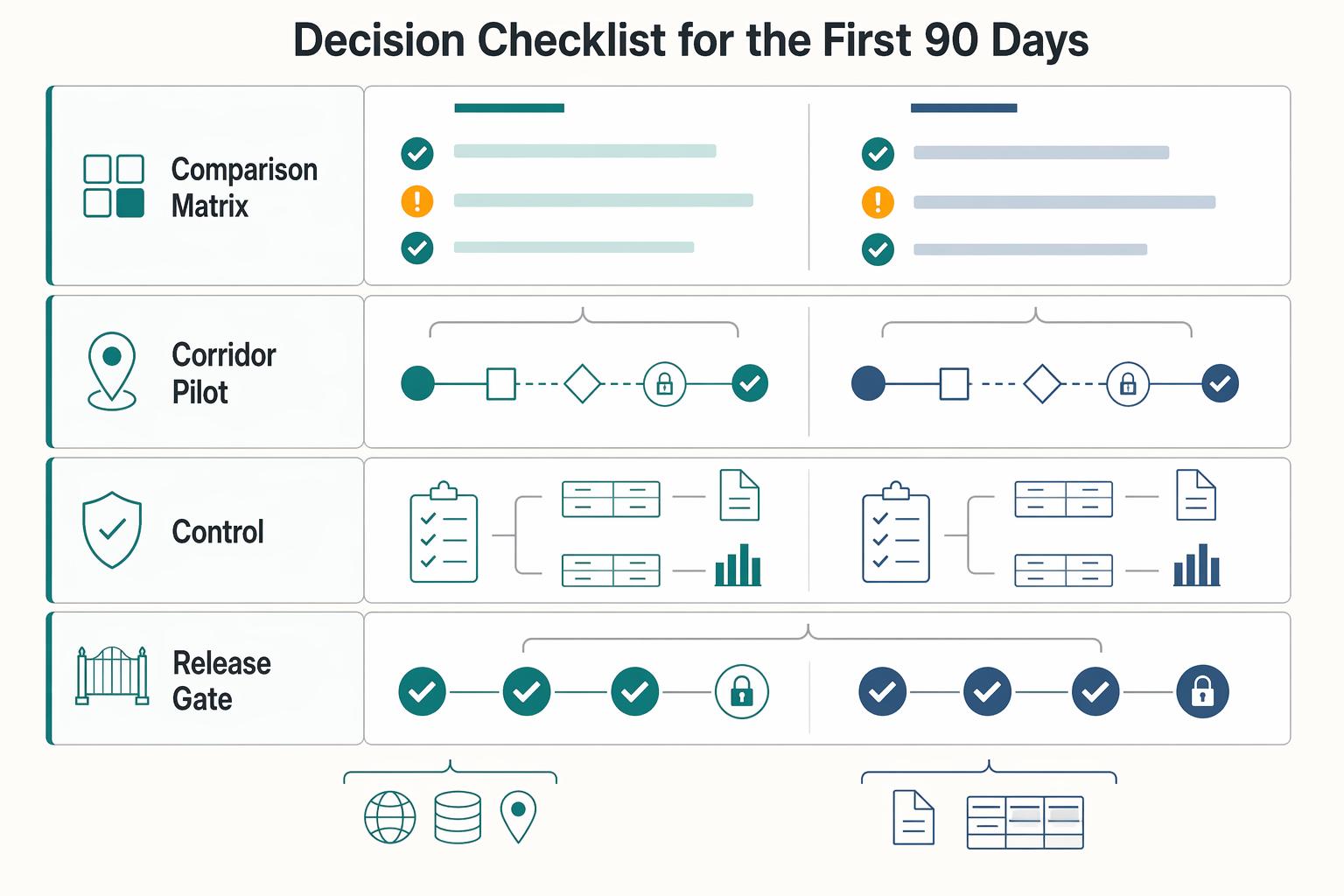
Decision checklist for the first 90 days#
Use the first 90 days to prove operating reliability and reconciliation readiness, not headline speed. Launch only when the rail, any processor dependency, and your internal controls all hold up in pilot evidence.
| Workstream | What to lock down | Launch blocker |
|---|---|---|
| Comparison matrix | Separate confirmed facts from unknowns for Visa Direct, Mastercard Send, and any processor dependency in a Mastercard Send path | Corridor claims or processor assumptions are untracked or unresolved |
| Corridor pilot | Define timing bands, success-rate measurement, return handling, and operator touch time per failed payout | Approvals look fine, but returns, delayed credits, or manual investigation load are not under control |
| Controls | Idempotent retries, complete payout audit trail, and clear owners for exception queues | Duplicate-attempt risk or payouts that cannot be traced from initiation to final status |
| Sign-off | Engineering, payments ops, and finance each confirm reliability and reconciliation readiness | A team is "comfortable enough" but cannot evidence readiness |
Keep the unknowns log specific to payout operations: required recipient fields, provider references, status events, return codes, retry rules, and reconciliation exports for each contracted route. Resolve those items with the provider before treating a pilot approval as launch evidence.
In pilot, measure the checkpoints you will support in production: request accepted, provider approval, webhook received, recipient-visible credit, and any return or exception posted back to your ledger. For each failed payout, retain a failure pack with provider reference ID, internal ledger journal ID, webhook payloads, retry history, and final disposition.
Before launch, make control ownership explicit. Visa describes its network risk program as four components: VARS, VIRP, Monitoring Programs, and the Account Information Security Program. You do not need to mirror those labels, but you do need clear ownership for monitoring, integrity checks, and card-data security. Before locking your pilot plan, align your API and webhook design to operational controls in the Gruv docs.
Conclusion#
Choose based on live operating evidence, not brand familiarity or headline speed language. For Visa Direct vs Mastercard Send payouts, the better rail is the one that performs better in your target corridors with fewer exceptions, cleaner reconciliation, and less support load.
Visa Direct is positioned for near real-time push payouts using Original Credit Transactions (OCTs) initiated through a platform or API. Availability is only typically within minutes and can still depend on the receiving bank's policies. That is the right decision model here: network capability matters, and issuer or bank behavior often determines what recipients actually experience.
Treat network claims as a starting point, not a launch decision. Visa and Mastercard are networks, while issuers can shape many end-user outcomes, so timing and success-rate promises should be validated with real recipients before you commit volume or customer messaging.
Before you scale, use three checks:
- Pilot behavior: Test available routes on the same recipient cohort and track initiation, provider acceptance, webhook receipt, and recipient-visible credit.
- Exception cost: Price retries, support contacts, and manual investigations alongside quoted transaction fees.
- Evidence and controls: Keep a complete payout trail, including provider reference ID, internal ledger journal ID, webhook payloads, retry history, and final disposition, so ops and finance can resolve disputes quickly.
Finally, get a written price schedule for each contracted corridor and payout type, including FX treatment, failed attempts, returns, and support handling.
If you want to operationalize these decisions with compliance-gated flows and traceable payout statuses, review Gruv Payouts.
Frequently Asked Questions
Is Visa Direct faster than Mastercard Send for payouts in practice?
A consistent winner is not established without your own pilot data. Ecommpay describes card-scheme transfers as reaching target accounts in 30 minutes or less, but Visa Direct materials also note that actual fund availability depends on receiving-bank policies. If speed is part of your product promise, test both rails on the same recipient cohort and track request accepted, provider approval, webhook received, and recipient-visible credit as separate checkpoints.
Which rail is usually cheaper for platform payouts once retries and support work are included?
No single rail is established here as usually cheaper overall once exception costs are included. A lower quoted transaction fee can lose its advantage if a route creates more retries, returns, or support tickets. Price manual handling and failure operations alongside rail fees, especially for small payouts.
Can we cancel or reverse a payout after it is submitted?
Do not assume you can. Debit and credit legs can run separately or together, but post-submission cancellation and reversal behavior is not uniform across payout types, issuers, and providers. Before launch, confirm the last cancellable state for Visa Direct OCT and Mastercard PT, then make that rule explicit for support and finance.
What recipient data is required to send payouts successfully?
For Visa Direct, confirmed routing input includes the recipient's debit or prepaid card details. For Mastercard MoneySend, do not assume one universal field set across every program or corridor; validate required fields with your provider and store them in masked, least-privilege views.
Which rail is better for cross-border marketplace disbursements?
No blanket winner is established for cross-border payouts. Corridor-level eligibility and return behavior matter more than brand-level reach claims. Choose the rail that passes live tests in your top corridors, then expand deliberately.
Should we integrate both rails from day one or start with one?
No universal rule is established here. Start with one rail if it clearly covers launch corridors and pilot evidence shows low exception load. Add the second when it closes a real coverage gap, improves outcomes, or reduces concentration risk.
What should we verify in a pilot before committing contract volume?
Verify that the contracted mechanics map to your ledger: Visa documents OCT push and AFT pull where card funding is used; ecommpay specifically maps Mastercard MoneySend FT/PT and Visa AFT/OCT to its sale/payout operations. Keep the provider reference, ledger journal, callbacks, retry history and final disposition for every failed payout.
Try a related tool
Researched and edited by the Gruv editorial team. Gruv builds cross-border billing, payouts, and finance-operations software for global businesses.
Sources
Includes 5 external sources outside the trusted-domain allowlist.
- developer.visa.com/capabilities/visa_direct/docsexternal
- developer.visa.com/capabilities/visa_direct/docs-how-toexternal
- developers.ecommpay.com/en/en_gate_money_transfer_services.htmlexternal
- static.developer.mastercard.com/content/mastercard-send/release-notes/master...external
- static.developer.mastercard.com/content/mastercard-send/release-notes/master...external
Educational content only. Not legal, tax, or financial advice.
Related Posts

The Freelance Payment Penalty: A Modeled Audit of Platform Fees, FX Spreads, and Payout Delays
The money rarely disappears through a single, easy-to-spot fee. The real loss is stacked. A marketplace takes its commission, a processor adds a charge for international cards, a bank or payment company converts the currency at a spread, a platform holds the funds before release, and a wire sheds a little to intermediaries on the way in. Each layer looks defensible on its own, but the worker feels the combined result as a smaller deposit and a later payday.

How to Respond to a Subpoena for Business Records
Move fast, but do not produce records on instinct. If you need to **respond to a subpoena for business records**, your immediate job is to control deadlines, preserve records, and make any later production defensible.
A US Expat's Guide to Investing in UCITS ETFs to Avoid PFIC Issues
The real problem is a two-system conflict. U.S. tax treatment can punish the wrong fund choice, while local product-access constraints can block the funds you want to buy in the first place. For **us expat ucits etfs**, the practical question is not "Which product is best?" It is "What can I access, report, and keep doing every year without guessing?" Use this four-part filter before any trade: