
Quick Answer
Use a proof-first method for a healthcare staffing payout reliability case study: baseline your current batch outcomes, map failure points, redesign rail routing by cohort, and verify that finance cleanup work drops as completion quality improves. The core move is not “pay faster for everyone,” but to combine Gruv controls, explicit gate order, and ledger-linked confirmation so reliability gains do not get canceled by exception handling and reconciliation drag.
Why this case study matters now#
Treat this as a monetization and operations question first. The question is whether a staffing platform could make payouts more dependable with Gruv while keeping margin intact after support load, exception handling, and reconciliation work are counted.
That framing matters because payout reliability is easy to market and harder to prove. A staffing marketplace can say workers got paid faster or had fewer payout headaches. The real operator question is different. Did the change reduce failure handling and admin drag, or did it just move cost from one team to another? If reliability improves on paper while finance ops spends more time chasing exceptions, the economics may not have improved at all.
Examples in circulation can be useful as directional signals only. What we do not have from the available excerpts is the part an operator needs to make a rollout decision: independent validation, payout failure-rate detail, or verified margin impact. Do not overread anecdotal examples as proof of Gruv-specific healthcare staffing results where the evidence pack does not support that conclusion.
So the right stance is evidence discipline, not cynicism. When you evaluate any payments case study, use the same proof standard you would trust elsewhere. A .gov website indicates an official U.S. government organization. A Single Audit is an audit package with reports from independent public accountants.
Even outside payments, the Utah TCIP program is a useful reminder of what structured evidence looks like. It showcases 90 projects across 2015, 2016, 2017, and 2018, and requires each company by contract to provide data updates and grant fund use updates. That is a higher bar than a vague customer win.
Set your proof threshold#
Before you borrow tactics from any case study, decide what would count as believable in your own business. At minimum, you want a clear before-and-after window, a named operating change, and a metric set that ties payout behavior to finance outcomes. Verification point: if you cannot trace the claim back to a documented source, audited-report-style evidence, or raw ops data, treat it as directional, not dispositive.
Use a proof-first decision method#
The goal here is practical. Founders, revenue leaders, and finance operators should leave with a way to test payout changes inside their own platform: what to measure, what to document, where margin can quietly erode, and what unknowns to flag before rollout.
The rest of the article stays anchored to that standard so you can judge whether a payout improvement is real, repeatable, and worth scaling. If you want a deeper dive, read Nursing Agency Payouts: How Healthcare Staffing Platforms Handle Shift-Based Payments.
What payout reliability actually means for margin#
Once you set a proof threshold, apply it to the term vendors blur most: payout reliability. In operator terms, reliability is not just "workers got paid faster." It means four things happen together: payouts complete on time, failed or returned payouts stay low, exceptions are resolved quickly, and payout batches reconcile cleanly to your ledger without manual cleanup. If one of those breaks, margin still gets eaten.
Define reliability at the batch level#
For a staffing platform, the unit that often matters most is the batch, not the anecdote. You want each batch to show what was released, what actually completed, what was returned or held, and a status trail that ties back to your internal payout record. Verification point: if your finance team cannot explain every non-complete line item by the next reconciliation cycle, you do not yet have reliable payout operations.
Price the admin drag, not just the speed#
Healthcare operations can already be resource-constrained. NIH context on work environment and resource allocation is a useful reminder that workforce shortages and policy gaps create real operating strain. That is why payout design has to remove manual work, not simply accelerate the first disbursement attempt. The real economic question is whether the change cuts ticket handling, rework, and finance follow-up across the full payout path.
Reject false wins#
Be blunt about this. If on-time completion improves but exception cost per payout rises, the model is not fixed yet. A common failure mode is celebrating faster releases while support spends more time chasing bad payout details, returned payouts, or unreconciled batch lines. Until you see both cleaner completion and less cleanup work, reliability has improved only on the surface, not in the margin line.
Related: Related payout example.
What to prepare before you change payout design#
Before you switch rails or add faster payout options, freeze the current state and collect the proof file. If you skip this prep, you will not know whether a later improvement came from better payout design or from finance and support absorbing more cleanup.
Build the minimum evidence pack#
Start with the operating facts you can verify in a week, not a giant data project. Your pack should show:
| Evidence item | Detail |
|---|---|
| Payout method mix | Current payout method mix by cohort |
| Exception logs | Failed, returned, held, and delayed payouts |
| Support ticket themes | Tied to payout issues |
| Reconciliation | Delays and unresolved items from finance ops |
Keep it batch-level where possible, because that is where margin damage shows up. A useful checkpoint is simple: can finance and support point to the same set of exception reasons for the same payout period? If ticket tags say "missing payout details" but finance logs say "unreconciled return" with no shared reference, you do not yet have a clean baseline.
This is also where you catch a common failure mode. Teams often redesign the payout experience based on anecdotal complaints from workers, then discover later that the bigger cost sat in manual reconciliation or duplicate handling. The evidence pack should tell you whether the main problem is method coverage, bad input data, exception recovery, or ledger mismatch.
Confirm policy and legal reviews before design work#
Do not treat compliance checks as something to layer in after product decisions. Before changing payout design, confirm with your internal compliance and legal owners that any required reviews and approvals are defined for the model you plan to run. The exact gate set is not established by this section, but the operator rule is still clear: if those requirements are unresolved, hold the redesign.
Use the same discipline for tax ownership and related legal questions. A faster disbursement path does not fix a bad policy assumption, and it can make later remediation harder because volume grows before governance catches up. Verification point: you should be able to name the decision owner for compliance, tax handling, and legal review before engineering starts.
Gather tax artifacts by cohort and flag cross-border reporting early#
Group workers and entities into cohorts before you talk about forms. For U.S. tax handling, that usually means pulling the document inventory you already depend on, then checking whether your planned payout change alters what you need to collect or store. Do not assume one document set fits every worker type or market.
| Form 8938 item | Detail | Scope/timing |
|---|---|---|
| General rule | Specified foreign financial assets above applicable thresholds | Certain U.S. taxpayers must report them on Form 8938 |
| Baseline trigger | More than $50,000 | Some filers |
| Higher thresholds | Higher thresholds | Joint filers and some taxpayers residing abroad |
| Return attachment | Attached to the annual income tax return | Annual filing |
| No return required | Form 8938 is not required | If no income tax return is required for the year |
| Specified domestic entities | $75,000 at any time during the tax year | Certain specified domestic entities |
| Effective period | Tax years beginning after December 31, 2015 | Specified domestic entity filing |
If your redesign could introduce foreign accounts or other new foreign-asset exposure, escalate that review before launch, not after the first payout batch. For a step-by-step walkthrough, see Build a Staffing Payout Platform That Can Support Weekly Pay.
Step 1 map the current payout flow and failure points#
With the evidence pack in hand, turn it into a precise process map. If you cannot show the real path from approval to money received, you will blame the wrong step, fix the wrong rail, and keep the same exception load.
Map the payout path end to end#
Use an end-to-end business scenario view, not a product diagram, to show how the parts come together across one actual payout, including every handoff between ops, finance, support, and the payout provider. Start with one recent batch and one recent exception case, then walk both through the same sequence.
Document the exact sequence in plain language. For a staffing platform, that may mean approval, payable amount creation, eligibility review, payout method selection, request submission, status return, accounting update, and recipient notification. Mark any step that still depends on a spreadsheet, manual export, in-person collection, or support intervention.
A useful verification point is simple: can you match one payout request to one final disbursement outcome and one ledger entry without asking three teams for help? If not, your map is still too abstract. Another checkpoint is whether a consistent reference follows the payout through every handoff. Without that, teams can struggle to distinguish a failed payout from a delayed one.
One practical failure mode shows up fast here. Teams often map only the happy path, then discover the real cost sits in retries, reissues, and manual recovery after the first attempt fails. GAO uses "high risk" to describe areas vulnerable to fraud, waste, abuse, or mismanagement. You do not need a federal-scale problem for that logic to matter. Any payout step that cannot be traced or reconciled should be treated as a risk point.
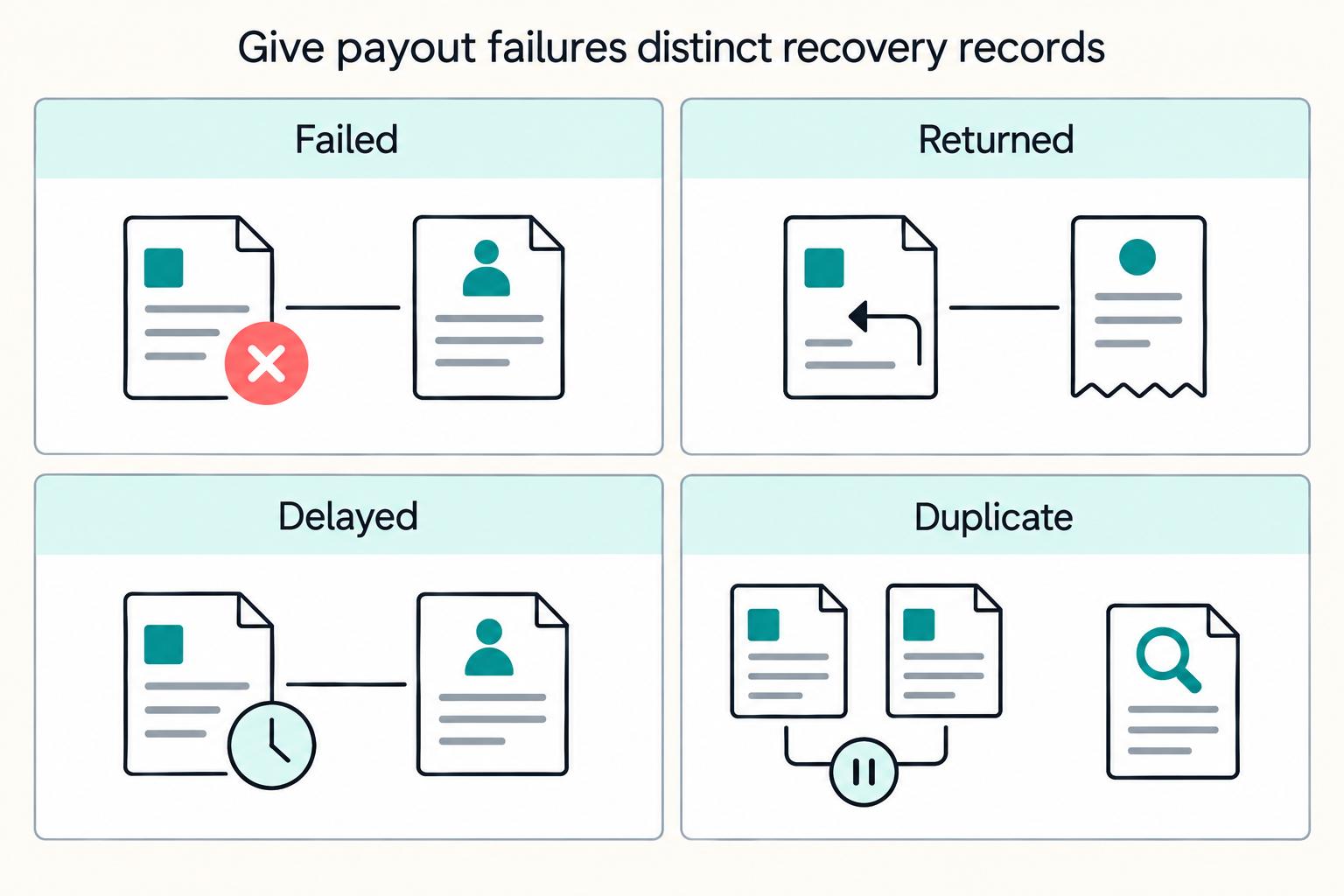
Create a failure taxonomy you can assign and measure#
Do not leave exception language loose. "Payment issue" is not an operator category. Build a small taxonomy that finance, support, and product all use the same way, then assign an owner and a recovery SLA field for each type.
| Failure type | What it means in your map | Primary owner to name | Recovery SLA field to define |
|---|---|---|---|
| Failed payout | The payout attempt was rejected or did not execute on the intended rail | Payments ops or finance ops | Time to triage and reattempt |
| Returned payout | Funds were sent but came back after initiation | Finance ops | Time to identify cause and reissue path |
| Delayed payout | The payout is still in flight past the expected window without confirmed completion | Payments ops | Time to status confirmation and worker update |
| Duplicate attempt | More than one initiation was triggered for the same obligation | Engineering plus finance ops | Time to stop, reverse, or reconcile |
| Unresolved exception | The issue is known but remains open with no clean disposition | Named queue owner | Maximum open age before escalation |
Fill the table with your actual owner names, not departments alone. If no one owns returned payouts, they will sit between support and finance until month end. If no SLA exists for unresolved exceptions, backlog becomes the default operating model.
Compare known friction patterns and mark legal checkpoints#
Now compare your current state against the legacy friction patterns that often show up in manual payout operations: in-person dependency, repeated rekeying, and exception handling by email or spreadsheet. Ask where recipients still depend on manual collection and where your team still rekeys data or manages exceptions outside the core system.
Be especially careful where legal or policy decisions change how the payout is handled. Add a legal review checkpoint anywhere those decisions affect timing, recordkeeping, or the path used to release funds.
The operator rule is narrower and still important: if a payout design choice only works under one unresolved legal or policy assumption, escalate it before rollout. Expected outcome for this step: one current-state map, one shared failure taxonomy, and one marked list of legal review points. If you do not have all three, you are not ready to redesign rails yet.
You might also find this useful: Related logistics payout example.
Step 2 redesign payout rails and policy gates without breaking margin#
Do not push every worker and supplier through the same payout rail. Once your map shows where exceptions and support cost sit, route by cohort: use faster options only where urgency is real and the data quality is strong enough to support them, and keep standard rails where coverage, cost, or recovery control matters more.
The map from Step 1 should now drive routing choices. If a cohort raises repeat support tickets or shows clear urgency when funds arrive late, test faster options where supported. If a cohort mainly creates returns, stale payout details, or hard-to-trace retries, choose the rail that gives you cleaner status visibility and a simpler reissue path.
Segment cohorts by urgency and recovery cost#
Start with a small set of cohorts you can actually govern. In healthcare staffing, that may mean separating high-frequency recipients from lower-frequency recipients, separating domestic from cross-border recipients, and separating recipients with stable payout details from those who often update them. This is not complexity for its own sake; it is meant to stop one group's urgency from destroying another group's margin.
Use one rule consistently: if a cohort has high urgency and low error tolerance, prioritize faster rails; if failure recovery costs dominate, prioritize controllability and traceability. That sounds obvious, but it prevents a common mistake. Teams buy speed for everyone, then give the savings back through support load, manual recovery, and reconciliation cleanup.
A practical checkpoint is to take one recent payout week and reroute it on paper using the new cohort rules. You should be able to show, payout by payout, why it would have gone to a faster or standard path and what evidence supported the choice. If the answer still depends on a support lead's memory or a finance spreadsheet that only one person understands, your routing policy is still too loose.
Set policy gates before release and posting#
Make the gate order explicit before you optimize for speed. If you implement this with Gruv, keep required policy checks ahead of release, rely on idempotent retries so a replay does not create a duplicate payout, and let confirmed status updates and ledger records determine final completion. Treat that as a control design choice, not as a claim that one legal sequence is universally required.
| Control point | Article detail |
|---|---|
| Policy checks | Keep required policy checks ahead of release |
| Retry behavior | Rely on idempotent retries so a replay does not create a duplicate payout |
| Completion signal | Let confirmed status updates and ledger records determine final completion |
| Request submission | Your ledger should not mark a payout as complete just because a request was submitted |
| Final paid state | Move to a final paid state only when you have a confirmed outcome tied back to the original request and provider reference |
The operator detail that matters most is the handoff between execution and accounting. Your ledger should not mark a payout as complete just because a request was submitted. It should move to a final paid state only when you have a confirmed outcome tied back to the original request and provider reference. Without that match, you create room for duplicate disbursements, false positives in reconciliation, or both.
A common failure mode shows up here. Teams add a faster rail while leaving required recipient data or approvals unresolved, then discover the real result is more failed and returned payouts, not better reliability. Keep a lightweight evidence pack for each cohort: the routing rule, any relevant compliance or tax artifact, the exception owner, and the recovery path if the first attempt fails. If you cannot produce that pack quickly, the gate design is not mature enough.
Scope Gruv around the money flow you actually have#
Keep Gruv decisions tied to the flow you mapped. Do not buy a generic payout story that ignores where your cost and risk actually sit. If your biggest pain is returned payouts and reissues, focus on status visibility, reconciliation, and recovery control. If urgency is concentrated in one cohort, limit faster options to that cohort first and measure exception handling against your baseline.
Frequently Asked Questions
What does payout reliability mean in this case study?
Here, reliability means on-time completion, low failed or returned payouts, fast exception resolution, and clean batch reconciliation to the ledger. Faster money alone does not count if cleanup work or admin drag still grows.
Why is a proof threshold necessary before changing payout design?
Because anecdotal claims and vendor stories can sound positive without showing verified margin impact or failure-rate detail. The article recommends a before-and-after window, a named operating change, and finance-linked metrics before you treat a claim as decision-grade.
What belongs in the minimum evidence pack?
The pack should show batch-level operating facts that finance and support can both verify, including exception reasons, ticket themes, and reconciliation friction for the same payout period. If those teams cannot point to the same issues, the baseline is not clean enough yet.
How should a staffing platform map payout failure points?
Walk one normal payout and one exception case end to end from approval to final disbursement and ledger entry. Mark spreadsheet steps, manual handoffs, status gaps, and the owner and SLA for each failure type.
When should faster rails be limited to certain cohorts?
When urgency is concentrated in a cohort and the supporting data is strong enough to control exceptions. If a cohort mainly generates returns, stale payout details, or hard-to-trace retries, the article recommends favoring controllability and traceability over raw speed.
When should accounting mark a payout as complete?
Only after confirmed outcome data matches the original request and provider reference. Submitted requests alone are not enough, because they can hide duplicates, false positives, or unreconciled batch lines. That keeps the rollout honest. You are not trying to maximize speed in the abstract. You are trying to improve payout reliability without handing margin back through support work, retries, or finance cleanup. We covered this in detail in Case Study Framework: How to Document Platform Payment Wins for Marketing. Want to confirm what's supported for your specific country/program? Talk to Gruv.
Try a related tool
Researched and edited by the Gruv editorial team. Gruv builds cross-border billing, payouts, and finance-operations software for global businesses.
Sources
- cms.gov/files/document/nursing-home-staffing-study-f...trusted
- cms.gov/Medicare/Medicare-Fee-for-Service-Payment/Ph...trusted
- federalregister.gov/documents/2019/08/07/2019-16485/medicare-pro...trusted
- gao.gov/assets/a315740.htmltrusted
- hcpf.colorado.gov/sites/hcpf/files/Hewlett%20Packard%20MMIS%20...trusted
- irs.gov/businesses/corporations/do-i-need-to-file-fo...trusted
- irs.gov/forms-pubs/about-form-8938trusted
- le.utah.gov/interim/2018/pdf/00003194.pdftrusted
Educational content only. Not legal, tax, or financial advice.
Related Posts

Choosing Nursing Agency Payout Models for Shift-Based Healthcare Staffing
Choose your payout model based on operational proof, not payout-speed marketing. For healthcare staffing platforms, the real question is whether payouts stay reliable when shifts change, get canceled, or are disputed.

How an EdTech Marketplace Expanded Instructor Payouts with Gruv
Fast instructor payouts help only if you can still protect margin, controls, and trust. This case study looks at how an EdTech marketplace can expand instructor access to earnings with Gruv without turning refunds, compliance holds, and reconciliation work into finance pain later.
How a Logistics Platform Scaled Driver Payouts Across Southeast Asia
Redesigning driver payouts is rarely just a payments project. For a logistics platform, it is often a margin decision hiding inside an ops problem. Do you fix driver uncertainty first, settlement speed first, or manual finance work first?