
Quick Answer
Yes. Treat weekly pay as a payroll coordination system, not a payout button. Before launch, prove one worker record can be traced from approved time to gross pay, withholding, payout status, and the matching client invoice. Build in order: normalize timesheet intake, validate and lock approvals, enforce compliance holds, then release disbursements. If your team still depends on Friday CSV rework or side spreadsheets to close payroll-to-invoice gaps, the staffing motion is not ready.
What a staffing payout platform needs to support weekly pay#
Treat staffing payouts as payroll operations, not just money movement. The moment you promise weekly pay, you take responsibility for compensation timing, payroll tax withholding, approval timing, and the quality of the data behind every calculation. That reliability matters because payroll is not a back-office detail to workers. UKG cites 2023 survey data showing that more than 78% of people would find it somewhat or very difficult to meet their financial obligations if a paycheck were delayed by one week. SignalFire notes that once pay is late or inaccurate, 25% of workers start exploring other opportunities.
Before you start#
Use this guide as a readiness check before you spend heavily on engineering or start selling into staffing. Payroll processing can take minutes, hours, or days depending on process and inputs. The real question is not whether you can send funds, but whether you can do it every week with traceable inputs, predictable exceptions, and clean reconciliation across payroll and invoicing.
Step 1 Reframe weekly pay as a coordination problem#
If you treat payouts like a simple disbursement feature, you miss the coordination work: timesheet intake, approval timing, rate validation, withholding logic, and invoice alignment. In a weekly-pay setup, one bad handoff upstream can still turn into a pay issue on Friday, even if your payout rail works.
Use a simple check. Take one real worker record and confirm you can trace approved hours to gross pay, deductions or withholding, payout status, and the client invoice for the same period. If your ops or finance team cannot follow that chain without manual detective work, you are not ready to market weekly pay.
Step 2 Decide readiness before you build#
Founders and operators should make the vertical decision with evidence, not a surface reading of market demand. Gather a small but real packet of source material first: sample timesheets, payroll calendars, invoice cutoffs, and a list of common exceptions such as late approvals or disputed rates. That gives you a clearer view of whether your current product can absorb a weekly payroll cadence without constant human repair.
One red flag is building orchestration before you understand exception volume. Faster payout execution does not fix missing hours, unresolved approvals, or incomplete tax data; it just moves those issues closer to payday.
Each stage depends on the one before it: clean payout logic on top of inconsistent time data can still produce bad pay and manual reconciliation work.
Your checkpoint at each stage should be boring but strict: clear input requirements, visible exception states, and an auditable record of why a payout was released or held. If you establish that discipline early, the later sections will help you decide whether staffing fits now or should wait.
For a step-by-step walkthrough, see Building a Virtual Assistant Platform Around Payments Compliance and Payout Design.
Decide if staffing is the right vertical for your payout platform now#
Staffing is the right vertical now only if your weekly cycle stays reliable under variable time data, shift-based pay changes, and location-level compliance, not just in a clean payout demo.
Step 1 Score your operating reality first#
Use a practical go/no-go screen based on what breaks in real staffing payroll operations:
| Screen | Question | Grounded detail |
|---|---|---|
| Time data variability | Can you ingest and normalize changing hours, assignments, and rates without manual cleanup? | Changing hours, assignments, and rates |
| Compliance burden | Can you calculate taxes and compliance at the shift-location level? | One worker can have shifts in Pennsylvania, New Jersey, and New York in the same week |
| Payout cadence pressure | Can your team handle recurring weekly exceptions without defaulting to Friday fire drills? | Recurring weekly exceptions |
| Integration depth | Can payroll, invoicing, and ledger posting stay aligned without duplicate entry? | Payroll, invoicing, and ledger posting |
A useful stress case is one worker paid $35/hour for day shift, $42/hour for nights, and $50/hour for weekends in the same pay period. If that flow is not traceable end to end, staffing readiness is not proven yet.
Step 2 Treat incumbent names as discovery signals, not proof#
You will hear Greenshades, ADP, UKG, Paylocity, TempWorks, and Advance Partners in buyer conversations. Use those references to ask where teams still lose time each week, not to claim feature-by-feature wins you cannot evidence.
Two recurring signals to validate in discovery:
- Teams spending time every Friday exporting and reformatting ATS CSVs.
- Cost or workflow mismatch between payroll-system seat counts and actual weekly activity, for example 500 workers in the system vs 200 who worked.
If you cannot show removal of at least one recurring weekly friction with real workflow evidence, your positioning is still general payroll, not staffing-specific execution.
Step 3 Test one narrow staffing motion before broad rollout#
Do not evaluate "staffing" as one category. Start with one operating pattern and prove it works.
| Checkpoint | Lower-variability staffing motion | Higher-variability, multi-location motion |
|---|---|---|
| Time intake | Approved hours arrive consistently with minimal reformatting | Inputs still arrive cleanly despite more exceptions |
| Rate handling | Standard rate logic reconciles cleanly | Shift-based rate changes remain traceable and correct |
| Compliance handling | Core location rules are handled consistently | Location-by-location rules remain accurate across assignments |
| Reconciliation evidence | You can trace approved time to pay output, invoice line, and ledger entry | The same traceability holds under higher exception volume |
Use weekly payroll-to-invoice traceability as your internal launch gate for "weekly pay" messaging. If your team still depends on spreadsheet patching or operator memory to close the chain, delay the vertical launch and fix that path first.
For benchmark context, read Time to First Payout Benchmark by Vertical: Staffing Creator SaaS and Marketplace Platforms.
What to prepare before building anything#
Prepare your operating evidence first, then build. If you cannot assemble one clean packet from a recent weekly cycle, pause implementation until you can. Staffing payroll is a moving target, and rushed builds usually hard-code existing confusion.
-
Gather the evidence pack. Collect current timesheet sources such as VMS exports, spreadsheets, and API feeds, plus payroll calendars, invoicing calendars, and exception logs from ops and finance. The readiness check is simple: one reviewer can trace approved time through payroll output and invoicing without missing files or side-channel explanations.
-
Lock the worker taxonomy early. Define the cohorts you will support on day one, for example W-2, 1099, consultants, and edge categories, whenever those groupings change compliance or review paths. If taxonomy is unresolved, exception handling usually becomes manual and status tracking stops being reliable.
-
Document payout endpoints and fallbacks by cohort. Write down expected payout routes and fallback paths for each worker group, including direct deposit, paycard, and paper check where relevant. Confirm the required data for each route already exists in your records; if fallback data is inconsistent, that fallback is not operational.
-
Set launch acceptance checks before rollout. Require fewer manual reconciliations, deterministic status states, and clear exception ownership before go-live. If payroll and invoicing still depend on weekly memory-based reconciliation, launch readiness is not there yet.
For a staffing-specific compliance view, read Healthcare Staffing Platform Payments Compliance for Safer Rollouts.
Set product scope by worker type and geography before writing code#
Set hard scope boundaries for the first release before you design states or APIs. If worker classes or jurisdictions run differently in practice, treat them as different lanes from day one so sales, ops, and engineering are using the same limits.
Step 1. Separate worker classes before implementation. Start with explicit lanes for W-2 and 1099, even if you launch only one lane. This is operational: if a timesheet packet cannot move from intake to payout without class-specific side emails or spreadsheets, you already have multiple scopes.
If intake labels are loose, normalize them now. The 2018 Standard Occupational Classification gives a stable reference with 23 major groups. You do not need full SOC mapping on day one, but you do need fixed grouping rules so ad hoc categories do not leak into quoting and exception handling.
Step 2. Define coverage layers and source reliability upfront. Write coverage explicitly at the levels where you will operate: federal, state, local, and any separate program-level review tracks. Then set a source rule: do not mark a jurisdiction as live from informational pages alone. FederalRegister.gov notes that some content is unofficial for legal notice, and the captured page here returned a 500 Server Error, so verify against official editions or counsel-approved summaries before you make launch decisions.
Do not assume one federal flow gives you broad domestic coverage. State-level variation can still create operational compliance risk, including around items like breaks and final pay.
Step 3. Publish one expansion matrix across sales, ops, and engineering. If a market is not on the matrix, it is not supported.
| Scope area | Supported now | Supported with constraints | Not supported |
|---|---|---|---|
| State coverage | Launch cluster with documented rules, owner, and test cases | Cases allowed only with manual review or limited worker classes | No quoting or onboarding |
| Local coverage | Local tax and payroll handling documented in the launch cluster | Exceptions handled only by named ops review | No automated support claimed |
| Country or corridor coverage | Only where intake, payout, and compliance evidence are verified | Pilot only with explicit exclusions | No cross-border commitments |
Step 4. Expand one jurisdiction cluster at a time. Launch where your evidence is deepest and exception patterns are already understood. Add new states or corridors only after multiple weekly cycles close without reconciliation surprises. Keep two release gates: every exception has a named owner, and every supported jurisdiction has a current rules source you can point to.
Build time tracking intake and validation before payout automation#
After you narrow worker type and geography, make time intake the next hard gate. If you cannot turn incoming time data into one trusted record, payout automation will just move bad data faster.
- Normalize every source into one canonical timesheet schema.
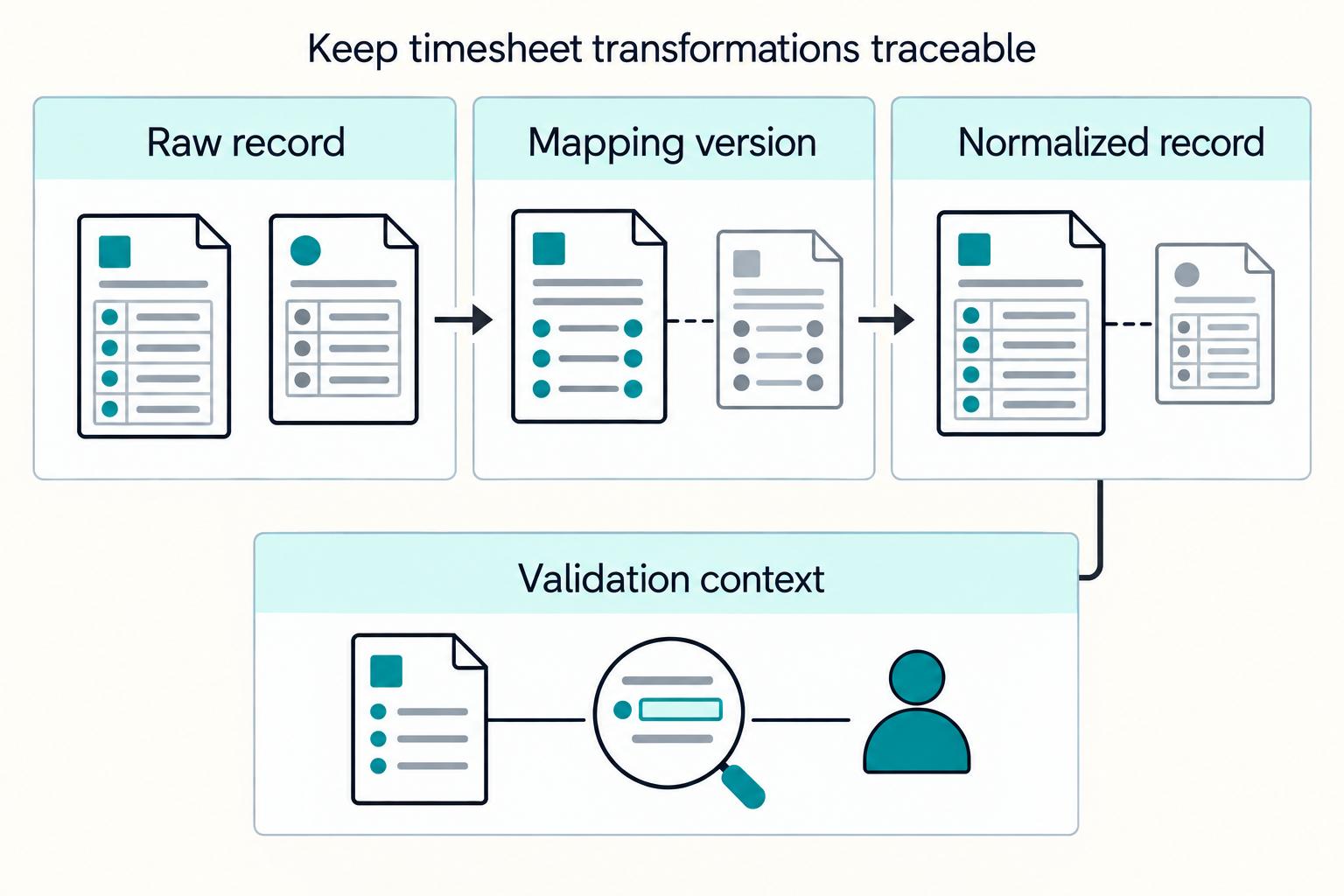
Do not run payroll from source-native payloads. Define one internal timesheet shape and require every feed to map into it with explicit, versioned mapping rules and documentation so changes stay traceable.
Your verification point: for any paid shift, your ops team can see the raw record, the mapping version applied, and the normalized output without digging through ad hoc logic.
- Validate hours, rates, and assignment fit before payroll math starts.
Bad inputs should fail in validation, not on payday. Put rule checks in front of payroll and invoicing, and make failures repeatable and audit-ready rather than case-by-case judgment calls.
For disputed records, keep the key context and failed rule visible in one place so exceptions do not spill into side channels.
- Enforce a fixed checkpoint order and lock records after approval.
Use one workflow every time: ingest, normalize, validate, approve, lock, then release. Once approved and locked, avoid silent edits; handle corrections through controlled updates so the record history stays clear.
Make timeline tracking part of the workflow so teams can see when each state changed, who approved, and what changed before lock.
- Turn failure cases into visible exception states with owners.
Late submissions, missing approvals, and rate conflicts should route into named exception states with clear owner queues. That keeps accountability explicit and handling consistent under weekly volume.
If approval is missing, hold release until the exception is resolved or explicitly overridden by a named approver. Related: Payment Status Visibility: How Real-Time Payout Tracking Reduces Support Load.
Add compliance gates that actually block bad payouts#
After time is approved and locked, make compliance eligibility a hard release gate. If identity or tax status is unresolved, hold payout in a named state and give the worker or client a remediation path they can actually complete.
Step 1. Gate payout eligibility on identity and counterparty status before release. Use one eligibility object tied to the worker and, where your program requires it, the client or counterparty. Attach required KYC outcomes and, for higher-risk or business-counterparty paths, required KYB and AML outcomes.
Blocking behavior matters here: approved time with unresolved identity should move to a deterministic hold state such as held_identity_review, not a generic error queue and not a manual bypass path. For every hold, keep auditable evidence: worker/client ID, compliance status at decision time, timestamp, rule version, and who or what changed status.
Step 2. Make tax readiness a production prerequisite, not a cleanup task. Require required tax documents and classification artifacts before first live disbursement. In practice, that usually means the relevant W-8 or W-9 is on file, 1099-dependent fields are present, and artifacts are stored for audit and dispute review.
Do not stop at file upload. Store document type, collection date, current status, and the exact artifact reference used to clear eligibility. Make remediation specific: say what is missing or expired, where to submit it, and when payout can resume.
Step 3. Scope cross-border reporting and planning flags by market and program. Keep domestic tax readiness separate from cross-border items like VAT validation, FEIE planning support, and FBAR tracking. Only enable what your market/program coverage actually supports.
For FEIE-related planning context, keep the rule-level facts straight:
| Item | Grounded rule |
|---|---|
| Physical presence test window | 330 full days in foreign country/countries within 12 consecutive months |
| Day count pattern | The 330 qualifying days do not have to be consecutive |
| Who it applies to | U.S. citizens and U.S. residents |
| FEIE eligibility baseline | Applies only if the person is a qualifying individual and files a return reporting the income |
| FEIE max | $130,000 (2025); $132,900 (2026) per qualifying person |
For FBAR, use the FinCEN filing due-date and extension resources, and avoid encoding eligibility logic from assumptions. Keep in mind an IRS Practice Unit explicitly states that it is not an official pronouncement of law.
Step 4. Audit every gate with deterministic state changes. Use explicit transitions such as pending_compliance, held_identity_review, held_tax_document, eligible_for_payout, and released_to_disbursement. Log old state, new state, trigger, actor, and related document IDs for each transition.
This is what keeps weekly reconciliation fast across ops, finance, and engineering. It also prevents urgent exceptions from becoming your default process.
Design payout operations for weekly pay without reconciliation debt#
Weekly pay stays reliable when time, payroll, billing, and compliance run as one connected workflow, not as separate handoffs.
1. Protect time-data quality before payroll starts. Incomplete or late time data can stall payroll runs, so approvals need to be complete and consistent before a weekly cycle is released. Treat approval quality as an operations gate, not a cleanup task.
2. Keep pay and bill automation on the same approved record. Use a connected pay-and-bill flow so payroll-ready exports and invoicing are generated from the same approved time data. This reduces mismatches that can otherwise create invoicing errors, hurt cash flow, and erode client trust.
3. Build weekly controls around known staffing pressure points. High-volume payroll runs and changing client billing rules are normal in staffing, so review exceptions early and close them within the same cycle. If payroll and invoicing outputs do not align, resolve the discrepancy before advancing the week.
4. Validate workflows in a sandbox before production changes. Test integrations and workflow changes in a sandbox workspace so teams can verify process behavior without production-data risk. Keep payroll compliance checks explicit in each cycle, since federal, state, and local payroll tax obligations carry penalty risk when missed.
Common failure patterns and how to recover quickly#
Step 1. Freeze rollout when payroll inputs are still drifting. If approved hours or payroll inputs keep changing because mappings, field names, or validation rules are unstable, pause expansion before defects repeat. The recovery move is to stabilize the input schema, tighten validation, and relaunch with a smaller cohort before scaling.
Your checkpoint should be simple: run one closed pay period and confirm key fields survive ingest to payroll export without manual rework. If your team is still patching records in spreadsheets, you are not ready for wider weekly pay.
Step 2. Turn compliance and tax readiness into a true gate. Payroll mistakes are highly preventable with stronger systems and oversight, and errors can get expensive fast. If required compliance or tax records are still unresolved, keep those records out of release until documentation is complete and status is visible.
The failure mode is treating compliance as launch debt. That is how you get late or missed paychecks, then reimbursements, back pay, penalties, and legal exposure.
Step 3. Narrow your market promise to the jurisdictions you can actually support. Location-specific laws matter, and global payroll gets more complicated as you add jurisdictions. If your sales story is broader than your current compliance depth, tighten scope and update messaging before clients assume unsupported coverage.
A good verification point is straightforward: for every marketed jurisdiction, be clear on the payroll treatment, tax handling path, and exception process.
Step 4. Assign one recovery path for reconciliation breaks. When a pay run and related records disagree, someone should own triage immediately. Define who checks the mismatch first, who confirms worker impact, and who signs off on reruns. If ownership is fuzzy, weekly cycles can stack unresolved exceptions.
We covered a similar recovery pattern in How Photo and Stock Image Platforms Pay Photographers with Royalty and Licensing Payout Models.
Conclusion and copy-paste launch checklist#
If the FAQ made one thing clear, it is this: do not launch on the strength of payout rails alone. You are ready only when approved time, compliance holds, payroll release, and reconciliation all survive a real weekly cycle without spreadsheet rescue.
- Confirm vertical fit.
Mark this as go only if all four pressures are real in your target cohort: messy time data, meaningful compliance burden, hard weekly cadence, and enough integration depth to avoid manual rekeying. A useful checkpoint is one closed week from your actual source system where you can ingest, normalize, validate, approve, lock, and reconcile hours without editing a CSV on Friday night. Verification point: if finance still needs a side spreadsheet to explain pay versus invoice differences, treat that as a no-go, not a minor cleanup item.
- Sequence the build in the right order.
Put time intake and validation live first. Enforce compliance gates second, including worker classification, signed contracts, required tax documentation where applicable, and valid payment details. Add payout orchestration and status visibility third, once the inputs are stable enough that status changes mean something. Expected outcome: a failed record stops early with a visible reason like missing approval, bad assignment window, or unresolved tax status, instead of turning into a payday exception. Red flag: if your team is debating rail fallbacks before it can trust approved hours, it is solving the wrong problem first.
- Test operating controls in production-like runs.
Run several weekly cycles with audit logs, named exception ownership, reconciliation exports, and replay-safe retries turned on. You want deterministic status transitions, not operator memory, to answer basic questions such as who approved the time, why a payout was held, and whether a retry created a duplicate release attempt. Verification point: pick one failed batch item and prove you can trace it end to end from intake through payroll and invoice impact. If that trail is missing, support load and close-week risk can stack up fast.
- Expand only after reliability is boring.
Hold scope until the current cohort is stable for multiple weekly cycles, then add one variable at a time: a new jurisdiction, a new worker class, or a new payout rail. This matters most around calendar and document boundaries. For example, if you support UK payroll programs, Sage lists a 19 April final submission date and final PAYE payment timing of 19 April by post or 22 April digitally. If you support U.S. payroll, year-end controls should include verifying employee information, final paychecks, and W-2 distribution, with an eye on state changes such as minimum wage updates effective January 1, 2026. Failure mode: broadening coverage before those controls are routine can create exception debt that looks like a product problem but is really an operating discipline problem.
Copy that checklist into your launch review doc. If any line is still "partly manual," you are not late to ship. You are early.
Related reading: End-to-End Payments Visibility: How CFOs at Platform Companies Track Every Dollar in Real Time.
Frequently Asked Questions
Why is weekly pay harder in staffing than in most other verticals?
Staffing payroll is a moving target because hours, rates, and work locations can change every week, and sometimes within the same week for the same worker. One person might work shifts in Pennsylvania, New Jersey, and New York in a single week, or see rates change from $35/hour to $42/hour to $50/hour by shift. Your checkpoint is whether you can calculate taxes and compliance at the shift-location level from approved time, not from a cleaned-up spreadsheet after the fact.
What compliance checks are non-negotiable before enabling weekly payouts?
Start with the basics that actually block bad pay: confirm worker classification, contracts, tax forms, and payment details before release. Accurate digital time capture is also non-negotiable, because clean payout logic usually cannot rescue bad hours. A good release gate is simple: if the worker record does not show completed classification, signed contract status, tax-form readiness, and valid payment details, hold payout instead of allowing manual bypass.
What happens if payroll cycles and client invoicing cycles do not align?
Misalignment can create reconciliation debt, because worker pay may be ready before the client invoice is clean, approved, or matched to the same hours and rates. The risk is not just timing; it can also be losing traceability between the timesheet, pay run, and invoice batch. If those cycles differ, define one shared lock point for approved time and one owner for mismatches before you automate anything.
Which integrations should be in place before automating payouts at scale?
You need stable intake from your time source first, plus a way to carry approvals into payroll and invoicing without rekeying. If someone is still spending Friday exporting ATS CSVs manually, you are likely not ready for scale. Verify one closed week end to end: ingest, validate, approve, lock, export, and reconcile with no spreadsheet patching.
How should we prioritize W-2 and 1099 support in the first release?
Pick one worker class first, and in most cases that means following your actual book of business rather than trying to support both on day one. W-2 employees change compliance, payroll, and benefits obligations, while 1099 independent contractors are treated as self-employed and carry real misclassification risk. If you plan to support 1099s early, treat states with stricter rules, including California AB5, as a red-flag review path rather than default coverage.
What should founders validate before entering a new country or state?
Validate the exact jurisdictional promise, not just the commercial demand. You should be able to name how time is captured, how payroll treatment changes by where each shift is worked, which worker classes are supported, and who owns exceptions when records fail. If you cannot explain that in writing for the new market, delay launch and use a tighter coverage matrix, especially for cross-border expansion. Cross-Border Compliance Checklist for Platform Payouts: Licenses Registrations and Reporting by Country
Try a related tool
Where Gruv fits
Gruv for agencies and contractors
Connect approved contractor work to a payable batch with invoice references, item-level review, and a clean finance export.
Plan and approve payout batches
See how payee status, approval rules, route review, and exception handling sit in one payout workflow.
Researched and edited by the Gruv editorial team. Gruv builds cross-border billing, payouts, and finance-operations software for global businesses.
Sources
- apps.legislature.ky.gov/record/26rs/record(24-2-2026).pdftrusted
- bls.gov/soc/2018/major_groups.htmtrusted
- eeoc.gov/best-practices-private-sector-employerstrusted
- eeoc.gov/laws/guidance/enforcement-guidance-retaliati...trusted
- federalregister.gov/documents/2021/01/07/2020-29274/independent-...trusted
- fincen.gov/report-foreign-bank-and-financial-accountstrusted
- irs.gov/individuals/international-taxpayers/figuring...trusted
- irs.gov/individuals/international-taxpayers/foreign-...trusted
Educational content only. Not legal, tax, or financial advice.
Related Posts

Time to First Payout Benchmark by Vertical for Platform Teams
A usable **time to first payout benchmark** starts when a payable event exists and ends only when delivered funds can be tied to one provider reference and one accounting trail. If the close condition is only approved or submitted, you are measuring internal workflow progress, not first payout.

Real-Time Payout Tracking for Platforms That Reduces Support Load
Faster rails do not fix unclear payout state. Payout tracking matters when each payout can be followed from authorization through reconciliation, not when disbursement is merely faster.
Country-by-Country Launch Rules for Platform Payout Compliance
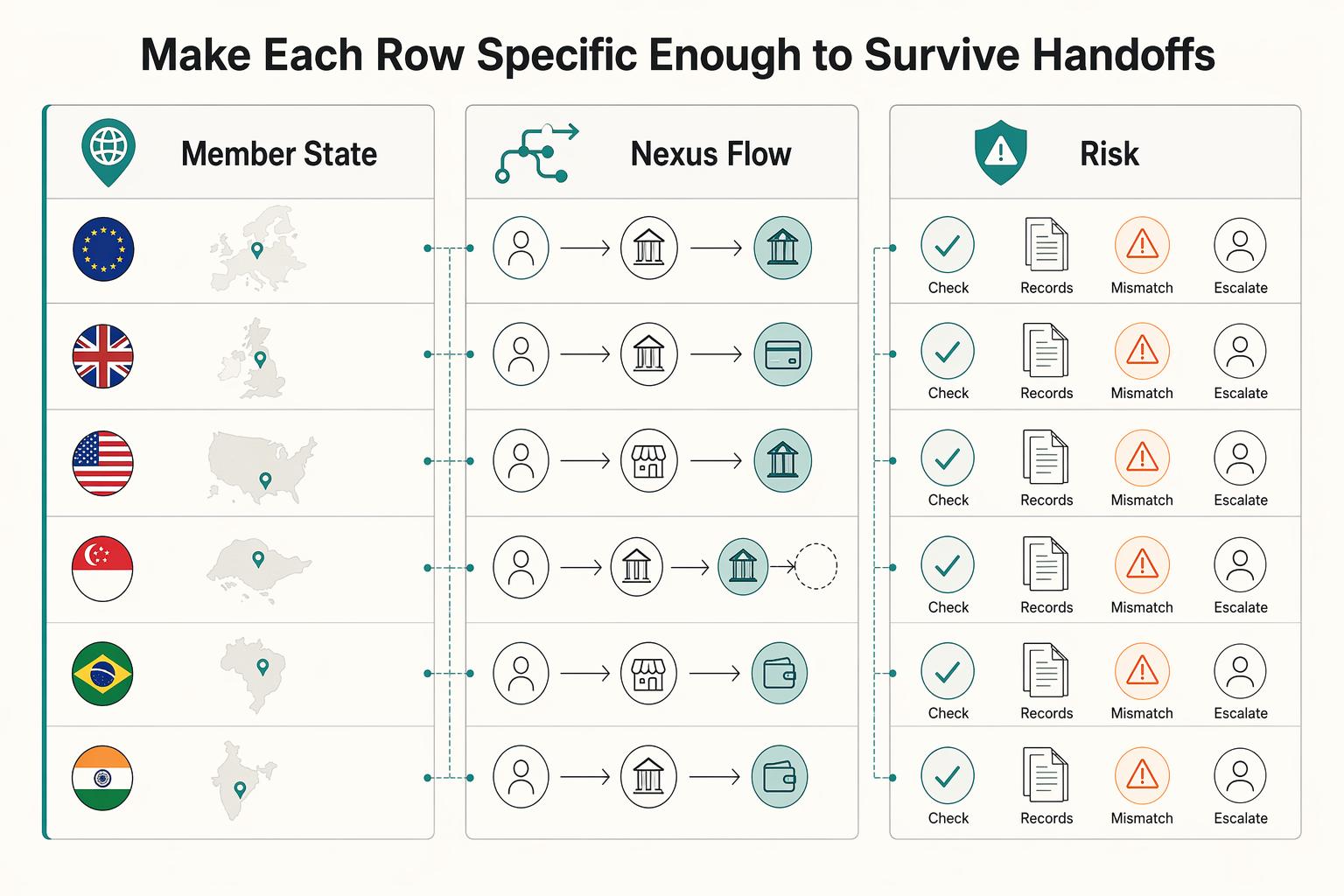
Treat each new payout country as a go or no-go decision. It may be blocked by law, blocked by operations, or cleared only with conditions. This guide helps compliance, legal, finance, and risk teams make that call early, assign ownership, and keep an evidence trail that holds up later.