
Quick Answer
Publish the royalty calculation base, licence terms, payout threshold, cycle and release conditions together. Buyer royalty-free rights, catalog curation and contributor exclusivity are separate choices. Test a statement from licence earnings through adjustments and payout, then verify account readiness, the applicable tax path and provider outcome before marking the liability paid.
How royalty and licensing payouts work#
Use platform-owned evidence, not marketplace landing pages, for this decision. Most comparisons of how photo stock image platforms pay photographers under different royalty, licensing, and payout models come down to four details that are often buried or split across pages: the license type, how contributor earnings are calculated, when payments actually go out, and what must be in place before money can move.
Before you start#
Prepare a short evidence sheet for each platform or model you are testing. At minimum, capture the source URL, the exact licensing wording, the royalty method or percentage, payout timing, and any stated tax or account prerequisites. If one of those fields is missing, that is not a minor gap. It means the comparison stays open.
Step 1. Verify the licensing promise before modeling contributor economics#
Separate the buyer’s rights from the photographer’s payment. Royalty-free usually allows repeated use under the licence without a new fee for every permitted reuse; it does not mean the image is free or the photographer receives no royalty. Rights-managed terms scope the permitted use. Getty’s guidance distinguishes these structures and says it no longer offers rights-managed licences for creative images. Check the actual content category and licence rather than assuming one label applies to the entire catalog.
Use a simple checkpoint: can you point to the exact public term that defines the buyer's rights? If not, you cannot credibly estimate the sales volume, catalog depth, or support burden the model will create.
Step 2. Confirm the earnings basis and payment timing together#
Shutterstock publishes separate image and video earnings levels from 15% to 40%, with annual resets; its monthly payment process issues eligible payments by the 15th. Adobe publishes 33% image royalties under non-exclusive licensing, with per-download amounts varying by plan. Neither percentage alone tells you when funds reach the contributor or which deductions and eligibility conditions apply.
That gives you a practical test. If a platform discloses percentages but not timing, or timing but not the earnings basis, the comparison is still incomplete. A common failure mode is modeling creator acquisition on a headline royalty rate, then discovering later that payout cadence, adjustments, or account prerequisites were not fully accounted for.
Step 3. Check payout prerequisites before you assume the model can scale across countries. Shutterstock states that both U.S. and non-U.S. contributors must have an approved tax form on file before payment can be released. That is the kind of operational fact you want early, because it changes onboarding, support, and payout exception handling. Once those points are documented from primary sources, you can evaluate royalty-free, curated, exclusive, or non-exclusive options with far less guesswork.
For a step-by-step walkthrough, see How Platform Operators Pay Creators Globally Across YouTube, Twitch, and Substack.
Gather the operator evidence pack before you compare models#
Build the evidence pack first, then compare models. If payout mechanics are missing or ambiguous, mark that option not decision-ready instead of filling the gaps with assumptions.
Step 1. Capture platform-owned terms as the comparison evidence. Record the exact source URL, page title and capture date for earnings, licence and payment settings. If an upload-management tool connects multiple agencies, verify the specific agency and country route separately; a tool’s advertised agency count does not establish the agency’s payout obligations.
Verification point: each row should link to a platform-owned page or be labeled "secondary only."
Step 2. Build a one-page sheet with required fields. Include, at minimum:
- contributor royalties method
- payout schedule
- payout threshold
- licensing type
- payout rails or methods
- prerequisites before first payout
- what is still undisclosed
Keep the actual threshold and payment method in the evidence sheet. Shutterstock lists PayPal, Skrill and Payoneer and allows a minimum-payment setting from USD 25 to USD 2,000; USD 2,000 is the highest configurable threshold, not a cap on total earnings. For content readiness, 500px’s contributor FAQ describes review before licensing and additional inspection by distribution partners. Do not promise a one-week review period without a current commitment.
Step 3. Add market-scope fields before economics. Add target countries, settlement currencies, likely payout rails, and Merchant of Record in scope: yes / no / unknown. Do not infer Merchant of Record responsibility from marketing copy. If it is undisclosed, treat that as a decision gap, not a neutral assumption.
Compare payout and licensing archetypes before choosing your default#
Choose the default model you can explain line by line to contributors, not the one that reads best in marketing copy. If payout threshold logic, settlement timing, or fee treatment are undisclosed in primary sources, that option is not decision-ready.
Step 1. Compare the four archetypes on operator risk first#
The following comparison is a planning aid, not measured industry risk ratings. Subscription allocation and on-demand pricing describe how a sale produces earnings; exclusivity describes the contributor’s restrictions. They can coexist. Adobe’s royalty examples vary by buyer plan and show extended-licence image amounts of USD 26.40 on demand and USD 21.12 by subscription, based on U.S. customer pricing.
| Model dimension | Margin predictability | Creator retention risk | Operational complexity | Unknowns that block launch |
|---|---|---|---|---|
| Subscription allocation model | Medium: recurring revenue, but contributor cost shifts with plan/download mix. | Medium to high if contributors cannot understand payout differences by plan. | High: statements, support, and dispute handling must explain plan-based payouts clearly. | Any undisclosed payout threshold logic, settlement timing, or fee treatment. |
| On-demand licensing model | Medium to high: earnings are tied more directly to each license event. | Medium: simpler to explain, but weak demand can make income feel inconsistent. | Medium: pricing and payout logic are usually easier to communicate. | Same blocker fields apply. |
| Exclusive licensing | Medium: can support stronger pricing only when differentiated supply is real. | High if exclusivity is requested before reliable sell-through and payout trust. | High: tighter rights checks, contributor management, and contract clarity are required. | Same blocker fields, plus unclear exclusivity treatment in terms. |
| Non-exclusive licensing | Medium to lower: easier supply intake, weaker differentiation. | Lower early, higher later as contributors benchmark across channels. | Medium: review quality, rights checks, and clear earnings reporting still matter. | Same blocker fields apply. |
Verification check: create one mock contributor statement per archetype. If finance and support cannot both explain every line item without improvising, do not set that model as default.
Step 2. Match licensing posture to demand reality#
Royalty-free describes buyer usage rights; curation describes how you select the catalog. A curated catalog can also use royalty-free licences. Stocksy’s contributor process, for example, requires application and review approval. Choose selection standards independently of buyer rights and contributor exclusivity.
Use broad intake when you can support catalog discovery and rights review at scale, or stricter curation when demand justifies the selection work. In either case, define the buyer licence and the contributor payment separately. Do not infer a premium royalty or exclusive rights from the word curated.
Step 3. Set launch checkpoints before you commit#
| Archetype | Demand | Supply | Support |
|---|---|---|---|
| Subscription allocation model | Demand should support recurring plans. | Supply should be deep enough that variable per-download outcomes remain credible. | Support must handle statement-level payout explanations. |
| On-demand licensing model | Demand should include per-asset buyers. | Supply must be commercially strong without bundle effects. | Support must resolve license-scope questions quickly. |
| Exclusive licensing | Demand should show clear value for differentiated rights. | Supply must be rights-clean and high quality. | Support must handle contract and removal edge cases. |
| Non-exclusive licensing | Demand can be less proven at launch. | Supply can be broader with disciplined acceptance standards. | Support still needs clear rejection and earnings explanations. |
Publish the versioned royalty rule and any reset or eligibility change so a contributor can reproduce a statement. If you offer exclusive and non-exclusive terms, identify the affected assets or content categories and the effective date; a headline catalog growth figure does not establish predictable earnings.
Pick your licensing stance based on catalog strategy and demand reality#
Choose the licensing stance your team can operate consistently, not just the one that sounds strongest in positioning. If demand is still uncertain and you need broader supply, start closer to non-exclusive licensing with clear acceptance discipline. If demand is already proven and buyers value differentiated access, test exclusive licensing with stricter contributor selection.
Step 1. Choose the posture your catalog and sales motion can support#
Use a broad-market posture when your model depends on scale and self-serve demand. Shutterstock describes itself as a global marketplace where creators sell royalty-free images, footage, vectors, and illustrations, which aligns with wider intake and larger catalog growth.
Use a curated posture only if you can enforce a real gate. Stocksy's contributor path requires artists to apply and be approved by a review team, so your selection criteria and review consistency need to hold up in day-to-day operations.
A practical check: write one clear reason contributors should join you if they can upload elsewhere. If your strongest answer is reach and reliable payouts, broad non-exclusive is usually the cleaner fit. If your strongest answer is selective placement for higher-value demand, a curated or exclusive stance may fit better.
Step 2. Set contributor rules that match the stance#
Set contributor rules before launch, and make them explicit.
- Review process: publish how review works and what contributors should expect from submission to decision.
- Rejection reasons: publish common fail cases clearly. For example, release forms can be rejected when fields are incomplete, illegible, or inaccurate.
- Rights verification: define the required releases by content type, licence use and your review policy. Commercial images of recognizable people can require model releases; property releases depend on the location and applicable rules. Do not apply commercial-release requirements blindly to editorial content.
If these rules are vague, non-exclusive catalogs get noisy fast, and curated or exclusive decisions are harder to defend.
Step 3. Decide what your moat really is#
Decide early whether your moat is licensing differentiation or payout reliability and distribution, because that choice changes product priorities. Differentiation pushes you toward tighter intake, review, and rights workflows. Reliability and distribution push you toward clearer statements, stronger discovery, and fewer payout surprises.
A mixed model requires a clear scope of exclusivity. iStock’s contributor page allows later application for exclusivity for one or more content types, with different benefits. Do not assume restrictions apply only to individual uploaded files; record the contract’s scope, duration, permitted exceptions and exit conditions. For related economics, see Platform Economics.
Set payout mechanics that creators can trust and finance can reconcile#
Publish payout mechanics before launch, and make sure contributors and finance see the same rules and statuses.
Step 1. Publish payout rules in plain language#
Document these five items in one easy-to-find place: contributor royalties basis, payout schedule, payout threshold, adjustment policy, and dispute path. If royalties vary by license type, content type, or exclusivity status, state exactly where each rule applies.
| Rule | What to publish | Grounded detail |
|---|---|---|
| Contributor royalties basis | How earnings are calculated | If royalties vary by license type, content type, or exclusivity status, state exactly where each rule applies. |
| Payout schedule | Cycle boundary and send window | Name the closed earnings period, calculation date, send window and expected receipt handling; distinguish issue from receipt |
| Payout threshold | Minimum or configurable threshold | Shutterstock lists a configurable payout threshold of $25 minimum / $2000 maximum. |
| Adjustment policy | How corrections appear | Post separate correction lines with a reason rather than silently editing prior earnings. |
| Dispute path | Where contributors raise issues | Document it in one easy-to-find place with the other payout rules. |
Define a monthly cutoff and calculation/send window if that fits your program. Shutterstock’s example starts a cycle at midnight U.S. Eastern on the first, normally sends electronic payments between the seventh and fifteenth, and explicitly distinguishes payment history from successful receipt. Publish your own applicable timezone, eligibility cutoff and late/failed-payment process; do not copy its dates as a universal standard.
Verification point: support responses, dashboard copy, and policy text should match on cycle boundary, eligibility, and timing.
Step 2. Define the payout cycle order of operations#
Write the cycle in the order your team actually executes it:
- Finalize earnings for the closed period.
- Run hold or review checks for eligibility.
- Create the payout file or batch.
- Submit to the payout provider.
- Resolve exceptions and post final status to statements.
Keep contributor statements reconcilable: show covered earning period, adjustments, payout period, and provider reference after submission. If you issue corrections later, post separate correction lines with a reason rather than silently editing prior earnings.
Worked contributor statement: royalty, adjustment and carry-forward#
Assume your published rule pays 30% of an eligible USD 100 licence price, with no other deductions. That licence produces USD 30 of royalty. A later approved USD 20 refund of that same licence reverses USD 6 of royalty, leaving USD 24. Show the original USD 30 earning and a separate minus USD 6 adjustment linked to the licence, rather than rewriting history.
If the payout threshold is USD 25 and there is no earlier balance, the USD 24 carries forward. A subsequent USD 10 royalty makes the unpaid balance USD 34. After required eligibility checks, reserve USD 34 for the payout attempt; submitted status does not erase the liability. Mark it paid on the defined completion evidence, or release the reservation after confirmed failure/return and record any permitted fee separately. These are hypothetical platform rules, not competitor rates or tax assumptions.
Step 3. Expose shared payout status transitions with webhooks#
Use provider events together with outcome retrieval to keep Ops and contributor statuses aligned. Record which event means submitted, processing, completed, failed or returned under that provider’s definitions. An issued payment or a successful API response is not necessarily confirmed beneficiary receipt, and a late failure can require a later status change.
Map provider-specific events to ready, submitted, processing, paid, failed, returned and action required, with explicit definitions. If a payout fails, retrieve its outcome and confirm whether funds returned before restoring the payable amount for another attempt. Keep the original attempt linked to the new one and show the reason on the statement. A timeout remains unresolved until you recover its actual result.
Add compliance and tax gates before cross-border scale#
Before a country launch, identify the actual payer entity, provider account, contributor type and payment activity. Determine which identity, sanctions, tax and beneficiary requirements apply to that program. Release only after required checks are satisfied; a generic claim of AML approval is not a substitute for defined rules and a recorded decision.
Step 1. Sequence onboarding gates by jurisdiction and risk#
Collect and verify the identity and business details required by your provider and applicable obligations. Individuals and entities can need different records. Requirements can be staged and capability-dependent, so enforce the current payout eligibility conditions rather than assuming one onboarding form or a bank’s account-opening rule governs every marketplace.
Assign responsibility for applicable sanctions and financial-crime controls between your platform and provider. Record which checks are required, which entity performs them, how stale or unresolved results block release, and who can resolve a hold. Preserve the earnings and liability record while a review is pending; handle legally blocked funds under the applicable process rather than treating every flag as an ordinary payout delay.
Where EU VAT handling applies, validate VAT numbers through VIES instead of free-text entry. Also account for the VIES change where UK (GB) VAT validation through that service ceased on 01/01/2021.
Step 2. Define the tax document path before payout eligibility#
Set tax intake by contributor type and tax status, not by ad hoc support decisions. Non-U.S. certification and U.S. taxpayer certification are different workflows and should be separated in onboarding.
| Item | When relevant | Use |
|---|---|---|
| W-9 | U.S. payees when required for taxpayer certification | Collect the correct taxpayer name/TIN and applicable certification |
| W-8BEN / W-8BEN-E | Foreign individuals / foreign entities respectively, where appropriate | Document status and any supported treaty position; other forms apply to particular entities or income |
| 1099-MISC royalty reporting | Covered U.S. reporting of royalty payments | Royalties generally use box 2, with the USD 10 threshold and applicable exceptions; do not automatically use1099-NEC |
| Nonresident royalty withholding/reporting | When payment source, recipient and payer facts bring it within U.S. rules | Analyse where the copyright is used, documentation, any treaty relief and1042-S/1042 duties as applicable |
Separate royalty payments for licensing intellectual property from fees for commissioned photography or other services. IRS royalty reporting guidance uses Form 1099-MISC for covered royalties; service compensation has a different analysis. For foreign recipients, copyright royalty source generally follows where the property is used, rather than where the photographer took the image or where the payer sits. U.S.-source royalties can raise withholding and reporting duties, subject to the recipient, income and treaty facts. Record the selected form and treatment; personal FEIE or FBAR tracking is not a universal platform payout prerequisite.
Step 3. Require a country-level pre-payout release check#
Before first payout in each country, run one release check with four statuses:
- Required identity/provider verification satisfied
- Applicable tax documentation and treatment resolved
- Required sanctions or financial-crime checks resolved
- Beneficiary and payout capability eligible
Keep pending required checks in a review queue with an owner and permissible contributor-facing reason. Do not disclose restricted screening details. The release record should identify the evidence, decision time and applicable program rules; unresolved or stale results must not become eligible merely because an earnings cycle closed.
Need the full breakdown? Read Choosing Creator Platform Monetization Models for Real-World Operations.
Implement payout rails and ledger controls without creating reconciliation debt#
Treat your internal ledger as the payout source of truth before any provider call. If you cannot trace royalties to a provider reference and then to settlement reporting, reconciliation work will compound as you add corridors.
Step 1. Post to the ledger before calling the provider#
Record the payout intent in your ledger first, then call the payout API. Finalize earnings, apply holds, reserve the payable amount, and only then create the provider payout request.
Use provider-supported idempotency on outgoing payout creation, with a stable internal operation ID and documented key scope and retention. Test request timeout recovery separately from event replay: retrieve the original outcome before a new send, and process duplicate or late events without double-posting. Keep a durable record after provider key retention expires; retrying a pruned key may create a new operation.
Step 2. Route inbound funds through Virtual Accounts where available#
Where supported, virtual receiving details can help identify inbound funding by entity, contributor or program. Their account, custody and ledger structures vary by provider. Confirm which legal entity holds the money, the underlying account and the references available for matching; a virtual identifier alone does not prove a separately held balance or completed settlement.
Do not stop at a generic "funded" status. Move funds through explicit internal states and store operator evidence at each transition, including provider reference, internal batch ID, timestamp, and last processed event. That gives your team a clear investigation path when a batch moves to failed or under-review status.
Step 3. Define corridor routing fallback and reconciliation artifacts#
Set provider routing by corridor, not as one global default. Cross-border payouts add corridor-specific complexity across currencies, regulation, payment networks, and data requirements, so primary and fallback routes should be pre-defined only where compliance, payee data, and reporting remain valid on both paths.
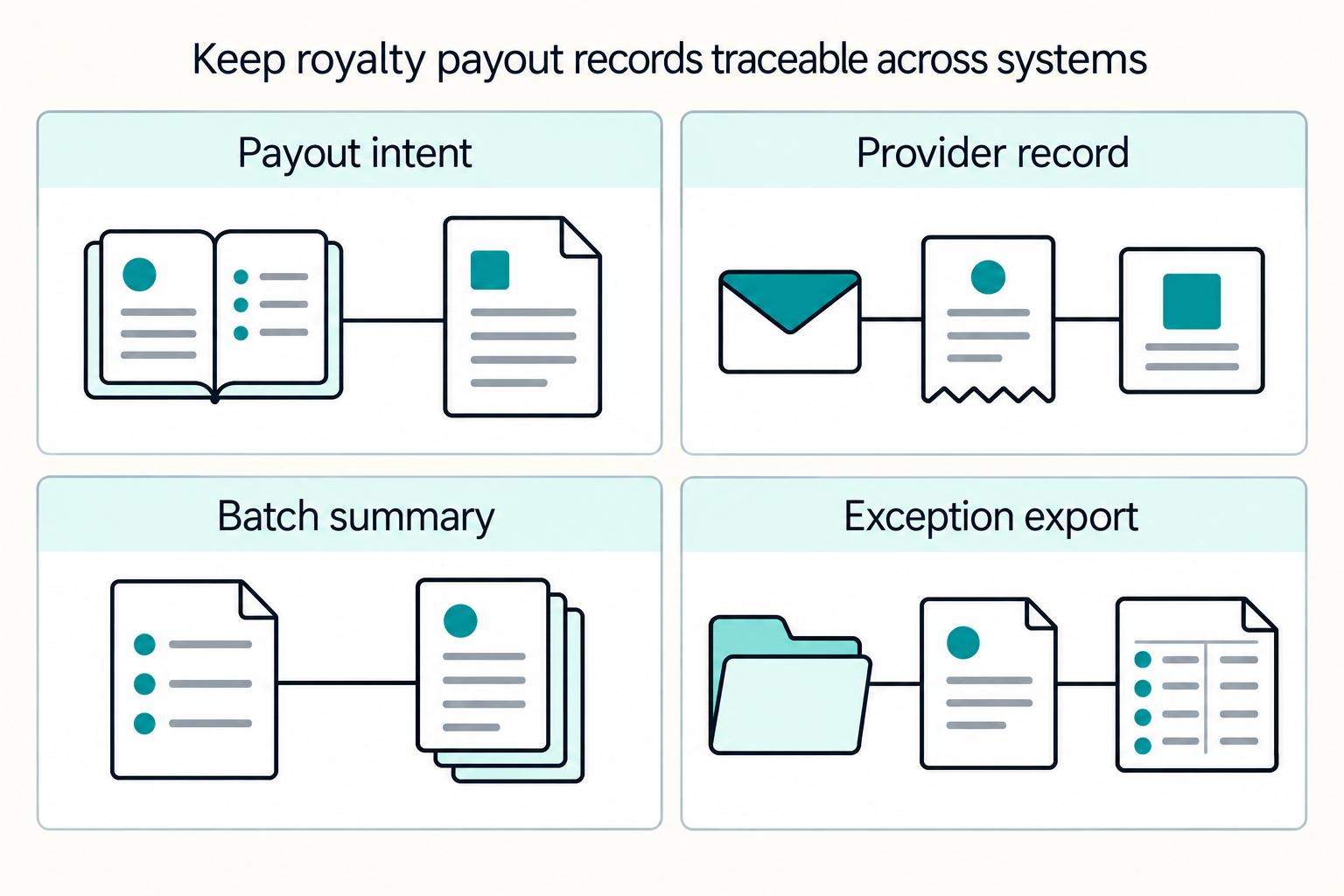
If a corridor has failures or unresolved data, stop new instructions on that route. Recover each submitted outcome before using a fallback; only reroute obligations proven not to have moved money or whose returned funds are confirmed. Keep a batch summary, itemized exception log and finance export tied to provider references. Match reports to the actual payout mode: Stripe’s payout-reconciliation report targets automatic payouts, while manual and instant flows can need balance/transaction records and your own allocation.
Related: How to Pay Drivers on a Ride-Hailing Platform: Earnings Models Tax and Payout Frequency.
Avoid the most expensive rollout mistakes and recover fast#
The costliest failures come from scaling while payout uncertainty is still unresolved. If payout disclosures, compliance gates, or reconciliation evidence are incomplete, pause expansion and close those gaps first.
Mistake 1: Locking licensing decisions before payout disclosure is decision-ready. Recovery: Re-open the model choice until your evidence pack is complete. Contributor earnings structures vary materially across platforms, for example published ranges like 15% to 40%, plus contract-level payment minimum conditions, so treat licensing decisions as provisional until royalty basis, payment minimum, payout timing, and known unknowns are explicitly documented.
Mistake 2: Launching countries before required verification and tax paths work. Recovery: stop new expansion, resolve the actual provider and legal requirements, and retest eligible, pending and rejected cases before reopening. A required missing document or unresolved screening result remains a hold; do not import a bank’s identity rule as a universal marketplace obligation.
Mistake 3: Relying on dashboard totals instead of traceable reconciliation. Recovery: Enforce ledger-to-statement proof on every payout cycle. Validate that each payout can be traced from internal ledger entry to provider reference to settlement statement, then run webhook recovery tests that include manual replay and duplicate-safe handling while retries continue.
Mistake 4: Accelerating contributor acquisition while payout operations are unstable. Recovery: Cap onboarding until payout reliability and support load stabilize. If failed disbursements and payout-related support work are rising, reduce intake and fix payout operations before resuming growth.
We covered this in detail in How Streaming Platforms Calculate and Pay Artist Royalties Per Stream.
Conclusion#
The goal is not to copy the most visible marketplace. It is to choose the licensing and payout model your team can explain, verify, and operate without exceptions piling up in support or finance.
Use this as a practical launch checklist, and treat any unchecked item as a real blocker rather than a note for later.
- Step 1. Document the licensing choice.
Document buyer licence rights, catalog selection and contributor exclusivity as separate choices. State permitted reuse and restricted uses in buyer terms, and define which assets or content types the contributor agreement makes exclusive. Confirm that sales language, review policy and royalty statements describe the same combination.
- Step 2. Publish the payout mechanics.
Write down the royalty basis, payout threshold, payout schedule, and exception handling in plain language. Include what happens when earnings are under threshold, when a payout is held for review, and how corrections appear on contributor statements. If you cannot answer those points with exact product and finance agreement, do not present the model as decision-ready. Ambiguous exception treatment is one of the fastest ways to create creator trust issues.
- Step 3. Turn on compliance gates before payouts.
Enforce the verification and eligibility conditions that apply to the provider account and market. Where relevant, validate EU VAT registration with VIES and use the correct UK route for GB checks. Define W-9 and appropriate foreign-status forms, separate royalties from service compensation, and establish the applicable information-return and withholding treatment before release.
- Step 4. Make money movement controls observable.
Test event deduplication and outgoing-request idempotency separately. A replayed event should not double-post earnings or trigger another payout. An unknown request result must be retrieved before resending or switching routes. Tie the resulting liability and attempt records to provider and bank evidence, with separate adjustment or reversal entries.
- Step 5. Approve country rollout only when the evidence pack is complete.
Launch country by country, not by aspiration. Each corridor should have a complete evidence pack for licensing terms, payout threshold and schedule, verification requirements, AML handling, VAT or tax path, and reconciliation output. If one of those pieces is still unknown, mark that country as not decision-ready and hold the rollout. That discipline matters more than copying the most popular market model.
Frequently Asked Questions
What are the main payout models stock photo platforms use?
Many platforms anchor payouts to contributor royalties, meaning the photographer earns a percentage of what the platform receives for licensing the content. One documented model is Shutterstock's tiered structure with six earnings levels for images and videos, ranging from 15% to 40%, with levels resetting to level 1 on January 1 each year. That reset is a real operator detail to surface early, because contributors may read a published percentage very differently if it can step down on a fixed date.
How does royalty-free licensing differ from curated licensing in photographer payouts?
They describe different things. Royalty-free defines permitted buyer reuse under the licence; curated describes catalog selection. A curated platform can license royalty-free images, and contributors can still earn royalties. Define the selection standard, buyer rights, contributor exclusivity and earnings base independently so the terms and statement explain the same offer.
When should a founder choose exclusive licensing over non-exclusive licensing?
A common starting point is non-exclusive licensing when demand is still unproven and you need faster catalog growth. iStock explicitly says contributors are offered a non-exclusive agreement to get started, and can later apply to be Exclusive for higher royalty rates and rewards. Exclusive only makes sense when you can support that promise with better economics, better distribution, or stronger brand demand, because exclusivity without a measurable upside is just contributor constraint.
What minimum data should we collect before selecting a royalty model?
At minimum, collect the royalty basis, licensing type, payout threshold, payout schedule, and any fee or adjustment treatment. For payout readiness, you also need the contributor's location, business type, and requested capabilities, because required verification information is not universal across countries or account types. If any of those fields are still ambiguous, mark the option as not decision-ready instead of filling gaps with competitor averages.
How do payout thresholds and payout schedules affect creator retention risk?
They determine when accrued earnings can be scheduled for payment, rather than guaranteeing receipt. A balance below the published threshold should carry forward under clear terms. Define the cutoff, issue window, deductions, held amounts and failed-payment handling. Contributors need to distinguish earned, payable, submitted and actually paid balances.
What must be in place before launching cross-border payouts for contributors?
Resolve the requirements for the actual payer, provider, country and contributor type. Provider verification is capability-dependent; tax forms depend on payee and income classification. Required checks must be satisfied before release, with pending cases held and a recorded resolution path. Confirm the beneficiary and supported currency/rail, then test payout outcome retrieval and reconciliation before expanding.
Try a related tool
Researched and edited by the Gruv editorial team. Gruv builds cross-border billing, payouts, and finance-operations software for global businesses.
Sources
Includes 3 external sources outside the trusted-domain allowlist.
- docs.stripe.com/connect/required-verification-informationtrusted
- docs.stripe.com/reports/payout-reconciliationtrusted
- europa.eu/youreurope/business/finance-and-tax/vat/chec...trusted
- irs.gov/forms-pubs/about-form-1099-misctrusted
- irs.gov/publications/p515trusted
- contributor.stock.adobe.com/royaltiesexternal
- gettyimages.com/faq/working-filesexternal
- istockphoto.com/en/workwithusexternal
Educational content only. Not legal, tax, or financial advice.
Related Posts

The Freelance Payment Penalty: A Modeled Audit of Platform Fees, FX Spreads, and Payout Delays
The money rarely disappears through a single, easy-to-spot fee. The real loss is stacked. A marketplace takes its commission, a processor adds a charge for international cards, a bank or payment company converts the currency at a spread, a platform holds the funds before release, and a wire sheds a little to intermediaries on the way in. Each layer looks defensible on its own, but the worker feels the combined result as a smaller deposit and a later payday.

How to Respond to a Subpoena for Business Records
Move fast, but do not produce records on instinct. If you need to **respond to a subpoena for business records**, your immediate job is to control deadlines, preserve records, and make any later production defensible.

A US Expat's Guide to Investing in UCITS ETFs to Avoid PFIC Issues
The real problem is a two-system conflict. U.S. tax treatment can punish the wrong fund choice, while local product-access constraints can block the funds you want to buy in the first place. For **us expat ucits etfs**, the practical question is not "Which product is best?" It is "What can I access, report, and keep doing every year without guessing?" Use this four-part filter before any trade: