
Quick Answer
Start with one jurisdiction-specific operating model and treat unresolved evidence as a stop sign. To pay drivers on a ride-hailing platform, lock three items first: earnings calculation, VAT/GST treatment, and disbursement cadence, each with an owner, source, and recheck date. Then gate withdrawals on completed tax profile data and policy approval, especially where Form 8938 and FBAR obligations may both apply. Run a controlled pilot with one market and one model, and expand only after reconciliation, exception handling, and compliance checks stay stable.
Why this decision is high risk before market launch#
This is a go/no-go market-entry decision, not a detail to clean up after launch. If your earnings model, VAT/GST handling, and payout design are misaligned at launch, you can lock in avoidable risk and costly rework from day one.
In ride-sourcing, copying another platform's mechanics without checking the local policy context is high risk. OECD describes platform-mediated gig activity as a new commercial reality across industries, including transportation, and notes that some activity may not yet be fully captured by existing VAT/GST rules and administrative practice. The practical message is simple: use a formal VAT/GST strategy, not ad hoc interpretation.
Step 1 Treat payout design as a market entry decision#
Do not assume driver-pay logic travels cleanly across markets. Before you commit product build or GTM spend, document one market-specific answer to all three questions:
- How earnings are calculated
- How VAT/GST handling is framed and documented
- How and when money reaches drivers
If any answer still rests on imitation rather than source-backed validation, treat that as a launch blocker.
Step 2 Use policy-grade inputs before operator folklore#
Start with primary material: regulator text, official tax guidance, and named policy documents for each market in scope. Community posts and operator commentary can help you spot issues, but they should stay secondary.
Require a source-backed evidence pack for each target market before launch approval. At minimum, each assumption should include:
- a source URL or saved document
- an owner
- a last-checked date
- a note on whether the source is binding guidance, analysis, or commentary
Step 3 Expect design tradeoffs and unintended effects#
Earnings and transparency choices can change market behavior, and the effects are not always evenly distributed across stakeholders. One observed case came in February 2024, when Lyft introduced a policy guaranteeing drivers a minimum fraction of rider payments while increasing per-ride earnings transparency. One analysis used trip-level data from over 47 million rides across six months and described a staggered rollout that started in more urban major markets.
The lesson is not to copy that policy. It is to expect tradeoffs, phase rollout decisions deliberately, and define in advance what evidence would trigger a model change in each market.
Step 1 Define your launch assumptions and non-negotiables#
Do not treat this as launch-ready until your assumptions are explicit, owned, and date-tracked.
| Area | What to document | Tracking detail |
|---|---|---|
| Scope | Whether the day-one model treats drivers as an Independent contractor for this tax topic, launch jurisdictions, and a yes/no decision on cross-border payouts at launch | If cross-border is unresolved, keep scope domestic |
| Go conditions | Thresholds for payout reliability, compliance readiness, and acceptable manual ops load per payout cycle | Each threshold needs a named owner and approval criteria |
| Tax handling | Self-employment tax and other applicable taxes as separate handling tracks | Assign internal ownership for dispute handling |
| IRS anchors | IRS Topic 554 and Schedule SE (Form 1040) | Topic 554 includes independent contractors in self-employed status for this purpose, and Schedule SE is used to calculate tax due on net earnings from self-employment |
| Verification | A source, an owner, and a revalidation date for every assumption | Log the source URL, accountable owner, last-checked date, and a review trigger |
-
Lock scope in writing. State whether your day-one model treats drivers as an Independent contractor for this tax topic, list launch jurisdictions, and make a yes/no decision on cross-border payouts at launch. If cross-border is unresolved, keep scope domestic rather than leaving tax treatment ambiguous.
-
Define go conditions before build. Set internal thresholds for payout reliability, compliance readiness, and acceptable manual ops load per payout cycle. These thresholds are your call, but each one needs a named owner and approval criteria.
-
Set tax and ownership red lines. For U.S.-linked flows, document Self-employment tax and other applicable taxes as separate handling tracks, and assign internal ownership for dispute handling. IRS guidance is explicit that self-employment tax covers Social Security and Medicare only, not other taxes.
-
Anchor assumptions to IRS artifacts. If your model relies on independent-contractor treatment for this topic, anchor it to IRS Topic 554 and Schedule SE (Form 1040). Topic 554 includes independent contractors in self-employed status for this purpose, and Schedule SE is used to calculate tax due on net earnings from self-employment.
-
Run a hard verification checkpoint. Every assumption needs a source, an owner, and a revalidation date. Log the source URL, accountable owner, last-checked date, and a review trigger. IRS corrections, including the 20-FEB-2026 correction to the 2025 Schedule SE instructions, are reason enough not to treat this as static.
Step 2 Build a market evidence pack you can defend#
Do not launch a market until your evidence pack clearly separates legal classification risk from payout-timing demand and flags any material unknowns.
| Evidence type | What to record | What it can support | What it cannot support |
|---|---|---|---|
| Official rule text | Regulator name, rule text excerpt, effective date, your interpretation owner | Defensible statements about local requirements | Driver preference or behavior assumptions |
| Commissioned analysis | Study scope, method, geography, date, key finding | Directional product signals, for example, payout cadence preference | Binding legal or regulator conclusions |
| Non-authoritative commentary | Author, publication, claim summary | Context for questions to verify | Launch-critical decisions on its own |
This split matters because it keeps you from mixing unlike facts. For example, TNC driver classification disputes were described as unresolved across multiple jurisdictions at the time of writing. Unpaid employer taxes, including Social Security and Medicare, were identified as a key concern in contractor-classification debates. Treat that as legal-risk context, not settled status.
Use payout-timing evidence differently. A large ridesharing survey experiment in Brazil reports that many drivers would trade earnings for faster pay. That includes a median tradeoff of about one-third for same-day pay versus payment a month later, with stronger preference among workers facing tighter financial constraints. That is useful input for payout design, but it is not regulator text.
Add an explicit Unknowns column for each market and block launch when unknowns are material, for example, missing regulator rule text, unresolved classification status, or inaccessible sources. If a source is inaccessible or blocked, log it as unresolved evidence rather than filling the gap with inference.
For a related operating pattern, see Build a Staffing Payout Platform That Can Support Weekly Pay.
Step 3 Pick the driver earnings model for each market#
Pick a model that can hold up under both regulation and demand swings, then optimize around it. If a market resembles Driver Minimum Pay Rules, design to the regulated floor first and treat incentives as a second layer.
Compare components before combining them#
Use one comparison view so operators and drivers can both see how pay is set, when it is paid, and where volatility lands.
| Model component | How it works in practice | Main upside | Main risk | Who bears demand volatility most of the time |
|---|---|---|---|---|
| Per-trip floor | Guarantees a minimum for a completed or qualifying trip | Clear promise that is easier to explain and audit | Cost pressure when trip mix or demand shifts | Mostly the platform once the floor is guaranteed |
| Time-and-distance formula | Pays from trip inputs such as time and distance | Predictable structure you can simulate before launch | Sensitive to traffic, idle assumptions, and input quality | Shared; can tilt to drivers when unpaid waiting time is frequent |
| Incentives layer | Adds bonuses for peaks, trip counts, zones, or supply targets | Changes behavior without replacing the base model | Trust risk if rules change often or feel game-like | Mixed, based on whether incentives are guaranteed |
| Adjustment logic | Applies true-ups, corrections, or transparency-backed guarantees | Corrects underpayment and supports transparency commitments | Retroactive changes can create trust disputes | Operationally the platform, with trust impact on drivers |
One useful contrast is commission-based rideshare versus taxi-style lease compensation. In commission models, drivers pay a share of fares. In lease models, drivers pay a fixed amount independent of earnings. Evidence shows these structures shift risk differently by hours worked, and fixed lease setups can create upfront shift pressure because the fixed cost is paid before shift outcomes are known.
Apply the regulation-first rule#
If local rules resemble Driver Minimum Pay Rules, start with the floor calculation and verify it first. Only then should you tune incentives.
That order can reduce the chance that bonuses hide underpayment in quieter periods, lower-density zones, or dispute reviews. Keep a market memo with the rule text, a plain-language interpretation, sample calculations, and accountable owners across product, ops, and finance.
Match model complexity to volatility and payout cadence#
High-volatility markets often need tighter controls around adjustments and payout timing. More stable markets may be able to run simpler weekly settlement patterns if the earnings logic is clear and correction handling is consistent.
Uber's 2016 Instant Pay rollout is a useful reminder that cadence and earnings design interact. Drivers had been paid weekly, with effort-to-pay lag around ~3 days versus ~9 days depending on when trips occurred. The trial reported increases including 2.4% in work minutes and earnings and 1.5% in distinct driving sessions. Use that as an interaction signal, not as a guaranteed outcome in every market.
Lyft's 2024 guaranteed-share and transparency policy was introduced in major urban markets first. That is a practical reason to test market segments separately rather than assuming urban results carry directly into nearby suburban areas.
Stress-test edge cases before launch#
Before you finalize the model, run it through the failure paths that most often damage trust:
- long idle windows
- cancellations after acceptance
- retroactive corrections or true-ups after drivers viewed a trip as settled
For each case, require a driver-visible earnings view and an internal recomputation view that reconcile to the same result.
Decision checkpoint#
End each market review with one default model and one fallback model, plus explicit switch triggers. Define those triggers in a market-specific rubric tied to local rules and observed reconciliation behavior, then review them across product, ops, and finance.
Step 4 Set payout frequency and cash-out rules that survive real operations#
Set a scheduled cadence you can reconcile first, then add optional instant cash-out only after operations are stable. If liquidity or banking operations are still tight, do not launch with instant access as a promise. A predictable weekly cycle is usually easier to operate, explain, and audit.
1 Set one baseline cadence and write the exact cut-off#
The key decision is not just weekly versus instant. It is whether every team uses the same cut-off, settlement window, and payout statuses. In the Uber study context, the schedule was explicit: earnings accrued from Monday 4am to the following Monday 4am, then paid on the subsequent Wednesday. Use that as an example of precision, not as a default for your market.
| Policy element | What to specify |
|---|---|
| Cut-off | Cut-off time and timezone |
| Payout timing | Payout creation day and expected arrival window |
| Calendar handling | Weekend and bank-holiday handling |
| Fees | Fee ownership, if transfer fees apply |
| Statuses | Driver-visible statuses before, during, and after disbursement |
For launch, define one short payout policy used by product, ops, finance, and support. Include:
- cut-off time and timezone
- payout creation day and expected arrival window
- weekend and bank-holiday handling
- fee ownership, if transfer fees apply
- driver-visible statuses before, during, and after disbursement
Then test trips around the cut-off boundary and confirm that driver totals, ledger totals, and payout batch totals reconcile to the same result.
2 Treat Uber and Lyft patterns as directional, not default#
Use large-platform patterns as signals, then verify your own market. In the cited study period, Uber's March 2016 Instant Pay rollout reduced lag between effort and pay by 3 to 9 days, and the study reports that flexible pay increased work time and earnings. That shows payout timing can influence behavior, but it does not prove the same outcome everywhere.
Lyft is also a reminder that product behavior varies by market. Its earnings page states that upfront pay is not available in Washington state, New York City, or Portland. Before you promise cadence, preview, or cash-out behavior in a new market, verify it against current platform documentation and your own settlement setup.
3 Gate instant cash-out behind operational proof#
Instant cash-out can improve driver cashflow, and it may add treasury and exception-handling pressure. Launch with scheduled payouts first, then add optional faster access after clean reconciliation cycles.
Put safeguards in place before rollout:
- payout batch controls that allow freeze, review, and safe re-run without duplicates
- an exception queue for returned transfers, account mismatches, and trips under review
- clear driver-facing payout statuses like
processing,sent, andfailed
Keep transparency high when payouts are delayed or adjusted. Lyft's weekly earnings breakdown and ride-level split visibility are a useful benchmark for clarity. Drivers should be able to see what changed and why.
Step 5 Design tax and classification controls before first payout#
Do not enable withdrawals until a driver has a complete tax profile and your classification policy gate is approved. Once payouts start, missing tax data turns into an audit and remediation problem, not an onboarding fix.
This is the control layer behind your payout cadence. For each launch jurisdiction, define a short decision tree before first payout that covers payee classification for that market, reporting steps, and required document collection. The goal is simple: block payout activation when required facts are still unknown.
1 Build the jurisdiction decision tree first#
Keep the tree operational: market, entity, and payee type first, then required documents and reporting review. In U.S.-linked contractor flows, mark Internal Revenue Service (IRS) steps for Form 8938 timing and for keeping FBAR (FinCEN Form 114) separate, without turning support into tax advice.
Use a hard gate:
- no payout activation without country, tax residency, and payee classification captured
- no payout activation if required tax forms are missing or expired
- no payout activation while jurisdiction policy review is open
- no manual override unless finance or compliance approval is logged
2 Separate platform collection from payee filing dependencies#
For U.S.-linked and cross-border programs, make dependencies visible and operational ownership explicit. Do not assume one form covers everything. IRS instructions state that filing Form 8938 does not remove a separate FBAR requirement, FinCEN Form 114.
| Item | Pre-activation check | Red flag |
|---|---|---|
| Form 8938 | Whether guidance flags that some taxpayers may have separate annual reporting when specified foreign financial assets exceed the applicable threshold and a return is required | Assuming every foreign payout triggers Form 8938 |
| FBAR | Whether your guidance clearly separates FBAR from IRS return attachments | Saying Form 8938 covers FBAR |
Form 8938 is a good precision check because it is used to report specified foreign financial assets above the applicable threshold. Attach Form 8938 to the annual return and file it by that return's due date, including extensions. The IRS notes a general $50,000 trigger for certain U.S. taxpayers and also notes higher thresholds for joint filers or taxpayers residing abroad. If no income tax return is required for the year, Form 8938 is not required even when asset values are above the threshold. Some assets are excluded, including certain accounts maintained by a U.S. payer, so avoid blanket messaging that all payees with international activity must file.
3 Use the vendor portal as the control point#
Use the vendor portal to store the fields and evidence you will need later: legal name, taxpayer identification number where relevant, applicable tax year, document status, consent records, and a timestamped change history. That lines up with practical identity checkpoints such as name and TIN fields and preserves an audit trail when profiles change after onboarding.
Verification checkpoint: no withdrawals enabled state until the tax profile is complete and the policy gate passes. Before launch, test a standard domestic driver, a foreign payee requiring additional tax review, and a driver whose document state changes after approval. If any of them can still cash out with an incomplete profile, fix that before scaling. For deeper cross-border form design, see FATCA and W-8 Tax Compliance for Platforms: How to Avoid Withholding on Foreign Payouts.
Related: How to Build a Vendor Portal for Platforms: Tax Forms Invoices Payouts and Disputes in One Workspace.
Step 6 Translate regulation into product rules and audit trails#
Turn policy text into testable, versioned product behavior before you ship. If a requirement is not clearly tagged as enforced logic, configurable logic, or disclosure-only content, it is still too vague for production.
Step 1 Classify each policy input before engineering it#
Use a simple triage so legal text does not turn into ambiguous product behavior.
| Policy input type | Product meaning | Build requirement |
|---|---|---|
| Enforced rule | The platform must block, require, or calculate something | Eligibility checks, payout calculations, hard stops, exception handling |
| Configurable rule | Logic is stable, but values or scope can change | Versioned parameters, market flags, effective dates |
| Disclosure-only item | You must explain it clearly, without enforcement logic | Earnings UI copy, help text, payout statements, notices |
Step 2 Keep wording precise in product and support surfaces#
Use terms exactly as your source text uses them. For example, treat minimum per-trip payment and minimum wage as distinct terms unless your governing rule text explicitly defines them as equivalent.
Apply the same discipline to fares and earnings. If a rule affects earnings display but not rider pricing, do not use wording that implies fare control.
Step 3 Store policy decisions as versioned rules#
Do not keep payout policy only in static notes. Store each rule with market scope, source document reference, effective date when specified, and approval metadata so historical payouts can be reproduced from the rule version active at that time.
Step 4 Require payout-cycle evidence, not just transparency#
For each payout cycle, keep internal audit evidence such as the rule version used, computation inputs, manual approvals, and exception rationale. These are not established as regulator-mandated fields, so treat them as implementation controls.
This matters because transparency changes can alter behavior. One study of Lyft's February 2024 policy change, a minimum fraction guarantee plus per-ride transparency, used trip-level data from over 47 million rides across six months. It found higher activity and earnings in that setting while also flagging potential strategic driver behavior.
If you increase ride-level visibility, pair it with traceable logs of what was shown, what was calculated, and what was overridden.
Once your rule matrix is stable, pressure-test it in an operational payout flow with idempotent retries, batch visibility where enabled, and traceable status handling in Gruv Payouts.
Step 7 Build payout operations for failures before scale#
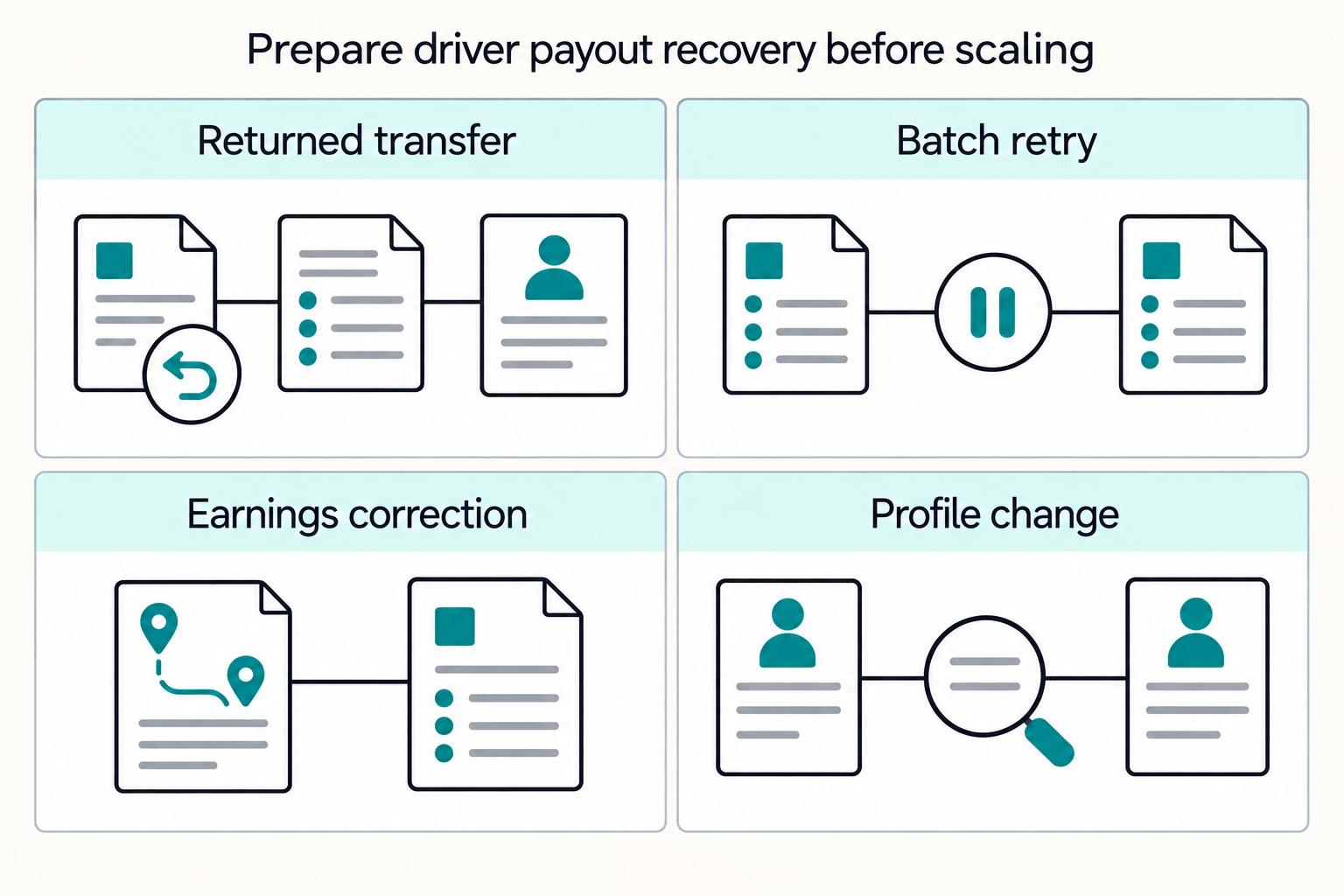
Assume your first real payout failure will happen before the operation feels busy. Design the recovery path early, while volumes are still small enough to inspect by hand. The main question is not whether failures occur, but whether your team can stop damage, explain the state clearly, and recover without double-paying or losing the audit trail.
Build operations around the failure paths already implied by your payout design: returned transfers, batch re-runs, account mismatches, late earnings corrections, and profile changes after approval. If those cases still depend on ad hoc Slack messages or spreadsheet handoffs, you do not yet have a scalable payout operation.
| Failure path | What ops needs ready | What you should verify before scale |
|---|---|---|
| Returned transfer | A clear owner, reversal path, and next-step status for the driver | Ledger reversal, payout status, and support explanation all match |
| Batch re-run after an issue | Idempotent retry logic and duplicate-prevention controls | A safe re-run does not create a second payout |
| Post-payout correction or true-up | A documented adjustment workflow and driver-visible explanation | The original trip view, correction record, and next payout reconcile |
| Payee profile or bank detail change before disbursement | A re-check or hold rule tied to the profile change | Funds cannot move on stale payee details without logged approval |
Before you scale, run recovery drills on the cases most likely to damage trust: a payout marked sent that later fails, a trip that lands on the cut-off boundary, a correction after a driver believed earnings were settled, and a payee record that changes between approval and cash-out. If ops, finance, and support cannot all explain the same case from the same evidence, keep the launch scope tight until they can.
Step 8 Run a 60 day pilot with explicit go no-go gates#
Use this pilot as a decision tool, not a broad launch. Start with one market and one earnings model. If you change multiple policy or payout variables in the same phase, it becomes much harder to isolate what drove results.
Step 1 Fix the pilot scope before launch#
Lock one jurisdiction and one rule interpretation before launch. For New York City, keep your compliance evidence tied to the TLC Driver Pay (High-Volume For-Hire Vehicles) rule page and retain the listed artifacts, including Adopted Rule Full Text and Hearing transcript. That page shows Rule status: Adopted and an Effective date: August 1, 2025, so your pilot is anchored to a specific policy version.
Freeze the earnings model for the pilot window. The Lyft evidence from February 2024 combined a minimum-fraction earnings guarantee with higher per-ride transparency, and its staggered rollout across major markets created a natural experiment over 47 million rides and six months. The practical takeaway is to stage changes so cause and effect stay observable.
Step 2 Review a fixed metric set on a regular cadence#
Use one short metric set, reviewed by a named owner and source of truth. Keep that set stable through the pilot so you can compare results cleanly across the rollout period.
Step 3 Set explicit go/no-go gates before expansion#
Expand only when compliance evidence and operational performance are both stable. If either is weak, hold scope and fix root causes first. Do not rely on engagement movement alone when transparency changes are in play. The Lyft study reports stronger engagement and earnings outcomes, but it also flags a risk of unintended strategic driver behavior, so your go decision should require operational evidence, not marketplace momentum by itself.
Before expansion review, require one complete pilot evidence pack for the market and rule version you tested, plus the operational records needed to reproduce your results.
Common mistakes that delay launch and how to recover#
Launch delays usually come from preventable assumption errors. The recovery path is straightforward: re-check primary evidence, rebuild market logic by jurisdiction, enforce tax completeness before payout, and test one change at a time.
| Mistake | Recovery action |
|---|---|
| Anecdotal payout claims used as policy | Rebuild the evidence pack using dated primary sources and assign an owner and last-validated date to each assumption |
| Exporting one-city assumptions to other markets | Rebuild a market matrix for each jurisdiction, include legal review for that market, and keep an explicit Unknowns column |
| Tax-state completeness not enforced before payout | Freeze new payout activation, backfill missing records, and keep an audit trail with a law inventory and a timeline of tax events |
| Pricing tests and payout-rule changes run together | Rerun the pilot with one controlled change and review a fixed weekly set: payout success rate, exception volume, tax-profile completion rate, and reconciliation lag |
Step 1 Re-baseline anecdotal payout claims#
Treat forum posts and driver-community claims as signals, not policy. Confirm each payout or earnings assumption against current primary documentation for that market before you use it in rules or operations.
To recover, rebuild your evidence pack using dated primary sources and assign an owner and last-validated date to each assumption. If any assumption lacks that trail, pause it until validated.
Step 2 Rebuild market logic instead of exporting one-city assumptions#
Do not treat one city's operating context as a default template for other markets. Ride-hailing outcomes are sensitive to local market conditions, and copied assumptions can fail when route and time patterns differ. Analysis that ignores rider substitution across ride-sharing, taxis, and public transit can also overestimate gains.
To recover, rebuild a market matrix for each jurisdiction, include legal review for that market, and keep an explicit unknowns column. Flag any row that still depends on borrowed assumptions from another market.
Step 3 Enforce tax-state completeness before payout#
Before launching payouts, treat tax-state completeness as a required checkpoint. Put a pre-payout gate so payout eligibility and tax-profile completeness are checked together.
If you are already behind, freeze new payout activation, backfill missing records, and keep an audit trail with a law inventory and a timeline of tax events. Resume only when payout-eligible and tax-complete status match.
Step 4 Separate pricing tests from payout-rule changes#
Change pricing and payout rules in separate tests. Dynamic pricing and time- or route-sensitive demand can move rider and driver behavior at the same time, which makes root-cause analysis unreliable if both variables change together.
To recover, rerun the pilot with one controlled change and review a fixed weekly set: payout success rate, exception volume, tax-profile completion rate, and reconciliation lag.
Your copy-paste launch checklist#
If any one of these checks fails, treat it as a no-launch decision for that market or payout option.
- Freeze the jurisdiction evidence pack before build sign-off.
Each market file should include the source document, owner, review date, and whether the item is binding rule text or context. For U.S. foreign-asset reporting touchpoints, use primary IRS materials. The IRS About Form 8938 page shows a last reviewed date of 31-Mar-2026. If a material question is still unknown, keep launch blocked.
- Lock one earnings model and one fallback model per market.
Document a named default model, a named fallback model, and the trigger to switch. A non-product reviewer should be able to identify what applies now, what changes it, and who approves the change.
- Test payout cadence, cut-offs, and exception handling with a full batch rehearsal.
Define the cut-off time, what enters the current batch versus the next batch, and how holds or corrections are handled. Run a dry batch that includes exception cases, then confirm that ops and finance can explain the same outcome from the same records.
- Enforce tax and compliance gates before payout activation, especially for cross-border scope.
Keep clear boundaries between platform collection tasks and taxpayer filing obligations. For U.S. checks, Form 8938 reports specified foreign financial assets when the applicable threshold is exceeded, is attached to the annual return by that return's due date (including extensions), and does not replace FBAR (FinCEN Form 114). If no income tax return is required for the year, Form 8938 is not required. If your team treats Form 8938 and FBAR as interchangeable, resolve that before launch.
- Make audit trail and reconciliation outputs review-ready for every payout batch.
Keep rule version, batch totals, exceptions, approvals, and supporting data for foreign-asset reporting positions when relevant. Form 8938 highlights the level of detail tax reviews may need, including auditable fields like number of deposit accounts and maximum values.
- Hold expansion until pilot metrics are met and stable.
Add markets or payout options only after pre-set go/no-go thresholds are met. Do not use immediate IRS filing acceptance as an operational trigger. Return-processing can include rejections of electronically filed returns and slow processing of paper returns. Use completed profile state and internal review evidence as the launch gate.
Before scaling beyond your pilot, align implementation owners on policy gates, webhook states, and reconciliation checkpoints using Gruv Docs.
Frequently Asked Questions
Do ride-hailing drivers always owe `Self-employment tax` when treated as an `Independent contractor`?
From the provided IRS excerpts, this cannot be answered as an "always." It is established that Schedule SE (Form 1040) is used to figure tax due on net earnings from self-employment, and that this tax applies regardless of age or whether someone already receives Social Security or Medicare benefits. Treat that as a U.S. review point, not proof that every driver in every case owes it.
How often should a new platform pay drivers if instant cash-out is not yet mature?
Set cadence only after separate market-specific operational and legal validation.
Do `Driver Minimum Pay Rules` in NYC set `minimum wage` or only `minimum per-trip payment`?
Keep this unresolved until you verify current regulator text directly. Do not label the rule either way.
Can we copy `Uber` and `Lyft` payout timing as our default in every country?
Treat competitor timing as non-authoritative until local legal, tax, and payout constraints are validated for each market.
What does `An Earnings Standard for New York City’s App-based Drivers` actually prove for operators today?
This remains unresolved. What it proves for operators today, or whether it creates a binding operator requirement, is not established. Use it as context until you verify current regulator text for your target market.
Which tax documents should we collect first for cross-border payouts such as `W-8` and `FATCA`-related data?
Whether W-8 or FATCA-related data should be collected first is not established. It is established that Form 8938 reports specified foreign financial assets, must be attached to the annual return by that return's due date, including extensions, and does not replace FinCEN Form 114 (FBAR). There is also a $50,000 trigger for certain taxpayers, with higher thresholds for joint filers or taxpayers residing abroad. For collection-order decisions, use dedicated tax review and this guide.
Try a related tool
Researched and edited by the Gruv editorial team. Gruv builds cross-border billing, payouts, and finance-operations software for global businesses.
Sources
- anderson.ucla.edu/faculty_pages/keith.chen/papers/WP_InstantPa...trusted
- dot.ca.gov/-/media/dot-media/programs/road-charge/docum...trusted
- irs.gov/forms-pubs/about-schedule-se-form-1040trusted
- irs.gov/businesses/small-businesses-self-employed/se...trusted
- nyc.gov/assets/dca/downloads/pdf/about/PublicComment...trusted
- pmc.ncbi.nlm.nih.gov/articles/PMC7410973trusted
- sec.gov/Archives/edgar/data/1543151/0001543151250000...trusted
- sec.gov/Archives/edgar/data/1543151/0001543151210000...trusted
Educational content only. Not legal, tax, or financial advice.
Related Posts

The Freelance Payment Penalty: A Modeled Audit of Platform Fees, FX Spreads, and Payout Delays
The money rarely disappears through a single, easy-to-spot fee. The real loss is stacked. A marketplace takes its commission, a processor adds a charge for international cards, a bank or payment company converts the currency at a spread, a platform holds the funds before release, and a wire sheds a little to intermediaries on the way in. Each layer looks defensible on its own, but the worker feels the combined result as a smaller deposit and a later payday.

How to Respond to a Subpoena for Business Records
Move fast, but do not produce records on instinct. If you need to **respond to a subpoena for business records**, your immediate job is to control deadlines, preserve records, and make any later production defensible.

A US Expat's Guide to Investing in UCITS ETFs to Avoid PFIC Issues
The real problem is a two-system conflict. U.S. tax treatment can punish the wrong fund choice, while local product-access constraints can block the funds you want to buy in the first place. For **us expat ucits etfs**, the practical question is not "Which product is best?" It is "What can I access, report, and keep doing every year without guessing?" Use this four-part filter before any trade: