
Quick Answer
Platforms should release a foreign payout only after they can rely on valid W-8 documentation, confirm the payee's status, and determine whether the payment is U.S.-source FDAP or otherwise in scope for withholding. If documentation is missing, invalid, expired, or cannot be reliably tied to the payment, hold the payout or apply statutory withholding under presumption rules, then retain records for Forms 1042 and 1042-S.
Introduction and the payout decision this guide solves#
The decision is not whether you collected a tax form. The question is whether you can release, hold, or withhold a foreign payout based on documentation you can rely on, the payee's status, and whether the payment is in scope for U.S. withholding.
If your platform receives, controls, has custody of, disposes of, or pays the funds, you may be the withholding agent. That means your team needs a defensible payout decision. You also need a reporting trail that supports Form 1042 and Form 1042-S where required.
Scope the guide around withholding-agent duties#
This guide is for teams managing cross-border payouts. It focuses on FATCA's report-or-withhold framework, reliance on Form W-8, presumption rules when documentation is missing or unreliable, and the reporting trail that follows.
Set ownership early. Who approves payout treatment when tax status is unclear? Without a clear owner, payouts either move on incomplete facts or stall with no accountable decision.
Collect documents before payout release#
The core documents include Form W-8 variants, such as Form W-8BEN-E for entities. The payee gives the form to the payer or withholding agent for withholding purposes. The payee does not file it with the IRS.
Collection is only the first gate. Documentation you cannot rely on is not a release signal. If you do not have a valid Form W-8 or Form W-9 you can rely on, you must apply presumption rules.
Validate status before accepting a signed form#
Confirm the form matches the payee type, covers the payment at issue, and is consistent with the information you have about the payee and payment. This is where U.S.-source income treatment and FATCA classification can change the outcome.
Keep tax validation separate from onboarding completion. A payee can be commercially onboarded and still be blocked from payout release until tax status is validated.
Decide treatment from a documented rule#
Decide payout treatment from a documented rule, not instinct. For covered U.S.-source FDAP or gain payments to foreign persons, Chapter 3 withholding generally starts at 30%. A lower rate or exemption may apply under the Code or a treaty.
Use specialist judgment where Publication 515 exceptions or treaty interpretation are unclear. IRS model treaty materials can help frame the issue, but they are not a universal answer key.
Report and retain evidence as one control#
A payout is not complete when funds move. Form 1042 is the annual return for U.S.-source income of foreign persons. Form 1042-S reporting can still apply even when no tax was withheld because a treaty exemption applied. If you cannot reconstruct a payout decision months later, your audit position is weak even if the tax logic was sound.
Prerequisites and evidence to gather before your first payout cycle#
Do not release payouts until you can name the decision owner, confirm which W-8 records are valid, and show exactly where a payment is blocked when tax status is unclear.
Assign decision ownership#
Name the owners before the first live cycle. IRS rules may not prescribe your org chart, but the withholding agent is responsible, and withholding is required when payment is made.
Set a clear approval path for FATCA and withholding treatment decisions, legal escalations when facts are disputed, and the operational release, hold, or withhold action. For any sample payout, you should be able to name who approved the tax treatment.
Inventory your Form W-8 records#
Build a current inventory of Form W-8 records for active foreign payees, including Form W-8BEN-E for foreign entities. Review each record for completeness and accuracy, confirm it can be reliably associated with the payee, and check whether it remains valid through the end of the third succeeding calendar year, absent a change in circumstances.
A stored form is not enough if it is expired, incomplete, or unreliable. If valid documentation cannot be reliably associated to the payment, presumption rules apply, and 30% withholding becomes the default benchmark.
Trace U.S.-source and FDAP exposure in payout flows#
Map where U.S.-source income and FDAP can appear in each payout path, then identify the exact release gate in that path. This shows you whether withholding logic must run before funds move.
Test at least one path end to end. If a missing or expired W-8 does not stop release before payment, the control is documentary, not operational.
Prepare an audit packet before you need one#
Prepare a consistent internal evidence pack now. Include the tax decision log, approver record, documentation relied on, payout details, and the reporting export used to support any required Form 1042-S and Form 1042 filings.
Use a simple checkpoint: reconstruct one released payout and one held payout from the record alone, without cross-team rework. If you cannot, an audit will be harder than the tax analysis.
Classify payout flows before you automate withholding decisions#
Get classification right before you automate anything. Tag each payout flow by payee type, income character, and U.S.-source status first, then apply withholding logic.
Segment by payee profile and payout pattern#
Start with facts you can verify: individual versus entity, and recurring versus one-off payment pattern. The individual/entity split affects documentation immediately because Form W-8BEN is for individuals and W-8BEN-E is for entities.
Do not treat all nonresident payouts as one class. IRS characterization guidance generally divides nonresident alien income into FDAP and ECI categories, so segment by what is being paid, not just who is being paid. A recurring royalty flow, a services fee, and a mixed invoice with fees plus expense lines should be routed separately.
Before assigning withholding status, make sure each payout record clearly shows three fields: payee type, payout character, and potential U.S.-source status.
Map the payment to income character before tax form logic#
Character drives the tax analysis, so do not let form collection lead the process. Use Section 61 as the starting point: gross income is broad, so identify the payment's actual character before you apply form-based treatment. Internal labels like "creator payout" or "reimbursement" are not enough on their own.
| Payout flow | Character question | U.S.-source checkpoint | Review trigger |
|---|---|---|---|
| Recurring creator royalties | Is this a royalty for use of property or rights? | Royalties from property used in the United States are U.S. source | Contract does not state where rights are used |
| Contractor service fee | Is this compensation for services? | Service income is generally sourced where services are performed | Invoice does not support service location |
| One-off contractor reimbursement | Is this reimbursement only, or bundled compensation? | Do not assume non-U.S.-source or non-withholdable based on label alone | Reimbursement is bundled with fee lines |
Mixed invoices can be a recurring risk. If labor, fees, and expense items are blended, split them for classification or hold for review instead of coding one character for the full amount.
Add a U.S.-source determination checkpoint before withholding status#
Source determination should happen before Chapter 3 or Chapter 4 (FATCA) treatment. For services, source generally follows where services are performed. For royalties, source can depend on where property is used. For FATCA, the analysis starts with whether the payment is a withholdable payment, which is generally U.S.-source FDAP income.
Make this a hard gate: no source determination, no automated release decision. If source evidence is missing, ambiguous, or inconsistent, route to human review.
Use scenario contrasts to keep automation honest#
Use clear scenario contrasts so automation does not flatten meaningful differences. Recurring creator royalties and one-off contractor reimbursements can raise different tax questions. A royalty stream tied to U.S. use can raise U.S.-source FDAP issues. A reimbursement label alone does not resolve character.
Do not assume a W-8 on file cures bad classification. If character and source are not defensible, withholding risk rises, including default 30 percent Chapter 3 withholding on amounts subject to withholding when reliable documentation for other treatment is not in place.
Set intake and validation rules for W-8 documentation#
Treat W-8 intake as a payout gate, not a file upload task. If you cannot reliably associate a payment with documentation you can rely on, presumption rules apply, and 30% withholding may apply on amounts subject to withholding paid to a foreign payee.
Require minimum fields before a payee becomes payable#
Set a hard rule: onboarding can continue, but payable status stays blocked until the correct Form W-8 is present and required checks pass. For entities, W-8BEN-E documents foreign entity status for chapters 3 and 4, and it is provided to the withholding agent or payer, not sent by the payee to the IRS.
| Form | Minimum validation checks to enforce | Hard reject examples |
|---|---|---|
| Form W-8BEN | Permanent residence address must be a street address, not a P.O. box or in-care-of address; collect U.S. TIN if required by the instructions and the payee's facts | P.O. box listed as permanent residence, missing required TIN field |
| Form W-8BEN-E | Name of organization that is the beneficial owner; country of incorporation or organization; one Chapter 3 status box only; Chapter 4 status with the applicable certification completed | Missing entity name, no country of organization, multiple Chapter 3 statuses selected, FATCA status selected without matching certification |
As a practical first check, make sure the form type aligns with the payee type you classified earlier. If an entity uploads an individual form, or required W-8BEN-E status fields are blank, keep the record in onboarding and out of payable.
Tie each payment to documentation you can rely on#
"On file" is not a control. Each payment must be reliably associated with documentation the withholding agent can rely on. Keep a current tax record linked to the payee record that will actually receive funds.
In practice, keep the payee ID, legal payee name used for payout, document image or PDF, intake timestamp, and validation result connected throughout the payment lifecycle. If funds can be released without that link on the payment date, the control is not reliable.
Define invalid-document handling explicitly. If the form is wrong, unreadable, incomplete, or inconsistent with the payee record, mark tax status unresolved and block release. A collected W-8 does not resolve withholding by itself. If you cannot reliably associate the payment with valid documentation, presumption rules apply, and Chapter 4 risk remains if withholding is not performed.
Add freshness and change-in-circumstances controls#
W-8BEN-E validity needs to operate as a live control, not as a policy note. The general validity period runs through the last day of the third succeeding calendar year, unless a change in circumstances makes the information incorrect sooner.
At minimum, track an effective date, a calculated W-8BEN-E expiry date, and a separate change review required flag. Trigger review when previously validated facts change, such as country of organization or selected Chapter 3 or Chapter 4 status. One failure mode is showing "tax form received" in onboarding while payout gates never recheck whether the form is still usable.
Separate document collection from payout approval#
Keep document collection and payout approval as separate states. A payee can upload a form before income is paid or credited, but the withholding agent still needs the ability to block release when tax status is unresolved.
Use a clear state chain: document received -> document validated -> tax status approved for payout. Only the final state should unlock release. If "W-8 on file" currently acts as an automatic green light, fix that before adding more automation.
Related: VAT and SEPA: How European Platforms Combine Tax Compliance with Automated Euro Payouts.
Build release hold withhold decision rules your ops team can run daily#
Run one rule every day: no payout is released without a recorded tax treatment outcome of release, hold, or withhold. If Form W-8 status is unresolved at payout time, do not release as nonwithheld.
Hold the payout, or apply statutory treatment when you have determined the payment is U.S.-source FDAP or otherwise treated as withholdable for Chapter 4 and your policy allows payment to proceed. Missing or invalid documentation does not support a clean nonwithheld release, and presumption-rule exposure follows if required withholding is not performed.
Set a three-factor decision table#
Standardize the daily decision around three questions: documentation validity, FATCA status certainty, and U.S.-source or withholdable-payment determination.
| Documentation status at payout | FATCA status certainty | U.S.-source income determination | Daily ops outcome | Why |
|---|---|---|---|---|
| Valid Form W-8 reliably associated to payee and payment | Certain and consistent with form certifications | Not U.S. source, or not income subject to withholding under your classified flow | Release | No withholding treatment is triggered by the documented facts |
| Valid Form W-8 reliably associated | Certain and consistent | U.S.-source FDAP or other payment your policy routes to withholding review | Release only if rate and reporting treatment are fully approved, otherwise hold | A valid form alone does not complete U.S.-source withholding analysis |
| Missing, invalid, unreadable, expired, or not reliably associated | Unresolved or inconsistent | U.S.-source determination unresolved | Hold | No defensible treatment decision yet |
| Missing, invalid, unreadable, expired, or not reliably associated | Unresolved or inconsistent | Determined U.S.-source FDAP / withholdable payment | Withhold under statutory treatment, or hold if policy requires review before payment | Presumption-rule risk applies if valid documentation is not obtained and required withholding is not done |
| Valid document | FATCA status unclear, conflicting, or unsupported by completed certification | Determined U.S.-source FDAP / withholdable payment | Hold or withhold pending specialist review | Chapter 4 exposure can still exist if FATCA status is not established |
| Valid document | Certain | U.S.-source determination clearly no | Release | Nonwithholding decision is documented and traceable |
If a case does not fit a row cleanly, route it to exception review before funds move.
Encode hard if-then rules in the payout gate#
Once the decision table is set, encode it in both policy text and product logic at the payment-authority control point:
- If Form W-8 status is unresolved at payout time, do not release as nonwithheld. Hold, or apply statutory withholding when the payment is classified as U.S.-source FDAP or Chapter 4 withholdable and policy permits payment.
- If the form is valid but FATCA status is uncertain, do not treat the payment as cleared.
- If U.S.-source determination is missing, hold.
- If withholding occurs, capture reporting fields needed for Form 1042-S so income and amounts withheld are traceable.
Verification check: report any payout marked decision complete that lacks document ID, source determination, or treatment code.
Assign owners and an exception SLA#
Exception handling breaks down quickly when it sits in an unowned queue. Assign an owner, due time, and escalation path for every item.
At minimum, track:
- Assigned reviewer, such as tax, legal, or payments compliance
- Reason code, for example
missing_w8,fatca_status_conflict,us_source_unresolved - Next action date
- Escalation owner when due date is missed
IRS and eCFR materials here do not set your queue timing, so define an internal SLA that matches your payout cadence and enforce it.
Log decision traceability for Form 1042 and Form 1042-S support#
For payouts subject to chapter 3/4 withholding and reporting, decisions should reconcile to Forms 1042 and 1042-S. For each decision, store:
- Payout ID and payee ID
- Legal payee name used for payment
- Active Form W-8 record ID and validation result
- U.S.-source determination result
- FATCA status relied on, if relevant
- Final outcome:
release,hold, orwithhold - Rate applied when withholding occurred, including 30% statutory treatment (or 24% backup withholding when that treatment applies)
- Approver name or role, approval timestamp, and reason note for internal control traceability
Daily verification: sample released and withheld payouts, then confirm reported items trace forward to Form 1042-S fields and backward to supporting W-8 documentation.
Before you lock your if-then table, compare it to a payout flow built for policy gates, approvals, and traceable status changes in Gruv Payouts.
Define escalation triggers before funds move#
Escalation has to happen before release, while funds are still controllable. If a fact gap could change Chapter 3 (including Section 1441) or Chapter 4 treatment, do not let the payout drift toward payment.
Flag fact conflicts as a documentation failure#
Treat material conflicts between documentation and known payment facts as an escalation trigger. If documentation does not match what you know or have reason to know, it cannot support treaty, reduced-rate, or nonwithholding treatment.
Use a simple match check across legal payee name, entity type/status, country of residence, income description, and payment record. If treaty or nonwithholding treatment is claimed but source or amount facts are unresolved, hold for review before release.
Escalate unclear FATCA status before Section 1441 treatment is finalized#
Documentation that looks valid is not enough when Chapter 4 status is unclear. Escalate if FATCA status is inconsistent, unsupported, or missing certification detail, because the outcome can shift to 30% withholding on withholdable payments.
This matters most when the entity could be an FFI or an NFFE and the record does not support a defensible classification. Any payout marked ready for release should include the Chapter 4 status basis and the document relied on. If either is missing, treat the payout as not cleared.
Stop treaty calls your team cannot defend#
Do not grant treaty rates your team cannot defend on the facts. If treaty eligibility is doubtful or cannot be explained for the specific case, escalate and stop release until resolved.
Require written disposition for high-risk exceptions#
For high-risk or high-value exceptions, make written tax or legal disposition a release condition as an internal control. Record the payment type, U.S.-source conclusion, documentation relied on, withholding rate selected, and expected Form 1042 or Form 1042-S reporting path.
Avoid verbal-only approvals. If the reasoning is not attached to the payout record before funds move, treat the case as unresolved.
Configure Gruv controls so policy gates enforce tax decisions#
Policy only works if the product enforces it. In Gruv, configure tax decisions to directly control payout release or hold states. Treat Form W-8 and FATCA outcomes as gating inputs, not reference notes, so release pressure cannot bypass control.
Map tax outcomes to payout states#
Define payout states from tax conclusions, not comments: eligible for release, hold for tax review, release with withholding, and blocked pending corrected documentation.
| Tax outcome | Payout state |
|---|---|
| Valid, reliably associated Form W-8 on file and no unresolved Chapter 4 issue | Eligible for release |
| Missing, expired, or unreliable Form W-8 documentation | Hold, or route to statutory treatment under your Section 1441 policy |
| Chapter 4 status unresolved for a withholdable payment | Hold, or release only through a withholding path that applies the 30% baseline when appropriate |
| Written tax or legal exception attached | Release only after named approver signoff |
For any payout marked ready, the record should include the document ID used, Chapter 3 and Chapter 4 status basis, exception approver identity if used, and a pre-release timestamp. If any of these are missing, the payout is not tax-cleared.
Make withholding decisions idempotent and log them once#
Build for retries and parallel actors: the same payout should not create duplicate withholding outcomes. IRS rules allow multiple withholding agents around one payment, but full tax should be withheld once, so use a stable decision key, for example payout ID + tax-decision version + effective date.
On retry, return the existing withholding decision instead of creating a second withholding entry or duplicate hold. Keep decision history non-destructive so reviewers can trace original status, overrides, and who changed what.
Minimize PII on operational screens and protect the full tax record#
Operational screens should show only what reviewers need to make a release decision. Keep the full tax record protected separately. Store tax profiles with encryption, expose only the fields needed for release decisions, and restrict full-document access.
Most reviewers usually need masked taxpayer identifiers, legal name, country, form type, signature date, expiration date, Chapter 4 status, and exception flags. Keep full documents and unmasked values in restricted evidence storage, and log and verify sensitive exports or extracts. Masking reduces exposure, but valid underlying Form W-8 documentation still must be retained before payment.
Tie payout status to ledger and reporting outputs#
Any payout status that changes withholding should create a finance-readable ledger event. That gives you a clean path from Form 1042 totals to the underlying Form 1042-S reporting by March 15.
At minimum, preserve gross amount, withholding amount, payment date, payee record ID, documentation ID, chapter used, and Form 1042-S reporting attributes. Enforce line-level consistency: only payments with the same income code, exemption code, withholding rate, and recipient code can be reported on one Form 1042-S record.
For a step-by-step walkthrough, see FEIE vs Foreign Tax Credit for High-Earning US Expats.
Handle failure modes without creating silent noncompliance#
The biggest post-gating risk is a false pass: a payout marked tax-cleared when documentation is missing, stale, unreliable, or no longer matches the payee. Controls should fail closed to a named recovery path, because if a payment cannot be reliably associated with valid documentation, presumption rules apply.
Map failure modes to explicit recovery paths#
Do not leave broken tax states in a generic "review" bucket. Put the failure mode, immediate action, and re-verification checkpoint on the payout record so ops, tax, and finance share the same next step.
| Failure mode | Why it is risky | Immediate recovery action | Re-verification checkpoint |
|---|---|---|---|
| Missing Form W-8 or W-8BEN-E at payout time | Documentation generally must be obtained before payment, and reduced Chapter 3 rates cannot be applied from presumed status when documentation is required | Place the payout on hold until valid documentation is obtained, or route the payment into withholding treatment under presumption rules if it must proceed | Withholding agent confirms valid document ID, payout association, Chapter 3 and Chapter 4 status, and readiness for Form 1042-S and Form 1042 outputs |
| Expired W-8BEN-E | A W-8BEN-E is generally valid through the last day of the third succeeding calendar year unless a change in circumstances makes it incorrect sooner | Request corrected documentation and stop release decisions that depend on the expired form | Reviewer confirms new signature date, recalculated validity, retained prior document, and refreshed tax-decision version on the payout |
| Conflicting payee attributes | Documentation is not valid if you know, or have reason to know, it is unreliable or incorrect | Hold the payout and escalate to tax or legal if the conflict could change Chapter 3 or Chapter 4 treatment | Written disposition is attached, conflicting fields are resolved in payee and document records, and named approver signs release or withholding treatment |
| Late status change after approval | A change in circumstances can invalidate prior reliance, and W-8BEN-E instructions require notification within 30 days | Freeze unreleased payouts, reassess released items for adjusted withholding treatment and possible reporting correction | Effective date of change is logged, affected payouts are re-evaluated, and withholding agent signs off on updated reporting attributes |
This table is not paperwork for its own sake. It keeps a payout from drifting to "paid" after the release basis has already failed.
Grade the response by severity#
Every defect needs a deterministic response, even when legal escalation is not required. If a required form is missing or expired and funds have not moved, a temporary hold plus a corrected-document request is usually the clean first action. Releasing first and collecting later conflicts with the requirement to generally obtain documentation before payment.
Escalate faster when validity is in question, not just completeness. If core attributes conflict across the contract, payee record, and W-8BEN-E, treat the documentation as potentially unreliable and fail closed.
Treat allocation gaps as a real failure mode. If you cannot tie a payment, or payment portions, to specific documentation, apply presumption rules. For Chapter 4 entity payments without reliable documentation, that can mean treating the entity as a nonparticipating FFI. Chapter 3 reduced rates cannot be applied from presumed status where documentation is required.
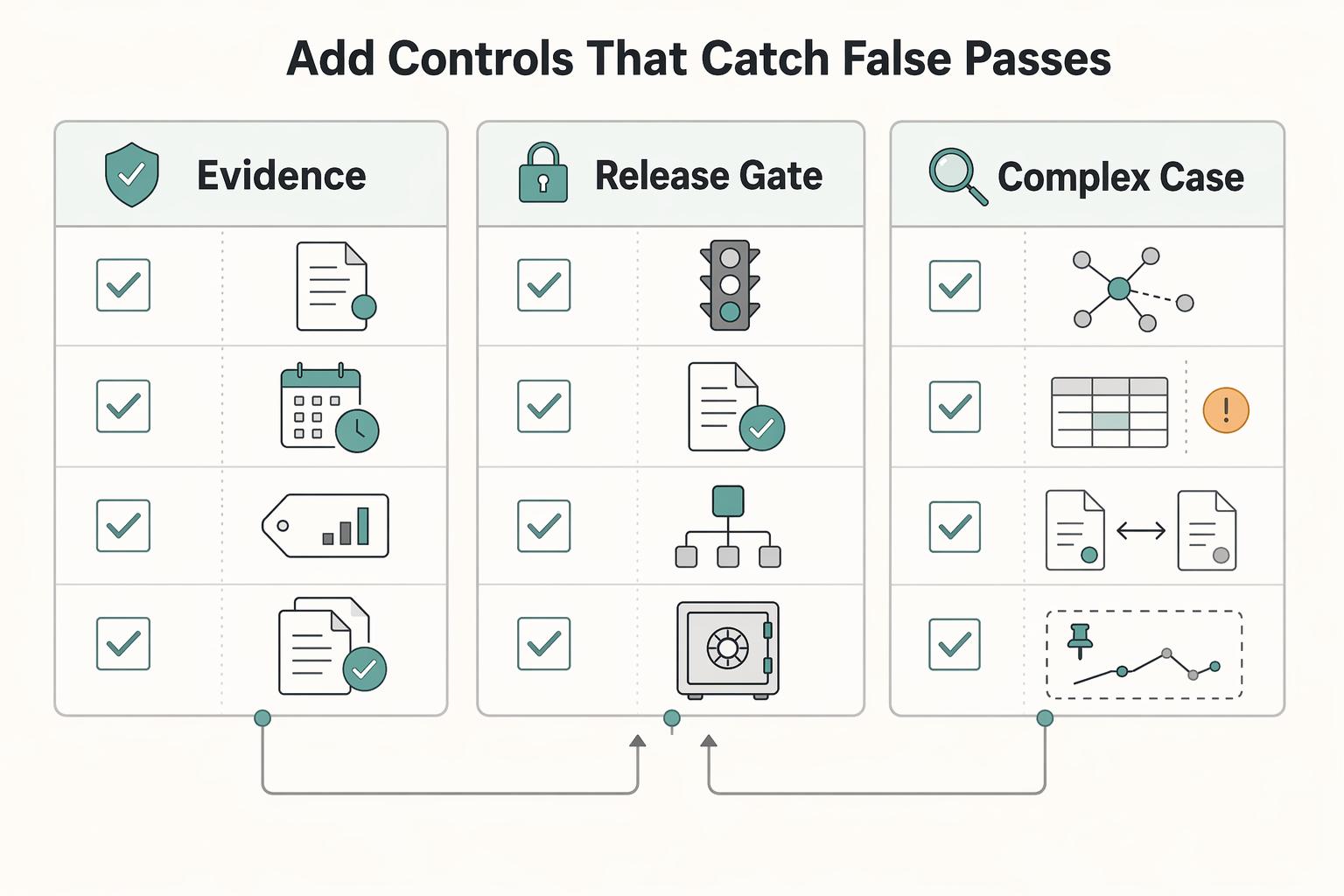
Add controls that catch false passes#
Silent noncompliance usually starts with status flags that outlive the evidence underneath them. Add controls that target that risk directly:
- Clear any "compliant" or "ready for release" status when document ID, signature date, Chapter 4 status, or document-to-payout association is missing.
- Recheck form freshness on a defined cadence. If W-8BEN-E passes the last day of the third succeeding calendar year, or a change-in-circumstances flag appears, revoke prior approval automatically.
- Compare legal name, country, and entity status across payee master, contract, and tax document. Mismatches should force review.
- Reject partial-allocation logic that cannot show which documentation supports which payment amount. When allocation cannot be determined, apply presumption rules instead of releasing.
As a control check, sample released payouts and confirm each one has a complete evidence pack: document ID, approval timestamp, tax-decision version, and Chapter 3 or Chapter 4 basis.
Re-verify before release and before reporting#
Do not treat remediation as complete until the withholding agent can defend both the tax treatment and the reporting path. The payout record should show final treatment, the relied-on document, the approver, and the withholding result.
These are immediate controls, not year-end cleanup. Payments subject to NRA withholding must be reported on Form 1042-S and included on Form 1042. Form 1042 includes payments reported on Form 1042-S under Chapters 3 or 4.
Use a final report-readiness gate before release: gross amount, withholding amount if any, payment date, payee record ID, documentation ID, and reporting attributes all present and consistent. If an item would break your Form 1042-S filing due March 15, 2026, for 2025 forms, keep it in remediation.
Prepare reporting artifacts early so year-end is routine#
Make each payout report-ready when it posts. If you wait until January to build Form 1042 and Form 1042-S data, gaps are much harder to unwind under deadline.
Capture the minimum reporting fields at payout time#
Your records should support both forms, not only withholding. Form 1042 reports tax withheld on certain income of foreign persons and must reconcile aggregate income paid and tax withheld across all Forms 1042-S. Form 1042-S also includes reportable U.S.-source amounts under Chapter 3 or 4 even when withholding was not required.
A workable minimum data model looks like this:
| Record area | Minimum fields to store | Why it matters |
|---|---|---|
| Payee and status | payee ID, legal name, foreign status record, Chapter 3 status code, Chapter 4 status code, country, TIN if collected | Form 1042 includes chapter status code fields, and status supports Form 1042-S reporting treatment |
| Payout line | payout ID, payment date, gross amount, income type label used internally, U.S.-source determination, amount subject to withholding, withholding rate, withheld amount | Supports Form 1042-S line creation and annual Form 1042 aggregation |
| Documentation and decision | Form W-8 or W-8BEN-E ID, signature date, validity end date, and decision record | Supports showing the payment was reliably associated with documentation you relied on |
Verification checkpoint: sample one released payout and confirm you can trace the ledger entry, payee record, document ID, and withholding result without searching email or shared drives.
Reconcile monthly before annual totals harden#
Monthly reconciliation is a practical way to keep year-end clean. Form 1042 includes a Record of Federal Tax Liability section that rolls into annual lines, so early drift turns into filing-season rework.
Run three reconciliations each month:
- Compare ledger withholding totals to payout-level withheld amounts, split by Chapter 3 and Chapter 4 where tracked.
- Compare paid payees against active Form W-8 or W-8BEN-E records, and flag payouts tied to missing, expired, or changed documentation.
- Compare reportable U.S.-source payments to draft Form 1042-S rows, including items with zero withholding.
Key red flag: a payout reaches the ledger but never reaches the 1042-S draft population because "no withholding" was treated as "not reportable."
Keep an external evidence trail for withholding audits#
Maintain support files outside the filed return. Withholding certificates are not required attachments to Form 1042, so your audit file has to stand on its own.
For each reported line item, retain a durable evidence pack: source payout record, tax document image or record, decision record, and ledger posting for gross and withheld amounts. If you cannot reliably associate a payment with the documentation you relied on, your reporting position is harder to defend. Also retain a copy of Form 1042 for the applicable statute-of-limitations window and keep records sufficient to substantiate return amounts.
Assign filing handoffs before January#
Set ownership before filing season so reporting gaps surface early. Define who owns reporting logic and exceptions, who owns reconciliation and ledger agreement, and who owns data exports and defect fixes.
Run one prefiling checkpoint in early January. IRIS availability starts January 1, 2026, for 2025 Forms 1042-S. Run one final checkpoint before March 15. If another entity will act as reporting or paying agent, use Form 8655 to authorize that arrangement with the IRS.
Separate platform withholding duties from individual filer topics#
Keep the scope tight. Your controls should answer what the withholding agent must do before releasing a foreign payout and what must be reported on Form 1042 and Form 1042-S. They should not answer a payee's personal filing plan.
Define the platform scope around withholding-agent duties#
Center payout controls on withholding and reporting decisions. For Chapter 4, a withholding agent is a U.S. or foreign person with control, custody, or payment authority over withholdable payments, and Chapter 3 reporting for NRA withholding includes Form 1042-S and Form 1042. Keep controls tied to W-8 collection, W-8BEN or W-8BEN-E validation, U.S.-source determination, withholding treatment, and reporting support.
Verification checkpoint: confirm your policy names the withholding-agent owner, the document types you rely on, and the reporting outputs. If it also tries to decide a payee's personal return filing position, it is out of scope.
Exclude individual filing topics from payout gating#
Do not use individual filing topics as payout-release controls. FBAR (FinCEN Form 114), Form 8938, Form 1040-NR, and Schedule SE are separate individual filing obligations and are outside platform withholding decisions. FBAR is filed with FinCEN, and Form 8938 is an IRS filing for certain U.S. taxpayers.
So the $10,000 FBAR threshold, the Form 8938 threshold floor of at least $50,000, and the $400 Schedule SE threshold should not be part of withholding logic. Avoid holding payouts just to ask about filings that do not determine whether valid W-8 documentation supports foreign status.
Split user education from internal controls#
Keep these lanes separate in writing. Internal controls govern facts that affect withholding treatment. User education can provide general context on adjacent filing topics without giving personalized advice.
- Internal controls: W-8 status, Chapter 4 status, U.S.-source analysis, withholding rate, Form 1042 or 1042-S reporting data
- User education: general background on FBAR, Form 8938, Form 1040-NR, and Schedule SE, without platform-side determinations
Add a referral rule for out-of-scope questions#
Use one standard referral for personal filing questions. Example: we can explain the forms we collect and the withholding applied to platform payouts, but we cannot advise whether you must file FBAR, Form 8938, Form 1040-NR, or Schedule SE. For general background, point users to A guide to the Foreign Account Tax Compliance Act (FATCA) for individuals.
Final check: sample recent tickets and verify personal filing questions did not change payout state unless they exposed a real defect in W-8 or withholding records.
If you want a deeper dive, read FATCA Compliance for Marketplace Platforms: Identifying and Reporting Foreign Account Holders.
Conclusion and copy-paste checklist for the next payout cycle#
Good outcomes come from explicit decision rules, defensible evidence, and payout gates that stop bad releases. Document collection alone is not enough. W-8 and W-8BEN-E intake is the start, but stale, conflicting, or poorly linked documentation can still leave you with a withholding failure.
If you are the withholding agent, each payout should be explainable from four records you can produce on demand: payout type and U.S.-source or FDAP analysis, relied-on documentation, release-or-withhold decision, and reporting data for Form 1042 and Form 1042-S by March 15. If one is missing, close the gap before release or apply presumption rules where required.
- Classify payout types before assigning tax treatment.
Tag each payout flow for likely FDAP and U.S.-source exposure before treaty or Chapter 4 status analysis. Your exports should show payout category and source determination per payable, not only country and form presence.
- Enforce W-8 intake and freshness, not just uploads.
Form W-8 is provided to the withholding agent or payer, and W-8BEN-E documents foreign entity status for Chapters 3 and 4. Track receipt and validity as separate controls. For W-8BEN-E, the general validity period runs through the last day of the third succeeding calendar year unless a change in circumstances makes it incorrect earlier.
- Document release-or-withhold logic under a named owner.
"Document uploaded" is not the same as "documentation can be relied on." When documentation is missing, unreliable, or incorrect, the owner must apply the right treatment. If reliable Chapter 4 status is not established for a withholdable payment, presumption rules can require treating an entity as a nonparticipating FFI and applying 30% withholding.
- Define escalation triggers and require written legal-tax dispositions.
Do not resolve conflicts between forms, contract terms, and payout behavior informally. Keep an exception evidence pack: relied-on form, relevant contract excerpt, payout facts, reviewer notes, approver name, and override reason.
- Configure Gruv controls in the payout path.
Map documentation status, approval status, and decision outcome directly to payout gates in Gruv. Use idempotent logs so retries do not create duplicate actions. Keep audit-ready exports showing approver, relied-on data, and payout outcome.
- Reconcile reporting data before filing season turns reactive.
Form 1042-S can be required for U.S.-source amounts paid to foreign persons even when no withholding was required, and withholding agents also file Form 1042. Reconcile payee status, paid amounts, withheld amounts, and report outputs well ahead of March 15.
- Payout types classified for FDAP and U.S.-source income exposure.
- Form W-8 and W-8BEN-E intake rules enforced with freshness checks.
- Release-or-withhold logic documented and owned by the withholding agent.
- Escalation triggers and legal-tax handoffs defined in writing.
- Gruv controls configured with idempotent logs and audit-ready exports.
- Form 1042 and Form 1042-S data reconciliation process running before filing season.
Related reading: A Deep Dive into the Foreign Tax Credit (Form 1116).
If your team needs to confirm market/program fit and control design before rollout, contact Gruv for a scope review.
Frequently Asked Questions
When do foreign payouts trigger withholding treatment under FATCA and Section 1441?
Foreign payouts trigger withholding treatment when the payment is in scope and you cannot rely on documentation for a different result. Under Section 1441, the default is 30% on an amount subject to withholding paid to a foreign person unless the payment is reliably associated with documentation you can rely on. Under FATCA, withholding applies to withholdable payments, generally U.S.-source FDAP income, when required Chapter 4 status is not established.
What minimum Form W-8 controls should exist before a payout can be released?
Obtain the Form W-8 before payment and reliably associate it with both the payee and the payment. Treat document collection and document validity as separate checks, because a form is not usable if it is unreliable, incorrect, incomplete, expired, or inconsistent. If documentation is missing or insufficient, apply presumption rules instead of releasing by default.
Is Form W-8BEN-E enough by itself, or do we need additional due diligence checks?
Form W-8BEN-E is not enough by itself to determine the final withholding outcome. It documents foreign entity status for Chapters 3 and 4, but additional entity statements can still be required for some treaty claims. Use it as a core document, then confirm the rest of the required support before applying reduced treatment.
Does automation eliminate withholding risk or only reduce operational error rates?
Automation does not eliminate withholding risk. The withholding agent remains personally liable for tax required to be withheld, independent of the foreign payee's liability. Build automation so each release, hold, or withhold decision is traceable.
Who is liable when a platform misses required withholding as the withholding agent?
If the platform is the withholding agent, the withholding agent is personally liable for tax required to be withheld. That liability is separate from the foreign payee's own tax liability.
What records do we need to support Form 1042 and Form 1042-S reporting?
Keep the documentation you relied on and the payment records that support amounts paid, withheld, and deposited. Form 1042-S can be required even when no withholding was required, and if Form 1042-S is required, Form 1042 is also required. Your records should let you trace each reported line back to the documentation and payout data before the March 15 filing cycle.
When should we escalate to tax counsel instead of making an internal judgment call?
Escalate when you cannot defend the documentation reliability or status determination from the records you have. Examples include reason-to-know concerns and Chapter 4 uncertainty where presumption rules could change treatment. If the team cannot clearly support the withholding and reporting position, pause and escalate before release.
Researched and edited by the Gruv editorial team. Gruv builds cross-border billing, payouts, and finance-operations software for global businesses.
Sources
Educational content only. Not legal, tax, or financial advice.
Related Posts

The Freelance Payment Penalty: A Modeled Audit of Platform Fees, FX Spreads, and Payout Delays
The money rarely disappears through a single, easy-to-spot fee. The real loss is stacked. A marketplace takes its commission, a processor adds a charge for international cards, a bank or payment company converts the currency at a spread, a platform holds the funds before release, and a wire sheds a little to intermediaries on the way in. Each layer looks defensible on its own, but the worker feels the combined result as a smaller deposit and a later payday.

How to Respond to a Subpoena for Business Records
Move fast, but do not produce records on instinct. If you need to **respond to a subpoena for business records**, your immediate job is to control deadlines, preserve records, and make any later production defensible.

A US Expat's Guide to Investing in UCITS ETFs to Avoid PFIC Issues
The real problem is a two-system conflict. U.S. tax treatment can punish the wrong fund choice, while local product-access constraints can block the funds you want to buy in the first place. For **us expat ucits etfs**, the practical question is not "Which product is best?" It is "What can I access, report, and keep doing every year without guessing?" Use this four-part filter before any trade: